B2B Marketing Plan Template: A Step-by-Step Guide for 2026
Most B2B marketing plans die in a slide deck. Use this template to turn goals, ICP, channels, and budget into a one-page plan your team actually executes.
TL;DR
- A B2B marketing plan template is a reusable framework that forces you to connect goals, audience, channels, budget, and KPIs before you spend a dollar.
- The plan that works fits on one page: an objective tied to revenue, a sharply defined ICP, two or three channels you can actually staff, a budget split, and metrics with owners.
- Skip the 40-slide deck. Most of those never get opened twice. The sections below are the only ones that move pipeline.
- Your plan is only as good as the data feeding it. A flawless channel strategy aimed at the wrong or unreachable contacts produces nothing.
- Copy the template in this post, fill the nine sections, and review it monthly against actual numbers—not quarterly against vibes.
What is a B2B marketing plan template?#
A B2B marketing plan template is a fill-in-the-blanks structure that turns a vague intention ("grow leads next year") into a documented, measurable operating plan. Think of it like a recipe card versus "cook something with chicken." Both end in dinner, but only one is repeatable, teachable, and easy to fix when it tastes wrong.
The template matters more in B2B than in B2C because the buying cycle is longer, the buying committee is larger (Gartner pegs the typical B2B group at six to ten decision-makers), and the cost of chasing the wrong account is measured in months, not minutes. A template keeps every campaign anchored to the same target account profile and the same revenue goal, so marketing and sales stop arguing about what a "qualified" lead even is.
A good template is short. If yours runs longer than a few pages, you have written a strategy document, not a plan. The plan is the part people act on.

What are the core sections of a B2B marketing plan?#
Below are the nine sections every B2B marketing plan needs. Treat them as a checklist—if a section is blank, your plan has a hole that will surface as a missed number later.
- Executive summary — Three sentences a busy CRO can read in the hallway: what you will achieve, by when, and roughly how. Write this last.
- Business goals and marketing objectives — Tie every marketing objective to a revenue or pipeline number. "Generate 400 MQLs" is a task; "source $2M in pipeline at a 22% win rate" is an objective.
- Ideal customer profile and personas — Firmographics (industry, size, region, tech stack) plus the humans inside the account. Reference your own data on where Tomba gets data so the ICP is grounded in reachable reality, not a wish list.
- Positioning and messaging — One core value proposition, three proof points, and the objections you must defuse.
- Channel strategy — The two or three channels you will commit to, and explicitly the ones you will not.
- Budget and resource allocation — Dollars and headcount per channel, with a contingency line.
- Campaign calendar — Quarter-by-quarter themes and launches, not a day-by-day to-do list.
- KPIs and measurement — A metric per objective, each with a named owner and a reporting cadence.
- Review and iteration cadence — When you look at the numbers and what authorizes you to kill or double down.
The discipline is in the sequencing. You cannot pick channels before you know the ICP, and you cannot set a budget before you know the channels. Most failed plans jump straight to "let's run LinkedIn ads" without finishing steps two and three.
How do you set goals in a B2B marketing plan?#
Lead with the revenue number, then work backward. This is the single highest-leverage habit in the whole template.
Start with the pipeline target the business needs, divide by your historical win rate to get required opportunities, divide by your opportunity-to-MQL conversion rate to get required leads, and only then ask which channels can realistically produce that volume. If the math demands 5,000 qualified leads and your best channel has ever produced 800, you have found the problem in week one instead of month nine.
Use a simple goal frame for each objective:
- Objective — the revenue or pipeline outcome
- Metric — the single number that proves it
- Baseline — where you are today (no baseline = no plan)
- Target — where you intend to be
- Owner — one name, not a team
Vague goals are where accountability goes to die. "Improve brand awareness" cannot be passed or failed. "Lift branded search volume 30% by Q3, owned by Priya" can.
What does a filled-in B2B marketing plan template look like?#
Here is the template applied to a fictional mid-market SaaS company, so you can see the shape of real answers rather than empty headers.
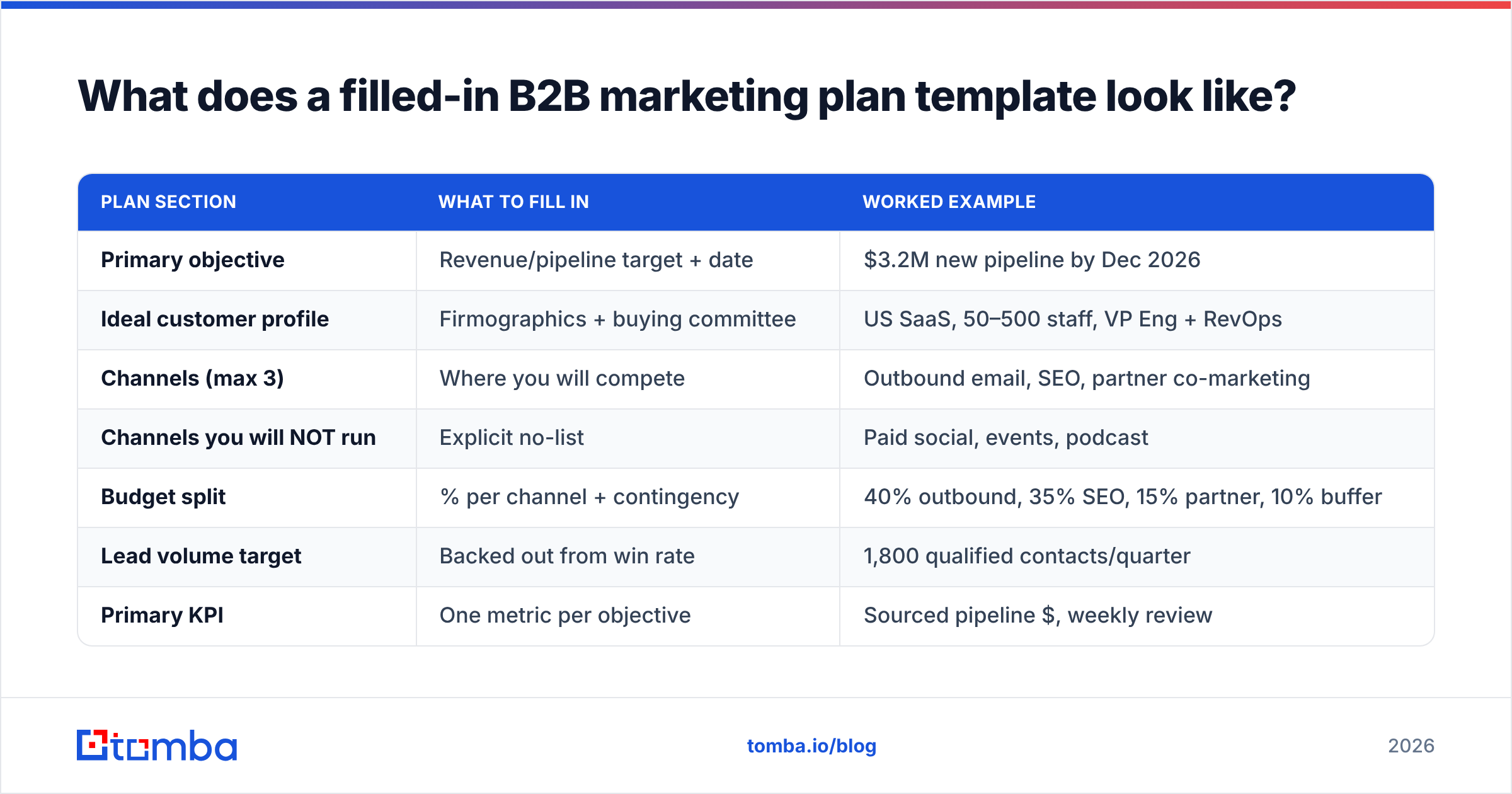
| Plan section | What to fill in | Worked example |
|---|---|---|
| Primary objective | Revenue/pipeline target + date | $3.2M new pipeline by Dec 2026 |
| Ideal customer profile | Firmographics + buying committee | US SaaS, 50–500 staff, VP Eng + RevOps |
| Channels (max 3) | Where you will compete | Outbound email, SEO, partner co-marketing |
| Channels you will NOT run | Explicit no-list | Paid social, events, podcast |
| Budget split | % per channel + contingency | 40% outbound, 35% SEO, 15% partner, 10% buffer |
| Lead volume target | Backed out from win rate | 1,800 qualified contacts/quarter |
| Primary KPI | One metric per objective | Sourced pipeline $, weekly review |
| Data source | How you reach the ICP | Verified contacts via email finder + enrichment |
| Review cadence | When you cut or scale | Monthly metric review, quarterly re-plan |
Notice the "channels you will NOT run" row. Naming what you are saying no to is what makes a plan a plan instead of a wish list. A buffer line that you actually protect is the difference between a budget and a fantasy.
For a deeper benchmark on how teams structure goals and reporting, HubSpot's annual State of Marketing report is a useful external reference point, and peer reviews on G2 help you sanity-check the tools you plan to fund.
How does data quality make or break the plan?#
Conclusion first: the best plan in the world fails if it targets contacts you cannot reach. Channel strategy is the engine; contact data is the fuel.
Here is the chain reaction. Your ICP says "VP of Engineering at US SaaS firms." Your outbound channel needs to email those people. If 30% of your contact list is bounced, role-changed, or guessed addresses, you do not lose 30% of results—you lose more, because bounce rates above a few percent damage your sender reputation and drag down deliverability for the contacts that were valid. One bad list poisons the whole channel.
This is why the template includes an explicit "data source" row. Before you commit budget to outbound, you decide how you will source and verify contacts. A practical stack:
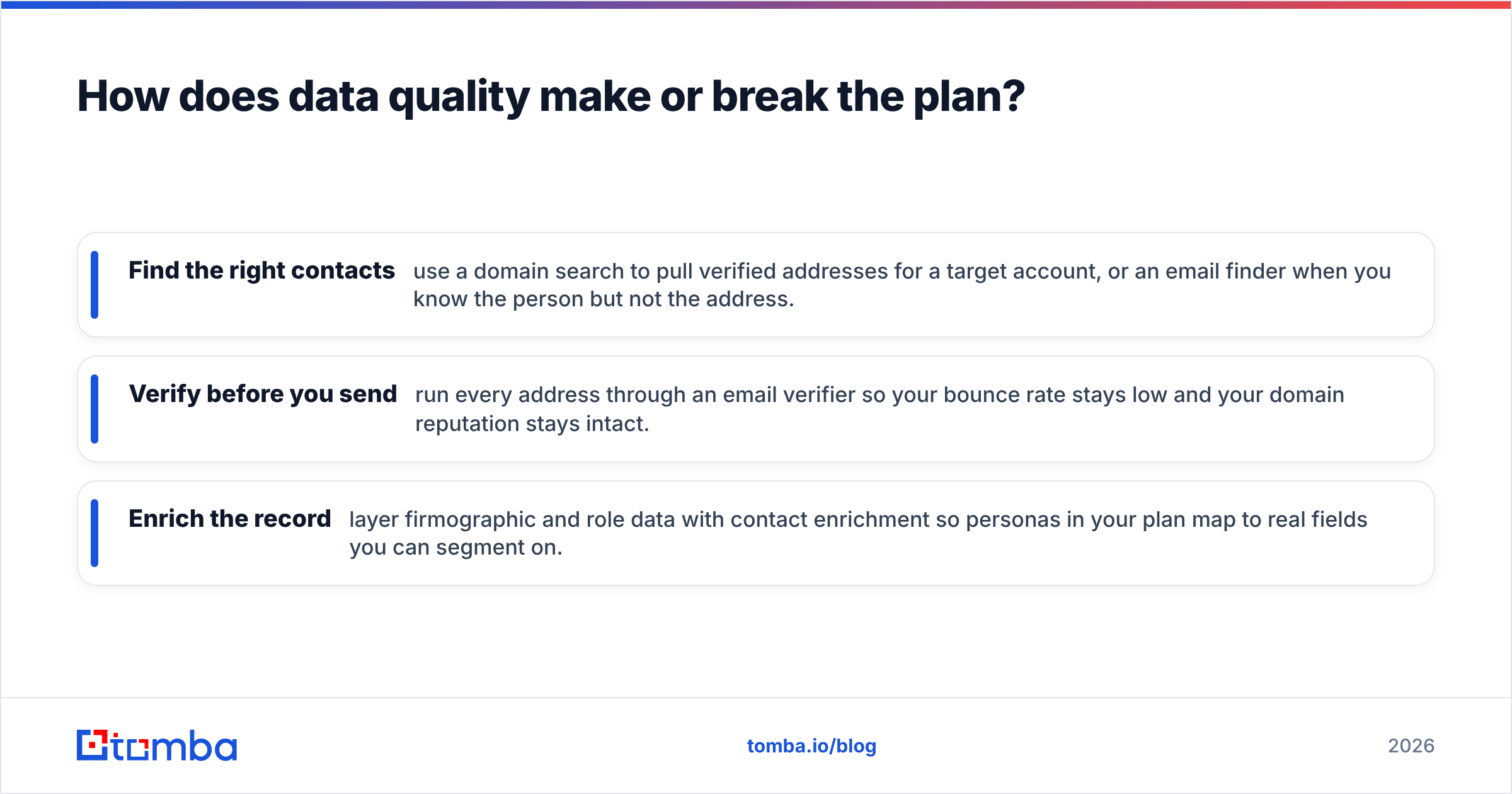
- Find the right contacts — use a domain search to pull verified addresses for a target account, or an email finder when you know the person but not the address.
- Verify before you send — run every address through an email verifier so your bounce rate stays low and your domain reputation stays intact.
- Enrich the record — layer firmographic and role data with contact enrichment so personas in your plan map to real fields you can segment on.
A plan that treats data as an afterthought is like planning a road trip down to the playlist and forgetting to check whether there is gas in the tank.

How is a B2B marketing plan different from a marketing strategy?#
People use the words interchangeably and then wonder why nothing ships. They are different artifacts with different jobs.
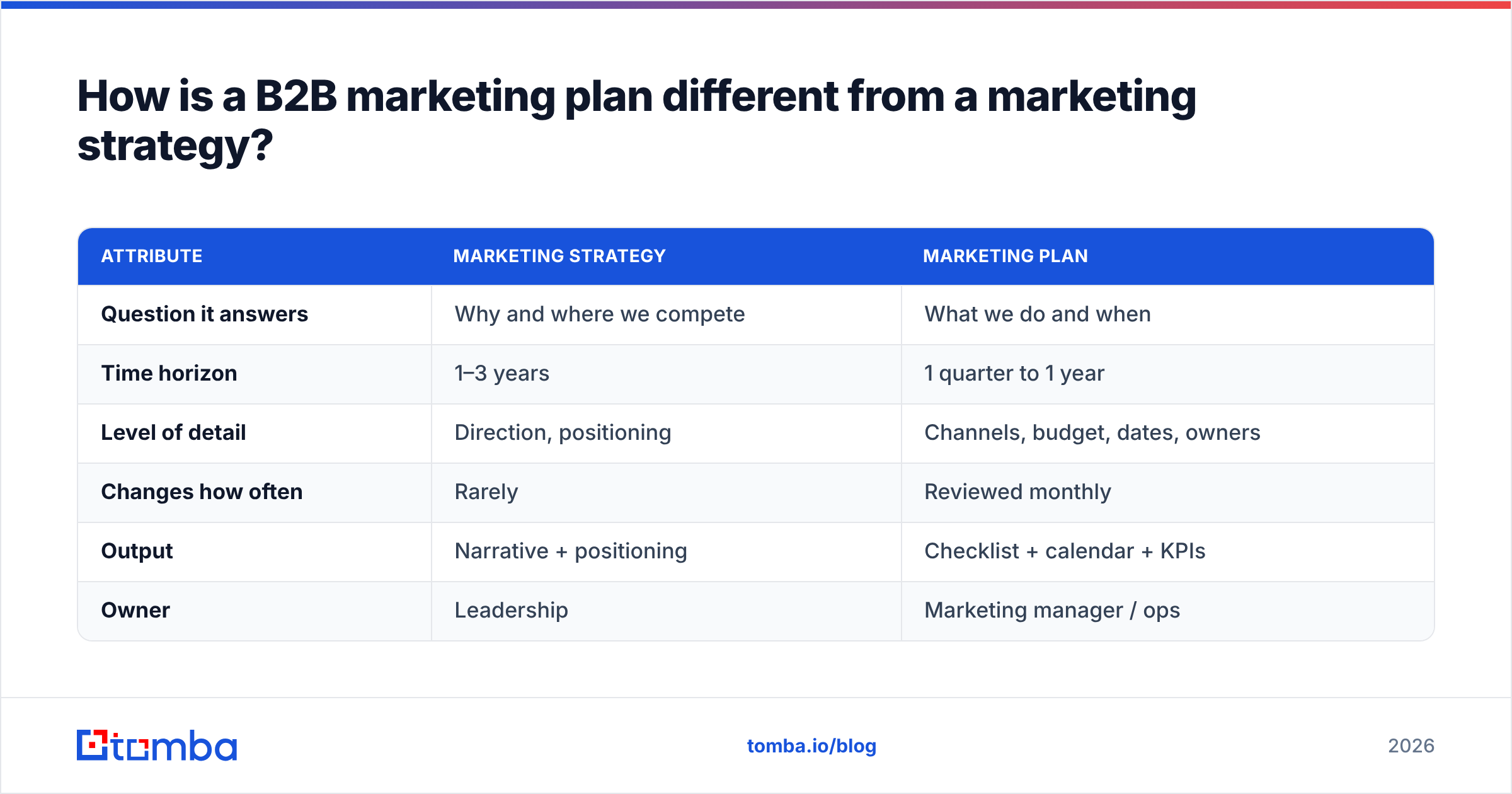
| Attribute | Marketing strategy | Marketing plan |
|---|---|---|
| Question it answers | Why and where we compete | What we do and when |
| Time horizon | 1–3 years | 1 quarter to 1 year |
| Level of detail | Direction, positioning | Channels, budget, dates, owners |
| Changes how often | Rarely | Reviewed monthly |
| Output | Narrative + positioning | Checklist + calendar + KPIs |
| Owner | Leadership | Marketing manager / ops |
The strategy is the destination and the reason for going. The plan is the turn-by-turn directions. You need both, but this template is the plan. If your "plan" reads like a strategy—lots of "we believe" and no dates or dollars—you will feel productive and accomplish nothing.
What are the most common B2B marketing plan mistakes?#
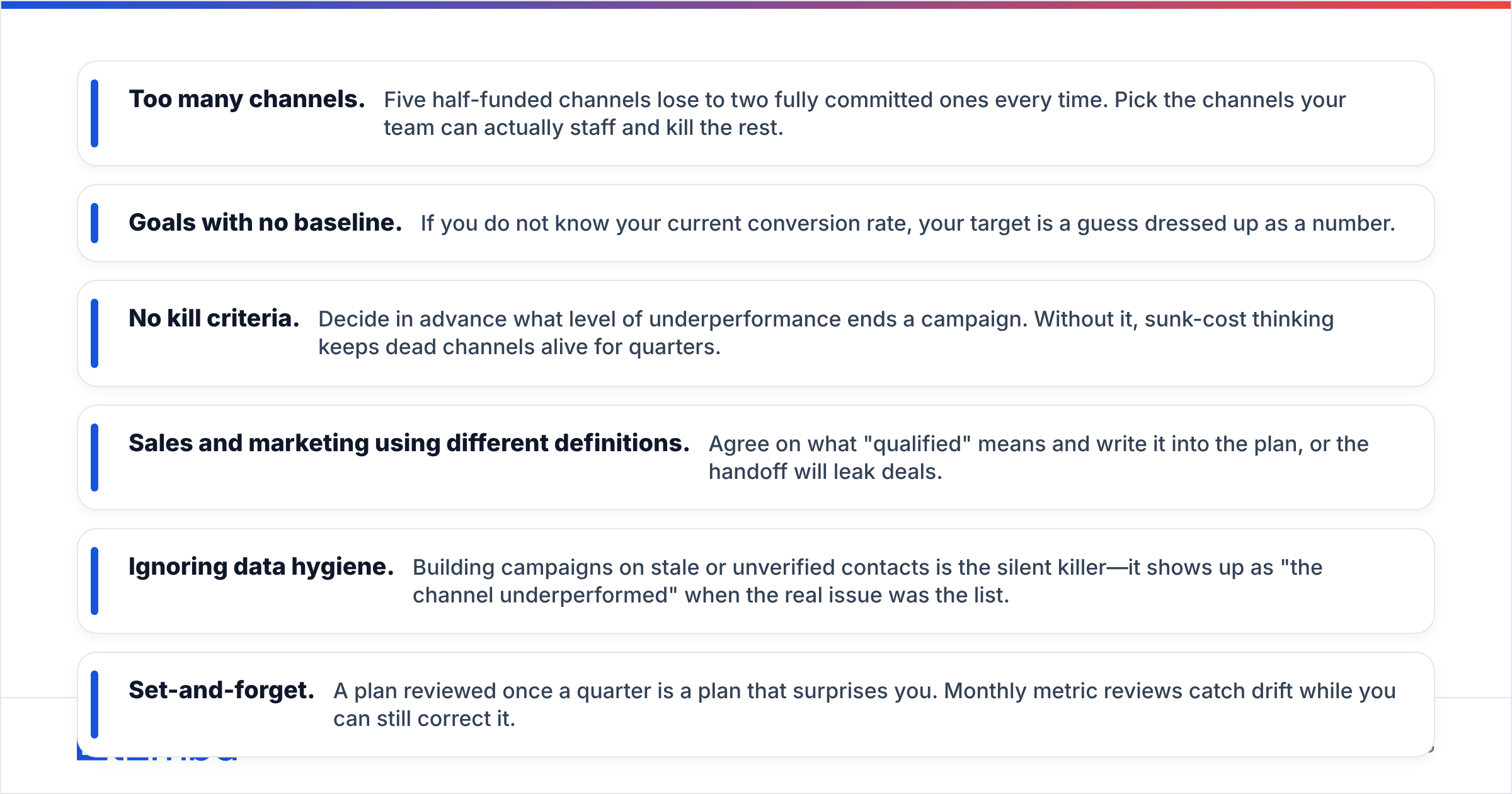
- Too many channels. Five half-funded channels lose to two fully committed ones every time. Pick the channels your team can actually staff and kill the rest.
- Goals with no baseline. If you do not know your current conversion rate, your target is a guess dressed up as a number.
- No kill criteria. Decide in advance what level of underperformance ends a campaign. Without it, sunk-cost thinking keeps dead channels alive for quarters.
- Sales and marketing using different definitions. Agree on what "qualified" means and write it into the plan, or the handoff will leak deals.
- Ignoring data hygiene. Building campaigns on stale or unverified contacts is the silent killer—it shows up as "the channel underperformed" when the real issue was the list.
- Set-and-forget. A plan reviewed once a quarter is a plan that surprises you. Monthly metric reviews catch drift while you can still correct it.
The throughline: most "marketing problems" are really planning problems that became visible six months too late. The template's job is to make those problems visible in week one.
How often should you update your B2B marketing plan?#
Review the metrics monthly; re-plan quarterly; rewrite the strategy annually. The cadence matters because each layer changes at a different speed.
The monthly review is short—pull the KPI dashboard, compare to target, and decide whether each channel scales, holds, or dies. The quarterly re-plan is where you reallocate budget based on what the months taught you. The annual rewrite is where you revisit the ICP and positioning if the market shifted.
A living plan also means a living contact database. As accounts change—people leave, companies get acquired, roles shift—your target list decays at roughly 2–3% per month. Refresh it with a B2B database and re-verification on the same cadence you review the plan, so your beautiful channel strategy keeps pointing at people who actually exist.
How do you turn the plan into action this week?#
Start narrow and ship. Pick your single primary objective, define the one ICP you will chase first, choose one channel, and source a verified contact list for it. That is a complete, executable plan you can run in days—then layer the second channel once the first is producing.
The most common failure mode is polishing the document instead of running the plan. A one-page plan you execute beats a thirty-page plan you admire.
If outbound is your first channel—and for most B2B teams it should be, because it is the fastest path to controlled, measurable pipeline—the bottleneck is almost always reaching the right people. That is exactly the job of the Tomba Email Finder: give it a name and a company, get back a verified professional email, and feed your plan a contact list that converts instead of bounces. Pair it with the built-in verifier, start free with 25 searches a month, and scale up through Tomba pricing tiers ($49/mo Starter, $99/mo Growth) only once the plan proves the channel works. Build the plan, fuel it with clean data, and review it like you mean it.
// get started
Find, verify and enrich your first contacts today
Start on the free plan with 25 searches a month, then scale when your team is ready.
Free plan · No credit card required · GDPR & CCPA
// about the author