B2B Marketing Research in 2026: A Data-Driven Field Guide
B2B marketing research tells you who to sell to, what they care about, and why deals stall. Here's how to run it in 2026 without burning months on guesswork.
TL;DR
- B2B marketing research is the process of gathering and analyzing data about your market, buyers, and competitors so your go-to-market decisions stop being guesses.
- It splits into two halves: primary research (surveys, interviews, win/loss calls) and secondary research (analyst reports, firmographic data, intent signals).
- The 2026 shift is speed — research is now continuous and data-backed, not a quarterly PDF nobody reads.
- The biggest unlock is clean contact and firmographic data; bad data quietly poisons every downstream insight.
- Use a tight five-step loop: define the question, pull the data, segment, validate with real buyers, then act and re-measure.
What is B2B marketing research?#
B2B marketing research is the disciplined collection and analysis of information about the businesses you sell to — their size, structure, buying committees, pain points, and the alternatives they're weighing. Think of it like a doctor's intake before a diagnosis: you don't prescribe before you understand the patient. Spraying messaging at a market you haven't studied is how teams burn budget and blame the channel.
The B2B flavor is different from consumer research in three concrete ways. First, your "customer" is a buying committee — usually five to eleven people, per Gartner's B2B buying research — not one shopper. Second, deals are high-value and low-volume, so a sample of 30 well-chosen interviews can outweigh 30,000 anonymous clicks. Third, the data you need (job titles, tech stack, headcount, revenue band) is firmographic and technographic, not demographic.
Get this right and everything downstream gets cheaper: your ad targeting tightens, your cold email reply rates climb, and sales stops chasing accounts that were never going to close.
Why does B2B marketing research matter in 2026?#
Because the cost of being wrong went up. Buyers now self-educate through 70% of the journey before they ever talk to sales, and they're allergic to generic outreach. If your research is stale, you're personalizing to a buyer who no longer exists.
Three forces make research non-negotiable this year:
- AI-generated noise. Everyone can now produce volume. Differentiation comes from insight, and insight comes from research your competitors didn't do.
- Tighter budgets. CFOs want pipeline math, not vibes. Research is how you defend spend with evidence.
- Fragmented signals. Intent data, social, review sites, and product usage all hint at demand — but only if someone connects them.
The teams winning in 2026 treat research as an always-on system, not a one-off project. They wire firmographic data and data enrichment into their CRM so every new lead arrives pre-qualified, then layer human interviews on top to explain the why behind the numbers.
What are the main types of B2B marketing research?#
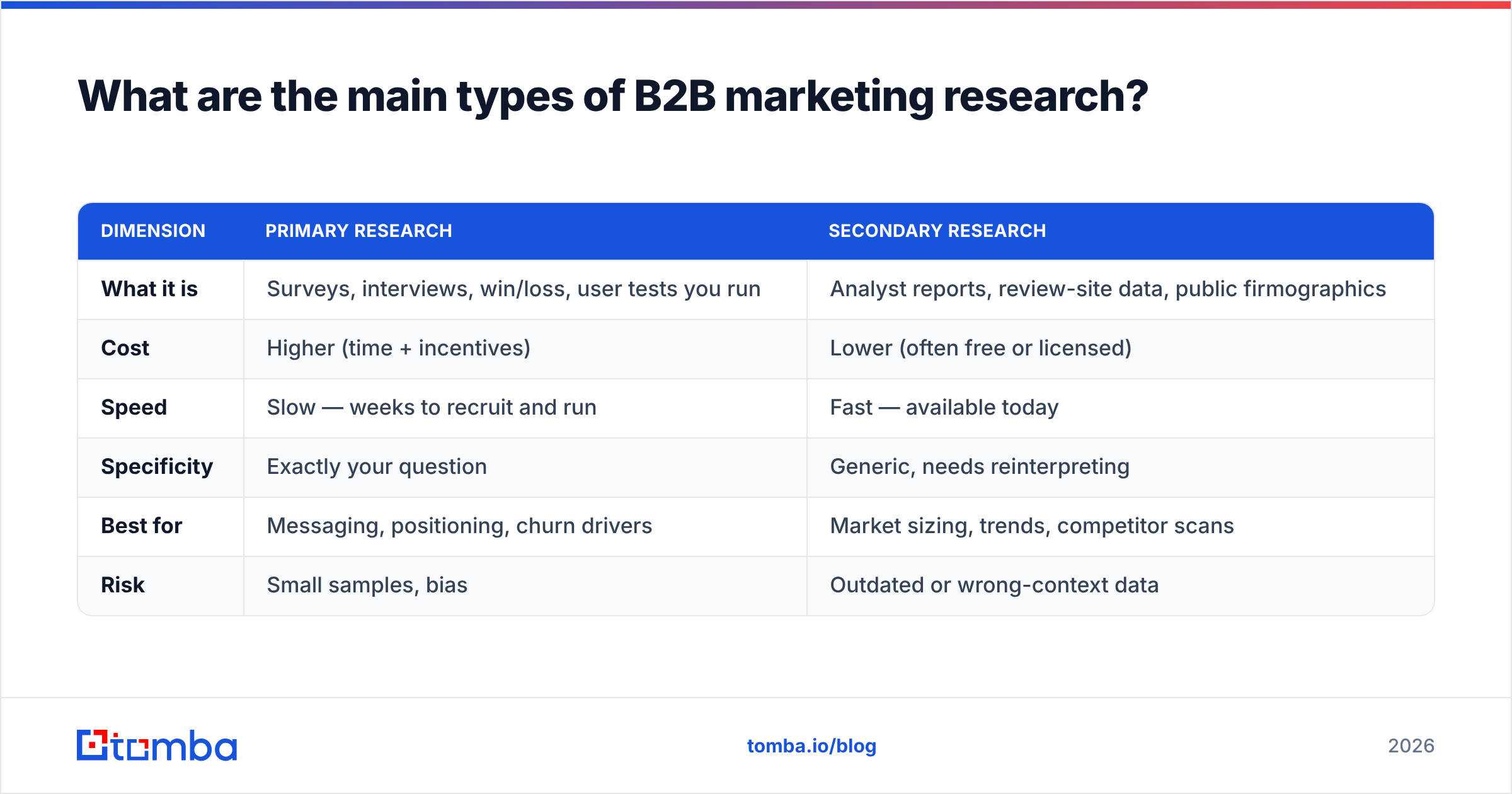
There are two families, and you need both. Primary research is data you collect yourself, fresh and specific to your question. Secondary research is data someone else already gathered that you reinterpret for your context. Below is how they compare on the dimensions that actually matter when you're deciding where to spend a limited research budget.
| Dimension | Primary research | Secondary research |
|---|---|---|
| What it is | Surveys, interviews, win/loss, user tests you run | Analyst reports, review-site data, public firmographics |
| Cost | Higher (time + incentives) | Lower (often free or licensed) |
| Speed | Slow — weeks to recruit and run | Fast — available today |
| Specificity | Exactly your question | Generic, needs reinterpreting |
| Best for | Messaging, positioning, churn drivers | Market sizing, trends, competitor scans |
| Risk | Small samples, bias | Outdated or wrong-context data |
A practical rule: start with secondary research to frame the problem cheaply, then spend your primary-research budget only on the questions the secondary data couldn't answer. Running expensive interviews to learn something you could have found in a G2 category report is a waste of everyone's calendar.
What data sources power good B2B research?#
Garbage in, garbage out — this is where most research quietly fails. Your insight is only as good as the underlying records. Here are the source categories worth building into your stack, with the role each one plays.
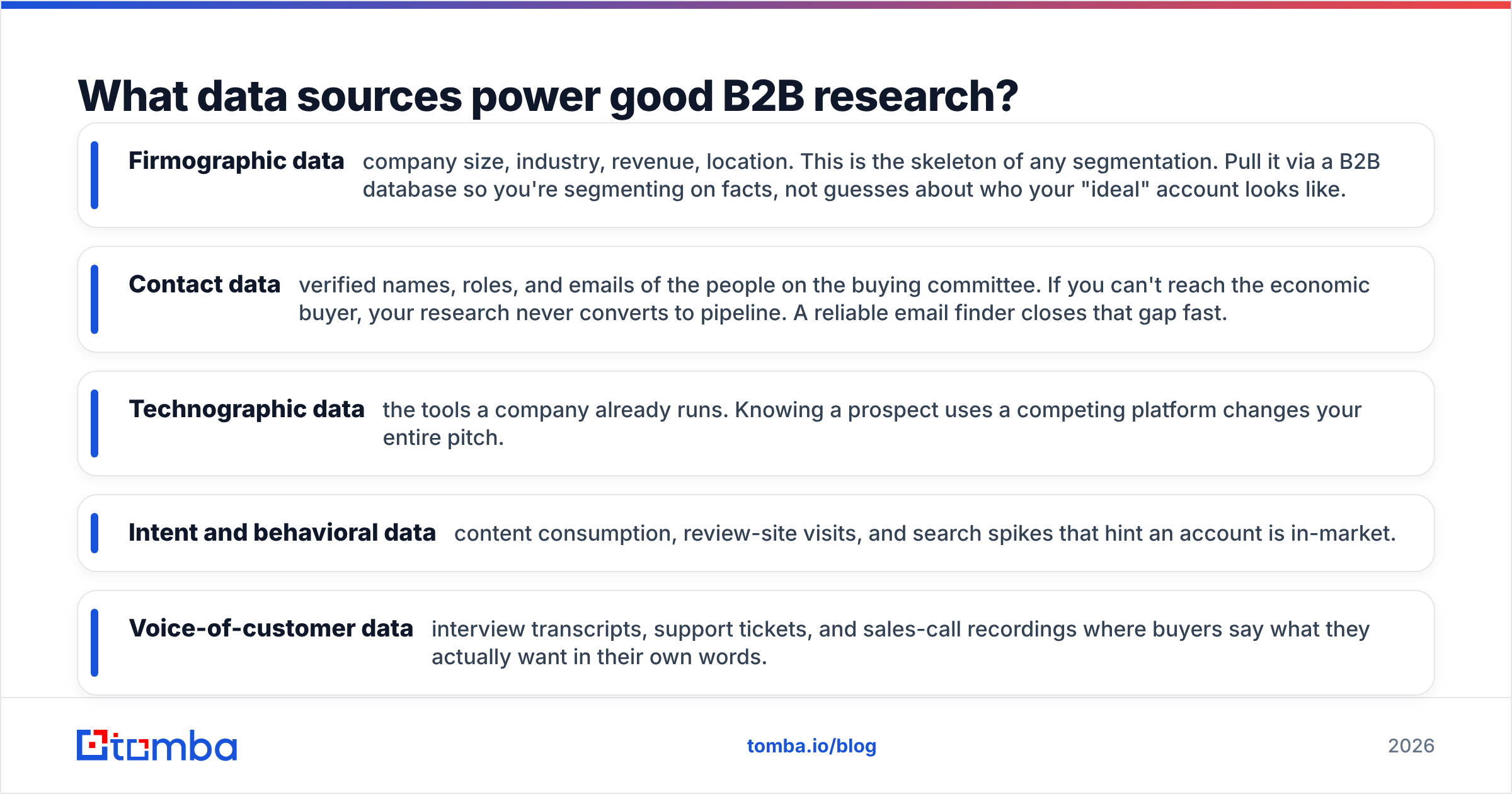
- Firmographic data — company size, industry, revenue, location. This is the skeleton of any segmentation. Pull it via a B2B database so you're segmenting on facts, not guesses about who your "ideal" account looks like.
- Contact data — verified names, roles, and emails of the people on the buying committee. If you can't reach the economic buyer, your research never converts to pipeline. A reliable email finder closes that gap fast.
- Technographic data — the tools a company already runs. Knowing a prospect uses a competing platform changes your entire pitch.
- Intent and behavioral data — content consumption, review-site visits, and search spikes that hint an account is in-market.
- Voice-of-customer data — interview transcripts, support tickets, and sales-call recordings where buyers say what they actually want in their own words.
The mistake teams make is collecting all five and never cleaning them. Run contact records through an email verifier before they enter analysis, because a dataset full of bounced, role-based, or catch-all addresses will skew every segment you build on top of it.
How do you run a B2B marketing research project step by step?#
Use a five-step loop you can repeat every quarter. The point is momentum, not a 90-page deck.
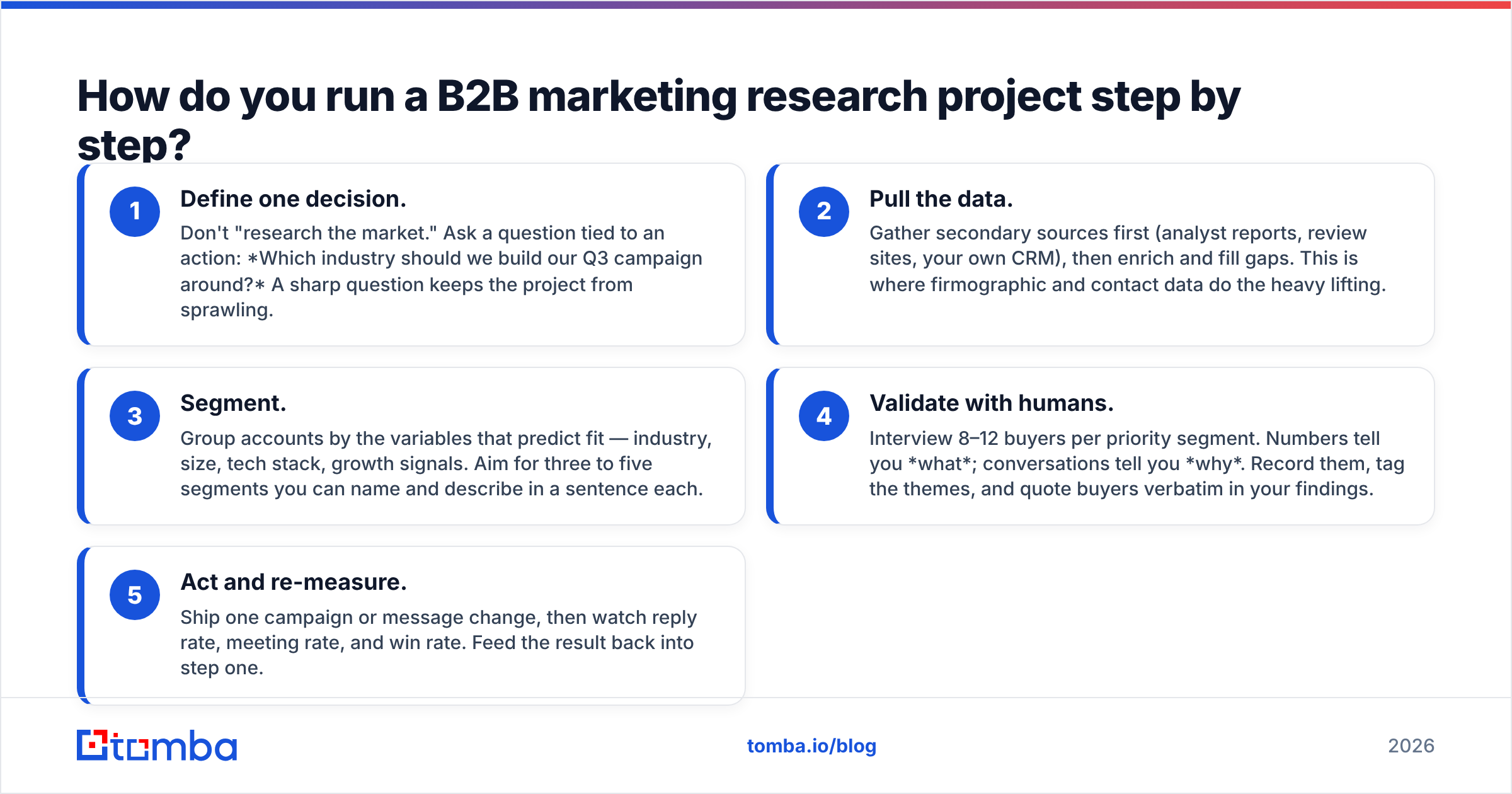
- Define one decision. Don't "research the market." Ask a question tied to an action: Which industry should we build our Q3 campaign around? A sharp question keeps the project from sprawling.
- Pull the data. Gather secondary sources first (analyst reports, review sites, your own CRM), then enrich and fill gaps. This is where firmographic and contact data do the heavy lifting.
- Segment. Group accounts by the variables that predict fit — industry, size, tech stack, growth signals. Aim for three to five segments you can name and describe in a sentence each.
- Validate with humans. Interview 8–12 buyers per priority segment. Numbers tell you what; conversations tell you why. Record them, tag the themes, and quote buyers verbatim in your findings.
- Act and re-measure. Ship one campaign or message change, then watch reply rate, meeting rate, and win rate. Feed the result back into step one.
Most failed research dies between steps four and five — the insight gets a slide and never reaches the SDR script. Tie every finding to a specific asset (a subject line, a landing page, an ICP filter) so it can't evaporate.
Which tools do B2B marketing researchers actually use?#
Your stack should cover four jobs: find accounts, reach people, organize signals, and analyze. Here's a comparison of the tool categories and where each fits, so you're not paying for overlap.
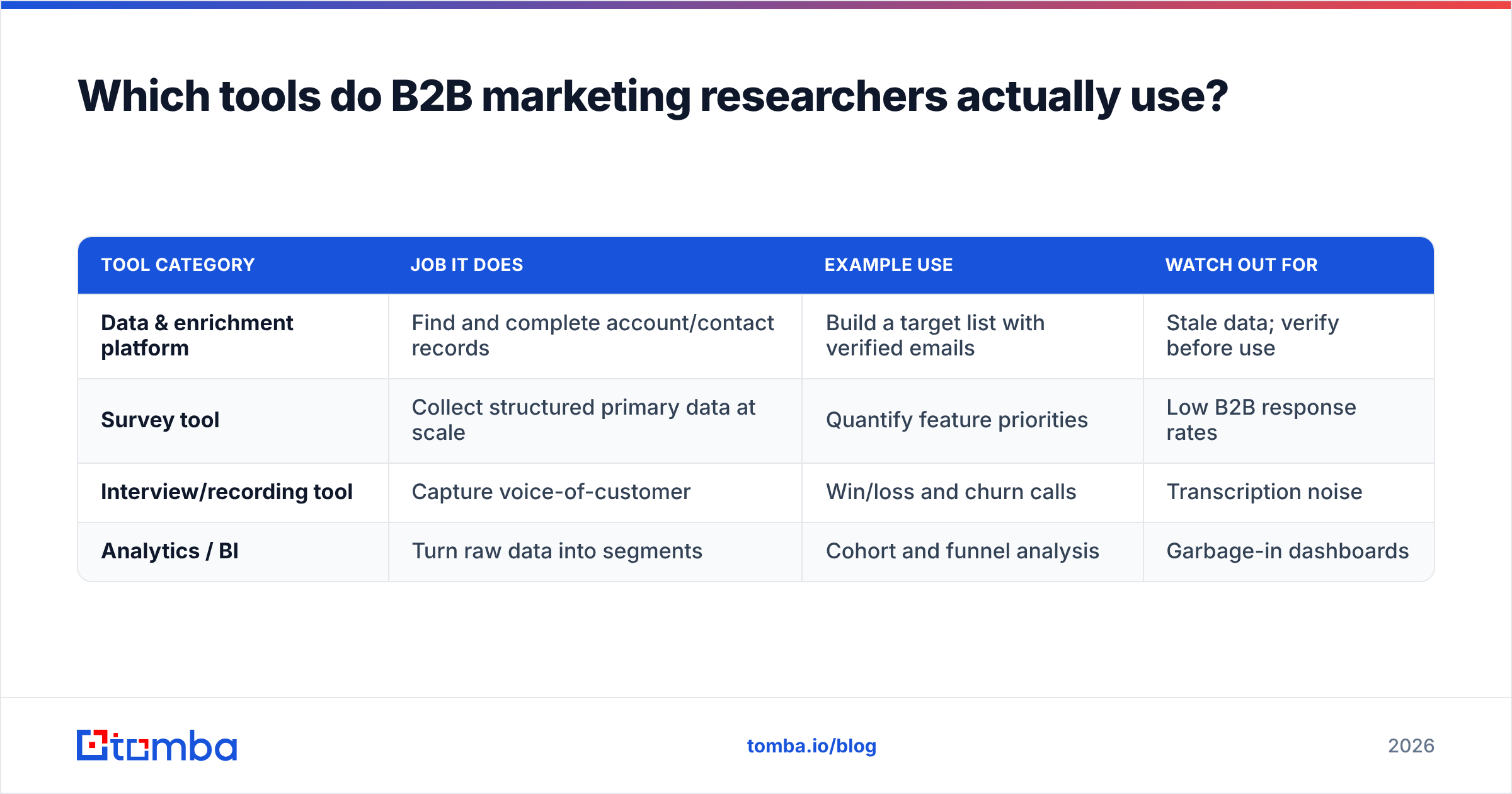
| Tool category | Job it does | Example use | Watch out for |
|---|---|---|---|
| Data & enrichment platform | Find and complete account/contact records | Build a target list with verified emails | Stale data; verify before use |
| Survey tool | Collect structured primary data at scale | Quantify feature priorities | Low B2B response rates |
| Interview/recording tool | Capture voice-of-customer | Win/loss and churn calls | Transcription noise |
| Analytics / BI | Turn raw data into segments | Cohort and funnel analysis | Garbage-in dashboards |
For the find-and-reach layer, Tomba covers the part most research projects stumble on: turning a list of target companies into reachable decision-makers. Use domain search to map every contact at a target account, then the bulk email finder to do it across hundreds of accounts at once. You can compare plans on the Tomba pricing page — the Free tier gives you 25 searches a month to test the workflow before committing.
For the survey and interview layers, pair a quantitative tool with a recorded-call tool. The combination — numbers plus quotes — is what makes findings persuasive to a skeptical leadership team.
How is B2B marketing research different from B2C?#
The short answer: smaller samples, higher stakes, and a committee instead of a person. In B2C you might A/B test against 50,000 sessions and trust the statistics. In B2B, a single enterprise deal can be worth more than a thousand SMB customers, so depth beats breadth.
A few practical consequences:
- Recruiting is harder. You can't intercept B2B buyers in a mall app. You reach them through verified professional contacts, which is why a clean reverse email lookup or LinkedIn-sourced contact data matters more than survey panels.
- Incentives differ. A $10 gift card won't move a VP of Engineering. Offer them a copy of the aggregated findings — peers find that genuinely valuable.
- The unit of analysis is the account, not the individual. You roll up multiple stakeholders' views into one account-level picture, weighting by influence on the deal.
Treat B2B research like investigative journalism on a few important sources, not a census of a crowd.
What mistakes kill B2B research projects?#
Most failures aren't methodology problems — they're discipline problems. Watch for these:
- No decision attached. Research with no downstream action is a hobby. Always start from a choice you need to make.
- Dirty data. Building segments on unverified contacts means your "insight" is an artifact of bad records. Clean first.
- Confirmation bias. Interviewing only happy customers tells you why people who already love you love you. Talk to churned and lost-deal accounts too — that's where the painful, useful truth lives.
- Sample of one. One loud customer anecdote is a hypothesis, not a finding. Look for a pattern across at least eight conversations before you rewrite positioning.
- Research theater. A beautiful deck that no SDR, marketer, or PM ever opens. Ship findings as scripts, filters, and copy — not just slides.
If you only fix one thing, fix the data layer. Everything else compounds on top of it.
How often should you refresh your research?#
Continuously for data, quarterly for synthesis. Firmographic and contact data decays fast — people change jobs every few years, companies merge, tech stacks churn. A target list you built twelve months ago is already meaningfully wrong. Re-enrich your core account list monthly and re-verify contacts before any major campaign.
The qualitative layer (interviews, win/loss) moves slower. A quarterly cadence of 8–12 fresh conversations per priority segment keeps your messaging honest without overwhelming your team. Set a standing calendar reminder; the projects that get skipped are the ones that depend on someone "finding time."
Putting it together#
Good B2B marketing research isn't a once-a-year megaproject — it's a tight, repeatable loop powered by clean data and a handful of honest conversations. Define one decision, pull and verify the data, segment, talk to real buyers, then ship something and measure it. Do that four times a year and you'll know your market better than competitors who are still guessing.
The foundation under all of it is reachable, accurate contact data. If your research keeps stalling because you can't actually connect with the decision-makers you've identified, start there. Tomba's Email Finder turns a list of target companies into verified, reachable buyers — so your research converts into pipeline instead of dying in a slide deck. Spin up the free tier, build one validated segment, and let the data do the convincing.
// get started
Find, verify and enrich your first contacts today
Start on the free plan with 25 searches a month, then scale when your team is ready.
Free plan · No credit card required · GDPR & CCPA
// about the author