B2B Marketing Statistics 2026: 70+ Data Points That Matter
The B2B marketing statistics that actually move pipeline in 2026 — budgets, channels, content, email, AI adoption, and lead-gen benchmarks, organized so you can act on them.
TL;DR
- B2B buyers now complete most of their research before talking to sales, so your content and data quality decide deals long before a rep dials.
- Email remains the highest-ROI B2B channel, but deliverability and list accuracy — not volume — separate winners from spammers.
- AI adoption in B2B marketing crossed the majority line in 2025 and is now table stakes for content, personalization, and lead scoring.
- Lead generation is still the top-cited marketing challenge, and bad contact data is the silent tax on every campaign.
- Use the benchmarks below to set targets, then fix the inputs — accurate, enriched contact data is the cheapest lever you have.
Why do B2B marketing statistics matter in 2026?#
Because you cannot manage what you refuse to measure — and most B2B teams are still steering by gut feel. Statistics give you a baseline. When you know the median B2B email open rate, the typical content-to-conversion path, or how many touches a deal really takes, you stop arguing about opinions and start fixing inputs.
The catch: a statistic is only useful if it changes a decision. A "90% of buyers do X" line that you nod at and forget is trivia. The same number, used to reallocate budget or rewrite a sequence, is strategy. This guide is organized so every cluster of numbers ends with a "so what" you can act on this quarter.
One more framing note. Marketing statistics drift. Open rates, channel costs, and AI adoption all shifted hard between 2023 and 2026. Treat any single number as a direction, not gospel, and always sanity-check it against your own analytics before you set an OKR around it.
What do the headline B2B marketing statistics say?#
Here are the data points that show up most often in 2026 planning decks, with the practical takeaway attached to each:
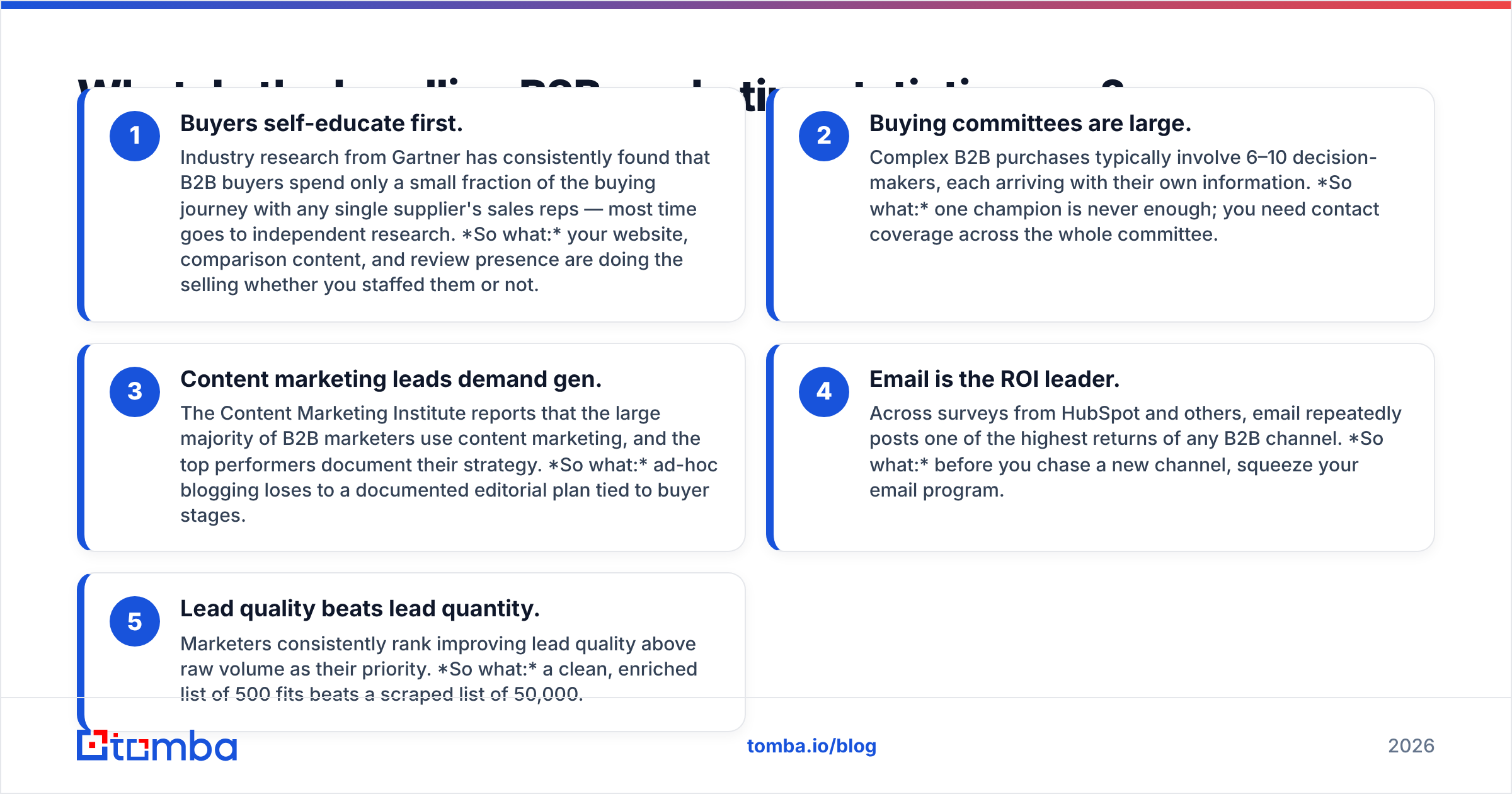
- Buyers self-educate first. Industry research from Gartner has consistently found that B2B buyers spend only a small fraction of the buying journey with any single supplier's sales reps — most time goes to independent research. So what: your website, comparison content, and review presence are doing the selling whether you staffed them or not.
- Buying committees are large. Complex B2B purchases typically involve 6–10 decision-makers, each arriving with their own information. So what: one champion is never enough; you need contact coverage across the whole committee.
- Content marketing leads demand gen. The Content Marketing Institute reports that the large majority of B2B marketers use content marketing, and the top performers document their strategy. So what: ad-hoc blogging loses to a documented editorial plan tied to buyer stages.
- Email is the ROI leader. Across surveys from HubSpot and others, email repeatedly posts one of the highest returns of any B2B channel. So what: before you chase a new channel, squeeze your email program.
- Lead quality beats lead quantity. Marketers consistently rank improving lead quality above raw volume as their priority. So what: a clean, enriched list of 500 fits beats a scraped list of 50,000.
These are the load-bearing facts. Everything below is detail that helps you act on them.
How are B2B marketing budgets and channels shifting?#
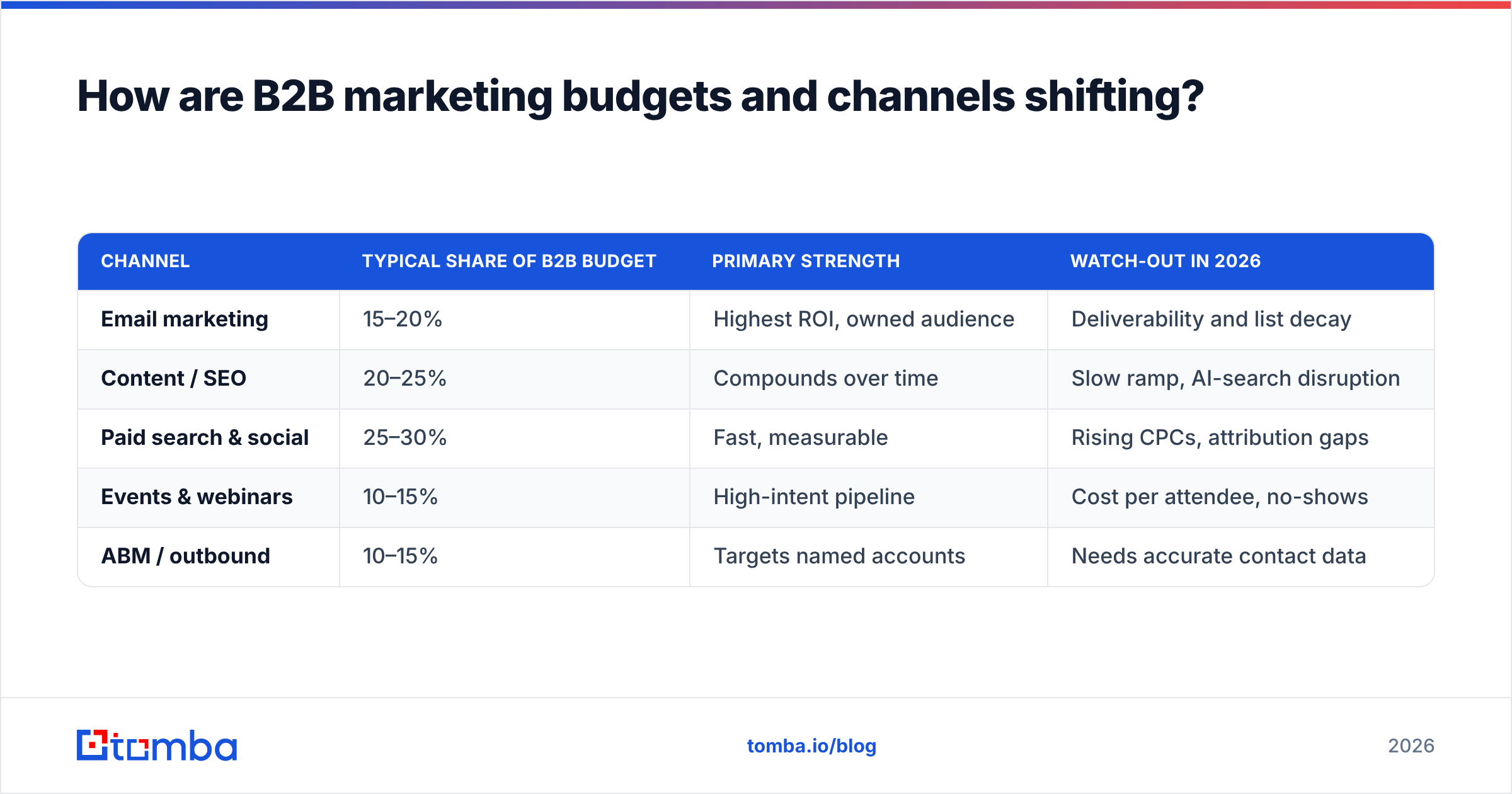
Budgets are flat-to-modest in most 2026 forecasts, which means the pressure is on efficiency, not expansion. The dollars that exist are concentrating in channels with measurable attribution.
| Channel | Typical share of B2B budget | Primary strength | Watch-out in 2026 |
|---|---|---|---|
| Email marketing | 15–20% | Highest ROI, owned audience | Deliverability and list decay |
| Content / SEO | 20–25% | Compounds over time | Slow ramp, AI-search disruption |
| Paid search & social | 25–30% | Fast, measurable | Rising CPCs, attribution gaps |
| Events & webinars | 10–15% | High-intent pipeline | Cost per attendee, no-shows |
| ABM / outbound | 10–15% | Targets named accounts | Needs accurate contact data |
The pattern is clear: owned channels (email, content) are defensive moats, while paid channels are increasingly expensive rental. The teams winning in 2026 are reinvesting paid-channel learnings into owned assets so they stop renting their audience.
Account-based marketing deserves a callout. ABM keeps growing because it ties spend to revenue accounts instead of vanity reach — but it lives and dies on data. An ABM play aimed at 200 named accounts collapses if you can't reach the right people inside them. That's where a reliable email finder and data enrichment move from "nice to have" to "the campaign doesn't run without it."
What are the key B2B email marketing statistics?#
Email is the workhorse, so the numbers here matter more than most. Commonly cited 2026 benchmarks:
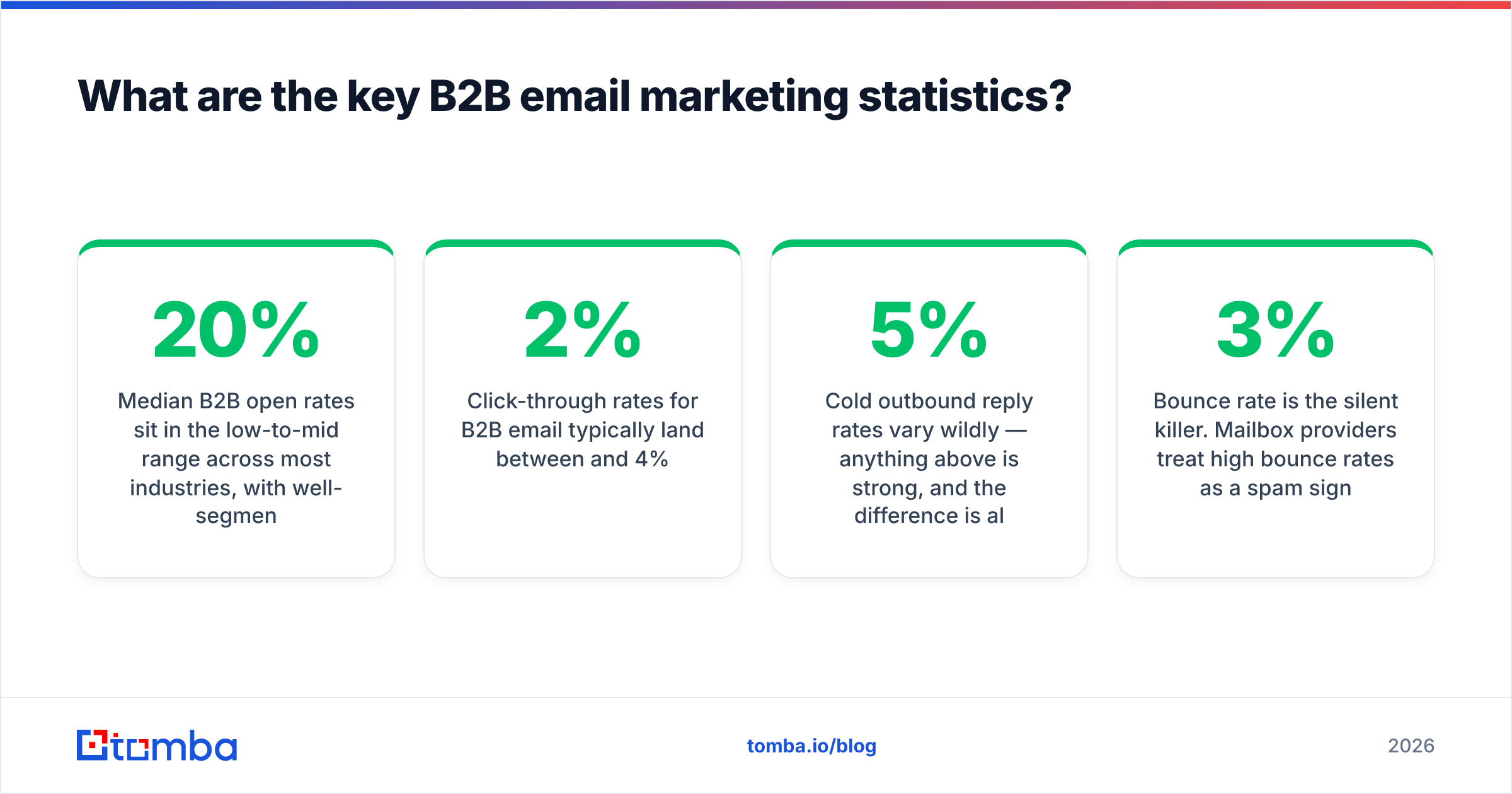
- Median B2B open rates sit in the low-to-mid 20% range across most industries, with well-segmented lists pushing higher.
- Click-through rates for B2B email typically land between 2% and 4%.
- Cold outbound reply rates vary wildly — anything above 5% is strong, and the difference is almost always targeting and personalization, not subject-line tricks.
- Bounce rate is the silent killer. Mailbox providers treat high bounce rates as a spam signal, and a bounce rate above 2–3% starts dragging your whole sender reputation down.
That last point is where most programs quietly bleed performance. You can write the perfect sequence, but if 15% of your list bounces, providers throttle you and your good contacts never see the message. Verifying addresses before you send — with an email verifier — is the cheapest deliverability insurance available. It also protects the long-term value of your domain, which is far harder to repair than to maintain.
A second under-appreciated stat: list decay runs roughly 22–30% per year as people change jobs. That means a list you built 18 months ago is substantially wrong today. Re-enrichment and periodic re-verification aren't optional hygiene; they're how you keep the ROI numbers above from sliding.
What do content and SEO statistics tell us?#
Content is the top-of-funnel engine, and the data has gotten more nuanced as AI search reshapes discovery.
- The majority of B2B marketers say content marketing is core to demand generation, and documented strategies outperform undocumented ones by a wide margin.
- Long-form, research-backed content (original data, benchmarks, frameworks) earns disproportionately more links and shares than thin posts.
- Buyers consume multiple pieces of content before converting — typically several assets across blog, comparison pages, and case studies.
- AI-driven search summaries are compressing some informational traffic, pushing value toward bottom-funnel, decision-stage content that AI can't fully answer for the buyer.
The strategic shift for 2026: stop measuring content by pageviews alone and start measuring assisted conversions. A comparison page that gets 800 visits but influences 30 deals beats a viral post that gets 50,000 visits and influences none. If you publish original statistics (like this page), you also build the kind of citable authority that AI answer engines surface — which is increasingly how buyers find you.
How fast is AI adoption changing B2B marketing?#
AI crossed from experiment to default between 2024 and 2026. The majority of B2B marketing teams now report using generative AI somewhere in their workflow — most commonly for drafting, research summarization, and personalization at scale.
What the statistics also show is a quality gap. Teams that bolt AI onto bad data get faster bad output. Teams that pair AI with clean, enriched contact records get genuine leverage: AI personalizes the message, but accurate data makes sure it reaches a real person who matches the ICP. Adoption rate is not the interesting number anymore — outcome per AI dollar is. The differentiator in 2026 is data quality feeding the model, not access to the model itself.
If you're wiring AI into outbound, the same rule applies to your pipeline of contacts. Pulling verified emails programmatically through the Tomba API keeps your AI sequences fed with addresses that actually deliver, instead of guesses your AI confidently sends into the void.
What are the B2B lead generation benchmarks?#
Lead generation is the perennial top challenge in B2B marketing surveys, and the benchmarks explain why expectations and reality keep colliding.
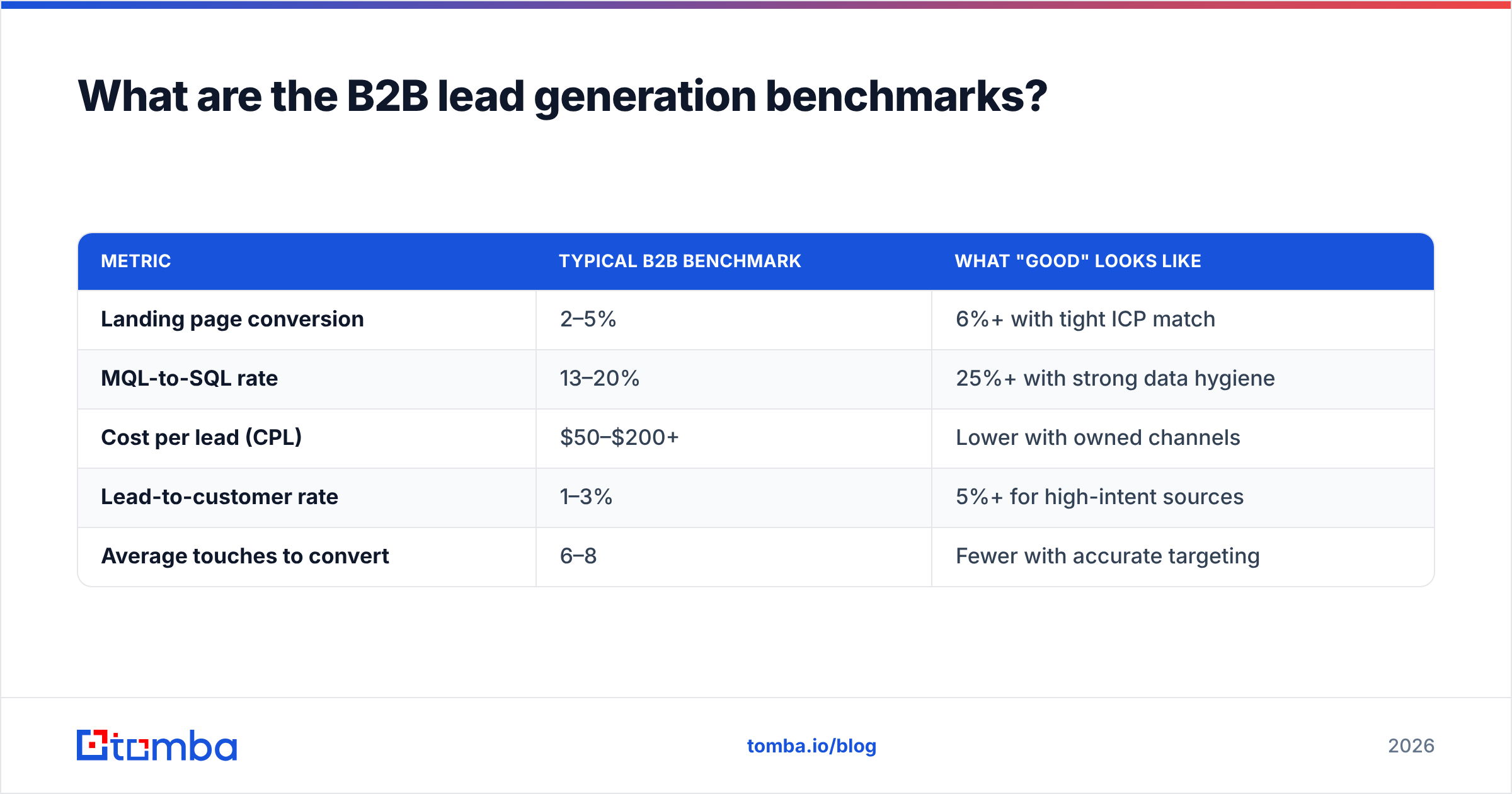
| Metric | Typical B2B benchmark | What "good" looks like |
|---|---|---|
| Landing page conversion | 2–5% | 6%+ with tight ICP match |
| MQL-to-SQL rate | 13–20% | 25%+ with strong data hygiene |
| Cost per lead (CPL) | $50–$200+ | Lower with owned channels |
| Lead-to-customer rate | 1–3% | 5%+ for high-intent sources |
| Average touches to convert | 6–8 | Fewer with accurate targeting |
The throughline across every row is data accuracy. A 2% landing-page conversion against a poorly targeted audience and a 6% conversion against an enriched, qualified one are the same funnel with different inputs. Improving your marketing qualified lead definition and feeding it accurate firmographic data does more for these numbers than another round of button-color tests.
This is also where contact data compounds. If your MQL-to-SQL handoff includes verified emails, direct phone numbers, and enriched company context, sales spends time selling instead of researching. Tools like domain search and bulk enrichment turn a raw account list into a routable, ready-to-work pipeline.
How does data quality affect every other statistic?#
Bluntly: bad data quietly poisons every metric above. Industry estimates routinely put the cost of poor data quality in the millions per year for larger organizations, and B2B contact data decays faster than almost any other dataset because people change roles constantly.
Consider how one bad input cascades:
- Bounced emails raise spam complaints, which lowers deliverability, which lowers open rates, which lowers your "email ROI" stat.
- Wrong contacts inflate cost per lead because you pay to reach people who can't buy.
- Stale records drag down MQL-to-SQL rates because sales chases dead ends.
- Duplicate or incomplete data breaks attribution, so your channel-budget decisions are built on sand.
The fix isn't glamorous, but it's high-leverage: verify before you send, enrich before you target, and re-validate on a schedule. A reliable email finder and verifier sit upstream of every channel metric you care about, which is why "improve our data" usually returns more than "launch a new channel."
Which B2B marketing statistics should you actually track?#
Don't drown in the benchmarks above. Pick a small set of inputs and outputs and watch them monthly:
- List health — bounce rate, verification pass rate, percentage enriched. These predict everything downstream.
- Email engagement — open, click, and reply rates by segment, not blended.
- Conversion path — landing-page conversion and MQL-to-SQL by source.
- Pipeline efficiency — cost per lead and lead-to-customer rate.
- Velocity — average touches and days to convert, trending over time.
If you only fix one thing this quarter, fix list health. It's the cheapest input to improve and it lifts every other number on the list. You can compare what better data costs against your current waste on the Tomba pricing page — the math usually favors clean data fast.
Frequently asked questions#
What is the most important B2B marketing statistic in 2026? There isn't a single one, but if forced to choose: lead quality consistently outranks lead volume as a priority, because every downstream metric depends on reaching the right people. Accurate contact data is the input that makes the rest true.
How often do B2B marketing statistics change? Channel costs, open rates, and AI adoption shift meaningfully year over year, and contact data itself decays 22–30% annually. Re-check your benchmarks against your own analytics at least quarterly.
Where do these statistics come from? Reputable, recurring sources include HubSpot's annual marketing reports, Gartner's marketing research, the Content Marketing Institute's B2B benchmarks, and review platforms like G2. Always prefer first-party data over a number you found in a slide deck.
Can better email data really move these numbers? Yes — directly. Verification cuts bounce rates, which protects deliverability and open rates; enrichment improves targeting, which lifts conversion and lowers cost per lead. It's the highest-leverage, lowest-cost intervention in the stack.
Turn statistics into pipeline#
Numbers only matter when they change what you do next. The single most reliable way to improve nearly every B2B marketing statistic on this page is to fix the data feeding your campaigns — verified, enriched, up-to-date contacts that actually reach a real buyer.
That's exactly what the Tomba Email Finder is built for: find professional email addresses by domain, name, or company, verify them before you send, and enrich them so your sequences land with the right person on the buying committee. Start on the free tier (25 searches/month), and scale to Starter at $49/mo when your pipeline demands it. Better inputs, better benchmarks — in that order.
// get started
Find, verify and enrich your first contacts today
Start on the free plan with 25 searches a month, then scale when your team is ready.
Free plan · No credit card required · GDPR & CCPA
// about the author