B2B Marketing Strategy in 2026: A Practical GTM Playbook
Most B2B marketing burns budget on vanity metrics. Here is a 2026 strategy built around your ICP, the channels that actually convert, and the data layer that ties it to pipeline.
TL;DR
- A B2B marketing strategy is a documented plan that connects your ideal customer profile (ICP), positioning, channels, and content to one number: qualified pipeline. Everything else is decoration.
- In 2026, the winners are narrow, not broad. Tight ICP plus a few channels executed deeply beats a thin presence everywhere.
- Demand generation (creating future buyers) and demand capture (converting in-market buyers) are different jobs. Fund both, but measure them differently.
- Your data layer is the strategy's foundation. Clean account data, verified contacts, and enrichment turn campaigns into routed, scored, sellable pipeline.
- Pick metrics that a CFO respects: pipeline created, win rate, CAC payback. Drop MQL-only scorecards that reward volume over revenue.
What is a B2B marketing strategy?#
A B2B marketing strategy is the decision about who you serve, why they should pick you, and how you will reach them profitably — written down so a team can execute it the same way twice.
Think of it like a restaurant. The menu (your offer), the neighborhood you open in (your ICP), and the reason regulars keep coming back (your positioning) all have to agree. A great kitchen in the wrong neighborhood still goes out of business. Technically, that alignment is the difference between a "strategy" and a pile of disconnected campaigns.
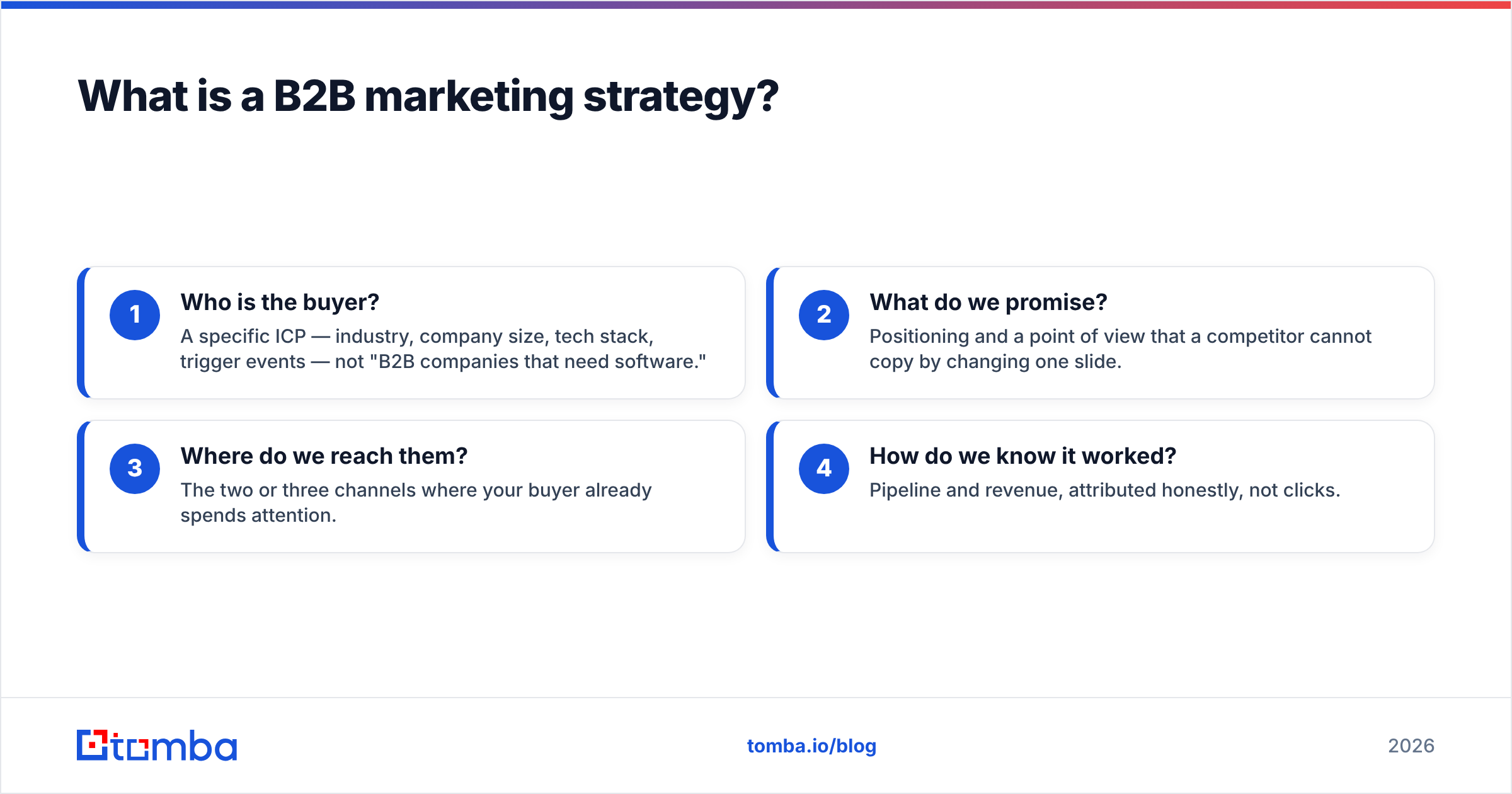
Most teams skip the strategy and jump to tactics: a webinar here, a LinkedIn push there, a rebrand because the logo felt stale. The output is motion without direction. A real strategy answers four questions before anyone opens a campaign tool:
- Who is the buyer? A specific ICP — industry, company size, tech stack, trigger events — not "B2B companies that need software."
- What do we promise? Positioning and a point of view that a competitor cannot copy by changing one slide.
- Where do we reach them? The two or three channels where your buyer already spends attention.
- How do we know it worked? Pipeline and revenue, attributed honestly, not clicks.
Why do most B2B marketing strategies fail?#
They fail because they optimize for activity that is easy to count instead of outcomes that are hard to earn. Three failure modes show up again and again.
Spray-and-pray targeting. When the ICP is vague, every channel underperforms because the message can't be sharp. According to Gartner research on B2B buying, a typical buying group involves six to ten stakeholders — a generic message that speaks to none of them gets ignored by all of them.
Vanity-metric scorecards. Impressions, followers, and raw MQL counts make dashboards look healthy while pipeline stalls. If marketing is "winning" but sales has nothing to close, the metric is lying.
A broken data layer. Beautiful campaigns route bad records into the CRM: duplicate accounts, role-based inboxes, contacts who left the company a year ago. The campaign isn't the problem; the foundation is. This is why data enrichment and verification belong in the strategy, not as an afterthought.
Fixing these is less glamorous than a brand refresh, but it is where the compounding returns live.
What are the core components of a B2B marketing strategy in 2026?#
Use these six components as the skeleton. Each one is a decision you commit to in writing, not a vibe.
- Ideal Customer Profile (ICP): Define the accounts worth winning by firmographics, technographics, and trigger events. Then build a contact map of the buying group inside those accounts.
- Positioning and messaging: State the category you play in, the alternative you beat, and the one outcome you own. Make it specific enough to alienate the wrong buyers.
- Demand strategy: Split budget between demand generation (educating future buyers) and demand capture (converting in-market buyers searching now).
- Channel mix: Choose two or three primary channels where your ICP is reachable, plus owned channels (newsletter, site) you control outright.
- Content engine: Produce a point of view, not just SEO filler. One strong narrative repurposed across formats beats ten shallow posts.
- Data and RevOps layer: Verified contacts, enrichment, lead routing, and scoring that hand sales a clean, prioritized list. See revenue operations for how this glues marketing to sales.
The order matters. You cannot pick channels before you know the buyer, and you cannot measure anything without the data layer underneath.
Demand generation vs demand capture: which should you fund?#
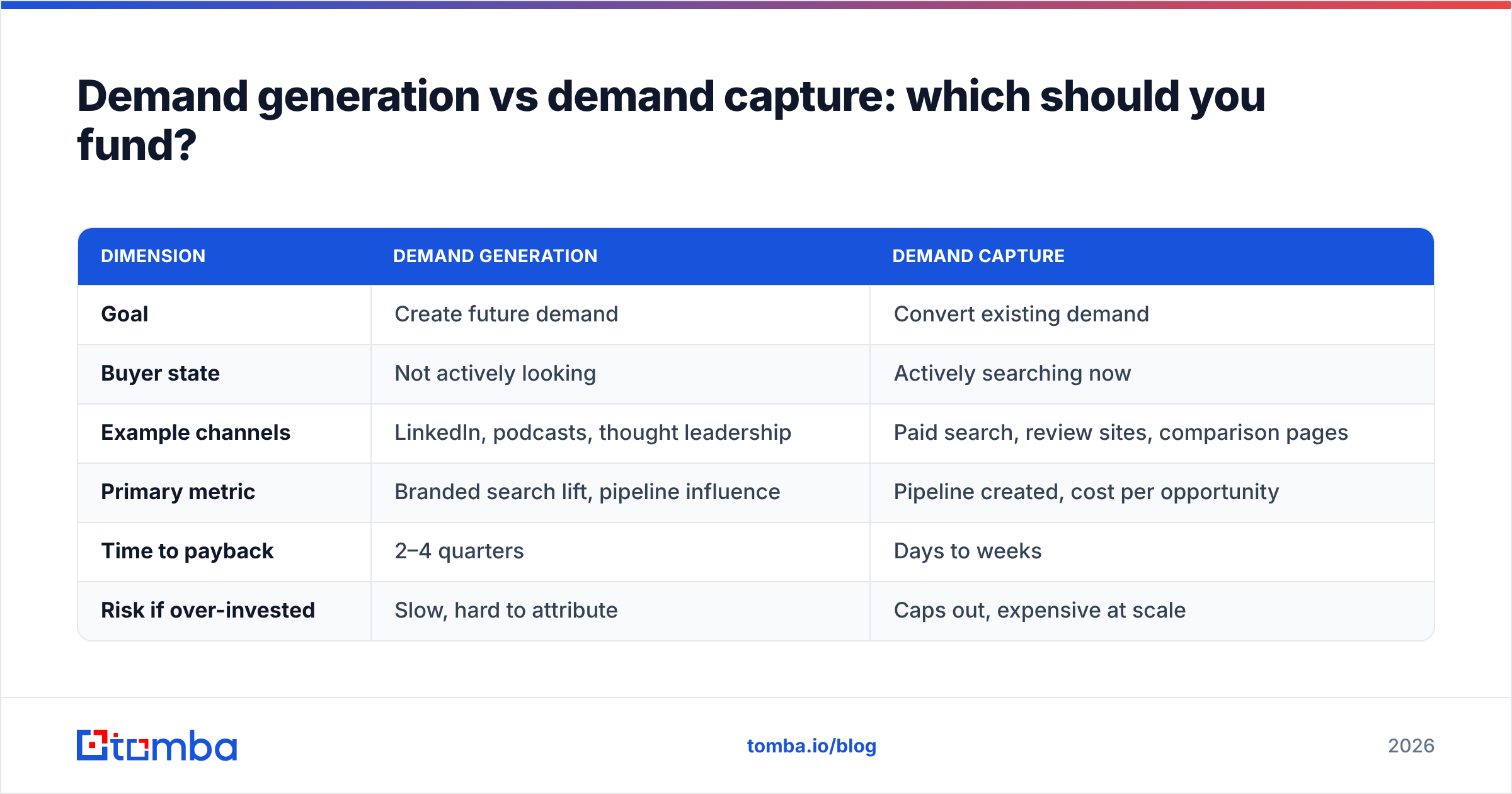
Both — but in deliberate proportion, because they do opposite jobs. Demand generation creates demand that doesn't exist yet; demand capture harvests demand that already does. Underfunding either one breaks the engine: all capture and you run out of in-market buyers, all generation and you never convert the interest you create.
| Dimension | Demand generation | Demand capture |
|---|---|---|
| Goal | Create future demand | Convert existing demand |
| Buyer state | Not actively looking | Actively searching now |
| Example channels | LinkedIn, podcasts, thought leadership | Paid search, review sites, comparison pages |
| Primary metric | Branded search lift, pipeline influence | Pipeline created, cost per opportunity |
| Time to payback | 2–4 quarters | Days to weeks |
| Risk if over-invested | Slow, hard to attribute | Caps out, expensive at scale |
A practical 2026 split for most mid-market teams: roughly 60% of effort on demand generation to build a durable pipeline of future buyers, and 40% on capture to convert the buyers ready today. Adjust based on how mature your category is — newer categories need more generation, crowded ones need sharper capture.
How do you choose the right B2B marketing channels?#
Choose channels by where your ICP already pays attention, not by where the loudest case studies came from. A channel that printed money for a PLG SaaS company can be a money pit for an enterprise compliance vendor.
Run every candidate channel through three filters:
- Reach: Can you actually find your ICP here at meaningful volume?
- Cost to win: What does a qualified opportunity cost once you account for content and ad spend?
- Control: Do you own the audience (email list, community) or rent it (ad platform, social algorithm)?
Owned channels score highest on control and should anchor the mix. A newsletter and a content site can't be throttled by an algorithm change overnight. Outbound is where many B2B teams get the fastest, most controllable pipeline — but only when the contact data is accurate. Sending a tightly targeted sequence to a verified domain search list of decision-makers outperforms blasting a purchased list every time, because deliverability and relevance both hold up.
What does a B2B marketing funnel look like in 2026?#
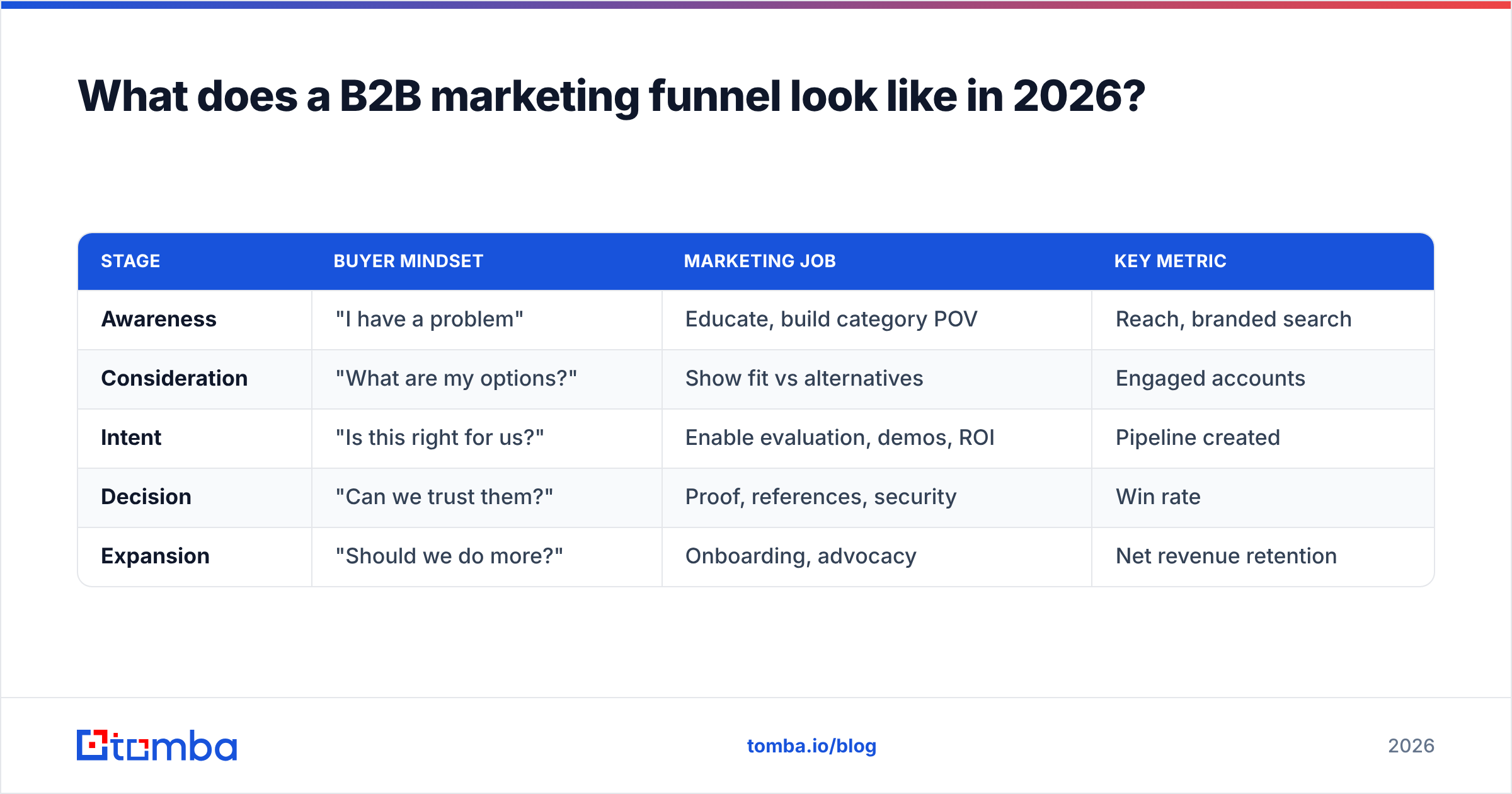
The clean linear funnel is a useful fiction; real buying journeys loop. Still, you need stages to assign metrics and owners. Here is a pragmatic version mapped to what marketing actually controls.
| Stage | Buyer mindset | Marketing job | Key metric |
|---|---|---|---|
| Awareness | "I have a problem" | Educate, build category POV | Reach, branded search |
| Consideration | "What are my options?" | Show fit vs alternatives | Engaged accounts |
| Intent | "Is this right for us?" | Enable evaluation, demos, ROI | Pipeline created |
| Decision | "Can we trust them?" | Proof, references, security | Win rate |
| Expansion | "Should we do more?" | Onboarding, advocacy | Net revenue retention |
The mistake is staffing only the top (content, ads) and the bottom (sales), leaving the middle — consideration and intent — empty. That middle is where comparison pages, ROI calculators, and verified outbound do their work. It is also where your data layer earns its keep: enriching an engaged account so sales calls the right person at the right moment.
How do you measure B2B marketing performance?#
Measure the metrics a CFO will fund again, and quietly retire the ones that only flatter the dashboard. The shift in 2026 is away from lead volume toward pipeline and revenue quality.
Track these:
- Pipeline created: Dollar value of qualified opportunities marketing sourced or influenced. This is the headline number.
- Win rate by source: Which channels produce deals that actually close, not just leads that look busy. Learn more about win rate as a diagnostic.
- CAC payback: Months to recover the cost of acquiring a customer. The single best efficiency check.
- Pipeline velocity: How fast opportunities move from created to closed-won.
- Data quality rate: Percentage of marketing-sourced contacts that are verified, reachable, and correctly routed.
That last one is the quiet differentiator. You can have a brilliant campaign and still lose if 30% of the contacts bounce or land on the wrong rep's desk. Independent reviews on G2 consistently show that teams who invest in clean, verified data report higher conversion at every stage — because every downstream metric inherits the quality of the data feeding it.
How does data quality power your B2B marketing strategy?#
Data quality is the strategy's foundation, not a back-office chore — every campaign, score, and forecast is only as honest as the records underneath it. Garbage in, confident wrong decisions out.
Here is how a verified data layer changes each stage:
- Targeting: Enriched firmographics and technographics let you build an ICP list that's accurate today, not a stale export from last quarter.
- Outreach: Verified emails protect sender reputation and deliverability, so your demand-capture sequences actually reach inboxes. A reliable email finder plus verification keeps bounce rates low.
- Routing: Clean account data means leads hit the right rep instantly instead of dying in a manual triage queue.
- Reporting: Deduplicated accounts produce attribution you can trust, so budget moves to what works.
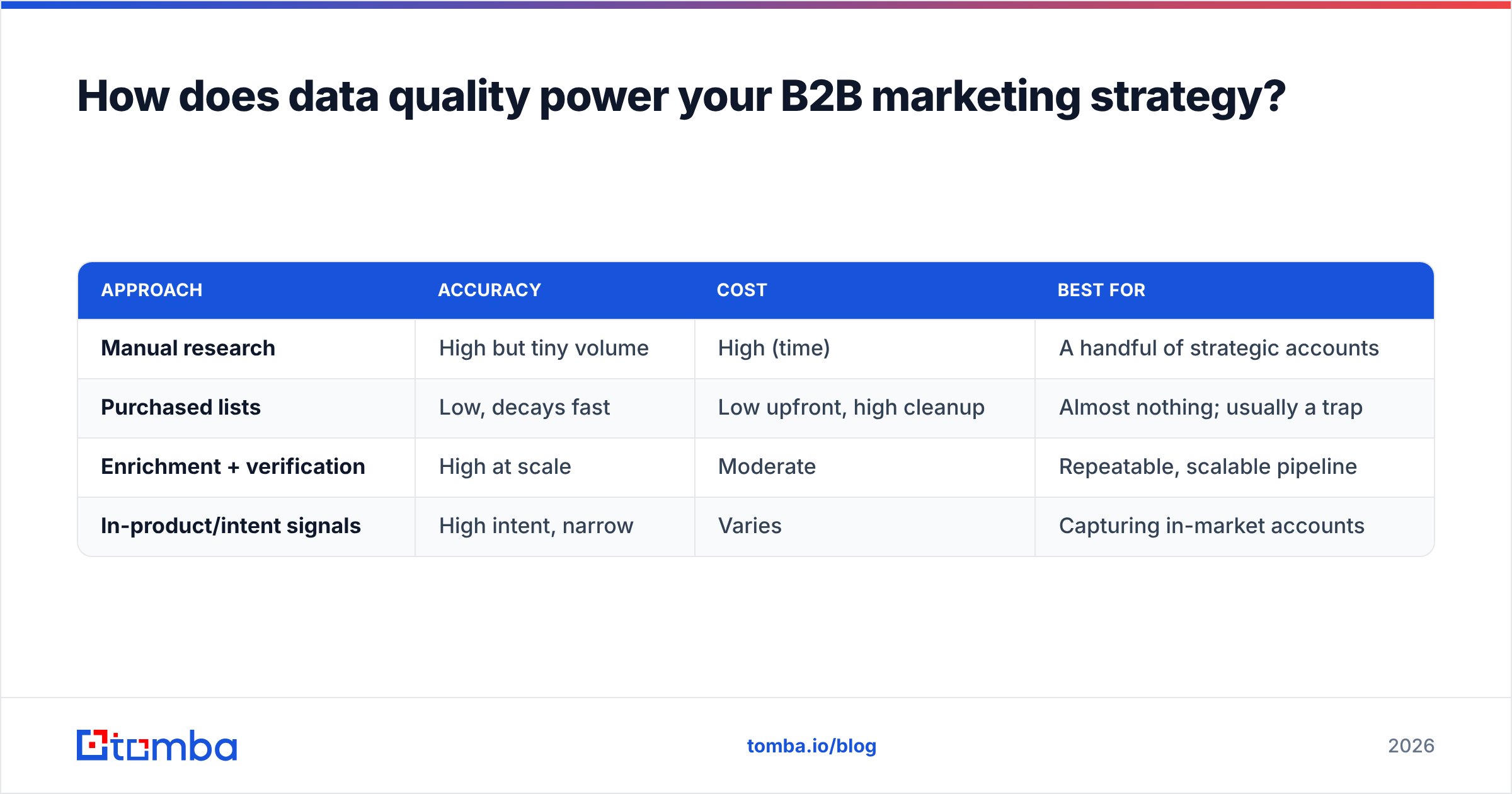
Compare a few data approaches honestly:
| Approach | Accuracy | Cost | Best for |
|---|---|---|---|
| Manual research | High but tiny volume | High (time) | A handful of strategic accounts |
| Purchased lists | Low, decays fast | Low upfront, high cleanup | Almost nothing; usually a trap |
| Enrichment + verification | High at scale | Moderate | Repeatable, scalable pipeline |
| In-product/intent signals | High intent, narrow | Varies | Capturing in-market accounts |
For most teams, the durable answer is enrichment plus verification feeding a tight ICP — the only approach that holds accuracy as volume grows. Industry leaders like HubSpot make the same point in their reporting: dirty data is the most common reason good campaigns underperform.
What's a 90-day plan to launch your B2B marketing strategy?#
Don't boil the ocean. Sequence it so each phase produces evidence before you scale spend.
- Days 1–30 — Foundation: Document the ICP, positioning, and primary metric. Audit and clean your contact data. Stand up tracking for pipeline created, not just MQLs.
- Days 31–60 — Build the engine: Ship one strong content narrative, launch one demand-capture channel (paid search or review sites), and start one verified outbound sequence to your core ICP.
- Days 61–90 — Measure and double down: Compare win rate and cost per opportunity by channel. Kill what doesn't convert, reinvest in what does, and tighten routing so no qualified lead waits.
This cadence keeps the strategy honest. By day 90 you have real pipeline data, not opinions, deciding where the next dollar goes.
Putting it together#
A B2B marketing strategy in 2026 isn't a bigger budget or a louder brand — it's tighter focus. A specific ICP, a sharp position, two or three channels you commit to, and a clean data layer that turns activity into routed, scored pipeline. Do those four things well and the vanity metrics take care of themselves.
The fastest place to feel the difference is your contact data. Start by building a verified, ICP-matched list with the Tomba Email Finder — find decision-makers by domain, name, or company, verify before you send, and hand sales a list that actually converts. Check the Tomba pricing plans, including a free tier of 25 searches per month and a Starter plan at $49/mo, and put a real data foundation under your strategy this quarter.
// get started
Find, verify and enrich your first contacts today
Start on the free plan with 25 searches a month, then scale when your team is ready.
Free plan · No credit card required · GDPR & CCPA
// about the author