B2B Marketing Strategy Examples That Actually Convert in 2026
Nine real B2B marketing strategy examples — ABM, demand gen, content, and outbound — with the channels, metrics, and data foundation that make them work in 2026.
Most "B2B marketing strategy" articles hand you a definition and a funnel diagram. You don't need another diagram. You need to see what actual teams do, in what order, with what budget, and how they measure whether it worked. That's what this is.
TL;DR#
- Strategy is the bet, not the channel. Each example below pairs a clear thesis (who we target, why they buy) with the channels that serve it — not the other way around.
- Account-based marketing (ABM), demand generation, and content-led growth are the three dominant 2026 plays. Most strong teams run a blend, weighted by deal size.
- Every example shares one dependency: accurate contact and account data. A brilliant ABM play dies if 30% of your target emails bounce.
- Vanity metrics (impressions, MQL volume) are out; pipeline and revenue influence are the scoreboard. We list the real KPI for each play.
- You can start most of these for under $200/mo in tooling — the examples note the lean stack as well as the enterprise version.
What counts as a B2B marketing strategy (and what doesn't)?#
A B2B marketing strategy is a documented bet about which accounts you'll win, why they'll choose you, and the repeatable motions that move them from unaware to closed. A list of tactics ("post on LinkedIn, send newsletters, run webinars") is not a strategy — it's a to-do list with no thesis behind it.
The everyday way to think about it: a strategy is the restaurant's concept (farm-to-table bistro for the 30-something office crowd), while tactics are the daily specials. You can change the specials weekly, but if you have no concept, the specials are random and the kitchen is chaos. Technically, strategy sets the segmentation, positioning, and channel priorities; tactics execute against them.
Three things separate a real strategy from a tactic dump:
- A named target. "Mid-market SaaS companies, 50–500 employees, in North America, with a VP of RevOps" — not "businesses."
- A point of view on why they buy. The trigger event, the pain, the competitor they're escaping.
- A measurement model that ladders to revenue. If you can't connect the activity to pipeline, it's a hobby.
What are the main types of B2B marketing strategy?#
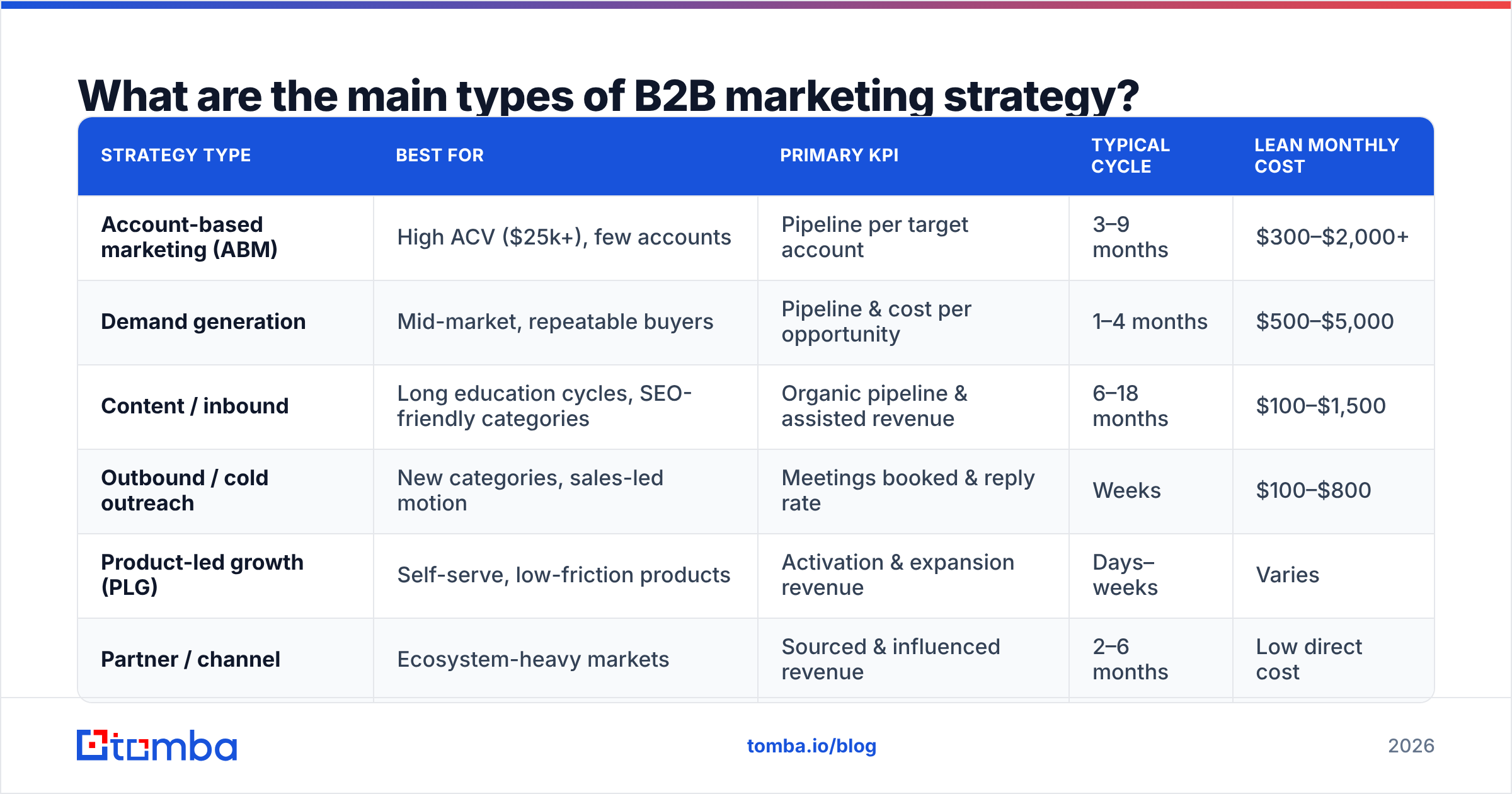
Before the examples, here's the landscape. Most 2026 teams pick a primary motion and borrow from the others.
| Strategy type | Best for | Primary KPI | Typical cycle | Lean monthly cost |
|---|---|---|---|---|
| Account-based marketing (ABM) | High ACV ($25k+), few accounts | Pipeline per target account | 3–9 months | $300–$2,000+ |
| Demand generation | Mid-market, repeatable buyers | Pipeline & cost per opportunity | 1–4 months | $500–$5,000 |
| Content / inbound | Long education cycles, SEO-friendly categories | Organic pipeline & assisted revenue | 6–18 months | $100–$1,500 |
| Outbound / cold outreach | New categories, sales-led motion | Meetings booked & reply rate | Weeks | $100–$800 |
| Product-led growth (PLG) | Self-serve, low-friction products | Activation & expansion revenue | Days–weeks | Varies |
| Partner / channel | Ecosystem-heavy markets | Sourced & influenced revenue | 2–6 months | Low direct cost |
Notice the costs. The strategy that fits a 5-person startup is not the one that fits a 200-person revenue org. The examples below cover both ends.
B2B marketing strategy examples: 9 playbooks that convert#
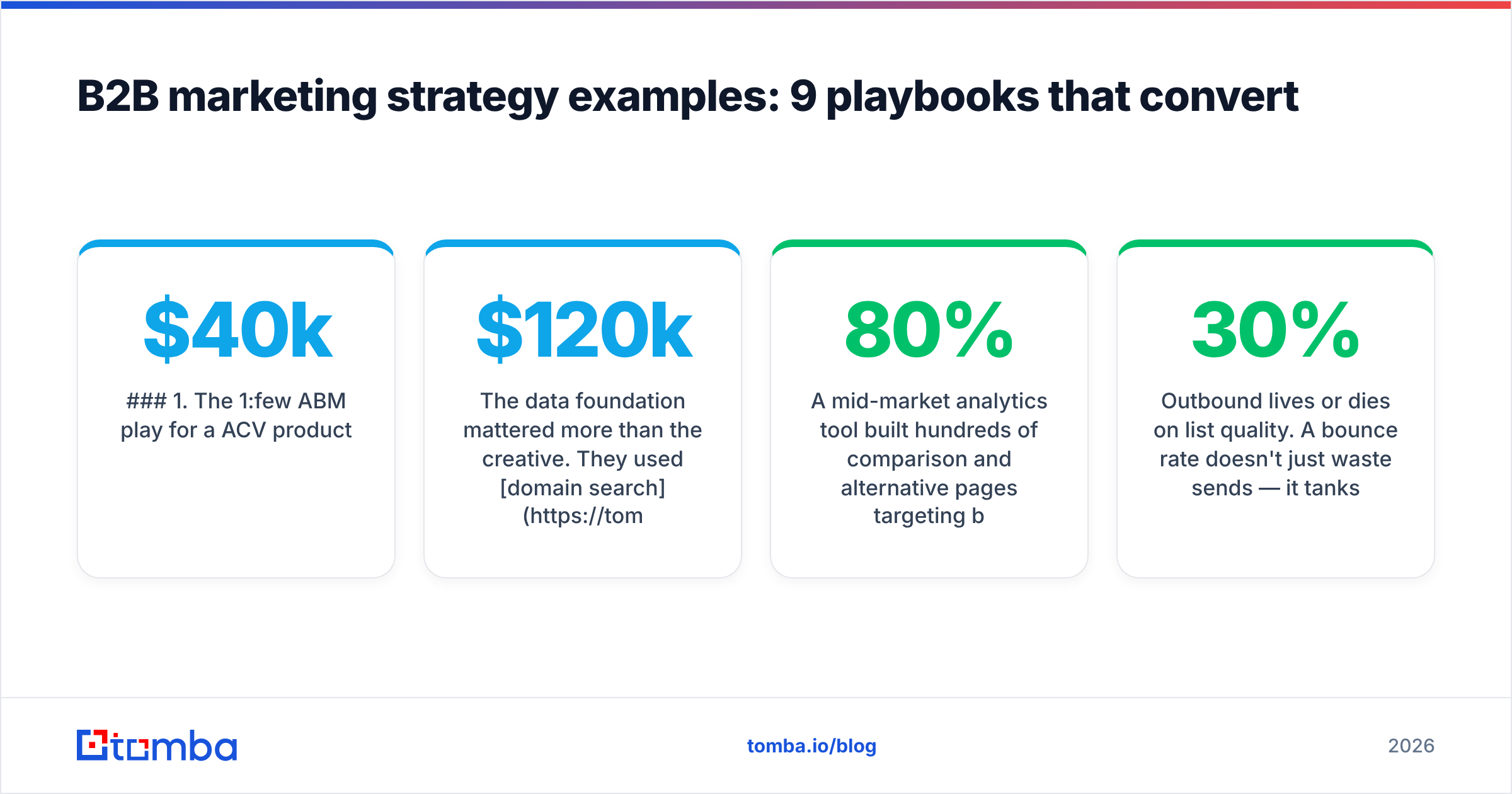
1. The 1:few ABM play for a $40k ACV product#
A 12-person security vendor picked 150 target accounts that matched their best three closed-won customers (fintech, 200–1,000 employees, using a specific competitor). The marketing team built a one-pager and a short ROI calculator per industry cluster — three variants, not 150 — then sales ran personalized outreach against the buying committee.
The data foundation mattered more than the creative. They used domain search to map every relevant contact at each target account, then ran email verification so reps weren't burning sends on dead addresses. Result over two quarters: 38 meetings, 9 opportunities, 3 closed — roughly $120k in new ARR from a play that cost under $1,500 in tooling and a few weeks of build time.
KPI that mattered: pipeline created per target account, not email opens.
2. Demand gen with a "dark funnel" content engine#
A RevOps platform stopped gating every asset behind a form. Instead they published opinionated teardowns on LinkedIn and YouTube, let people consume freely, and measured demand by self-reported attribution ("How did you hear about us?") plus branded search lift. Gated content was reserved for high-intent assets (a calculator, a benchmark report).
This is the dominant 2026 demand-gen shape: educate in public, capture only when intent is obvious. For the gated benchmark report, they enriched every signup with contact enrichment so sales saw company size and role before the first reply.
KPI that mattered: pipeline sourced + branded search growth. MQL volume was deliberately ignored.
3. The programmatic SEO + comparison content play#
A mid-market analytics tool built hundreds of comparison and alternative pages targeting bottom-funnel queries. The thesis: people comparing tools are 60–80% through their decision, so ranking there captures the highest-intent traffic. They paired this with original data studies for backlinks — a pattern HubSpot and others have used for years to dominate category SEO.
The catch nobody mentions: comparison content only converts if the follow-up is fast. They wired form fills to instant routing and used a Chrome extension so SDRs could pull a verified email the moment a prospect's company was identified.
KPI that mattered: organic-sourced pipeline and keyword rankings in positions 1–3.
4. Outbound built on a verified data spine#
A new-category startup had no inbound demand — nobody was searching for a thing that didn't have a name yet. So outbound was the only motion. They built a tightly-scoped list (one persona, one trigger), wrote three-touch sequences, and obsessed over deliverability.
Outbound lives or dies on list quality. A 30% bounce rate doesn't just waste sends — it tanks your sender reputation and lands future mail in spam. They built lists with the bulk email finder, verified before every send, and kept bounce rates under 2%. Reply rates landed at 7–9%, well above the 1–3% you get from a purchased list.
5. Community-led growth#
A developer-tools company invested in a Slack community and an open-source library instead of paid ads. The community became the top of funnel: members hit limits, asked questions, and self-selected into the paid product. Marketing's job shifted from lead gen to community health and content that fed discussion.
KPI that mattered: active members → product activation rate.
6. The webinar-to-pipeline loop#
A compliance vendor ran a monthly expert webinar, then sliced each recording into 8–12 short clips, a blog post, and an email sequence. One hour of expert time produced a month of content. Registrants were enriched and scored; only sales-ready accounts got a rep follow-up.
KPI that mattered: registrant-to-opportunity conversion, not registration count.
7. Partner co-marketing#
A vertical SaaS tool co-hosted content and events with complementary (non-competing) vendors who served the same buyer. Each partner brought their audience; both sourced pipeline at a fraction of solo-event cost. Integrations were the hook — a shared customer base made the partnership credible.
KPI that mattered: partner-sourced and partner-influenced revenue.
8. Intent-data-triggered ABM#
An enterprise platform layered third-party intent signals on top of their ICP list. When a target account showed a spike in research activity for relevant topics, it triggered a coordinated burst: ads, a personalized LinkedIn message from the AE, and a tailored email. Timing beat volume.
The play needs clean account-to-contact mapping. They used domain search to keep the buying committee current as people changed roles.
KPI that mattered: time-to-first-touch after an intent spike.
9. Product-led growth with a sales-assist overlay#
A collaboration tool let users start free, then watched for "product-qualified" signals (team invites, usage thresholds). When an account crossed the line, a rep reached out — armed with enrichment data so the message referenced the company's actual context, not a generic upgrade nudge.
KPI that mattered: product-qualified account → paid conversion.
How do you choose the right strategy for your company?#
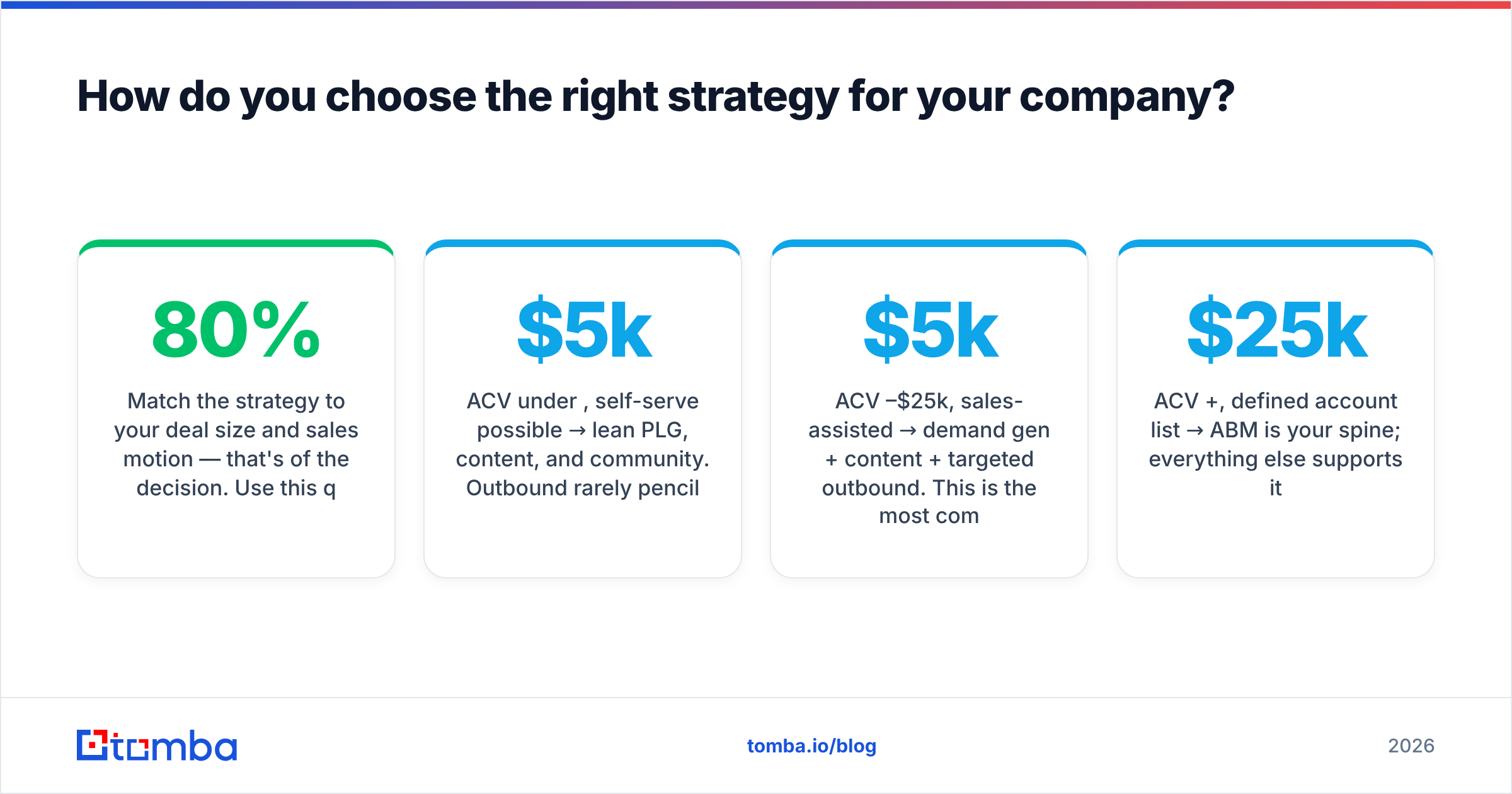
Match the strategy to your deal size and sales motion — that's 80% of the decision. Use this quick filter:
- ACV under $5k, self-serve possible → lean PLG, content, and community. Outbound rarely pencils out.
- ACV $5k–$25k, sales-assisted → demand gen + content + targeted outbound. This is the most common mid-market blend.
- ACV $25k+, defined account list → ABM is your spine; everything else supports it.
- Brand-new category → outbound and content to create demand, because none exists to capture yet.
Two more inputs: your sales cycle (longer cycles reward content and nurture; shorter ones reward outbound and PLG) and your team size (one marketer can't run six motions — pick one primary).
A word on revenue alignment: whichever you choose, marketing and sales must share one definition of a qualified lead and one pipeline number. If your strategy doesn't connect to revenue operations, you'll generate activity that nobody downstream can use. Define the handoff before you launch the campaign, not after.
Why does every strategy depend on data quality?#
Because the most creative campaign in the world fails if it reaches the wrong inbox — or no inbox at all. This is the unglamorous truth under all nine examples above.
Consider the chain in any of them: you identify an account, find the right people, reach them, and route the response. Break any link and the whole thing collapses:
- Wrong account → you waste budget on companies that will never buy.
- Wrong contact → your perfect message reaches an intern, not the VP.
- Bad email → it bounces, hurts deliverability, and never gets read.
- Slow routing → a hot lead goes cold before a human replies.
Industry research consistently puts B2B data decay at roughly 25–30% per year — people change jobs, companies rebrand, domains shift. Review sites like G2 are full of teams who blame "bad campaigns" when the real culprit was a list that was 30% dead on arrival.
That's why the data layer is a strategy decision, not a procurement afterthought. Before you scale any play, verify your contacts, enrich your accounts, and put a freshness process in place. Compare what that costs against a wasted campaign — see Tomba pricing and you'll find verified data runs a fraction of one misfired ad flight.
What does a 90-day rollout look like?#
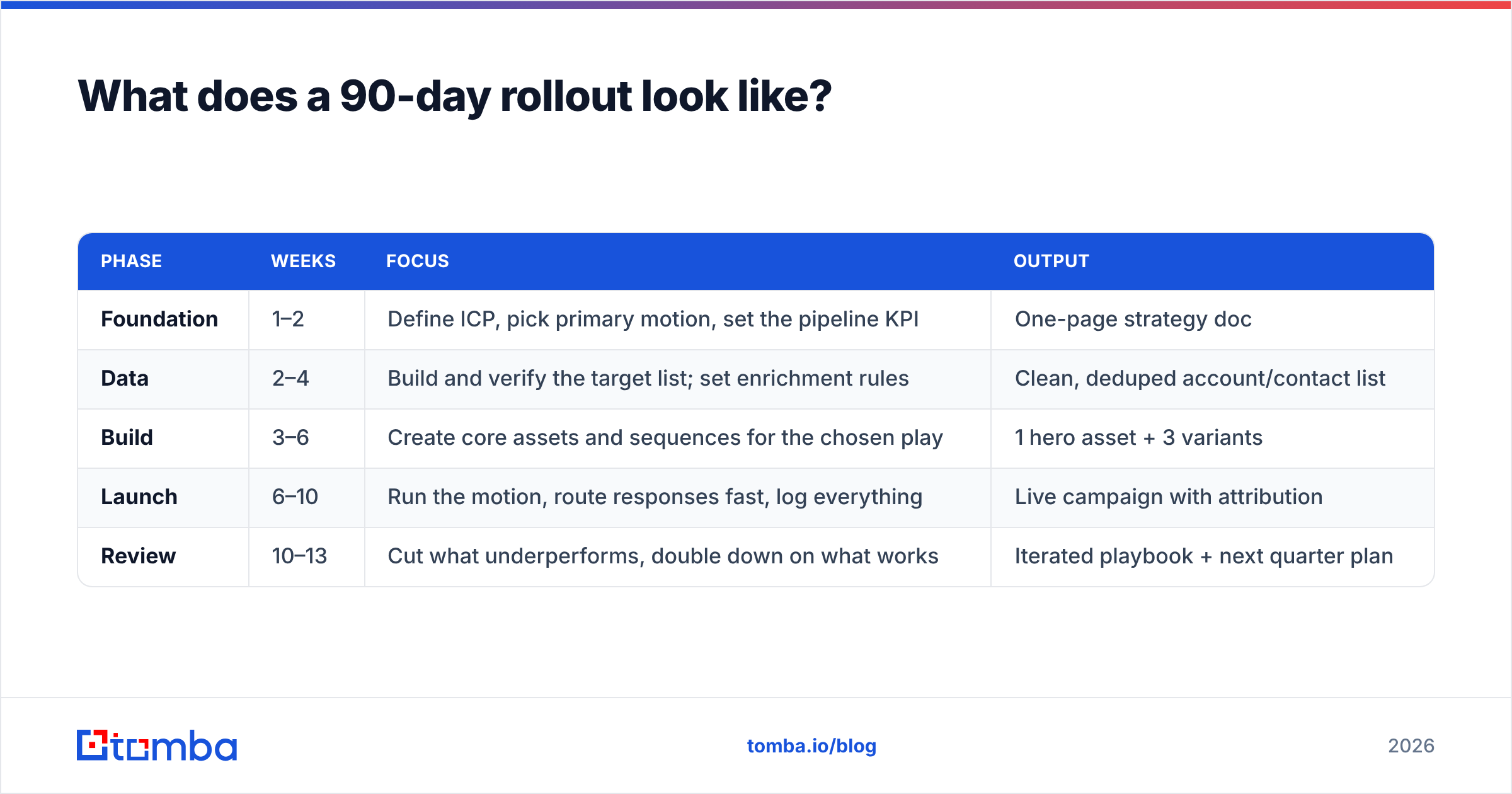
Here's a realistic sequence for a small team launching its first documented strategy:
| Phase | Weeks | Focus | Output |
|---|---|---|---|
| Foundation | 1–2 | Define ICP, pick primary motion, set the pipeline KPI | One-page strategy doc |
| Data | 2–4 | Build and verify the target list; set enrichment rules | Clean, deduped account/contact list |
| Build | 3–6 | Create core assets and sequences for the chosen play | 1 hero asset + 3 variants |
| Launch | 6–10 | Run the motion, route responses fast, log everything | Live campaign with attribution |
| Review | 10–13 | Cut what underperforms, double down on what works | Iterated playbook + next quarter plan |
Notice that data work (verify, enrich, dedupe) happens before launch — not as cleanup after the bounces roll in. Teams that skip this phase spend weeks debugging "low reply rates" that were really a list problem.
Common mistakes that sink B2B marketing strategies#
- Chasing every channel at once. One marketer running ABM, SEO, PLG, and events does all four badly. Pick a primary.
- Measuring activity instead of pipeline. 10,000 impressions and 400 MQLs feel productive and influence zero revenue. Report on opportunities and sourced ARR.
- Treating data as a one-time buy. A list you bought 18 months ago is now ~40% wrong. Re-verify on a schedule.
- No sales-marketing handoff. Leads pile up in a queue nobody owns. Agree on the definition and the SLA first.
- Copying a strategy that fits a different deal size. A PLG playbook from a $20/mo tool won't work for your $80k enterprise sale.
Conclusion: pick one bet, fund the data behind it#
The best B2B marketing strategy examples aren't the cleverest creative — they're the ones where a clear target, a single primary motion, and a clean data foundation reinforce each other. ABM, demand gen, content, outbound: each can win, but only when the contacts are real, the routing is fast, and the scoreboard is pipeline.
Whichever play you choose, the first dependency is finding and verifying the right people at the right accounts. The Tomba Email Finder gives you verified professional emails by domain, name, or company so your strategy reaches real inboxes instead of bouncing — and it scales from a free tier (25 searches/mo) up through Starter at $49/mo when you're ready to run the full play. Build the data spine first; the campaigns get easier from there.
Ready to find emails that actually work?
Join 150,000+ professionals who stopped guessing and started sending. Free credits on signup — no credit card required.
Get the Tomba newsletter
Practical outbound tactics and product updates — once every two weeks.
About the author