The B2B Marketing Strategy Framework That Wins Pipeline in 2026
A practical, 6-layer B2B marketing strategy framework for 2026 — from ICP and positioning to channels, data, and revenue measurement. Steal the template.
(title rendered separately)
Most B2B marketing fails for one reason: there's no framework underneath it. Campaigns get shipped, budgets get spent, and nobody can draw a straight line from a LinkedIn ad to a closed deal. A b2b marketing strategy framework fixes that by forcing every tactic to ladder up to a revenue goal.
This guide gives you a six-layer framework you can put to work this quarter, plus a comparison of the popular strategic models so you pick the right one instead of cargo-culting whatever your competitor posted on LinkedIn.
TL;DR#
- A B2B marketing strategy framework is a layered system — ICP, positioning, demand strategy, channels, data, and measurement — where each layer constrains the one below it.
- Skip the foundational layers (ICP, positioning) and everything downstream becomes expensive guessing.
- Pick a strategic model (account-based, demand gen, PLG, or a hybrid) based on deal size and sales motion, not hype.
- Your data layer is the silent killer: even a perfect strategy collapses on stale or unverified contact data.
- Measure pipeline and revenue contribution, not vanity metrics like impressions or MQL volume.
What is a B2B marketing strategy framework?#
A B2B marketing strategy framework is the decision-making structure that connects who you sell to, why they should care, and how you reach them — all the way down to how you measure whether it worked. Think of it like the foundation, framing, and wiring of a house. You don't decide the paint color (your ad creative) before you've poured the foundation (your ICP and positioning).
The difference between a "strategy" and a "framework" is repeatability. A strategy is a set of choices for this quarter. A framework is the system that produces good choices every quarter, so you're not reinventing your approach every time a new channel gets hot.
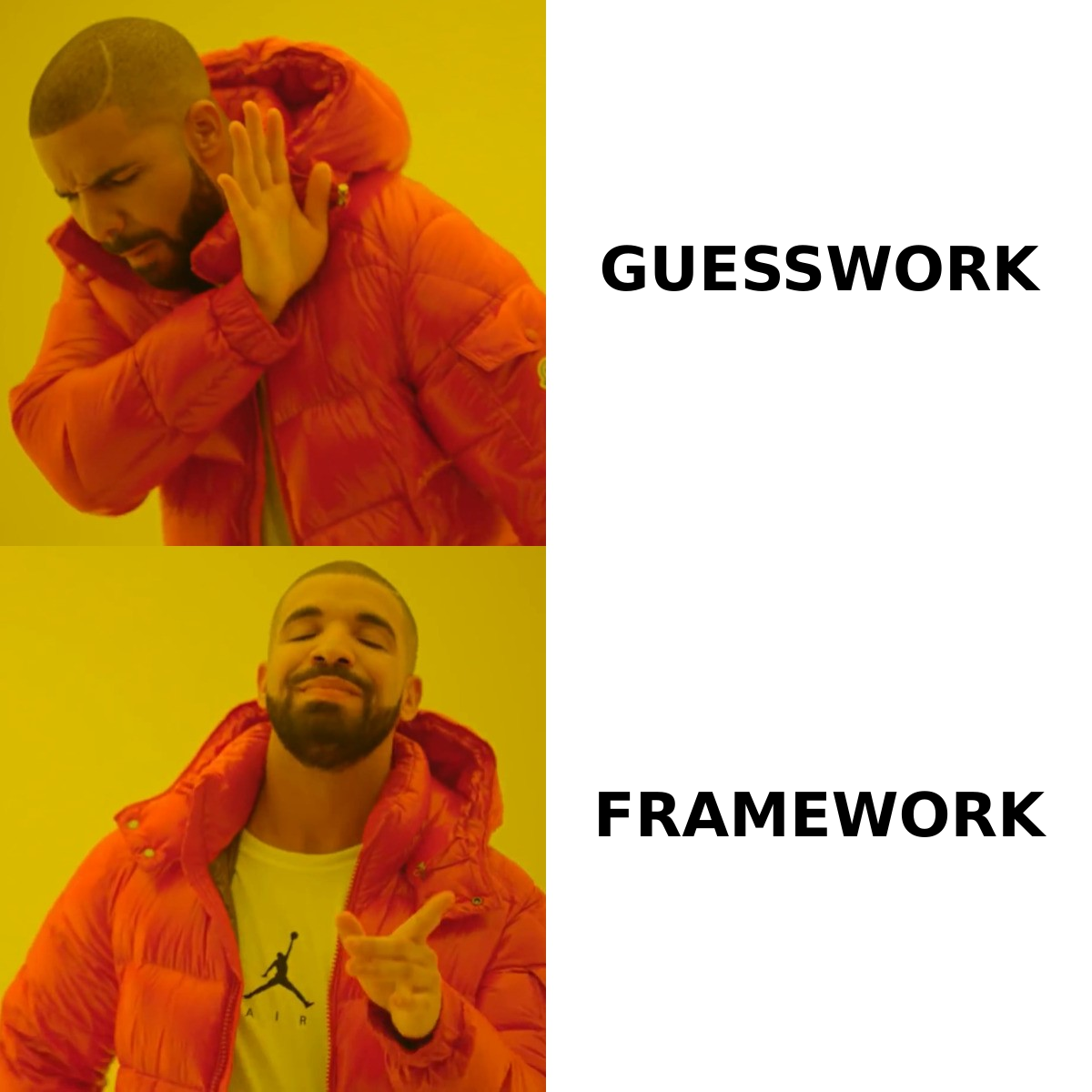
Here are the six layers, top to bottom. Each one constrains the layers beneath it.
- Ideal Customer Profile (ICP) — The accounts and personas worth winning. Defined by firmographics, technographics, and buying triggers — not just "companies with 50+ employees."
- Positioning and messaging — Why a buyer in your ICP should choose you over the status quo or a competitor. This is your wedge.
- Demand strategy — The macro motion: account-based, broad demand generation, product-led, or a blend.
- Channel mix — The specific surfaces (paid search, LinkedIn, events, content, outbound) where you execute the demand strategy.
- Data and operations — The contact data, enrichment, routing, and tooling that make execution possible at scale.
- Measurement — The metrics and attribution that tell you what to double down on and what to kill.
Most teams obsess over layers 3–4 (the fun ones) while neglecting 1, 2, 5, and 6. That's why their pipeline is unpredictable.
Why do most B2B marketing strategies fail?#
They fail because they start in the middle. A team picks channels before defining an ICP, so the targeting is fuzzy. Or they generate leads without a positioning wedge, so sales burns cycles on prospects who were never a fit.
According to Gartner research on B2B buying, the typical purchase now involves 6 to 10 stakeholders, each arriving with their own pile of information. A framework that targets a single "decision maker" is already obsolete. You need messaging that maps to a buying committee, not a buyer.
The second failure mode is the data layer. You can nail ICP, positioning, and channels — then watch 30% of your outbound list bounce because the contact data is stale. Good data enrichment and verification isn't a "nice to have" bolted on at the end; it's load-bearing for the entire framework.
Which strategic model should you choose?#
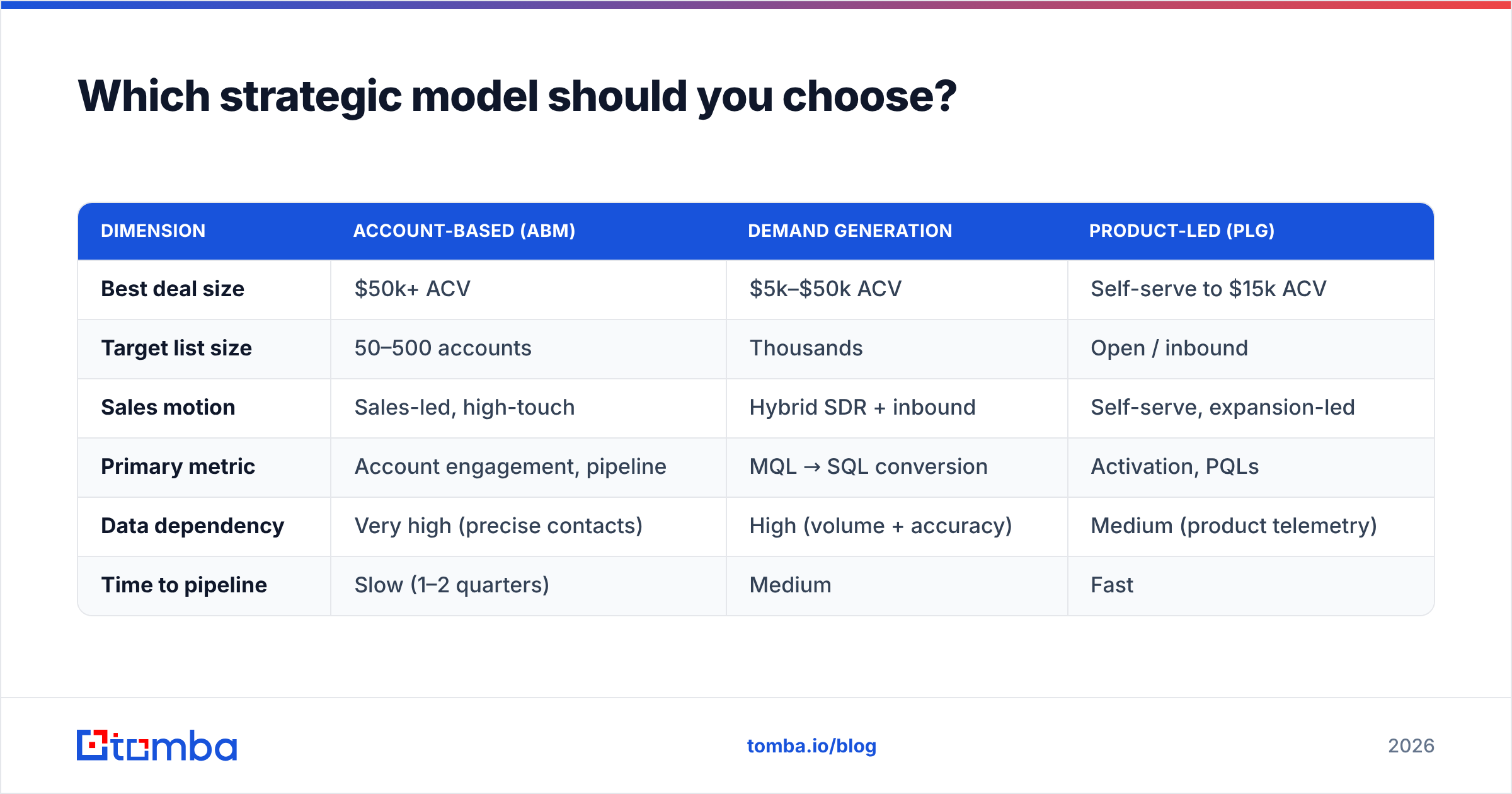
The demand-strategy layer is where teams agonize most. Account-based marketing (ABM), broad demand generation, and product-led growth (PLG) are not interchangeable — each fits a different deal size and sales motion. Here's how they compare.
| Dimension | Account-Based (ABM) | Demand Generation | Product-Led (PLG) |
|---|---|---|---|
| Best deal size | $50k+ ACV | $5k–$50k ACV | Self-serve to $15k ACV |
| Target list size | 50–500 accounts | Thousands | Open / inbound |
| Sales motion | Sales-led, high-touch | Hybrid SDR + inbound | Self-serve, expansion-led |
| Primary metric | Account engagement, pipeline | MQL → SQL conversion | Activation, PQLs |
| Data dependency | Very high (precise contacts) | High (volume + accuracy) | Medium (product telemetry) |
| Time to pipeline | Slow (1–2 quarters) | Medium | Fast |
If you're closing six-figure enterprise deals, broad demand gen wastes money — you need ABM precision. If you're a $99/month SaaS tool, ABM is overkill and PLG plus demand gen will compound faster. Most growing companies run a hybrid: PLG for the long tail, ABM for the strategic logos.
The model you pick cascades into your channel mix and your data requirements. ABM, for instance, demands you can reliably find email addresses and direct dials for named contacts at named accounts — which is a very different data problem than casting a wide net.
How do you build the framework, layer by layer?#
Layer 1: Define a sharp ICP#
Don't define your ICP by size alone. Layer in:
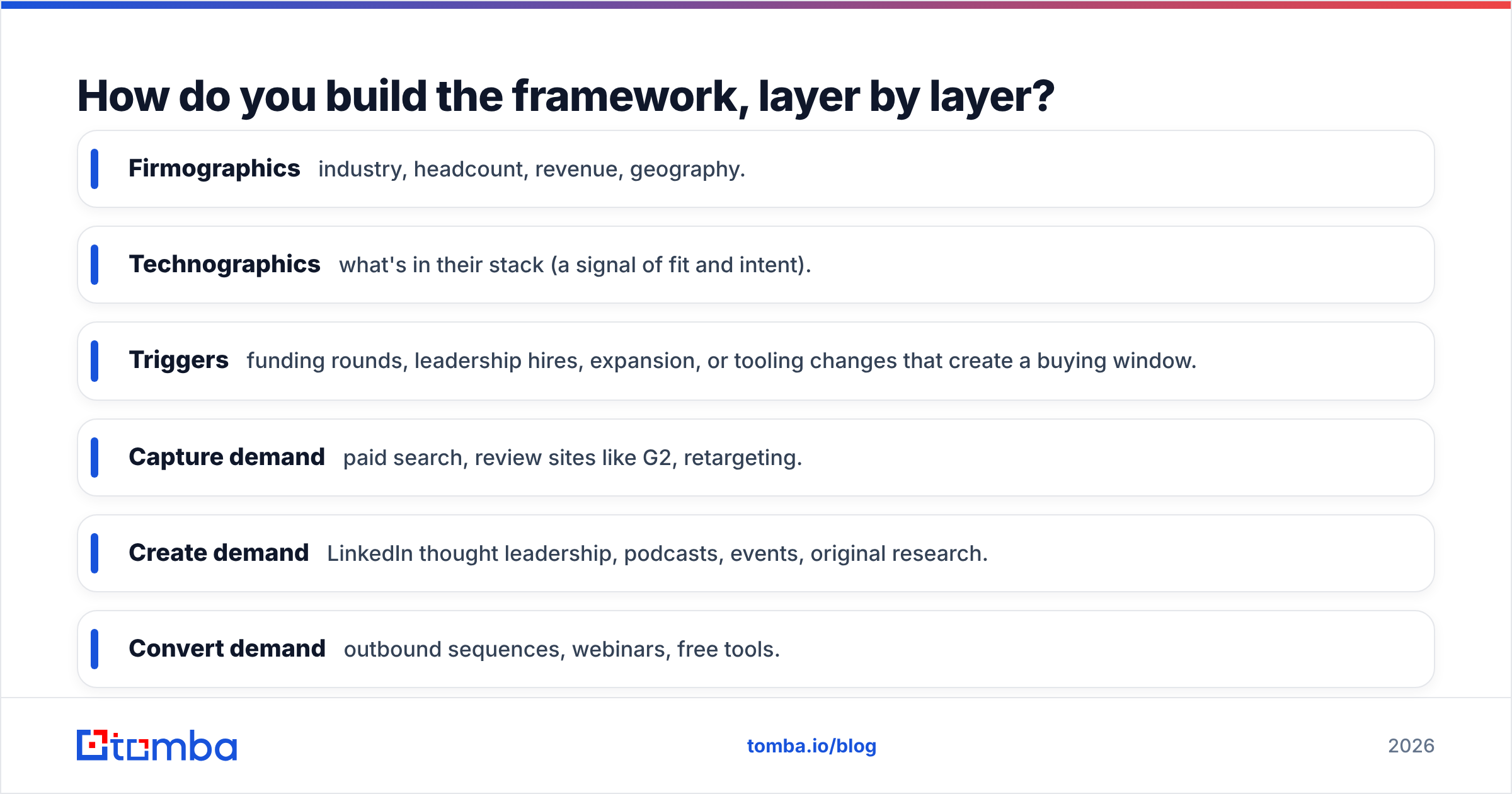
- Firmographics — industry, headcount, revenue, geography.
- Technographics — what's in their stack (a signal of fit and intent).
- Triggers — funding rounds, leadership hires, expansion, or tooling changes that create a buying window.
Use a B2B database to size the market and pull the actual account list. If your ICP is "everyone," it's not an ICP — it's a wish.
Layer 2: Nail positioning#
Positioning answers one question: compared to what? Your buyer's default is the status quo (doing nothing). Your messaging has to make the cost of inaction feel real. April Dunford's framing — competitive alternatives, unique attributes, value, target segment — is still the cleanest model here. Document it in one page and make sales sign off on it.
Layer 3: Pick your demand model#
Use the comparison table above. Commit to one primary motion and at most one secondary. Teams that try to run ABM, demand gen, and PLG simultaneously with one small team do all three badly.
Layer 4: Build the channel mix#
Map channels to where your ICP actually spends attention. For a CFO persona, that's probably not TikTok. Pair each channel with a job:
- Capture demand — paid search, review sites like G2, retargeting.
- Create demand — LinkedIn thought leadership, podcasts, events, original research.
- Convert demand — outbound sequences, webinars, free tools.
Layer 5: Wire the data and ops layer#
This is where strategies quietly die. Your channel execution is only as good as the contacts feeding it.
At minimum you need: a way to find contacts at target accounts, a email verifier to keep bounce rates low and protect sender reputation, enrichment to fill gaps in your CRM, and clean routing so leads reach the right rep fast. Connect it to your CRM — see how teams wire this with the HubSpot integration — so data flows instead of rotting in spreadsheets.
Layer 6: Measure revenue, not vanity#
Tie reporting to pipeline created and revenue influenced. HubSpot's research consistently shows that teams measuring revenue contribution — not lead volume — allocate budget far more effectively. Build a dashboard that answers: which segments, channels, and campaigns produced closed-won revenue, and at what cost.
What does a complete framework look like in practice?#
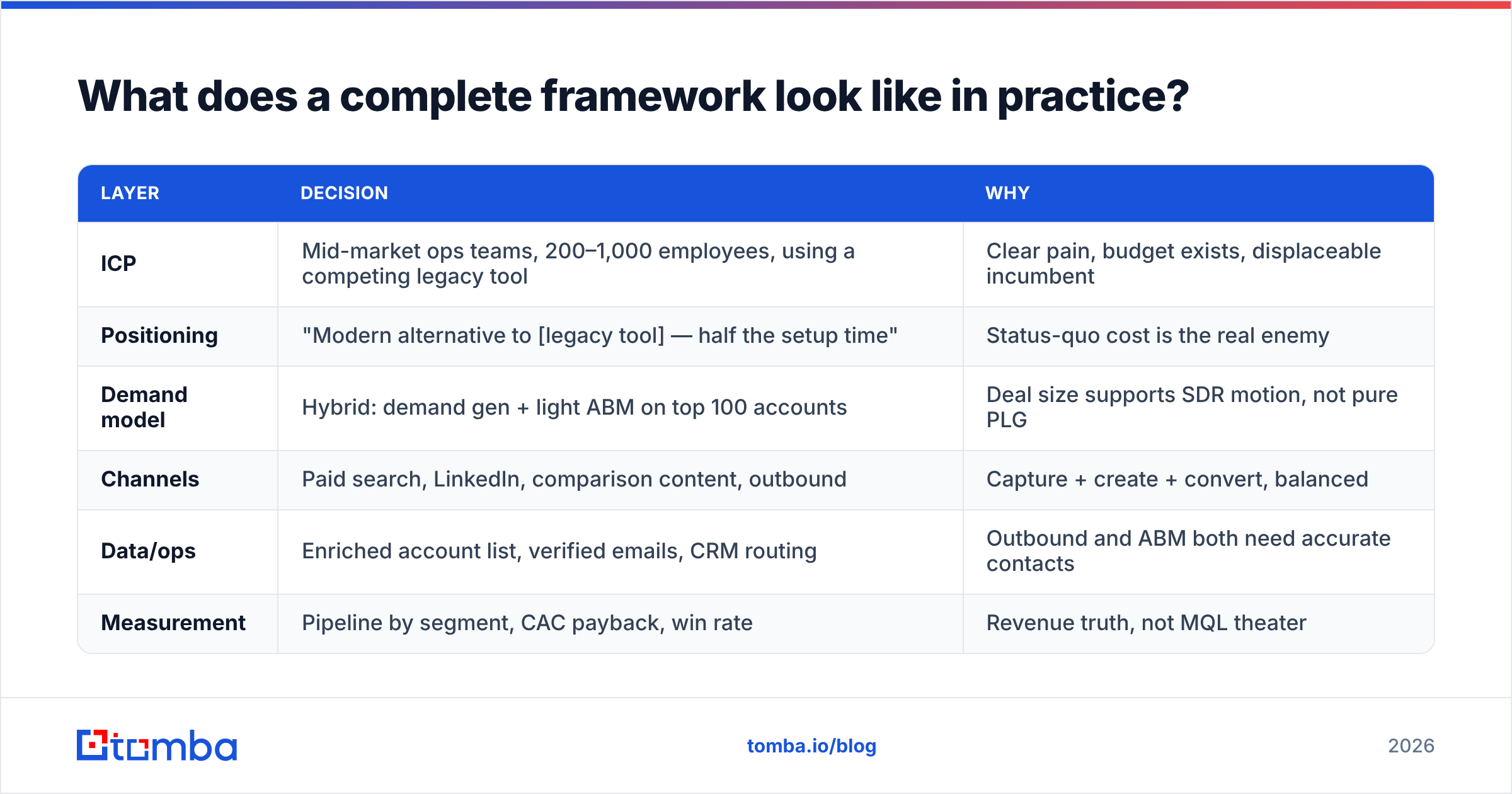
Here's how the six layers connect for a hypothetical $30k-ACV B2B SaaS company.
| Layer | Decision | Why |
|---|---|---|
| ICP | Mid-market ops teams, 200–1,000 employees, using a competing legacy tool | Clear pain, budget exists, displaceable incumbent |
| Positioning | "Modern alternative to [legacy tool] — half the setup time" | Status-quo cost is the real enemy |
| Demand model | Hybrid: demand gen + light ABM on top 100 accounts | Deal size supports SDR motion, not pure PLG |
| Channels | Paid search, LinkedIn, comparison content, outbound | Capture + create + convert, balanced |
| Data/ops | Enriched account list, verified emails, CRM routing | Outbound and ABM both need accurate contacts |
| Measurement | Pipeline by segment, CAC payback, win rate | Revenue truth, not MQL theater |
Notice how every row is constrained by the row above. The channels exist to serve the demand model; the demand model exists to win the ICP. That top-down discipline is the entire point of using a framework.
How is AI changing the B2B marketing framework in 2026?#
AI hasn't replaced the framework — it's compressed the execution layers. Drafting positioning variants, generating first-pass campaign copy, scoring intent signals, and enriching records all happen faster now. But AI amplifies whatever you feed it. Point it at a vague ICP and bad data, and it produces wrong outputs at scale.
The teams winning in 2026 use AI to accelerate layers 4–6 (channels, data, measurement) while keeping human judgment firmly in layers 1–2 (ICP, positioning). Strategy is still a human decision; AI is the leverage on top of it. The constraint, as always, is data quality — which is why the data layer keeps mattering more, not less.
How do you measure if the framework is working?#
Pick a small set of metrics per layer and review them monthly:
- ICP fit — % of pipeline from in-ICP accounts (target: 80%+).
- Positioning — win rate vs. the status quo and vs. named competitors.
- Demand model — pipeline coverage ratio (3x quota is a common benchmark).
- Channels — cost per opportunity by channel, not cost per lead.
- Data — bounce rate and CRM data completeness.
- Revenue — CAC payback period and net revenue retention.
If in-ICP pipeline is low, your problem is layer 1 — not your ad creative. The framework tells you where to look when results stall, which is its most underrated benefit.
Common mistakes that break the framework#
- Starting with channels. Picking tactics before ICP and positioning is the original sin.
- One metric to rule them all. MQL volume optimizes for the wrong behavior; you'll drown sales in junk.
- Ignoring the data layer. A flawless strategy on stale contacts still bounces. Verify and enrich before you send.
- No feedback loop. A framework you don't review monthly is just a slide deck.
- Copying a competitor's model. Their deal size and sales motion may be nothing like yours.
Conclusion: ship the framework, not just campaigns#
Pick one model, define a sharp ICP, write one page of positioning, and instrument the data and measurement layers before you spend another dollar on ads. The framework isn't bureaucracy — it's the thing that makes your spend predictable.
And since every layer above ultimately runs on contact data, start there. Tomba's Email Finder lets you find and verify professional emails for the exact accounts in your ICP, so your outbound and ABM motions launch on accurate data instead of guesses. The free tier gives you 25 searches a month to test it; paid plans start at $49/mo on the Tomba pricing page. Build the strategy, then feed it the data it deserves.
// get started
Find, verify and enrich your first contacts today
Start on the free plan with 25 searches a month, then scale when your team is ready.
Free plan · No credit card required · GDPR & CCPA
// about the author