B2B Marketing Structure in 2026: Teams, Roles, and Models
How to design a B2B marketing structure that scales: team models, core roles, reporting lines, and the data layer that keeps demand gen and sales aligned in 2026.

B2B Marketing Structure in 2026: Teams, Roles, and Models
Your B2B marketing structure is not an org chart you draw once and forget. It is the operating system that decides how fast leads move, who owns pipeline, and whether a campaign ships in two days or two months. Get it wrong and you get silos, finger-pointing, and a CMO who can't explain where revenue came from. Get it right and marketing behaves like a single, accountable revenue engine.
This guide breaks down how to actually build that structure in 2026 — the models that work at each company stage, the roles you genuinely need, and the data layer that keeps the whole thing honest.
TL;DR#
- A B2B marketing structure is the way you group roles, set reporting lines, and assign ownership so demand, content, product marketing, and ops work toward shared revenue goals.
- There is no universal best model — the right shape depends on company size, motion (PLG vs. sales-led), and whether you sell one product or many.
- The four common models are functional, segment/pod, product-line, and centralized-COE. Most scaling companies land on a pod model around 15–30 marketers.
- RevOps and a clean data layer are now core, not optional — marketing structure fails when lead data is dirty or disconnected from sales.
- Start lean, add specialists later. Hiring a "growth lead" before you have product-market fit is the most common structural mistake.
What is a B2B marketing structure?#
A B2B marketing structure is the framework that defines who does what, who reports to whom, and how marketing connects to sales and product. Think of it like the kitchen of a busy restaurant: you can have brilliant chefs, but without stations, a pass, and an expediter calling tickets, the food comes out cold and late. The structure is the stations and the pass — it turns individual talent into reliable output.
In practical terms, a marketing structure answers four questions:
- Grouping — Are people organized by function (content, demand gen, design), by customer segment (enterprise, mid-market, SMB), or by product line?
- Reporting — Who owns the number? Where do demand gen and brand sit relative to the CMO?
- Hand-offs — How does a lead move from a campaign to an SDR to an AE without dropping?
- Shared metrics — Is everyone measured against pipeline and revenue, or against vanity activity?
The companies that scale cleanly treat these as deliberate design decisions. The ones that stall let the structure happen by accident, usually by hiring reactively whenever a channel feels under-served.
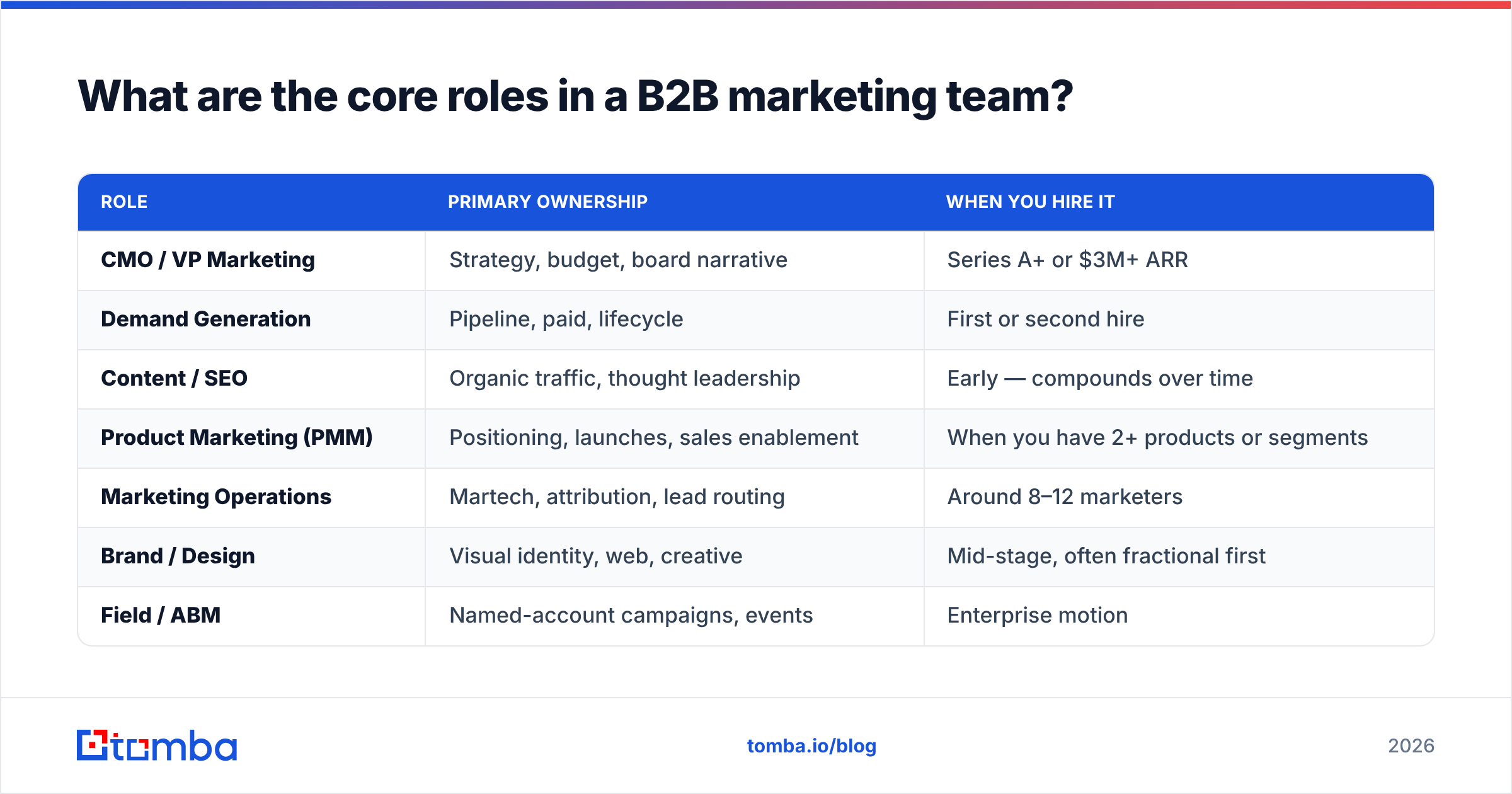
What are the core roles in a B2B marketing team?#
Before you pick a model, you need to know the building blocks. Not every company needs every role, but these are the functions that show up again and again in a healthy B2B marketing structure.
| Role | Primary ownership | When you hire it |
|---|---|---|
| CMO / VP Marketing | Strategy, budget, board narrative | Series A+ or $3M+ ARR |
| Demand Generation | Pipeline, paid, lifecycle | First or second hire |
| Content / SEO | Organic traffic, thought leadership | Early — compounds over time |
| Product Marketing (PMM) | Positioning, launches, sales enablement | When you have 2+ products or segments |
| Marketing Operations | Martech, attribution, lead routing | Around 8–12 marketers |
| Brand / Design | Visual identity, web, creative | Mid-stage, often fractional first |
| Field / ABM | Named-account campaigns, events | Enterprise motion |
| RevOps (shared) | Data, forecasting, sales–marketing glue | When CRM data starts breaking |
The two roles teams most often under-invest in early are product marketing and marketing operations. PMM is what keeps your messaging from drifting into jargon; MOps is what keeps your lead data from rotting. Skip them and you'll feel the pain later as misaligned campaigns and untrustworthy reporting.
What are the main B2B marketing structure models?#
There are four dominant models. Most companies move through them in sequence as they grow, rather than picking one forever.
- Functional model — People are grouped by what they do: a content team, a demand team, a design team. Simple, clear craft ownership, and ideal under ~15 marketers. The weakness is that nobody owns a customer segment end-to-end, so cross-team campaigns get slow.
- Segment / pod model — Small cross-functional pods (a demand gen lead, a content person, a designer, sometimes a PMM) each own a segment or motion. This is the most popular structure for scaling B2B companies because it balances speed with specialization. The risk is duplicated effort and inconsistent brand if pods drift.
- Product-line model — Each product or business unit gets its own marketing team. Common in multi-product platforms. Great focus, but expensive and prone to inconsistent customer experience across products.
- Centralized center-of-excellence (COE) — Specialists (SEO, paid, lifecycle, ops) sit in shared hubs that serve all segments. Strong craft and economies of scale, but it can feel like an internal agency with a queue, slowing time-to-launch.
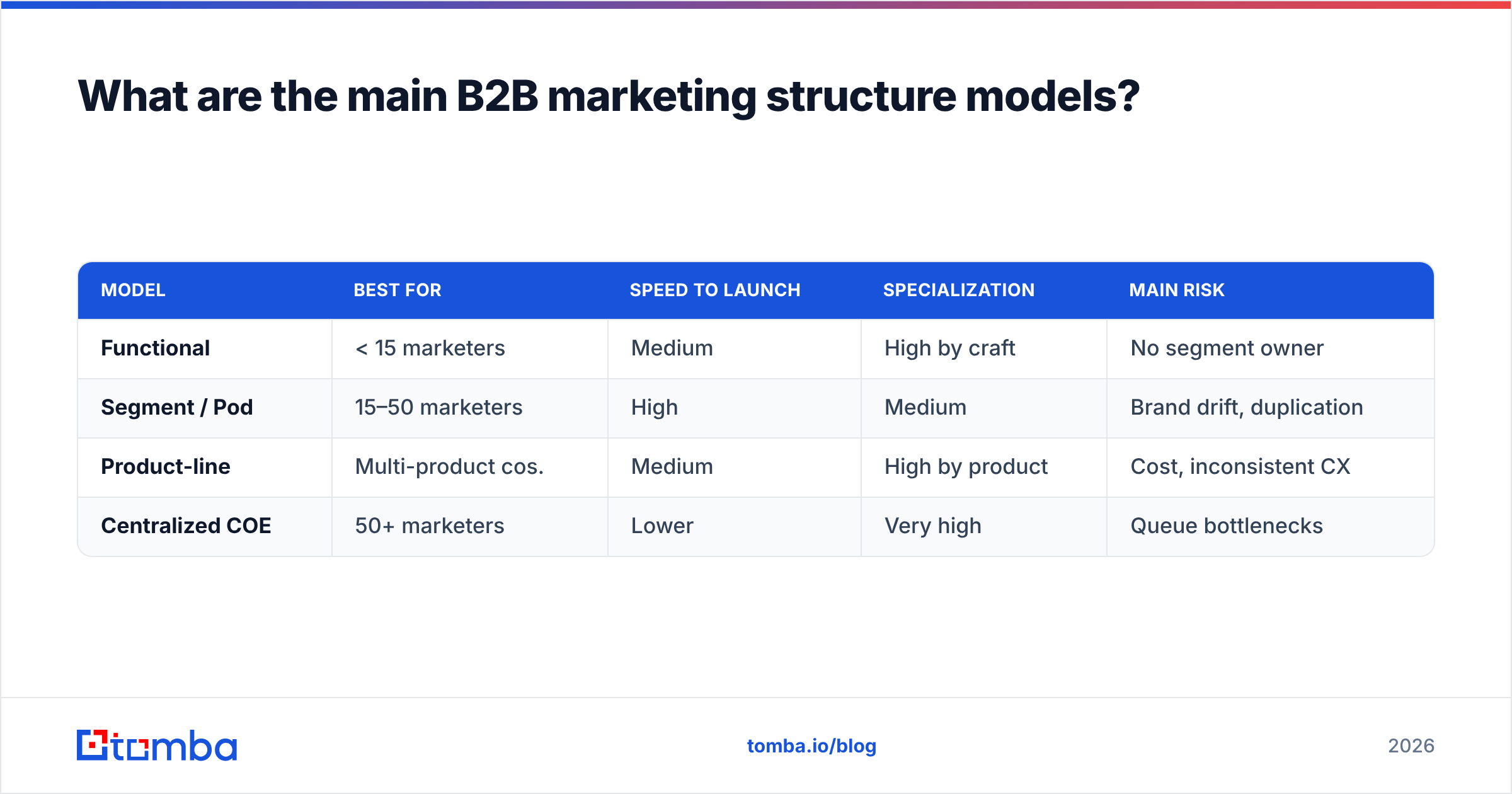
Here is how the trade-offs compare side by side:
| Model | Best for | Speed to launch | Specialization | Main risk |
|---|---|---|---|---|
| Functional | < 15 marketers | Medium | High by craft | No segment owner |
| Segment / Pod | 15–50 marketers | High | Medium | Brand drift, duplication |
| Product-line | Multi-product cos. | Medium | High by product | Cost, inconsistent CX |
| Centralized COE | 50+ marketers | Lower | Very high | Queue bottlenecks |
If you're unsure where to start, default to functional until ~15 people, then migrate to pods. That path keeps overhead low while you find product-market fit, then unlocks speed once you have enough headcount to staff cross-functional teams. For broader context on how marketing slots into the wider go-to-market engine, the discipline of revenue operations is increasingly the connective tissue across all four models.
How does company size change the structure?#
Structure should follow stage. A 5-person team and a 50-person team that copy each other's org chart will both fail.
- Seed / pre-PMF (1–3 marketers) — One generalist "full-stack" marketer plus maybe a contractor. No specialization. The job is to find a repeatable channel, not to build a department.
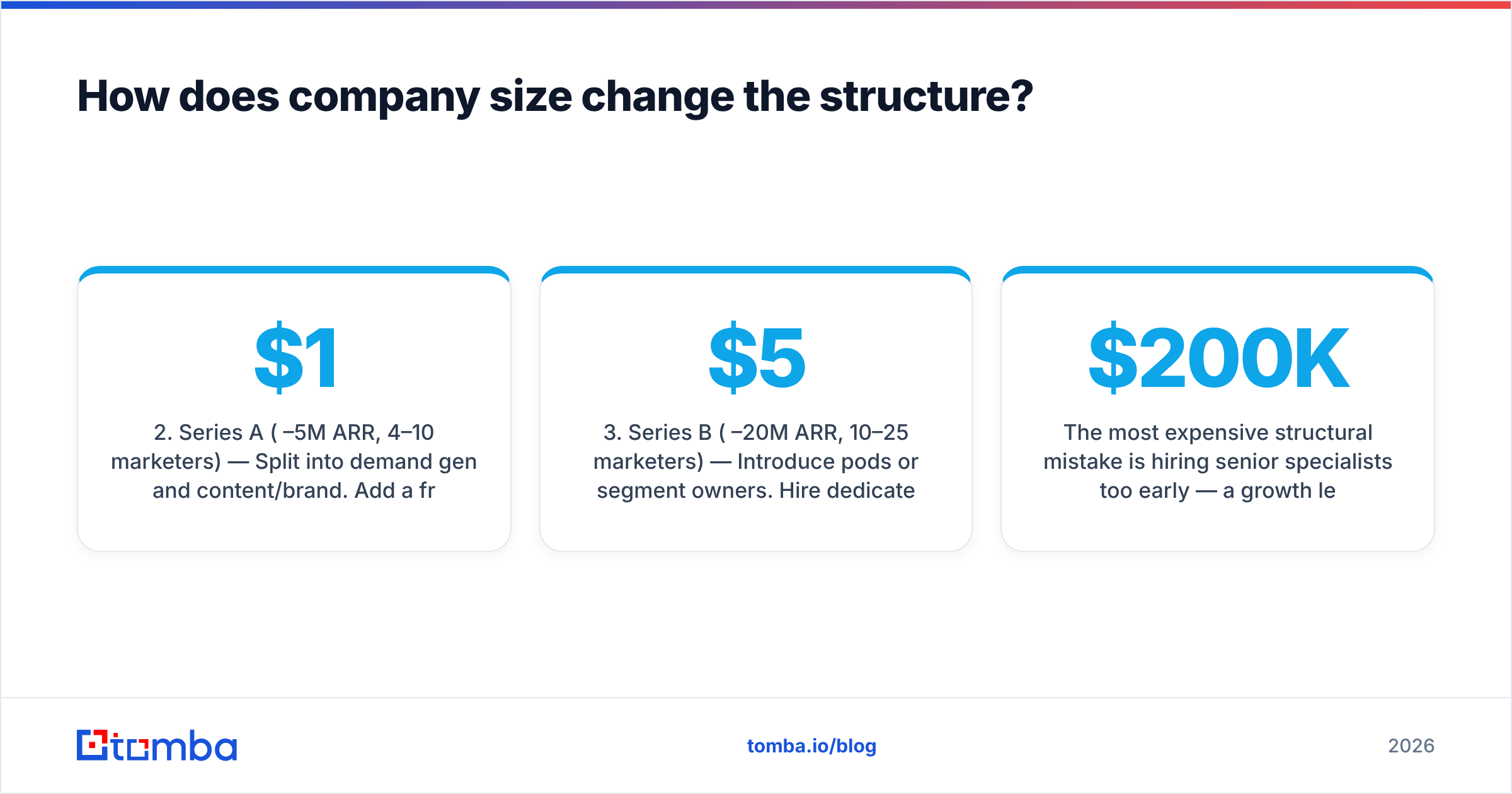
- Series A ($1–5M ARR, 4–10 marketers) — Split into demand gen and content/brand. Add a fractional or junior ops person once lead volume makes manual routing painful.
- Series B ($5–20M ARR, 10–25 marketers) — Introduce pods or segment owners. Hire dedicated PMM and a real MOps lead. This is where data hygiene becomes a board-level issue.
- Growth / late-stage (25+ marketers) — Layer in centralized COEs for paid, SEO, and lifecycle. Field/ABM teams form around enterprise. RevOps becomes a shared function reporting into both marketing and sales.
The most expensive structural mistake is hiring senior specialists too early — a $200K growth lead with nothing to optimize, or a brand director before you have a brand worth scaling. Build the structure to match the problem in front of you, not the company you hope to be in three years.
Where do marketing operations and data fit?#
Marketing operations and clean data are the foundation the entire structure stands on. You can design the perfect pod model, but if the lead that enters your CRM has a guessed email, no job title, and a duplicate record, every downstream hand-off breaks.
This is the part teams romanticize least and regret most. According to Gartner research on go-to-market, data quality and operational maturity are now leading predictors of marketing ROI — ahead of creative or channel choice. A pod can't run account-based plays if it can't trust the account list.
Three operational pillars hold a modern B2B marketing structure together:
- Lead routing and SLAs — Defined rules for who gets a lead and how fast sales must follow up. This is where most "marketing vs. sales" conflict actually originates.
- Attribution and reporting — A shared source of truth so the CMO can defend spend and pods can kill what doesn't work.
- Data enrichment and verification — Filling in firmographics, titles, and verified contact details so segmentation and personalization are even possible.
That last pillar is where tooling earns its keep. If your SDRs are bouncing on bad addresses, no org chart will save the funnel. A reliable email verifier keeps your database deliverable, while data enrichment backfills the firmographic detail your pods need to route and personalize. Clean inputs make every model above work better.

How do you align marketing structure with sales?#
Alignment is a structural choice, not a personality fix. The teams that "just communicate better" usually have shared incentives baked into the org design — not nicer people.
Three structural levers create real alignment:
- Shared pipeline targets — Marketing carries a sourced-pipeline number, not just MQLs. When both teams are measured on the same downstream metric, the hand-off arguments mostly disappear. Track it against your win rate so the whole funnel stays visible.
- A common definition of a qualified lead — Marketing and sales jointly own what counts as a marketing qualified lead. If sales rejects half your MQLs, the definition is the problem, not the leads.
- A shared RevOps or data function — One team owning the CRM, the routing rules, and the reporting removes the "your numbers vs. my numbers" standoff entirely.
A useful test: ask your demand gen lead and your top AE to independently describe how a lead becomes an opportunity. If their answers differ, your structure has a gap no amount of slack messages will close. HubSpot's research on sales and marketing alignment consistently links shared goals and SLAs to higher revenue growth — the mechanism is structural, not cultural.
What does a B2B marketing structure look like in practice?#
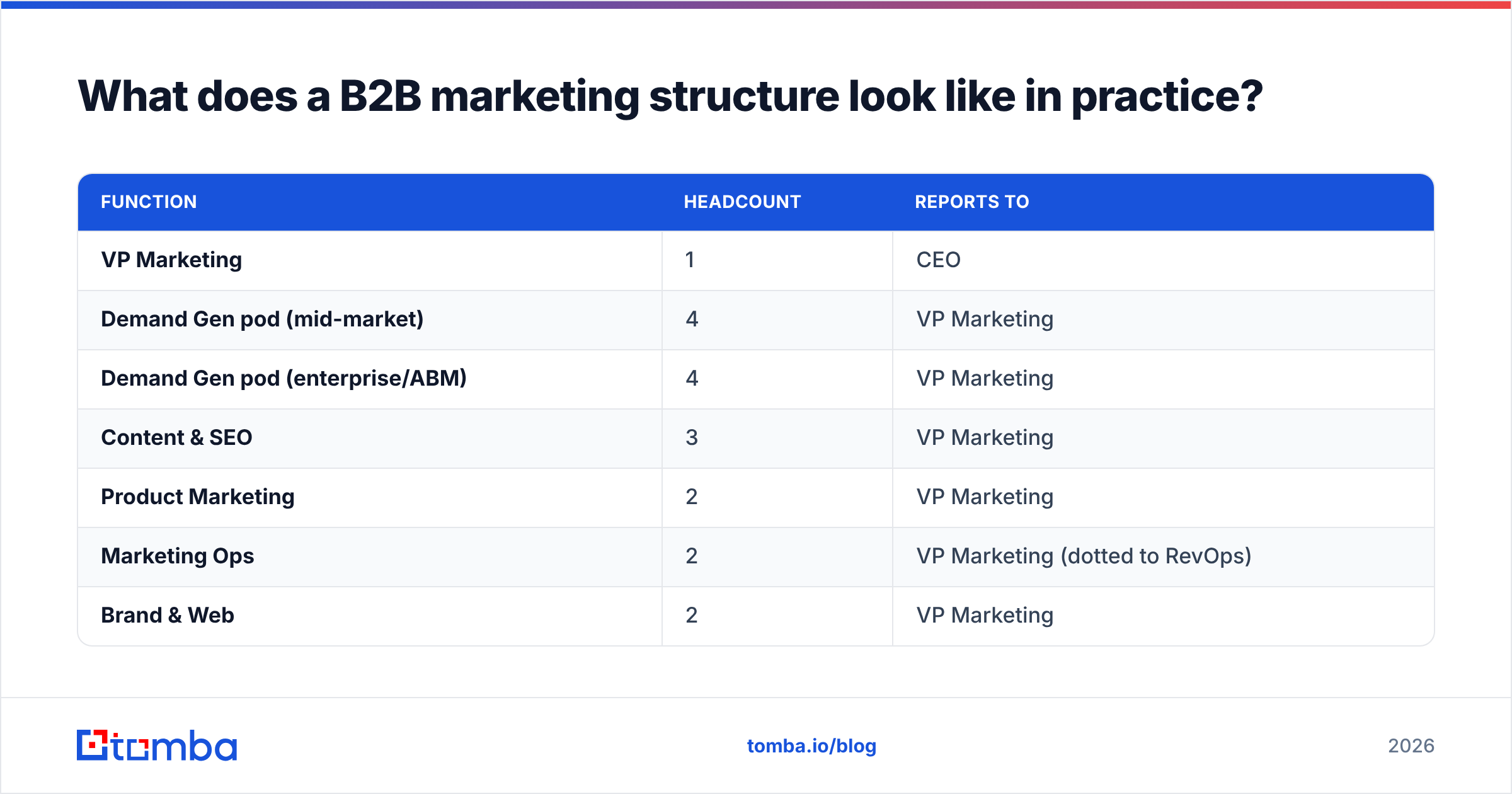
Here is a concrete example: a $12M ARR B2B SaaS company, sales-led with a light PLG motion, ~18 marketers.
| Function | Headcount | Reports to |
|---|---|---|
| VP Marketing | 1 | CEO |
| Demand Gen pod (mid-market) | 4 | VP Marketing |
| Demand Gen pod (enterprise/ABM) | 4 | VP Marketing |
| Content & SEO | 3 | VP Marketing |
| Product Marketing | 2 | VP Marketing |
| Marketing Ops | 2 | VP Marketing (dotted to RevOps) |
| Brand & Web | 2 | VP Marketing |
The two demand pods each own a segment end-to-end, content and PMM operate as shared services feeding both pods, and ops sits underneath everything with a dotted line into a cross-functional RevOps team shared with sales. This is the pod model in its natural habitat — fast enough to ship segment campaigns weekly, structured enough that brand and messaging stay consistent.
The data layer underneath this chart matters as much as the boxes. Both demand pods pull target-account lists, enrich them, and verify contacts before any outreach goes out. That is where a bulk email finder and clean enrichment workflow quietly determine whether the enterprise pod's ABM plays actually reach a human or die in a spam folder.
Common B2B marketing structure mistakes to avoid#
- Hiring specialists before product-market fit. A growth or brand specialist with nothing proven to scale burns budget and morale.
- Measuring activity, not pipeline. If your structure rewards MQL volume, you'll get junk leads and an angry sales team.
- Treating ops and data as an afterthought. Dirty data quietly breaks every model. Verification and enrichment are infrastructure, not nice-to-haves.
- Copying a later-stage company's org chart. A 200-person marketing structure applied to a 15-person team creates queues and politics with no upside.
- Letting pods drift on brand. Speed is the pod model's gift; inconsistency is its tax. A light central brand/PMM layer keeps it in check.
Frequently asked questions#
What is the best B2B marketing team structure for a startup? A single full-stack marketer who can run demand and content, supported by contractors for design and paid. Don't build a department before you've found a repeatable channel.
When should I switch from a functional to a pod structure? Around 15 marketers, or whenever cross-team campaigns consistently stall because no single person owns a customer segment end to end.
Does marketing operations belong under marketing or RevOps? Both. MOps should report into marketing for day-to-day execution but share a dotted line into a cross-functional RevOps team that owns the CRM and shared reporting.
How do I keep brand consistent in a pod model? Keep brand, design, and product marketing as shared services that serve every pod, rather than embedding a separate brand person inside each one.
Build the structure on data that actually works#
A marketing org chart is only as strong as the data flowing through it. The cleanest pod model in the world still misfires if your contact records are guessed, stale, or undeliverable. Before you redraw boxes, fix the inputs: enrich your target accounts, verify every address, and give each pod a database it can trust.
Tomba's Email Finder gives your demand and ABM pods verified, professional email addresses by domain, name, or company — so the structure you build actually reaches the people it's designed to convert. Start on the free tier (25 searches a month), then scale into the Starter plan at $49/mo as your pods spin up. Get the data layer right, and every model in this guide works better.
// get started
Find, verify and enrich your first contacts today
Start on the free plan with 25 searches a month, then scale when your team is ready.
Free plan · No credit card required · GDPR & CCPA
// about the author