B2B Marketing Tech Stack in 2026: Build vs Buy Guide
Most B2B marketing tech stacks are bloated, overlapping, and underused. Here's how to design a lean 2026 stack that actually drives pipeline.
TL;DR
- A B2B marketing tech stack is the connected set of tools you use to attract, capture, enrich, nurture, and measure demand — not a random pile of subscriptions.
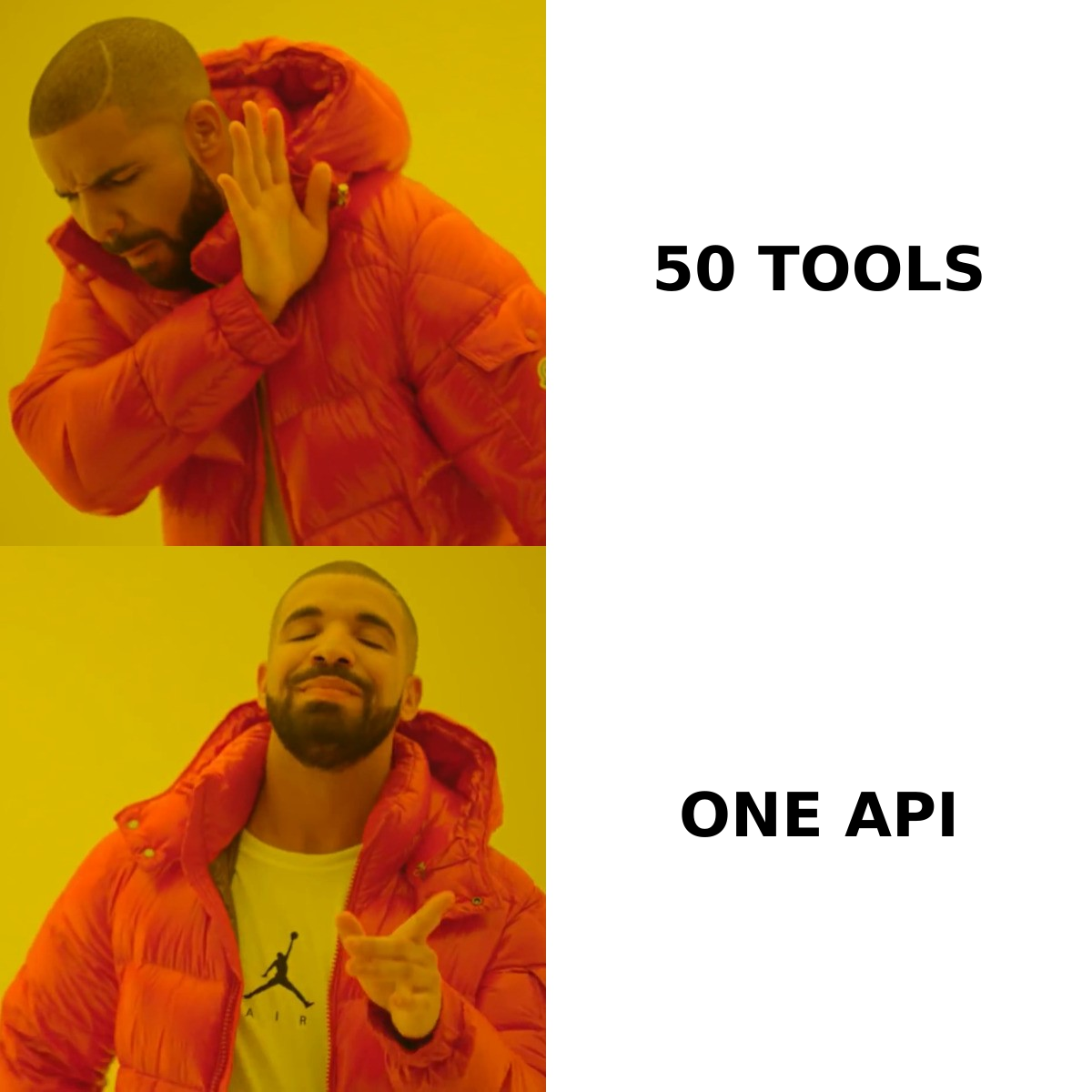
- The average mid-market team pays for 30–50 tools and actively uses fewer than half. Overlap, not capability gaps, is the real budget leak.
- Build your stack in five layers: data foundation, capture, engagement, orchestration, and measurement. Get the data layer right first or everything downstream inherits the rot.
- Buy for commodity functions (email, CRM, analytics); build or use APIs for the parts that are your competitive edge.
- Clean contact data is the cheapest performance lever you have. A $49/mo data layer beats a $2,000/mo automation suite firing at bad addresses.
What is a B2B marketing tech stack?#
A B2B marketing tech stack is the collection of software your team uses to run demand generation end to end: finding accounts, capturing contacts, enriching records, running campaigns, scoring leads, and reporting on what worked. Think of it like a kitchen. The CRM is your pantry, the email platform is the stove, and your data tools are the ingredients. You can own the most expensive range on the market, but if the ingredients are spoiled, dinner is still bad.
The mistake most teams make is buying appliances before they fix the ingredients. They layer on a sequencer, an intent platform, a chatbot, and a conversational-AI add-on while their core contact database is 30% stale. According to Gartner research on martech, utilization of owned marketing technology has hovered around a third for years — meaning two-thirds of what you pay for sits idle.
So before we talk tools, fix the mental model: a stack is a system, and systems are only as strong as the data flowing through them.
What are the layers of a modern stack?#
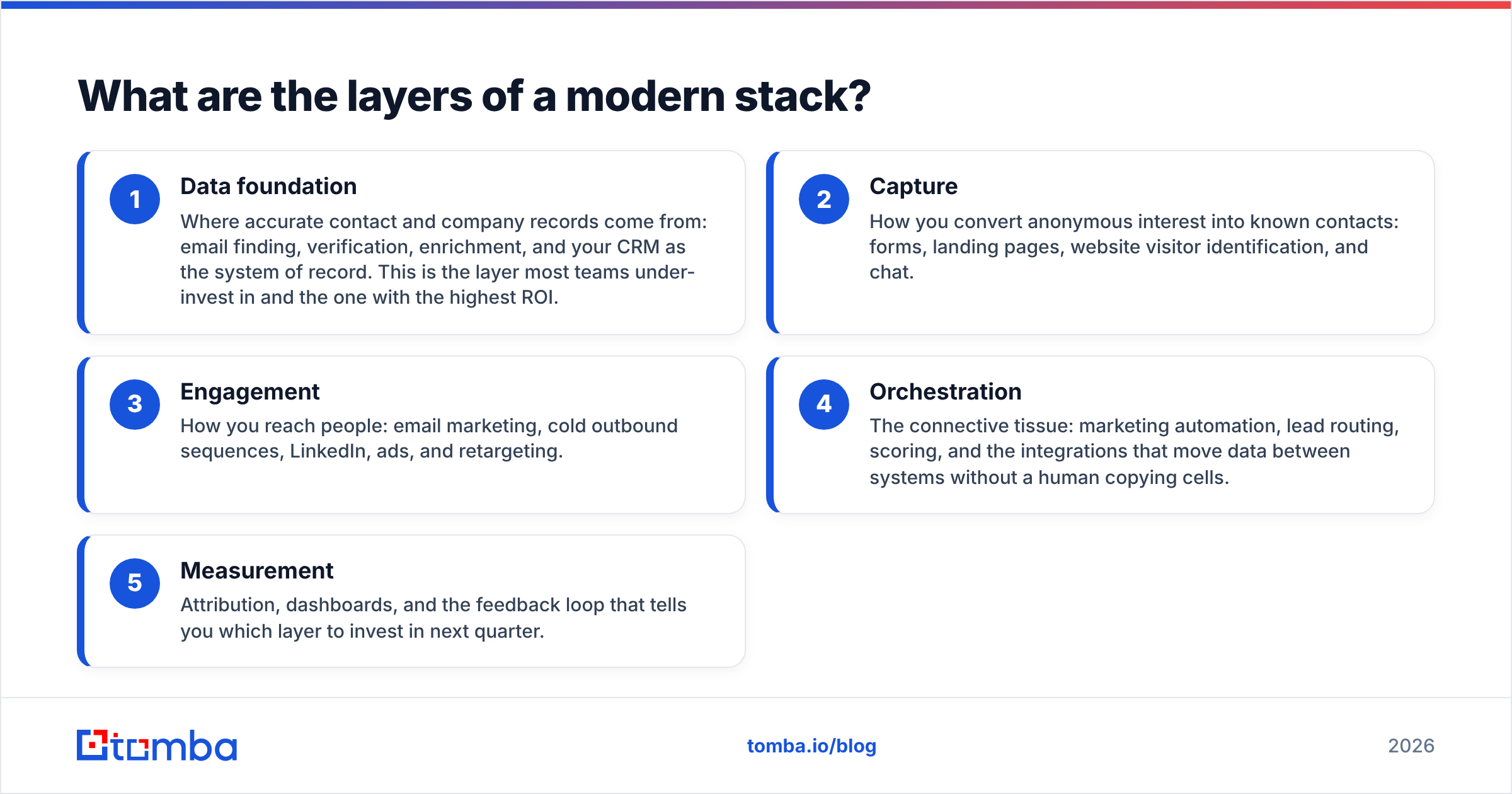
Every effective 2026 stack maps to five layers. Tools can span more than one, but each layer has a job, and skipping one creates a gap a vendor will happily sell you three products to fill.
- Data foundation — Where accurate contact and company records come from: email finding, verification, enrichment, and your CRM as the system of record. This is the layer most teams under-invest in and the one with the highest ROI.
- Capture — How you convert anonymous interest into known contacts: forms, landing pages, website visitor identification, and chat.
- Engagement — How you reach people: email marketing, cold outbound sequences, LinkedIn, ads, and retargeting.
- Orchestration — The connective tissue: marketing automation, lead routing, scoring, and the integrations that move data between systems without a human copying cells.
- Measurement — Attribution, dashboards, and the feedback loop that tells you which layer to invest in next quarter.
Here is the trap: vendors price themselves as "platforms" that promise to cover three or four layers at once. Sometimes that consolidation is genuinely better. Often it locks you into a mediocre version of each function. The skill is knowing which layers to consolidate and which to keep best-of-breed.
How do I choose tools without overspending?#
Start from the layer, not the logo. For each function ask three questions: Is this commodity or competitive edge? Will the data leave the tool cleanly? What does it cost per active seat at our real usage, not the demo's usage?
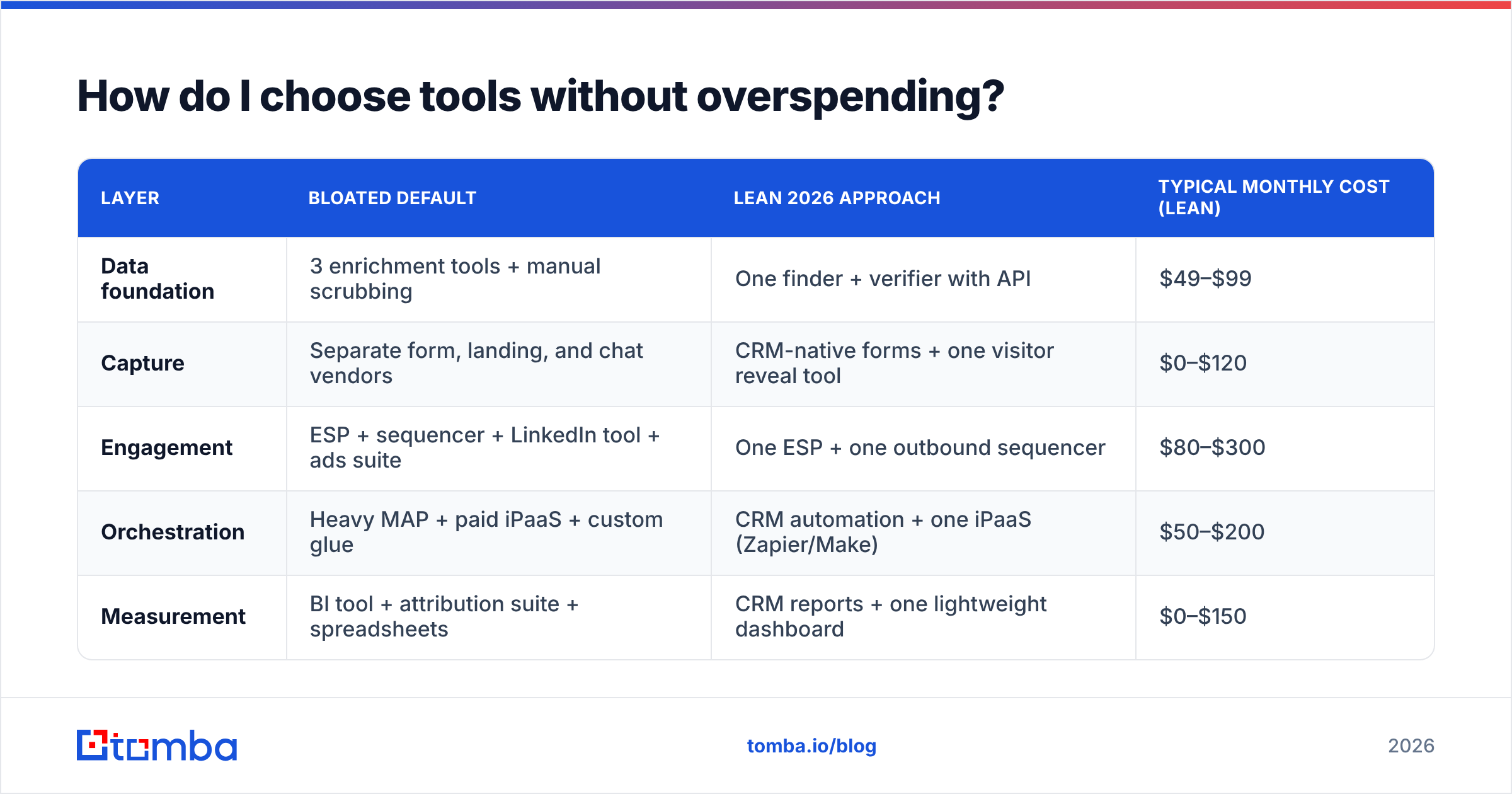
The table below shows how a lean stack compares to the bloated default most teams drift into.
| Layer | Bloated default | Lean 2026 approach | Typical monthly cost (lean) |
|---|---|---|---|
| Data foundation | 3 enrichment tools + manual scrubbing | One finder + verifier with API | $49–$99 |
| Capture | Separate form, landing, and chat vendors | CRM-native forms + one visitor reveal tool | $0–$120 |
| Engagement | ESP + sequencer + LinkedIn tool + ads suite | One ESP + one outbound sequencer | $80–$300 |
| Orchestration | Heavy MAP + paid iPaaS + custom glue | CRM automation + one iPaaS (Zapier/Make) | $50–$200 |
| Measurement | BI tool + attribution suite + spreadsheets | CRM reports + one lightweight dashboard | $0–$150 |
Notice the data foundation is the cheapest line and the one everything else depends on. That is not a coincidence — it is the highest-leverage place to spend first. A well-run data enrichment and verification layer means your expensive engagement tools fire at real people, which quietly lifts every downstream metric.
When evaluating any vendor, cross-check real buyer reviews on G2 rather than trusting the sales deck. Pay attention to complaints about data export limits and contract lock-in — those are the costs that don't show up until renewal.
Build vs buy: where should you draw the line?#
Buy the commodity layers. Build (or use APIs for) the edge.
Email delivery, CRM, and analytics are solved problems with mature vendors — buying is almost always right. You will not out-engineer HubSpot on a CRM, and trying to is a waste of headcount.
The data foundation is where "build vs buy" gets interesting. You don't build an email database from scratch, but you do want programmatic control over how contact data enters your systems. That is why API-first data tools matter: instead of a human running lookups in a dashboard, your stack enriches records automatically the moment a form is submitted or a visitor is identified. The Tomba API and Tomba MCP let you wire email finding and verification directly into your capture and orchestration layers, so enrichment happens in the pipeline rather than as a weekly manual chore.
This is the difference between a stack that scales and one that needs a full-time "ops person" to babysit CSV exports.
Which tools actually belong in each layer?#
Concrete picks beat abstractions, so here is a defensible lean stack you could stand up this quarter. Substitute equivalents where you already have contracts.
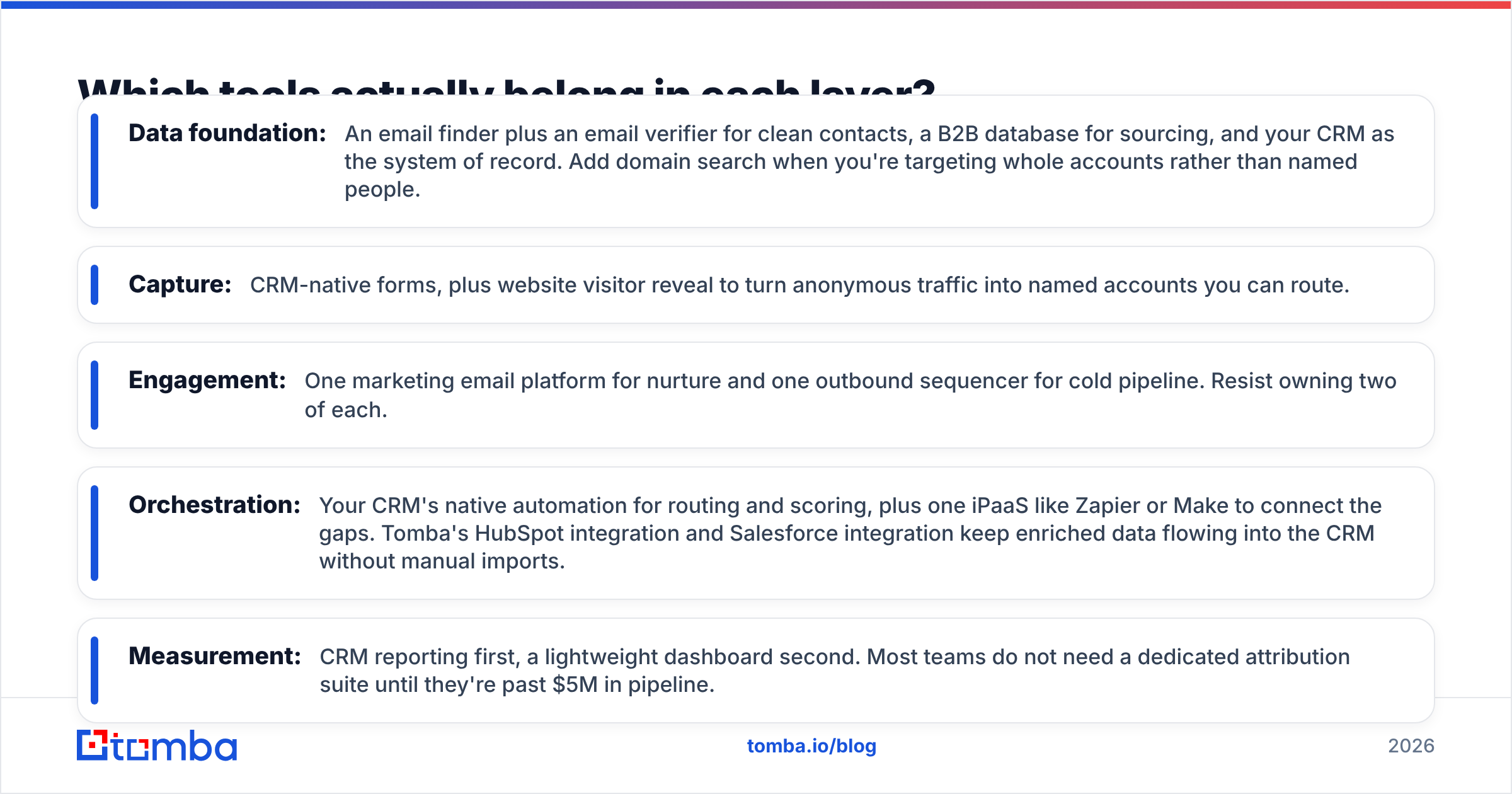
- Data foundation: An email finder plus an email verifier for clean contacts, a B2B database for sourcing, and your CRM as the system of record. Add domain search when you're targeting whole accounts rather than named people.
- Capture: CRM-native forms, plus website visitor reveal to turn anonymous traffic into named accounts you can route.
- Engagement: One marketing email platform for nurture and one outbound sequencer for cold pipeline. Resist owning two of each.
- Orchestration: Your CRM's native automation for routing and scoring, plus one iPaaS like Zapier or Make to connect the gaps. Tomba's HubSpot integration and Salesforce integration keep enriched data flowing into the CRM without manual imports.
- Measurement: CRM reporting first, a lightweight dashboard second. Most teams do not need a dedicated attribution suite until they're past $5M in pipeline.
That's roughly five to seven core tools — not fifty. If a proposed addition doesn't clearly own a job no current tool does, it's overlap.
How does data quality affect the whole stack?#
Bad data doesn't stay in one layer — it compounds. A wrong email address costs you a send, then a skewed open rate, then a misfired lead score, then a rep's wasted hour, then a polluted attribution report. One stale record taxes all five layers.
This is why revenue operations teams obsess over data hygiene. The math is brutal and simple: if 20% of your contacts are invalid, every per-contact cost in your stack is effectively 25% higher than it looks, and every rate-based metric is quietly wrong.
The fix is unglamorous. Verify before you send. Enrich at the point of capture. Deduplicate on a schedule. Use a bulk email finder and verifier to clean lists in batches rather than discovering dead addresses one bounce at a time. None of this is expensive — a clean data layer typically costs less than a single mid-tier seat of your engagement platform — and it makes everything above it perform better without changing a single campaign.
A practical rule: spend your first stack dollar on data accuracy, your last on another dashboard. Teams do the reverse and wonder why their expensive martech "isn't working."
How do I keep the stack lean over time?#
Stacks bloat the same way closets do — one reasonable purchase at a time. Run a quarterly audit with three columns: tool, the single job it owns, and active-seat usage last 90 days. Any tool that can't name a unique job, or shows under 40% usage, is a cut candidate or a consolidation target.
Watch for these specific bloat patterns:
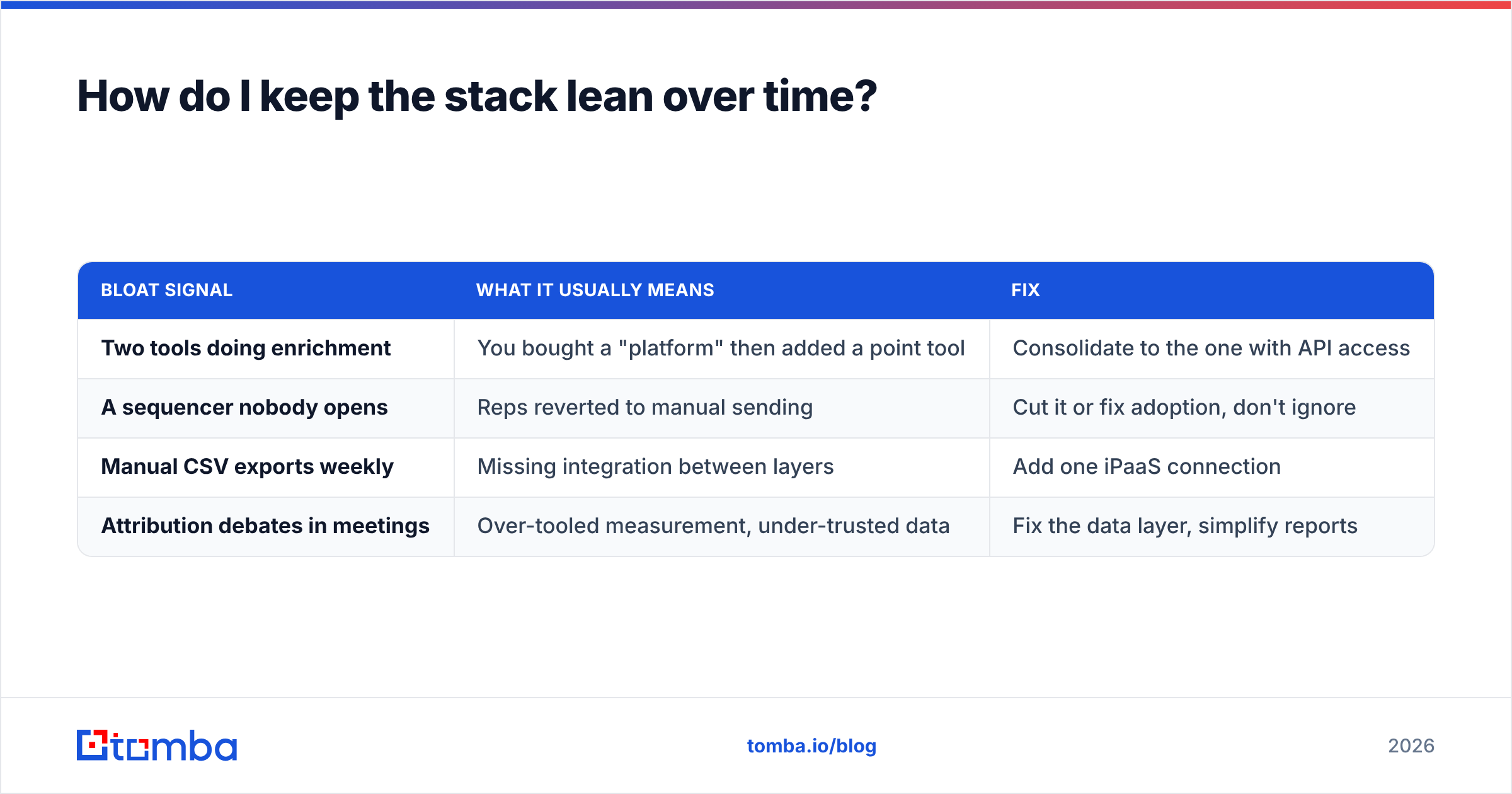
| Bloat signal | What it usually means | Fix |
|---|---|---|
| Two tools doing enrichment | You bought a "platform" then added a point tool | Consolidate to the one with API access |
| A sequencer nobody opens | Reps reverted to manual sending | Cut it or fix adoption, don't ignore |
| Manual CSV exports weekly | Missing integration between layers | Add one iPaaS connection |
| Attribution debates in meetings | Over-tooled measurement, under-trusted data | Fix the data layer, simplify reports |
The discipline isn't buying less — it's making each tool earn its renewal. A lean stack with clean data and tight integrations will out-perform a sprawling one every quarter, because the team actually understands and uses it.
If you want to benchmark your current tools or replace an overpriced one, our Apollo alternative and Clearbit alternative breakdowns show how to swap a bundled platform for a leaner data layer without losing coverage. And before you renew anything, check the Tomba pricing tiers against your per-contact math — the comparison is often more lopsided than buyers expect.
What does a good 2026 stack look like in practice?#
Picture a 12-person revenue team. Their data foundation is one finder-plus-verifier feeding HubSpot via API. Capture runs on native forms and visitor reveal. Engagement is a single ESP for nurture and one sequencer for outbound. Orchestration is HubSpot automation plus Make for the two integrations the CRM doesn't cover. Measurement is HubSpot reports with one dashboard for the exec team.
Total: six core tools, every record verified at entry, no weekly CSV ritual, and a budget under what most teams pay for enrichment alone. That's the goal — not the most tools, the fewest tools that fully cover all five layers with clean data moving between them.
The teams that win in 2026 aren't the ones with the biggest stack. They're the ones whose stack they can explain on a single whiteboard.
Start with the layer that pays for itself#
If you only fix one thing this quarter, fix the data foundation. It's the cheapest layer, it determines the ceiling on every other layer's performance, and it's the easiest to get wrong by neglect. Clean contacts in means clean pipeline out.
Tomba's Email Finder is built to be exactly that foundation — find verified professional emails by name, company, or domain, then push them straight into your CRM through the API or a native integration. Start free with 25 searches a month, scale to the Starter plan at $49/mo when you're ready to run volume, and let every other tool in your stack inherit data it can actually trust. Build the foundation first; the rest of the stack gets easier from there.
// get started
Find, verify and enrich your first contacts today
Start on the free plan with 25 searches a month, then scale when your team is ready.
Free plan · No credit card required · GDPR & CCPA
// about the author