B2B Meaning in 2026: What Business-to-Business Really Is
The full B2B meaning for 2026: how business-to-business works, how it differs from B2C, the buying process, the stack, and why clean data wins deals.
TL;DR
- B2B meaning: business-to-business — companies selling products or services to other companies rather than to individual consumers.
- B2B deals are bigger, slower, and decided by buying committees, not single shoppers — which changes everything about how you sell.
- The B2B model spans manufacturers, wholesalers, SaaS vendors, agencies, and professional services.
- The modern B2B stack is CRM + outreach + enrichment, and it only works when the contact data underneath is accurate.
- Accurate, verified contact data is the difference between a pipeline and a spam folder.
What does B2B actually mean?#
B2B meaning, in one line: business-to-business is any commercial relationship where one company sells to another company instead of to an individual consumer. When a software firm sells a project-management tool to a 500-person logistics company, that is B2B. When the same logistics company buys steel shelving from a warehouse-equipment supplier, that is also B2B.
Think of it like wholesale versus retail at the corner market. The farmer who sells crates of apples to the grocery store is doing business-to-business. The shopper who buys three apples is the business-to-consumer (B2C) transaction. Same apple, completely different sale: different volume, different pricing, different decision-makers, and a different relationship.
Technically, B2B describes a transaction model and an entire ecosystem of companies, tools, and processes built around selling to organizations. According to Gartner and most enterprise research, the typical B2B purchase now involves six to ten stakeholders — which is why "selling to a company" never means selling to one person.
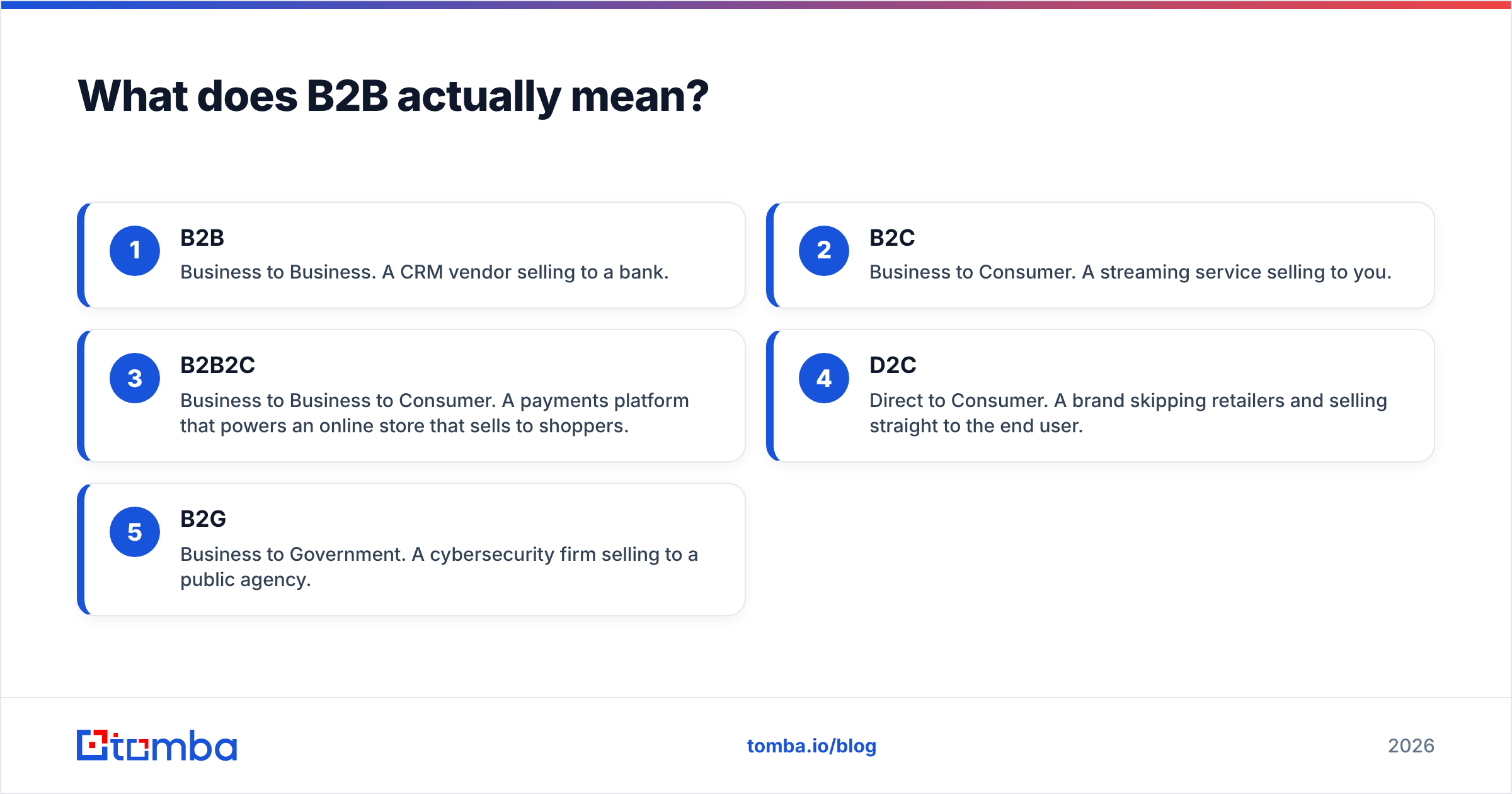
The acronym sits next to a few cousins you will see constantly:
- B2B — Business to Business. A CRM vendor selling to a bank.
- B2C — Business to Consumer. A streaming service selling to you.
- B2B2C — Business to Business to Consumer. A payments platform that powers an online store that sells to shoppers.
- D2C — Direct to Consumer. A brand skipping retailers and selling straight to the end user.
- B2G — Business to Government. A cybersecurity firm selling to a public agency.
How is B2B different from B2C?#
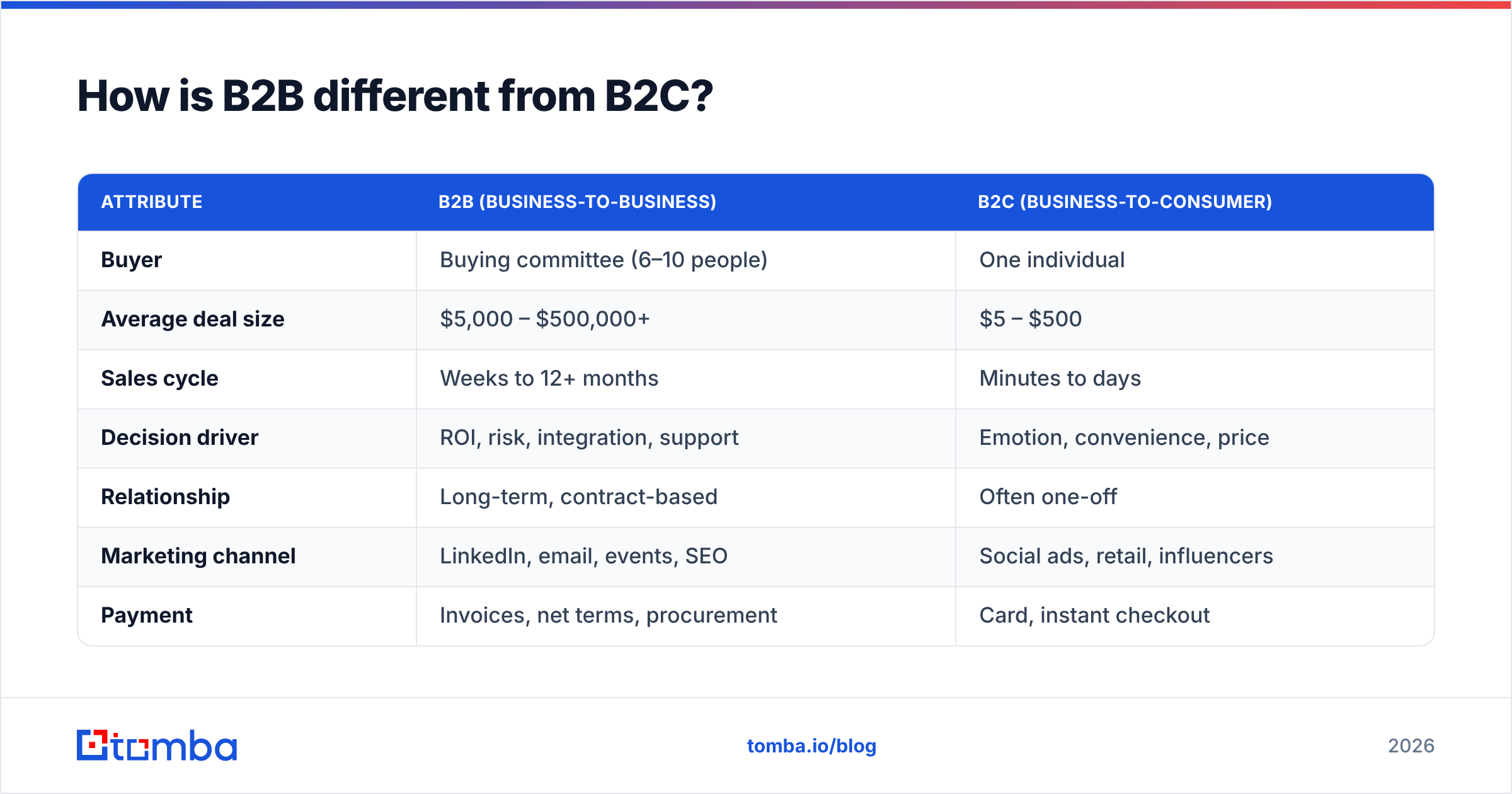
The short answer: B2B sales are higher in value, longer in cycle, and driven by logic and ROI more than impulse. A consumer buys running shoes in five minutes. A procurement team buys a payroll platform over five months, with legal, finance, and IT all weighing in.
Here is the practical breakdown:
| Attribute | B2B (Business-to-Business) | B2C (Business-to-Consumer) |
|---|---|---|
| Buyer | Buying committee (6–10 people) | One individual |
| Average deal size | $5,000 – $500,000+ | $5 – $500 |
| Sales cycle | Weeks to 12+ months | Minutes to days |
| Decision driver | ROI, risk, integration, support | Emotion, convenience, price |
| Relationship | Long-term, contract-based | Often one-off |
| Marketing channel | LinkedIn, email, events, SEO | Social ads, retail, influencers |
| Payment | Invoices, net terms, procurement | Card, instant checkout |
The takeaway is not that one is harder — it is that they reward different skills. B2C wins on scale and brand. B2B wins on relationships, precise targeting, and getting the right message to the right person at the right account. That last part is where most teams quietly lose, because they target the right company but the wrong contact, or the right contact with a dead email.
)
What are the main types of B2B companies?#
"B2B" is an umbrella over several distinct business models. Knowing which one you are — or which one you are selling to — shapes the entire go-to-market motion.
- Manufacturers and producers. They make goods sold to other businesses: components, raw materials, machinery. Long relationships, contract pricing, slow to switch vendors.
- Wholesalers and distributors. The middle layer that buys in bulk and resells to retailers or other businesses. Margin-thin, volume-driven, relationship-heavy.
- SaaS and software vendors. The fastest-growing B2B category. Recurring revenue, product-led or sales-led, and obsessed with retention and expansion.
- Agencies and professional services. Consultancies, marketing agencies, law and accounting firms. They sell expertise and time, so trust and referrals dominate.
- Marketplaces and platforms. Companies connecting businesses to other businesses — think procurement marketplaces or B2B fintech rails.
If you want the textbook framing, Wikipedia's business-to-business entry is a clean reference. But in practice, the model you operate determines your sales cycle, your margins, and how much your growth depends on outbound prospecting versus inbound demand.
How does the B2B buying process actually work?#
The B2B buyer journey is rarely a straight line. HubSpot's research and most modern GTM frameworks describe it as a loop of problem definition, solution exploration, and validation that the buying committee runs through — often re-entering earlier stages as new stakeholders join.
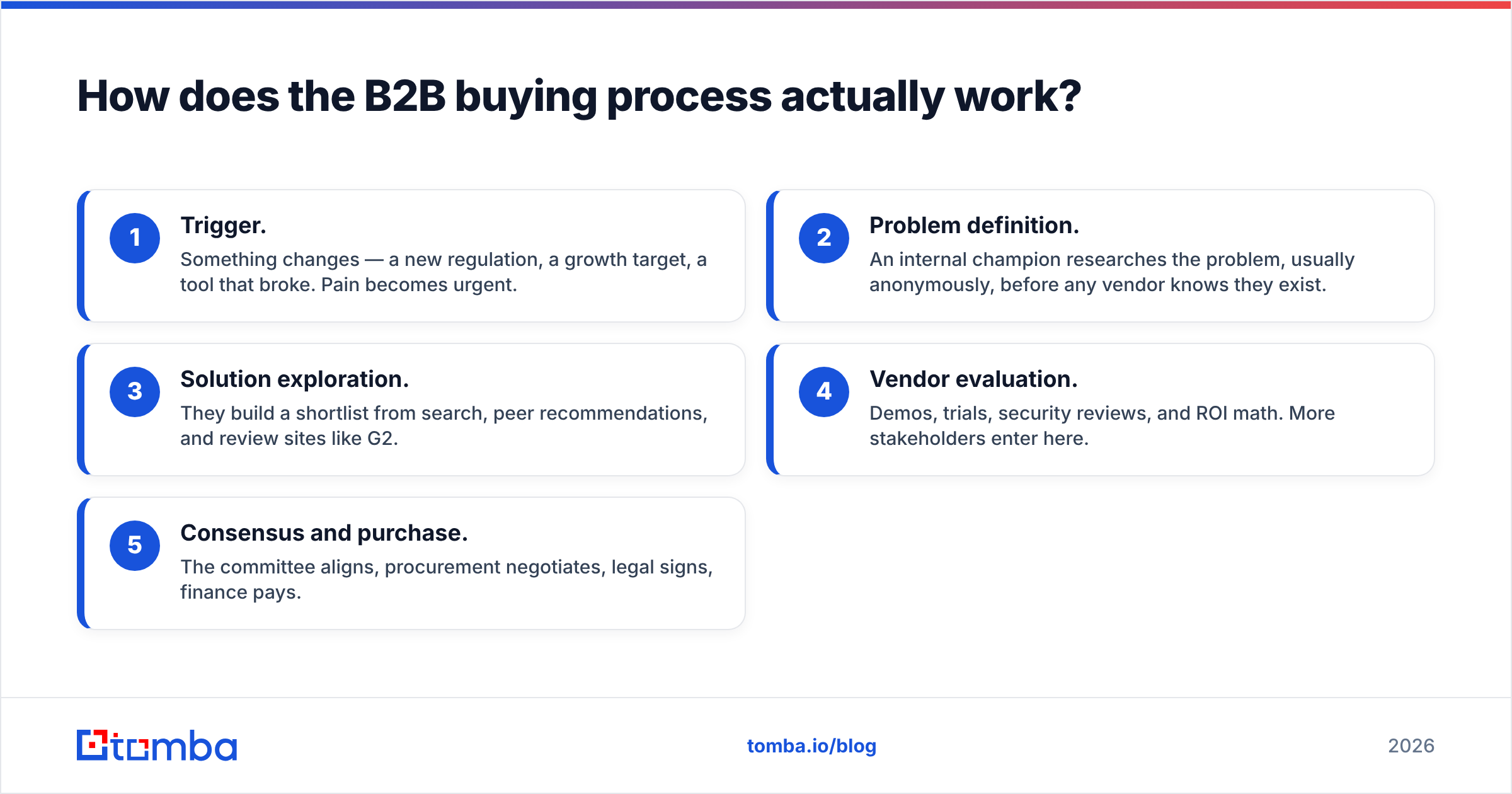
A realistic flow looks like this:
- Trigger. Something changes — a new regulation, a growth target, a tool that broke. Pain becomes urgent.
- Problem definition. An internal champion researches the problem, usually anonymously, before any vendor knows they exist.
- Solution exploration. They build a shortlist from search, peer recommendations, and review sites like G2.
- Vendor evaluation. Demos, trials, security reviews, and ROI math. More stakeholders enter here.
- Consensus and purchase. The committee aligns, procurement negotiates, legal signs, finance pays.
For sellers, the lesson is blunt: by the time a prospect raises a hand, much of the decision is already formed. That is why proactive outbound — reaching the right accounts before they start searching — remains a core B2B muscle, and why the quality of your contact data sets a ceiling on everything downstream.
What does a modern B2B sales and marketing stack look like?#
A modern B2B engine is three layers stacked on top of clean data: a system of record, an activation layer, and a data layer that feeds both.
- System of record (CRM). HubSpot, Salesforce, or Pipedrive — where accounts, contacts, and deals live. This is your single source of truth for revenue operations.
- Activation layer. Outreach tools, sequencers, LinkedIn automation, and ad platforms that put your message in front of buyers.
- Data and enrichment layer. This is the foundation everything else stands on. If the email is wrong, the sequence bounces; if the title is stale, the personalization misfires; if the account data is thin, scoring is guesswork.
That third layer is where teams overspend on big "all-in-one" platforms and still get bad results — because broad databases go stale fast. The smarter play in 2026 is a focused, accurate source: use a domain search to map every contact at a target account, an email finder to get the specific decision-maker, and data enrichment to fill the gaps in your CRM. Get the data layer right and the rest of the stack actually performs.
)
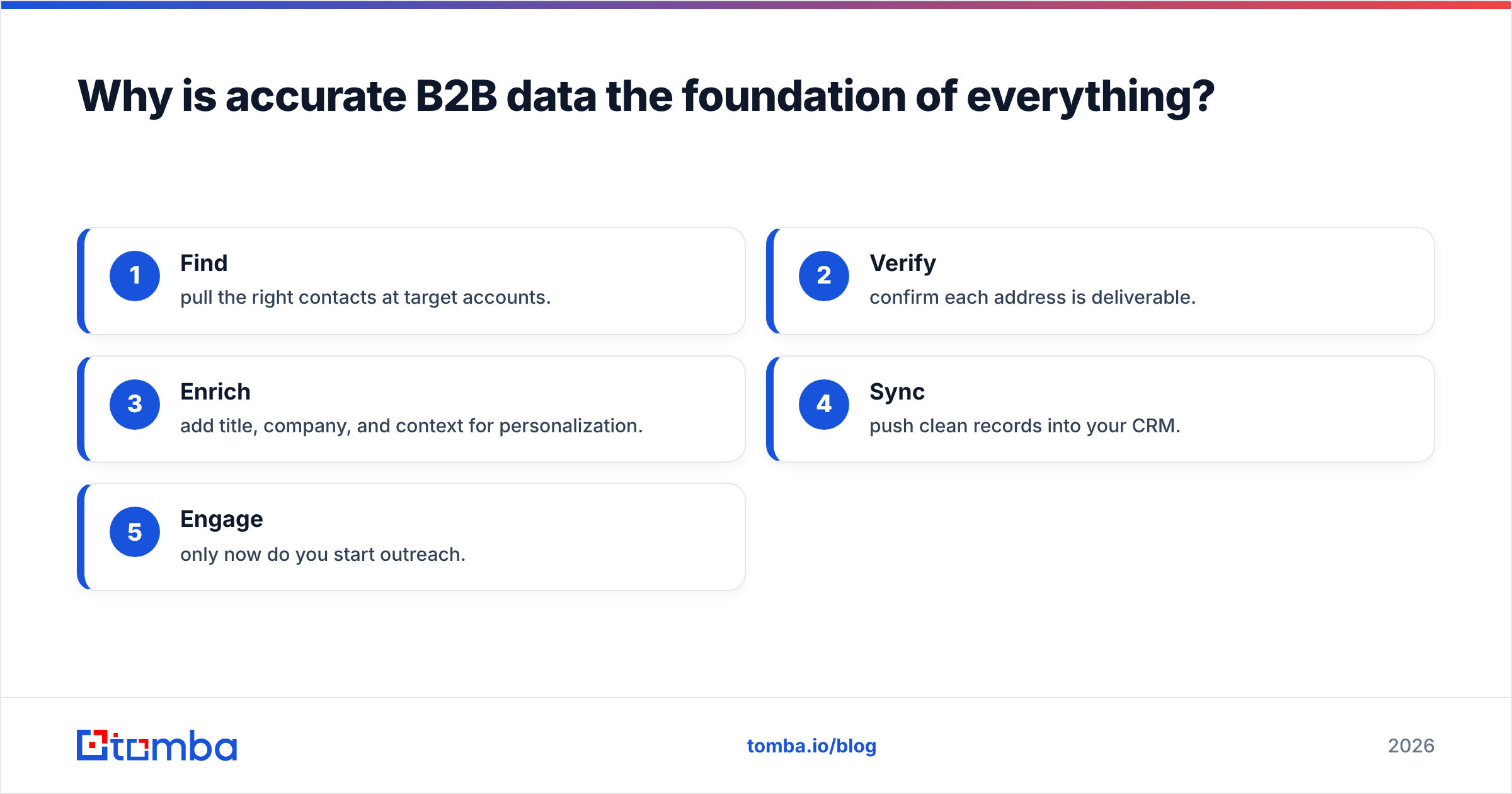
Why is accurate B2B data the foundation of everything?#
Because in B2B, you cannot sell to a company you cannot reach — and reaching the wrong person, or a person whose email bounces, costs you more than just a lost email. It damages your sender reputation, which quietly tanks deliverability for every future campaign.
Consider the math. If your list is 20% inaccurate and you send 1,000 cold emails, 200 bounce. A bounce rate that high signals mailbox providers that you might be a spammer, and your good emails start landing in spam too. Now your accurate contacts never see you either. One bad data set poisons the whole channel.
This is why verification is not optional. Before a single sequence goes out, run your list through an email verifier to drop invalid and risky addresses. The pattern that wins:
- Find — pull the right contacts at target accounts.
- Verify — confirm each address is deliverable.
- Enrich — add title, company, and context for personalization.
- Sync — push clean records into your CRM.
- Engage — only now do you start outreach.
Skip step two and you are building a pipeline on sand. The teams that compound results in B2B treat data hygiene as a continuous process, not a one-time import.
How do you get started with B2B prospecting?#
Start narrow, prove the motion, then scale. The most common mistake is buying a 50,000-record list and blasting it. The second most common is targeting the right companies but guessing at contacts.
A clean starting workflow:
- Define your ICP. Industry, company size, region, and the exact job titles that own the problem you solve. Specific beats broad.
- Build the account list. Pull 50–100 target companies you can actually serve well.
- Map the contacts. Use domain search to find everyone relevant at each account, then narrow to the buying committee.
- Verify before you send. Always. A small verified list outperforms a large dirty one every time.
- Personalize at the account level. Reference the company's actual situation, not a mail-merge first name.
- Measure and tighten. Track reply rate by segment and double down on what converts.
If you are weighing tools, compare on accuracy and verification first, then price. You can review Tomba pricing against alternatives, but the real test is bounce rate on a sample list — run it before you commit budget. Cheap data that bounces is the most expensive data you will ever buy.
What are common B2B mistakes to avoid?#
- Treating B2B like B2C. Impulse tactics and discount urgency do not move a buying committee. Lead with ROI and risk reduction.
- Selling to one person. You need a champion, but you also need to arm them to sell internally to finance, IT, and legal.
- Ignoring data decay. B2B contacts change jobs constantly — roughly 30% of a database goes stale each year. Re-verify regularly.
- Over-automating too early. Automation amplifies whatever you point it at. Point it at bad data and you scale the damage.
- Skipping verification to save time. This is the costliest shortcut in outbound. It is also the easiest to fix.
Frequently asked questions#
What is the simplest B2B meaning? Business-to-business: one company selling to another company instead of to individual consumers.
Is SaaS B2B or B2C? It can be either. Slack selling to companies is B2B; a personal note-taking app selling to individuals is B2C. Many products do both.
Why are B2B sales cycles so long? Because purchases are high-value and decided by committees that must align finance, IT, legal, and end users — each adding evaluation time.
What is the most important part of B2B sales? Reaching the right decision-maker with accurate, verified data. Everything downstream depends on it.
The bottom line#
B2B means selling to organizations — and that one fact reshapes your deal size, your sales cycle, your stack, and above all your dependence on accurate contact data. You can have the best product and the sharpest messaging, but if you cannot reliably reach the right person at the right account, none of it ships revenue.
That is exactly the problem the Tomba Email Finder is built to solve. Find verified, decision-maker emails by name, company, or domain, then push clean records straight into your CRM — so your B2B outreach lands in inboxes instead of bouncing. Start free with 25 searches a month, and scale to a Starter plan at $49/mo when your pipeline does. In B2B, the data layer is the foundation. Build it right.
Ready to find emails that actually work?
Join 150,000+ professionals who stopped guessing and started sending. Free credits on signup — no credit card required.
Get the Tomba newsletter
Practical outbound tactics and product updates — once every two weeks.
About the author