B2B Messaging in 2026: Frameworks That Get Replies
Most B2B messaging gets ignored because it talks about the seller, not the buyer. Here are the frameworks, channels, and metrics that actually earn replies in 2026.
B2B Messaging in 2026: Frameworks That Get Replies
Most B2B messaging fails for one boring reason: it talks about the sender instead of the buyer. You can fix tooling, add channels, and hire more reps, but if the core message is generic, every dollar you spend just scales the noise.
This guide breaks down what B2B messaging actually is, the frameworks that move pipeline, the channel mix that works in 2026, and the data hygiene that decides whether any of it lands.
TL;DR#
- B2B messaging is the coordinated set of statements you make about value, fit, and proof across every channel a buyer touches — not just your cold email opener.
- Buyer-centric beats clever. Messages framed around the prospect's problem out-reply self-promotional pitches by a wide margin.
- Channel mix matters more than channel choice. Email, LinkedIn, and phone reinforce each other when the message stays consistent.
- Bad data kills good copy. A perfect message sent to a wrong or unverified address never gets read — accuracy is upstream of everything.
- Measure replies and meetings, not opens. Opens are vanity in 2026; positive-reply rate and meetings booked are the signals that predict revenue.
What is B2B messaging?#
B2B messaging is the full system of claims, proof points, and calls to action your company communicates to a business buyer across channels — email, LinkedIn, phone, ads, and your website. Think of it like a restaurant: the menu, the host's greeting, the plating, and the follow-up check-in all have to tell the same story. If the menu promises fine dining and the host is rude, the experience breaks. Same with messaging — one inconsistent channel undercuts the rest.
Technically, B2B messaging splits into three layers:
- Positioning — who you help and the category you compete in. This is the foundation; everything else inherits from it.
- Value messaging — the specific outcomes a buyer gets, framed in their language, not your feature list.
- Outreach messaging — the channel-level execution: subject lines, openers, LinkedIn connection notes, voicemail scripts.
Most teams obsess over layer three and ignore layers one and two. That's why their copy reads fluent but converts poorly. A sharp opener built on weak positioning is a fast car with no road.

Why does most B2B messaging get ignored?#
Because it fails a simple test: would the buyer forward this to a colleague? If the answer is no, the message is about you.
Here are the recurring failure modes worth auditing your own messaging against:
- Feature-first openers. "We're an AI-powered platform that..." The buyer doesn't care what you are; they care what changes for them.
- Fake personalization. Inserting
{{first_name}}and the company name is table stakes, not personalization. Real relevance references a trigger — a hire, a funding round, a tech-stack change. - No clear next step. "Let me know if you're interested" puts all the work on the buyer. A specific, low-friction ask converts better.
- Wrong person, wrong time. Even flawless copy fails if it lands in the inbox of someone with no budget or authority.
- Channel mismatch. A 300-word pitch as a LinkedIn connection note reads as desperation; the same content as a nurture email reads as helpful.
The fix is structural, not cosmetic. Tighten positioning, lead with the buyer's problem, and make sure the contact data behind the send is accurate before you worry about word choice.
What B2B messaging frameworks actually work?#
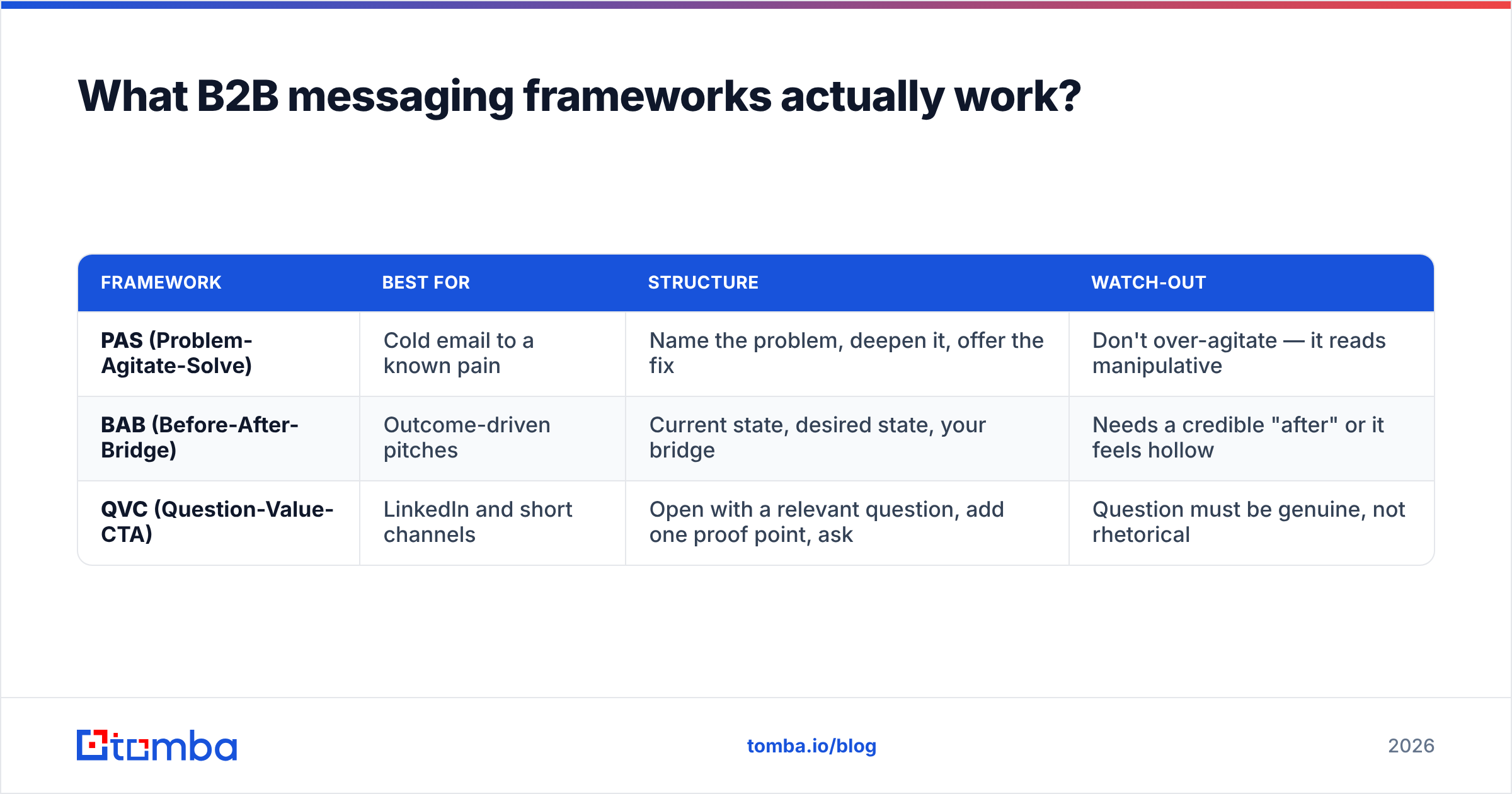
A framework is just a repeatable skeleton so your reps don't reinvent structure on every send. The three below cover most outbound and nurture scenarios. Pick one per message — mixing them dilutes the point.
| Framework | Best for | Structure | Watch-out |
|---|---|---|---|
| PAS (Problem-Agitate-Solve) | Cold email to a known pain | Name the problem, deepen it, offer the fix | Don't over-agitate — it reads manipulative |
| BAB (Before-After-Bridge) | Outcome-driven pitches | Current state, desired state, your bridge | Needs a credible "after" or it feels hollow |
| QVC (Question-Value-CTA) | LinkedIn and short channels | Open with a relevant question, add one proof point, ask | Question must be genuine, not rhetorical |
The common thread: every framework starts with the buyer's reality and ends with a single, specific ask. None of them open with your company's origin story.
A practical sequencing tip — use different frameworks across a multi-touch sequence so each message feels fresh. Touch one might be PAS, touch three a short QVC nudge, touch five a BAB case-study angle. Repetition of the same structure is what makes sequences feel robotic. For more on multi-touch structure, see how a tight response rate depends on cadence as much as copy.
How should you mix channels in 2026?#
Conclusion first: no single channel wins anymore — the buyers who reply are the ones touched consistently across two or three. The message stays the same; the format adapts.
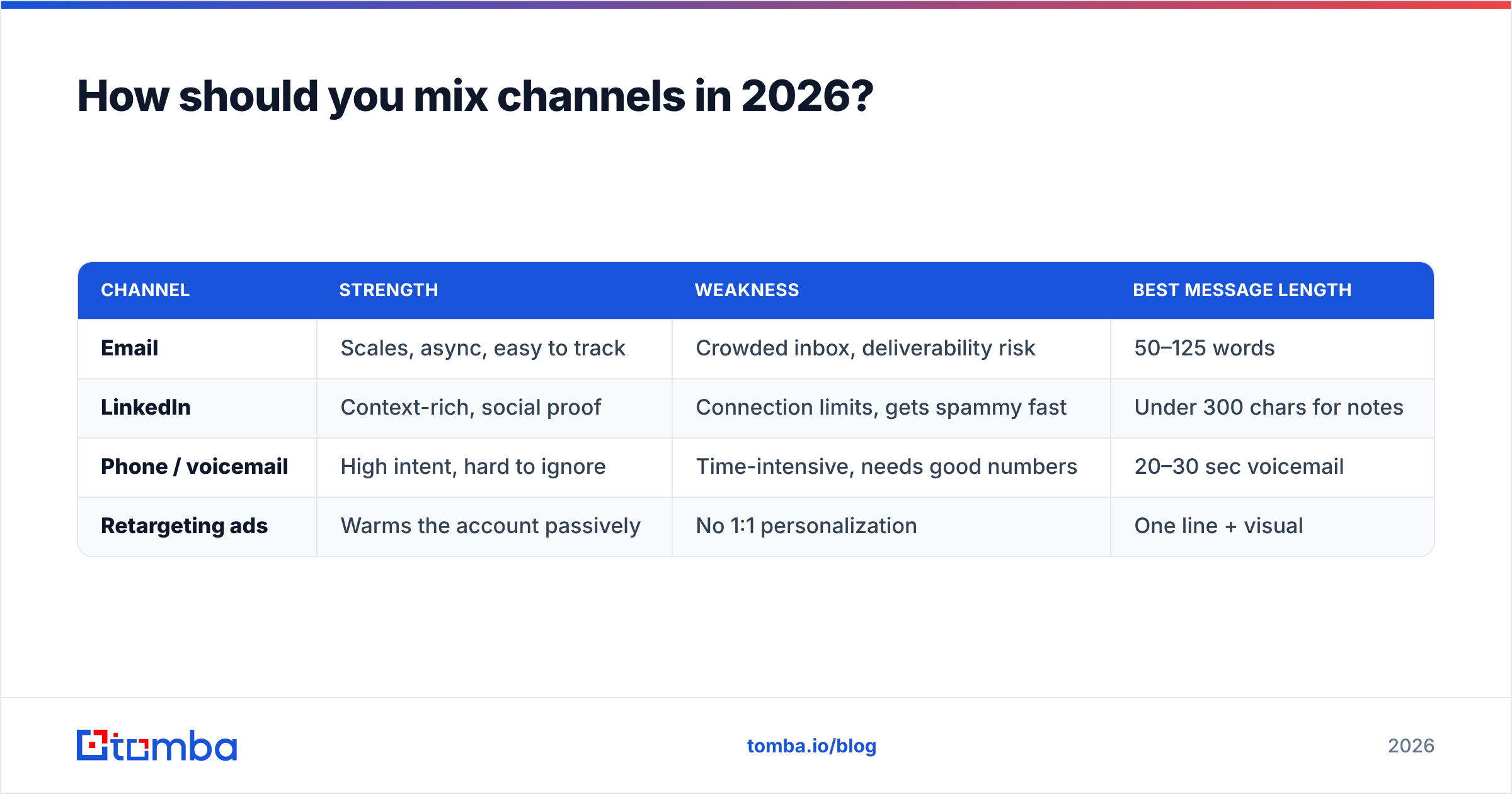
Here's a realistic channel comparison for B2B outreach this year:
| Channel | Strength | Weakness | Best message length |
|---|---|---|---|
| Scales, async, easy to track | Crowded inbox, deliverability risk | 50–125 words | |
| Context-rich, social proof | Connection limits, gets spammy fast | Under 300 chars for notes | |
| Phone / voicemail | High intent, hard to ignore | Time-intensive, needs good numbers | 20–30 sec voicemail |
| Retargeting ads | Warms the account passively | No 1:1 personalization | One line + visual |
The mistake teams make is treating these as separate campaigns with separate messaging. They aren't. A buyer who sees a consistent value statement in an ad, an email, and a LinkedIn note experiences one coherent message repeated — which builds familiarity. A buyer who gets three contradictory pitches experiences spam.
To run phone as a real channel, you need verified mobile and direct-dial data, not switchboard numbers. Tools like the phone finder and a phone validator keep that channel from collapsing into voicemail purgatory. For social, pairing a LinkedIn finder with your email data lets you match the same contact across channels instead of guessing.

How does data quality affect your messaging?#
Directly and brutally. The best message in the world scores a zero if it bounces or reaches the wrong person. Data quality is upstream of every messaging metric you care about.
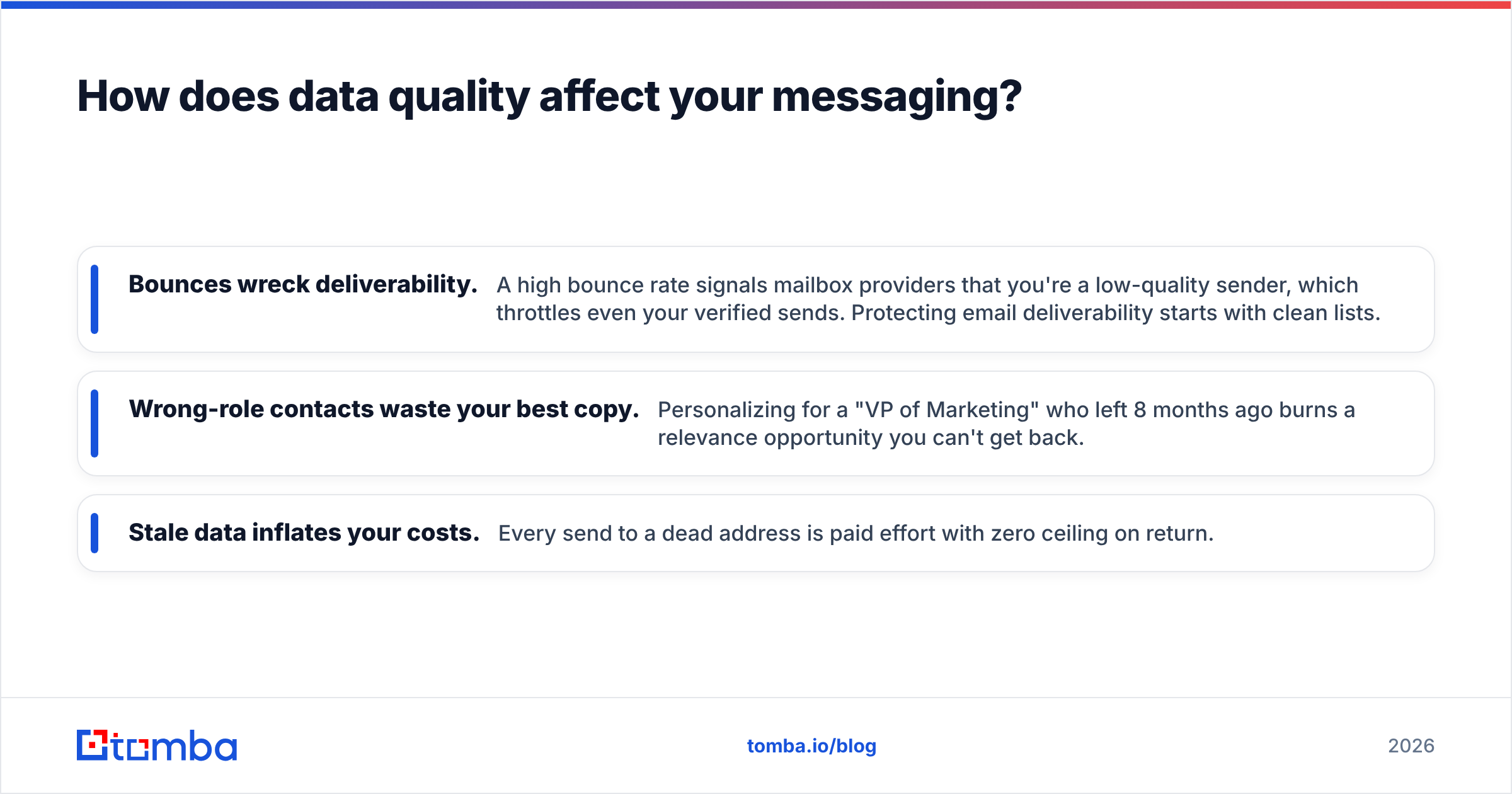
Three ways bad data sabotages good messaging:
- Bounces wreck deliverability. A high bounce rate signals mailbox providers that you're a low-quality sender, which throttles even your verified sends. Protecting email deliverability starts with clean lists.
- Wrong-role contacts waste your best copy. Personalizing for a "VP of Marketing" who left 8 months ago burns a relevance opportunity you can't get back.
- Stale data inflates your costs. Every send to a dead address is paid effort with zero ceiling on return.
The fix is a verification step before any campaign goes out. Run new lists through an email verifier to strip invalid and risky addresses, and use a catch-all verifier for domains that accept everything so you don't mistake a black hole for a valid inbox. When you're building lists from scratch, domain search pulls verified contacts by company so your messaging reaches real, current decision-makers.
According to HubSpot's research on sales outreach, personalization and relevance consistently outperform volume — but relevance is impossible without accurate underlying data. The copy and the data are not separate projects; they're the same project.
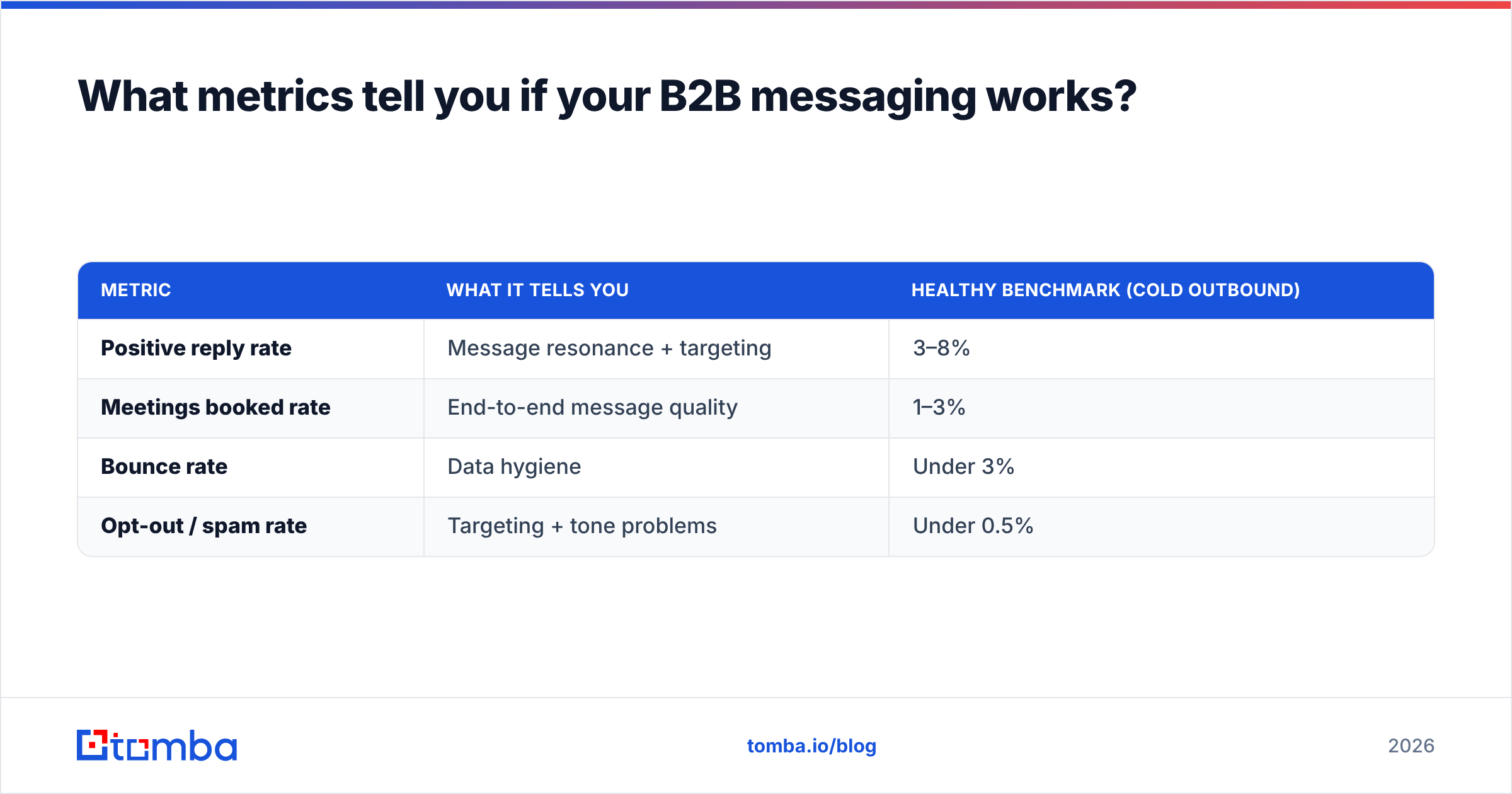
What metrics tell you if your B2B messaging works?#
Stop reporting open rates. With privacy changes and image proxies inflating opens since 2024, the metric is noise. Measure what actually predicts revenue.
| Metric | What it tells you | Healthy benchmark (cold outbound) |
|---|---|---|
| Positive reply rate | Message resonance + targeting | 3–8% |
| Meetings booked rate | End-to-end message quality | 1–3% |
| Bounce rate | Data hygiene | Under 3% |
| Opt-out / spam rate | Targeting + tone problems | Under 0.5% |
Read these together, not in isolation. A high reply rate with a high opt-out rate means your message is provocative but mistargeted. A low bounce rate with a low reply rate means your data is clean but your copy is forgettable. The combination tells the story; any single number lies.
Run A/B tests on one variable at a time — subject line, opener framework, or CTA — and let the positive-reply rate decide. If you change three things at once, you learn nothing about which one moved the needle.
How do you scale B2B messaging without making it generic?#
The tension every growing team hits: personalization drives replies, but personalization doesn't scale. The resolution is tiered personalization, not more headcount.
- Tier 1 — top accounts (deep personalization). Manual research, custom messaging per contact. Reserve for your highest-value targets.
- Tier 2 — strong-fit accounts (template + variable). A proven framework with a real, data-driven personalization token — a recent trigger, not just a name.
- Tier 3 — broad fit (segment-level messaging). Same message across a tight segment that genuinely shares the pain. Honest about being one-to-many.
The leverage point is the data layer feeding all three tiers. With bulk enrichment you can append firmographics, roles, and triggers to whole lists at once — turning a Tier 3 blast into Tier 2 relevance. The bulk email finder and data enrichment handle that volume so personalization scales with data, not with hours. If your outreach lives in a CRM, a clean HubSpot integration keeps the enriched data flowing where reps actually work.
The principle: don't write more messages, build better data so each message can be more relevant with the same effort.
Common B2B messaging mistakes to avoid#
- Leading with your company. Open with the buyer's world, not your founding date.
- Over-automating tone. Automation should handle delivery and data, not strip the human voice from the words.
- Ignoring the unsubscribe signal. Rising opt-outs are a message problem, not a list-size problem.
- One-channel dependence. If email is your only channel, one deliverability dip zeroes your pipeline.
- Skipping verification "just this once." That's exactly the send that tanks your sender reputation.
Final take: fix the message and the data together#
B2B messaging in 2026 rewards the teams that get two things right at the same time: a buyer-centric message built on a real framework, and accurate, verified data underneath every send. Neither works alone. Sharp copy on bad data bounces; clean data with generic copy gets ignored.
Start by tightening your positioning, pick one framework per message, and run every list through verification before it ships. When you're ready to build outreach lists that actually reach current decision-makers, the Tomba Email Finder finds verified professional emails by name, domain, or company — so your best message lands in a real inbox instead of a bounce report. Check Tomba pricing to match a plan to your send volume, starting free with 25 searches a month.
Ready to find emails that actually work?
Join 150,000+ professionals who stopped guessing and started sending. Free credits on signup — no credit card required.
Get the Tomba newsletter
Practical outbound tactics and product updates — once every two weeks.
About the author