B2B Omnichannel Marketing in 2026: A Practical Playbook
B2B omnichannel marketing isn't more channels for the sake of it. Here's how to connect email, LinkedIn, phone, and ads into one buyer journey that actually converts in 2026.
TL;DR
- B2B omnichannel marketing means one coordinated buyer journey across email, LinkedIn, phone, ads, and web — not the same message blasted everywhere at once.
- The payoff is real: omnichannel buyers convert faster and spend more, but only when channels share data and timing.
- The hard part isn't tooling, it's the contact data underneath. Disconnected, stale records break every channel downstream.
- Start with two or three channels you can actually coordinate, prove the play, then expand. "All channels day one" is how teams burn budget.
- This guide gives you a channel-by-channel comparison, a maturity model, and a 90-day rollout you can run with your current stack.
What is B2B omnichannel marketing?#
B2B omnichannel marketing is the practice of treating every touchpoint a buyer has with you — email, LinkedIn, cold calls, retargeting ads, your website, events — as a single connected conversation rather than separate campaigns.
Think of it like a good waiter at a restaurant you visit often. They remember you skipped dessert last time, that you're allergic to shellfish, and that you usually come in on Fridays. They don't restart the relationship every visit. Multichannel marketing is the opposite: three different waiters each ask your name and pitch the same special, none of them aware the others already did.
The technical distinction matters. Multichannel means you're present on many channels. Omnichannel means those channels share state — what was sent, what was opened, what was ignored, and what the buyer is in-market for right now. A LinkedIn connection request that references the exact webinar someone attended is omnichannel. A LinkedIn request that lands the same day as an unrelated cold email from your SDR is just noise wearing two hats.
According to McKinsey research, B2B buyers now routinely use ten or more channels through a single purchase, and a large share will walk away from a vendor whose experience feels disjointed. That's the entire case for omnichannel in one sentence: buyers already behave this way, so your go-to-market has to match.
Why does B2B omnichannel marketing matter in 2026?#
The short answer: single-channel response rates have collapsed, and buyers expect continuity.
Cold email open rates are noisier than ever after Google and Yahoo tightened sender requirements. LinkedIn connection limits throttle pure social outreach. Cold calling connect rates sit in the low single digits. No one channel carries a pipeline target alone anymore. What works is sequencing: a buyer sees a relevant ad, gets a personalized email referencing their role, then a LinkedIn touch, then a call that opens with "I sent you a note about X." Each touch is cheap; the coordination is the moat.
There's also a measurement reason. When channels are siloed, attribution is a fistfight — email claims the win, ads claim the win, the SDR claims the win. An omnichannel model built on shared contact records and a clear definition of a marketing qualified lead lets revenue operations see the real assist chain. That's how you stop funding channels that only look good because they fire last.
What channels belong in a B2B omnichannel mix?#
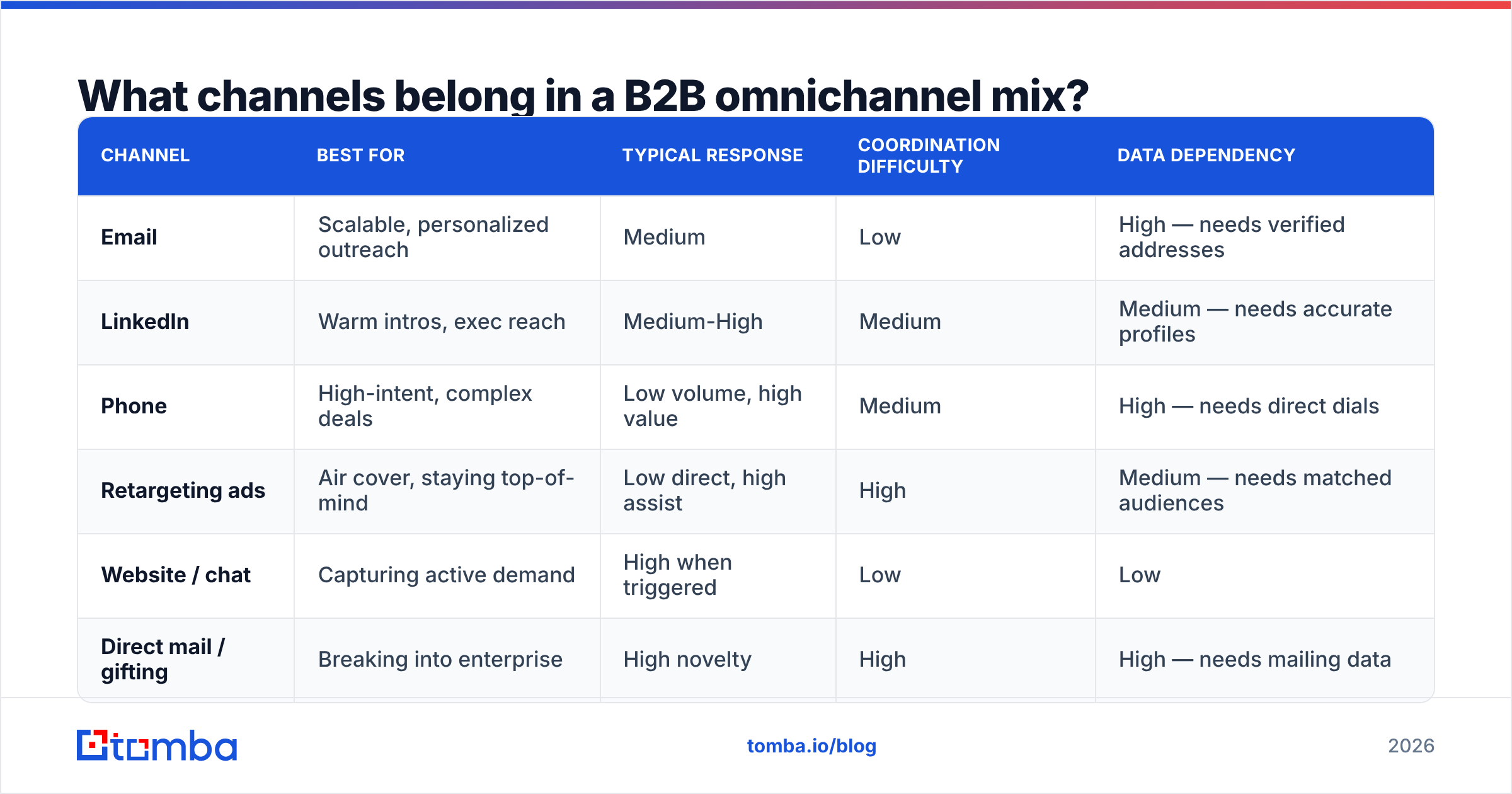
Not all channels deserve equal weight, and the right mix depends on deal size and buyer. Here's how the core B2B channels compare on the attributes that actually drive a sequencing decision.
| Channel | Best for | Typical response | Coordination difficulty | Data dependency |
|---|---|---|---|---|
| Scalable, personalized outreach | Medium | Low | High — needs verified addresses | |
| Warm intros, exec reach | Medium-High | Medium | Medium — needs accurate profiles | |
| Phone | High-intent, complex deals | Low volume, high value | Medium | High — needs direct dials |
| Retargeting ads | Air cover, staying top-of-mind | Low direct, high assist | High | Medium — needs matched audiences |
| Website / chat | Capturing active demand | High when triggered | Low | Low |
| Direct mail / gifting | Breaking into enterprise | High novelty | High | High — needs mailing data |
A few takeaways. Email and phone are the most data-hungry channels — they fail silently when the underlying contact is wrong, because a bounced email or a dead number just disappears. Ads and direct mail are the hardest to coordinate in real time but give you "air cover" that makes the direct channels land warmer. The website is your highest-converting channel and the most underused in outbound planning, because teams forget that a visitor reveal turns anonymous traffic into a named, sequence-able contact.
If you're building from zero, the highest-leverage starting trio for most B2B teams is email + LinkedIn + phone, layered with retargeting once you have enough matched contacts to make an audience worthwhile.
How do you build a B2B omnichannel strategy step by step?#
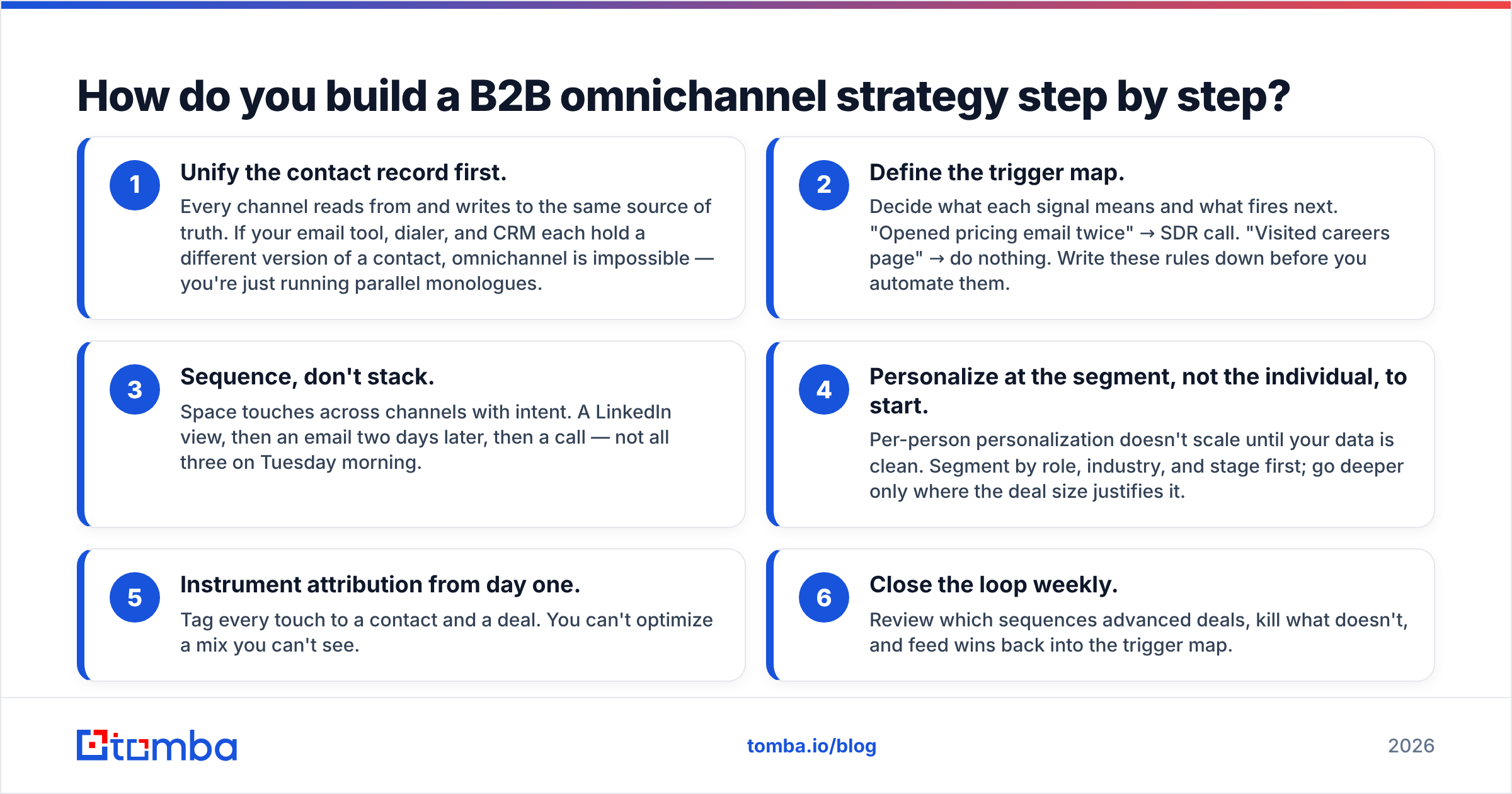
Strategy here is less about creative and more about plumbing. Run it in this order:
- Unify the contact record first. Every channel reads from and writes to the same source of truth. If your email tool, dialer, and CRM each hold a different version of a contact, omnichannel is impossible — you're just running parallel monologues.
- Define the trigger map. Decide what each signal means and what fires next. "Opened pricing email twice" → SDR call. "Visited careers page" → do nothing. Write these rules down before you automate them.
- Sequence, don't stack. Space touches across channels with intent. A LinkedIn view, then an email two days later, then a call — not all three on Tuesday morning.
- Personalize at the segment, not the individual, to start. Per-person personalization doesn't scale until your data is clean. Segment by role, industry, and stage first; go deeper only where the deal size justifies it.
- Instrument attribution from day one. Tag every touch to a contact and a deal. You can't optimize a mix you can't see.
- Close the loop weekly. Review which sequences advanced deals, kill what doesn't, and feed wins back into the trigger map.
The reason most omnichannel programs stall is step one. Teams jump straight to step three because sequencing is the fun part, then discover half their contacts bounce or ring dead. Get the data enrichment and verification layer right and the rest is configuration.
Is omnichannel better than a single strong channel?#
Not always — and pretending otherwise wastes money.
If you have one channel that's genuinely working and you haven't saturated it, doubling down there often beats spreading thin. A focused, well-executed cold email finder-plus-sequence motion can outperform a sloppy six-channel program every time. Omnichannel is a force multiplier, not a substitute for a working motion.
Omnichannel wins decisively when:
- Your deals have multiple stakeholders. A 6-person buying committee can't be reached through one channel. The CFO ignores email; the champion lives on LinkedIn.
- Your sales cycle is long. More touches over more time means you need variety to stay relevant without becoming annoying.
- Your single-channel response is plateauing. When email-only stops scaling, adding coordinated channels lifts the whole curve.
Single-channel wins when you're early, resource-constrained, and still finding product-market fit. Coordinating five channels you can't measure is worse than nailing one you can. Be honest about which situation you're in.
What is the B2B omnichannel maturity model?#
Most teams fit one of four stages. Find yours honestly — it tells you what to fix next, not what to brag about.
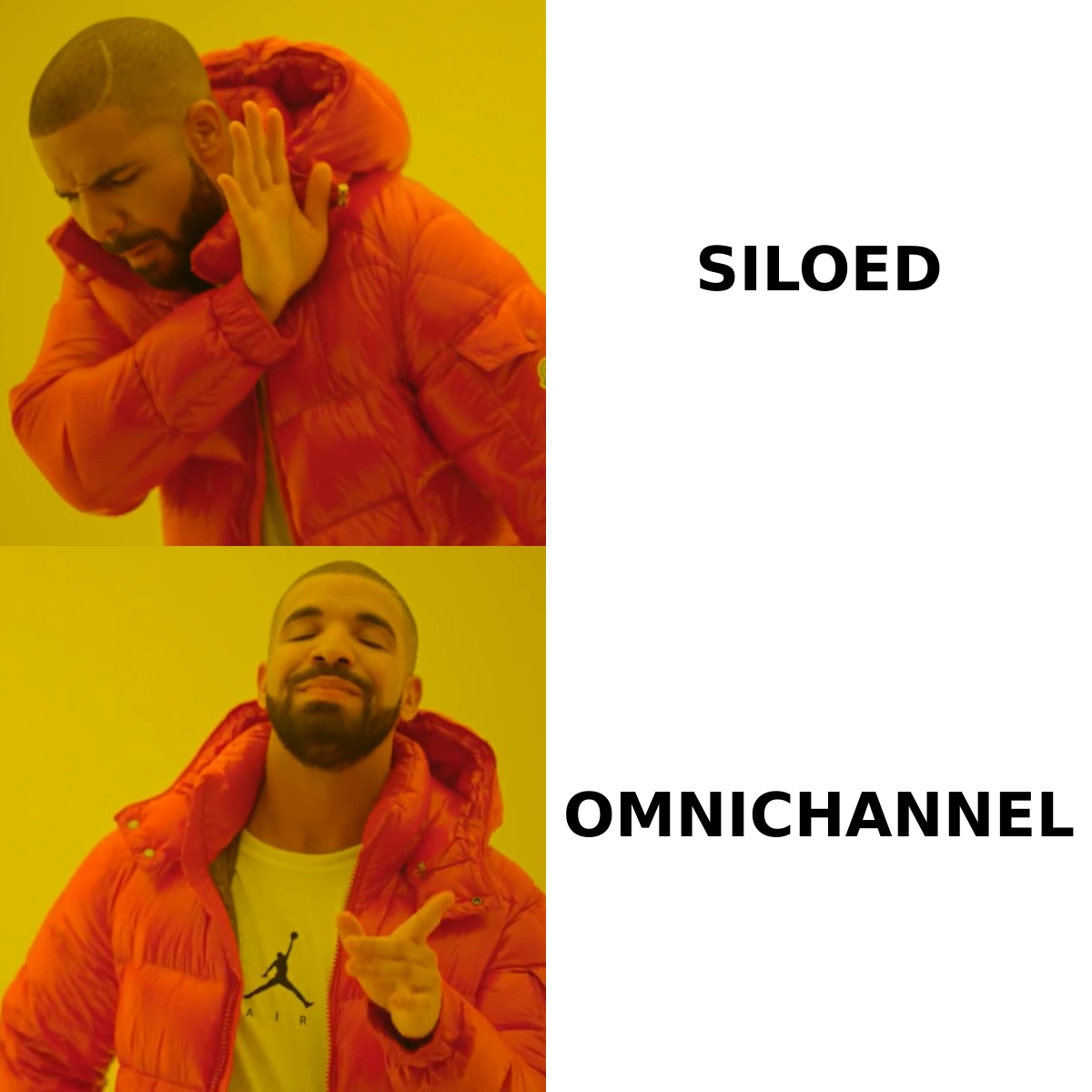
- Stage 1 — Siloed: Channels run independently, owned by different people, with no shared data. Email doesn't know what sales called about. This is the default, not a failure — just your starting line.
- Stage 2 — Connected: Contacts sync to a central CRM. You can see touches in one place, even if they aren't coordinated yet. The HubSpot integration or a Salesforce integration usually marks this stage.
- Stage 3 — Coordinated: Touches are sequenced across channels with deliberate timing and shared triggers. A signal in one channel fires action in another. Most high-performing teams plateau here, and that's fine.
- Stage 4 — Orchestrated: Real-time signals (intent, web visits, product usage) dynamically route buyers into the right next touch. This requires mature data infrastructure and is overkill for most mid-market teams.
The mistake is chasing Stage 4 tooling while sitting at Stage 1 data. Buy the orchestration platform after your contacts are unified and verified, not before. The jump from Siloed to Connected delivers more pipeline than the jump from Coordinated to Orchestrated for almost everyone.
How does data quality make or break omnichannel?#
Bad data doesn't just hurt one channel — it compounds across all of them, which is what makes it the silent killer of omnichannel programs.
Picture a single wrong contact record. The email bounces and dings your sender reputation. The phone number is dead, so the SDR wastes a slot. The LinkedIn profile is for a different person, so the connection note is irrelevant. The retargeting audience never matches. One bad row poisons five channels. Now multiply by a list of ten thousand. This is why "we have an omnichannel strategy" so often means "we have five ways to annoy the wrong people."
The fixes are unglamorous but decisive:
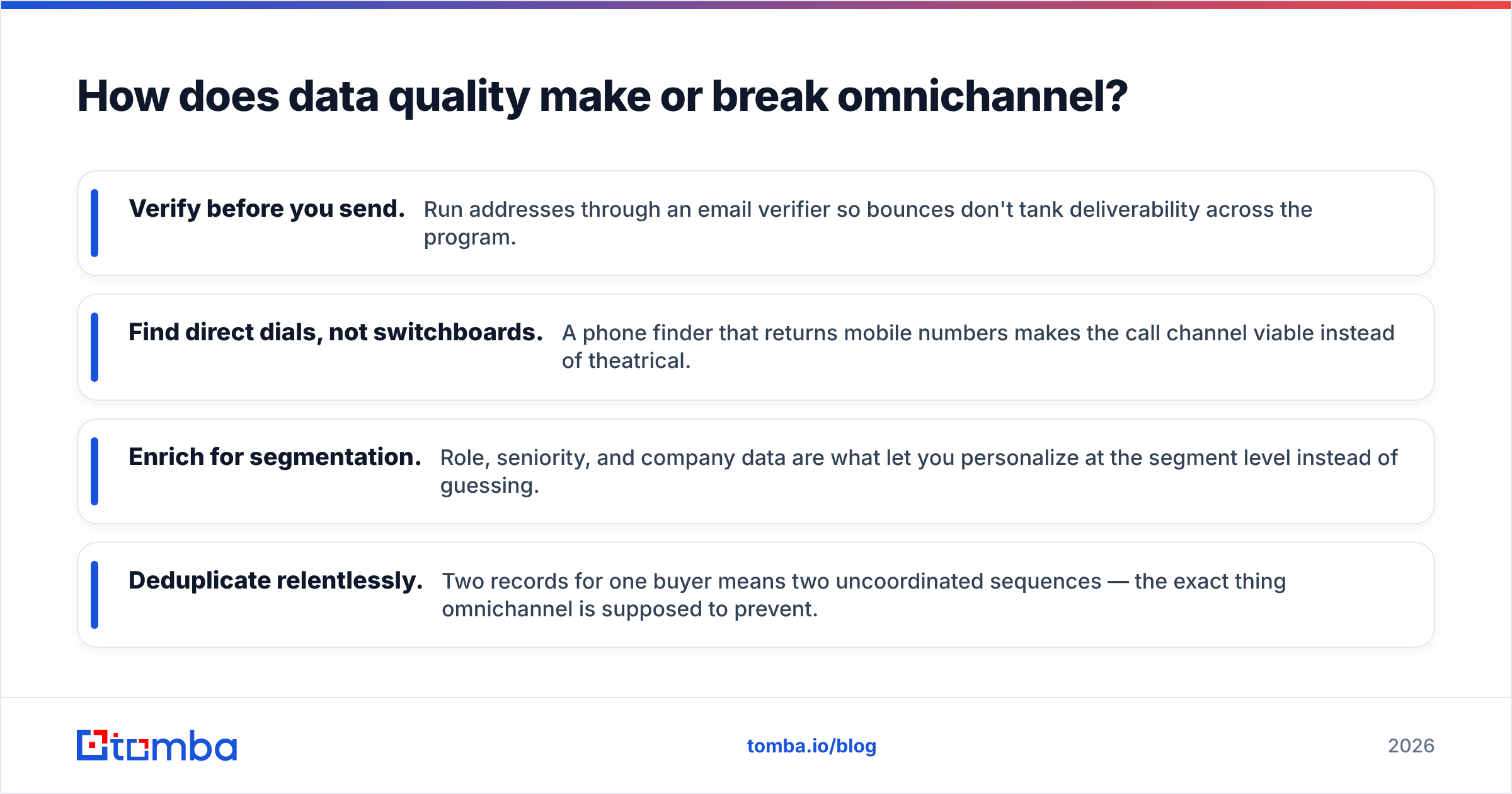
- Verify before you send. Run addresses through an email verifier so bounces don't tank deliverability across the program.
- Find direct dials, not switchboards. A phone finder that returns mobile numbers makes the call channel viable instead of theatrical.
- Enrich for segmentation. Role, seniority, and company data are what let you personalize at the segment level instead of guessing.
- Deduplicate relentlessly. Two records for one buyer means two uncoordinated sequences — the exact thing omnichannel is supposed to prevent.
Teams that treat data as a one-time import lose; teams that treat it as continuous maintenance win. Your contact database decays roughly 2-3% a month as people change jobs. An omnichannel program built on a dataset you cleaned last year is already broken.
How do you measure B2B omnichannel marketing?#
Measure assists, not just last-touch wins — that's the whole point of going omnichannel.
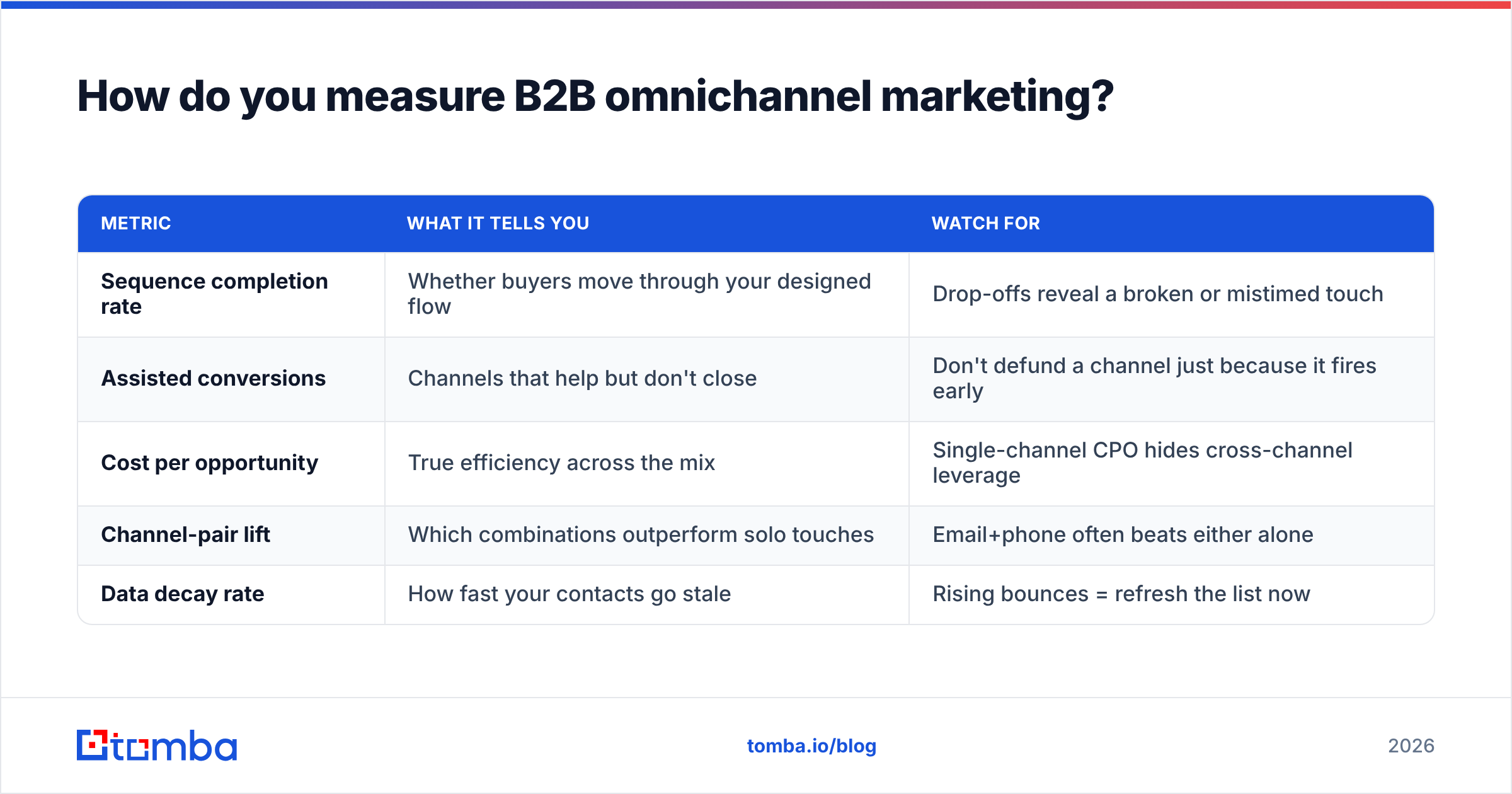
The trap is letting each channel claim full credit. Set up multi-touch attribution so you can see the chain: ad impression → email open → LinkedIn reply → call → demo. Then watch a handful of metrics that actually move decisions:
| Metric | What it tells you | Watch for |
|---|---|---|
| Sequence completion rate | Whether buyers move through your designed flow | Drop-offs reveal a broken or mistimed touch |
| Assisted conversions | Channels that help but don't close | Don't defund a channel just because it fires early |
| Cost per opportunity | True efficiency across the mix | Single-channel CPO hides cross-channel leverage |
| Channel-pair lift | Which combinations outperform solo touches | Email+phone often beats either alone |
| Data decay rate | How fast your contacts go stale | Rising bounces = refresh the list now |
Tie these back to deal outcomes, not vanity engagement. A channel with great open rates and zero assisted pipeline is a hobby, not a strategy. Review the chain monthly and prune.
What does a 90-day omnichannel rollout look like?#
You don't need a year. You need a focused quarter that proves one play, then a second that scales it.
Days 1-30 — Foundation. Unify contacts into one CRM. Verify and enrich your core list. Pick your starting trio of channels. Write the trigger map. Don't launch anything cross-channel yet — you're laying track.
Days 31-60 — First coordinated play. Launch one sequence across your three channels for one segment. Keep it small enough to monitor by hand. Instrument every touch. Compare it head-to-head against your old single-channel baseline.
Days 61-90 — Prove and expand. Read the assist data. Double down on the channel pair that lifted conversion, cut what didn't, and roll the winning play out to a second segment. Only now consider adding a fourth channel like retargeting.
This beats the big-bang approach because it keeps the data clean and the learnings legible. You can run the whole thing on tools you likely already have — a CRM, an email platform, a dialer — connected through Zapier integration or native connectors. The constraint is never the software; it's the discipline to sequence instead of stack.
The bottom line#
B2B omnichannel marketing works when channels share one source of truth and fire in deliberate sequence — and it fails when they don't, no matter how many platforms you buy. The differentiator in 2026 isn't which channels you're on; nearly everyone is on the same ones. It's whether the contact data underneath them is accurate enough to coordinate around a real human buyer.
That's where the foundation pays off. Before you sequence a single touch, make sure the emails resolve, the numbers ring, and the records describe one person each. Tomba's Email Finder gives you verified, accurate contact data to build that foundation on — find the right people by domain, name, or company, confirm the addresses are real, and feed clean records into every channel in your mix. Start free with 25 searches a month, and check Tomba pricing when you're ready to scale the program. Get the data right first, and omnichannel stops being a buzzword and starts being a pipeline.
// get started
Find, verify and enrich your first contacts today
Start on the free plan with 25 searches a month, then scale when your team is ready.
Free plan · No credit card required · GDPR & CCPA
// about the author