B2B Outbound Telemarketing in 2026: The Complete Playbook
B2B outbound telemarketing still books pipeline in 2026 — if your data, scripts, and cadence are right. Here is the full playbook with scripts, metrics, and a tool comparison.
TL;DR
- B2B outbound telemarketing is alive in 2026 — but only when it sits on clean data, tight targeting, and a human script. Spray-and-pray dialing is dead.
- The single biggest lever is list quality: a verified, enriched list of the right titles beats a bigger list of stale numbers every time.
- Connect rates live or die on accurate direct-dial numbers. Mobile-first data and pre-call validation are now table stakes.
- A repeatable cadence (call + email + LinkedIn touch) outperforms phone-only by a wide margin.
- Track conversations and meetings booked, not raw dials. Vanity activity metrics hide a broken process.
What is B2B outbound telemarketing in 2026?#
B2B outbound telemarketing is the practice of proactively calling business prospects who have not raised their hand yet, with the goal of starting a conversation that leads to a qualified meeting or sale. Think of it as door-to-door selling for the digital era: instead of knocking on houses at random, you knock on the doors of decision-makers you have a real reason to talk to.
The difference between 2026 and the boiler-room era is precision. You are no longer handed a phone book and a quota of 200 dials. You are handed a short, enriched list of accounts that match your ideal customer profile, a direct mobile number that actually rings the right person, and context about why this prospect might care. The phone is still the channel — but the targeting is closer to sniper than shotgun.
This matters because buyers have gotten harder to reach. Gatekeepers, spam filters on mobile carriers, and crowded inboxes mean a poorly prepared call gets hung up on in three seconds. A well-prepared call — relevant, brief, and human — still books meetings that no email ever would.
Does outbound telemarketing still work for B2B?#
Yes — when the fundamentals are right. The complaint "cold calling is dead" almost always traces back to one of three broken fundamentals, not the channel itself:
- Bad data. Wrong numbers, disconnected lines, and prospects who left the company two years ago. If half your list is junk, your reps spend half their day talking to dial tones.
- No targeting. Calling anyone with a pulse instead of the 50 accounts that actually fit. Volume without fit produces noise, not pipeline.
- A robotic pitch. Reading a stiff script word-for-word makes you sound like every other vendor. Buyers can hear a teleprompter.
Fix those three and the phone becomes one of the highest-conversion channels you own. According to HubSpot's sales research, phone outreach still drives a meaningful share of booked meetings for B2B teams, especially for higher-ticket deals where a real conversation shortens the sales cycle. The phone is not competing with email and LinkedIn — it works best alongside them.
How do you build a B2B telemarketing call list?#
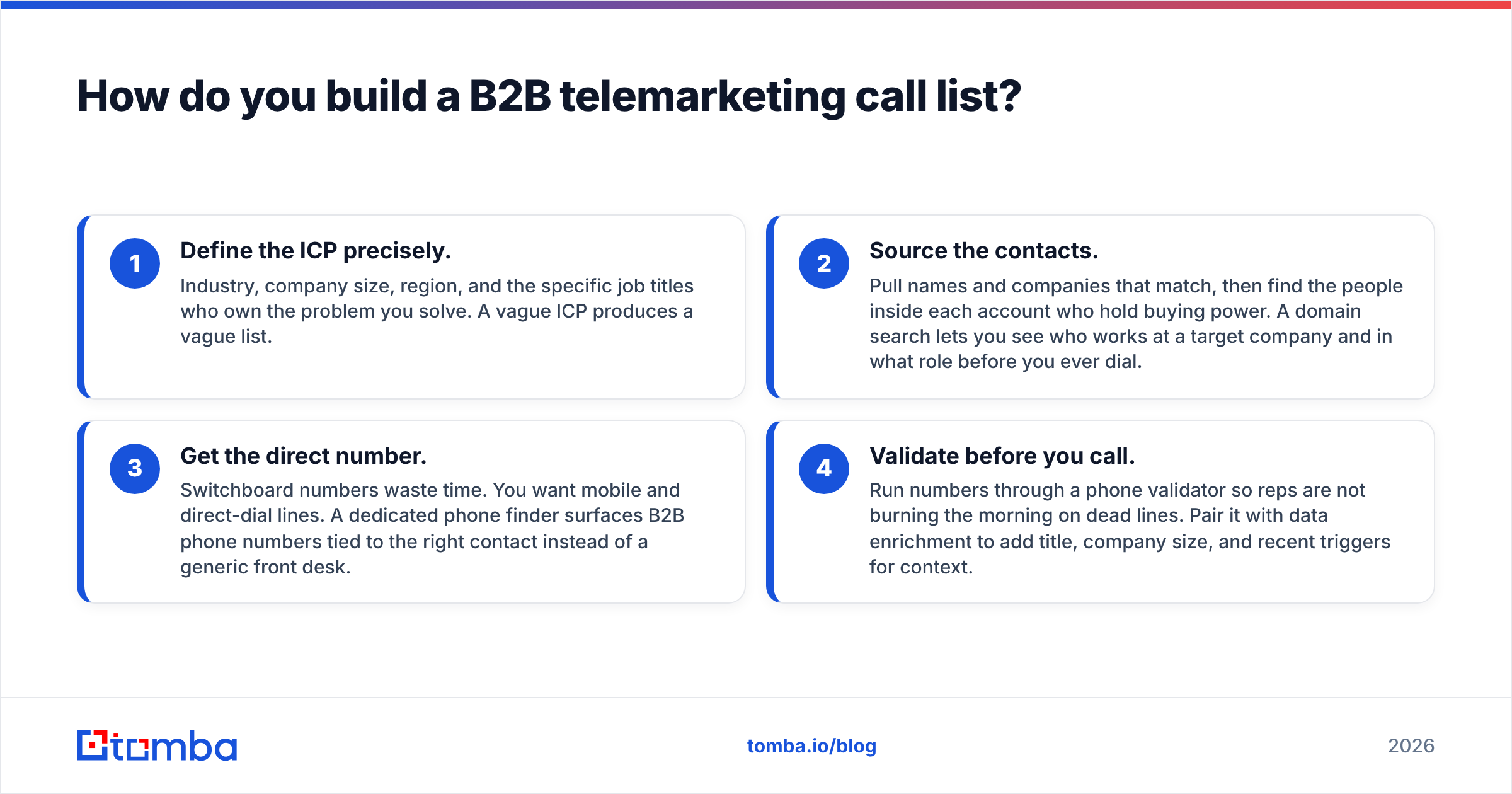
Your call list is the foundation. Everything downstream — connect rate, conversion, rep morale — is capped by the quality of the names and numbers you feed in. Build it in four steps:
- Define the ICP precisely. Industry, company size, region, and the specific job titles who own the problem you solve. A vague ICP produces a vague list.
- Source the contacts. Pull names and companies that match, then find the people inside each account who hold buying power. A domain search lets you see who works at a target company and in what role before you ever dial.
- Get the direct number. Switchboard numbers waste time. You want mobile and direct-dial lines. A dedicated phone finder surfaces B2B phone numbers tied to the right contact instead of a generic front desk.
- Validate before you call. Run numbers through a phone validator so reps are not burning the morning on dead lines. Pair it with data enrichment to add title, company size, and recent triggers for context.
A clean list of 200 verified contacts will outperform a raw list of 2,000 every single time. Reps stay in flow, connect rates climb, and the conversations are with people who can actually say yes.
What does a good B2B cold call script look like?#
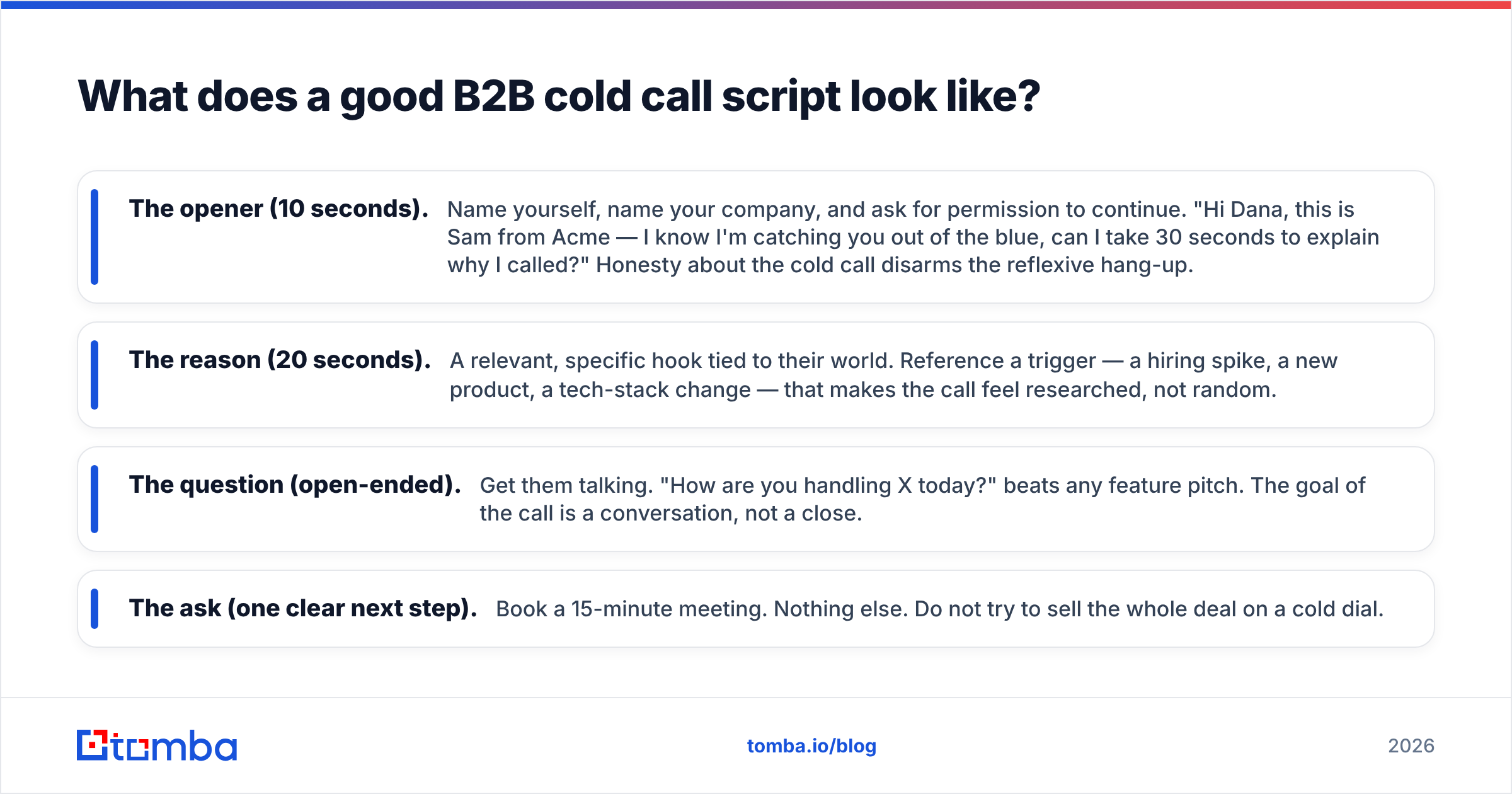
A good script is a flexible frame, not a monologue. It guides the rep through four beats while leaving room to sound like a human. Here is the structure that holds up across industries:
- The opener (10 seconds). Name yourself, name your company, and ask for permission to continue. "Hi Dana, this is Sam from Acme — I know I'm catching you out of the blue, can I take 30 seconds to explain why I called?" Honesty about the cold call disarms the reflexive hang-up.
- The reason (20 seconds). A relevant, specific hook tied to their world. Reference a trigger — a hiring spike, a new product, a tech-stack change — that makes the call feel researched, not random.
- The question (open-ended). Get them talking. "How are you handling X today?" beats any feature pitch. The goal of the call is a conversation, not a close.
- The ask (one clear next step). Book a 15-minute meeting. Nothing else. Do not try to sell the whole deal on a cold dial.
Keep the whole opening under a minute. The prospect decides whether to keep listening in the first 10 seconds, so spend your preparation budget there. For more on framing the conversation, see how teams structure their response rate goals across channels.
Phone-only vs multi-channel cadence: which wins?#
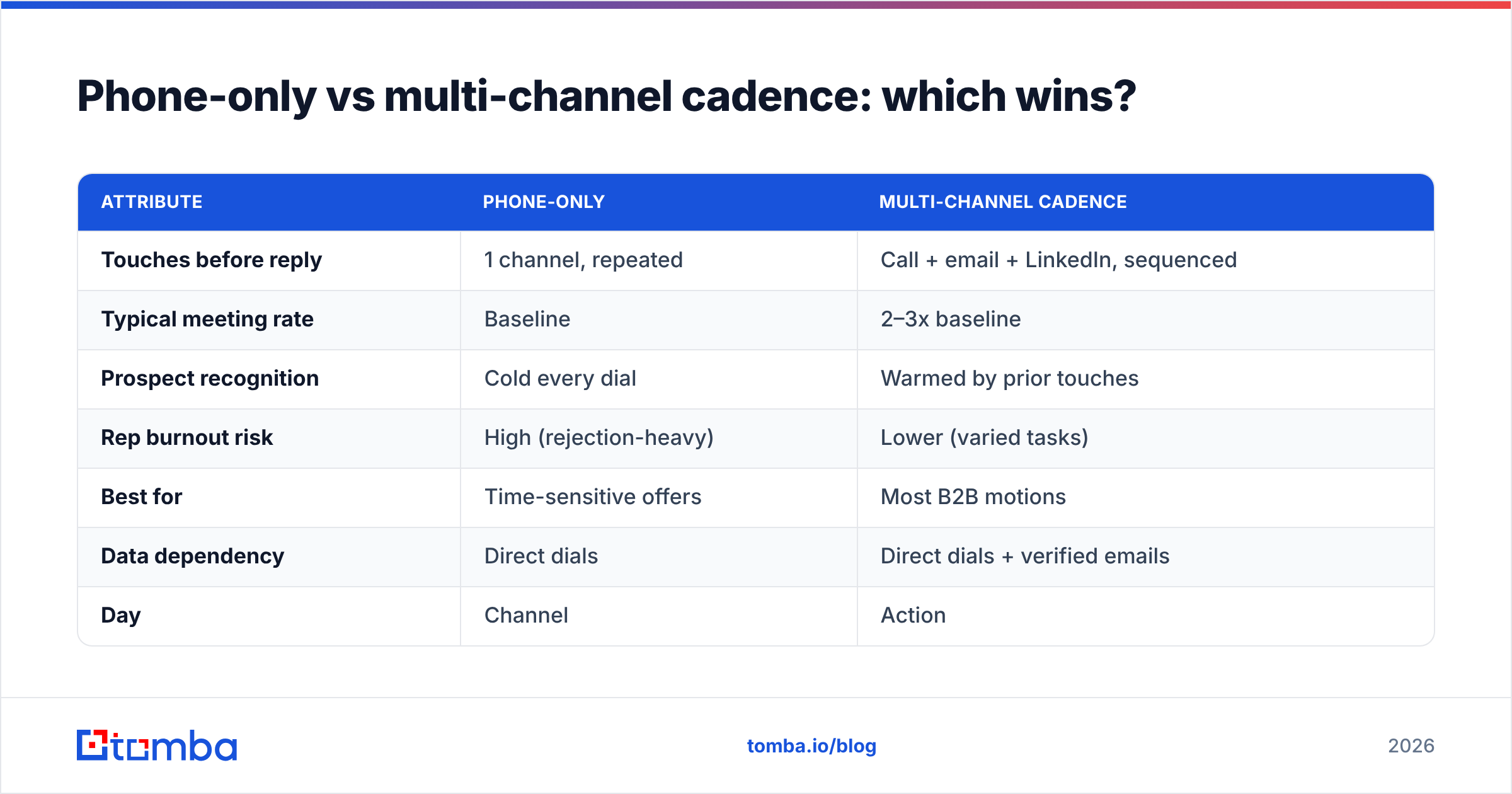
Multi-channel wins, decisively. The phone is your sharpest tool, but it is sharper when the prospect has already seen your name. A coordinated cadence warms the line before you dial. Here is how the two approaches compare in practice:
| Attribute | Phone-only | Multi-channel cadence |
|---|---|---|
| Touches before reply | 1 channel, repeated | Call + email + LinkedIn, sequenced |
| Typical meeting rate | Baseline | 2–3x baseline |
| Prospect recognition | Cold every dial | Warmed by prior touches |
| Rep burnout risk | High (rejection-heavy) | Lower (varied tasks) |
| Best for | Time-sensitive offers | Most B2B motions |
| Data dependency | Direct dials | Direct dials + verified emails |
A simple, effective 10-business-day cadence looks like this:
| Day | Channel | Action |
|---|---|---|
| 1 | Short intro tied to a trigger | |
| 2 | Call + voicemail | Reference the email |
| 4 | Connection request, no pitch | |
| 6 | Call | Different time of day |
| 8 | New angle, social proof | |
| 10 | Call + breakup email | Final attempt, leave the door open |
Notice the phone appears three times — but never alone. Each dial lands on a prospect who has already seen your email or LinkedIn touch, which lifts both connect and conversion rates. Tools that connect your data to a CRM keep these touches synced so nothing falls through the cracks.
What metrics actually matter in outbound telemarketing?#
Stop celebrating dials. Dials are an input, not an outcome, and rewarding them encourages reps to game the number with rushed, low-quality calls. Track the metrics that map to revenue:
- Connect rate — conversations started ÷ dials. This is the truest read on data quality. A low connect rate almost always means bad numbers, not lazy reps.
- Conversation-to-meeting rate — meetings booked ÷ conversations. This reads your script and rep skill.
- Meetings held — booked meetings that actually happen. No-shows hide here.
- Meeting-to-opportunity rate — how many meetings become real pipeline. This tells you whether your targeting matches your offer.
- Cost per meeting — fully loaded cost ÷ meetings booked. The number that survives a CFO conversation.
When connect rate sags, the fix is upstream in your data, not in more dials. That is why verified numbers and enrichment pay for themselves: every percentage point of connect rate is conversations your reps were already paid to have but couldn't reach.
How do you stay compliant when cold calling B2B?#
Compliance is non-negotiable, and the rules tightened again going into 2026. Cutting corners here risks fines that dwarf any pipeline you generate. The essentials:
- Honor do-not-call registries in every region you dial. Scrub your list against them before each campaign.
- Respect calling windows. Most jurisdictions restrict when you may call. Standard business hours in the prospect's local time zone is the safe default.
- Identify yourself and your company at the start of every call. No pretexting.
- Log consent and opt-outs. When someone asks not to be called, record it immediately and suppress that contact across channels.
- Mind data-privacy law. GDPR, CCPA, and their successors govern how you store and process the personal data behind your list. Source your data from providers transparent about where their data comes from.
Resources from Salesforce and analyst guidance from Gartner are worth reviewing as regulations evolve. When in doubt, route policy questions through your legal team before a campaign launches — it is far cheaper than a violation.
Build vs buy: what tooling does a telemarketing team need?#
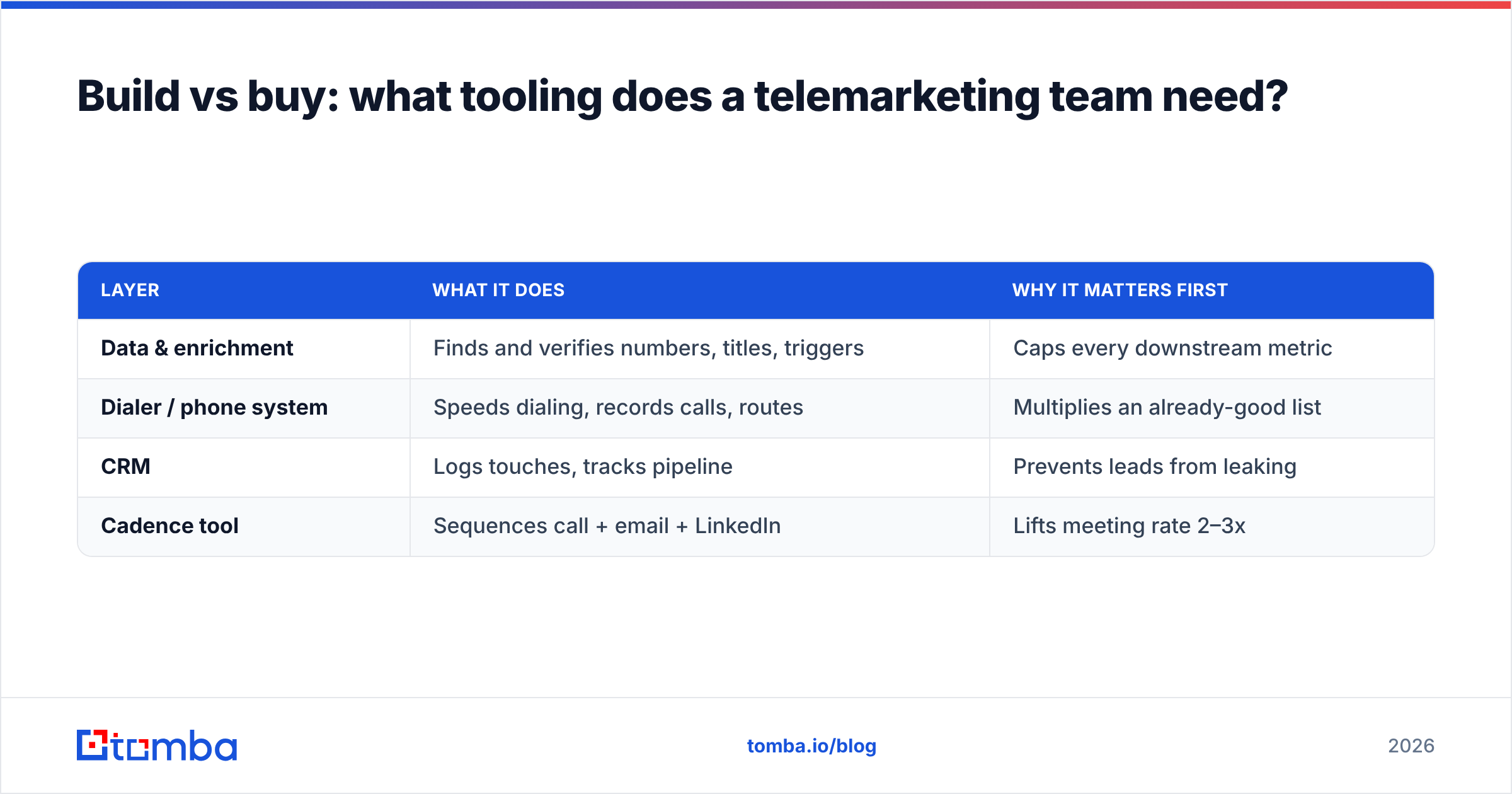
You need three layers: a data source, a dialer, and a CRM to track it all. Many teams over-invest in dialer software while feeding it garbage data — the equivalent of buying a sports car and putting sand in the tank. Prioritize in this order:
| Layer | What it does | Why it matters first |
|---|---|---|
| Data & enrichment | Finds and verifies numbers, titles, triggers | Caps every downstream metric |
| Dialer / phone system | Speeds dialing, records calls, routes | Multiplies an already-good list |
| CRM | Logs touches, tracks pipeline | Prevents leads from leaking |
| Cadence tool | Sequences call + email + LinkedIn | Lifts meeting rate 2–3x |
Get the data layer right first. A precise, verified list run through a basic dialer beats a premium dialer chewing through a stale list. Once your data is solid, layer in dialing speed and cadence automation to scale what already works.
Frequently asked questions#
Is B2B telemarketing the same as cold calling? Mostly yes. Telemarketing is the broader discipline — outbound calling to generate or qualify business — while "cold calling" specifically refers to dialing prospects with no prior relationship. In B2B, the terms overlap heavily.
How many dials does it take to book a meeting? It varies wildly by industry and data quality, but the right question is connect rate, not dial count. With verified direct dials and a multi-channel cadence, teams routinely book meetings in far fewer dials than phone-only campaigns on raw lists.
Should SDRs or a vendor run the calls? In-house SDRs give you control and feedback loops; agencies give you speed. Either way, the data and script determine results more than who holds the phone.
Start with better data#
The fastest way to lift every telemarketing metric is to fix the list before you fix anything else. Clean targeting, verified direct dials, and enriched context turn rejection-heavy grind into real conversations. Start by finding the right people inside your target accounts: the Tomba Email Finder surfaces verified professional contacts by name, company, or domain, and pairs with Tomba's phone finder and enrichment so your reps dial people who actually pick up. Check Tomba pricing — the free tier gives you 25 searches a month to test the data quality before you commit. Better data in, more meetings out.
// get started
Find, verify and enrich your first contacts today
Start on the free plan with 25 searches a month, then scale when your team is ready.
Free plan · No credit card required · GDPR & CCPA
// about the author