B2B Partner Programs in 2026: How to Build One That Scales
A practical 2026 guide to B2B partner programs: the program types that actually drive revenue, how to build one step by step, the metrics that matter, and the data stack behind it.
Partner-sourced revenue is no longer a "nice to have" line in your GTM deck. In 2026, the companies growing efficiently are the ones treating partners as a primary channel — not an afterthought bolted onto direct sales. This guide breaks down what B2B partner programs are, the types that work, and exactly how to build one that produces pipeline instead of logos on a slide.
TL;DR#
- B2B partner programs are structured systems for recruiting, enabling, and rewarding third parties (affiliates, resellers, agencies, tech integrators) who help you sell or deliver value.
- The biggest mistake is launching the program before you have a clear ideal partner profile and a repeatable enablement motion — recruiting random logos produces zero revenue.
- Choose a program type that matches your motion: affiliate for volume, reseller for margin, agency for delivery, and tech/integration for stickiness.
- Track partner-sourced and partner-influenced pipeline, not just signups. A 500-partner directory that sources 2% of revenue is a vanity asset.
- Clean contact data is the unglamorous engine: you need accurate emails and enrichment to recruit partners, route co-sell leads, and measure attribution.
What are B2B partner programs?#
A B2B partner program is a repeatable system for turning other companies into a revenue channel. Think of it like a restaurant franchise model: instead of opening every location yourself, you give qualified operators a proven playbook, the supplies, and a cut of the revenue — and they extend your reach far faster than you could alone.
Technically, a partner program codifies four things: who you partner with (the ideal partner profile), how they create value (refer, resell, integrate, or deliver), what they get in return (commission, margin, leads, co-marketing), and how you support them (training, portals, deal registration, MDF).
Done well, partnerships become a compounding channel. Each partner you enable can source deals for years, and the best programs see partner-sourced revenue grow as a percentage of total revenue, not just in absolute terms. According to HubSpot's research on partner ecosystems, companies with mature partner programs consistently report shorter sales cycles and higher retention on partner-sourced accounts — because a trusted third party did the warm introduction.
Why do B2B partner programs matter in 2026?#
The short answer: direct outbound is more expensive and more crowded than ever, and buyers trust peers far more than vendors.
Three forces make partnerships a priority this year:
- CAC is climbing. Paid channels are saturated and cold outbound reply rates keep falling. Partner referrals arrive pre-qualified and pre-trusted, which lowers blended customer acquisition cost.
- Buyers self-educate through ecosystems. Marketplaces like the Salesforce AppExchange and category review sites mean prospects often discover you through a partner before they ever talk to your reps.
- RevOps maturity. Modern revenue operations teams can finally attribute partner-influenced deals properly, so finance will fund the channel when you can prove it.
Gartner has repeatedly flagged ecosystem and partner-led growth as a defining go-to-market shift for B2B software. The takeaway isn't "build a program because it's trendy" — it's that a well-run channel is one of the few levers that improves both growth and efficiency at the same time.
What types of B2B partner programs exist?#
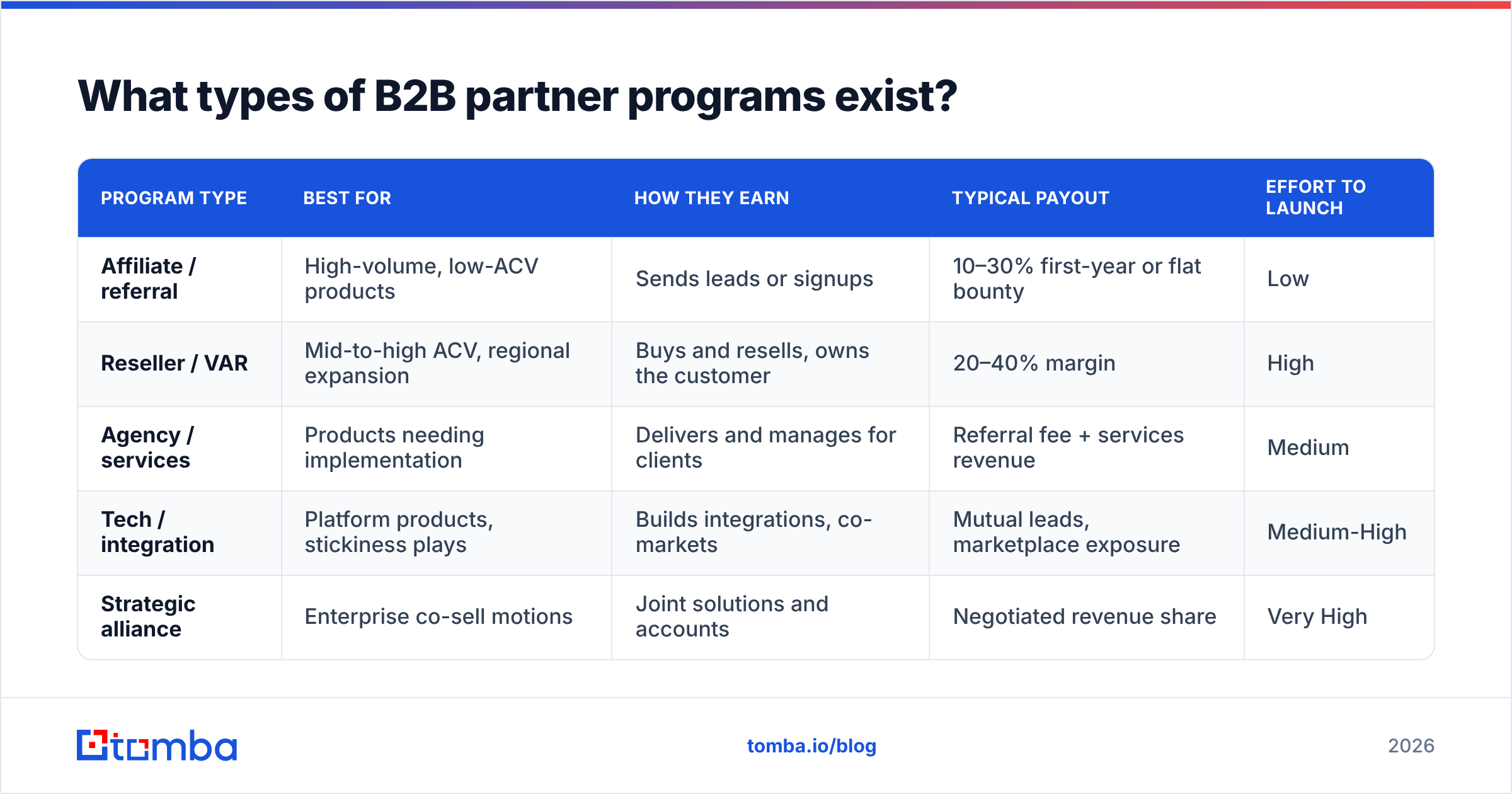
Not all partnerships are the same, and picking the wrong model is the fastest way to waste a year. Here's how the main types compare.
| Program type | Best for | How they earn | Typical payout | Effort to launch |
|---|---|---|---|---|
| Affiliate / referral | High-volume, low-ACV products | Sends leads or signups | 10–30% first-year or flat bounty | Low |
| Reseller / VAR | Mid-to-high ACV, regional expansion | Buys and resells, owns the customer | 20–40% margin | High |
| Agency / services | Products needing implementation | Delivers and manages for clients | Referral fee + services revenue | Medium |
| Tech / integration | Platform products, stickiness plays | Builds integrations, co-markets | Mutual leads, marketplace exposure | Medium-High |
| Strategic alliance | Enterprise co-sell motions | Joint solutions and accounts | Negotiated revenue share | Very High |
A quick rule of thumb: if your product is self-serve and cheap, start with affiliate. If it's expensive and consultative, reseller or agency partners will carry more weight. Most mature programs eventually run two or three types in parallel — but never launch more than one at once.
How do you build a B2B partner program from scratch?#
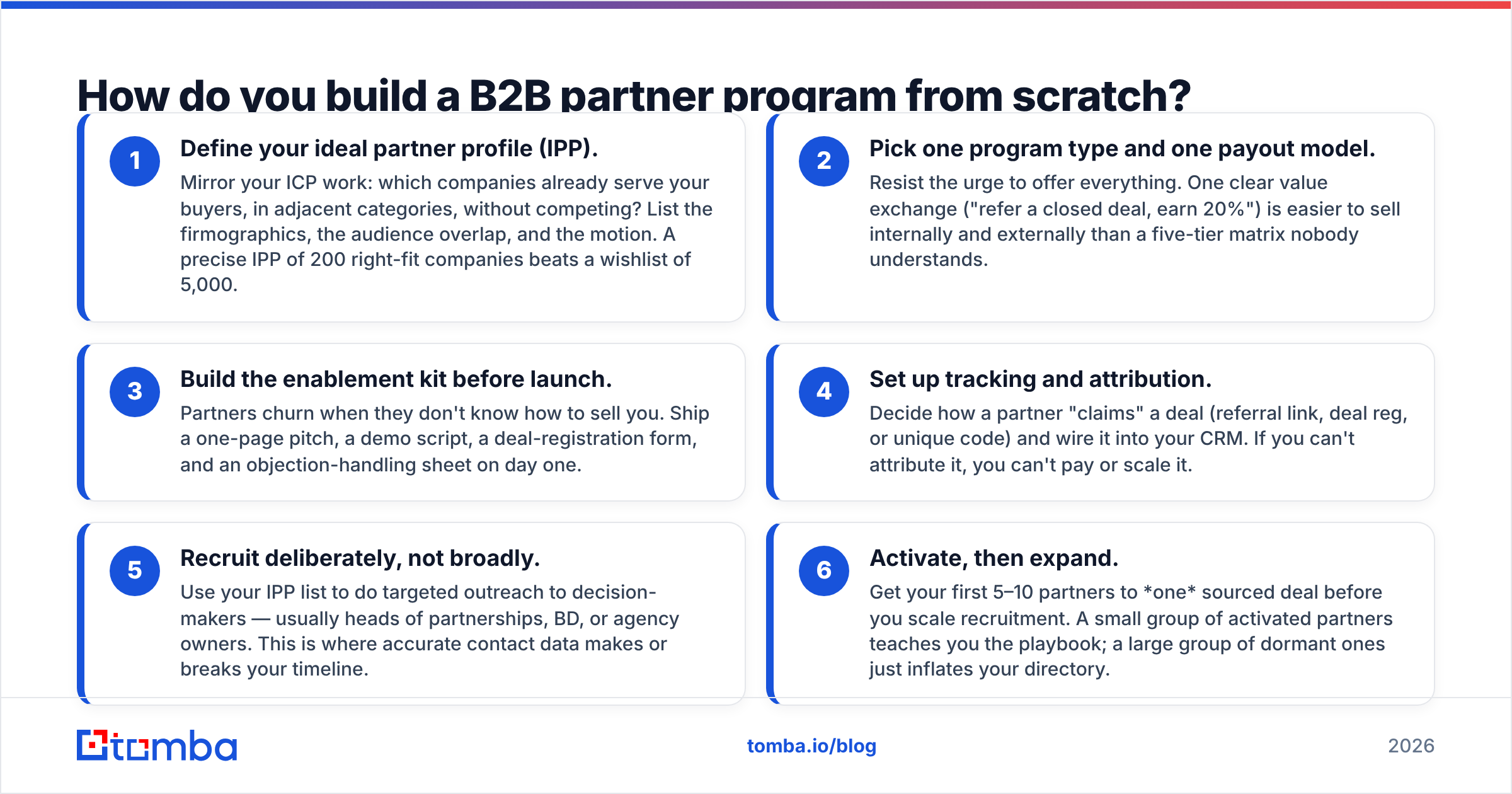
Build the engine before you recruit the drivers. Here is the sequence that works, in order:
- Define your ideal partner profile (IPP). Mirror your ICP work: which companies already serve your buyers, in adjacent categories, without competing? List the firmographics, the audience overlap, and the motion. A precise IPP of 200 right-fit companies beats a wishlist of 5,000.
- Pick one program type and one payout model. Resist the urge to offer everything. One clear value exchange ("refer a closed deal, earn 20%") is easier to sell internally and externally than a five-tier matrix nobody understands.
- Build the enablement kit before launch. Partners churn when they don't know how to sell you. Ship a one-page pitch, a demo script, a deal-registration form, and an objection-handling sheet on day one.
- Set up tracking and attribution. Decide how a partner "claims" a deal (referral link, deal reg, or unique code) and wire it into your CRM. If you can't attribute it, you can't pay or scale it.
- Recruit deliberately, not broadly. Use your IPP list to do targeted outreach to decision-makers — usually heads of partnerships, BD, or agency owners. This is where accurate contact data makes or breaks your timeline.
- Activate, then expand. Get your first 5–10 partners to one sourced deal before you scale recruitment. A small group of activated partners teaches you the playbook; a large group of dormant ones just inflates your directory.
The single point that quietly kills most launches is step 5. Teams build a beautiful portal and then try to recruit partners with a generic LinkedIn blast. To reach the right person at the right company, you need their direct work email — which is exactly where an email finder and data enrichment replace weeks of manual digging.
What metrics prove a B2B partner program is working?#
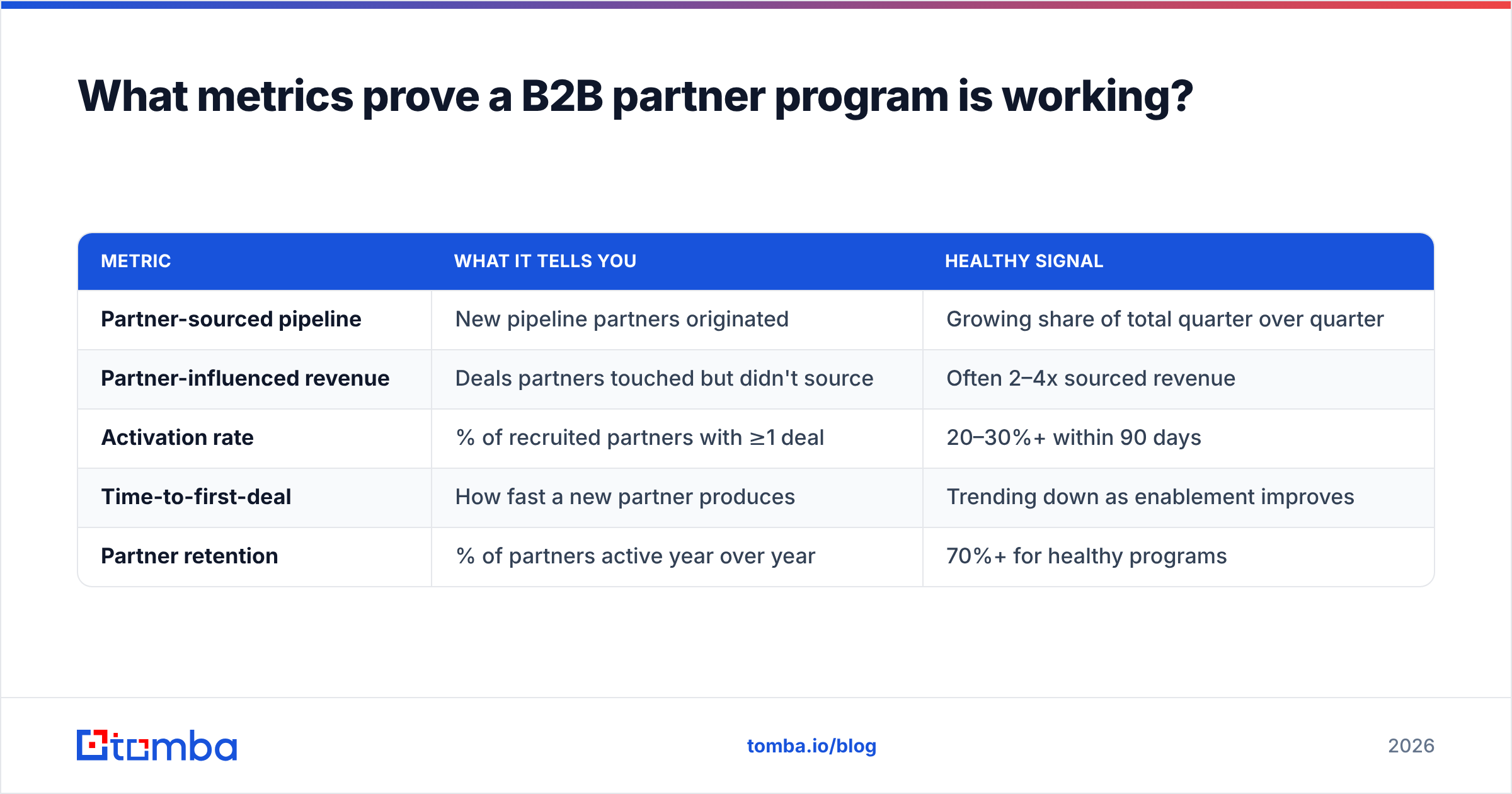
Signups are a vanity metric. Revenue contribution is the truth. Track these instead:
| Metric | What it tells you | Healthy signal |
|---|---|---|
| Partner-sourced pipeline | New pipeline partners originated | Growing share of total quarter over quarter |
| Partner-influenced revenue | Deals partners touched but didn't source | Often 2–4x sourced revenue |
| Activation rate | % of recruited partners with ≥1 deal | 20–30%+ within 90 days |
| Time-to-first-deal | How fast a new partner produces | Trending down as enablement improves |
| Partner retention | % of partners active year over year | 70%+ for healthy programs |
If your activation rate is in the single digits, the problem is enablement or partner fit — not the number of partners. Fix the funnel before you pour more recruits into it. Pair this with your broader win rate tracking so leadership sees the channel's full contribution, not just its top line.
What tools and data power a partner program?#
A partner program runs on three layers of tooling: recruitment data, a partner platform (PRM), and attribution inside your CRM.
The platform layer gets the attention — tools like PartnerStack, Crossbeam, and Reveal handle deal registration, account mapping, and commissions. You can compare options on G2 before committing. But the layer teams underestimate is data, and it touches every stage:
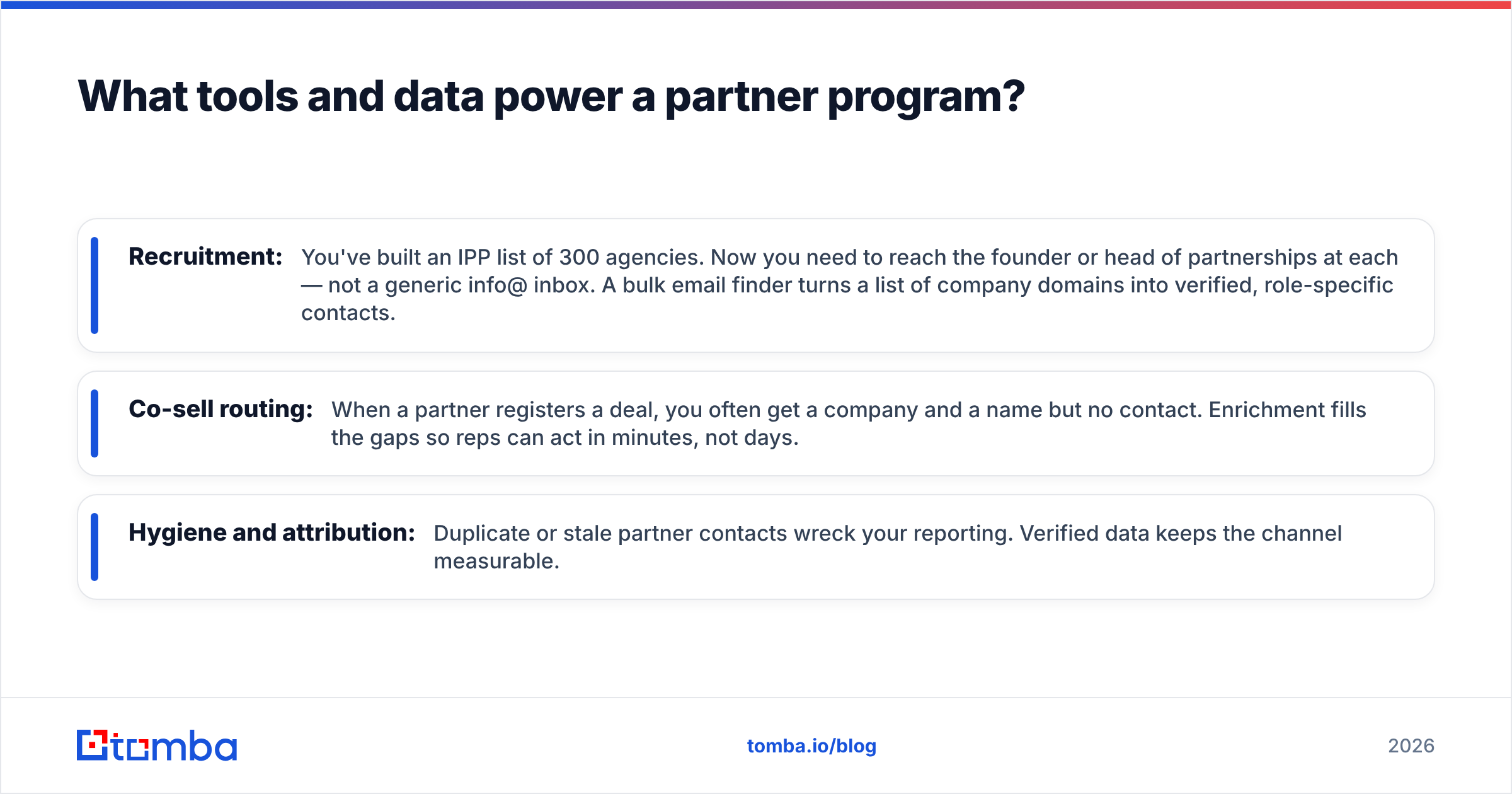
- Recruitment: You've built an IPP list of 300 agencies. Now you need to reach the founder or head of partnerships at each — not a generic info@ inbox. A bulk email finder turns a list of company domains into verified, role-specific contacts.
- Co-sell routing: When a partner registers a deal, you often get a company and a name but no contact. Enrichment fills the gaps so reps can act in minutes, not days.
- Hygiene and attribution: Duplicate or stale partner contacts wreck your reporting. Verified data keeps the channel measurable.
For programmatic teams, the Tomba API lets you wire email finding and verification directly into your PRM or CRM workflow, so partner records are enriched automatically the moment a deal is registered. And if you'd rather earn from a program than build one this quarter, Tomba's own affiliate program is a low-effort way to test the referral motion end to end.
What are the most common B2B partner program mistakes?#
Avoiding these saves you the most common 12-month false start:
- Recruiting before enabling. A partner with no pitch deck and no demo script will not sell you. Build the kit first.
- Too many tiers, too soon. Bronze/Silver/Gold/Platinum looks professional and confuses everyone. Start flat.
- Paying for signups instead of outcomes. Reward sourced revenue, not registrations, or you'll attract list-builders, not sellers.
- No internal owner. Partnerships fail when they're "everyone's job." Assign a dedicated owner with a number.
- Ignoring data hygiene. If you can't reliably reach partners or attribute their deals, the program becomes unmeasurable — and unfunded.
- Treating partners like vendors. The best programs feel like a two-way alliance: shared leads, co-marketing, and genuine support, not a one-way commission pipe.
Frequently asked questions#
How long before a B2B partner program produces revenue? Expect 3–6 months to your first sourced deals if you recruit deliberately and enable well. Programs that launch broad without enablement often take a year or never activate.
How many partners do I need to start? Five to ten activated partners beat hundreds of dormant ones. Prove the playbook small, then scale recruitment against your IPP.
Affiliate or reseller — which first? Match it to your price point. Self-serve, lower-ACV products start with affiliate/referral; consultative, higher-ACV products lean reseller or agency.
What's the cheapest way to test the model? Run a simple referral program with a single payout, track deals in your CRM, and use verified contact data to recruit a focused first cohort. You can scale the tooling once the motion proves out.
Start building your partner pipeline today#
Every partner program lives or dies on one thing: reaching the right person at the right company and routing clean data through your funnel. Before you buy a PRM or design a tier structure, make sure you can actually contact the partners on your IPP list. Tomba's Email Finder turns company domains and names into verified, role-specific emails — so your recruitment outreach lands with founders and partnership leads instead of bouncing off generic inboxes. Start on the free tier (25 searches/month), then scale to the Starter plan at $49/mo as your program grows. Build the channel on data you can trust, and the revenue follows.
// get started
Find, verify and enrich your first contacts today
Start on the free plan with 25 searches a month, then scale when your team is ready.
Free plan · No credit card required · GDPR & CCPA
// about the author