B2B Predictive Analytics in 2026: The Complete Sales Guide
Most B2B teams still rank leads on gut feel. Predictive analytics scores every account on real signals — here's how it works, what it costs, and which tools win in 2026.
TL;DR
- B2B predictive analytics uses historical CRM data, firmographics, and behavioral signals to score which accounts and leads are most likely to convert — so reps work the best opportunities first.
- It is not magic. A model is only as good as the data feeding it; dirty contact records and stale firmographics sink accuracy faster than any algorithm choice.
- The biggest wins are in lead scoring, account prioritization, churn prediction, and pipeline forecasting — not in replacing your sales team.
- Tooling ranges from native CRM add-ons (HubSpot, Salesforce Einstein) to dedicated platforms (6sense, MadKudu). Pricing spans free CRM features to $50k+/year enterprise contracts.
- You can start small: clean your data, define one conversion event, and score leads on five signals before you ever buy a dedicated platform.
What is B2B predictive analytics?#
B2B predictive analytics is the practice of using past data to forecast future buyer behavior — which leads will convert, which accounts will churn, and which deals will close this quarter.
Think of it like a weather forecast for your pipeline. A meteorologist doesn't know it will rain; they look at pressure, humidity, and wind patterns that preceded rain in the past, then assign a probability. Predictive analytics does the same with your sales data: it studies the patterns that preceded closed-won deals and assigns each new lead a probability of converting.
Technically, it's a set of statistical and machine-learning models — logistic regression, gradient boosting, sometimes neural networks — trained on labeled historical outcomes. The model learns which combinations of attributes (company size, tech stack, page visits, email opens) correlate with the outcome you care about.
The key shift is from descriptive analytics ("what happened last quarter") to predictive ("what will happen next"). Most B2B teams already have dashboards telling them what closed. Predictive analytics tells them where to spend tomorrow morning.
How does B2B predictive analytics actually work?#
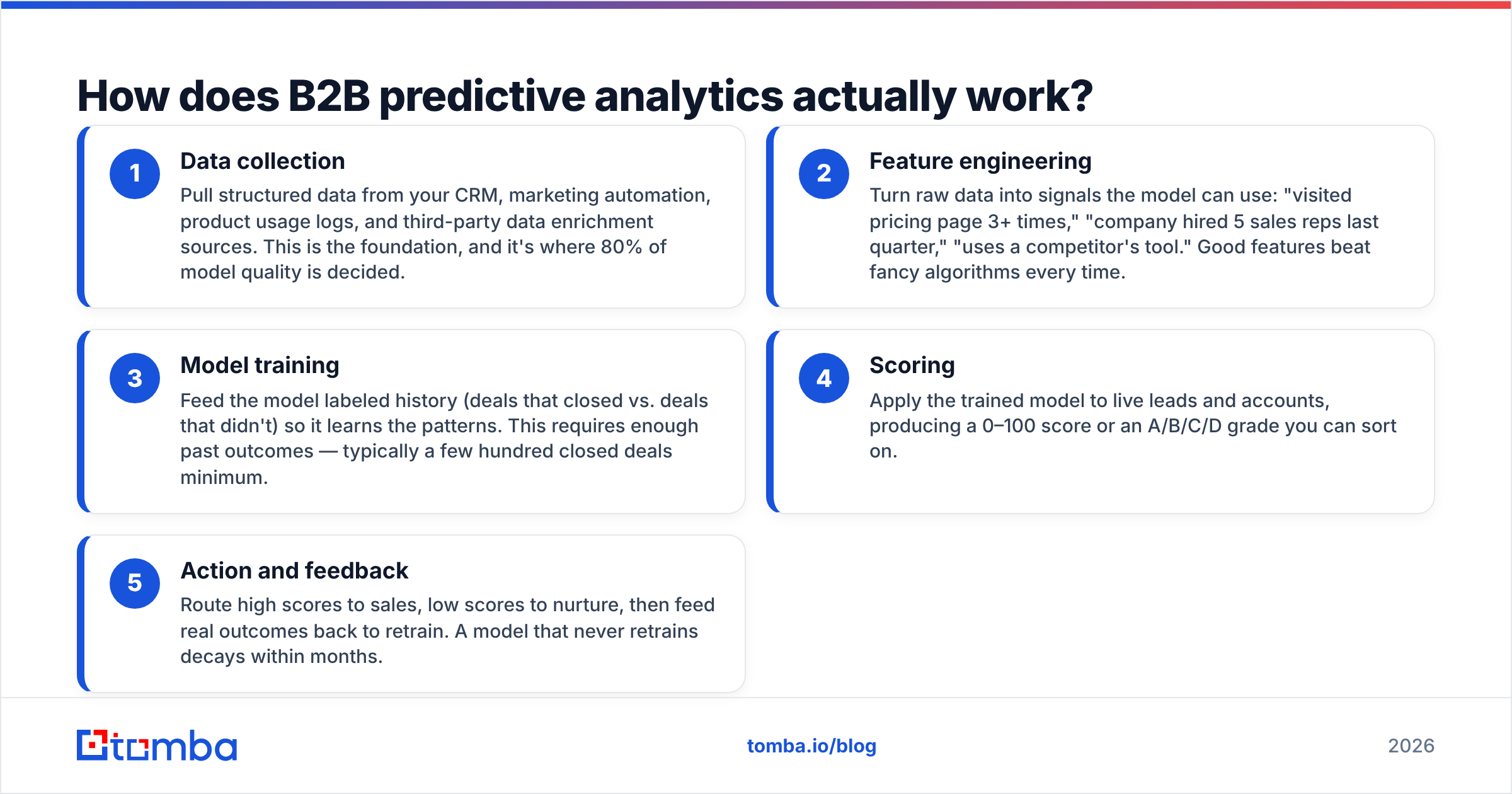
Every predictive system, whether a $50k platform or a spreadsheet, follows the same five stages. Understanding them tells you exactly where most projects fail.
- Data collection — Pull structured data from your CRM, marketing automation, product usage logs, and third-party data enrichment sources. This is the foundation, and it's where 80% of model quality is decided.
- Feature engineering — Turn raw data into signals the model can use: "visited pricing page 3+ times," "company hired 5 sales reps last quarter," "uses a competitor's tool." Good features beat fancy algorithms every time.
- Model training — Feed the model labeled history (deals that closed vs. deals that didn't) so it learns the patterns. This requires enough past outcomes — typically a few hundred closed deals minimum.
- Scoring — Apply the trained model to live leads and accounts, producing a 0–100 score or an A/B/C/D grade you can sort on.
- Action and feedback — Route high scores to sales, low scores to nurture, then feed real outcomes back to retrain. A model that never retrains decays within months.
The uncomfortable truth: stages 1 and 2 determine success. A team obsessing over which algorithm to use while feeding the model duplicate contacts and three-year-old job titles is polishing the hubcaps on a car with no engine. Clean, current B2B data — accurate emails, verified firmographics, real intent — is the actual lever.
Why does data quality matter more than the algorithm?#
Bad data produces confident, wrong predictions. A model trained on stale records will happily score a lead 95/100 even though that person left the company eight months ago.
Here's the chain of damage when your underlying data is dirty:
- Garbage features — If 30% of your contact emails bounce, every "email engagement" signal is corrupted, and the model learns from noise.
- Mislabeled outcomes — Duplicate accounts split one closed deal across two records, so the model sees two half-signals instead of one strong one.
- Drift you can't see — Firmographics like headcount and funding change constantly; a model fed last year's snapshot predicts against a company that no longer exists.
This is why serious predictive programs start with enrichment and verification, not data science. Before you score anything, you want verified contact data and a clean B2B database underneath it. Tools that find and validate emails, fill in firmographic gaps, and dedupe records do more for model accuracy than swapping logistic regression for a neural net ever will.
According to Gartner, poor data quality costs organizations millions annually in wasted effort and bad decisions — and predictive models amplify that cost because they act on the bad data at scale and speed.
What can you predict in a B2B sales motion?#
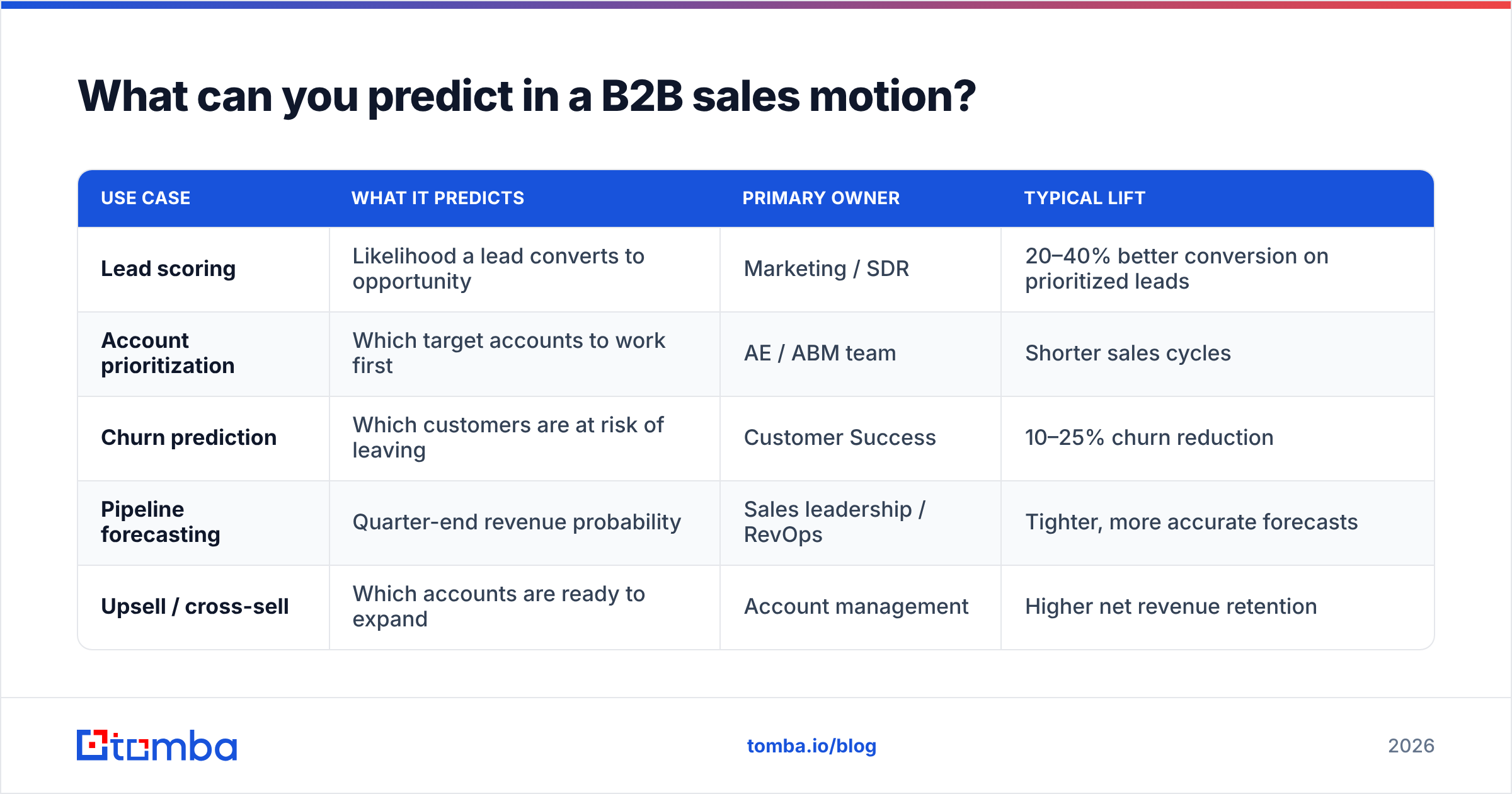
Predictive analytics isn't one use case. It's a toolkit applied to several high-value questions across the revenue funnel.
| Use case | What it predicts | Primary owner | Typical lift |
|---|---|---|---|
| Lead scoring | Likelihood a lead converts to opportunity | Marketing / SDR | 20–40% better conversion on prioritized leads |
| Account prioritization | Which target accounts to work first | AE / ABM team | Shorter sales cycles |
| Churn prediction | Which customers are at risk of leaving | Customer Success | 10–25% churn reduction |
| Pipeline forecasting | Quarter-end revenue probability | Sales leadership / RevOps | Tighter, more accurate forecasts |
| Upsell / cross-sell | Which accounts are ready to expand | Account management | Higher net revenue retention |
The mistake teams make is trying to do all five at once. Pick the one tied to your current bottleneck. Drowning SDRs in unqualified leads? Start with lead scoring. Forecasts always wrong? Start with pipeline modeling. One use case done well builds the credibility (and clean data pipeline) for the next.
What are the best B2B predictive analytics tools in 2026?#
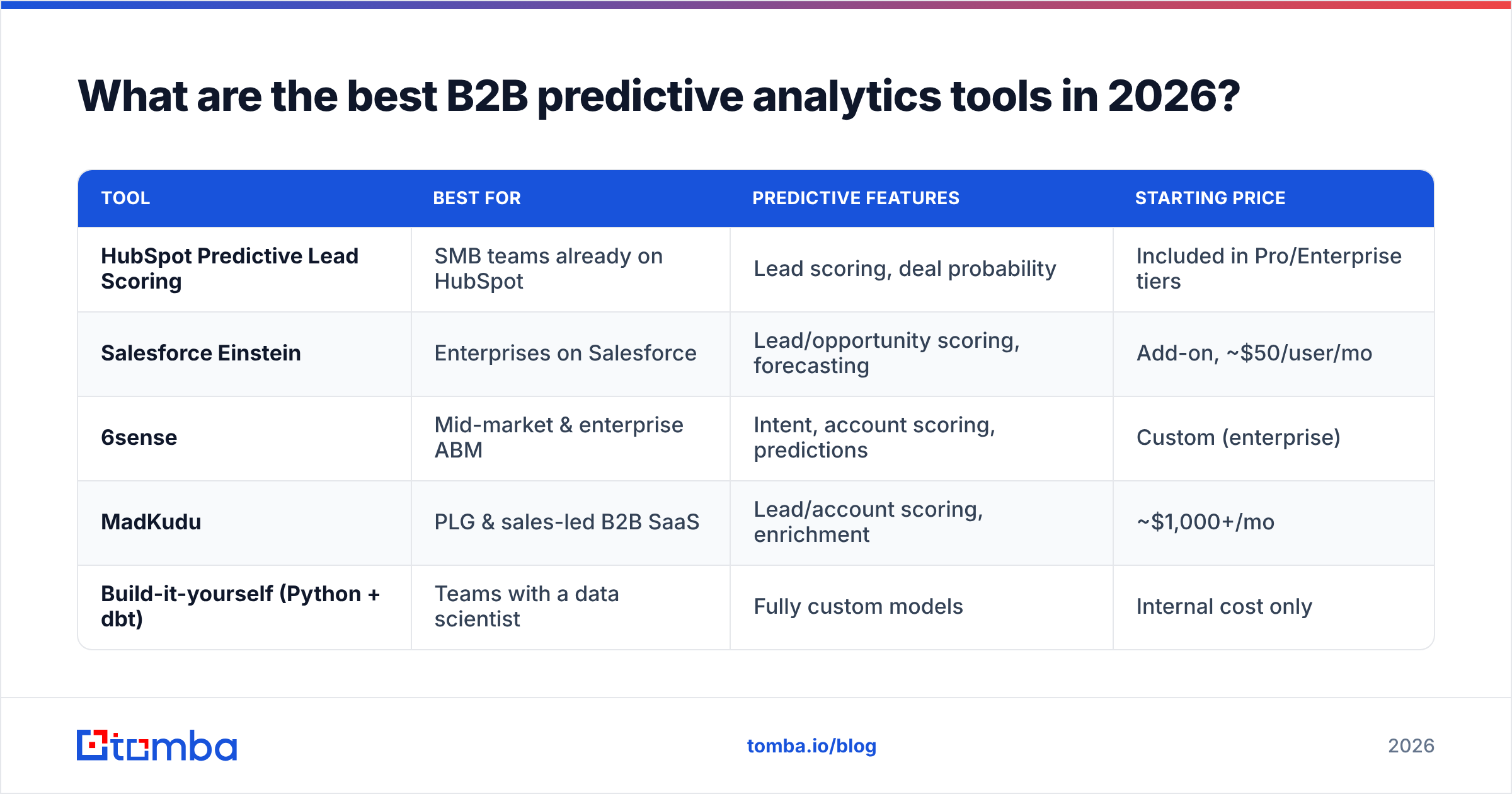
The market splits into three tiers: native CRM features, dedicated predictive/intent platforms, and the data layer that feeds them all. Here's an honest comparison.
| Tool | Best for | Predictive features | Starting price |
|---|---|---|---|
| HubSpot Predictive Lead Scoring | SMB teams already on HubSpot | Lead scoring, deal probability | Included in Pro/Enterprise tiers |
| Salesforce Einstein | Enterprises on Salesforce | Lead/opportunity scoring, forecasting | Add-on, ~$50/user/mo |
| 6sense | Mid-market & enterprise ABM | Intent, account scoring, predictions | Custom (enterprise) |
| MadKudu | PLG & sales-led B2B SaaS | Lead/account scoring, enrichment | ~$1,000+/mo |
| Build-it-yourself (Python + dbt) | Teams with a data scientist | Fully custom models | Internal cost only |
A few honest notes on this table:
- Native CRM scoring (HubSpot, Salesforce) is the right starting point for most teams. It's already in your stack, and the HubSpot lead scoring documentation shows you can stand up a basic model in an afternoon.
- Dedicated platforms like 6sense add third-party intent data — signals from across the web, not just your own funnel. That's powerful for net-new account discovery but expensive and overkill for sub-50-person sales teams. (If you're evaluating that category, our 6sense alternative breakdown compares the trade-offs.)
- DIY gives you total control and no per-seat fees, but you own retraining, monitoring, and the data engineering. It only pays off when you have the talent in-house.
- Read real reviews on G2 before committing — vendor demos always look better than production.
Whichever tier you choose, none of them ships with your contact data. They model on what you feed them, which brings us back to the data layer.
Is predictive analytics worth it for small B2B teams?#
Yes — but probably not the enterprise platform you're picturing. For a team under 25 reps, the ROI comes from clean data and simple scoring, not a six-figure intent platform.
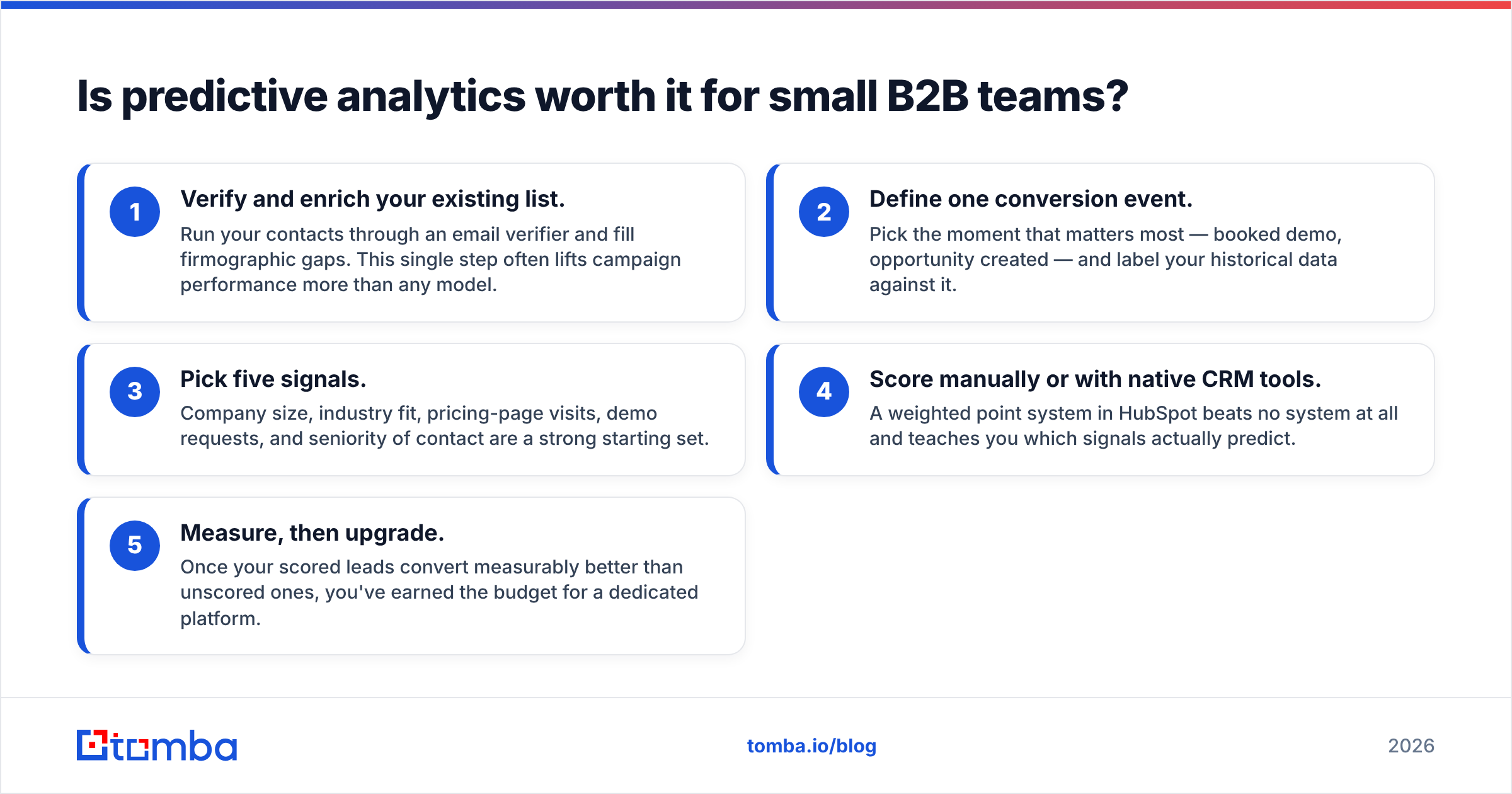
Here's a realistic starter path that costs almost nothing:
- Verify and enrich your existing list. Run your contacts through an email verifier and fill firmographic gaps. This single step often lifts campaign performance more than any model.
- Define one conversion event. Pick the moment that matters most — booked demo, opportunity created — and label your historical data against it.
- Pick five signals. Company size, industry fit, pricing-page visits, demo requests, and seniority of contact are a strong starting set.
- Score manually or with native CRM tools. A weighted point system in HubSpot beats no system at all and teaches you which signals actually predict.
- Measure, then upgrade. Once your scored leads convert measurably better than unscored ones, you've earned the budget for a dedicated platform.
The companies that fail at predictive analytics usually skipped step 1 and jumped to step 5. They bought the platform, fed it dirty data, got noisy predictions, and concluded "AI doesn't work for us." The platform was never the problem.
How do you keep a predictive model accurate over time?#
A model is a snapshot, and your market is a movie. Without maintenance, accuracy decays — a phenomenon data scientists call model drift.
Three disciplines keep predictions sharp:
- Continuous data hygiene. Job changes, company moves, and email churn never stop. Re-verify and re-enrich contacts on a schedule, not once. This is where ongoing access to fresh data sources matters as much as the initial load.
- Scheduled retraining. Feed real outcomes back into the model monthly or quarterly. The patterns that predicted conversion in 2024 are not the same ones that predict it in 2026.
- Score-vs-reality audits. Track whether your A-grade leads actually close at higher rates than B-grades. If the grades stop separating, the model has drifted and needs attention.
Forrester research on revenue operations consistently ties this kind of closed-loop measurement to higher win rates — the teams that audit and retrain outperform the ones that "set and forget."
What are the common mistakes to avoid?#
Most predictive analytics failures repeat the same handful of errors. Watch for these:
- Predicting without enough history. Fewer than a few hundred labeled outcomes means the model is guessing with false confidence. Wait until you have signal.
- Optimizing the algorithm, ignoring the inputs. As covered above, data quality dwarfs algorithm choice. Spend your effort on enrichment and verification first.
- No human override. Scores guide reps; they don't replace judgment. A brilliant deal sometimes scores low because it's unusual — let reps flag those.
- Treating it as a one-time project. Predictive analytics is a program, not a launch. Budget for ongoing data and retraining or expect decay.
- Ignoring explainability. If reps don't understand why a lead scored high, they won't trust the score, and an ignored model delivers zero ROI.
How does Tomba fit into a predictive analytics stack?#
Tomba sits at the foundation layer — the data your model learns from. Predictive analytics rises or falls on whether your contact and company records are accurate, complete, and current, and that's exactly what Tomba's data products deliver.
Use the Tomba Email Finder to discover and validate professional email addresses across your target accounts, then enrich those records with firmographic and contact detail so your scoring model trains on real, verified signals instead of noise. For teams building lists at scale, the bulk email finder and domain search feed clean contacts straight into your CRM and predictive pipeline — and you can start on the free tier (25 searches/month) before scaling to the Starter plan at $49/mo. Check the full Tomba pricing to match a plan to your data volume.
The best algorithm in the world can't fix a bad email. Get the data right first, and the predictions follow. Start with a clean, verified foundation from Tomba, and let your predictive model do what it's actually good at — finding the patterns hiding in accurate data.
// get started
Find, verify and enrich your first contacts today
Start on the free plan with 25 searches a month, then scale when your team is ready.
Free plan · No credit card required · GDPR & CCPA
// about the author