Best B2B Prospecting Tool UK in 2026: Compare Top Picks
Choosing a B2B prospecting tool in the UK means balancing GDPR, data accuracy, and price. Here's how the top platforms actually compare in 2026.
TL;DR
- A B2B prospecting tool for the UK has to clear three bars at once: accurate UK contact data, defensible GDPR/PECR compliance, and pricing that survives a tight 2026 budget.
- Most "global" tools have shallow UK coverage outside London and the FTSE 350 — verify a sample before you commit a year of spend.
- Email accuracy and a built-in verifier matter more than raw database size; a 200M-record database is useless if half the UK rows bounce.
- For lean UK teams, a focused email-finder-plus-verifier stack (like Tomba) often beats a bloated all-in-one suite on cost per usable lead.
- Below: a side-by-side comparison table, a GDPR checklist, and guidance on matching the tool to your motion.
If you sell into the UK market, your prospecting tool quietly decides your whole pipeline. Pick one with thin UK data and you'll spend reps' hours chasing bounced emails and dead numbers. Pick one that ignores GDPR and you inherit legal risk you can't see until it's expensive. This guide cuts through the vendor noise and shows you how to choose a B2B prospecting tool that actually works for UK selling in 2026.
What is a B2B prospecting tool?#
A B2B prospecting tool is software that finds, verifies, and enriches contact data for the companies and people you want to sell to. Think of it as a research assistant who never sleeps: you describe the account or person, and it returns a work email, a direct dial, a LinkedIn profile, and the firmographic context your rep needs to write a relevant first line.
The category has split into roughly three shapes, and knowing which one you're buying matters more than any feature checklist:
- All-in-one sales platforms — database, sequencing, and dialer in one login (Apollo, Cognism, Lusha). Powerful, but you pay for modules you may already own.
- Focused data tools — email finders, verifiers, and enrichment APIs that do one job extremely well and plug into the stack you already run (Tomba, ZeroBounce for verification).
- Intent and signal platforms — layer buying signals on top of contact data (6sense, Bombora-fed tools). Useful at scale, overkill for most UK SMB teams.
Most UK teams over-buy. They purchase a £15k/year suite to get at the contact data, then never touch the sequencing engine because they already run HubSpot or Pipedrive. The smarter move is to separate "where do I get clean UK data" from "where do I send the emails."

What makes a good UK prospecting tool different?#
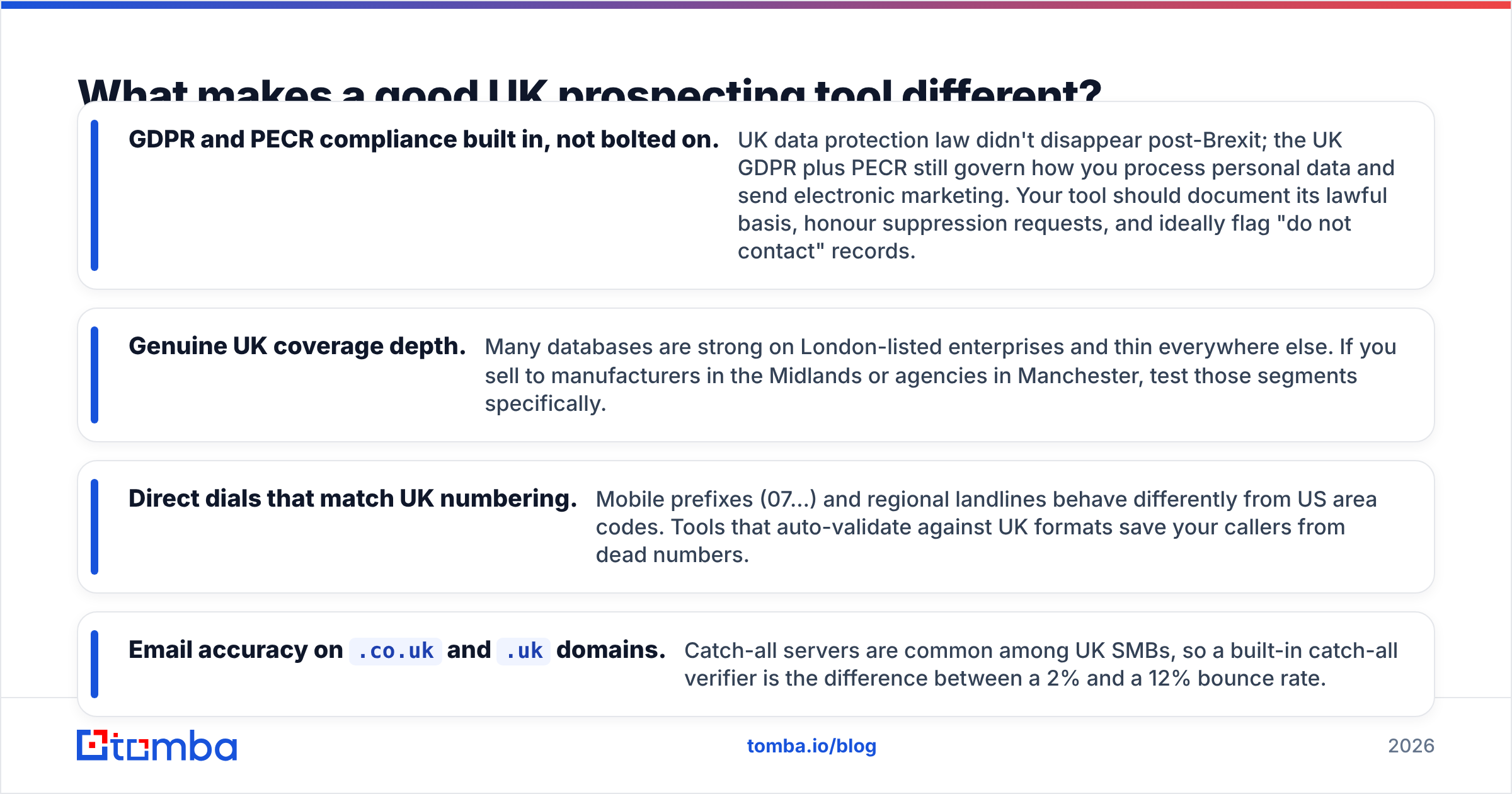
Selling into the UK is not the same as selling into the US, and a tool tuned for North American data will quietly underperform on British accounts. Four things separate a genuine B2B prospecting tool UK buyers should trust from a US tool with a Union Jack on the pricing page.
- GDPR and PECR compliance built in, not bolted on. UK data protection law didn't disappear post-Brexit; the UK GDPR plus PECR still govern how you process personal data and send electronic marketing. Your tool should document its lawful basis, honour suppression requests, and ideally flag "do not contact" records.
- Genuine UK coverage depth. Many databases are strong on London-listed enterprises and thin everywhere else. If you sell to manufacturers in the Midlands or agencies in Manchester, test those segments specifically.
- Direct dials that match UK numbering. Mobile prefixes (07…) and regional landlines behave differently from US area codes. Tools that auto-validate against UK formats save your callers from dead numbers.
- Email accuracy on
.co.ukand.ukdomains. Catch-all servers are common among UK SMBs, so a built-in catch-all verifier is the difference between a 2% and a 12% bounce rate.
The single biggest mistake UK buyers make is trusting headline database size. A vendor claiming "250 million contacts globally" might hold only a few million verified UK records. Always run a sample search on your real ICP before signing.
How do the top B2B prospecting tools for the UK compare?#
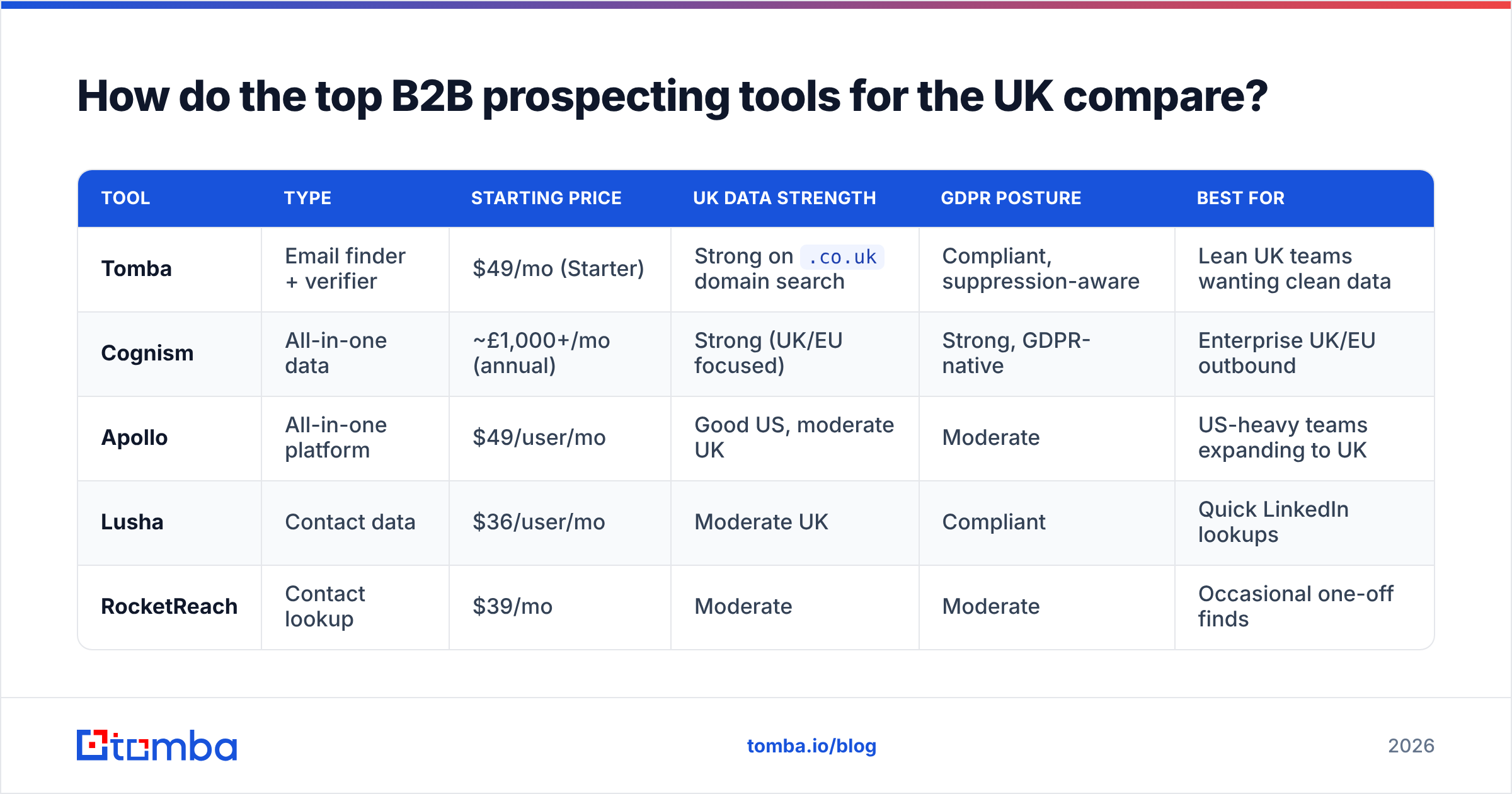
Here's how the most common options stack up for a UK-focused team in 2026. Prices are entry business tiers and change often — treat them as directional and confirm on each vendor's site.
| Tool | Type | Starting price | UK data strength | GDPR posture | Best for |
|---|---|---|---|---|---|
| Tomba | Email finder + verifier | $49/mo (Starter) | Strong on .co.uk domain search |
Compliant, suppression-aware | Lean UK teams wanting clean data |
| Cognism | All-in-one data | ~£1,000+/mo (annual) | Strong (UK/EU focused) | Strong, GDPR-native | Enterprise UK/EU outbound |
| Apollo | All-in-one platform | $49/user/mo | Good US, moderate UK | Moderate | US-heavy teams expanding to UK |
| Lusha | Contact data | $36/user/mo | Moderate UK | Compliant | Quick LinkedIn lookups |
| RocketReach | Contact lookup | $39/mo | Moderate | Moderate | Occasional one-off finds |
A few honest reads on this table. Cognism is the strongest pure-play for UK/EU enterprise outbound, and if you have the budget and a large team, it's a defensible choice — its phone-verified mobile data is genuinely good. But it prices out most SMBs and requires an annual commitment. Apollo is excellent value if your motion is US-first, yet its UK depth thins out below the enterprise tier. Lusha and RocketReach are convenient for spot lookups but weren't built as your primary pipeline engine.
For the large middle of the UK market — agencies, SaaS startups, recruiters, B2B service firms doing focused outbound — a finder-plus-verifier approach wins on cost per usable lead. You pay for accurate emails and verification, not for a sequencing engine you'll never log into. Compare the full Tomba pricing against a per-seat suite and the maths usually favours the focused tool for teams under 20 reps.
Is an all-in-one platform better than a focused email finder?#
It depends on what you already own. Conclusion first: if you have no CRM and no sending tool, an all-in-one can simplify procurement; if you already run a CRM and a sequencer, a focused data tool gives you better data at a fraction of the cost.
The all-in-one pitch is seductive — "one login, one invoice." The reality is that you rarely use every module equally. You bought it for the data, but you're paying for the dialer, the Chrome extension, the analytics dashboard, and three other things your existing stack already does. That bundled cost is dead weight on your cost-per-lead.
A focused tool inverts the logic. You get the email finder, email verifier, and data enrichment as an API or extension, then pipe results into the HubSpot, Salesforce, or Pipedrive instance you already pay for. You're buying the one thing that's hard to replicate — accurate data — and nothing else.

Here's a simple decision rule:
- Choose all-in-one if you're starting from zero tooling, have a team large enough to use every module, and budget isn't the constraint.
- Choose a focused finder + verifier if you already own a CRM/sequencer, run a team under ~20 reps, or measure success in cost per booked meeting rather than seats deployed.
How do you stay GDPR-compliant while prospecting in the UK?#
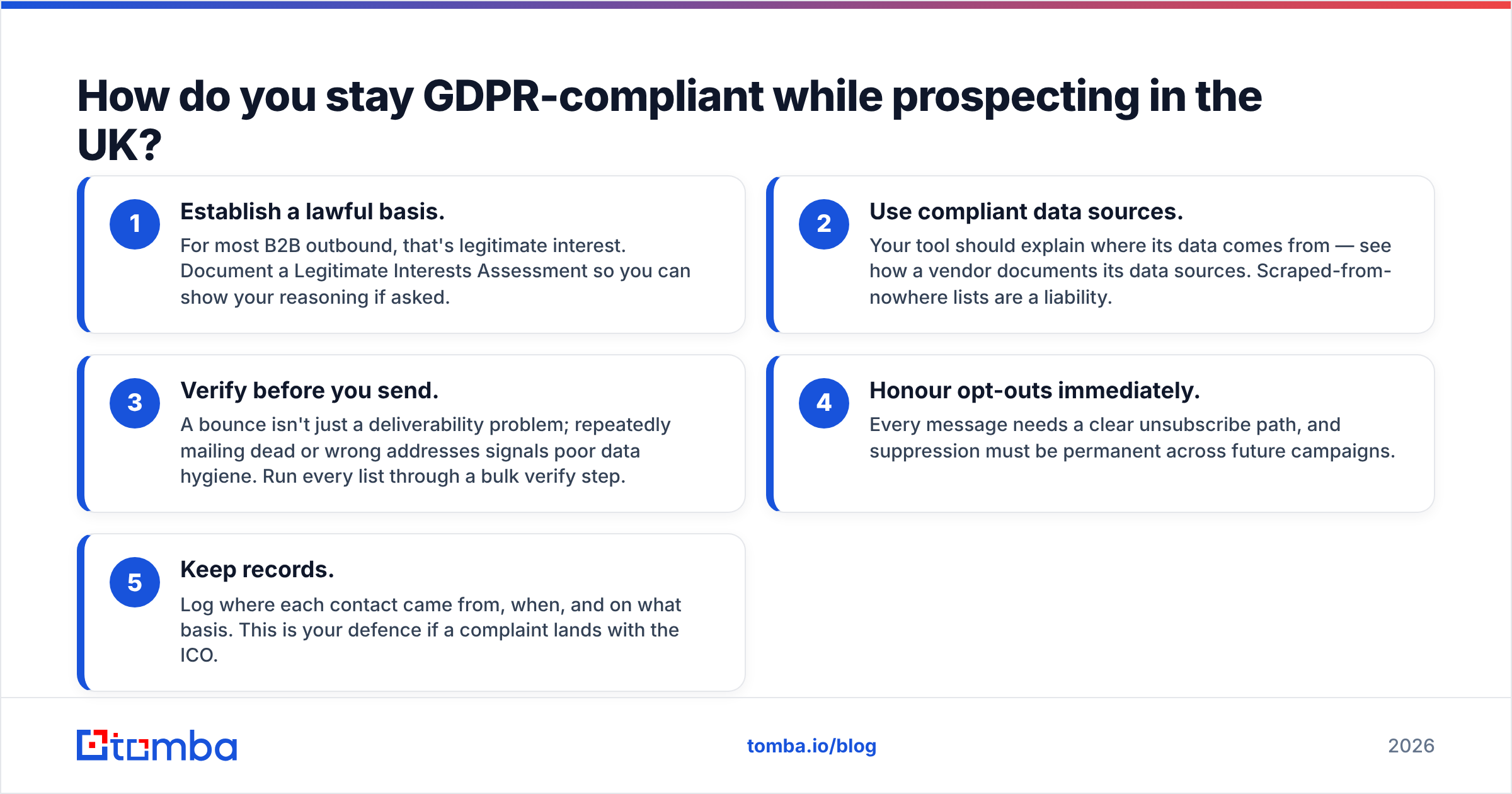
You can prospect B2B in the UK legally, but you have to respect both UK GDPR and PECR. The headline: B2B email outreach to corporate subscribers (limited companies, LLPs) generally relies on legitimate interest, while contacting sole traders and individuals is treated more strictly. None of this is legal advice — confirm with your DPO — but a compliant prospecting workflow looks like this.
- Establish a lawful basis. For most B2B outbound, that's legitimate interest. Document a Legitimate Interests Assessment so you can show your reasoning if asked.
- Use compliant data sources. Your tool should explain where its data comes from — see how a vendor documents its data sources. Scraped-from-nowhere lists are a liability.
- Verify before you send. A bounce isn't just a deliverability problem; repeatedly mailing dead or wrong addresses signals poor data hygiene. Run every list through a bulk verify step.
- Honour opt-outs immediately. Every message needs a clear unsubscribe path, and suppression must be permanent across future campaigns.
- Keep records. Log where each contact came from, when, and on what basis. This is your defence if a complaint lands with the ICO.
For the regulatory baseline, the UK's Information Commissioner's Office publishes plain-English guidance on direct marketing and electronic communications at ico.org.uk. Read it once; it removes most of the fear and most of the guesswork.
The practical upside: tools with strong verification and clear sourcing make compliance easier, not harder. Clean data and good record-keeping are the same discipline that protects your sender reputation and your email deliverability.
What features actually matter when choosing?#
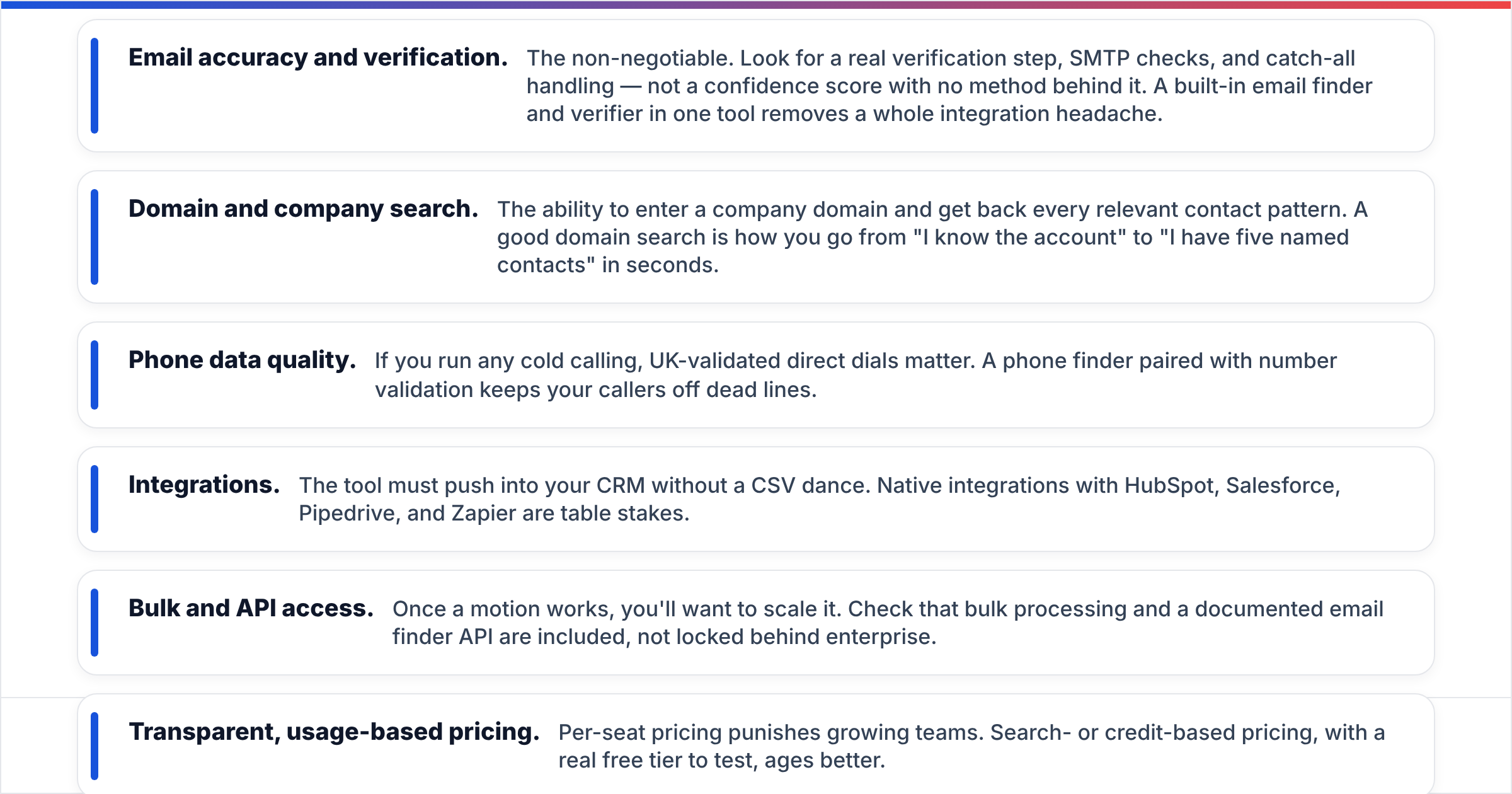
Strip away the marketing and a UK prospecting tool earns its keep on six capabilities. Rank vendors on these, in this order:
- Email accuracy and verification. The non-negotiable. Look for a real verification step, SMTP checks, and catch-all handling — not a confidence score with no method behind it. A built-in email finder and verifier in one tool removes a whole integration headache.
- Domain and company search. The ability to enter a company domain and get back every relevant contact pattern. A good domain search is how you go from "I know the account" to "I have five named contacts" in seconds.
- Phone data quality. If you run any cold calling, UK-validated direct dials matter. A phone finder paired with number validation keeps your callers off dead lines.
- Integrations. The tool must push into your CRM without a CSV dance. Native integrations with HubSpot, Salesforce, Pipedrive, and Zapier are table stakes.
- Bulk and API access. Once a motion works, you'll want to scale it. Check that bulk processing and a documented email finder API are included, not locked behind enterprise.
- Transparent, usage-based pricing. Per-seat pricing punishes growing teams. Search- or credit-based pricing, with a real free tier to test, ages better.
Notice what's not on this list: AI features, dashboards, and "intent signals." Those are nice, but they don't fix a 12% bounce rate or a non-compliant data source. Buy the fundamentals first.
For a sanity check on any tool's review profile before you commit, G2 and Capterra carry verified UK user reviews — filter by company size to find feedback from teams that look like yours.
Which tool should a UK team actually pick?#
Match the tool to your motion, not to the loudest vendor:
- Solo founder or small agency, tight budget: Start with a focused finder on a free or Starter tier. Test your real ICP, verify a sample, scale only when the numbers work.
- Growing SMB sales team (5–20 reps), existing CRM: A finder + verifier feeding your CRM beats a per-seat suite. You keep your workflow and cut cost per lead.
- Enterprise UK/EU outbound, large team, signal-driven: A heavyweight all-in-one or intent platform earns its price — you'll use the modules and need the mobile data depth.
Most readers of this guide sit in the first two buckets, and that's exactly where a lean stack shines. You don't need a £15k contract to run disciplined UK outbound. You need accurate .co.uk emails, a verifier that catches the bounces, and clean handoff into the tools you already trust.
Start prospecting the UK market the smart way#
If you sell into the UK in 2026, lead with data quality and compliance — everything else is downstream of those two. Test before you buy, verify before you send, and don't pay for modules your stack already covers.
The fastest way to feel the difference is to run your own ICP through a focused tool. Tomba's Email Finder lets you search by domain, name, or company, verifies results as it goes, and pushes straight into your CRM — on a free tier of 25 searches a month before you spend a penny, then plans from $49/mo that scale on usage, not seats. Point it at ten UK accounts you care about, check the emails that come back, and let the bounce rate make the decision for you.
// get started
Find, verify and enrich your first contacts today
Start on the free plan with 25 searches a month, then scale when your team is ready.
Free plan · No credit card required · GDPR & CCPA
// about the author