B2B Referral Program: How to Build One That Drives Leads in 2026
A B2B referral program turns happy customers into your cheapest, highest-converting lead source. Here's how to design, launch, and scale one in 2026.
B2B Referral Program: How to Build One That Drives Leads in 2026
Referred leads close faster, churn less, and cost a fraction of what you pay for paid search. Yet most B2B teams treat referrals as a happy accident instead of a system. This guide shows you how to build a B2B referral program that produces warm pipeline on purpose — the structure, the incentives, the tooling, and the numbers to track.
TL;DR#
- A B2B referral program is a repeatable system that rewards customers, partners, and contacts for introducing new buyers — not a one-off "refer a friend" link.
- Referred deals typically convert 2–4x better than cold outbound and carry lower CAC because trust is pre-built.
- The four pillars: a clear ideal-referrer profile, an incentive that fits B2B (cash, credits, co-marketing), frictionless mechanics, and tight attribution.
- You still need data hygiene — enrich and verify every referred contact before it hits your CRM or sequence.
- Measure participation rate, referral-to-opportunity rate, and referred-deal velocity, then iterate quarterly.
What is a B2B referral program?#
A B2B referral program is a structured way to ask your existing customers, partners, and network to introduce you to other companies that fit your ideal customer profile — and to reward them for it consistently.
Think of it like a restaurant with a great regular who keeps bringing friends. You could hope they keep doing it, or you could give them a reason (a free dessert, priority seating) and make it dead simple to bring people along. The second approach is a program; the first is luck. In B2B, the "friends" are other businesses, the rewards are larger, and the sales cycle is longer — so the system has to be deliberate.
The difference between a program and a hope:
- A defined referrer audience — you know exactly who is best positioned to refer (power users, champions, agency partners), not "anyone."
- A documented incentive — the reward, who qualifies, and when it pays out are written down and predictable.
- A frictionless ask — referrers know how to refer in under two minutes, with a link, form, or warm-intro template ready to go.
- Closed-loop attribution — every referral is tracked from introduction to closed-won, so you can pay accurately and prove ROI.
- A feedback loop — you thank referrers, report outcomes, and refine the offer each quarter.
When those five exist, referrals stop being anecdotes and start being a forecastable line on your pipeline.
Why do referrals outperform other B2B channels?#
Referred leads win because trust transfers. When a respected peer says "talk to this vendor," your prospect skips most of the skepticism that kills cold outreach. According to research summarized by HubSpot, referred customers tend to have higher retention and lifetime value than customers acquired through other channels — they arrive pre-qualified by someone who already understands the problem you solve.
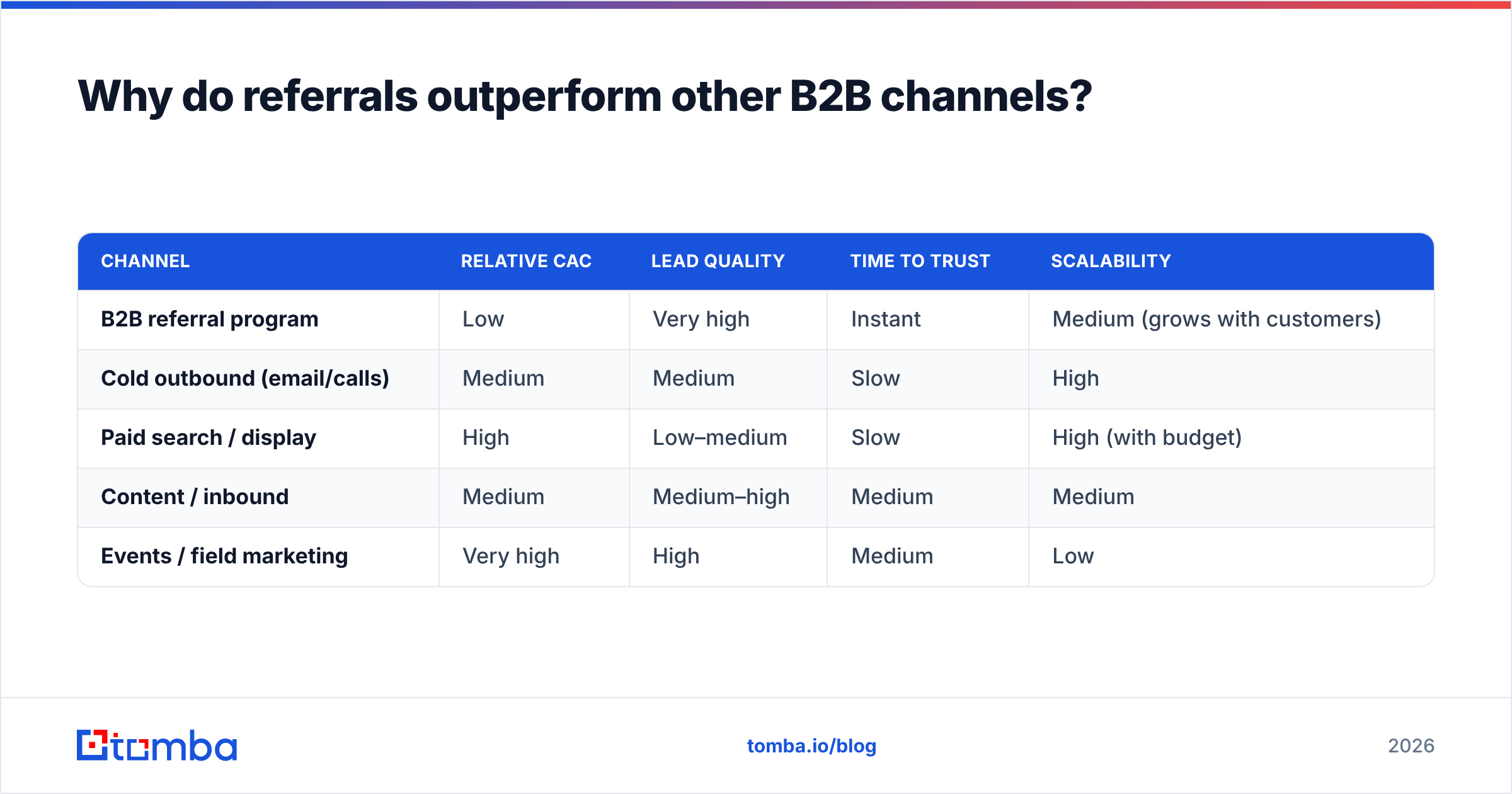
Here is how a referral program stacks up against the channels most B2B teams over-rely on:
| Channel | Relative CAC | Lead quality | Time to trust | Scalability |
|---|---|---|---|---|
| B2B referral program | Low | Very high | Instant | Medium (grows with customers) |
| Cold outbound (email/calls) | Medium | Medium | Slow | High |
| Paid search / display | High | Low–medium | Slow | High (with budget) |
| Content / inbound | Medium | Medium–high | Medium | Medium |
| Events / field marketing | Very high | High | Medium | Low |
The takeaway is not "kill outbound." It is that referrals deserve the same operational rigor you already give to your outbound and paid motions — because per dollar, they usually return more. The smartest teams pair the two: referrals supply warm intros, and a strong email finder fills the gaps when a referrer can give you a name but not a contact.
Who should you ask to refer you?#
Not every customer is a good referrer, and not every referrer is a customer. Segment your potential referral sources so your asks land with the people most likely to say yes.
- Champions and power users — the individuals who log in daily, hit your activation milestones, and have publicly praised you. They have credibility and motivation.
- Recently successful customers — anyone who just hit a measurable win (onboarding completed, ROI realized, renewal signed). Ask while the result is fresh.
- Strategic partners — agencies, consultants, and complementary vendors who serve the same buyer but don't compete. These relationships can produce volume.
- Investors and advisors — well-connected stakeholders who want your growth and can open doors quickly.
- Lapsed-but-happy contacts — former champions who moved companies. They already trust you and now sit in a new account.
For partner and champion referrals, you often get a company name or a LinkedIn profile but no email. That is where enrichment matters: a quick pass through data enrichment or a LinkedIn finder turns a half-introduction into a complete, contactable record without nagging your referrer for details they don't have.
How do you structure B2B referral incentives?#
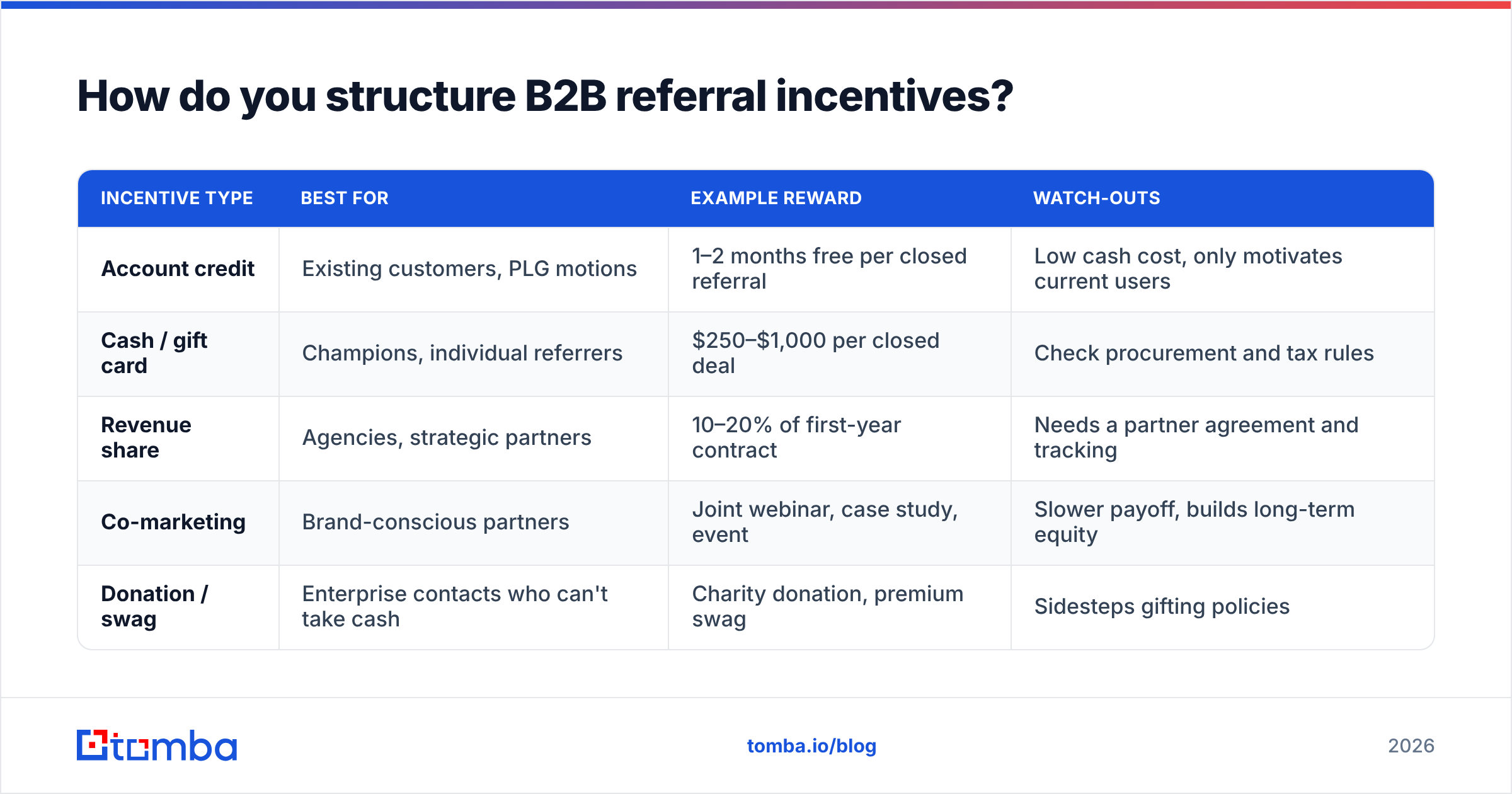
Match the incentive to the referrer's motivation and your deal size. A $200 gift card is insulting on a $90k ACV deal and overkill on a $49/month plan. Use a tiered model so rewards scale with value delivered.
| Incentive type | Best for | Example reward | Watch-outs |
|---|---|---|---|
| Account credit | Existing customers, PLG motions | 1–2 months free per closed referral | Low cash cost, only motivates current users |
| Cash / gift card | Champions, individual referrers | $250–$1,000 per closed deal | Check procurement and tax rules |
| Revenue share | Agencies, strategic partners | 10–20% of first-year contract | Needs a partner agreement and tracking |
| Co-marketing | Brand-conscious partners | Joint webinar, case study, event | Slower payoff, builds long-term equity |
| Donation / swag | Enterprise contacts who can't take cash | Charity donation, premium swag | Sidesteps gifting policies |
Two rules keep incentives clean. First, reward on a qualified outcome, not a raw lead — pay when the referral becomes an opportunity or closes, so you don't drown in junk. Second, make the payout visible and fast. Nothing kills participation like a referrer who never hears what happened to their introduction. If you run a partner tier, document terms the way you document your Tomba pricing — transparent, tiered, and easy to reason about.
How do you launch a referral program step by step?#
You can stand up a credible v1 in a few weeks. Resist the urge to over-engineer before you have proof.
- Pick one referrer segment to start. Usually your happiest customers. Narrow beats broad for a first launch.
- Define the qualifying event and reward. Decide what counts (opportunity vs. closed-won) and what they get. Write it in one paragraph.
- Build the ask and the asset. A short referral form, a unique link, and a copy-paste warm-intro email template. Keep the effort under two minutes.
- Make the in-product and in-email moments. Trigger the ask right after a customer hits a success milestone — a positive NPS response, a renewal, a feature win.
- Set up attribution. Tag referred leads in your CRM with the referrer's name and source so reporting and payouts are automatic.
- Enrich and verify on intake. Before a referred contact enters a sequence, confirm the email is valid and complete the record.
- Close the loop. Notify referrers when their lead progresses, pay promptly, and publicly thank top contributors.
Step six is the one teams skip and regret. A referred name with a guessed or stale email burns your sender reputation and embarrasses you in front of someone a customer vouched for. Run referred contacts through an email verifier before the first send, and use domain search when a referrer gives you a company but not a person.
What tools do you need to run it?#
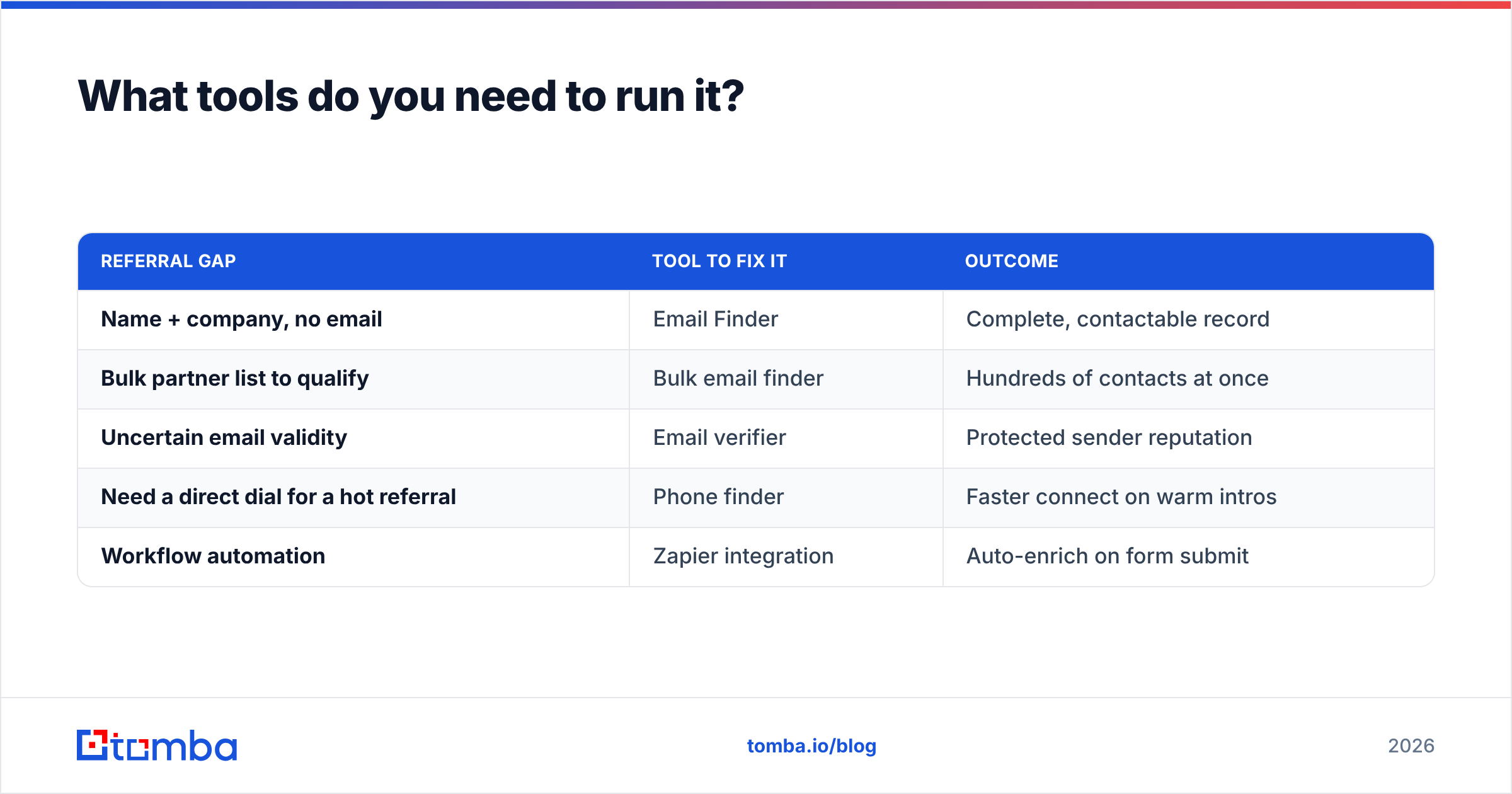
You do not need a dedicated referral platform on day one. You need four capabilities, which you can assemble from tools you likely already own plus a data layer.
- A capture mechanism — a form (Typeform, native), unique referral links, or a partner portal. Start simple.
- A CRM with attribution fields — Salesforce or HubSpot both handle custom source and referrer fields natively. Connect them through Tomba's HubSpot integration or Salesforce integration so enrichment happens where reps work.
- A data and verification layer — to enrich partial referrals and verify deliverability before outreach.
- A reward fulfillment path — gift-card APIs, billing credits, or a partner payout process.
For the data layer specifically, here is how the pieces map to common referral gaps:
| Referral gap | Tool to fix it | Outcome |
|---|---|---|
| Name + company, no email | Email Finder | Complete, contactable record |
| Bulk partner list to qualify | Bulk email finder | Hundreds of contacts at once |
| Uncertain email validity | Email verifier | Protected sender reputation |
| Need a direct dial for a hot referral | Phone finder | Faster connect on warm intros |
| Workflow automation | Zapier integration | Auto-enrich on form submit |
This is also why pairing a referral program with strong outbound data beats running either alone — referrals tell you who to reach, and the data layer makes sure you can actually reach them. For a deeper look at where reliable contact data comes from, see Tomba's data sources.
How do you measure a B2B referral program?#
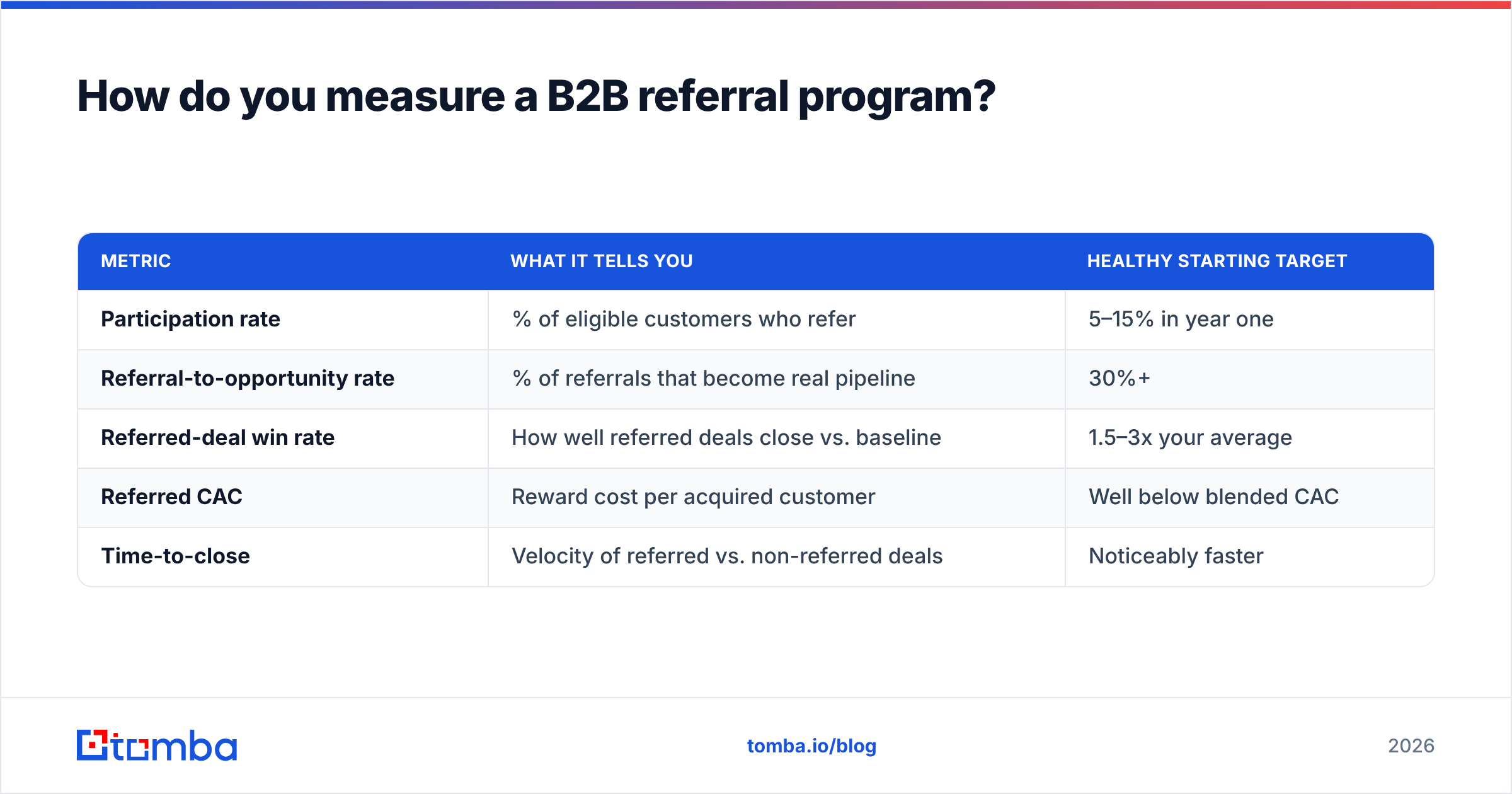
Track participation, conversion, and economics — in that order. A program can have a great close rate and still fail if almost no one participates.
| Metric | What it tells you | Healthy starting target |
|---|---|---|
| Participation rate | % of eligible customers who refer | 5–15% in year one |
| Referral-to-opportunity rate | % of referrals that become real pipeline | 30%+ |
| Referred-deal win rate | How well referred deals close vs. baseline | 1.5–3x your average |
| Referred CAC | Reward cost per acquired customer | Well below blended CAC |
| Time-to-close | Velocity of referred vs. non-referred deals | Noticeably faster |
Review these quarterly, not weekly — B2B cycles are too long for weekly noise to mean anything. If participation is low, the problem is usually the ask (wrong timing, too much friction) or the incentive (too small, too slow). If conversion is low, your referrers may be misaligned on your ICP, so tighten who you ask. For shared definitions across your team, a B2B glossary keeps everyone using "opportunity" and "MQL" the same way.
What mistakes kill B2B referral programs?#
Most failures trace back to a handful of avoidable errors:
- Asking too broadly. "Refer anyone" produces low-quality leads and clutters your pipeline. Specify the ICP in the ask.
- Slow or invisible rewards. If referrers don't see outcomes and payouts quickly, they stop.
- Bad data on intake. Sending to unverified, guessed emails damages deliverability and the referrer's trust.
- No attribution. If you can't trace a closed deal back to a referrer, you can't pay fairly or prove ROI — and the program quietly dies.
- Treating it as a campaign, not a system. Referrals compound when they're always-on and tied to customer success moments, not a one-time email blast.
Avoid these and you have a channel that gets cheaper and stronger as your customer base grows — the opposite of paid acquisition, which gets more expensive as you scale.
Final takeaway and next step#
A B2B referral program is the rare growth lever that improves your unit economics while improving your win rate. Build it as a system: choose the right referrers, offer an incentive that fits B2B deal sizes, remove friction from the ask, and — critically — keep your contact data clean so every warm introduction actually reaches a real inbox.
That last piece is where Tomba fits. When a customer or partner hands you a name and a company but no email, the Tomba Email Finder completes the record, verifies it's deliverable, and drops it straight into your CRM so your reps can act on the introduction while it's still warm. Start on the free tier (25 searches a month), and scale to a paid plan once your referral pipeline proves itself. Turn the introductions you're already earning into contacts you can actually close.
Ready to find emails that actually work?
Join 150,000+ professionals who stopped guessing and started sending. Free credits on signup — no credit card required.
Get the Tomba newsletter
Practical outbound tactics and product updates — once every two weeks.
About the author