B2B Relationship Marketing: The 2026 Playbook for Lasting Deals
B2B relationship marketing trades spray-and-pray for trust that compounds. Here is how to build it in 2026 — frameworks, metrics, tools, and a tactical playbook.
TL;DR
- B2B relationship marketing prioritizes long-term trust and retention over one-shot conversions — the goal is a buyer who renews, expands, and refers.
- It works because B2B deals are high-value, multi-stakeholder, and slow; the vendor people trust wins, not the one who emails loudest.
- The 2026 playbook blends personalized outreach, account-based plays, customer marketing, and community — measured by retention, NRR, and lifetime value, not open rates.
- Accurate contact data is the foundation: you cannot nurture a relationship with a bounced email or the wrong stakeholder.
- Start small — pick 20 priority accounts, map the buying committee, enrich the data, and run one genuinely useful touch per month.
What is B2B relationship marketing?#
B2B relationship marketing is a strategy that treats every account as a long-term partnership rather than a single transaction. Instead of optimizing for the next click, you optimize for the next five years — renewals, upsells, expansions, and referrals.
Think of it like the difference between a food truck and a neighborhood restaurant. The food truck wants volume today and never sees you again. The neighborhood restaurant learns your order, remembers your name, and earns a customer who comes back weekly and brings friends. In B2B, where a single account can be worth six or seven figures over its lifetime, the restaurant model wins almost every time.
Technically, relationship marketing spans the entire lifecycle: awareness, evaluation, purchase, onboarding, adoption, renewal, and advocacy. It pulls marketing, sales, and customer success into one motion aimed at a single outcome — a customer who stays and grows.

Why does relationship marketing matter more in B2B than B2C?#
The short answer: B2B purchases are bigger, slower, and made by committees. According to Gartner, a typical B2B buying group involves six to ten decision-makers, each armed with their own research. You are not persuading a person — you are earning the trust of a coalition.
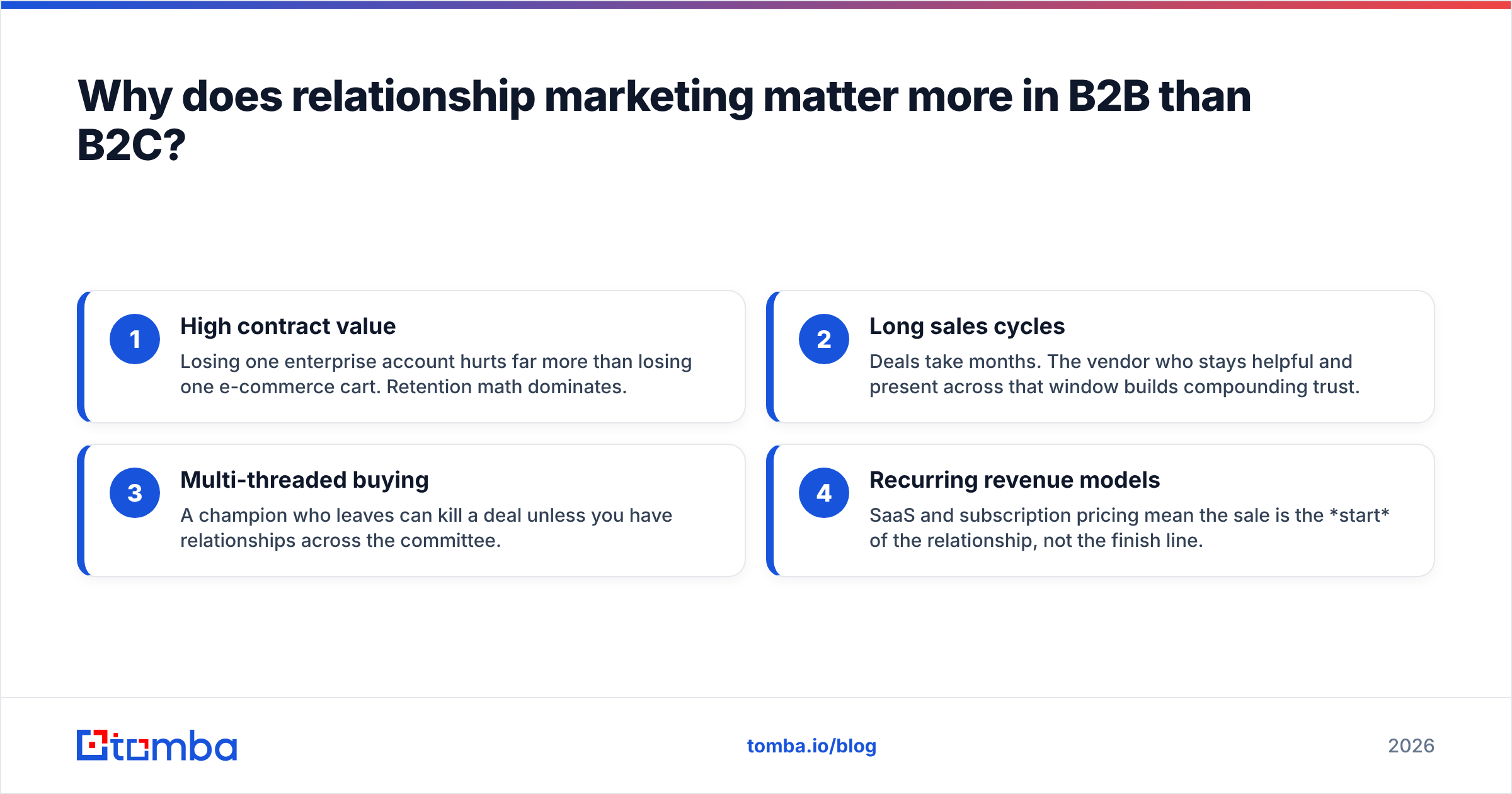
Three structural realities make relationships decisive:
- High contract value — Losing one enterprise account hurts far more than losing one e-commerce cart. Retention math dominates.
- Long sales cycles — Deals take months. The vendor who stays helpful and present across that window builds compounding trust.
- Multi-threaded buying — A champion who leaves can kill a deal unless you have relationships across the committee.
- Recurring revenue models — SaaS and subscription pricing mean the sale is the start of the relationship, not the finish line.
This is why net revenue retention (NRR) has become the metric boards obsess over. Acquiring a new customer costs far more than expanding an existing one, and existing customers buy more when they trust you. Relationship marketing is simply the discipline of manufacturing that trust at scale.
How is relationship marketing different from transactional marketing?#
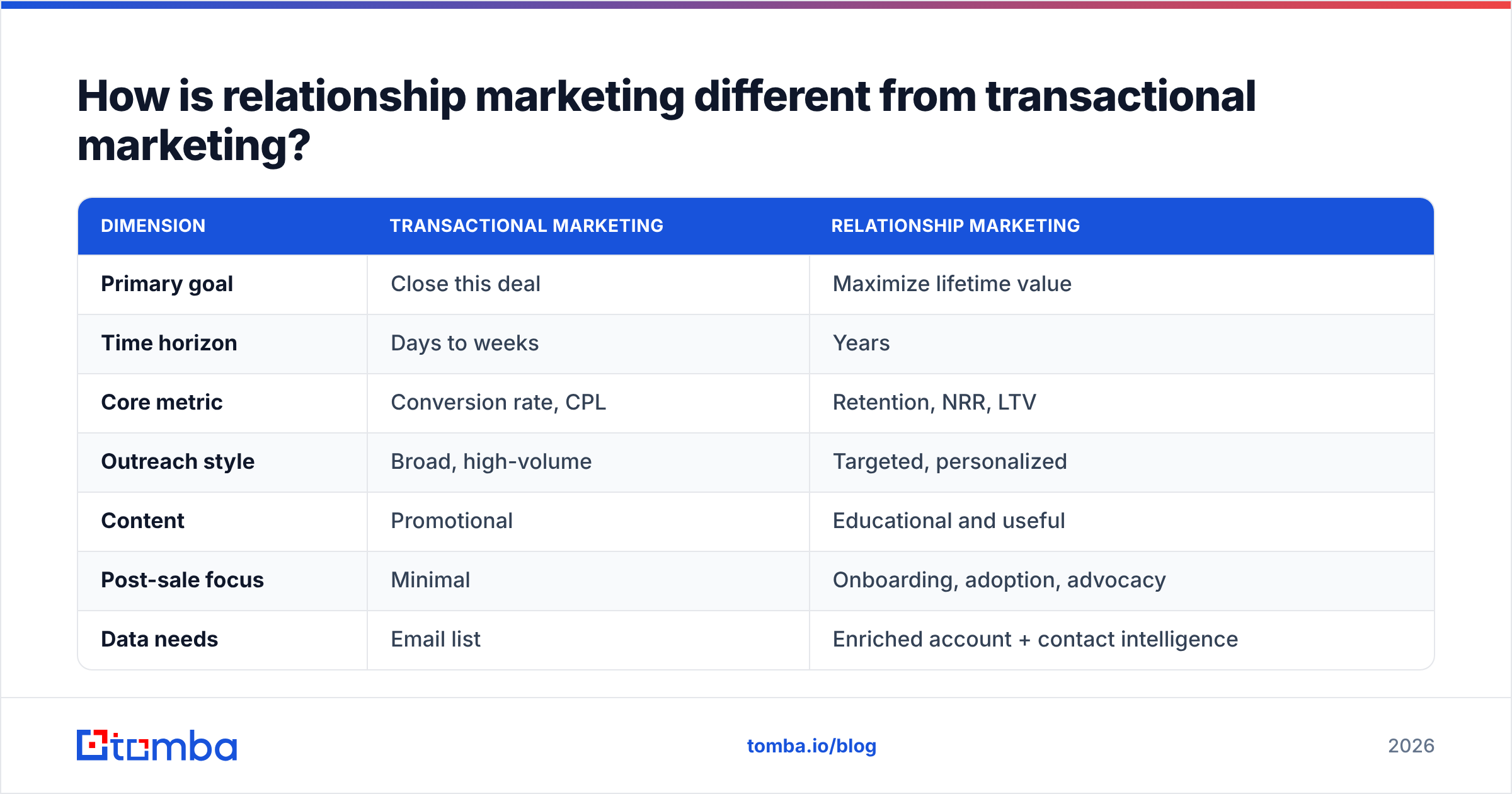
The two approaches optimize for opposite time horizons. Transactional marketing wants the conversion now; relationship marketing wants the lifetime. Here is how they compare across the dimensions that matter.
| Dimension | Transactional marketing | Relationship marketing |
|---|---|---|
| Primary goal | Close this deal | Maximize lifetime value |
| Time horizon | Days to weeks | Years |
| Core metric | Conversion rate, CPL | Retention, NRR, LTV |
| Outreach style | Broad, high-volume | Targeted, personalized |
| Content | Promotional | Educational and useful |
| Post-sale focus | Minimal | Onboarding, adoption, advocacy |
| Data needs | Email list | Enriched account + contact intelligence |
| Typical owner | Demand gen | Marketing + sales + CS combined |
Neither is wrong — a self-serve $20/month tool can run almost entirely on transactional plays. But the higher your average contract value and the more your revenue depends on renewals, the more the right-hand column dictates whether you grow.
What are the core frameworks of B2B relationship marketing?#
You do not need a new framework invented every quarter. Four durable ones cover most of the work.
1. Account-Based Marketing (ABM). Treat individual accounts as markets of one. Marketing and sales agree on a target list, map the buying committee, and coordinate personalized touches. ABM is relationship marketing operationalized for your highest-value accounts.
2. The customer lifecycle / flywheel. Replace the linear funnel with a loop where happy customers generate referrals and case studies that fuel new acquisition. HubSpot popularized the flywheel precisely because retention and advocacy feed growth more efficiently than top-of-funnel spend alone.
3. Land-and-expand. Win a small initial deal, deliver real value, then grow the account through new seats, products, and departments. This is where strong revenue operations practices turn one relationship into a portfolio of expansions.
4. Community-led growth. Build a space — Slack group, user conference, peer network — where customers help each other. The relationship is no longer just vendor-to-buyer; it is buyer-to-buyer, with your brand as the connective tissue.
Most mature programs run all four at once: ABM for acquisition, lifecycle for nurture, land-and-expand for growth, and community for stickiness.
How do you build a B2B relationship marketing strategy in 2026?#
Start with accuracy, not volume. A relationship strategy built on a stale list collapses on the first send. Here is a practical sequence.
Step 1 — Define your ideal customer profile (ICP). Be specific: industry, company size, tech stack, and the trigger events that signal a fit. Relationships are expensive to build, so spend them on accounts that can actually become large, loyal customers.
Step 2 — Map the buying committee. For each target account, identify the economic buyer, the champion, the end users, and the blockers. You are not selling to a company; you are building relationships with five to ten humans inside it.
Step 3 — Enrich and verify your contact data. Find the right people and confirm their emails and phone numbers are real before you invest in outreach. This is where a data enrichment layer earns its keep — appending titles, seniority, and verified contact details so your personalization is grounded in fact.
Step 4 — Design value-first touches. Every interaction should give before it asks: a relevant benchmark, an intro to a peer, a teardown of their competitor's positioning. Save the pitch for when you have earned attention.
Step 5 — Coordinate across teams. Marketing warms, sales engages, customer success retains. Shared dashboards and a single source of truth in your CRM keep the relationship coherent instead of fragmented across departments.
Step 6 — Measure relationships, not just responses. Track engagement depth, account penetration, NRR, and advocacy — covered below.
Which channels work best for relationship marketing?#
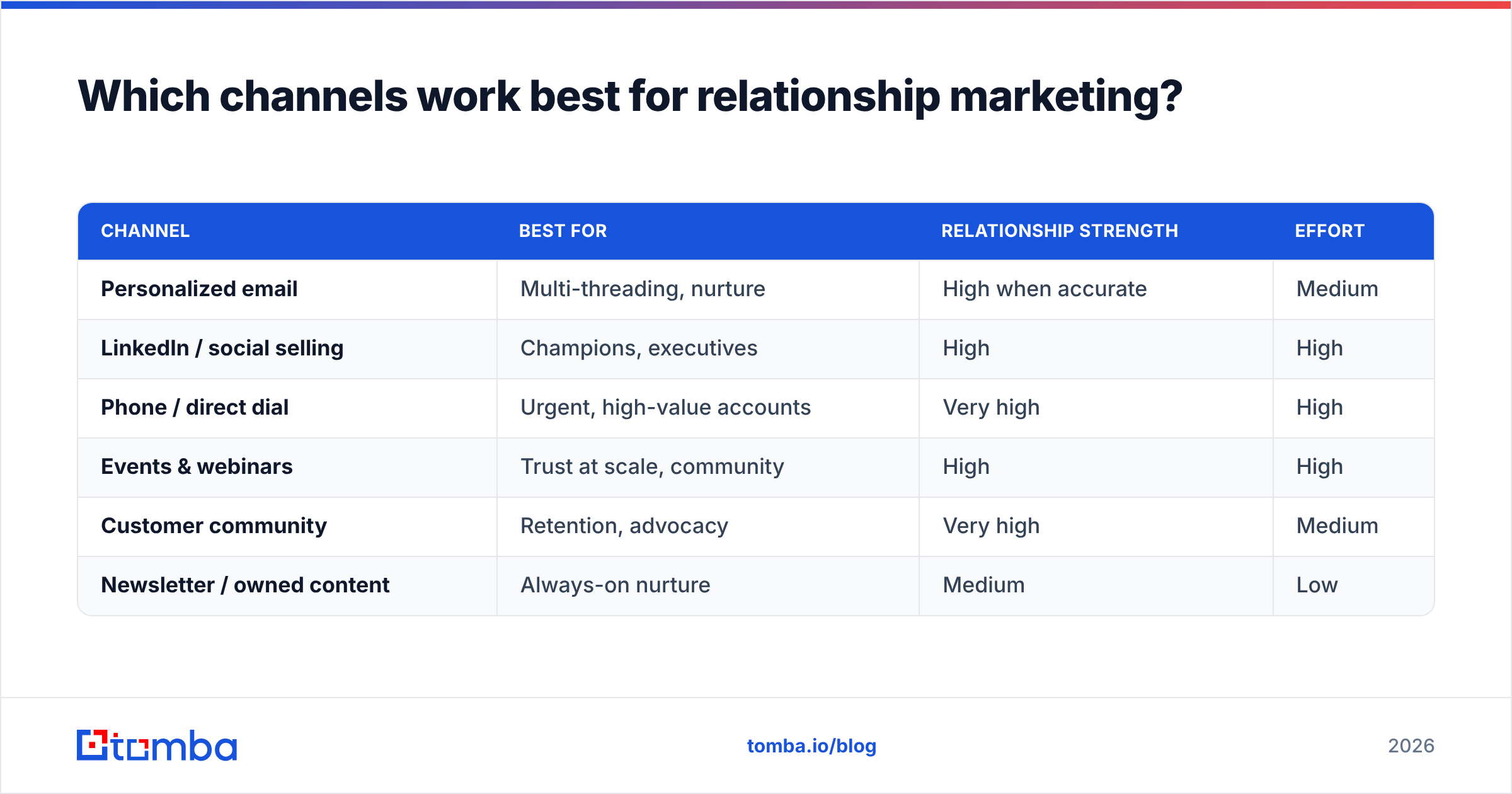
The best channel is the one your buyer actually trusts, and that varies by persona. In practice, a layered mix outperforms any single channel.
| Channel | Best for | Relationship strength | Effort |
|---|---|---|---|
| Personalized email | Multi-threading, nurture | High when accurate | Medium |
| LinkedIn / social selling | Champions, executives | High | High |
| Phone / direct dial | Urgent, high-value accounts | Very high | High |
| Events & webinars | Trust at scale, community | High | High |
| Customer community | Retention, advocacy | Very high | Medium |
| Newsletter / owned content | Always-on nurture | Medium | Low |
Email remains the backbone because it scales personalization and respects the buyer's time — but only if deliverability and data quality hold up. Pair it with social selling on LinkedIn for executive relationships, and reserve direct phone outreach for your highest-intent accounts. The point is not to be everywhere; it is to be genuinely useful in the two or three places each persona actually pays attention.
What metrics prove relationship marketing is working?#
Open rates will not convince a CFO. Relationship marketing is judged on revenue durability, so track metrics that reflect trust compounding over time.
- Net Revenue Retention (NRR) — Revenue from existing customers including expansion, minus churn. Above 110% means your base grows even with zero new logos.
- Customer Lifetime Value (LTV) — Total value of an account across its lifespan. Relationship investments should lift this number.
- Logo and revenue churn — The leak in the bucket. Falling churn is the clearest signal trust is rising.
- Account penetration — How many stakeholders per account you are engaged with. Single-threaded accounts are fragile.
- Advocacy rate — Referrals, reviews on G2, and case-study participation. Advocates are the end state of a strong relationship.
- Engagement depth — Replies, meeting acceptance, and content interaction beat vanity opens.
Watch these as a cohort over quarters, not weeks. Relationship marketing is a slow compounder; judging it on a 30-day window guarantees you'll kill it before it pays off.
What tools support B2B relationship marketing?#
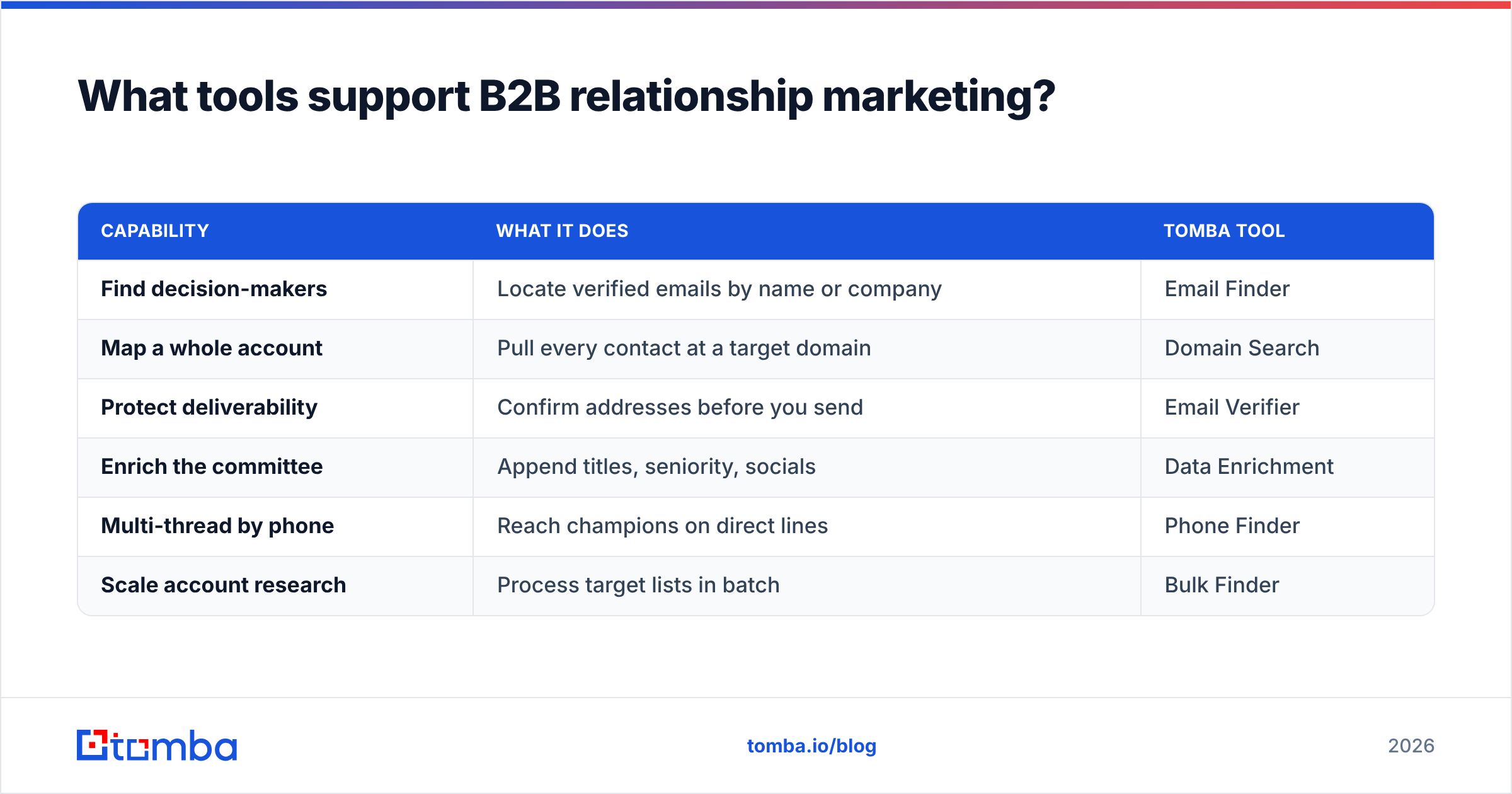
Your stack should do four jobs: find the right people, verify you can reach them, enrich what you know, and orchestrate the touches. The data layer underneath everything is non-negotiable — every downstream play depends on reaching a real person at a real address.
| Capability | What it does | Tomba tool |
|---|---|---|
| Find decision-makers | Locate verified emails by name or company | Email Finder |
| Map a whole account | Pull every contact at a target domain | Domain Search |
| Protect deliverability | Confirm addresses before you send | Email Verifier |
| Enrich the committee | Append titles, seniority, socials | Data Enrichment |
| Multi-thread by phone | Reach champions on direct lines | Phone Finder |
| Scale account research | Process target lists in batch | Bulk Finder |
On top of the data layer sit your CRM (Salesforce, HubSpot, or Pipedrive), a sequencer for cadenced outreach, and a community or events platform for the post-sale relationship. The mistake teams make is buying the orchestration tools first and starving the data layer — then wondering why personalized campaigns bounce. Get the contacts right, and everything above performs better. Tomba's HubSpot and Salesforce integrations push verified data straight into the system your relationships already live in.
How does data accuracy make or break relationships?#
Bad data does not just waste effort — it actively damages trust. Email a contact who left the company a year ago and you signal you have not done your homework. Worse, high bounce rates erode your sender reputation, so even your good emails start landing in spam. The relationship dies before the first real conversation.
Relationship marketing demands accuracy on two fronts. First, reachability — the email or phone number actually connects. Second, relevance — you know the person's role, seniority, and context well enough to be useful. Verification handles the first; enrichment handles the second.
This is why teams running serious ABM programs verify before every major send and re-enrich their target accounts quarterly. People change jobs, companies reorganize, and a contact list decays roughly 25–30% per year. Treating data as a one-time purchase rather than a living asset is the quiet reason most relationship programs underperform. If you only fix one thing this quarter, make it a verification and enrichment routine on your priority accounts.
What does a 30-day relationship marketing starter plan look like?#
You do not need a six-figure platform to begin. You need 20 accounts and a month.
- Week 1 — Target and map. Pick 20 ICP-fit accounts. For each, identify three to five stakeholders across the buying committee. Use domain search to surface contacts and a verifier to confirm them.
- Week 2 — Enrich and prioritize. Append titles and seniority, then rank accounts by fit and intent signals. Decide which two or three deserve phone-level effort.
- Week 3 — First value touch. Send one genuinely useful, personalized message per contact — a benchmark, a relevant insight, an intro. No pitch.
- Week 4 — Multi-thread and measure. Add a second stakeholder per account, log engagement depth, and book the first conversations. Review what landed.
Run that loop monthly and you will have a living, multi-threaded relationship across 20 accounts within a quarter — a far stronger position than 2,000 cold contacts you have emailed once.
Build relationships on data you can trust#
B2B relationship marketing is only as strong as the contact data underneath it. You can have the best ABM strategy, the warmest content, and the sharpest community — but if your emails bounce and your stakeholders are out of date, the relationship never starts. Get the foundation right first.
Start with the Tomba Email Finder to locate verified decision-makers at your target accounts, then layer in verification and enrichment so every touch reaches a real person with the right context. The free tier gives you 25 searches a month to test it on your top accounts, and paid plans start at $49/month when you are ready to scale your relationship program across the whole pipeline. Build the data foundation today, and the relationships that compound into revenue will follow.
Ready to find emails that actually work?
Join 150,000+ professionals who stopped guessing and started sending. Free credits on signup — no credit card required.
Get the Tomba newsletter
Practical outbound tactics and product updates — once every two weeks.
About the author