B2B Revenue Marketing in 2026: The Complete Playbook
B2B revenue marketing ties every campaign to pipeline and closed-won, not clicks. Here's the 2026 framework, metrics, tech stack, and how to make the shift.
TL;DR
- B2B revenue marketing measures marketing by pipeline and closed-won revenue, not leads, clicks, or MQL volume — it makes marketing a revenue line, not a cost center.
- The shift requires three things: a shared revenue definition with sales, a tech stack that traces every touch to an opportunity, and accurate contact data to reach the accounts that actually buy.
- Your core metrics move from cost-per-lead to pipeline created, pipeline velocity, marketing-sourced revenue, and CAC payback.
- Account-based execution and intent data make revenue marketing concrete: fewer, better-fit accounts worked deeper.
- Clean, verified contact data is the unglamorous foundation — a great campaign aimed at stale emails produces zero revenue.
Revenue marketing is the practice of running marketing as a direct contributor to revenue, measured the same way sales is. Instead of celebrating a spike in form fills, you ask one question of every program: did this create or accelerate pipeline that closed? This guide breaks down what that means in 2026, the metrics that matter, the stack you need, and how to make the transition without burning your demand engine to the ground.
What is B2B revenue marketing?#
B2B revenue marketing aligns marketing goals, budgets, and reporting to the same outcome sales owns: closed-won revenue. Think of it like a restaurant kitchen that gets judged on covers served and repeat diners, not on how many onions it chopped. Chopping onions (leads, impressions, MQLs) is necessary work, but nobody calls it success until food reaches a paying table.
Traditional demand generation optimizes for the top of the funnel — more leads, lower cost-per-lead, bigger lists. Revenue marketing keeps those activities but re-anchors them. A lead is only valuable if it belongs to an account that can buy, reaches a buying committee, and converts to pipeline. That reframing changes what you spend on, what you report, and how you and sales define a "win."
The discipline sits at the intersection of demand gen, revenue operations, and sales. It borrows ABM's account focus, RevOps' shared data model, and sales' obsession with the number. According to Forrester, buying groups in B2B now involve a dozen or more stakeholders, which is exactly why single-lead metrics mislead — you can have ten "leads" from one account and still no deal.
Why does revenue marketing matter in 2026?#
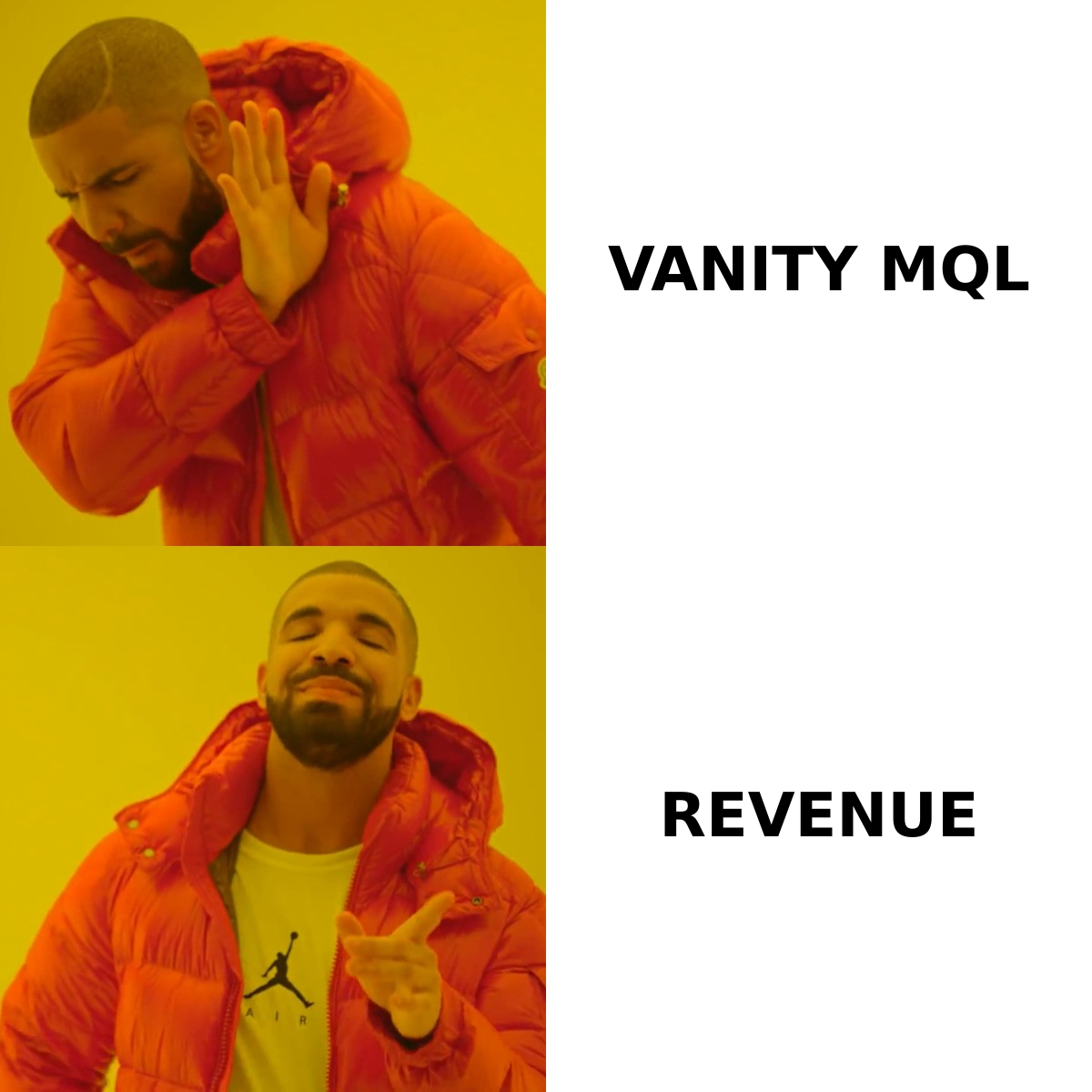
Because budgets are tighter and boards want proof. The era of "we generated 4,000 MQLs this quarter" being an acceptable answer is over — finance wants to know which of those became revenue and at what cost. Three forces make this urgent:
- Budget scrutiny. Marketing spend is one of the first things questioned in a downturn. Teams that can show marketing-sourced revenue and CAC payback keep their budgets; teams reporting only activity metrics get cut.
- Longer, more complex buying cycles. With larger buying committees and self-directed research, a single MQL rarely tells you whether an account is progressing. You need account-level signals.
- Better tooling. Attribution, intent data, and enrichment platforms have matured to the point where tracing a campaign dollar to a closed deal is achievable, not aspirational.
The payoff is organizational credibility. When marketing speaks the language of pipeline and revenue, it earns a seat at the planning table instead of being handed a number to hit. It also kills the recurring fight where sales says "marketing leads are garbage" and marketing says "sales doesn't follow up" — a shared revenue definition makes both claims measurable.
How is revenue marketing different from demand generation?#
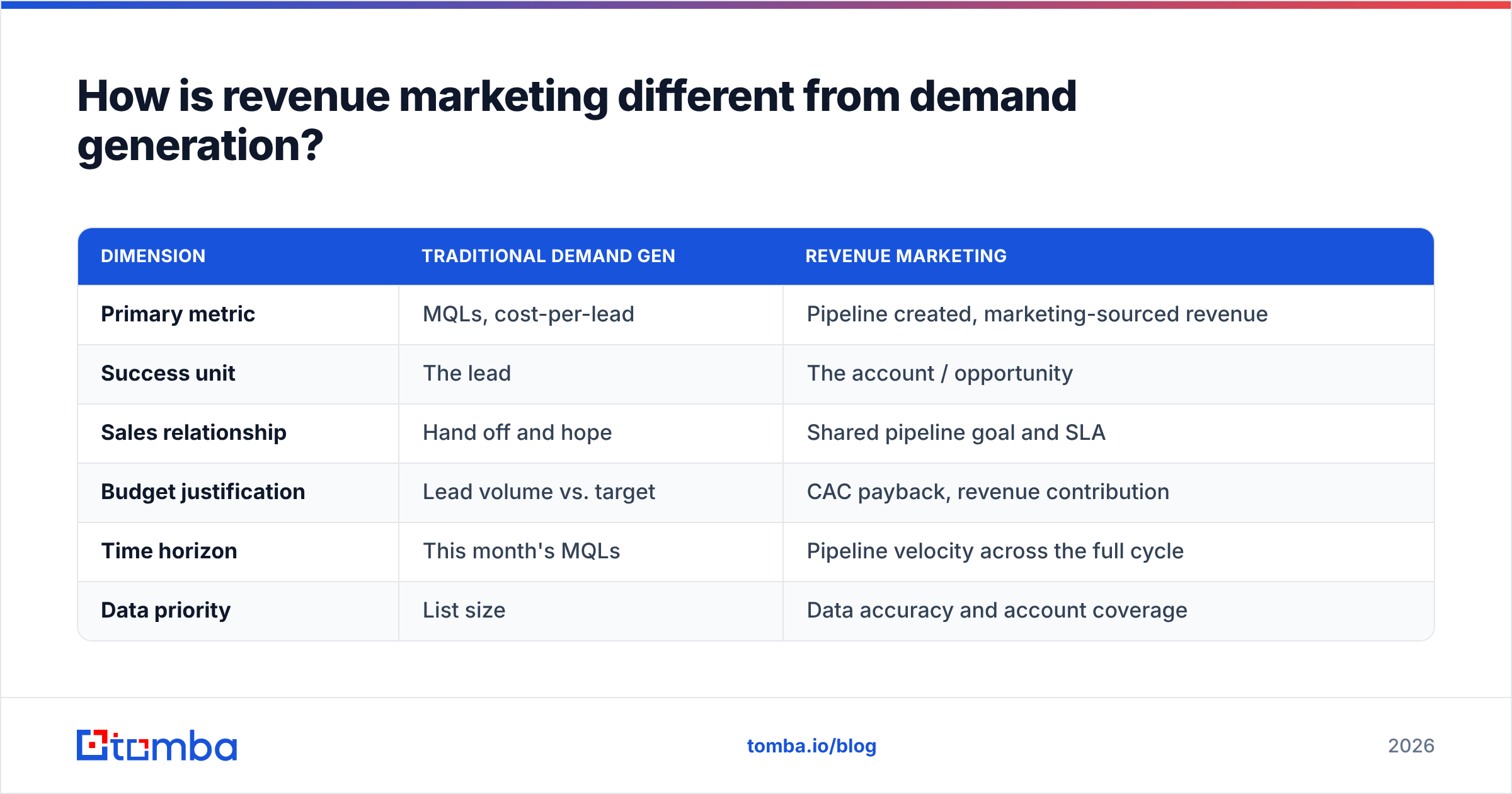
They overlap, but the scoreboard is different. Demand gen is a set of tactics; revenue marketing is an operating model that judges those tactics by revenue. Here's the contrast:
| Dimension | Traditional Demand Gen | Revenue Marketing |
|---|---|---|
| Primary metric | MQLs, cost-per-lead | Pipeline created, marketing-sourced revenue |
| Success unit | The lead | The account / opportunity |
| Sales relationship | Hand off and hope | Shared pipeline goal and SLA |
| Budget justification | Lead volume vs. target | CAC payback, revenue contribution |
| Time horizon | This month's MQLs | Pipeline velocity across the full cycle |
| Data priority | List size | Data accuracy and account coverage |
The practical difference shows up in decisions. A demand-gen lens says "this webinar drove 600 registrations — great." A revenue lens asks "how many of those 600 were from target accounts, how many entered pipeline, and how much closed?" The webinar might be a hit or a waste, and only the second question tells you which.
This is also where data quality stops being an IT footnote and becomes a revenue lever. If half your registrations carry role accounts, typos, or dead inboxes, your nurture sequence leaks before it starts. Running a list through an email verifier before campaigns is the cheapest pipeline insurance you can buy.
What metrics define B2B revenue marketing?#
The metrics that matter all connect activity to money. Swap your dashboard from volume metrics to these:
- Pipeline created (marketing-sourced and influenced). Total opportunity value marketing originated or touched. This is the headline number.
- Marketing-sourced revenue. Closed-won that traces to a marketing-originated opportunity. The ultimate proof.
- Pipeline velocity. How fast opportunities move from creation to close. Faster velocity means your programs are accelerating deals, not just filling the top.
- CAC payback period. Months to recoup the cost of acquiring a customer. Ties marketing spend to unit economics.
- Win rate by source. Which channels and campaigns produce deals that actually close — not just deals that open.
- Average deal size by segment. Reveals where to concentrate spend for revenue, not lead count.
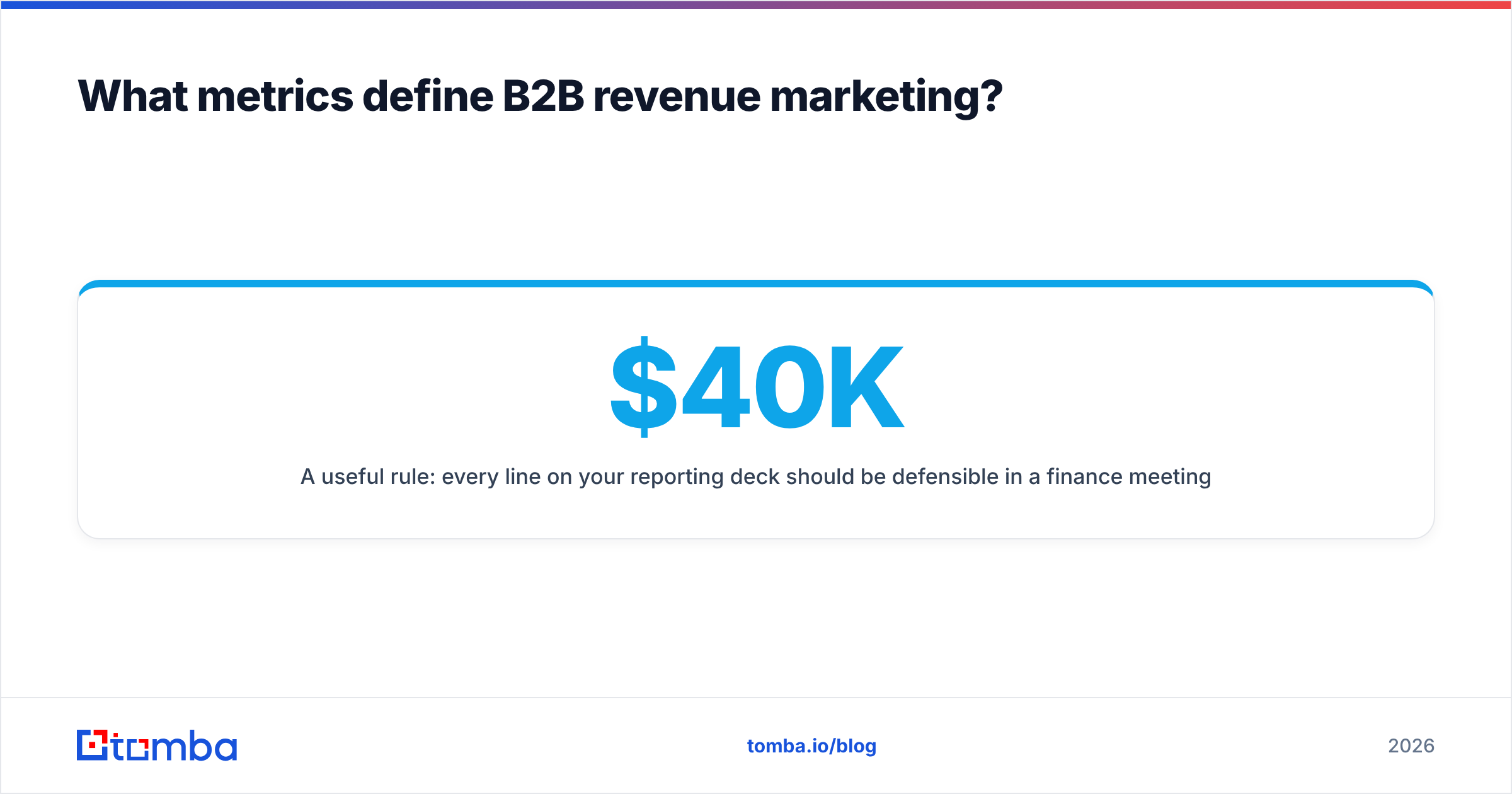
A useful rule: every line on your reporting deck should be defensible in a finance meeting. "We spent $40K on this program and it sourced $610K in pipeline with a 22% win rate" survives scrutiny. "We hit our MQL goal" does not. Tools like G2 and your CRM's reporting layer help benchmark win rates and deal sizes by category so your targets are grounded in reality.
Be honest about attribution limits, though. No model is perfect — multi-touch, first-touch, and last-touch each tell a partial story. The goal isn't a flawless equation; it's a consistent, agreed model that points budget toward what works.
What does the revenue marketing tech stack look like?#
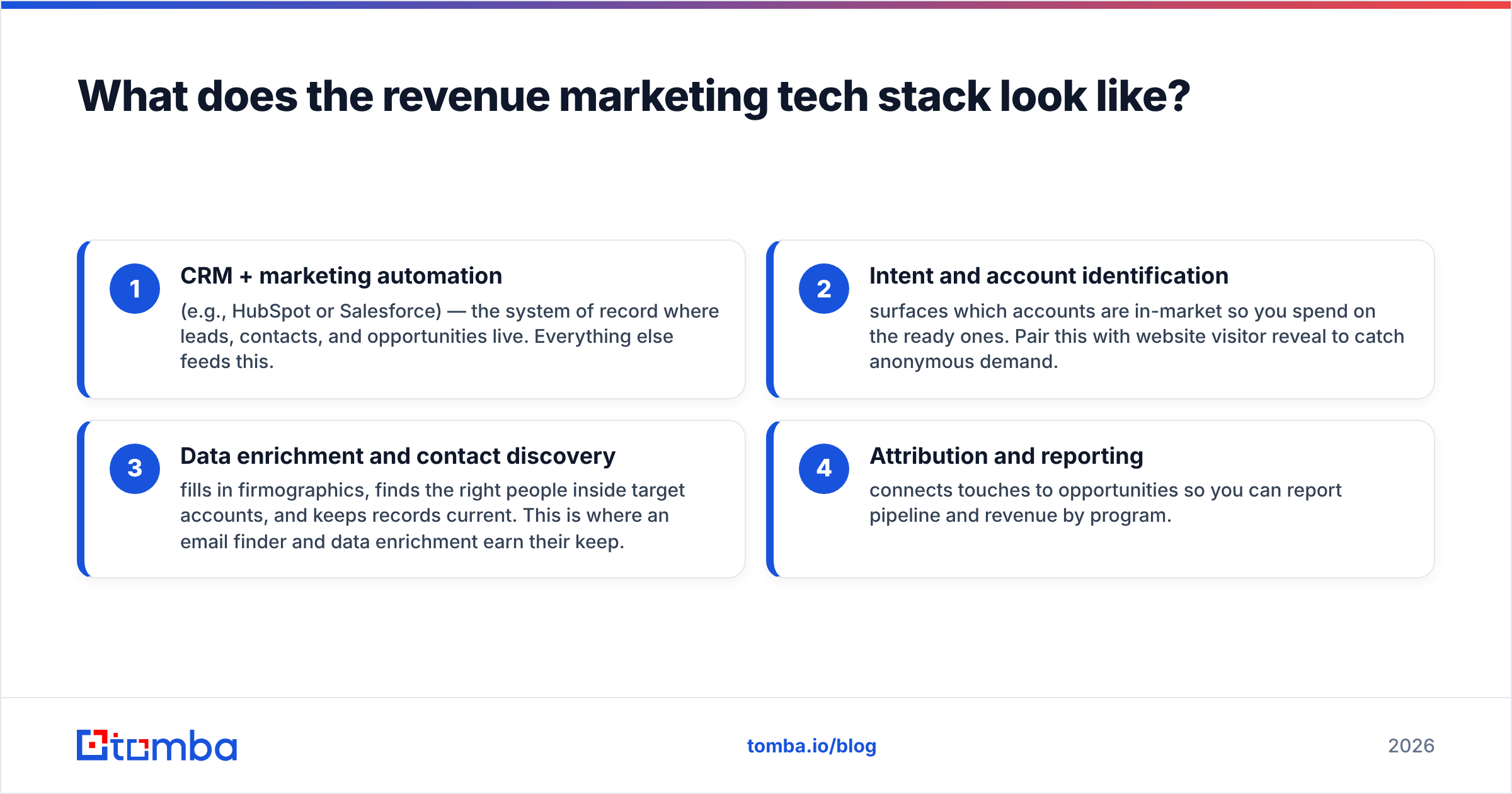
The stack has four jobs: capture demand, identify accounts, enrich and verify data, and attribute revenue. You don't need 30 tools — you need these layers working together:
- CRM + marketing automation (e.g., HubSpot or Salesforce) — the system of record where leads, contacts, and opportunities live. Everything else feeds this.
- Intent and account identification — surfaces which accounts are in-market so you spend on the ready ones. Pair this with website visitor reveal to catch anonymous demand.
- Data enrichment and contact discovery — fills in firmographics, finds the right people inside target accounts, and keeps records current. This is where an email finder and data enrichment earn their keep.
- Attribution and reporting — connects touches to opportunities so you can report pipeline and revenue by program.
The layer teams most often underinvest in is data. You can buy the slickest attribution platform on the market, but if your contact records are 30% stale, every downstream number is wrong and every campaign reaches fewer real humans. Verified emails, accurate B2B phone numbers, and current job titles are what turn a target account list into reachable pipeline.

A quick build-vs-buy note: most teams should buy the data and attribution layers and build the workflow logic on top. Reinventing email verification or firmographic enrichment in-house is a multi-year project that vendors already solved. Spend your engineering hours on what's specific to your motion.
How do you build a revenue marketing motion step by step?#
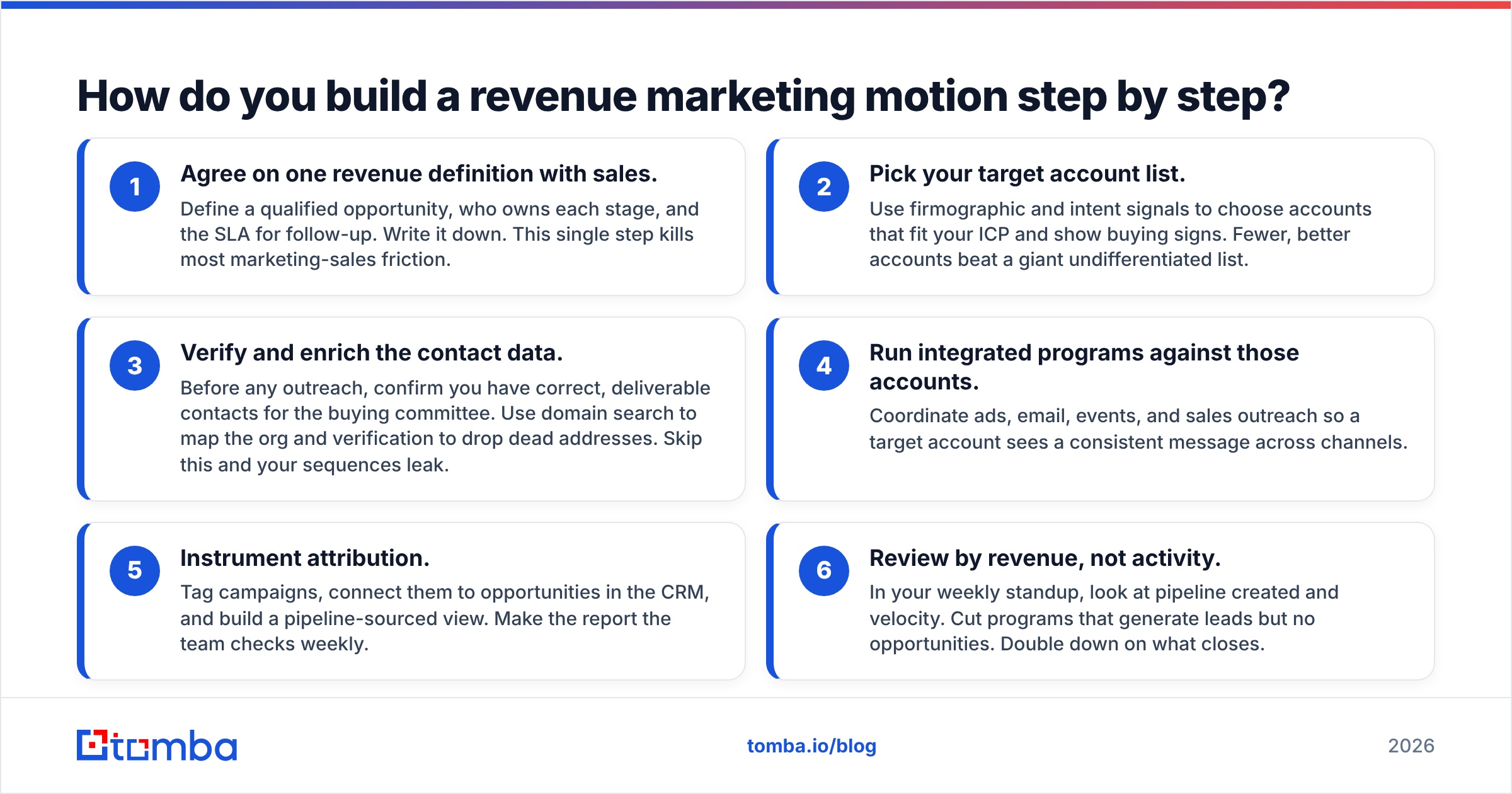
Start small, prove the model, then scale. Here's a sequence that works without a full reorg:
- Agree on one revenue definition with sales. Define a qualified opportunity, who owns each stage, and the SLA for follow-up. Write it down. This single step kills most marketing-sales friction.
- Pick your target account list. Use firmographic and intent signals to choose accounts that fit your ICP and show buying signs. Fewer, better accounts beat a giant undifferentiated list.
- Verify and enrich the contact data. Before any outreach, confirm you have correct, deliverable contacts for the buying committee. Use domain search to map the org and verification to drop dead addresses. Skip this and your sequences leak.
- Run integrated programs against those accounts. Coordinate ads, email, events, and sales outreach so a target account sees a consistent message across channels.
- Instrument attribution. Tag campaigns, connect them to opportunities in the CRM, and build a pipeline-sourced view. Make the report the team checks weekly.
- Review by revenue, not activity. In your weekly standup, look at pipeline created and velocity. Cut programs that generate leads but no opportunities. Double down on what closes.
The discipline here is restraint. The temptation is to run everything and measure later. Instead, run a tight set of programs against a defined account list with clean data, measure revenue, and expand only what proves out. Reviewing your Tomba pricing tier against the volume of accounts you actually work keeps the data layer cost-efficient as you scale.
What are the common mistakes to avoid?#
The failure modes are predictable, which makes them avoidable:
- Rebranding demand gen without changing metrics. Calling your team "revenue marketing" while still reporting MQLs is theater. The metrics have to change.
- Ignoring data quality. The most common silent killer. Campaigns built on stale or unverified contacts produce inflated activity numbers and zero revenue. Verification is not optional.
- Over-attributing. Claiming marketing "sourced" every deal sales touched destroys trust. Use a model both teams accept, even if it gives marketing less credit.
- Chasing volume over fit. A list of 50,000 poorly-fit contacts is worse than 2,000 ICP-matched ones, because it pollutes your funnel and your reporting.
- Skipping the sales alignment conversation. Without a shared definition and SLA, you're back to the blame game within a quarter.
Notice how many of these trace back to data and definitions rather than creative or channels. Revenue marketing is won in the unglamorous layers — clean records, agreed metrics, disciplined follow-up — more than in the campaign that goes viral.
How does revenue marketing change the marketer's role?#
It makes you a revenue operator who happens to use marketing channels. You'll spend less time defending creative and more time in pipeline reviews, forecasting conversations, and data-quality audits. You'll care about win rates and deal velocity the way a sales leader does. And you'll be measured — for better or worse — on the same number the whole company watches.
That's a feature, not a bug. The marketers thriving in 2026 are the ones who can walk into a board meeting and say "here's the pipeline we created, here's what it cost, here's the payback." That credibility is impossible to build on impressions and MQLs alone. It's built on a chain of evidence that runs from a verified contact, through a tracked campaign, to a closed deal — and you own every link in that chain.
Make your revenue marketing engine run on accurate data#
Every revenue marketing motion lives or dies on one thing: reaching the right people at the right accounts. A flawless attribution model and a perfect ICP list mean nothing if your contact data is stale, unverified, or incomplete. That's the layer to fix first.
Tomba's Email Finder gives your revenue marketing engine the foundation it needs — accurate, verified professional emails for the accounts you're targeting, so your campaigns reach real buying committees instead of dead inboxes. Start on the free tier (25 searches/month) to test coverage on your target account list, then scale to Starter at $49/mo or Growth at $99/mo as your pipeline grows. Pair it with the email verifier to keep every list deliverable, and you've got the clean data layer that makes every other revenue marketing investment pay off. Find the accounts, verify the contacts, and let your attribution prove the rest.
// get started
Find, verify and enrich your first contacts today
Start on the free plan with 25 searches a month, then scale when your team is ready.
Free plan · No credit card required · GDPR & CCPA
// about the author