B2B RevOps in 2026: How to Align Sales, Marketing & Success
B2B RevOps unifies sales, marketing, and customer success under one revenue engine. Here's how to build it in 2026 — the model, the metrics, the tech stack, and the data layer most teams get wrong.
TL;DR
- B2B RevOps is the discipline of running sales, marketing, and customer success as one revenue engine instead of three competing departments — shared data, shared metrics, shared process.
- The biggest RevOps failure point isn't strategy or tooling. It's dirty contact data feeding the CRM. Garbage in, misrouted leads out.
- A working 2026 RevOps function owns four things: the tech stack, the data layer, the process/workflow design, and the reporting that the CRO actually trusts.
- The fastest ROI in your first 90 days comes from fixing lead-to-account matching and enriching/verifying the records you already have.
- You don't need a 10-person team to start. You need clean data, one source of truth, and a handful of metrics everyone agrees on.
What is B2B RevOps?#
B2B RevOps (Revenue Operations) is the function that aligns sales, marketing, and customer success around a single, shared revenue process. Think of it like the operations crew at a relay race: the runners (your reps, marketers, and CSMs) are fast on their own, but if the baton drops at every handoff, you lose the race. RevOps owns the handoffs.
Technically, revenue operations consolidates the systems, data, and workflows that were historically split across three separate ops teams — sales ops, marketing ops, and success ops — into one accountable group. According to Gartner, the rise of RevOps is a direct response to fragmented tooling and the fact that buyers no longer move through a linear funnel.
The shift matters because the old model created structural blind spots. Marketing optimized for MQLs, sales optimized for closed deals, and success optimized for retention — three scoreboards, zero shared accountability for the number that actually matters: net revenue.
)
Why does B2B RevOps matter in 2026?#
The short answer: buying committees got bigger, sales cycles got longer, and the data feeding your funnel got dirtier. RevOps exists to absorb that complexity instead of passing it to your reps.
A few forces converged:
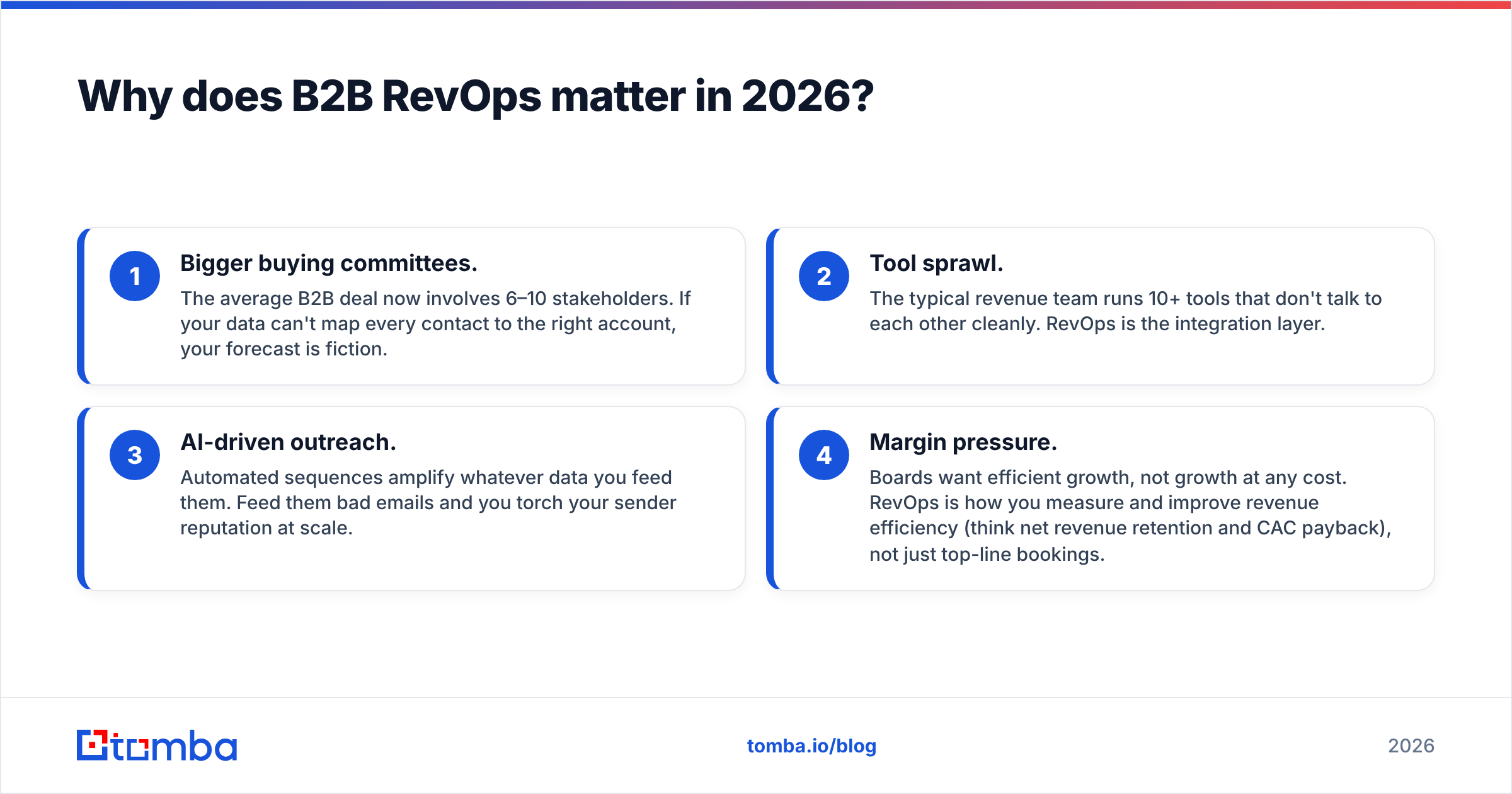
- Bigger buying committees. The average B2B deal now involves 6–10 stakeholders. If your data can't map every contact to the right account, your forecast is fiction.
- Tool sprawl. The typical revenue team runs 10+ tools that don't talk to each other cleanly. RevOps is the integration layer.
- AI-driven outreach. Automated sequences amplify whatever data you feed them. Feed them bad emails and you torch your sender reputation at scale.
- Margin pressure. Boards want efficient growth, not growth at any cost. RevOps is how you measure and improve revenue efficiency (think net revenue retention and CAC payback), not just top-line bookings.
The teams that win in 2026 treat RevOps as a growth lever, not a back-office cleanup crew.
What does a RevOps team actually own?#
RevOps owns four pillars. Confusing them is the most common reason the function stalls.
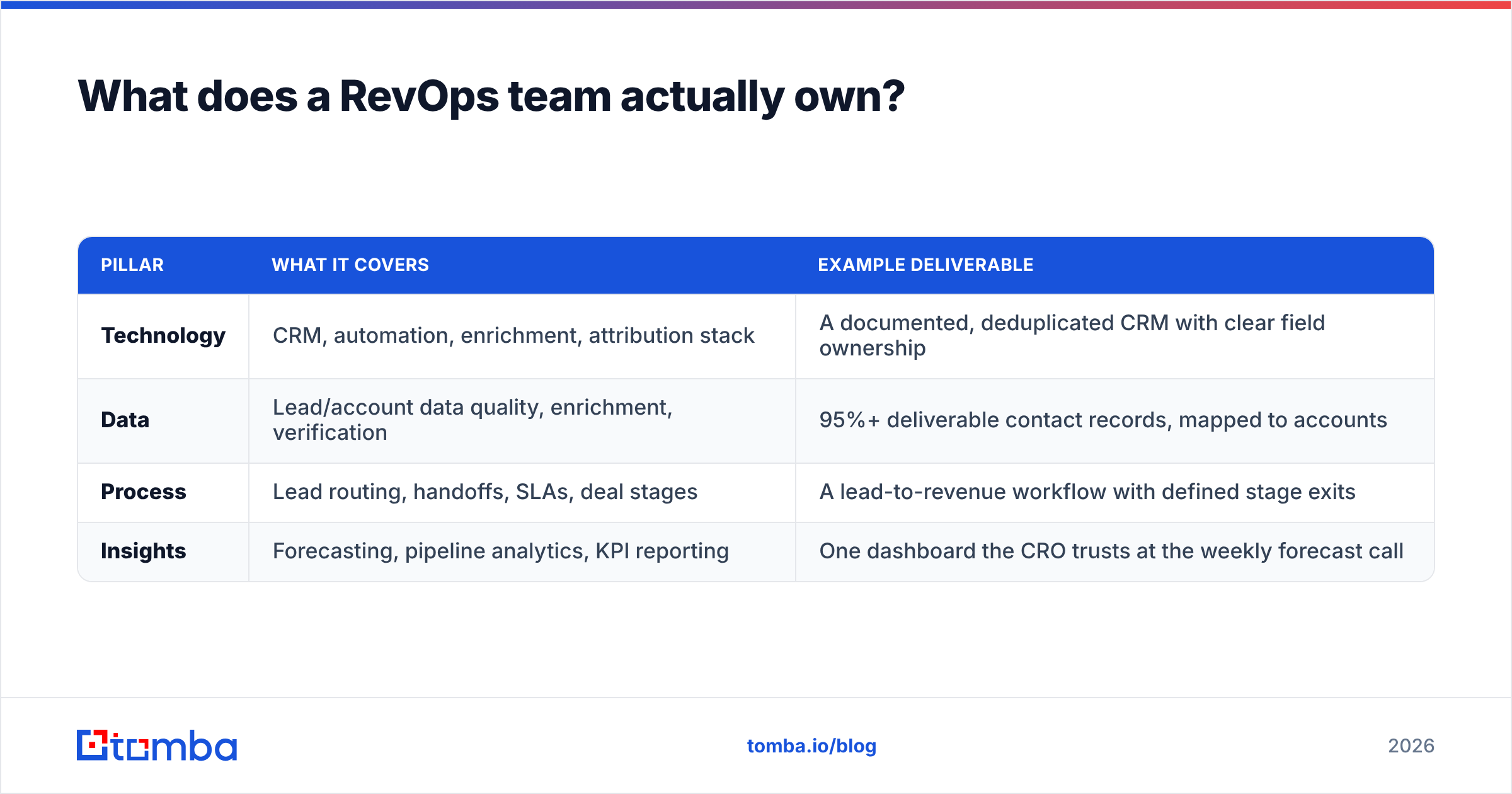
| Pillar | What it covers | Example deliverable |
|---|---|---|
| Technology | CRM, automation, enrichment, attribution stack | A documented, deduplicated CRM with clear field ownership |
| Data | Lead/account data quality, enrichment, verification | 95%+ deliverable contact records, mapped to accounts |
| Process | Lead routing, handoffs, SLAs, deal stages | A lead-to-revenue workflow with defined stage exits |
| Insights | Forecasting, pipeline analytics, KPI reporting | One dashboard the CRO trusts at the weekly forecast call |
Notice the order. Most teams jump straight to the Insights pillar — they buy a fancy dashboard — while the Data pillar underneath it is rotting. A beautiful forecast built on duplicate accounts and bounced emails is just a confident wrong answer.
The Data pillar is where RevOps either earns trust or loses it. If reps can't believe the contact record in front of them, no amount of process design fixes the funnel.
Which metrics should B2B RevOps track?#
Pick metrics that span the full funnel, not single-department vanity numbers. The job of RevOps reporting is to show where revenue leaks between teams.
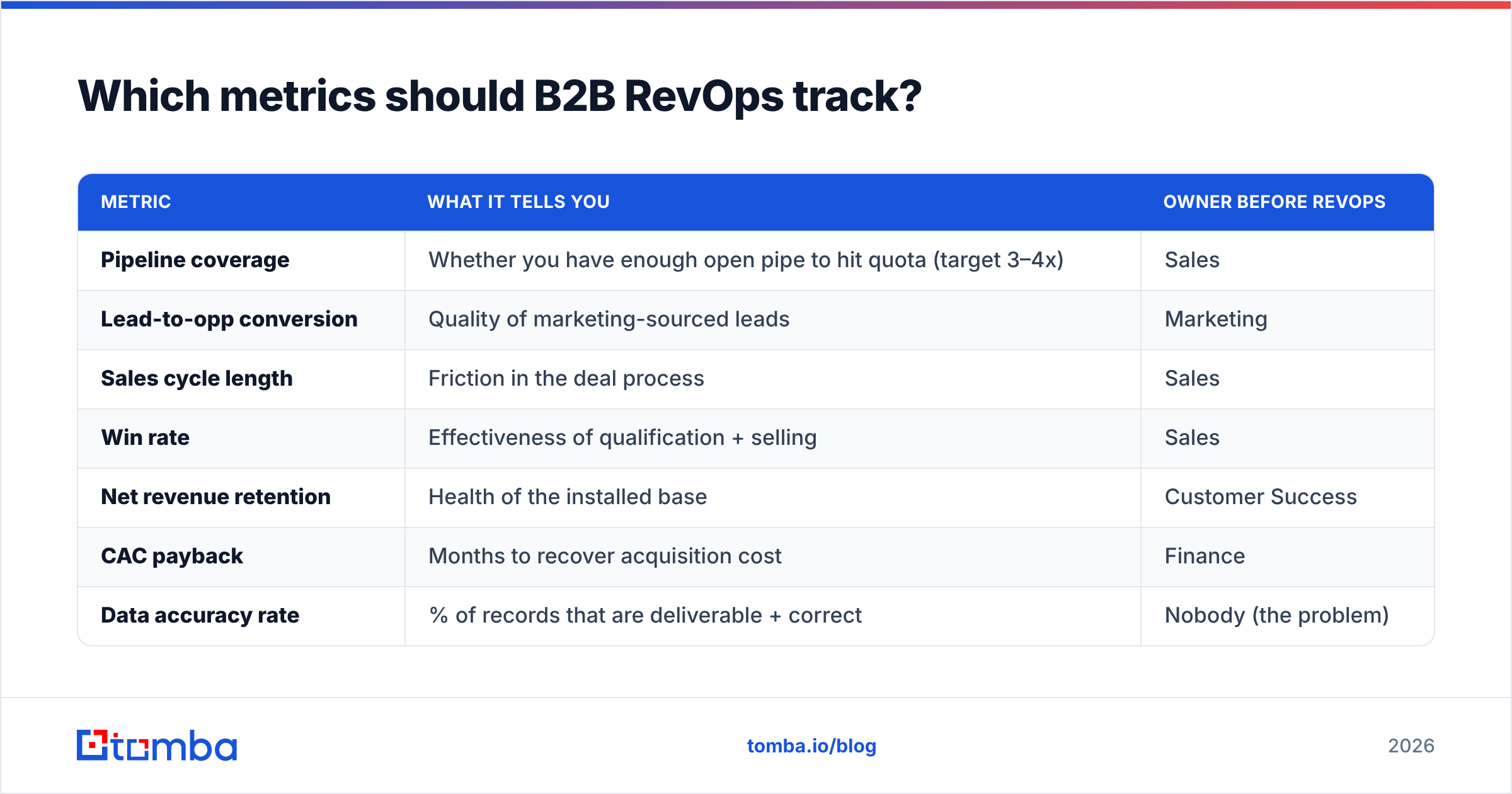
| Metric | What it tells you | Owner before RevOps |
|---|---|---|
| Pipeline coverage | Whether you have enough open pipe to hit quota (target 3–4x) | Sales |
| Lead-to-opp conversion | Quality of marketing-sourced leads | Marketing |
| Sales cycle length | Friction in the deal process | Sales |
| Win rate | Effectiveness of qualification + selling | Sales |
| Net revenue retention | Health of the installed base | Customer Success |
| CAC payback | Months to recover acquisition cost | Finance |
| Data accuracy rate | % of records that are deliverable + correct | Nobody (the problem) |
That last row is the one nobody owned before — and it quietly poisons every metric above it. Track your response rate and you'll see it move the moment your contact data gets clean.
The discipline here is consolidation. If marketing reports MQLs on one definition and sales counts them on another, RevOps' first job is to force one shared definition of a marketing qualified lead — then make every dashboard inherit it.
How do you build a B2B RevOps tech stack?#
Build from the data layer up, not the dashboard down. A practical 2026 stack looks like this:
- System of record (CRM): Salesforce or HubSpot. This is your single source of truth — everything else feeds it. See Salesforce's own RevOps overview for how the platform frames the model.
- Data enrichment + verification: the layer that keeps the CRM clean. This is where contact discovery, data enrichment, and email verification live.
- Engagement/automation: outreach sequencing, cadences, and follow-up.
- Attribution + analytics: multi-touch attribution and pipeline reporting.
- Integration glue: Zapier or Make to connect tools that lack native integrations.
Here's the trap: teams over-invest in the engagement and analytics layers while the enrichment/verification layer is an afterthought. That's backwards. Every other tool inherits the quality of your data layer.
)
If you're running outbound at any volume, verify before you send. A clean list protects email deliverability, and deliverability protects your domain — which is the one asset you can't buy back cheaply once it's blacklisted.
How does data quality make or break RevOps?#
Data quality is the foundation everything else stands on — and it decays faster than any other asset in your stack. Roughly 25–30% of B2B contact data goes stale every year as people change jobs, companies rebrand, and domains migrate. Left alone, your "single source of truth" becomes a single source of bounces.
Three data problems sink most RevOps initiatives:
- Duplicate accounts and contacts. The same company exists three times under three spellings, so your pipeline coverage and account scoring are both wrong.
- Unverified emails. Sequences fire into dead inboxes, bounce rates climb, and your sender reputation degrades — which then hurts the emails that would have landed.
- Missing firmographics. Without industry, size, and tech-stack data on each account, routing and scoring are guesswork.
The fix is a recurring hygiene loop, not a one-time import:
- Verify every email before it enters a sequence with an email verifier.
- Enrich thin records with firmographic and contact data so routing and scoring have something to work with.
- Dedupe on a defined match key (domain is more reliable than company name).
- Re-verify on a schedule — quarterly at minimum for active segments.
When you need net-new contacts at a target account, domain search pulls every known email pattern for a company in one pass, and the bulk email finder handles list-scale discovery. Wherever the data comes from, route it through verification before it touches your CRM. The goal isn't a perfect database; it's a trusted one.
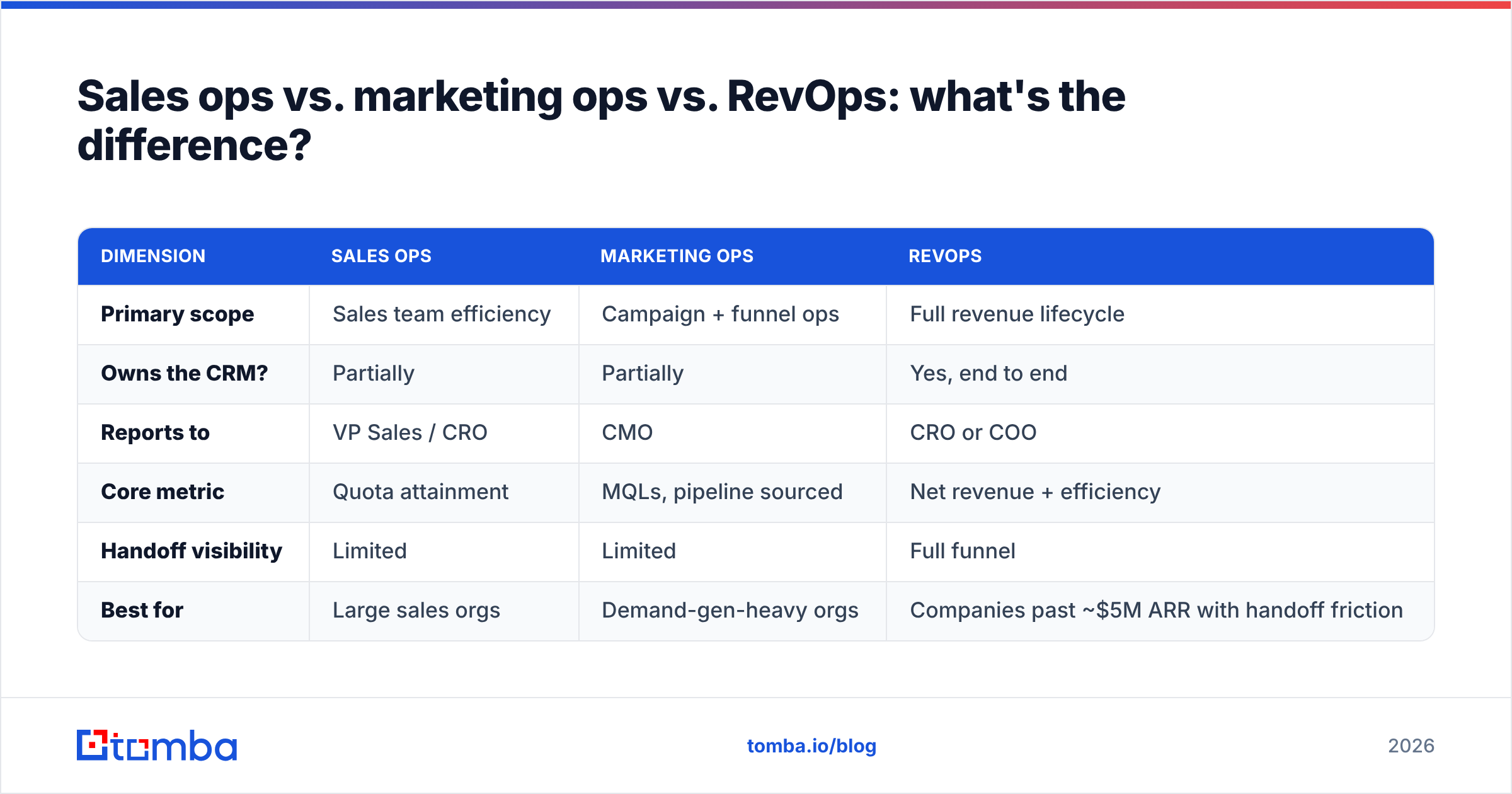
Sales ops vs. marketing ops vs. RevOps: what's the difference?#
They're not the same function at different scales — they're different scopes of accountability. Here's the honest comparison.
| Dimension | Sales Ops | Marketing Ops | RevOps |
|---|---|---|---|
| Primary scope | Sales team efficiency | Campaign + funnel ops | Full revenue lifecycle |
| Owns the CRM? | Partially | Partially | Yes, end to end |
| Reports to | VP Sales / CRO | CMO | CRO or COO |
| Core metric | Quota attainment | MQLs, pipeline sourced | Net revenue + efficiency |
| Handoff visibility | Limited | Limited | Full funnel |
| Best for | Large sales orgs | Demand-gen-heavy orgs | Companies past ~$5M ARR with handoff friction |
The practical takeaway: if your leads keep dying in the gap between marketing "sourcing" them and sales "accepting" them, you have a handoff problem that only a RevOps-style shared scope can fix. Sales ops and marketing ops each optimize their own half and call the dropped baton someone else's fault.
How do you start a RevOps function in 90 days?#
Start where the leak is biggest, which for most B2B teams is lead-to-account matching and data quality. A realistic first-quarter plan:
Days 1–30 — Audit and baseline.
- Map the current lead-to-revenue process and find every handoff.
- Measure your data accuracy rate (pull a sample, verify it, count the bounces and dupes).
- Agree on one shared definition for MQL, SQL, and a "sales-accepted" lead.
Days 31–60 — Fix the foundation.
- Dedupe the CRM on a domain match key.
- Stand up the verify → enrich → route pipeline so new records arrive clean.
- Build the single forecast dashboard and get the CRO to sign off on its definitions.
Days 61–90 — Operationalize.
- Automate lead routing with SLAs and alerting on breaches.
- Schedule recurring data hygiene (don't make it a heroic quarterly project).
- Review the funnel metrics weekly and kill the dashboards nobody uses.
You'll notice clean data shows up in week one and week eight. That's not redundancy — it's the point. RevOps that doesn't continuously protect the data layer is just sales ops with a new title.
For teams worried about budget, you can run this whole loop without enterprise pricing. A discovery-and-verification tool with a usable free tier and predictable Tomba pricing gets you started without a procurement cycle.
What does RevOps look like with AI in 2026?#
AI changes the speed of RevOps, not the fundamentals. It can draft sequences, score leads, summarize calls, and surface at-risk accounts — but every one of those capabilities multiplies whatever data you feed it.
That's the catch most teams miss. An AI SDR that personalizes 500 emails a day off a dirty list doesn't save you time; it scales your bounce rate and accelerates the damage to your domain reputation. AI is a force multiplier, and it multiplies bad data just as eagerly as good data.
The RevOps mandate in an AI-heavy stack is therefore the same as it always was, only more urgent: guarantee the inputs. Verified contacts, enriched accounts, deduplicated records. Get the data layer right and AI becomes a genuine accelerant. Get it wrong and AI becomes a faster way to fail.
Common B2B RevOps mistakes to avoid#
- Buying tools before fixing process. A new platform on a broken workflow is just a more expensive broken workflow.
- Letting each team keep its own metric definitions. One MQL definition, or none.
- Treating data hygiene as a project, not a system. It decays continuously, so the fix has to run continuously.
- Reporting bookings only. Without retention and efficiency metrics, you're flying half-blind.
- Over-hiring early. Start with one owner, clean data, and a single source of truth before you build a team.
Frequently asked questions#
Is RevOps just a rebrand of sales ops? No. Sales ops optimizes the sales team. RevOps owns the entire revenue lifecycle across marketing, sales, and customer success — including the handoffs sales ops can't see.
When should a company start investing in RevOps? Usually past ~$5M ARR, or earlier if you feel pain at the marketing-to-sales handoff. The trigger is friction between teams, not a specific revenue number.
What's the single highest-ROI RevOps project? For most teams, fixing lead-to-account matching and contact data quality. It improves routing, forecasting, and deliverability all at once.
Does RevOps require a big team? No. One owner plus clean data and a shared source of truth beats a five-person team built on a messy CRM.
Build your RevOps foundation on data you can trust#
Every RevOps pillar — process, reporting, automation, AI — sits on top of one thing: the accuracy of the contacts in your CRM. Fix that first and everything above it gets easier; ignore it and no dashboard will save your forecast. The Tomba Email Finder gives your revenue team verified, accurately mapped contact data at the source, so leads route correctly, sequences land, and the number your CRO sees is one they can actually trust. Start on the free tier, prove the lift in your first 90 days, and scale the data layer as your RevOps function grows.
// get started
Find, verify and enrich your first contacts today
Start on the free plan with 25 searches a month, then scale when your team is ready.
Free plan · No credit card required · GDPR & CCPA
// about the author