B2B Rocket Pricing 2026: Plans, Costs, and Alternatives
A clear, no-spin breakdown of B2B Rocket pricing in 2026 — what each plan costs, what you actually get, hidden gotchas, and when a cheaper stack wins.
B2B Rocket markets itself as an "AI sales agent" that prospects, emails, qualifies, and books meetings on autopilot. The promise is seductive. The pricing page is where most buyers get stuck — tiers shift, "AI agent" seat math is fuzzy, and the real per-meeting cost only shows up after you've signed.
This guide cuts through it. You'll get the current plan structure, what each tier actually includes, the cost gotchas to watch, and an honest look at when a leaner data-plus-sending stack beats an all-in-one AI agent.
TL;DR#
- B2B Rocket sells AI sales agents that combine lead data, email sending, and auto-qualification — priced per agent/seat plus credits, not a flat per-lead rate.
- Entry pricing typically starts around $99/month for a single AI agent, scaling to several hundred per month for multi-agent teams and higher send volume.
- The headline price rarely reflects true cost — deliverability infrastructure, extra mailboxes, and data top-ups are where the bill grows.
- All-in-one convenience has a tradeoff: less control over data accuracy and inbox health than a modular stack.
- A cheaper alternative for many teams: pair a high-accuracy email finder with your own sending tool and keep per-lead costs predictable.
What is B2B Rocket and how does its pricing model work?#
B2B Rocket is an AI-driven outbound platform. Instead of buying a list and a separate sender, you configure an "AI agent" that pulls prospects from a built-in database, writes and sends personalized cold emails, handles replies with AI, and pushes interested leads toward a booked meeting.
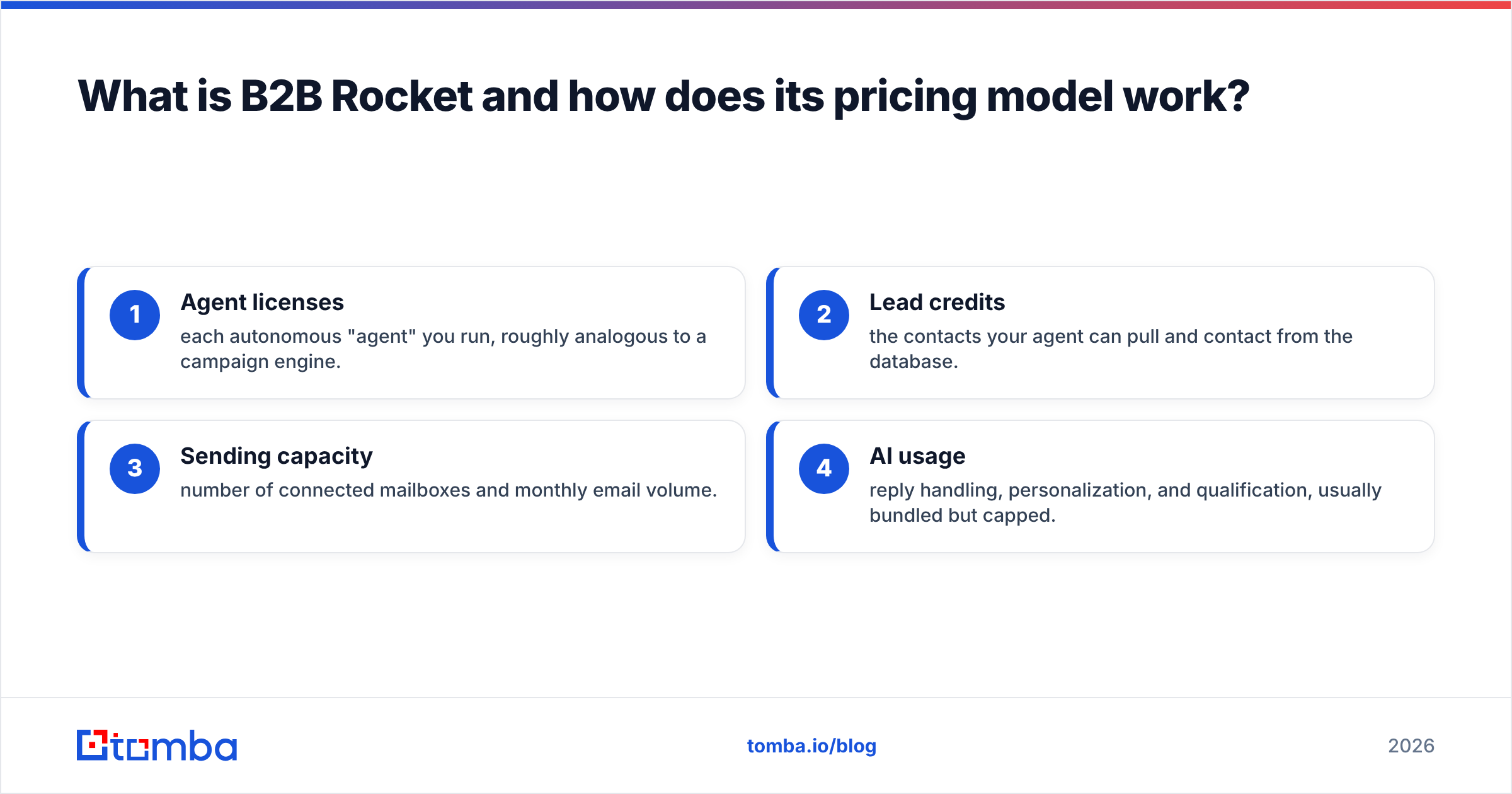
The pricing model follows the AI-agent framing rather than classic SaaS per-seat logic. You're effectively paying for:
- Agent licenses — each autonomous "agent" you run, roughly analogous to a campaign engine.
- Lead credits — the contacts your agent can pull and contact from the database.
- Sending capacity — number of connected mailboxes and monthly email volume.
- AI usage — reply handling, personalization, and qualification, usually bundled but capped.
That bundling is the core thing to understand. Unlike a pure email verifier or finder where you pay for one clear unit, B2B Rocket blends four cost drivers into one subscription, which makes apples-to-apples comparison hard.

How much does B2B Rocket pricing cost in 2026?#
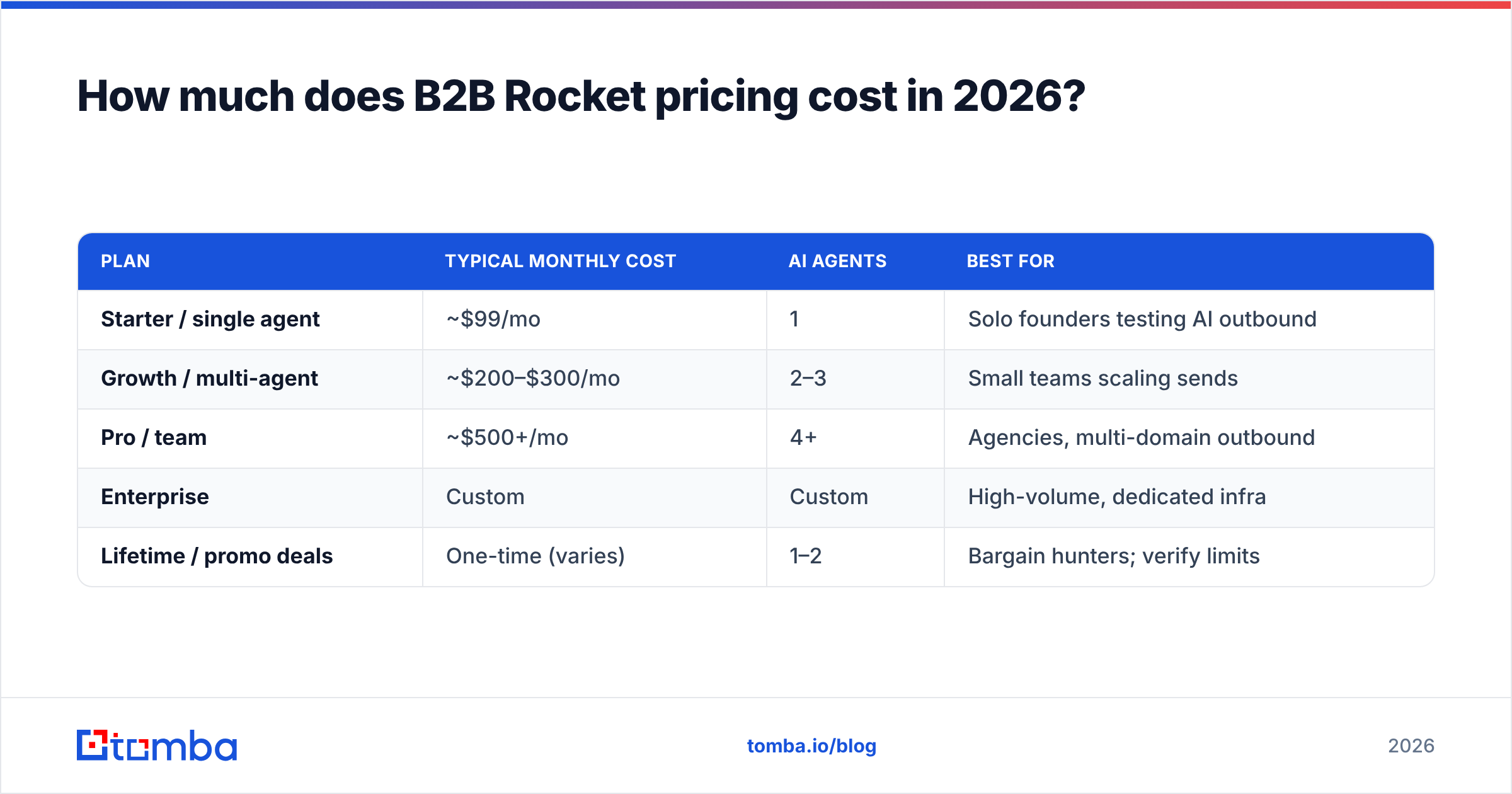
Pricing tiers for AI-agent platforms move frequently, and B2B Rocket has restructured its plans more than once. Always confirm live numbers on the official B2B Rocket site before budgeting. As a working reference, the structure in 2026 generally breaks down like this:
| Plan | Typical monthly cost | AI agents | Best for |
|---|---|---|---|
| Starter / single agent | ~$99/mo | 1 | Solo founders testing AI outbound |
| Growth / multi-agent | ~$200–$300/mo | 2–3 | Small teams scaling sends |
| Pro / team | ~$500+/mo | 4+ | Agencies, multi-domain outbound |
| Enterprise | Custom | Custom | High-volume, dedicated infra |
| Lifetime / promo deals | One-time (varies) | 1–2 | Bargain hunters; verify limits |
A few notes on reading this table. The single-agent tier is the realistic entry point for most individuals. The jump to multi-agent is where total spend climbs fast, because more agents usually means more mailboxes and more credits to keep them fed. Lifetime deals appear periodically on deal sites — they can be great value, but read the credit caps closely, because a cheap lifetime license throttled to a few hundred leads a month is not the same product.
What is actually included at each B2B Rocket tier?#
The line items that determine value are not the agent count — they're the limits attached to it. When you evaluate any tier, map it against these five dimensions:
- Lead credits per month — how many contacts the agent can source and email. This is the cap that quietly defines your pipeline ceiling.
- Connected mailboxes — more inboxes spread sending risk; too few and your deliverability suffers as volume rises.
- Monthly email volume — the total sends allowed across all agents.
- AI reply handling — whether auto-responses and qualification are unlimited or metered.
- Data refresh and accuracy — how current the underlying contact database is, and whether emails are verified before sending.
That last point matters more than the price. If sourced emails aren't verified, you burn sender reputation on bounces — and no AI agent can out-write a blacklisted domain. This is why many experienced operators run a dedicated verification pass regardless of what an all-in-one promises. Understanding email deliverability is non-negotiable before you trust any platform to send on your behalf.
What hidden costs should you watch for in B2B Rocket pricing?#
The subscription is the floor, not the ceiling. Budget for these:
- Extra mailboxes and domains. Safe cold outbound spreads volume across multiple sending domains and inboxes. Each one carries setup and often a monthly per-mailbox fee, whether through B2B Rocket or a third-party provider.
- Domain warmup. New domains can't blast on day one. You'll pay for warmup time (and lost weeks) before agents run at full tilt. Plan with an email warmup calculator so you don't sabotage reputation.
- Data top-ups. Hit your lead credit cap mid-month and you either upgrade or buy add-on credits at a marginal rate that's rarely cheap.
- Annual contract lock-in. Discounted annual plans look attractive until the tool underperforms in month two and you're committed for ten more.
- Deliverability cleanup. If unverified sends tank your reputation, recovery costs real time and money — sometimes a fresh domain.
Is B2B Rocket worth it compared to a modular stack?#
It depends on what you value: convenience or control.
B2B Rocket's pitch is that one subscription replaces a data vendor, a sending tool, and an SDR's manual reply work. For a solo founder with no time, that consolidation has genuine value. The friction of stitching tools together disappears.
The tradeoff is control over the two things that decide outbound success: data accuracy and inbox health. With a bundled AI agent, you largely trust the platform's database and sending logic. With a modular stack, you choose a best-in-class data source, verify every address, and manage your own warmup and rotation.
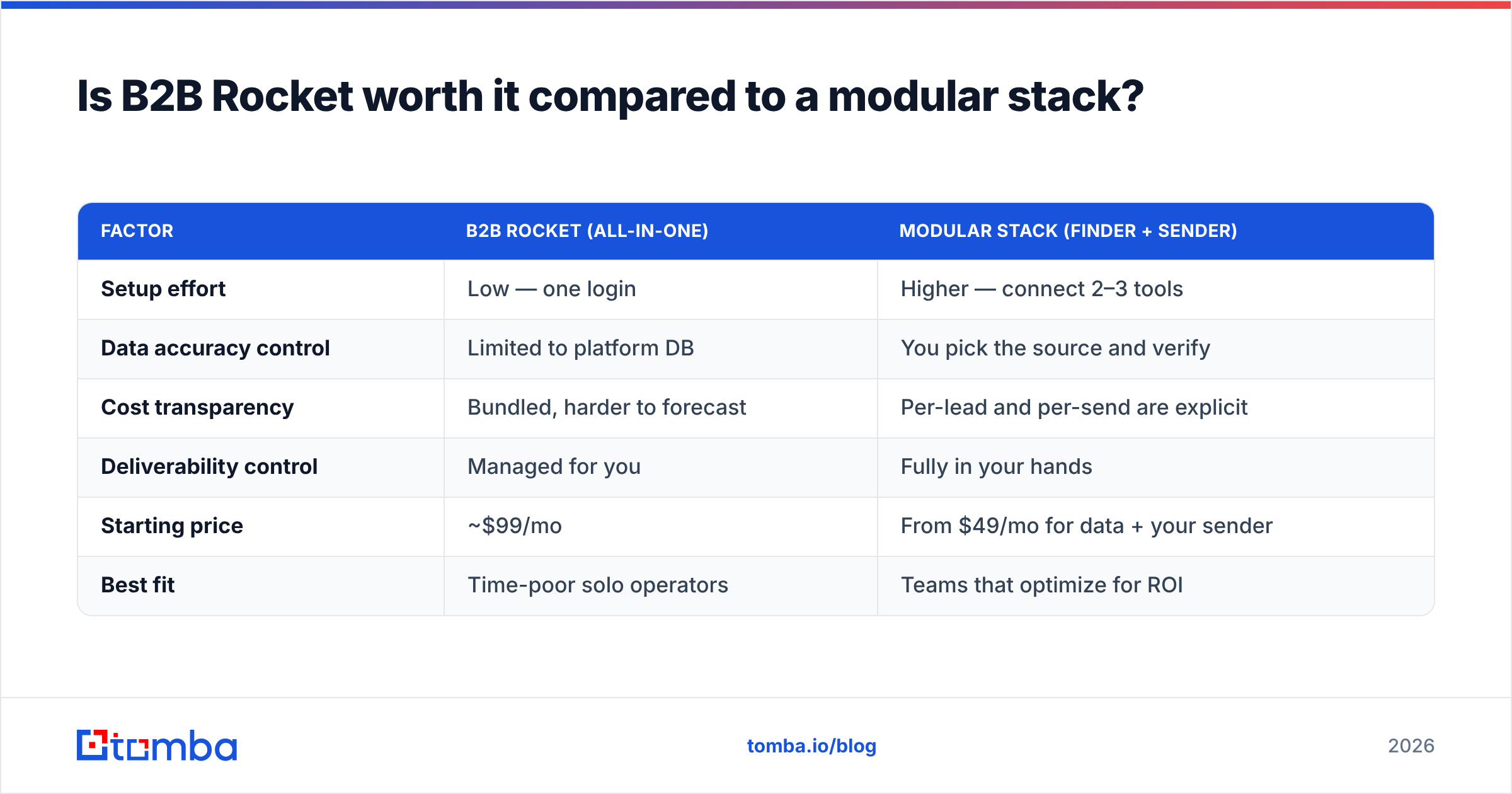
Here's the comparison that matters most:
| Factor | B2B Rocket (all-in-one) | Modular stack (finder + sender) |
|---|---|---|
| Setup effort | Low — one login | Higher — connect 2–3 tools |
| Data accuracy control | Limited to platform DB | You pick the source and verify |
| Cost transparency | Bundled, harder to forecast | Per-lead and per-send are explicit |
| Deliverability control | Managed for you | Fully in your hands |
| Starting price | ~$99/mo | From $49/mo for data + your sender |
| Best fit | Time-poor solo operators | Teams that optimize for ROI |
Independent reviews on platforms like G2 are worth scanning before you commit — look specifically for comments about data freshness and reply quality, which are the most common complaints against AI-agent tools.
How does the per-lead math compare?#
Run the numbers on cost per usable lead, not cost per subscription. A $99/month plan that sources 1,000 contacts looks like $0.10 per lead — but if 20% bounce or are stale, your real cost per deliverable contact jumps, and the bounces damage every other send.
Now compare a modular approach. A high-accuracy finder like Tomba's domain search returns verified addresses by company, you confirm them through an email verifier, and you send through a tool you already trust. You pay for clean data once and control exactly how it's used.
For teams running serious volume, a bulk email finder plus verification keeps the per-lead cost flat and predictable — no surprise top-up rates, no mystery about what's behind the bundled price. That predictability is often worth more than the convenience of a single dashboard.
Who should choose B2B Rocket, and who shouldn't?#
Choose B2B Rocket if:
- You're a solo founder or tiny team with zero bandwidth to manage tools.
- You want AI to handle first-touch replies and qualification automatically.
- You're testing whether autonomous outbound works for your motion before investing in a real RevOps stack.
Skip it (or pair it down) if:
- Data accuracy is critical and you sell into hard-to-reach roles.
- You already own a sending tool and just need better contact data.
- You want transparent, forecastable costs as you scale.
- Your domain reputation is an asset you refuse to risk on unverified sends.
For that second group, the smarter spend is usually a precise data layer feeding tools you already control. You keep the parts that work and replace only the contact-sourcing problem.
How do you keep outbound costs predictable in 2026?#
Three habits separate teams with healthy outbound economics from those bleeding budget:
- Verify before you send. Every address through a verifier first. Bounces are the most expensive thing in cold email — they cost reputation, not just credits.
- Track cost per booked meeting, not cost per tool. A "cheap" platform that books nothing is infinitely expensive. Tie every dollar to a meeting.
- Keep your data layer swappable. Whatever sends your email, source contacts from a provider you can audit. An email finder API lets you pipe verified data into any workflow, so you're never locked into one vendor's database quality.
The teams that win in 2026 treat data and sending as separate, optimizable decisions — not a bundle they hope works.
The bottom line on B2B Rocket pricing#
B2B Rocket pricing starts modestly but bundles four cost drivers — agents, credits, sending, and AI — into one subscription that's hard to forecast and harder to optimize. It's a reasonable bet for time-poor solo operators who value automation over control. For teams that live or die by data accuracy and deliverability, the math usually favors a modular stack you can audit and tune.
If your real bottleneck is finding accurate, verified contact data — not the sending wrapper around it — start with the Tomba Email Finder. You'll get verified professional emails by name, domain, or company, plug them into whatever sender you already run, and keep your per-lead cost flat and transparent. Try the free tier (25 searches/month), then scale to Starter at $49/month when you're ready — no agent math, no surprise top-ups, just clean data feeding pipeline you can actually forecast.
Ready to find emails that actually work?
Join 150,000+ professionals who stopped guessing and started sending. Free credits on signup — no credit card required.
Get the Tomba newsletter
Practical outbound tactics and product updates — once every two weeks.
About the author