B2B Rocket vs Apollo.io (2026): Which AI Sales Tool Wins?
B2B Rocket automates outreach with AI agents; Apollo.io is a 275M-contact prospecting database. Here's how the two compare on data, automation, pricing, and where each one actually fits in 2026.
You're trying to pick a tool that fills the top of your pipeline, and two very different products keep showing up on the shortlist: B2B Rocket and Apollo.io. They sound like competitors, but they solve different halves of the same problem. One sends the emails for you. The other tells you who to email. Choosing wrong means paying for automation on top of bad data — or great data that never gets used.
This guide breaks down B2B Rocket vs Apolloio on what actually matters: data accuracy, automation depth, pricing, deliverability, and the gap each one leaves open.
TL;DR#
- Apollo.io is a B2B database and sales-engagement platform — 275M+ contacts, filters, sequences, and a CRM. You drive it.
- B2B Rocket is an AI-agent layer that auto-prospects, emails, and books meetings with minimal human input. It drives itself.
- They aren't really rivals. Apollo gives you data and manual sequencing; B2B Rocket gives you autonomous outreach but leans on third-party data.
- Both have the same weak spot: contact data decays ~30% per year, and neither verifies as aggressively as a dedicated tool. Bounces tank your sender reputation.
- The fix: pair whichever you pick with a dedicated email verifier so your AI agents and sequences aren't blasting dead inboxes.
)
What is B2B Rocket?#
B2B Rocket is an AI-agent sales automation platform. You configure an "AI agent," give it an ideal customer profile, and it goes out, identifies prospects, sends personalized emails, handles replies, and schedules meetings on your calendar — largely on autopilot.
Think of it like hiring an SDR who never sleeps. You set the playbook once; the agent runs the plays. The pitch is volume and hands-off operation: define the campaign, then check your calendar for booked demos.
The trade-off is control and transparency. Because the agent sources and qualifies leads inside a closed loop, you have less visibility into where a given contact came from or how fresh that email address is. Autonomous outreach is only as good as the data feeding it — and that's exactly where a lot of AI-SDR tools quietly struggle.
What is Apollo.io?#
Apollo.io is a sales intelligence and engagement platform built around a large B2B contact database — over 275 million contacts and 73 million companies, by their own numbers. You search and filter by title, industry, headcount, technology, intent signals, and dozens of other attributes, then push contacts into sequences or your CRM.
Apollo is the opposite philosophy: it hands you the raw material and the tooling, and you decide the strategy. It includes email sequencing, a dialer, a Chrome extension, basic CRM features, and analytics. It's a Swiss Army knife for outbound teams who want to own their process.
The downside is that Apollo is a manual engine at heart. The database is broad but not flawless — data accuracy and email verification are the most common complaints you'll find on G2. You still do the work of building lists, writing copy, and managing deliverability.
B2B Rocket vs Apolloio: how do they compare?#
Here's the head-to-head on the attributes that decide most purchases.
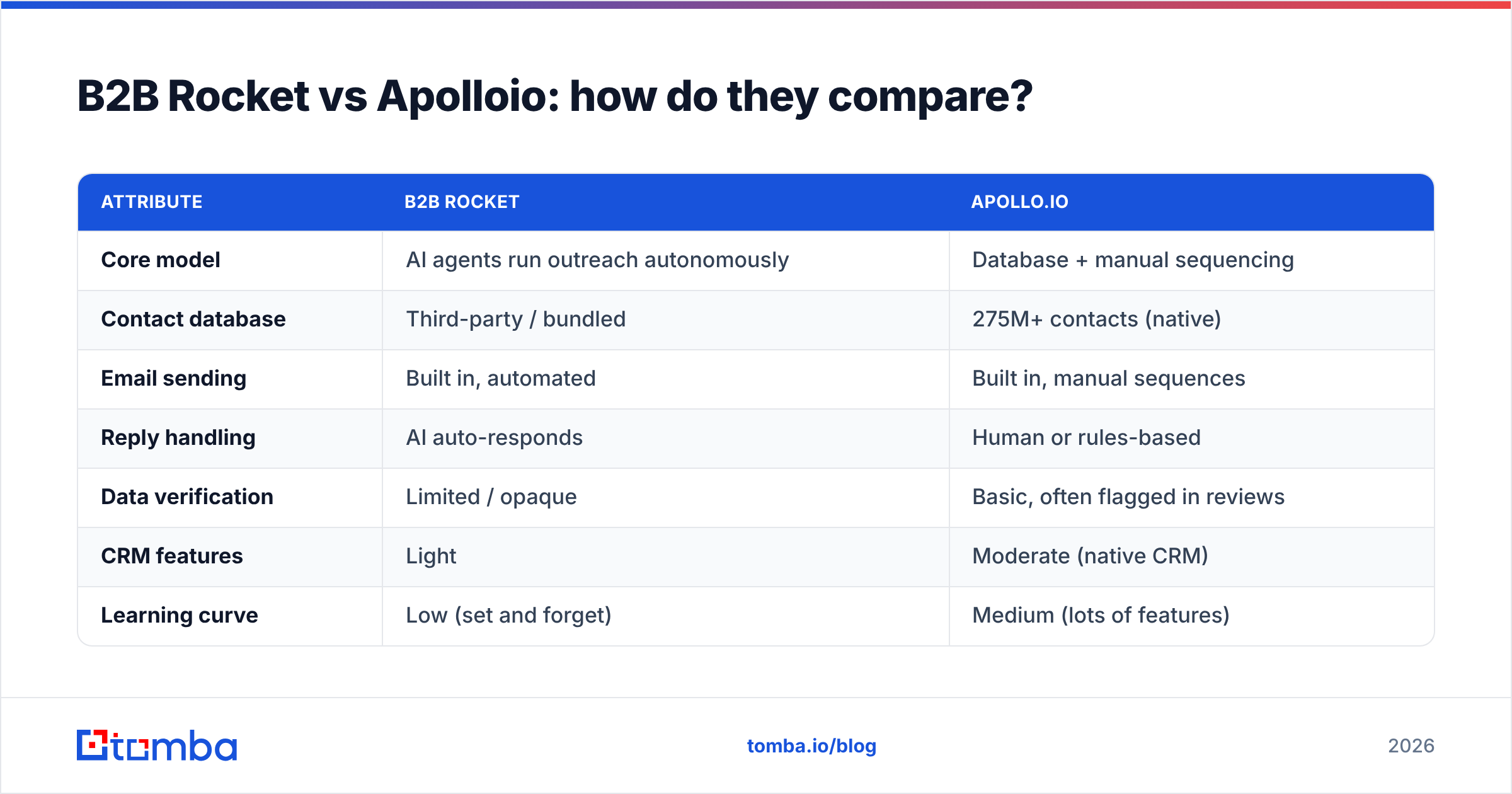
| Attribute | B2B Rocket | Apollo.io |
|---|---|---|
| Core model | AI agents run outreach autonomously | Database + manual sequencing |
| Contact database | Third-party / bundled | 275M+ contacts (native) |
| Email sending | Built in, automated | Built in, manual sequences |
| Reply handling | AI auto-responds | Human or rules-based |
| Data verification | Limited / opaque | Basic, often flagged in reviews |
| CRM features | Light | Moderate (native CRM) |
| Learning curve | Low (set and forget) | Medium (lots of features) |
| Best for | Lean teams wanting hands-off volume | Teams who want control + data |
| Entry pricing | ~$99+/mo per agent (varies) | Free tier; paid from ~$49/user/mo |
The pattern is clear: B2B Rocket optimizes for automation, Apollo optimizes for data and control. Neither leads on verified data quality, which is the variable that determines whether your campaigns land or bounce.
Which one has better data?#
Apollo wins on breadth; neither wins on freshness.
Apollo's native 275M-contact database is its biggest moat. If you need to build a list of "VP Engineering at 200–500 person SaaS companies in DACH," Apollo's filters get you there fast. B2B Rocket doesn't expose a comparable searchable database — it sources contacts behind the scenes to feed its agents.
But size isn't accuracy. B2B contact data decays roughly 30% per year as people change jobs, companies rebrand, and inboxes get retired. Both platforms inherit this decay, and both verify less rigorously than a purpose-built tool. The result is the same on either platform: a meaningful share of the addresses your campaign uses are wrong on day one.
That matters more than it sounds. A 5% bounce rate is the line where mailbox providers start throttling you. Push past it and your sender reputation craters — which means even your good emails stop reaching inboxes.
This is why the smartest setup isn't "B2B Rocket vs Apollo" at all. It's "whichever you pick, plus a verification layer." Running every address through a dedicated email verifier before it enters a sequence is the cheapest insurance in outbound. If you're sourcing net-new contacts, a focused email finder returns addresses with confidence scores so you know what you're sending before you hit go.
Is B2B Rocket better than Apollo.io for automation?#
Yes — automation is B2B Rocket's entire reason to exist, and it goes further than Apollo's sequences.
Apollo automates sending: you build a sequence, set delays, and it fires emails on schedule. But a human still writes the copy, builds the list, and reads the replies. It's automated outreach with a human in the loop.
B2B Rocket automates the whole loop: sourcing, personalizing, sending, replying, and booking. For a two-person startup with no SDR, that's genuinely useful — it compresses a full outbound function into a configuration screen.
The risk is autonomy without guardrails. An AI agent sending high volume on unverified data is a fast way to get a domain blacklisted. Hands-off is a feature right up until the agent is hands-off about your deliverability too. If you go the B2B Rocket route, gate the agent's contact list through verification first and warm your sending domain — automation amplifies whatever data quality you feed it, good or bad.
)
How do they price?#
Pricing is where the two diverge in philosophy as much as numbers.
Apollo.io uses a freemium, per-user model. There's a genuine free tier with limited credits, and paid plans scale by seat and credit volume (Basic, Professional, Organization). It's predictable for a growing team — you add seats as you hire.
B2B Rocket prices around its AI agents, typically per-agent per-month, with the cost reflecting the done-for-you automation. It can look cheaper for a solo founder replacing an SDR, or more expensive once you scale agents.
Here's a simplified breakdown:
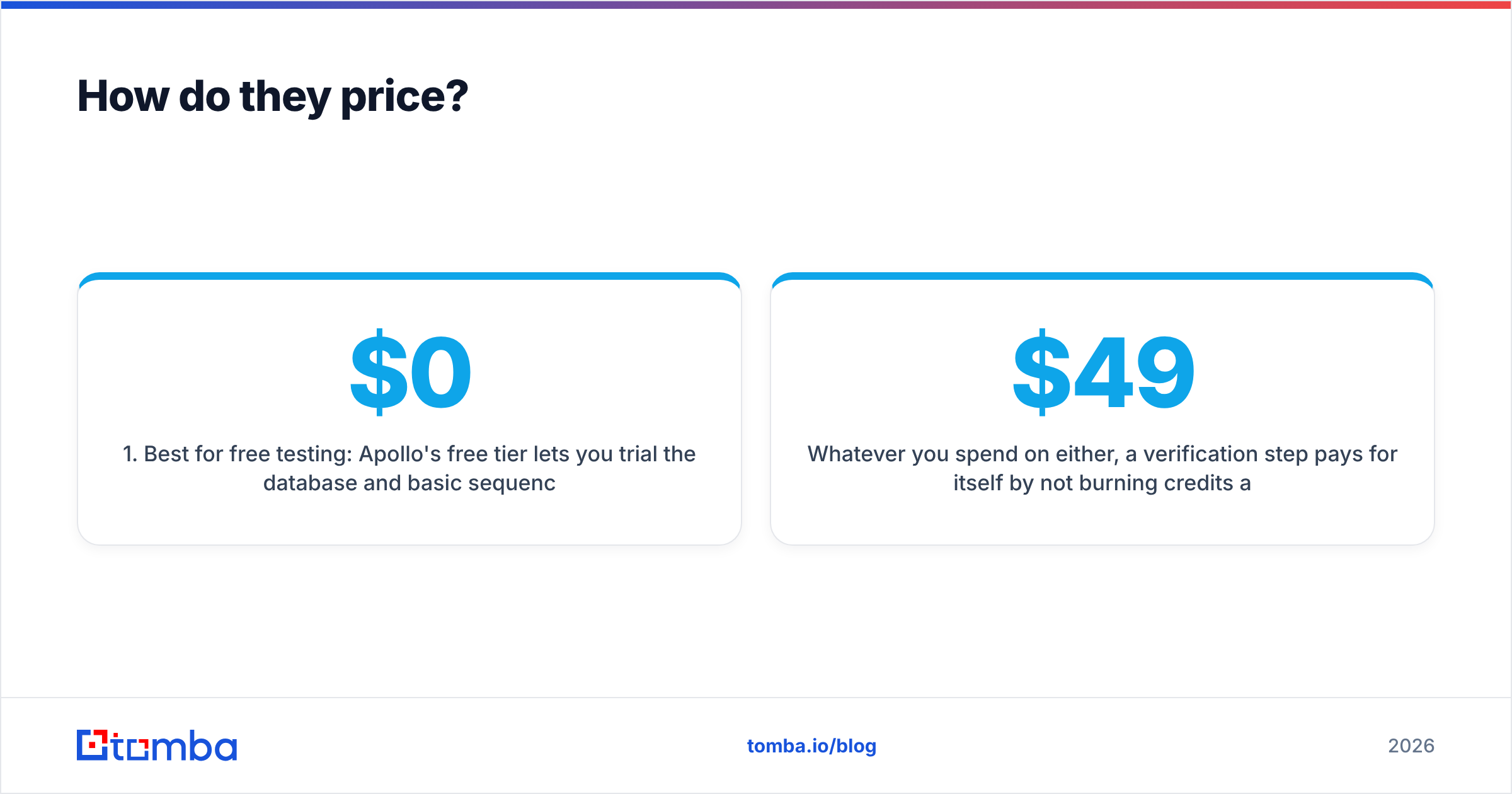
- Best for free testing: Apollo's free tier lets you trial the database and basic sequencing at $0.
- Best for solo founders: B2B Rocket — one agent can replace a chunk of manual SDR work.
- Best for scaling teams: Apollo — per-seat pricing and native CRM grow with headcount.
- Best for predictable spend: Apollo — seat-based costs are easier to forecast than agent-based volume.
- Hidden cost on both: wasted credits and damaged reputation from unverified sends. Verification recovers that spend.
Whatever you spend on either, a verification step pays for itself by not burning credits and inboxes on dead addresses. Compare that against Tomba pricing — a Free tier (25 searches/mo), Starter at $49/mo, Growth at $99/mo, and Pro at $249/mo — and the verification layer is a rounding error next to a throttled domain.
What about deliverability?#
Neither tool guarantees deliverability — and that's the most overlooked part of this decision.
Both B2B Rocket and Apollo can send email. Neither fully owns whether it lands. Inbox placement depends on factors outside either platform: your SPF, DKIM, and DMARC records, domain warmup, content spam-scoring, and — most of all — bounce rate. Send to a list with 8% invalid addresses and it doesn't matter how clever the AI copy is; mailbox providers will route you to spam.
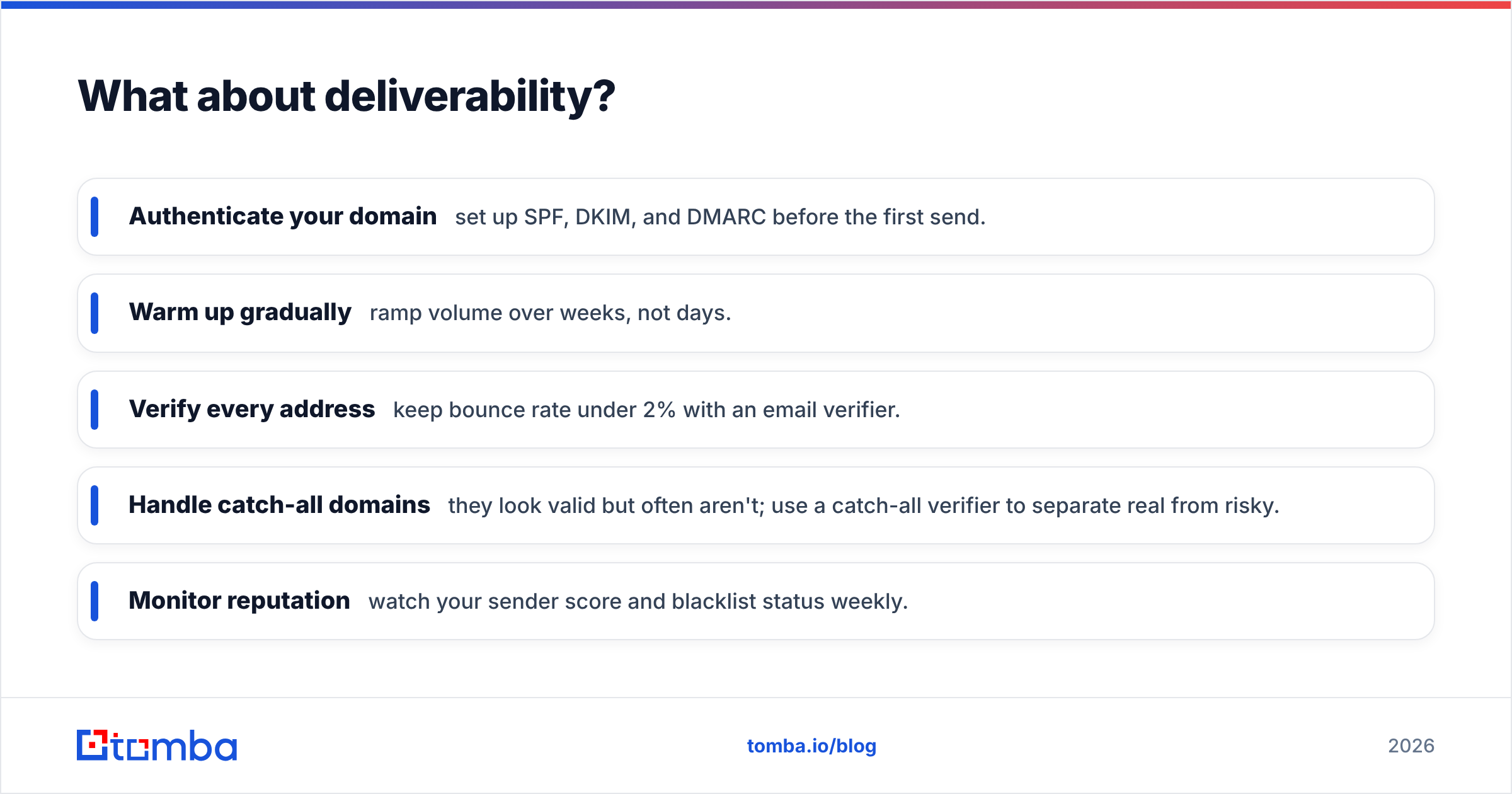
The deliverability checklist is the same regardless of which tool you choose:
- Authenticate your domain — set up SPF, DKIM, and DMARC before the first send.
- Warm up gradually — ramp volume over weeks, not days.
- Verify every address — keep bounce rate under 2% with an email verifier.
- Handle catch-all domains — they look valid but often aren't; use a catch-all verifier to separate real from risky.
- Monitor reputation — watch your sender score and blacklist status weekly.
Apollo and B2B Rocket help with steps one and two to varying degrees. Steps three and four are where a dedicated data tool does the heavy lifting neither sales platform was built for.
Which should you choose?#
Match the tool to your constraint, not the hype.
- Choose Apollo.io if you have a sales team that wants control, needs a searchable database, and will own its own copy and process. It's the better foundation for a deliberate, scalable outbound motion.
- Choose B2B Rocket if you're a lean team or solo founder who wants outreach to run without a dedicated SDR, and you're comfortable trading visibility for autonomy.
- Choose neither as your data source. Both are delivery and orchestration layers. The contact accuracy underneath them is what makes or breaks results — and that's a separate, solvable problem.
If you already lean toward Apollo but bristle at the data complaints, it's worth looking at an Apollo alternative that focuses purely on accurate, verified contact discovery rather than bundling a dozen half-features.
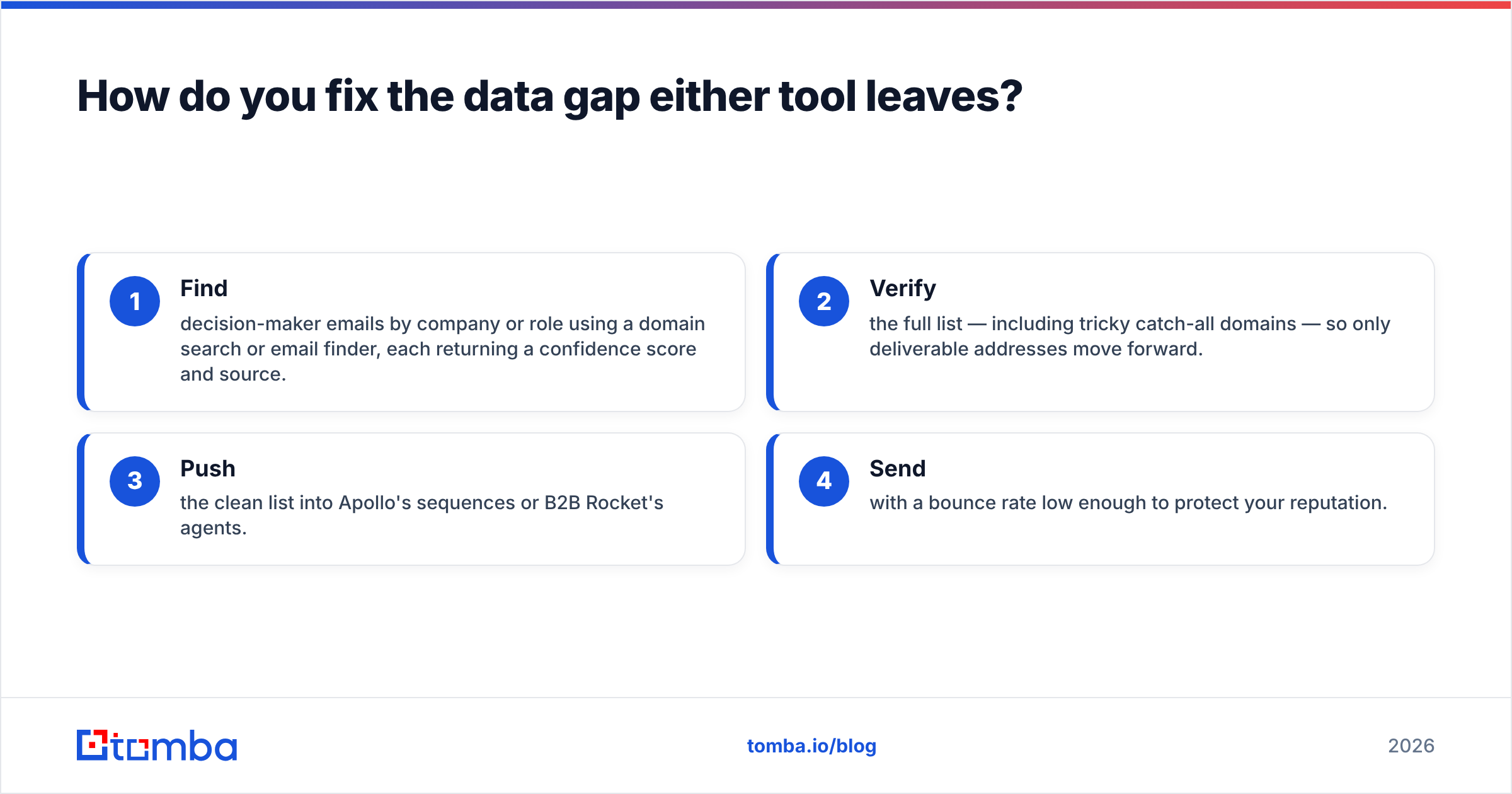
How do you fix the data gap either tool leaves?#
Layer a dedicated finder-and-verifier in front of whichever platform you run. The workflow is simple:
- Find decision-maker emails by company or role using a domain search or email finder, each returning a confidence score and source.
- Verify the full list — including tricky catch-all domains — so only deliverable addresses move forward.
- Push the clean list into Apollo's sequences or B2B Rocket's agents.
- Send with a bounce rate low enough to protect your reputation.
That sequence turns either platform from "spray and pray" into a precise machine. Tomba's email finder is built for exactly this front-of-funnel step — accurate professional emails by domain, name, or company, verified before they ever reach your outreach tool. Start free with 25 searches a month, and feed your Apollo lists or B2B Rocket agents data they can actually deliver to. Your open rates — and your domain — will thank you.
Frequently asked questions#
Is B2B Rocket a direct competitor to Apollo.io? Not exactly. B2B Rocket is an AI-agent automation layer that runs outreach for you, while Apollo.io is primarily a contact database and manual sequencing platform. They overlap on email sending but solve different problems.
Does Apollo.io have better data than B2B Rocket? Apollo exposes a far larger searchable database (275M+ contacts), so it wins on breadth. Neither verifies aggressively, so both benefit from a dedicated email verification step before sending.
Can I use both together? Yes. Some teams use Apollo to build and own lists, then run automated outreach. The bigger win is adding a verification layer in front of either so your sends stay deliverable.
Which is cheaper? Apollo has a free tier and per-seat pricing; B2B Rocket prices per AI agent. For a solo founder, B2B Rocket can be cost-effective as an SDR replacement; for scaling teams, Apollo's seat model is more predictable.
// get started
Find, verify and enrich your first contacts today
Start on the free plan with 25 searches a month, then scale when your team is ready.
Free plan · No credit card required · GDPR & CCPA
// about the author