B2B Rocket vs Clodura.ai (2026): Which AI Sales Tool Wins?
B2B Rocket runs autonomous AI sales agents; Clodura.ai is an all-in-one prospecting database with sequences. Here is an honest 2026 breakdown of pricing, data, and which one fits your team.
You are choosing between two very different "AI sales" platforms that happen to get compared a lot: B2B Rocket and Clodura.ai. One sells autonomous AI agents that prospect and book meetings for you. The other sells a sales-intelligence database with built-in sequences. Picking the wrong one wastes a quarter of pipeline.
This post breaks down what each tool actually does, where the data comes from, what you pay, and which scenario each one wins.
TL;DR#
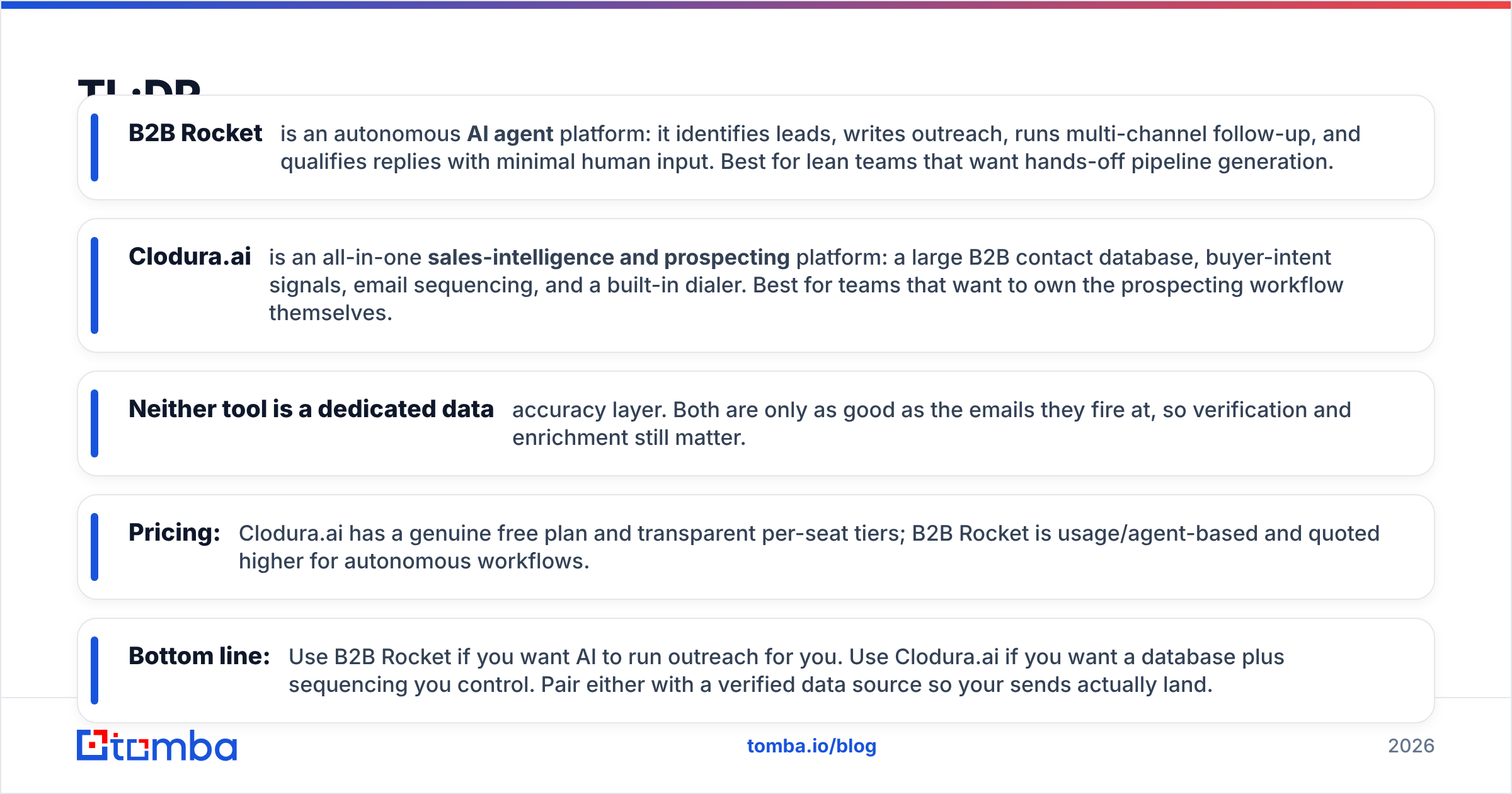
- B2B Rocket is an autonomous AI agent platform: it identifies leads, writes outreach, runs multi-channel follow-up, and qualifies replies with minimal human input. Best for lean teams that want hands-off pipeline generation.
- Clodura.ai is an all-in-one sales-intelligence and prospecting platform: a large B2B contact database, buyer-intent signals, email sequencing, and a built-in dialer. Best for teams that want to own the prospecting workflow themselves.
- Neither tool is a dedicated data-accuracy layer. Both are only as good as the emails they fire at, so verification and enrichment still matter.
- Pricing: Clodura.ai has a genuine free plan and transparent per-seat tiers; B2B Rocket is usage/agent-based and quoted higher for autonomous workflows.
- Bottom line: Use B2B Rocket if you want AI to run outreach for you. Use Clodura.ai if you want a database plus sequencing you control. Pair either with a verified data source so your sends actually land.
What is B2B Rocket?#
B2B Rocket is an AI agent platform built around the idea that a software "BDR" can run the top of your funnel. You define an ideal customer profile, connect a mailbox, and the agent sources matching prospects, drafts personalized messages, sends them, handles basic objection replies, and books qualified meetings on your calendar.
The pitch is autonomy. Instead of a rep manually building lists and writing sequences, the agent does the repetitive work and escalates only warm conversations. For a two-person startup with no SDR budget, that is attractive. You trade fine-grained control for speed and coverage.
The trade-off is the usual one with autonomous outreach: the agent will send whatever volume you let it, and if the underlying contact data is stale or unverified, it will cheerfully email dead inboxes. That hurts your domain reputation fast. AI does not fix a bad list — it scales it.
What is Clodura.ai?#
Clodura.ai is a sales-intelligence platform first and an automation tool second. Its core asset is a large B2B database — hundreds of millions of contacts and company records, plus org charts, technographics, and buyer-intent signals. On top of that sit email sequences, a built-in dialer, and email verification.
The workflow is rep-driven. You search the database, build a targeted list, verify the contacts, load them into a cadence, and work the replies yourself. It is closer to a lighter-weight ZoomInfo or Apollo than to an autonomous agent.
That makes Clodura.ai a better fit for teams that already have SDRs and want one tool to find, sequence, and dial — rather than handing the whole motion to software. You can read more about how prospecting databases work in our B2B database overview.
B2B Rocket vs Clodura.ai: how do they compare?#
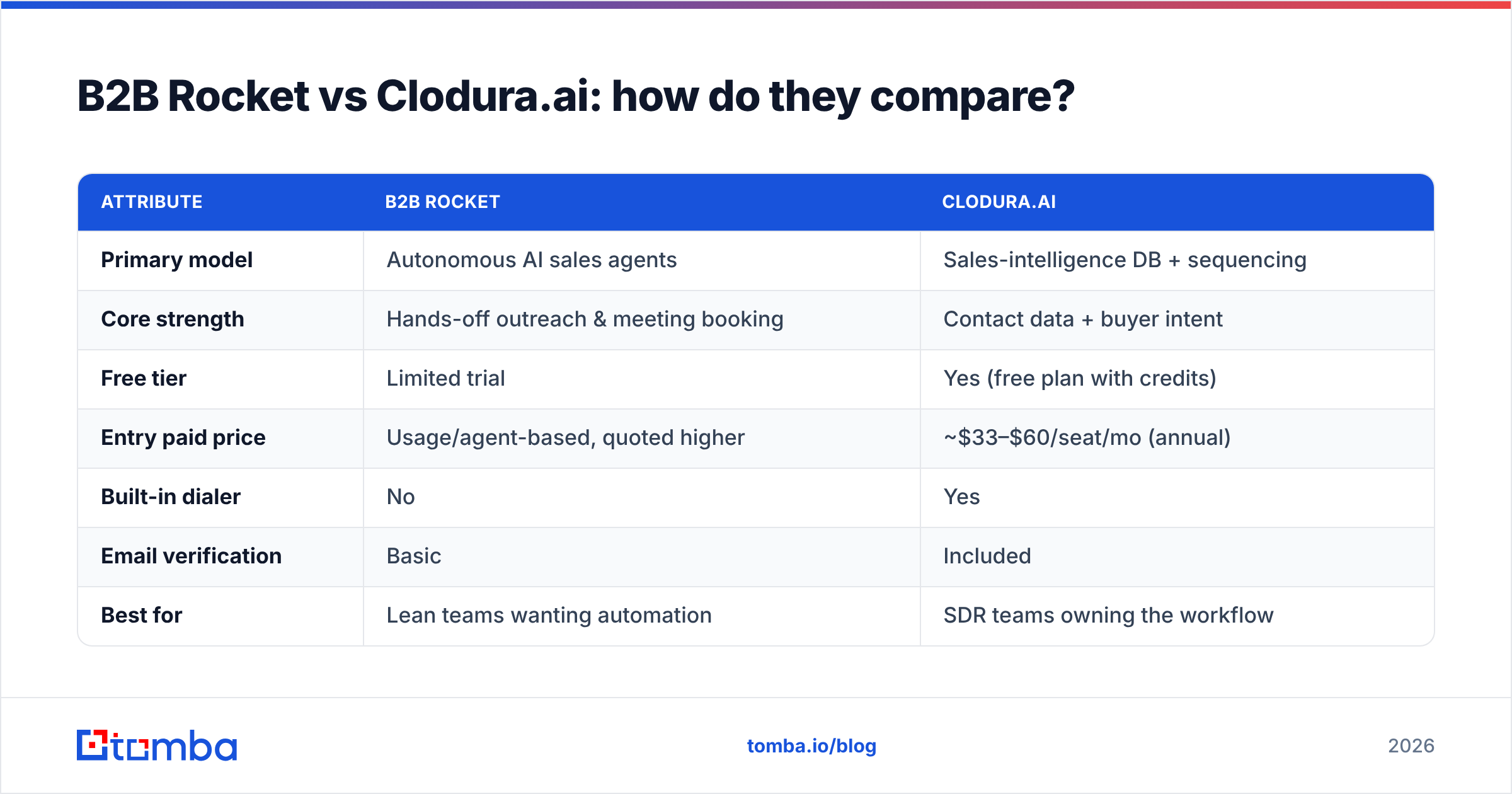
Here is the side-by-side. Pricing is indicative of publicly listed tiers and changes often — confirm on each vendor's site before you buy.
| Attribute | B2B Rocket | Clodura.ai |
|---|---|---|
| Primary model | Autonomous AI sales agents | Sales-intelligence DB + sequencing |
| Core strength | Hands-off outreach & meeting booking | Contact data + buyer intent |
| Free tier | Limited trial | Yes (free plan with credits) |
| Entry paid price | Usage/agent-based, quoted higher | ~$33–$60/seat/mo (annual) |
| Built-in dialer | No | Yes |
| Email verification | Basic | Included |
| Best for | Lean teams wanting automation | SDR teams owning the workflow |
| Learning curve | Low (set and forget) | Moderate (search + build) |
| Data control | Low (agent decides) | High (you build lists) |
A simple way to decide:
- You have no SDRs and want pipeline now — B2B Rocket. The agent replaces the manual motion.
- You have reps who prospect daily — Clodura.ai. Give them a database and a dialer instead of an autopilot.
- You live in the phone channel — Clodura.ai, because of the built-in dialer.
- You want maximum send volume with minimal effort — B2B Rocket, but watch deliverability closely.
- You want predictable per-seat budgeting — Clodura.ai's transparent tiers are easier to forecast.
Which has better data accuracy?#
Neither tool publishes independently audited match rates, and both rely on a mix of scraped, crowdsourced, and partner data. In practice that means a meaningful share of contacts will be outdated regardless of which vendor you pick. The fix is the same for both: verify before you send.
This is where the comparison stops being "Rocket vs Clodura" and starts being "garbage in vs verified in." An autonomous agent that blasts a 30% invalid list will torch your sender reputation in days. A rep working a hand-built list in Clodura.ai will waste hours chasing bounces. Both problems disappear when the data layer is clean.
Run lists through an email verifier before they enter any sequence, and use data enrichment to fill the gaps each platform leaves — direct dials, job-title changes, and verified work emails. A clean list lifts your response rate far more than any AI copy tweak.
Which is better for deliverability?#
Deliverability favors whichever workflow gives you more control over volume and list hygiene — which usually means Clodura.ai, but only if you use it carefully.
Autonomous agents like B2B Rocket are convenient precisely because they remove decisions from you, including how aggressively to send. High automated volume against unverified contacts is the fastest route to the spam folder. If you run B2B Rocket, cap daily volume, warm the mailbox, and feed it only verified addresses.
Clodura.ai gives reps the steering wheel: smaller batches, manual review, and verification before send. That is healthier for your domain, but it requires discipline your team has to supply.
Either way, the deliverability fundamentals are non-negotiable: authenticated sending domains, gradual warmup, and a verified list. Tools do not exempt you from the basics — review the core ideas in any solid guide to email deliverability and check sender health regularly.
What about pricing and value?#
Clodura.ai is the more transparent and budget-friendly option for most teams. It offers a free plan with monthly credits and per-seat paid tiers, so you can model cost against headcount. That predictability matters when finance asks what scaling to ten reps will cost.
B2B Rocket prices around agents and usage, and autonomous workflows tend to be quoted higher than a simple per-seat license. The value question is whether the agent genuinely replaces SDR labor. If it books even a couple of qualified meetings a month that you would otherwise pay a human to source, the math can work. If it mostly generates low-quality activity, you are paying a premium for noise.
A budgeting reality check both vendors gloss over: data credits run out, and "unlimited" rarely is. Build verification and enrichment cost into your plan from day one rather than discovering it after your first bounce spike.
When should you use a dedicated email-finder instead?#
When your real bottleneck is finding and verifying the right contact — not running the outreach engine — a focused finder beats a bundled database.
Both B2B Rocket and Clodura.ai bundle data into a larger product, which means you inherit their coverage gaps with no easy second opinion. A dedicated email finder lets you look up a specific prospect by name and company, confirm the address is deliverable, and pull it into whatever sequencing tool you already use. That is often cheaper and more accurate than paying for a full intelligence suite you only half-use.
This hybrid is common in 2026: keep B2B Rocket or Clodura.ai for the workflow, but verify and top up contacts with a specialist source so your sends land. You can compare independent reviews of these categories on G2 before committing.
B2B Rocket vs Clodura.ai: which should you choose?#
Choose B2B Rocket if you are a founder or lean team with no SDR capacity and you want software to run prospecting end to end. Accept that you trade control for automation, and commit to verifying the data the agent uses.
Choose Clodura.ai if you have reps who prospect daily and want one affordable tool for database search, sequencing, and dialing. You keep control of the motion and get more transparent pricing, at the cost of a steeper learning curve. Check current plans on the B2B Rocket and Clodura.ai sites, since both iterate quickly.
Either way, the platform is the engine, not the fuel. The teams that win with both tools are the ones that feed them clean, verified, enriched contacts instead of trusting the bundled data blindly.
Power your outreach with verified data from Tomba#
Whichever platform you pick, your results live and die on data quality. Tomba is the data layer that keeps your B2B Rocket agent or Clodura.ai sequences hitting real inboxes. Use the Tomba Email Finder to find verified professional emails by name or domain, run bulk verification before any campaign, and enrich contacts with direct phone numbers and current roles.
Start on the free tier (25 searches/month), then scale on the $49/mo Starter or $99/mo Growth plan as your pipeline grows — see full Tomba pricing for details. Feed your AI sales stack verified data, and let the automation do what it does best.
Ready to find emails that actually work?
Join 150,000+ professionals who stopped guessing and started sending. Free credits on signup — no credit card required.
Get the Tomba newsletter
Practical outbound tactics and product updates — once every two weeks.
About the author