B2B Rocket vs Overloop AI: 2026 AI Sales Tool Comparison
B2B Rocket vs Overloop AI compared on autonomous outreach, data quality, pricing, and deliverability — plus where each one actually wins in 2026.
Choosing between two "AI does your outbound for you" platforms is harder than it should be, because the marketing pages look nearly identical. B2B Rocket and Overloop AI both promise autonomous prospecting, AI-written sequences, and meetings booked on autopilot. The difference is in how they source data, how much control they hand you, and what they cost once you scale past a free trial.
This is a practical, neutral breakdown of B2B Rocket vs Overloop AI for 2026 — what each does well, where each falls short, and the one ingredient neither tool fully solves on its own.
TL;DR#
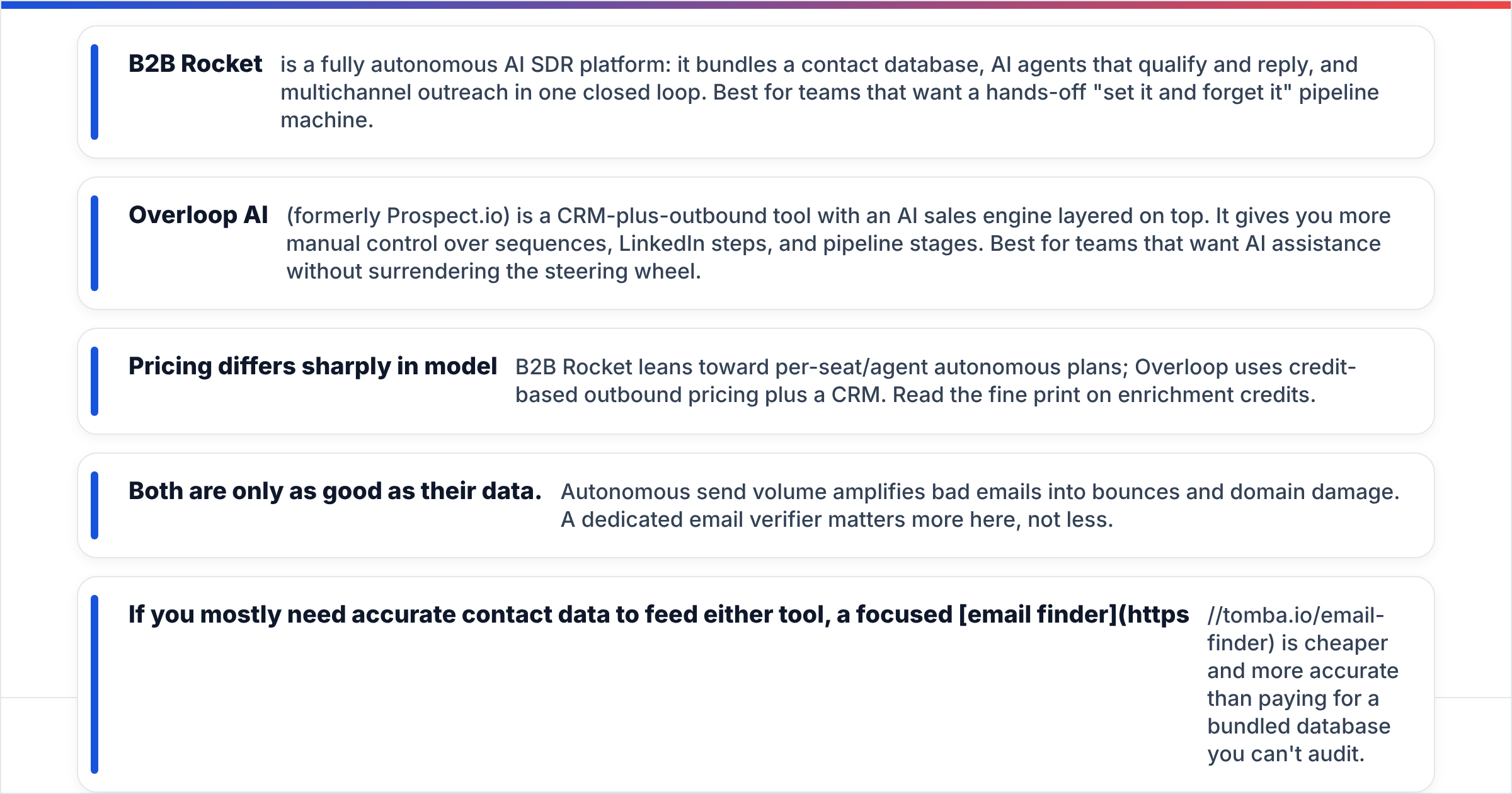
- B2B Rocket is a fully autonomous AI SDR platform: it bundles a contact database, AI agents that qualify and reply, and multichannel outreach in one closed loop. Best for teams that want a hands-off "set it and forget it" pipeline machine.
- Overloop AI (formerly Prospect.io) is a CRM-plus-outbound tool with an AI sales engine layered on top. It gives you more manual control over sequences, LinkedIn steps, and pipeline stages. Best for teams that want AI assistance without surrendering the steering wheel.
- Pricing differs sharply in model: B2B Rocket leans toward per-seat/agent autonomous plans; Overloop uses credit-based outbound pricing plus a CRM. Read the fine print on enrichment credits.
- Both are only as good as their data. Autonomous send volume amplifies bad emails into bounces and domain damage. A dedicated email verifier matters more here, not less.
- If you mostly need accurate contact data to feed either tool, a focused email finder is cheaper and more accurate than paying for a bundled database you can't audit.
What is B2B Rocket?#
B2B Rocket is an autonomous AI SDR (sales development representative) platform. You define an ideal customer profile, the platform pulls matching contacts from its database, and AI agents handle the outreach: sending the first email, interpreting replies, answering basic questions, handling objections, and booking the meeting straight onto a calendar.
The pitch is end-to-end automation. Instead of stitching together a data provider, a sequencer, and a meeting scheduler, you run one platform and let the agent work the top of funnel while your human reps focus on closing. It supports email plus LinkedIn and other channels, and the AI is tuned to keep conversations going until a prospect either books or opts out.
The trade-off with that level of autonomy is control. When an AI replies on your behalf at scale, your domain reputation rides on the quality of the data and the judgment of the model. You can read more about why that matters in the email deliverability section below.

What is Overloop AI?#
Overloop AI started life as Prospect.io, a cold-email and CRM tool, and has since added an AI sales engine. The result is more of a hybrid: a lightweight CRM with deal pipelines, plus outbound campaigns that can run across email and LinkedIn, plus AI features that draft messages and suggest next steps.
Where B2B Rocket wants to run the whole motion for you, Overloop assumes you still want to design campaigns, see every contact in a pipeline, and approve the flow. The AI accelerates the work — finding prospects, generating copy, recommending sequences — but a human stays in the loop. That appeals to teams who have been burned by black-box automation and want to keep their hands on the wheel.
Overloop's native CRM and built-in email finder mean fewer external integrations for a small team. The cost is that its database and enrichment are not its core competency the way they are for a dedicated data vendor — something to weigh when accuracy is the bottleneck.
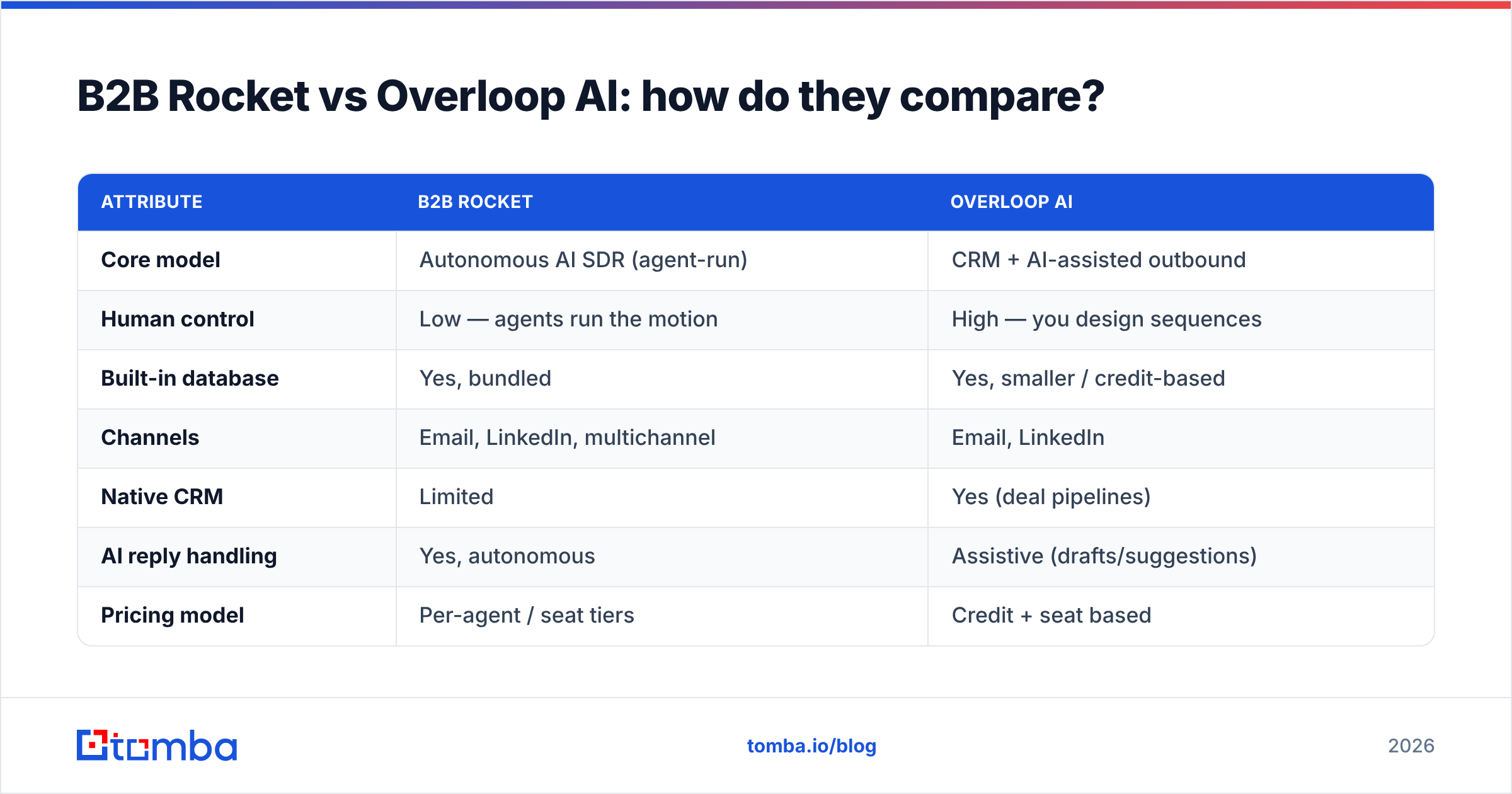
B2B Rocket vs Overloop AI: how do they compare?#
Here is the head-to-head on the attributes that actually change your results. Treat published numbers as directional — both vendors adjust plans frequently, so confirm on their pricing pages before you buy.
| Attribute | B2B Rocket | Overloop AI |
|---|---|---|
| Core model | Autonomous AI SDR (agent-run) | CRM + AI-assisted outbound |
| Human control | Low — agents run the motion | High — you design sequences |
| Built-in database | Yes, bundled | Yes, smaller / credit-based |
| Channels | Email, LinkedIn, multichannel | Email, LinkedIn |
| Native CRM | Limited | Yes (deal pipelines) |
| AI reply handling | Yes, autonomous | Assistive (drafts/suggestions) |
| Pricing model | Per-agent / seat tiers | Credit + seat based |
| Best for | Hands-off pipeline generation | Controlled, rep-led outbound |
| Data auditability | Hard to verify at source | Moderate |
The honest summary: pick B2B Rocket if you want volume and automation and you're willing to trust the machine. Pick Overloop if you want AI as a co-pilot and you care about pipeline visibility. Neither choice removes your responsibility for data hygiene.
Which one books more meetings?#
Meetings booked is the only metric that pays rent, and it comes down to three multiplied factors, not one:
- Targeting — are you reaching the right people? A bundled database is convenient but you usually can't see how fresh or accurate it is.
- Deliverability — do your emails land in the inbox? Autonomous tools send a lot, fast, which punishes bad data harder than a careful human cadence would.
- Message relevance — does the copy earn a reply? AI-generated sequences are a solid baseline but rarely beat a sharp human-edited angle.
B2B Rocket optimizes factor 1 and 3 inside one system and removes human bottlenecks, so raw activity goes up. Overloop gives you tighter control over factor 3 and keeps a human checking factor 2. But both share the same hidden ceiling: factor 2 collapses the moment your contact list is full of invalid or catch-all addresses. That's the part neither tool fully owns, and it's where most "AI SDR" disappointment actually originates.
How does data quality decide the winner?#
Conclusion first: the platform with cleaner data wins, regardless of which logo is on the dashboard. Autonomous and semi-autonomous tools both treat your email list as ground truth. If 15% of that list bounces, you don't just lose 15% of prospects — you signal to mailbox providers that you're a careless sender, and your inbox placement drops for the good addresses too.
This is why sender reputation is the real battleground. A bundled database that looks impressive in a feature comparison can quietly tank your results if it's stale. The fix is boring and effective: verify before you send, and enrich from a source you can audit.
That's the gap a dedicated data layer fills. Tomba's email verifier checks deliverability and flags catch-all domains before B2B Rocket or Overloop ever hits send, and the data enrichment API fills missing fields so your AI agents personalize with real attributes instead of guesses. If your campaigns already run inside Overloop, the Overloop alternative breakdown shows how teams swap in higher-accuracy data without rebuilding their whole stack.
What does each tool cost?#
Both vendors gate exact numbers behind sales or change them per quarter, so the structural difference matters more than any single figure:
- B2B Rocket prices around autonomous capacity — how many AI agents or seats run your outbound. The appeal is predictable "pipeline as a subscription." The risk is paying for send volume that amplifies whatever data quality you feed it.
- Overloop AI blends seat pricing with credits for finding and enriching contacts. You pay more granularly, which rewards disciplined usage but can spike when a campaign needs a big enrichment batch.
Compare that to a focused data tool. Tomba pricing runs a Free tier (25 searches/month), Starter at $49/mo, Growth at $99/mo, and Pro at $249/mo — so you can supply accurate emails to either platform without buying a second full outbound suite. For many teams, the cheapest winning combo is "one outbound engine + one accuracy layer," not "one all-in-one tool that does both jobs at B+ quality."
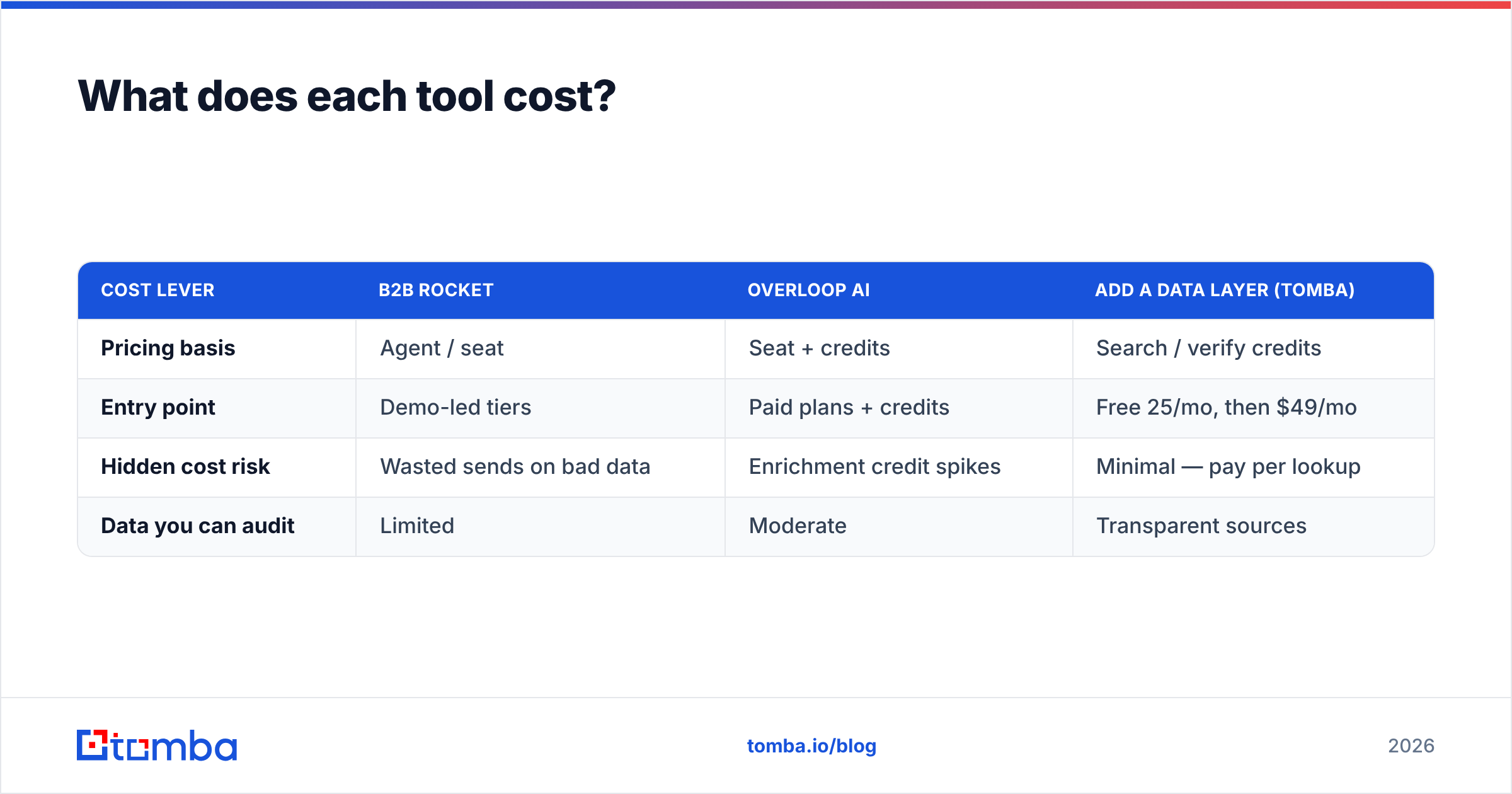
| Cost lever | B2B Rocket | Overloop AI | Add a data layer (Tomba) |
|---|---|---|---|
| Pricing basis | Agent / seat | Seat + credits | Search / verify credits |
| Entry point | Demo-led tiers | Paid plans + credits | Free 25/mo, then $49/mo |
| Hidden cost risk | Wasted sends on bad data | Enrichment credit spikes | Minimal — pay per lookup |
| Data you can audit | Limited | Moderate | Transparent sources |
When should you pick B2B Rocket?#
Choose B2B Rocket when:
- You're short on SDR headcount and want pipeline to keep moving without hiring.
- You value automation over control and are comfortable letting AI reply on your behalf.
- Your motion is high-volume, mid-ACV outbound where speed beats surgical personalization.
- You'll still verify your lists externally so the autonomous engine isn't firing at dead addresses.
It's a poor fit if you sell into a tight, high-value account list where one clumsy AI reply can burn a relationship, or if compliance requires a human to approve every outbound touch.
When should you pick Overloop AI?#
Choose Overloop AI when:
- You want a CRM and outbound in one lightweight tool without a heavy Salesforce-class rollout.
- You want AI as an assistant, not an autopilot — drafts and suggestions you approve.
- Pipeline visibility matters and you like seeing every deal stage.
- Your team is small and reducing the number of separate tools is itself a win.
It's a weaker fit if you need true hands-off volume, or if you're going to lean heavily on its bundled database as your only data source — that's where accuracy gaps show up fastest.
Can you use either tool with a dedicated data source?#
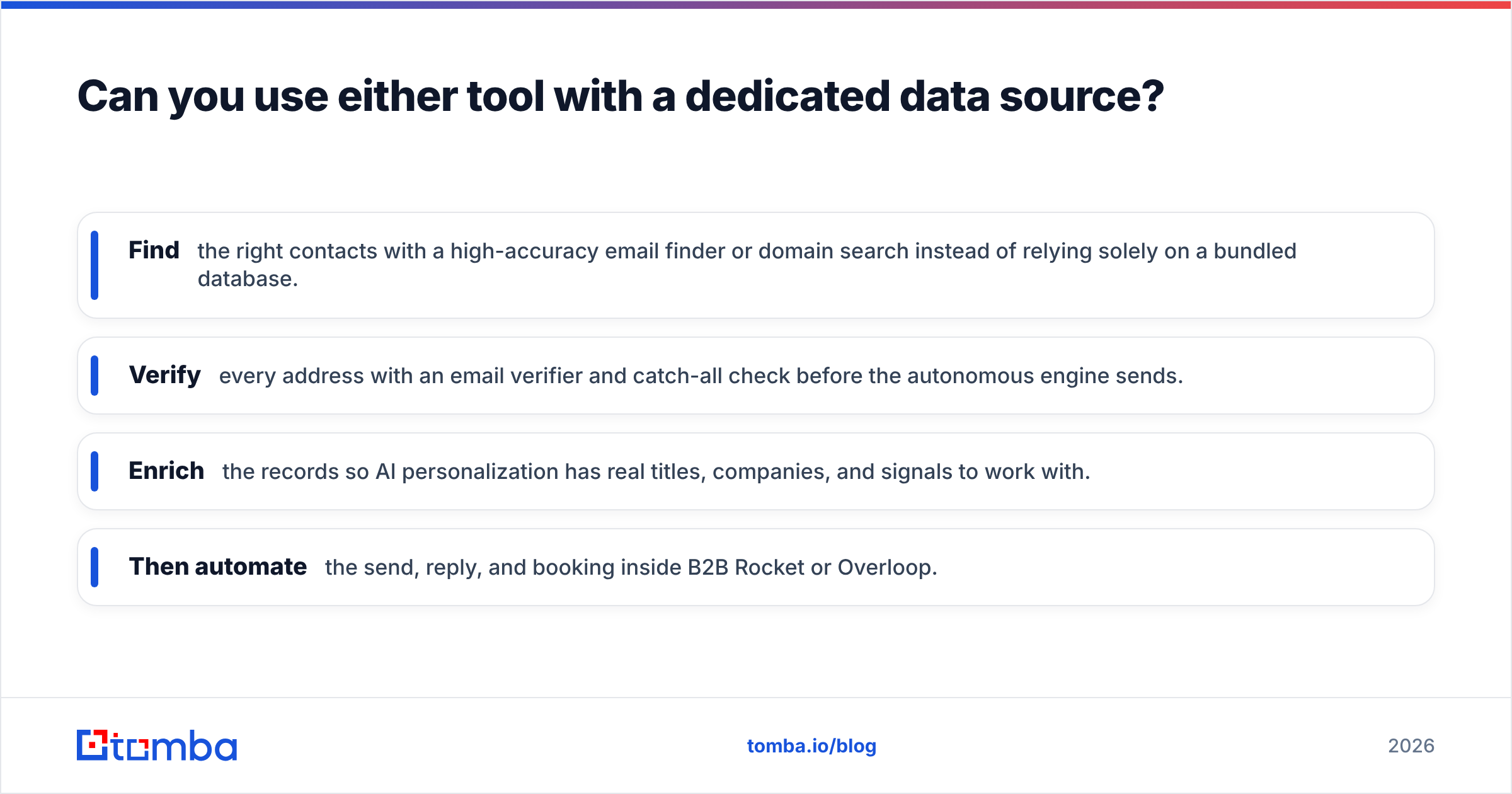
Yes, and you usually should. Both platforms expose contacts you can import or sync, which means you can run B2B Rocket or Overloop as your engine and use a specialist provider as your fuel. The pattern that consistently outperforms all-in-one:
- Find the right contacts with a high-accuracy email finder or domain search instead of relying solely on a bundled database.
- Verify every address with an email verifier and catch-all check before the autonomous engine sends.
- Enrich the records so AI personalization has real titles, companies, and signals to work with.
- Then automate the send, reply, and booking inside B2B Rocket or Overloop.
Independent review sites like G2 are useful for sanity-checking each vendor's current rating and recent user complaints before you commit — pricing and feature claims age fast in this category.
So which wins, B2B Rocket or Overloop AI?#
There's no universal winner — there's a winner for your motion. B2B Rocket wins on autonomy and raw pipeline velocity. Overloop AI wins on control, CRM visibility, and being a single tidy tool for a small team. If you forced a one-line verdict: pick B2B Rocket to scale activity fast, pick Overloop to stay in control.
But the decision that actually moves your numbers isn't the logo — it's the data underneath it. The most expensive mistake in this category is buying a powerful outbound engine and feeding it a stale, unverified list, then blaming the AI when replies don't come.
Start with accurate contacts and verified emails, and either platform performs noticeably better. Use the Tomba Email Finder to source verified professional emails by name, company, or domain — and run them through verification before your AI SDR ever hits send. Spin up the free tier with 25 searches, confirm the accuracy yourself, and let your chosen automation tool do what it's good at on top of data you can actually trust.
Ready to find emails that actually work?
Join 150,000+ professionals who stopped guessing and started sending. Free credits on signup — no credit card required.
Get the Tomba newsletter
Practical outbound tactics and product updates — once every two weeks.
About the author