B2B Rocket vs Seamless.AI 2026: Which AI Sales Tool Wins?
B2B Rocket automates outreach with AI agents; Seamless.AI sells a contact database. We compare pricing, data accuracy, and fit so you pick the right one in 2026.
You are choosing between two tools that solve different halves of the same problem. B2B Rocket wants to run your outreach for you with AI agents. Seamless.AI wants to hand you the contact data and let you run the outreach yourself. Picking the wrong one means paying for features you will never touch.
This guide breaks down where each tool actually earns its price, where the data falls apart, and which buyer profile should pick which. It also names the case where neither is the right answer.
TL;DR — B2B Rocket vs Seamless.AI in one screen#
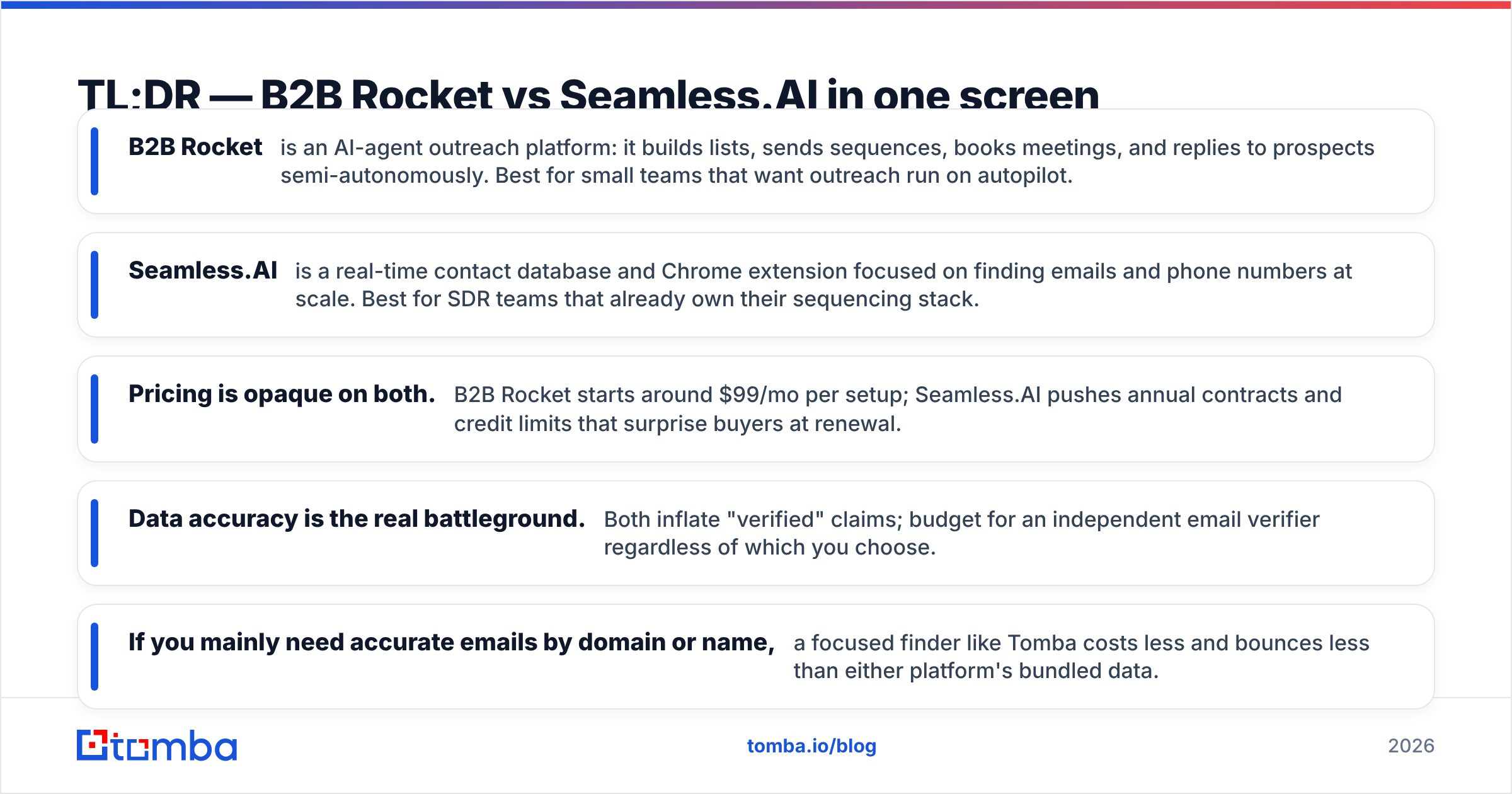
- B2B Rocket is an AI-agent outreach platform: it builds lists, sends sequences, books meetings, and replies to prospects semi-autonomously. Best for small teams that want outreach run on autopilot.
- Seamless.AI is a real-time contact database and Chrome extension focused on finding emails and phone numbers at scale. Best for SDR teams that already own their sequencing stack.
- Pricing is opaque on both. B2B Rocket starts around $99/mo per setup; Seamless.AI pushes annual contracts and credit limits that surprise buyers at renewal.
- Data accuracy is the real battleground. Both inflate "verified" claims; budget for an independent email verifier regardless of which you choose.
- If you mainly need accurate emails by domain or name, a focused finder like Tomba costs less and bounces less than either platform's bundled data.
What is B2B Rocket?#
B2B Rocket is an AI sales-automation platform built around "AI agents" that handle the outbound workflow end to end. You define an ideal customer profile, and the agent assembles a prospect list, writes and sends the cold emails, follows up on a schedule, qualifies replies, and hands warm conversations to a human or books a calendar slot directly.
Think of it like hiring a junior SDR who never sleeps and works for a flat fee. The pitch is fewer tools and fewer hours: instead of stitching together a data provider, a sequencer, and a meeting scheduler, you let one agent run the loop.
The tradeoff is control. Autonomous agents send on your domain's reputation. If the targeting or copy is mediocre, you are scaling mediocre outreach — and you may not notice until your sender reputation takes the hit. B2B Rocket works best when you treat the agent as a starting draft and review what it sends, not as a hands-off appliance.
What is Seamless.AI?#
Seamless.AI is a B2B contact database with a real-time search engine. Instead of serving records from a static dump, it claims to verify emails and phone numbers at the moment you search, using web crawlers and AI. The core surface is a web app plus a Chrome extension that pulls contacts off LinkedIn and company sites.
Seamless leans hard on volume: large credit packages, bulk list building, and integrations into CRMs like Salesforce and HubSpot. It does not run your outreach. You export the data — or sync it — and send through whatever sequencer you already use.
The recurring complaint, visible across G2 reviews, is the gap between "real-time verified" marketing and inbox reality: credits get consumed on guesses, and a meaningful share of emails still bounce. Seamless also has a reputation for aggressive annual contracts and renewal terms, so read the agreement before you sign.
How do B2B Rocket and Seamless.AI compare on features and pricing?#
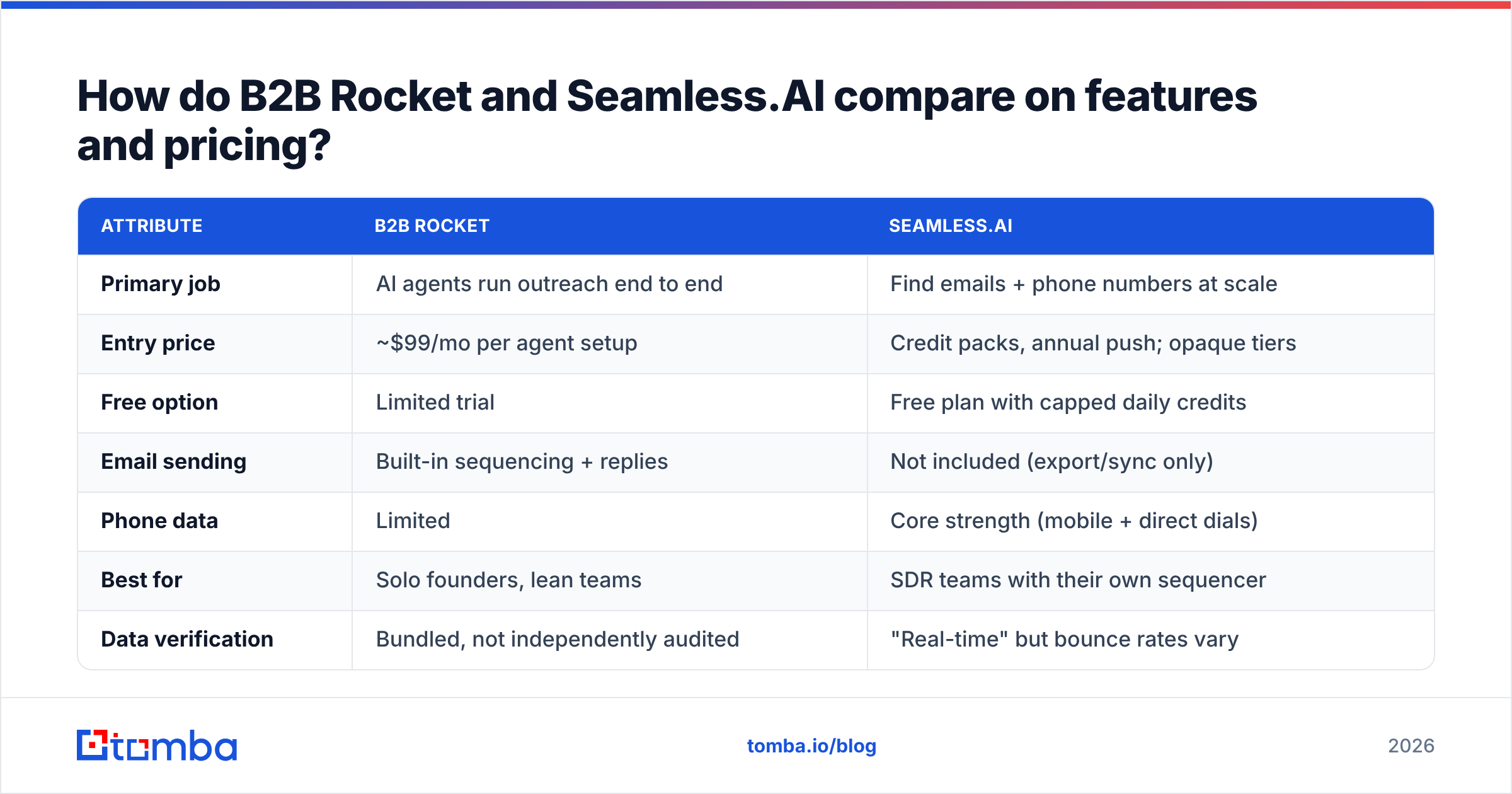
The two tools overlap on lead data but diverge everywhere else. B2B Rocket is an action layer; Seamless.AI is a data layer. Here is the head-to-head.
| Attribute | B2B Rocket | Seamless.AI |
|---|---|---|
| Primary job | AI agents run outreach end to end | Find emails + phone numbers at scale |
| Entry price | ~$99/mo per agent setup | Credit packs, annual push; opaque tiers |
| Free option | Limited trial | Free plan with capped daily credits |
| Email sending | Built-in sequencing + replies | Not included (export/sync only) |
| Phone data | Limited | Core strength (mobile + direct dials) |
| Best for | Solo founders, lean teams | SDR teams with their own sequencer |
| Data verification | Bundled, not independently audited | "Real-time" but bounce rates vary |
| Contract risk | Monthly available | Annual lock-in, renewal complaints |
A few things the table can't capture:
- B2B Rocket compounds your inputs. Good ICP and copy in, good meetings out. Weak inputs scale weak outreach automatically — the automation is a multiplier, not a fixer.
- Seamless.AI rewards heavy searchers. If you build hundreds of lists a month and already run a mature cold email motion, the database depth pays off.
- Neither replaces verification. Both report "verified" emails that still bounce. A standalone check before send is non-negotiable.
- Renewal is where budgets break. Seamless annual terms and B2B Rocket's per-seat agent fees both scale faster than buyers expect once usage ramps.
For a transparent point of comparison, Tomba pricing lists fixed monthly tiers — Free (25 searches), Starter $49/mo, Growth $99/mo, Pro $249/mo — with no annual lock-in required to start.
Which tool has more accurate data?#
Neither wins cleanly, and that is the honest answer. B2B Rocket's data is a means to an end — it exists to feed the agent — so it is rarely audited as a standalone dataset. Seamless.AI markets accuracy harder, but its "real-time verification" produces inconsistent bounce rates depending on industry and seniority. C-suite and niche verticals tend to degrade fastest.
The practical move is to decouple data acquisition from verification. Whatever finds the address, run it through a dedicated check before it touches your sending domain. A single bad send batch can undo months of warmup. Use Tomba's email verifier or its free email checker as the gate, and treat any vendor's "verified" label as a claim, not a guarantee.
If your targeting depends on catch-all domains — common in mid-market and enterprise — add a catch-all verifier to the pipeline. Both B2B Rocket and Seamless tend to mark catch-all addresses as sendable when they are really unknown.
Is B2B Rocket better than Seamless.AI for cold outreach?#
It depends on what you already own. B2B Rocket is better if you want the entire outreach loop handled and you do not have a sequencer or the time to manage one. It is worse if you have an experienced SDR team that wants control over copy, timing, and segmentation — the agent's autonomy becomes a liability there.
Seamless.AI is better if your stack is already built and the missing piece is contact data at volume. It is worse if you are a one-person team that does not want to assemble a tool chain, because Seamless solves only the data step and leaves sending, sequencing, and reply handling to you.
A useful test: count your tools. If you have zero sending infrastructure, B2B Rocket's all-in-one model removes setup friction. If you have a mature sales automation stack and just need fuel, Seamless slots in as a data source — but so do cheaper, more accurate finders.
What about deliverability and sender reputation?#
This is where automation platforms quietly cost you money. When an AI agent sends hundreds of emails to addresses it found and "verified" itself, every bad address is a bounce, and bounces erode your domain's standing with mailbox providers. High bounce rates feed straight into spam folder placement.
Two safeguards matter regardless of platform:
- Verify before the agent sends. Don't let any tool send to an address you haven't independently checked. This single step does more for email deliverability than any subject-line tweak.
- Watch your authentication. Confirm SPF, DKIM, and DMARC are set correctly with a tool like Tomba's SPF checker before scaling volume on either platform.
Seamless puts verification on you by design, which is actually safer if you have discipline. B2B Rocket's hands-off mode is riskier precisely because it removes the human checkpoint. Whichever you pick, keep a verifier in the loop.
Who should pick B2B Rocket, and who should pick Seamless.AI?#
Pick B2B Rocket if:
- You are a founder or a one-to-three-person team with no SDRs.
- You want meetings booked without building a tool chain.
- You will actually review the agent's output instead of letting it run blind.
- Monthly pricing and fast setup matter more than granular control.
Pick Seamless.AI if:
- You run an SDR team with an existing sequencer (Instantly, Salesloft, Outreach, etc.).
- You need phone numbers and direct dials, not just emails.
- You build high volumes of lists and can absorb the credit model.
- You are comfortable negotiating and committing to an annual contract.
Pick a focused email finder if:
- Your real need is accurate emails by name, company, or domain — not a full automation suite or a sprawling database.
- You want predictable monthly pricing and low bounce rates.
- You are price-sensitive and don't want to pay for agents or credits you won't use.
That third profile is more common than vendors admit. Many teams buy a heavy platform and use 15% of it. If your bottleneck is simply "I need the right person's verified email," neither B2B Rocket's agent nor Seamless's database is the lean choice — a dedicated email finder is.
How does Tomba fit into this comparison?#
Tomba isn't an autonomous outreach agent and it isn't a giant scraped database — it is a focused, transparent finder-and-verifier built for accuracy and predictable cost. Where B2B Rocket sells automation and Seamless sells volume, Tomba sells precision per contact.
The practical workflow looks like this: use domain search to pull every reachable contact at a target company, find specific people with the email finder, then run each address through the verifier before it enters any sequencer — including B2B Rocket's or any sender you pair with Seamless. You can also work in bulk with the bulk email finder and push results straight into your CRM via Tomba's integrations.
You don't have to replace your whole stack to benefit. Tomba commonly sits upstream of these platforms as the accuracy layer — the part that keeps your bounce rate low and your domain healthy while the bigger tools do what they're good at.
Frequently asked questions#
Is B2B Rocket or Seamless.AI cheaper? B2B Rocket's monthly entry (~$99) is easier to start and stop. Seamless.AI can look cheaper per credit but pushes annual contracts that cost more over a year and are hard to exit mid-term. Compare total annual cost, not headline price.
Does Seamless.AI really verify emails in real time? It attempts to, but independent reviews report variable bounce rates, especially for senior and niche roles. Treat its verification as a first pass and add an independent check before sending.
Can I use B2B Rocket's data without its automation? Not really — the data is built to feed the agent, not to export as a clean standalone dataset. If you want portable, verified contacts, a dedicated finder is the better source.
What's the safest setup for deliverability? Find contacts with any tool, then verify every address independently and confirm SPF/DKIM/DMARC before scaling. The verification step matters more than the source.
The bottom line#
B2B Rocket and Seamless.AI win different buyers: B2B Rocket for lean teams that want outreach run for them, Seamless.AI for SDR teams that need data volume and own their sequencer. Both demand independent verification, and both carry contract or reputation risks you should price in before signing.
If your core problem is simpler — get the right person's verified email without paying for an agent fleet or a credit treadmill — start with the Tomba Email Finder. Find emails by name, company, or domain, verify them in the same workflow, and keep your bounce rate low whether you send manually or feed a bigger platform. The free tier gives you 25 searches to test accuracy before you commit a dollar.
// get started
Find, verify and enrich your first contacts today
Start on the free plan with 25 searches a month, then scale when your team is ready.
Free plan · No credit card required · GDPR & CCPA
// about the author