B2B Rocket vs Successai (2026): AI SDR Tools Compared
B2B Rocket vs Successai: an honest 2026 breakdown of pricing, AI SDR features, data quality, and deliverability — plus where each one quietly falls short.
Choosing between B2B Rocket and Successai usually comes down to one quiet question that neither homepage answers: how good is the data the AI is actually sending to? Both platforms promise "autonomous AI SDRs" that find leads, write emails, and book meetings while you sleep. The pitch is nearly identical. The results are not — and most of the gap traces back to deliverability and contact accuracy, not the AI copywriting.
This is a neutral, hands-on comparison. We will look at what each tool does well, where each one struggles, and why the smartest teams treat the AI layer and the data layer as two separate buying decisions.
TL;DR#
- B2B Rocket is a full-stack AI SDR platform: it bundles lead lists, AI agents, multichannel sequences, and a built-in CRM-lite. Best for teams that want one tool to run outbound end to end.
- Successai (success.ai) leans into volume — large bundled B2B databases, unlimited-style sending across many inboxes, and warmup baked in. Best for high-volume cold email at a low entry price.
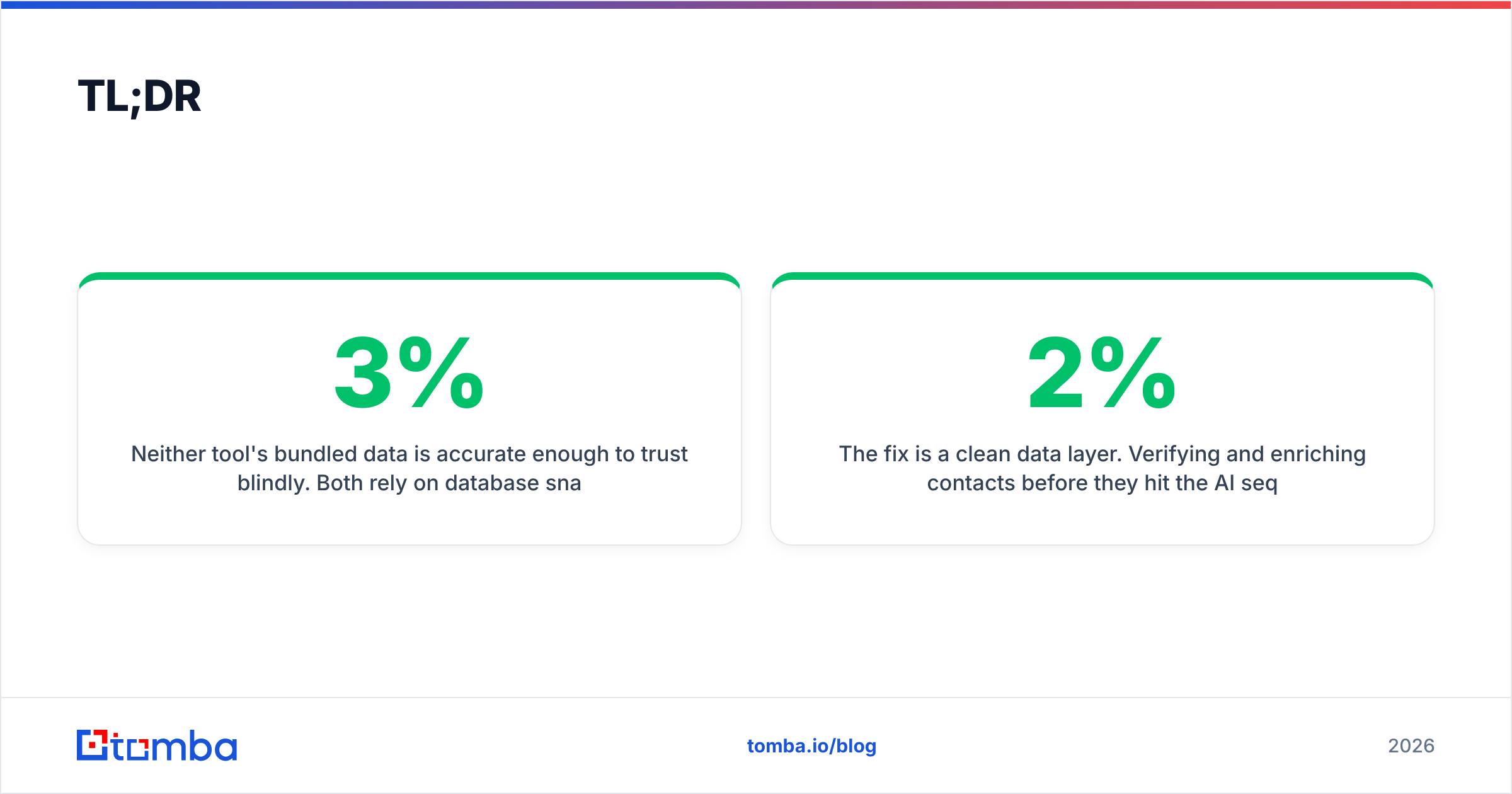
- Neither tool's bundled data is accurate enough to trust blindly. Both rely on database snapshots that decay ~2-3% per month, which quietly tanks deliverability.
- The fix is a clean data layer. Verifying and enriching contacts before they hit the AI sequence is what separates a 2% reply rate from a 12% one.
- If you only fix one thing this quarter, fix the list — not the AI.
What are B2B Rocket and Successai?#
Both are AI sales engagement platforms built around the same 2024-2026 trend: replacing parts of the SDR role with autonomous agents. You define an ideal customer profile, the platform pulls a lead list, an AI writes and sends the outreach, and a chatbot or auto-responder handles early replies.
Here is the core distinction in plain terms. Think of outbound as a restaurant: the data is your ingredients, and the AI SDR is the chef. B2B Rocket and Successai are both chefs that come with a pantry attached. The problem is that nobody checks whether the pantry ingredients are fresh — and a brilliant chef cooking with spoiled data still serves a bad meal (a bounced email, a spam complaint, a burned domain).
The four things that actually decide outbound ROI, in order:
- Data accuracy — Is the email real, deliverable, and tied to the right person right now? This is the single biggest lever and the one both tools under-invest in.
- Deliverability infrastructure — Inbox rotation, warmup, SPF/DKIM/DMARC, and bounce handling. Bad setup means even perfect leads never get seen.
- AI personalization quality — Does the copy read like a human did research, or like a mail merge with a thesaurus?
- Workflow and reporting — Sequencing, multichannel, CRM sync, and analytics you can actually act on.
Both platforms market hard on #3 and #4. The differences that change your numbers live in #1 and #2.
)
B2B Rocket vs Successai: feature and pricing comparison#
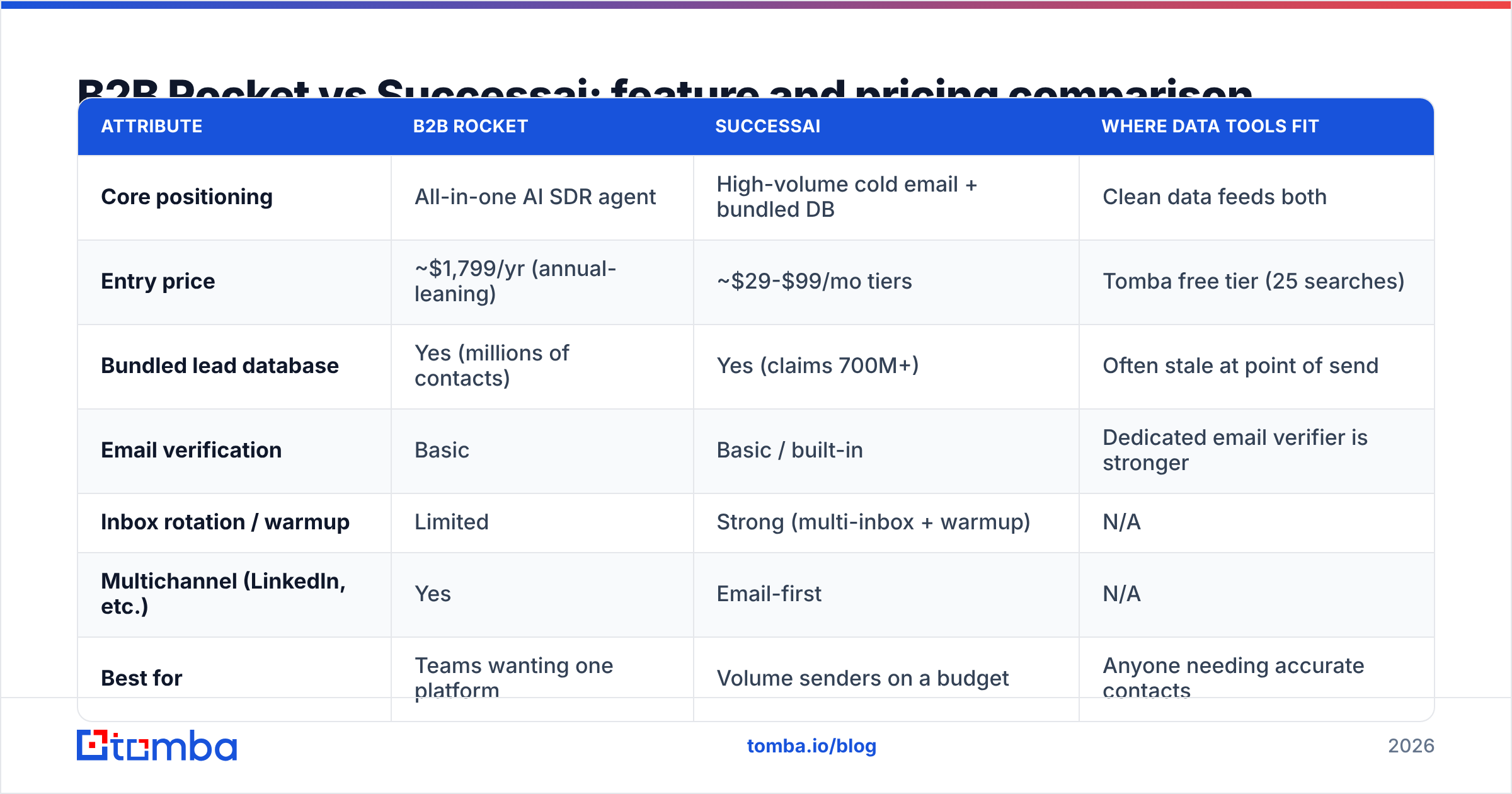
| Attribute | B2B Rocket | Successai | Where data tools fit |
|---|---|---|---|
| Core positioning | All-in-one AI SDR agent | High-volume cold email + bundled DB | Clean data feeds both |
| Entry price | ~$1,799/yr (annual-leaning) | ~$29-$99/mo tiers | Tomba free tier (25 searches) |
| Bundled lead database | Yes (millions of contacts) | Yes (claims 700M+) | Often stale at point of send |
| Email verification | Basic | Basic / built-in | Dedicated email verifier is stronger |
| Inbox rotation / warmup | Limited | Strong (multi-inbox + warmup) | N/A |
| Multichannel (LinkedIn, etc.) | Yes | Email-first | N/A |
| Best for | Teams wanting one platform | Volume senders on a budget | Anyone needing accurate contacts |
| Weak spot | Price, data freshness | Data quality, sending reputation | — |
A note on pricing: both vendors shift their public tiers often, so treat the figures above as directional and confirm on their sites. B2B Rocket skews toward annual commitments and a higher floor; Successai competes on a low monthly entry point and "unlimited" framing. You can sanity-check current plans and verified reviews on G2 before committing.
Is B2B Rocket better than Successai?#
It depends on what you are optimizing for — and honestly, the AI layers are closer than the marketing suggests.
Choose B2B Rocket if you want a single cockpit. It handles lead sourcing, multichannel sequencing (email plus LinkedIn touches), AI reply handling, and meeting booking in one interface. For a small team without a RevOps person to stitch tools together, that consolidation has real value. The trade-off is cost and flexibility: you are locked into their data and their sending logic, and the annual pricing is a meaningful commitment for an unproven channel.
Choose Successai if your strategy is volume and your budget is tight. Its strength is sending infrastructure — multiple connected inboxes, automatic warmup, and rotation that lets you push high daily volume without instantly torching one domain. The bundled database is enormous on paper. The catch is that "enormous" and "accurate" are different metrics, and high volume into stale data is exactly how you get blacklisted.
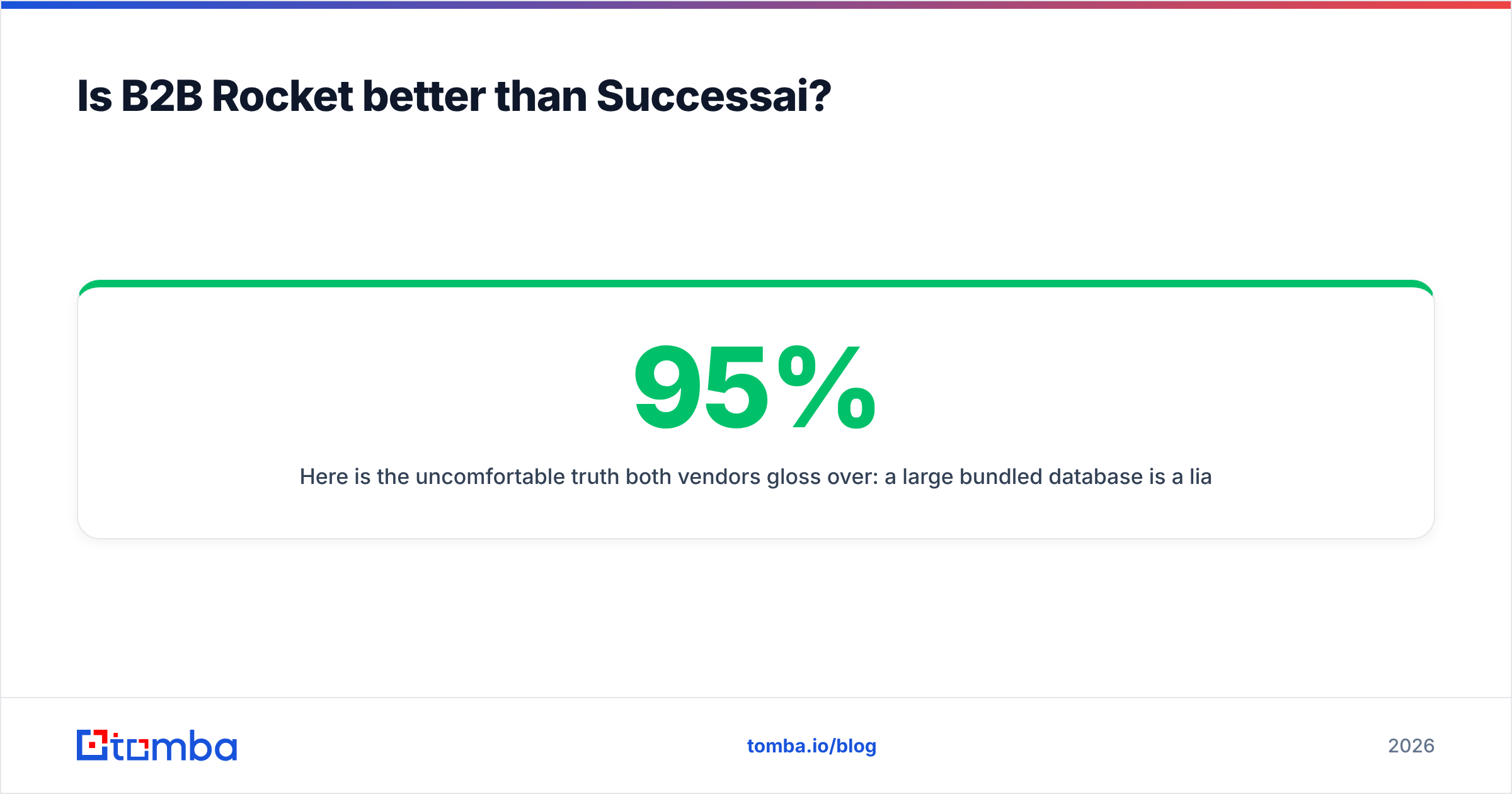
Here is the uncomfortable truth both vendors gloss over: a large bundled database is a liability if you don't verify it at send time. Contact data decays constantly — people change jobs, companies rebrand, inboxes get deactivated. A 700-million-record database that was 95% accurate at ingestion can be 80% accurate a year later. At scale, an 80% list is a domain-reputation grenade.
Why does data quality decide the winner?#
Because deliverability is downstream of data, and revenue is downstream of deliverability.
Run the math. Send 10,000 emails from a list with a 15% invalid rate. That is 1,500 hard bounces. Mailbox providers read a bounce rate above ~2-3% as a spam signal. You don't just lose those 1,500 sends — you poison the deliverability of the other 8,500 good addresses, which now land in spam. The AI wrote a beautiful email that nobody will ever see.
This is why your sender reputation and email deliverability matter more than which AI model writes your copy. Neither B2B Rocket nor Successai was built primarily as a verification engine — verification is a feature they bolt on, not the core competency. Dedicated tooling consistently outperforms bundled "good enough" checks here.
)
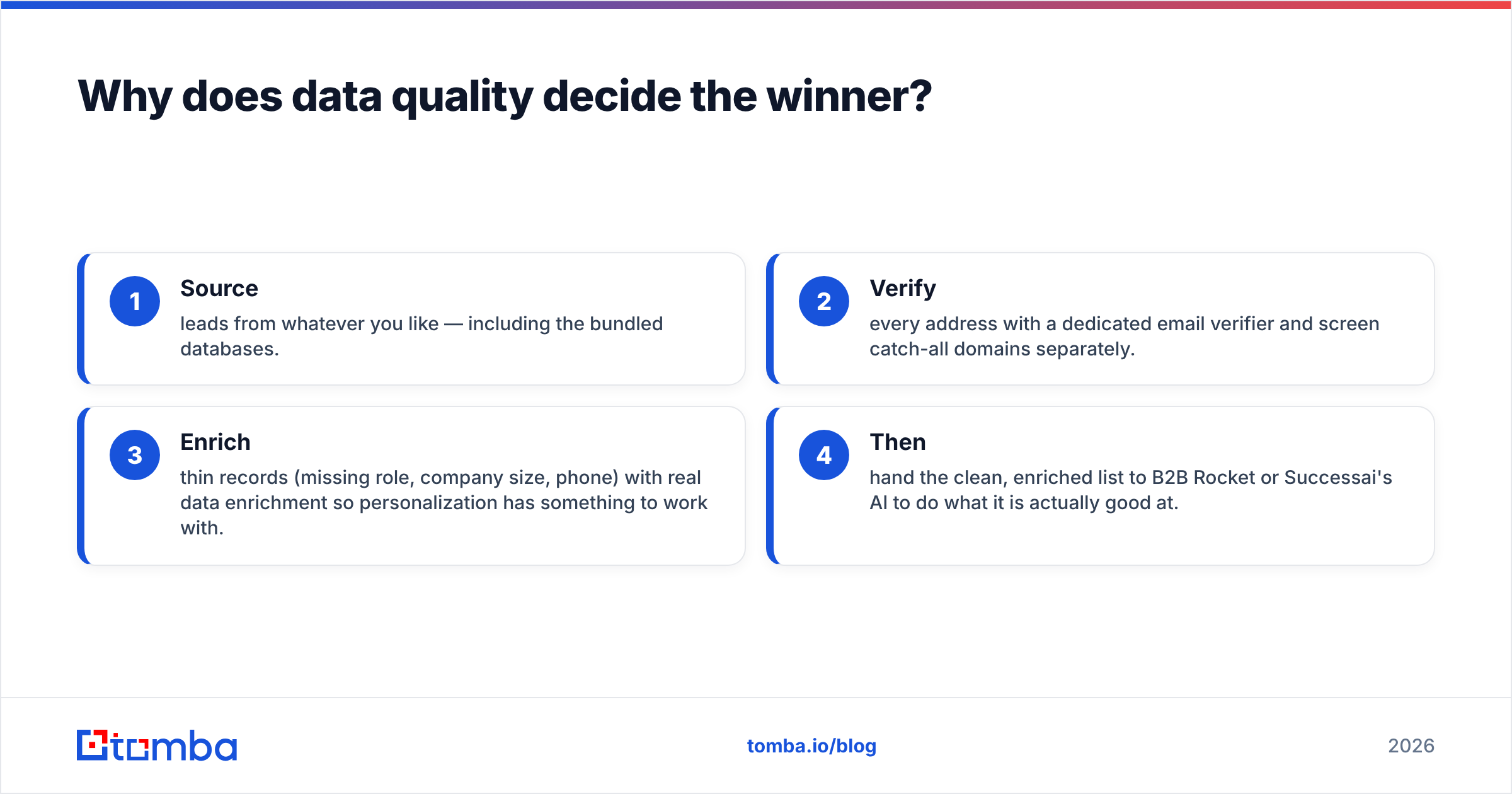
The practical workflow that beats both defaults:
- Source leads from whatever you like — including the bundled databases.
- Verify every address with a dedicated email verifier and screen catch-all domains separately.
- Enrich thin records (missing role, company size, phone) with real data enrichment so personalization has something to work with.
- Then hand the clean, enriched list to B2B Rocket or Successai's AI to do what it is actually good at.
That sequence is the difference between paying for an AI SDR and paying for an AI spam bot.
How does Tomba fit alongside these AI SDRs?#
Tomba is not an AI SDR, and that is the point. It is the data layer that makes either platform perform — the fresh-ingredient supplier for whichever chef you hire.
Where B2B Rocket and Successai bundle a static database and hope it holds up, Tomba is built to find and confirm contacts at the moment you need them:
- Find emails by name, company, or domain with source-cited results, so you know where an address came from.
- Verify deliverability in real time, including catch-all detection that most bundled checkers wave through.
- Bulk process entire lists before a campaign, instead of discovering bounces after your domain is already burned.
- Pull everything through the Tomba API so verification runs automatically inside your existing stack.
Used this way, Tomba and an AI SDR are not competitors — they are complementary. The AI handles cadence, copy, and replies. Tomba makes sure the cadence is aimed at real people. Teams that split the decision this way consistently get more out of B2B Rocket or Successai than teams who trust the bundled list and wonder why reply rates are flat.
B2B Rocket vs Successai: which should you pick?#
Match the tool to your actual constraint:
- You want one platform and have budget: B2B Rocket. Accept the price for the consolidation, but layer in independent verification before launch.
- You want volume on a budget: Successai. Its sending infrastructure is genuinely strong — just don't trust the bundled data without cleaning it first.
- You care most about accuracy and reply rates: Lead with a clean data layer regardless of which AI you pick. The AI is the cheap part to swap; a burned domain is expensive to recover.
- You're not sure yet: Start small. Verify a sample of either tool's bundled list with a free checker and look at the invalid rate before you commit annually.
For full plan details and how a verification-first stack compares on cost, see Tomba pricing — the free tier is enough to audit a sample list before you sign any annual AI SDR contract. You can also cross-reference current capabilities for both vendors directly on B2B Rocket and success.ai.
The bottom line#
B2B Rocket and Successai are both competent AI SDR platforms, and the right pick depends on whether you value consolidation (B2B Rocket) or low-cost volume (Successai). But the comparison most buyers obsess over — whose AI writes better emails — is the least important variable. The AI layers are converging. The data layer is where campaigns are won or lost.
Before you let any autonomous agent touch your domain reputation, make sure it is sending to verified, enriched, real contacts. Start with the Tomba Email Finder and its built-in verification: find the right person, confirm the address is live, and hand a clean list to whichever AI SDR you choose. Fix the ingredients first, and the chef finally gets a chance to cook.
Ready to find emails that actually work?
Join 150,000+ professionals who stopped guessing and started sending. Free credits on signup — no credit card required.
Get the Tomba newsletter
Practical outbound tactics and product updates — once every two weeks.
About the author