B2B SaaS CAC in 2026: How to Calculate and Cut Acquisition Cost
Your B2B SaaS CAC decides whether growth is profitable or just expensive. Here's how to calculate it, benchmark it for 2026, and bring it down without starving pipeline.
TL;DR
- B2B SaaS CAC is the fully loaded cost of acquiring one paying customer — sales, marketing, salaries, tools, and overhead divided by new customers won.
- Healthy benchmarks for 2026: an LTV:CAC ratio of 3:1 or better and CAC payback under 12 months for SMB, under 18 for mid-market/enterprise.
- Most teams measure CAC wrong by leaving out salaries, tooling, and time lag — which makes growth look cheaper than it is.
- The fastest CAC wins come from the top of the funnel: better targeting, accurate contact data, and killing wasted spend on bad-fit leads.
- You lower CAC by raising conversion and reducing waste, not just by cutting budget — accurate prospecting data does both.
What is B2B SaaS CAC?#
Customer acquisition cost (CAC) is the total amount you spend to win one new customer. Think of it like the price of a fishing trip: it's not just the bait, it's the boat, the fuel, the guide's day rate, and the licence — divided by the number of fish you actually bring home. If you only count the bait, you'll think fishing is nearly free and wonder why you're losing money.
For B2B SaaS specifically, CAC matters more than in most industries because the sales motion is expensive. You're often paying for SDRs, account executives, demos, free trials, and a long nurture cycle before a single dollar of revenue arrives. That lag is exactly why CAC, and its cousins LTV:CAC and CAC payback period, sit at the center of every board deck and every conversation about revenue operations.
The formula is simple. The discipline is in what you include.
CAC = Total sales & marketing spend (in a period)
      ÷ New customers acquired (in that period)
If you spent $200,000 on sales and marketing in Q1 and closed 50 new customers, your CAC is $4,000. The trouble starts when teams quietly drop costs out of the numerator to make the number look better.
How do you calculate B2B SaaS CAC correctly?#
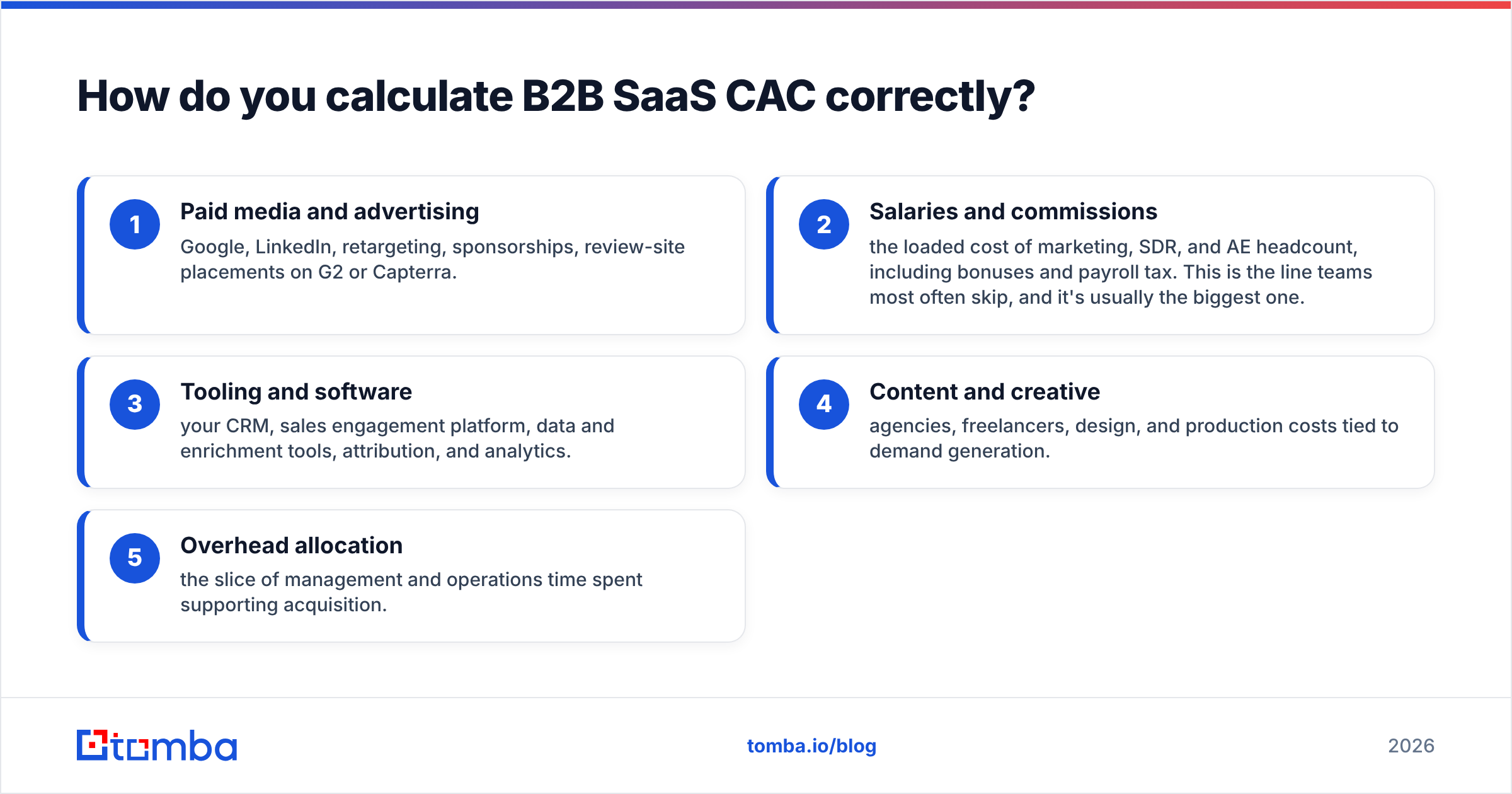
Conclusion first: include every cost that exists because you are trying to acquire customers, and match the time window to your sales cycle. Here's what belongs in a fully loaded calculation.
- Paid media and advertising — Google, LinkedIn, retargeting, sponsorships, review-site placements on G2 or Capterra.
- Salaries and commissions — the loaded cost of marketing, SDR, and AE headcount, including bonuses and payroll tax. This is the line teams most often skip, and it's usually the biggest one.
- Tooling and software — your CRM, sales engagement platform, data and enrichment tools, attribution, and analytics.
- Content and creative — agencies, freelancers, design, and production costs tied to demand generation.
- Overhead allocation — the slice of management and operations time spent supporting acquisition.
A common mistake is the timing mismatch. If your average B2B sales cycle is 90 days, the customers you close in March were generated by spend from December through February. Comparing March spend to March closes will whipsaw your CAC every quarter. Either lag the spend to match the cycle, or use a trailing window (e.g., a rolling quarter) so the numbers settle.

Blended CAC vs. paid CAC#
Two numbers, two jobs:
- Blended CAC divides all acquisition spend by all new customers, including the ones who arrived through word of mouth, organic search, and referrals. It tells you the true economics of the whole business.
- Paid CAC isolates customers acquired through paid channels. It tells you whether your paid engine is efficient on its own.
Report both. Blended CAC flatters you because free channels drag the average down; paid CAC keeps your demand-gen team honest.
What is a good CAC payback period and LTV:CAC ratio in 2026?#
The single number rarely means anything in isolation — a $12,000 CAC is fantastic for a $50k ACV enterprise deal and catastrophic for a $600/year SMB tool. That's why you pair CAC with two ratios.
LTV:CAC ratio compares the lifetime value of a customer to what you paid to get them. The widely cited healthy target is 3:1 — you earn three dollars for every dollar spent acquiring. Below 1:1 you're losing money on every deal. Above 5:1 you might be under-investing and leaving growth on the table.
CAC payback period is how many months of gross-margin-adjusted revenue it takes to earn back the CAC. It's the cash-flow view that LTV:CAC misses.
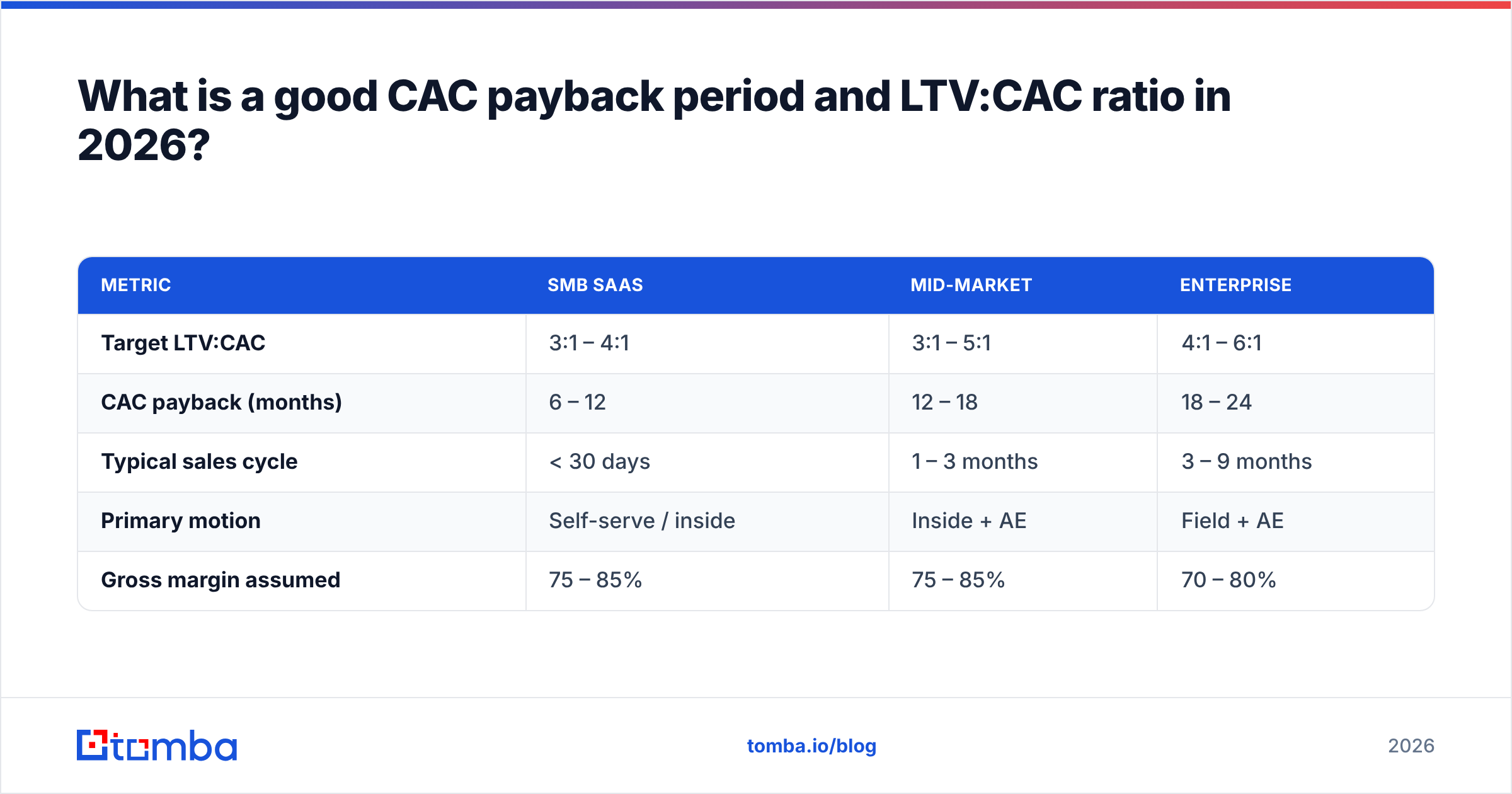
| Metric | SMB SaaS | Mid-Market | Enterprise |
|---|---|---|---|
| Target LTV:CAC | 3:1 – 4:1 | 3:1 – 5:1 | 4:1 – 6:1 |
| CAC payback (months) | 6 – 12 | 12 – 18 | 18 – 24 |
| Typical sales cycle | < 30 days | 1 – 3 months | 3 – 9 months |
| Primary motion | Self-serve / inside | Inside + AE | Field + AE |
| Gross margin assumed | 75 – 85% | 75 – 85% | 70 – 80% |
These are guideposts, not laws. A capital-efficient, bootstrapped company will push for faster payback; a venture-backed land-grab can tolerate longer payback if retention is strong. The danger sign is a long payback period combined with weak net revenue retention — that's how SaaS companies grow themselves into a cash crisis.
For a fuller treatment of how these ratios feed planning, SaaS-economics references like HubSpot's CAC guide and Salesforce's revenue benchmarks are worth keeping bookmarked.
Why is B2B SaaS CAC rising?#
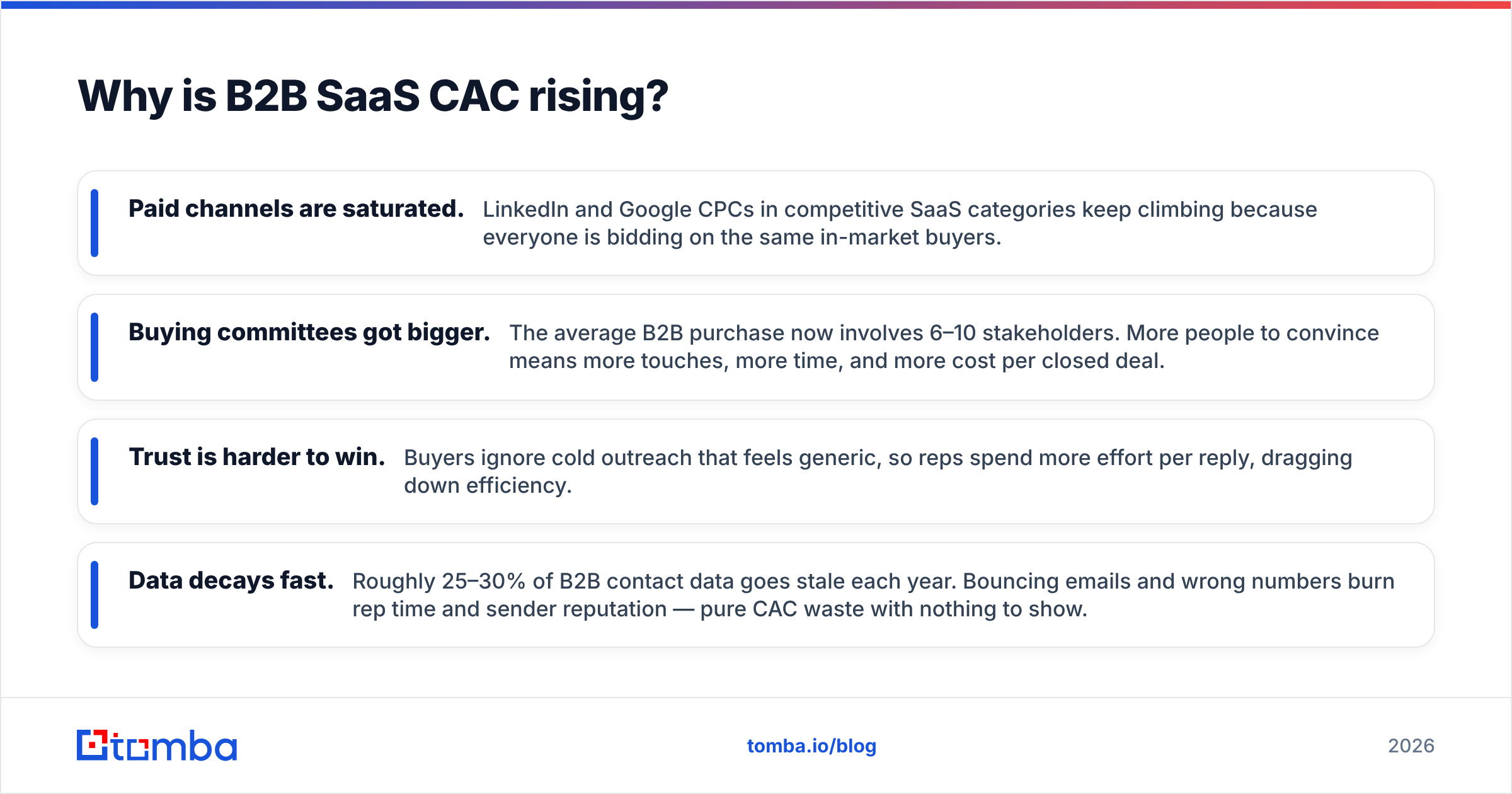
CAC has crept upward across B2B SaaS for several structural reasons, and naming them tells you where to fight back.
- Paid channels are saturated. LinkedIn and Google CPCs in competitive SaaS categories keep climbing because everyone is bidding on the same in-market buyers.
- Buying committees got bigger. The average B2B purchase now involves 6–10 stakeholders. More people to convince means more touches, more time, and more cost per closed deal.
- Trust is harder to win. Buyers ignore cold outreach that feels generic, so reps spend more effort per reply, dragging down efficiency.
- Data decays fast. Roughly 25–30% of B2B contact data goes stale each year. Bouncing emails and wrong numbers burn rep time and sender reputation — pure CAC waste with nothing to show.
That last point is where most teams quietly bleed money. You can't out-spend a saturated channel, but you can stop paying reps to chase contacts who left the company eight months ago.
How do you reduce B2B SaaS CAC?#
The instinct is to cut budget. The better move is to raise efficiency, because CAC is a ratio — you can shrink it by lowering spend or by closing more customers from the same spend. Here are the levers that actually move it.
1. Tighten your ICP and targeting#
Every dollar spent reaching a non-buyer is wasted CAC. Sharpen your ideal customer profile using closed-won data, then concentrate spend on look-alike accounts. Narrower targeting feels like shrinking the funnel, but it raises conversion enough to lower blended CAC.
2. Fix your data before you fix your ads#
You can have a perfect message and still burn budget if half your contacts are wrong. Verifying contacts with an email verifier before a campaign protects deliverability and stops reps from working dead records. Pair that with accurate sourcing from a tool like the Tomba Email Finder and your cost-per-meeting drops without touching ad spend.

3. Shorten the sales cycle#
Time is CAC. Every extra week a deal sits in pipeline is more rep salary attributed to that acquisition. Cut cycle time with better qualification (stop pushing bad-fit leads to AEs), tighter follow-up cadences, and self-serve options for smaller accounts.
4. Lean into lower-cost channels#
Blended CAC falls when a larger share of customers come from organic, referral, and product-led channels. Invest in content, SEO, partnerships, and a referral loop. These take longer to compound but structurally lower your acquisition cost over time.
5. Improve onboarding and retention#
This one is indirect but powerful. Higher retention raises LTV, which improves your LTV:CAC ratio even if CAC stays flat — and it gives you room to spend more to acquire good customers because you keep them longer.
6. Automate the repetitive top of funnel#
Manual list-building and copy-pasting from LinkedIn is expensive human time. Routing prospecting and enrichment through automation — for example via the Tomba API or a bulk workflow — frees reps to spend their hours on conversations, not data entry.
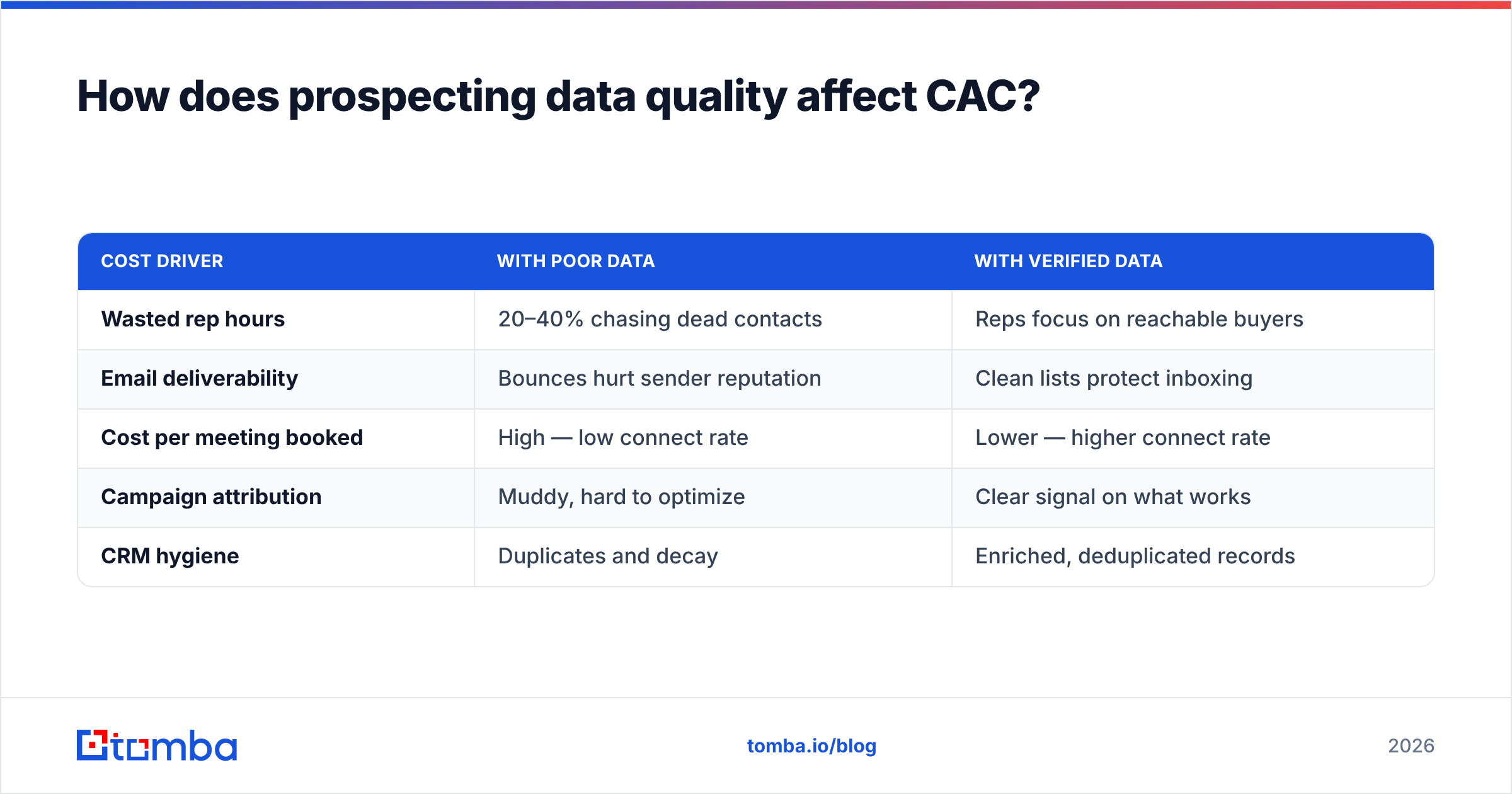
How does prospecting data quality affect CAC?#
Directly and more than most teams realize. Bad data inflates CAC three ways at once.
| Cost driver | With poor data | With verified data |
|---|---|---|
| Wasted rep hours | 20–40% chasing dead contacts | Reps focus on reachable buyers |
| Email deliverability | Bounces hurt sender reputation | Clean lists protect inboxing |
| Cost per meeting booked | High — low connect rate | Lower — higher connect rate |
| Campaign attribution | Muddy, hard to optimize | Clear signal on what works |
| CRM hygiene | Duplicates and decay | Enriched, deduplicated records |
The math is unforgiving. If a rep sends 1,000 emails and 30% bounce, you didn't just lose 300 sends — you risked the deliverability of the other 700 and you paid a salaried human to do it. Protecting email deliverability with verification is one of the cheapest CAC reductions available, because it costs cents and saves hours.
This is why data accuracy belongs in the CAC conversation, not just the data-ops conversation. Cleaner inputs mean every downstream dollar — ads, salaries, tooling — works harder.
How often should you measure CAC?#
Monthly for operational steering, quarterly for strategic decisions. A monthly cadence catches a channel going off the rails before it wrecks a quarter; a quarterly view smooths out the noise from your sales cycle and gives a truer read for budgeting and board reporting.
Segment it, too. A single company-wide CAC hides everything useful. Break it out by:
- Channel (paid search vs. outbound vs. organic)
- Segment (SMB vs. enterprise — they have wildly different CACs)
- Cohort (so you can see if newer customers cost more to acquire than older ones)
Segmented CAC is where the real decisions live. A blended number that looks fine can hide one channel quietly burning cash.
What tools help control B2B SaaS CAC?#
Anything that raises conversion or cuts waste in the acquisition funnel. In practice that's three categories: targeting and data (find and verify the right buyers), engagement (reach them efficiently), and analytics (measure what's working). The highest-leverage and most-overlooked is the first — because a flawed list makes every other tool less efficient.
Accurate sourcing and verification reduce the denominator-killing waste of chasing wrong contacts. When your reps work a clean, well-targeted list pulled from a reliable domain search and validated before outreach, connect rates climb and cost-per-customer falls. Compare options before you buy — independent reviews on G2 and Capterra are a useful sanity check against vendor claims.
Bringing it together#
CAC isn't a vanity metric you report and forget. It's the clearest signal of whether your growth is healthy or just expensive. Calculate it fully — salaries and tools included — pair it with LTV:CAC and payback, segment it by channel, and attack it from the top of the funnel where the cheapest wins live.
The pattern across every lever above is the same: efficiency beats austerity. You don't lower CAC by starving pipeline; you lower it by making sure every dollar reaches a real, reachable, good-fit buyer.
That starts with data you can trust. If wasted spend on bad contacts is quietly inflating your acquisition cost, put accurate sourcing at the front of your funnel — the Tomba Email Finder helps you reach verified decision-makers by name, company, or domain, so your reps spend their expensive hours closing instead of guessing. Start on the free tier (25 searches a month), and check Tomba pricing when you're ready to scale your outbound without scaling your CAC.
// get started
Find, verify and enrich your first contacts today
Start on the free plan with 25 searches a month, then scale when your team is ready.
Free plan · No credit card required · GDPR & CCPA
// about the author