B2B SaaS Growth Strategy: The 2026 Playbook for Scaling Fast
A no-fluff B2B SaaS growth strategy for 2026: pick the right motion, fix unit economics, and build a pipeline engine that compounds instead of leaking.
B2B SaaS Growth Strategy: The 2026 Playbook for Scaling Fast
Most "growth strategies" are just a list of tactics with a budget stapled to the front. That is why they stall. A real B2B SaaS growth strategy is a system: a chosen motion, healthy unit economics, and a pipeline engine that gets cheaper to run as you scale. This guide walks through all three, with the trade-offs spelled out so you can pick what fits your stage instead of copying a playbook built for a company 100x your size.
TL;DR#
- Pick one primary motion (product-led, sales-led, or community-led) and make everything else support it. Trying to run all three at once is how seed-stage teams burn cash.
- Your CAC payback period is the scoreboard. Under 12 months means you can pour fuel on the fire; over 18 months means fix the funnel before you spend more.
- Pipeline beats virality for most B2B SaaS. Predictable outbound + inbound that you control will outlast a lucky viral moment.
- Dirty data quietly kills growth. Bounced sends, wrong contacts, and stale records inflate CAC and wreck deliverability. Clean inputs are a growth lever, not a chore.
- Compounding > spikes. Optimize for motions that get more efficient each quarter (content, referrals, expansion revenue), not one-off campaigns.
What is a B2B SaaS growth strategy, actually?#
A B2B SaaS growth strategy is the set of decisions that determine how you acquire, retain, and expand revenue from business customers in a repeatable way. Think of it like the plumbing in a building: nobody admires it, but the moment a pipe leaks, everything above it floods. The "tactics" people obsess over — ad creative, subject lines, demo scripts — are the faucets. The strategy is the pipes.
The core decision is your growth motion: the dominant way customers move from stranger to paying account. Get this right and your tactics reinforce each other. Get it wrong and you spend money making noise.
Here are the four motions that matter for B2B SaaS in 2026:
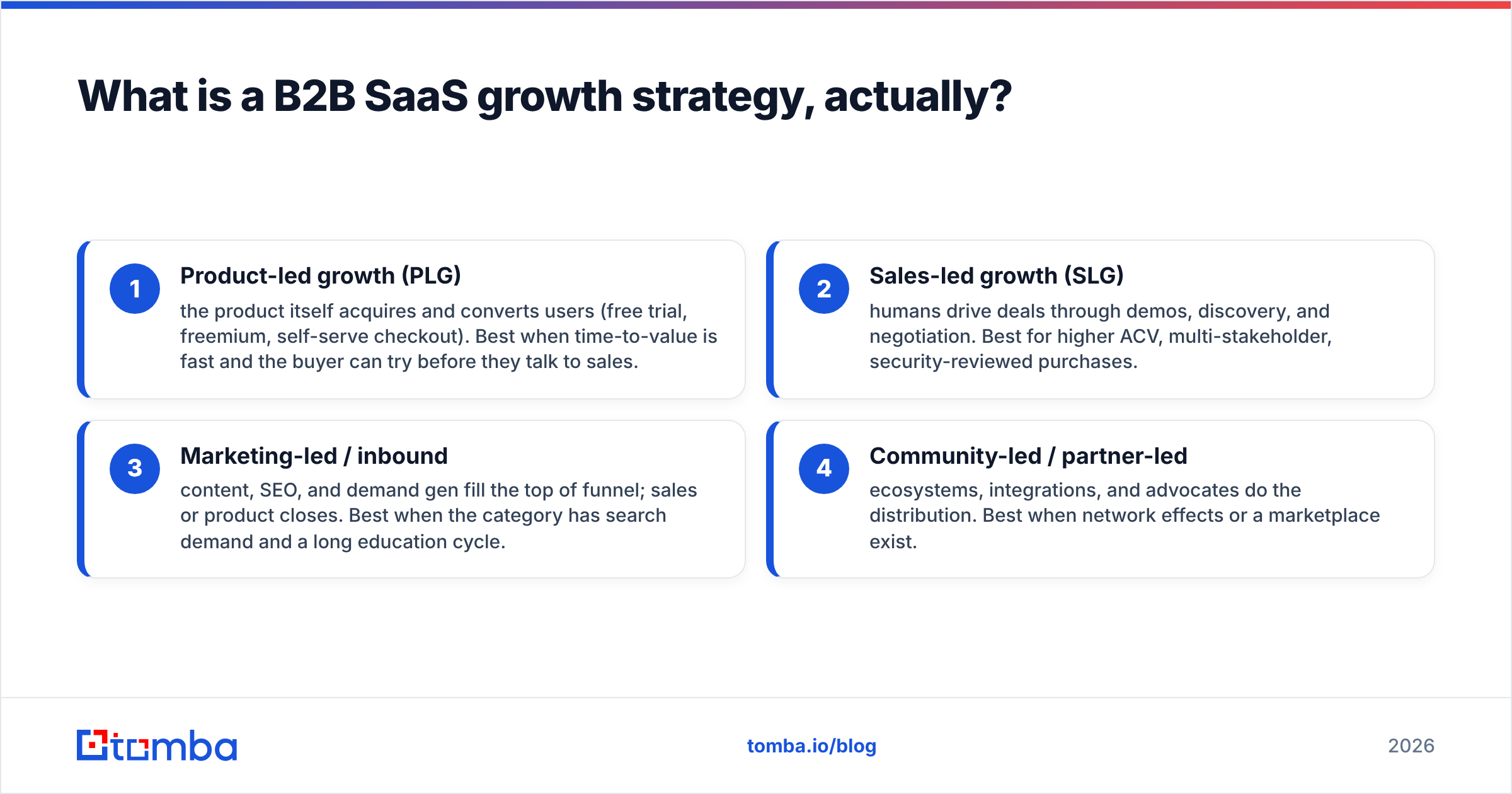
- Product-led growth (PLG) — the product itself acquires and converts users (free trial, freemium, self-serve checkout). Best when time-to-value is fast and the buyer can try before they talk to sales.
- Sales-led growth (SLG) — humans drive deals through demos, discovery, and negotiation. Best for higher ACV, multi-stakeholder, security-reviewed purchases.
- Marketing-led / inbound — content, SEO, and demand gen fill the top of funnel; sales or product closes. Best when the category has search demand and a long education cycle.
- Community-led / partner-led — ecosystems, integrations, and advocates do the distribution. Best when network effects or a marketplace exist.
Most successful companies run a hybrid, but they still have one primary motion that pays the bills while the others compound in the background.
)
Which growth motion is right for your stage?#
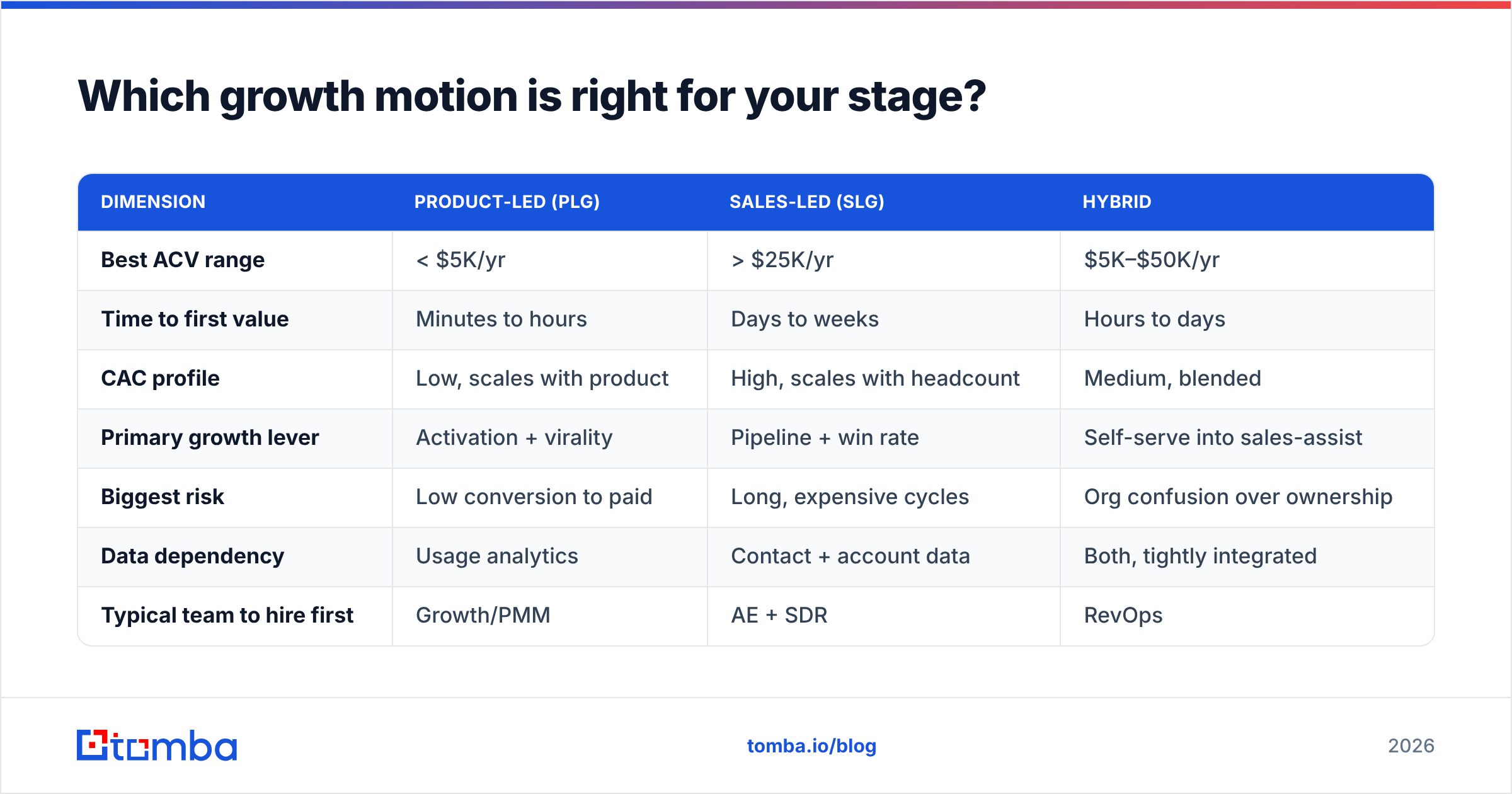
The honest answer: it depends on your average contract value (ACV) and how complex the buying decision is. Here is the trade-off laid out side by side.
| Dimension | Product-Led (PLG) | Sales-Led (SLG) | Hybrid |
|---|---|---|---|
| Best ACV range | < $5K/yr | > $25K/yr | $5K–$50K/yr |
| Time to first value | Minutes to hours | Days to weeks | Hours to days |
| CAC profile | Low, scales with product | High, scales with headcount | Medium, blended |
| Primary growth lever | Activation + virality | Pipeline + win rate | Self-serve into sales-assist |
| Biggest risk | Low conversion to paid | Long, expensive cycles | Org confusion over ownership |
| Data dependency | Usage analytics | Contact + account data | Both, tightly integrated |
| Typical team to hire first | Growth/PMM | AE + SDR | RevOps |
A quick gut check: if a prospect can experience real value before talking to a human, lean PLG. If the purchase needs a procurement review, a security questionnaire, and three approvers, you need a sales motion no matter how slick your product is. Gartner's research on the B2B buying journey is blunt about how non-linear and committee-driven these decisions have become — design your motion around that reality, not around a frictionless consumer fantasy.
How do you know if your unit economics can support growth?#
Before you spend a dollar scaling, the math has to work. Three numbers tell you almost everything:
- CAC payback period — how many months of gross margin it takes to recover the cost of acquiring a customer. Under 12 months is healthy for most B2B SaaS; over 18 means your funnel leaks somewhere.
- LTV:CAC ratio — lifetime value divided by acquisition cost. A 3:1 ratio is the classic benchmark. Below 3:1, you are buying revenue at a loss; far above 3:1 (like 6:1) often means you are under-investing in growth.
- Net revenue retention (NRR) — expansion minus churn across existing accounts. Above 100% means you grow even with zero new logos. The best SaaS companies run 120%+.
Think of these like a car's dashboard. Topline revenue is the speedometer — exciting but useless on its own. CAC payback is the fuel gauge, LTV:CAC is the engine temperature, and NRR tells you whether the tank is refilling itself as you drive. Scale only when all three read green.
If your payback is ugly, resist the urge to spend more on ads. The leak is usually in conversion (bad ICP fit), activation (slow time-to-value), or retention (weak onboarding) — not in your ad budget. HubSpot's annual sales and marketing benchmarks are a useful sanity check against your own conversion rates before you blame the top of funnel.
Why does pipeline beat virality for B2B SaaS?#
Because you can control it. Virality is a lottery ticket; pipeline is a machine you build, measure, and tune. For the overwhelming majority of B2B SaaS companies, predictable revenue comes from a deliberate blend of outbound and inbound that you own end to end.
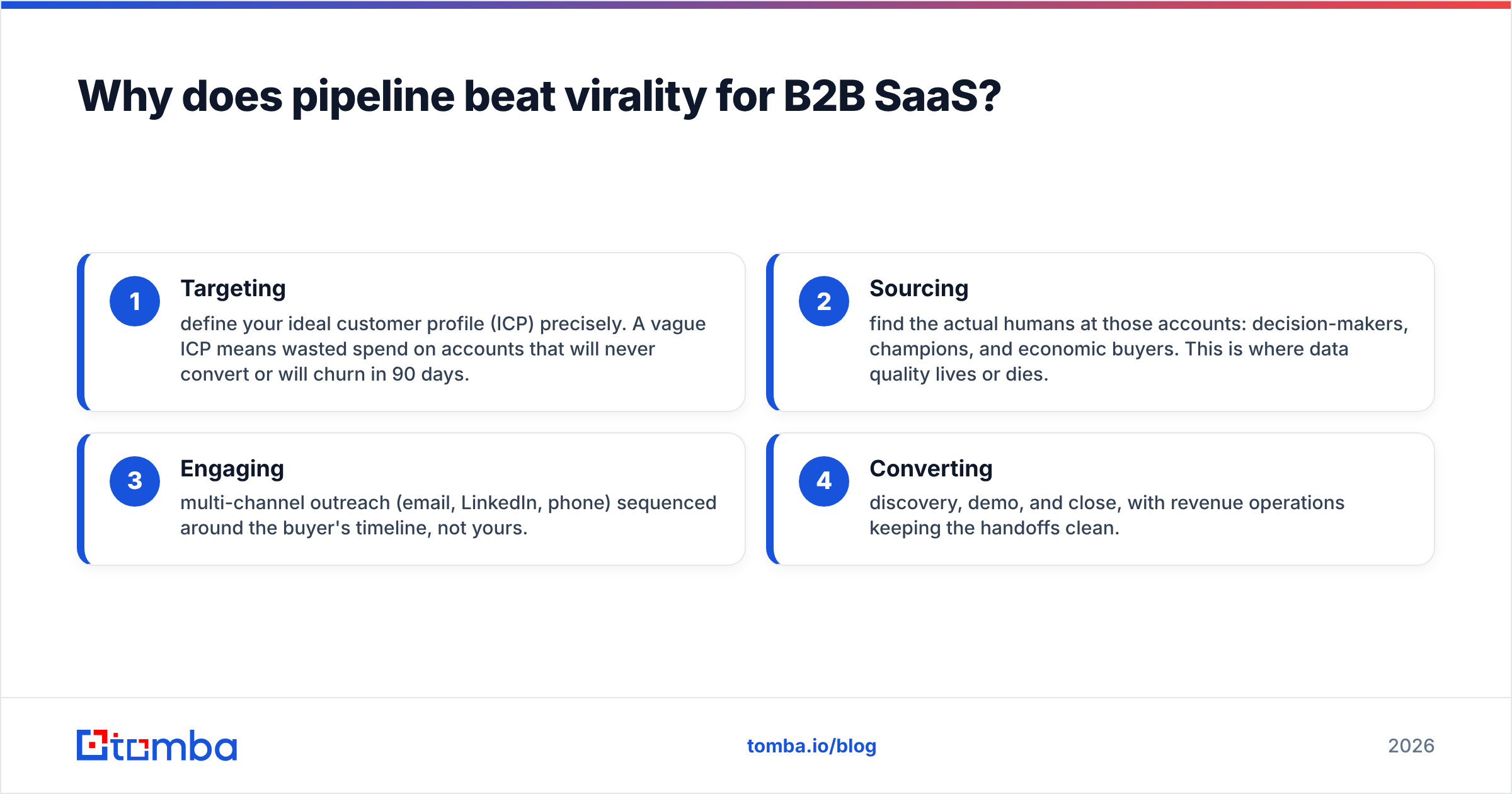
The pipeline engine has four jobs, and each one has a failure mode that quietly caps your growth:
- Targeting — define your ideal customer profile (ICP) precisely. A vague ICP means wasted spend on accounts that will never convert or will churn in 90 days.
- Sourcing — find the actual humans at those accounts: decision-makers, champions, and economic buyers. This is where data quality lives or dies.
- Engaging — multi-channel outreach (email, LinkedIn, phone) sequenced around the buyer's timeline, not yours.
- Converting — discovery, demo, and close, with revenue operations keeping the handoffs clean.
Step two is where most teams secretly bleed money. You can have a perfect ICP and a great sequence, but if 30% of your contact list bounces or routes to the wrong person, your sender reputation tanks, your AEs waste hours, and your CAC inflates without anyone noticing on a dashboard. Feeding the engine with verified, accurate contact data is one of the highest-leverage, least-glamorous moves in B2B SaaS growth.
)
How do you build a repeatable pipeline engine?#
Start with the account, not the contact. Define your ICP using firmographics (industry, size, tech stack, region) and then layer on trigger events — funding rounds, new hires in relevant roles, tooling changes — that signal a buying window. Tools that map a company domain to its people let you go from "this account fits" to "here are the five people I need to reach" in one step. A domain search over your target account list turns a flat company spreadsheet into an actual contact map, and data enrichment fills in the role, seniority, and channel details your sequences need to personalize at scale.
Then sequence with discipline:
- Multi-touch, multi-channel. A single cold email is noise. A coordinated sequence across email, LinkedIn, and a well-timed call earns replies.
- Personalize the opener, templatize the rest. Spend your effort on the first two lines and the relevance of the offer, not on rewriting the whole message every time.
- Protect deliverability. Verify every address before you send. One spammy list can blacklist your domain for weeks. If you are buying or scraping lists, run them through an email verifier first — non-negotiable.
- Measure reply-to-meeting, not just open rates. Opens are vanity in 2026; booked meetings are revenue.
The compounding part comes from feedback loops. Every closed-won and closed-lost deal teaches your ICP model something. Tighten the targeting each quarter and the same effort produces more pipeline — that is the difference between a strategy that scales and a treadmill that doesn't.
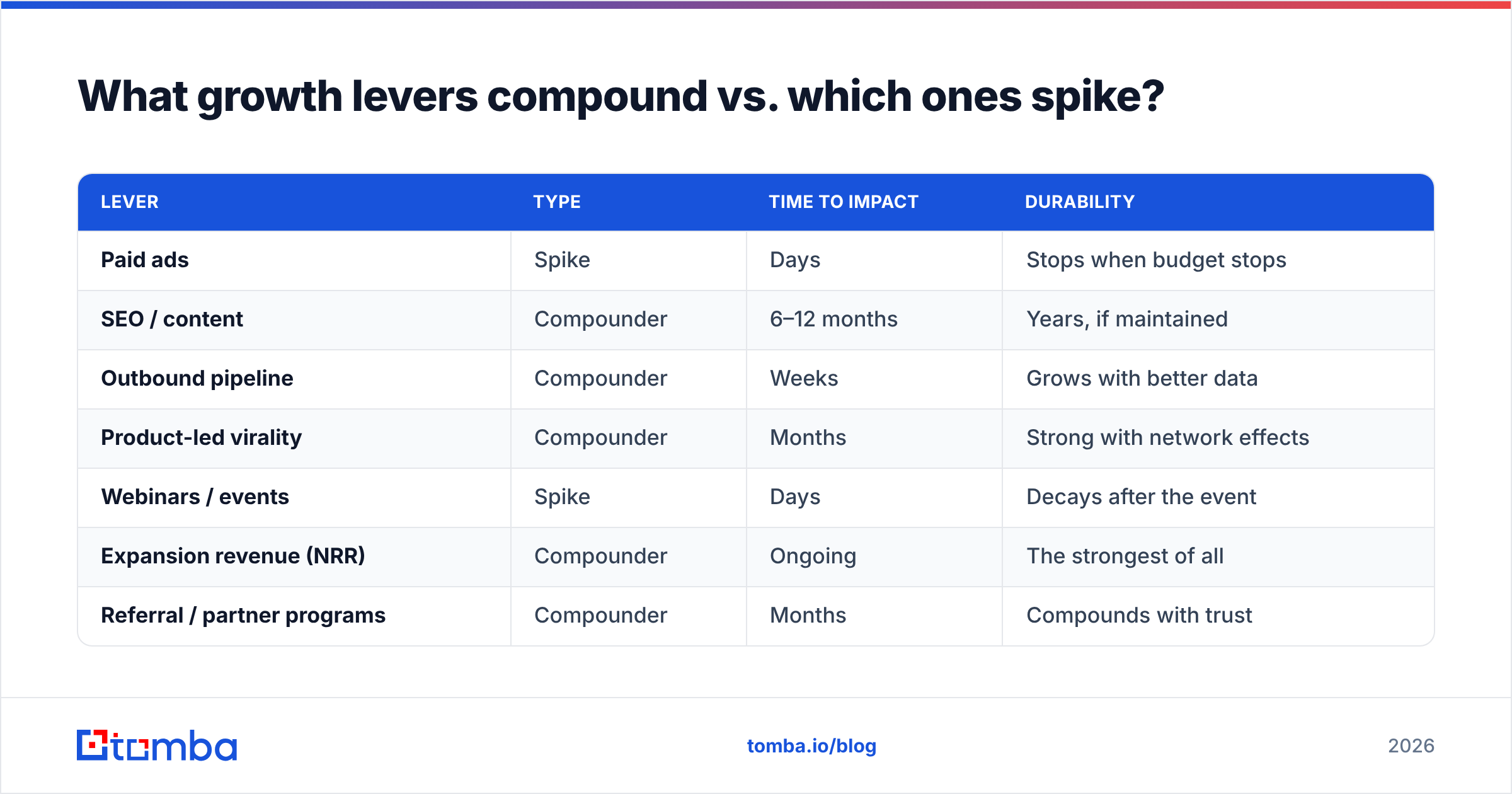
What growth levers compound vs. which ones spike?#
Not all growth is created equal. Some tactics give you a one-time bump and then decay; others build an asset that pays out for years. A serious B2B SaaS growth strategy weights the portfolio toward compounders.
| Lever | Type | Time to impact | Durability |
|---|---|---|---|
| Paid ads | Spike | Days | Stops when budget stops |
| SEO / content | Compounder | 6–12 months | Years, if maintained |
| Outbound pipeline | Compounder | Weeks | Grows with better data |
| Product-led virality | Compounder | Months | Strong with network effects |
| Webinars / events | Spike | Days | Decays after the event |
| Expansion revenue (NRR) | Compounder | Ongoing | The strongest of all |
| Referral / partner programs | Compounder | Months | Compounds with trust |
Spikes are not bad — they buy you data and momentum. The mistake is funding spikes with money that should be building compounders. A useful rule: spend roughly 70% of growth effort on compounding assets (content, pipeline systems, retention, expansion) and 30% on spikes that generate fast signal. Browse vendor reviews on G2 for any tool you are considering — the durable winners almost always show up as compounders in how customers describe the ROI over time.
How should you measure and adjust the strategy?#
Pick a small number of metrics that map directly to the motion you chose, and review them on a fixed cadence. A PLG company obsessing over SDR dials is measuring the wrong machine; a sales-led company chasing activation rate is doing the same in reverse.
A practical starter scorecard:
- Acquisition: qualified pipeline created per channel, blended CAC, CAC payback.
- Conversion: lead-to-opportunity rate, win rate, sales cycle length.
- Retention & expansion: gross churn, NRR, expansion revenue as a % of new revenue.
- Efficiency: magic number (net new ARR ÷ prior-quarter S&M spend), burn multiple.
Review weekly at the team level, monthly at the strategy level, quarterly at the motion level. The quarterly review is where you ask the hard question: is our primary motion still the right one for our current ACV and market? Companies that re-examine this stay efficient; companies that don't end up with a sales team selling a product that should be self-serve, or a free tier cannibalizing deals that should be sales-led.
What are the most common B2B SaaS growth mistakes in 2026?#
- Spreading across every motion at once. Seed and Series A teams that try PLG, SLG, and community simultaneously dilute everything. Pick one, win, then add.
- Scaling spend before fixing payback. More budget on a leaky funnel just leaks faster. Fix conversion and retention first.
- Treating data as a one-time purchase. B2B contact data decays around 2–3% per month as people change jobs. A list you bought a year ago is now a deliverability liability. Refresh and re-verify continuously.
- Confusing activity with progress. 10,000 emails sent means nothing if 2,000 bounced and 50 were relevant. Optimize for relevance and reply quality.
- Ignoring expansion. Chasing new logos while existing accounts churn is filling a leaky bucket. NRR above 100% is the cheapest growth you will ever buy.
Avoid these five and you are already ahead of most of your competitors, who are busy admiring their faucets while the basement floods.
Putting it together: your 2026 growth checklist#
- Choose your primary motion based on ACV and buying complexity — and write it down so the whole org aligns.
- Verify your unit economics are green (CAC payback < 12 mo, LTV:CAC ≥ 3:1, NRR ≥ 100%) before scaling spend.
- Build the pipeline engine with a precise ICP, verified contact data, and disciplined multi-channel sequencing.
- Weight your portfolio toward compounders — content, pipeline systems, retention, and expansion.
- Review on a cadence and re-examine the motion every quarter as your ACV and market evolve.
Feed your growth engine with data that converts#
Every motion above — PLG, sales-led, or hybrid — runs on accurate contact data. The fastest way to inflate your CAC and torch your sender reputation is to pour budget into outreach built on guessed or stale addresses. Tomba's Email Finder lets you turn a target-account list into verified decision-maker contacts in seconds, so your sequences land in the inbox and your AEs spend time selling instead of cleaning lists. Start free with 25 searches a month, and when the engine is humming, the Starter plan at $49/mo scales with you. Build the pipeline on clean inputs, and growth compounds instead of leaking.
Ready to find emails that actually work?
Join 150,000+ professionals who stopped guessing and started sending. Free credits on signup — no credit card required.
Get the Tomba newsletter
Practical outbound tactics and product updates — once every two weeks.
About the author