B2B SaaS Lead Generation in 2026: The Complete Playbook
B2B SaaS lead generation is harder than ever — more tools, more noise, less patience. Here is the 2026 playbook for building pipeline that actually converts, from channels to data to metrics.
placeholder
TL;DR
- B2B SaaS lead generation in 2026 is a data problem first and a channel problem second — accurate contact data decides whether your best campaigns ever reach a human.
- The winning motion blends inbound (content, SEO, product-led signups) with precise outbound powered by verified emails and intent signals.
- A handful of metrics — cost per qualified lead, lead-to-opportunity rate, and pipeline velocity — matter more than raw lead volume.
- Tooling has consolidated: you need a finder, a verifier, and an enrichment layer, ideally from one source to keep data consistent.
- Buy fewer lists, build more first-party data, and verify everything before it touches a sequence.
What is B2B SaaS lead generation in 2026?#
B2B SaaS lead generation is the process of attracting software buyers, capturing their interest, and qualifying them into a sales pipeline that closes recurring revenue. The "SaaS" part matters: you are selling a subscription, not a one-time deal, so the cost of acquiring a lead has to pay back over months of retention — not a single invoice.
Think of it like stocking a fish pond. Inbound channels (content, SEO, ads) fill the pond with fish that swam in on their own. Outbound is you walking to a specific lake and casting for the exact species you want. In 2026, the teams that win do both — and they obsess over whether the water is clean. Dirty data (wrong emails, stale job titles, dead domains) poisons every downstream step no matter how good your message is.
The shift over the last few years is that buyers research silently. By the time someone fills out a form, they have already read your docs, compared you on G2, and asked a peer in a Slack community. Your job is to be present during that silent research and to reach out with relevance when intent appears.
)
Why is B2B SaaS lead generation so hard right now?#
Three forces collided. First, inboxes are saturated — the average B2B buyer gets more cold outreach than ever, so generic sequences die on arrival. Second, email deliverability rules tightened: Google and Yahoo now enforce authentication and spam-rate thresholds, which means sloppy senders get throttled before they get read. Third, data decays fast — roughly 30% of B2B contact data goes stale every year as people change jobs.
The practical result: volume-based spray-and-pray is dead. A list of 50,000 scraped emails with a 40% bounce rate will wreck your sender reputation and get your domain blacklisted faster than it generates a single meeting. The constraint is no longer "can we find more people" — it is "can we reach the right people without burning our domain."
This is why the data layer has moved to the center of the strategy. You can have the best positioning in your category and still fail if your messages bounce.
What channels actually generate B2B SaaS leads?#
No single channel carries a SaaS pipeline. The reliable mix layers owned, earned, and outbound motions so a dip in one does not collapse the whole funnel.
- Content and SEO — Long-form, search-intent content compounds over time. A ranking comparison page or a how-to guide pulls in buyers who are already shopping. Slow to start, cheapest at scale.
- Product-led growth (PLG) — A free tier or trial turns the product itself into the top of funnel. Signups become marketing qualified leads you enrich and route to sales when usage signals fit.
- Outbound email — Targeted, verified, personalized sequences to accounts that match your ICP. The fastest channel to control, but only as good as your data and deliverability.
- LinkedIn and social selling — Social selling builds trust before the pitch. Pairs well with outbound when you find the same prospect's email and engage their posts.
- Paid acquisition — Retargeting and intent-based ads to capture demand you already created. Best as an accelerant, not a foundation.
- Partnerships and communities — Integrations, co-marketing, and niche communities deliver warm, high-intent referrals at low cost.
The mistake most teams make is starting all six at once. Pick two you can do well — usually content plus outbound for early-stage SaaS — and add channels only when the first two are predictable.
How do you build a clean lead data foundation?#
Start with first-party signals, then enrich. The cleanest pipeline is built from people who raised their hand somehow — trial signups, content downloads, webinar attendees, website visitors — augmented with verified contact data so sales can actually reach them.
Here is the workflow that holds up in 2026:
- Define your ICP precisely — firmographics (industry, size, tech stack), the buying-committee roles, and trigger events worth acting on.
- Capture intent — identify which companies are visiting key pages with a website visitor reveal tool, and watch for hiring or funding triggers.
- Find the right contacts — use a domain search to pull the relevant people at a target account, then resolve specific decision-makers with an email finder.
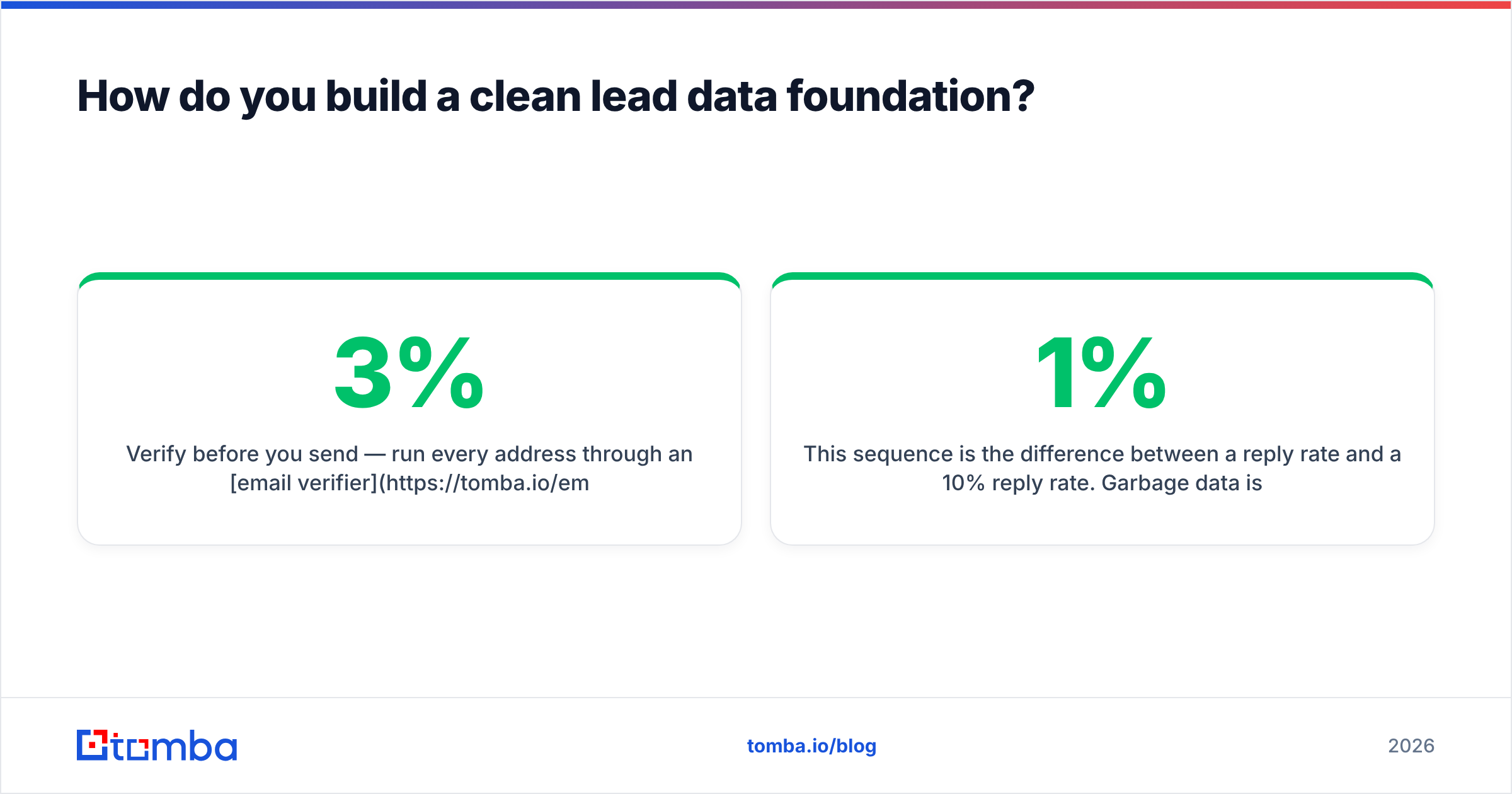
- Verify before you send — run every address through an email verifier so your bounce rate stays under 2-3%.
- Enrich and route — fill in titles, seniority, and phone numbers with data enrichment so reps personalize and prioritize.
This sequence is the difference between a 1% reply rate and a 10% reply rate. Garbage data is not a minor tax — it compounds at every stage.
)
Which tools do you need for B2B SaaS lead generation?#
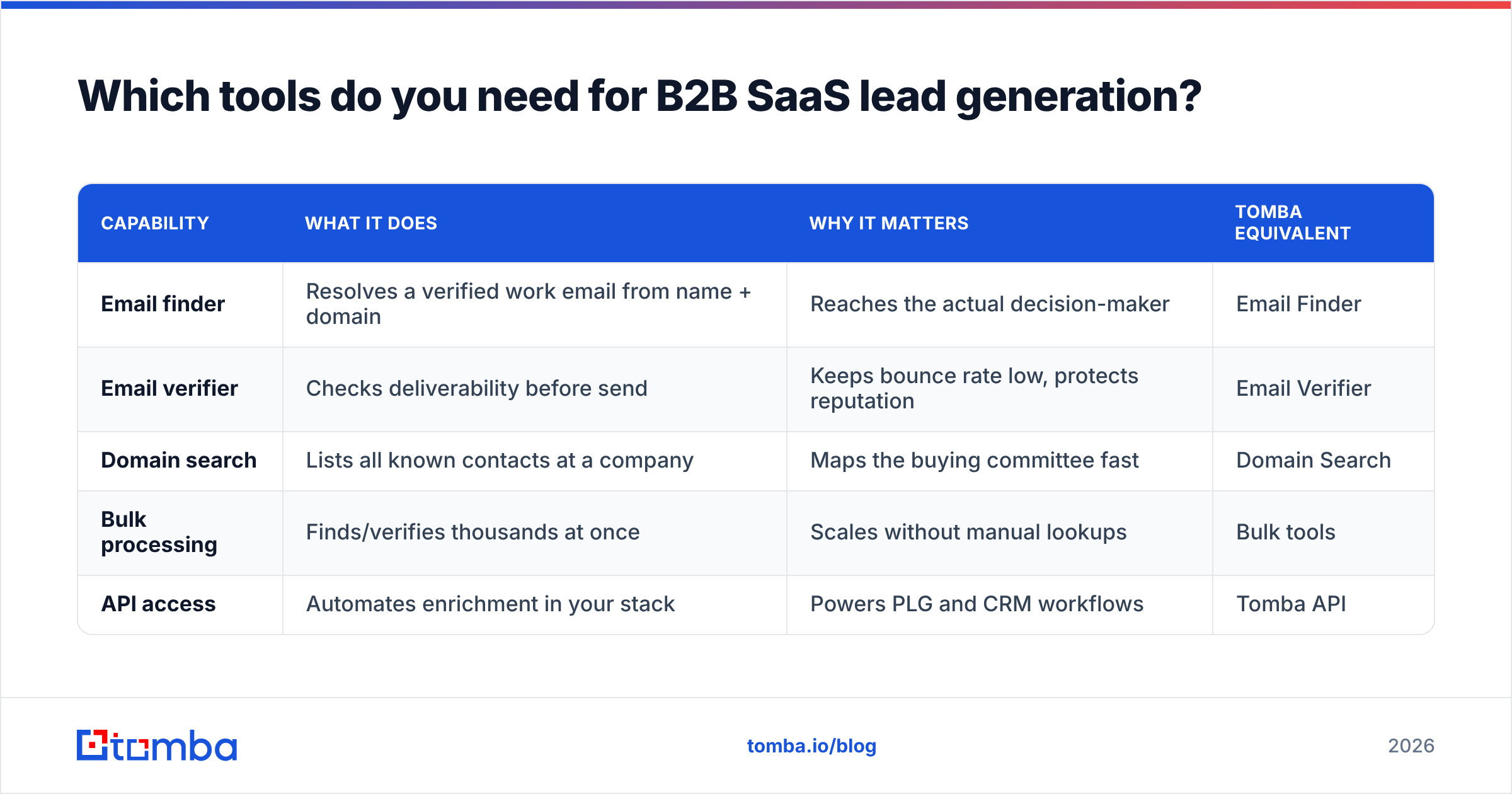
You need three capabilities: find, verify, and enrich. Some teams buy a separate vendor for each and spend the first month of every quarter reconciling mismatched records. The cleaner path is a single source that does all three so the data stays consistent end to end.
| Capability | What it does | Why it matters | Tomba equivalent |
|---|---|---|---|
| Email finder | Resolves a verified work email from name + domain | Reaches the actual decision-maker | Email Finder |
| Email verifier | Checks deliverability before send | Keeps bounce rate low, protects reputation | Email Verifier |
| Domain search | Lists all known contacts at a company | Maps the buying committee fast | Domain Search |
| Bulk processing | Finds/verifies thousands at once | Scales without manual lookups | Bulk tools |
| API access | Automates enrichment in your stack | Powers PLG and CRM workflows | Tomba API |
The integration layer matters as much as the data. If your finder pushes verified contacts straight into your CRM, you skip the CSV shuffle entirely — for example a native HubSpot integration or a Salesforce integration keeps enrichment automatic instead of manual.
How does Tomba compare to all-in-one prospecting platforms?#
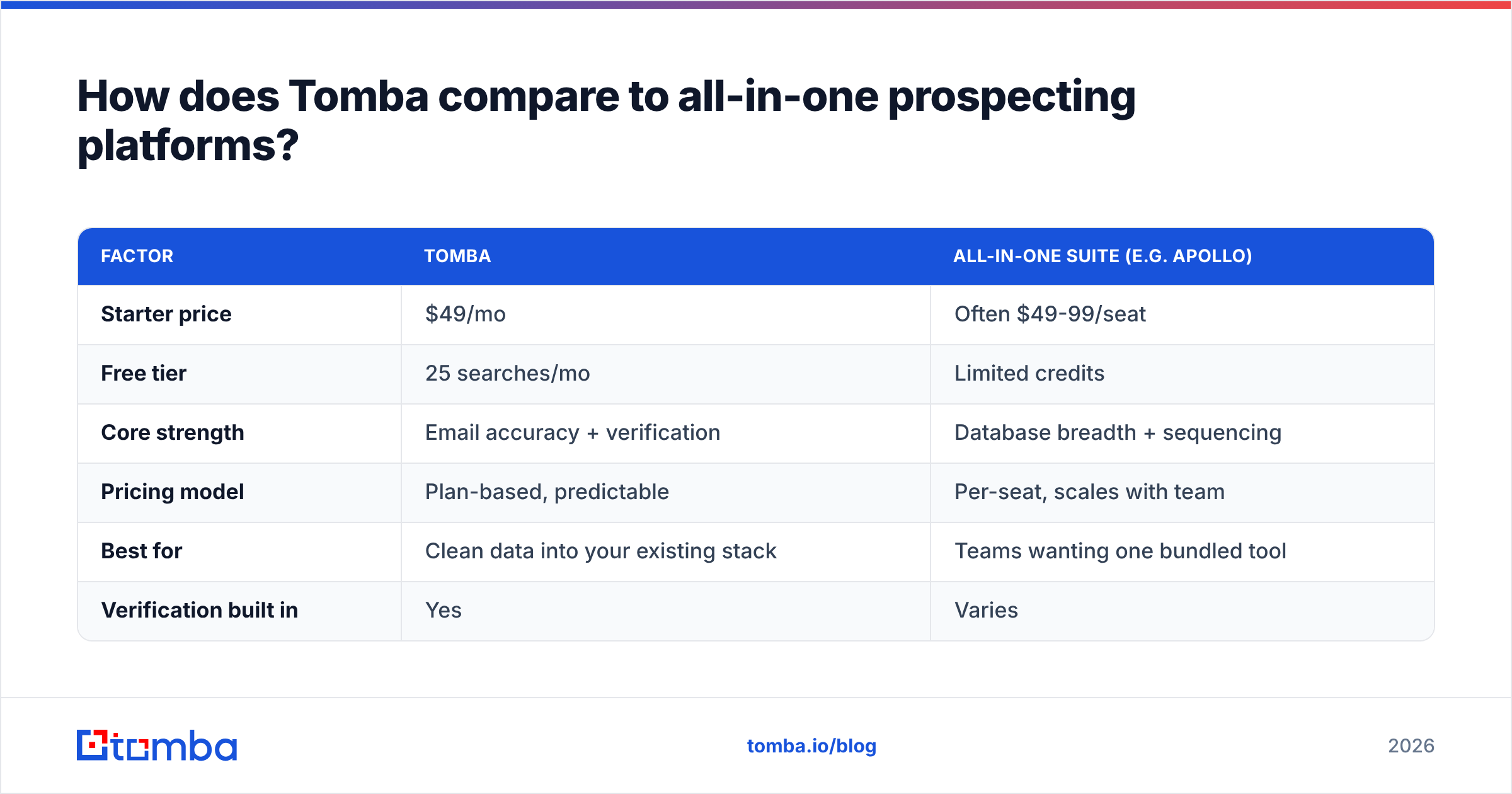
Most teams weigh a focused data tool against a heavyweight all-in-one suite. The all-in-one platforms bundle a database, sequencer, and dialer; the trade-off is per-seat pricing that climbs fast and data accuracy that varies by region. A focused, accuracy-first tool keeps cost predictable and plugs into the sequencer you already use.
| Factor | Tomba | All-in-one suite (e.g. Apollo) |
|---|---|---|
| Starter price | $49/mo | Often $49-99/seat |
| Free tier | 25 searches/mo | Limited credits |
| Core strength | Email accuracy + verification | Database breadth + sequencing |
| Pricing model | Plan-based, predictable | Per-seat, scales with team |
| Best for | Clean data into your existing stack | Teams wanting one bundled tool |
| Verification built in | Yes | Varies |
If you already run a sequencer like Instantly or a CRM-native cadence tool, you do not need to rip it out — you need clean, verified contacts flowing into it. That is where a focused finder wins. If you want a single login for everything and accept the per-seat cost, an all-in-one suite makes sense. Compare current Tomba pricing against the per-seat math for your headcount before deciding — the breakeven usually favors the focused tool past three reps. For a side-by-side on the suite side, see how teams evaluate an Apollo alternative.
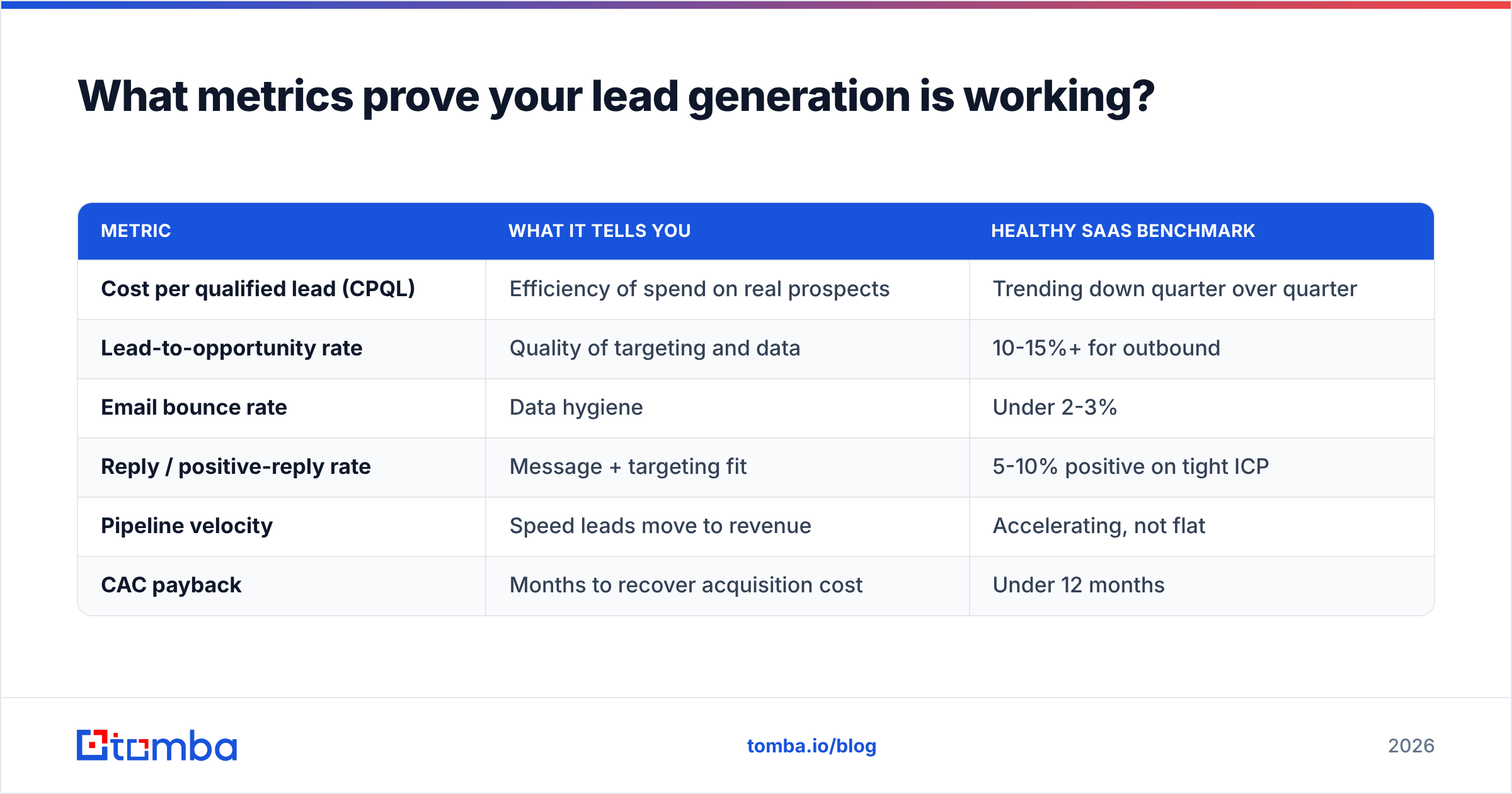
What metrics prove your lead generation is working?#
Lead volume is a vanity metric. The numbers that predict revenue sit deeper in the funnel.
| Metric | What it tells you | Healthy SaaS benchmark |
|---|---|---|
| Cost per qualified lead (CPQL) | Efficiency of spend on real prospects | Trending down quarter over quarter |
| Lead-to-opportunity rate | Quality of targeting and data | 10-15%+ for outbound |
| Email bounce rate | Data hygiene | Under 2-3% |
| Reply / positive-reply rate | Message + targeting fit | 5-10% positive on tight ICP |
| Pipeline velocity | Speed leads move to revenue | Accelerating, not flat |
| CAC payback | Months to recover acquisition cost | Under 12 months |
Watch the bounce rate especially. A creeping bounce rate is the earliest warning that your data source has decayed or your verification step slipped. It shows up before reply rates fall and long before deliverability collapses. Treat it as the canary in your lead-gen mine.
The response rate and lead-to-opportunity numbers together tell you whether the problem is your data or your message. High bounce, low reply: fix the data. Low bounce, low reply: fix the message and targeting.
How do you scale B2B SaaS lead generation without burning your domain?#
Scaling is where most teams self-destruct. They find a motion that works at 50 emails a day, then crank it to 2,000 overnight and watch deliverability crater. Scale the system, not just the volume.
Three guardrails keep growth healthy:
- Verify in bulk, always — Before any large send, run the list through a bulk verify pass. Never trust a list you did not verify, even from a reputable source.
- Warm and rotate sending infrastructure — Use multiple sending domains and inboxes, warm them gradually, and respect daily send limits. Authentication (SPF, DKIM, DMARC) is non-negotiable in 2026.
- Automate enrichment through the API — As volume grows, manual lookups break. Wire the email finder API into your signup flow and CRM so every new lead is enriched and verified the moment it enters your system.
The teams that scale cleanly treat data quality as an automated, always-on layer — not a quarterly cleanup project. When a trial user signs up, enrichment fires instantly. When a visitor hits your pricing page, the account gets resolved and routed. The pipeline becomes a system, not a scramble.
A note on lists: buying a generic list is the single fastest way to undo all of this. Bought lists are shared, stale, and full of spam traps. One bad send can land your domain on a blacklist — check yours with a blacklist checker — and recovery takes weeks. Build first-party data and find specific verified contacts instead.
What does a 90-day lead generation plan look like?#
If you are starting fresh, sequence the work so each phase compounds.
- Days 1-30 — Foundation. Lock your ICP, set up authentication on your sending domains, pick your find-verify-enrich stack, and connect it to your CRM. Ship two cornerstone content pieces targeting buying-intent keywords.
- Days 31-60 — First motions. Launch one outbound sequence to a tightly verified list and one inbound capture (gated asset or free tool). Measure bounce and reply rates, not volume.
- Days 61-90 — Optimize and scale. Double down on whichever motion produced qualified opportunities. Add bulk verification before scaling sends, layer in retargeting, and automate enrichment so new leads self-clean.
By day 90 you should have a repeatable, measurable motion — not necessarily a huge pipeline, but a predictable one you can pour more fuel into.
The bottom line#
B2B SaaS lead generation in 2026 rewards precision over volume. Clean, verified data feeding a focused channel mix beats a massive list run through generic spray every time. Get the data layer right and every channel downstream performs better; get it wrong and nothing else matters.
If your bottleneck is reaching the right buyers with addresses that actually deliver, start with the Tomba Email Finder. Find verified work emails by name, company, or domain, run them through built-in verification, and push clean contacts straight into your sequencer or CRM. The free tier gives you 25 searches a month to test accuracy on your own ICP before you commit — and Tomba pricing starts at $49/mo when you are ready to scale. Build your pipeline on data you can trust.
// get started
Find, verify and enrich your first contacts today
Start on the free plan with 25 searches a month, then scale when your team is ready.
Free plan · No credit card required · GDPR & CCPA
// about the author