B2B SaaS Marketing in 2026: The Complete Growth Playbook
A no-fluff B2B SaaS marketing playbook for 2026: channels that still convert, the metrics that matter, and how to feed sales a pipeline of qualified accounts.
B2B SaaS marketing in 2026 is no longer about generating the most leads — it is about generating the right accounts and proving revenue impact. Buyers research in the dark, budgets are scrutinized, and "spray and pray" demand gen burns cash without moving pipeline. This playbook breaks down what actually works.
TL;DR#
- B2B SaaS marketing in 2026 is account-led, not lead-led. Target named accounts that match your ICP instead of chasing volume.
- Self-serve and sales-led now coexist. Product-led growth (PLG) feeds the funnel; sales closes the expansion.
- Six channels carry most pipeline: content/SEO, paid demand, outbound, lifecycle email, community, and partnerships.
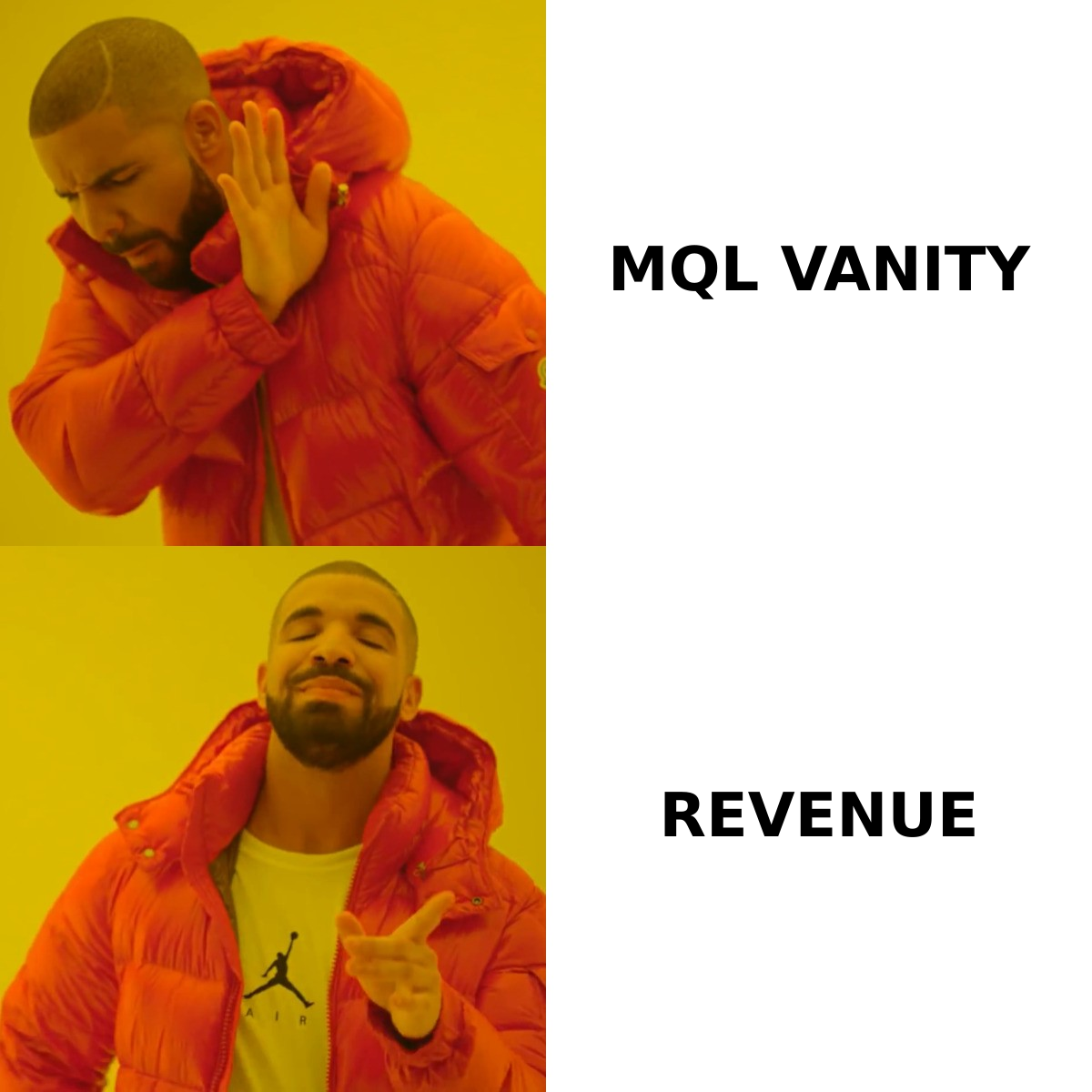
- Measure pipeline and revenue, not MQL vanity counts. CAC payback under 18 months is the bar.
- Clean contact data is the multiplier — even the best campaign fails if your outreach bounces.
What is B2B SaaS marketing in 2026?#
B2B SaaS marketing is the discipline of attracting, converting, and expanding business customers for software sold on a subscription model. Think of it like running a gym membership business instead of selling one-off treadmills: the sale is just the beginning, and your real money is in retention and expansion.
What changed by 2026 is where the buying happens. According to Gartner research on B2B buying, buyers spend only a small fraction of their journey talking to any vendor. Most of the decision happens across review sites, peer communities, and your own content — long before a rep ever gets a reply. So your marketing has to win the parts of the journey you cannot see.
That shifts the job from "generate leads" to "be the obvious, trusted choice when the account is ready to buy."
Which channels actually drive SaaS pipeline?#
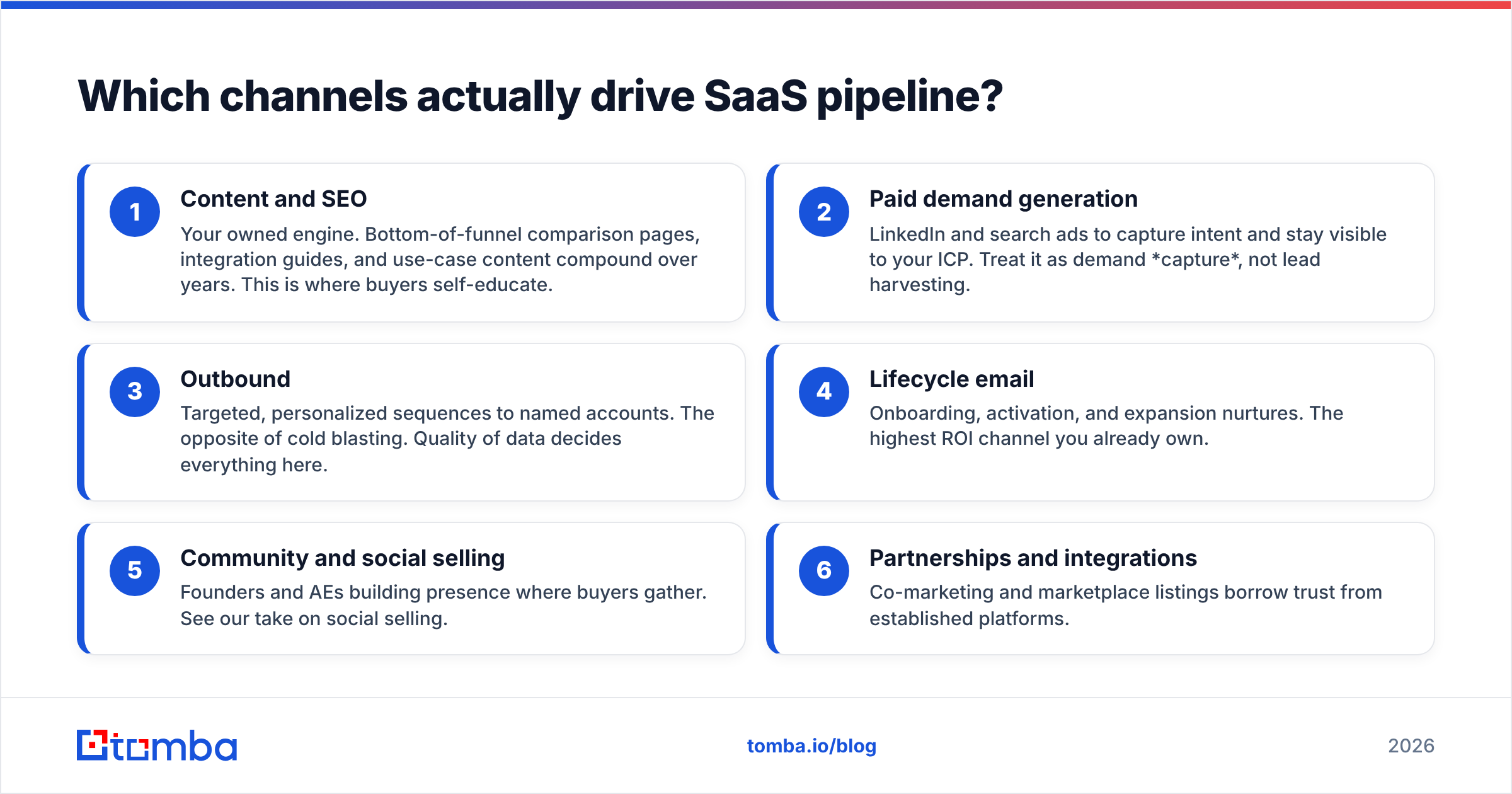
There is no single channel that wins. The teams that grow in 2026 run a portfolio and let each channel do one job well. Here are the six that consistently produce pipeline:
- Content and SEO — Your owned engine. Bottom-of-funnel comparison pages, integration guides, and use-case content compound over years. This is where buyers self-educate.
- Paid demand generation — LinkedIn and search ads to capture intent and stay visible to your ICP. Treat it as demand capture, not lead harvesting.
- Outbound — Targeted, personalized sequences to named accounts. The opposite of cold blasting. Quality of data decides everything here.
- Lifecycle email — Onboarding, activation, and expansion nurtures. The highest ROI channel you already own.
- Community and social selling — Founders and AEs building presence where buyers gather. See our take on social selling.
- Partnerships and integrations — Co-marketing and marketplace listings borrow trust from established platforms.
The mistake is funding only channels 1 and 2 (inbound) or only channel 3 (outbound). Modern GTM blends them: inbound warms the account, outbound reaches the buying committee directly.
Should you go product-led or sales-led?#
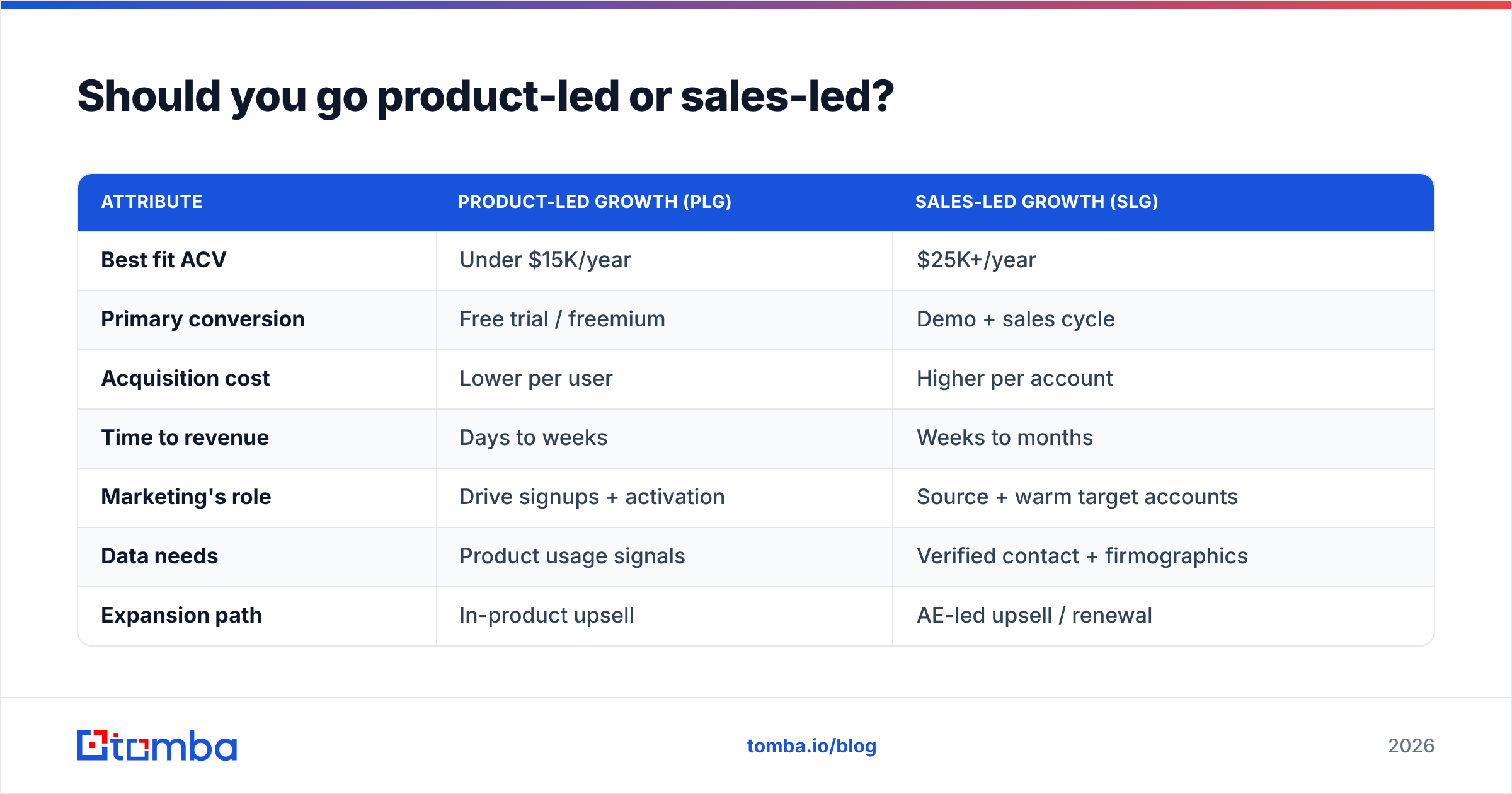
Both — and the answer depends on your average contract value (ACV). Here is how the two models compare on the attributes that matter for a SaaS go-to-market motion.
| Attribute | Product-Led Growth (PLG) | Sales-Led Growth (SLG) |
|---|---|---|
| Best fit ACV | Under $15K/year | $25K+/year |
| Primary conversion | Free trial / freemium | Demo + sales cycle |
| Acquisition cost | Lower per user | Higher per account |
| Time to revenue | Days to weeks | Weeks to months |
| Marketing's role | Drive signups + activation | Source + warm target accounts |
| Data needs | Product usage signals | Verified contact + firmographics |
| Expansion path | In-product upsell | AE-led upsell / renewal |
Most SaaS companies in 2026 run a hybrid: a self-serve tier that captures demand at the bottom, plus a sales team that pursues the accounts showing buying intent. HubSpot's research on inbound shows the funnel works best when product, marketing, and sales share the same definition of a qualified account — which is really a revenue operations problem more than a marketing one.
How do you build an ICP-driven account list?#
Conclusion first: stop buying generic lists and start building targeted account lists from your own ICP signals.
A repeatable process looks like this:
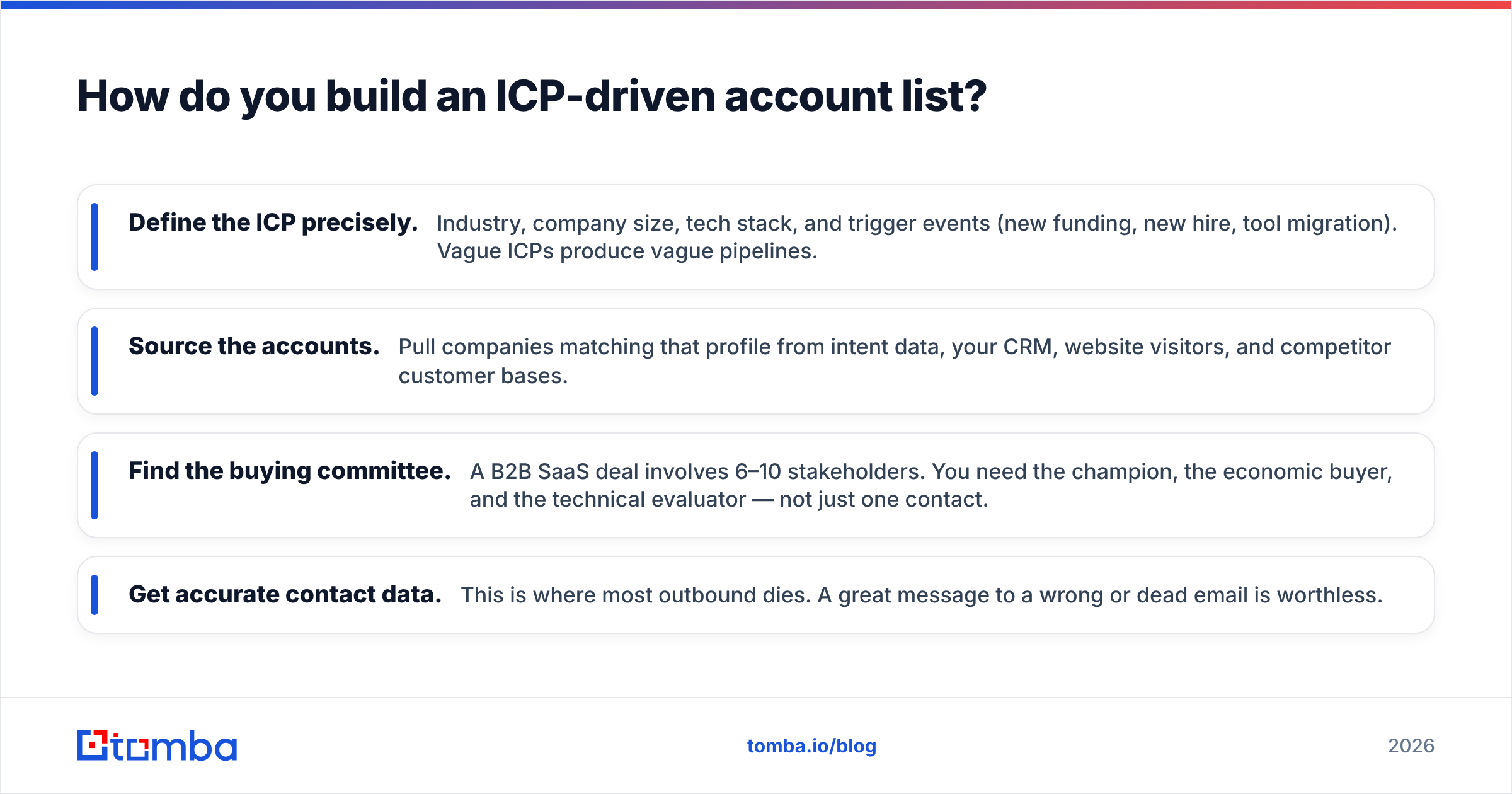
- Define the ICP precisely. Industry, company size, tech stack, and trigger events (new funding, new hire, tool migration). Vague ICPs produce vague pipelines.
- Source the accounts. Pull companies matching that profile from intent data, your CRM, website visitors, and competitor customer bases.
- Find the buying committee. A B2B SaaS deal involves 6–10 stakeholders. You need the champion, the economic buyer, and the technical evaluator — not just one contact.
- Get accurate contact data. This is where most outbound dies. A great message to a wrong or dead email is worthless.
For the last two steps, a tool like the Tomba Email Finder lets you find professional emails by name and company, while domain search surfaces every reachable contact at a target account. Pair that with data enrichment to fill in titles, seniority, and firmographics so your segmentation actually holds up.
What metrics actually matter for B2B SaaS marketing?#
Vanity metrics are the silent killer of SaaS marketing budgets. Impressions, raw lead counts, and "MQLs" feel like progress but do not pay salaries. Here is what to track instead, and why.
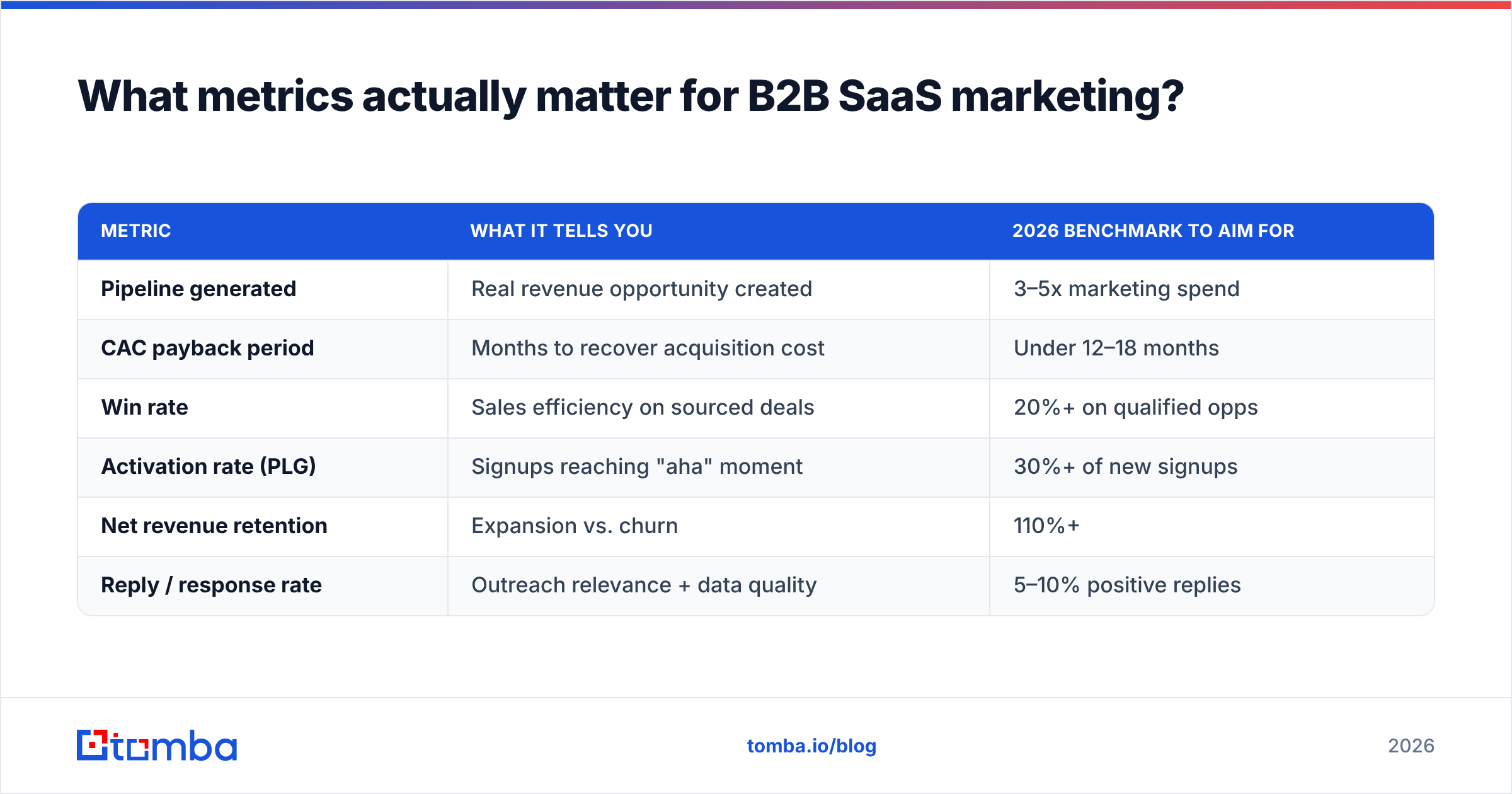
| Metric | What it tells you | 2026 benchmark to aim for |
|---|---|---|
| Pipeline generated | Real revenue opportunity created | 3–5x marketing spend |
| CAC payback period | Months to recover acquisition cost | Under 12–18 months |
| Win rate | Sales efficiency on sourced deals | 20%+ on qualified opps |
| Activation rate (PLG) | Signups reaching "aha" moment | 30%+ of new signups |
| Net revenue retention | Expansion vs. churn | 110%+ |
| Reply / response rate | Outreach relevance + data quality | 5–10% positive replies |
Notice the theme: every metric ladders up to revenue or retention. If a number cannot be tied to pipeline or expansion, demote it to a diagnostic, not a goal. Review platforms like G2 are also worth watching — buyer reviews and category placement increasingly influence who gets shortlisted.
Why does contact data quality decide everything?#
Because the best campaign in the world fails on a bounced send. In 2026, mailbox providers are stricter than ever about sender reputation. A high bounce rate from outdated lists doesn't just waste effort — it can land your whole domain in the spam folder, killing deliverability for every future email.
That is why data hygiene is now a marketing responsibility, not an afterthought:
- Verify before you send. Run lists through an email verifier to strip invalid, risky, and dead addresses.
- Handle catch-all domains carefully. Many corporate domains accept everything, then bounce later. A catch-all verifier reduces that risk.
- Enrich and dedupe continuously. CRMs decay roughly 25–30% per year as people change jobs. Refresh quarterly.
- Protect sender reputation. Warm up domains, monitor blacklists, and keep bounce rates under 2%.
Clean data is the multiplier on every other investment. Doubling your reply rate by sending to verified addresses is cheaper than doubling your ad budget.
How should marketing and sales work together?#
The handoff between marketing and sales is where most B2B SaaS pipeline leaks. The fix is a shared definition of a qualified account and a tight feedback loop.
Practically, that means:
- One source of truth. Marketing, SDRs, and AEs work from the same account list and the same data, synced through your CRM via Tomba's HubSpot integration or other connectors.
- Closed-loop reporting. Sales tells marketing which sourced accounts converted, so marketing doubles down on what works.
- Shared SLAs. Marketing commits to a pipeline number; sales commits to follow-up speed. Speed-to-lead under five minutes still wins disproportionately.
When marketing sources accurate, enriched, ICP-matched accounts and sales follows up fast, the whole engine compounds. When they operate in silos, you get the classic standoff: "marketing leads are garbage" versus "sales doesn't follow up."
What does a 90-day B2B SaaS marketing plan look like?#
If you are starting or resetting, here is a focused first quarter:
- Days 1–30 — Foundation. Lock the ICP, audit your data, and instrument analytics so you can measure pipeline (not just traffic). Clean your existing CRM list.
- Days 31–60 — Channels. Ship 5–10 bottom-of-funnel content pages, launch one paid demand campaign, and build your first targeted outbound sequence to 200 named accounts.
- Days 61–90 — Optimize. Double down on the channel producing the lowest CAC, kill the worst performer, and formalize the sales handoff with shared SLAs.
The goal of the first 90 days is not scale — it is signal. You want to know which channels and segments produce pipeline so you can pour fuel on them in the next quarter.
Common B2B SaaS marketing mistakes to avoid#
- Chasing volume over fit. 10,000 bad leads cost more to process than 100 great accounts.
- Ignoring retention. In SaaS, churn quietly eats your growth. Net revenue retention is a marketing metric too.
- Treating data as static. Lists decay. Budget for ongoing verification and enrichment.
- Over-relying on one channel. Algorithm changes and rising ad costs can wipe out a single-channel strategy overnight.
- Skipping the buying committee. Selling to one contact in a six-person committee is how deals stall.
Conclusion: build the engine, then feed it clean fuel#
B2B SaaS marketing in 2026 rewards precision over volume. Define a sharp ICP, run a portfolio of channels, measure pipeline and retention instead of vanity counts, and keep marketing and sales aligned on a single account list. The teams that win treat data quality as a first-class part of the strategy, not a cleanup task.
That is exactly where Tomba fits. Use the Tomba Email Finder to turn your ICP account list into accurate, verified contacts for the entire buying committee — then enrich and sync them straight into your CRM. Start on the free tier (25 searches/month) and scale up as your pipeline grows; see full Tomba pricing when you are ready for Starter ($49/mo) and beyond. Build the engine, then feed it clean fuel.
// get started
Find, verify and enrich your first contacts today
Start on the free plan with 25 searches a month, then scale when your team is ready.
Free plan · No credit card required · GDPR & CCPA
// about the author