The B2B SaaS Marketing Funnel: A 2026 Playbook That Converts
A stage-by-stage breakdown of the B2B SaaS marketing funnel in 2026 — the metrics that matter, where deals leak, and how to fix each layer with real data.
The B2B SaaS marketing funnel is the model you use to turn a stranger who has never heard of your product into a paying, renewing customer. Get the stages and the hand-offs right and your pipeline becomes predictable. Get them wrong and you spend a fortune filling the top while revenue trickles out the bottom.
This guide breaks the funnel down stage by stage for 2026, shows you the conversion benchmarks to measure against, and points to where most SaaS teams quietly leak deals.
TL;DR#
- The modern B2B SaaS funnel has five working stages: awareness, interest, consideration, intent, and retention/expansion — the funnel no longer ends at "closed won."
- Most leaks happen at the MQL-to-SQL hand-off, where bad contact data and loose qualification waste sales time.
- Track stage-to-stage conversion rate, not just top-line volume. A bigger top of funnel hides a broken middle.
- Clean, verified contact data is the cheapest funnel optimization you can make — it lifts every downstream rate at once.
- In 2026, product-led and sales-led motions blend; your funnel needs to map both self-serve signups and sales-assisted deals.
What is a B2B SaaS marketing funnel?#
Think of the funnel like a water filtration system. A large, messy volume pours in at the top, and at each layer something is removed until only qualified, ready-to-buy accounts pass through to the bottom. The funnel is simply the named stages that water passes through, plus the rate at which it moves from one to the next.
In B2B SaaS specifically, the funnel has three traits that make it different from e-commerce or consumer apps:
- Buying committees, not individuals. A typical deal involves 6 to 10 stakeholders, so your funnel tracks accounts as much as people.
- Long, considered cycles. Mid-market deals routinely take 60 to 120 days, so funnel stages span weeks, not minutes.
- Revenue lives after the sale. Net revenue retention and expansion often matter more than the first contract, so retention is a funnel stage, not an afterthought.
That last point is why the old "AIDA" funnel that ends at purchase no longer fits SaaS. Your customer acquisition cost only pays back over months of subscription, so the funnel has to keep going.
What are the stages of the funnel in 2026?#
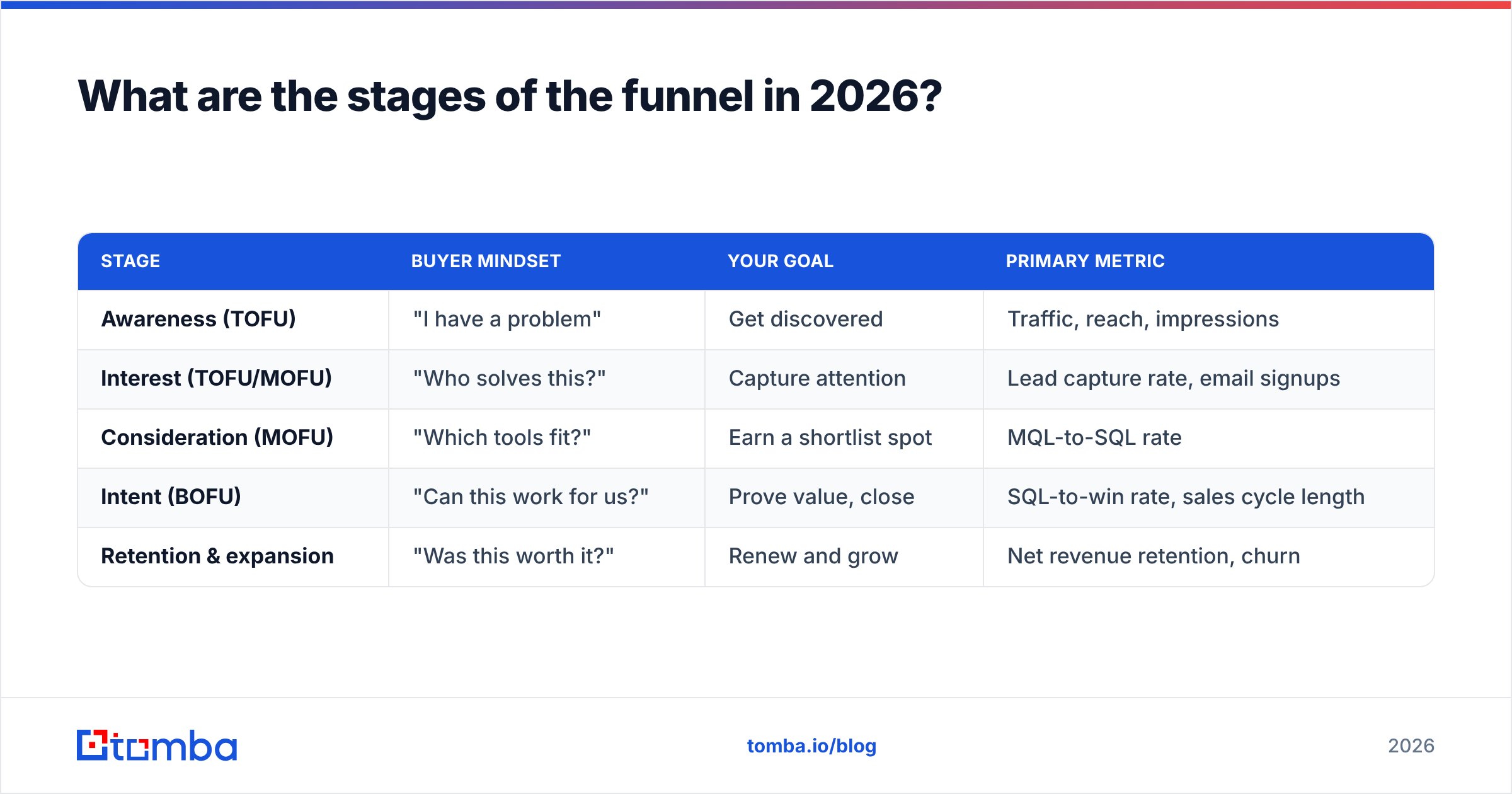
Here is the five-stage model most high-performing SaaS teams run today, with the job each stage does and the primary metric you watch.
| Stage | Buyer mindset | Your goal | Primary metric |
|---|---|---|---|
| Awareness (TOFU) | "I have a problem" | Get discovered | Traffic, reach, impressions |
| Interest (TOFU/MOFU) | "Who solves this?" | Capture attention | Lead capture rate, email signups |
| Consideration (MOFU) | "Which tools fit?" | Earn a shortlist spot | MQL-to-SQL rate |
| Intent (BOFU) | "Can this work for us?" | Prove value, close | SQL-to-win rate, sales cycle length |
| Retention & expansion | "Was this worth it?" | Renew and grow | Net revenue retention, churn |
Notice that the metrics shift from volume at the top to conversion in the middle to value at the bottom. Optimizing the wrong metric for a stage is the most common strategic mistake — chasing traffic when your real problem is a 4% MQL-to-SQL rate, for example.
How do you measure funnel performance?#
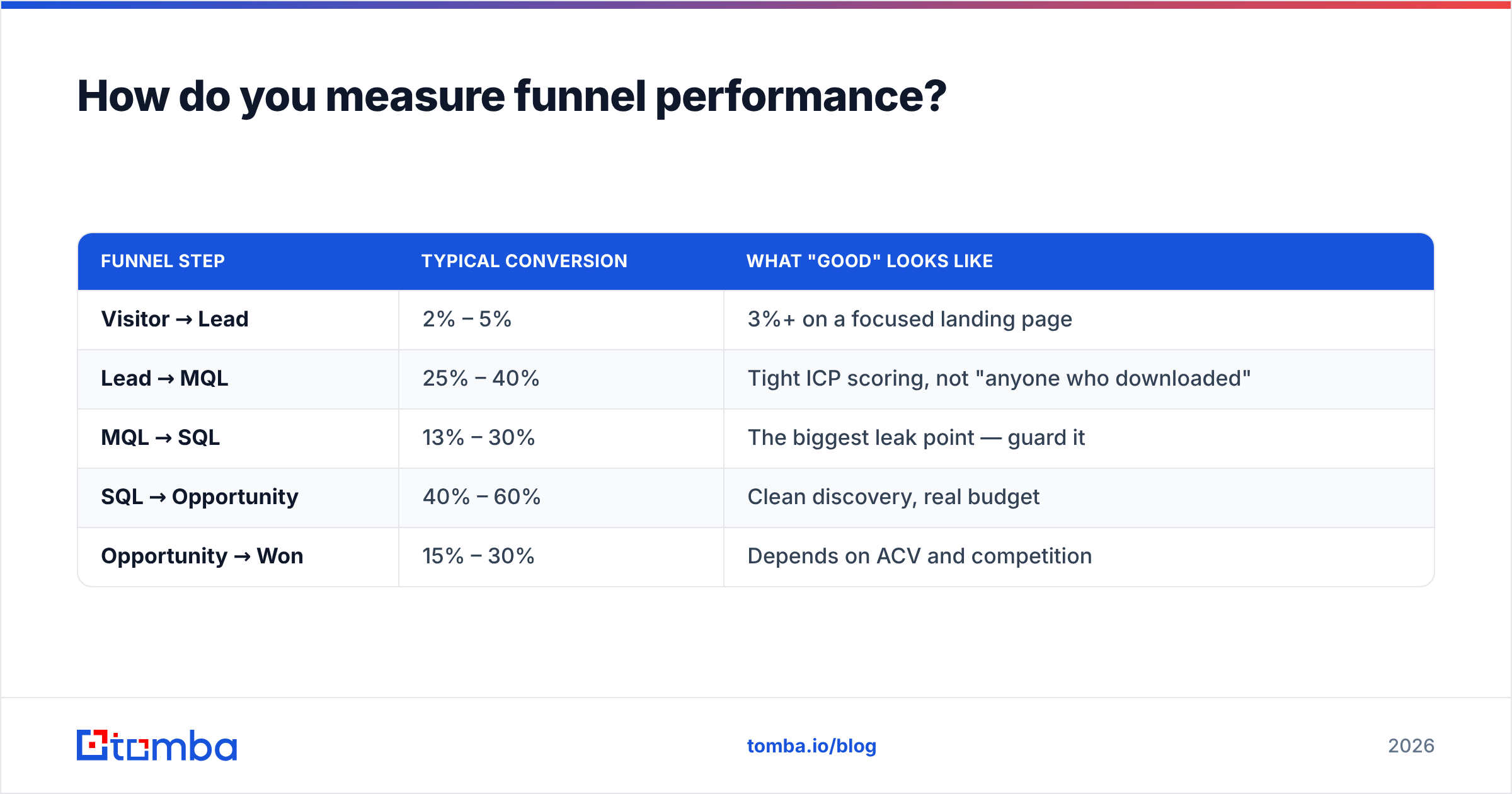
Conclusion first: measure stage-to-stage conversion rate, because that single set of numbers tells you exactly where to invest. Total volume tells you how busy you are; conversion tells you where you are losing money.
Here is a simplified worked example for a mid-market SaaS team in 2026. Use it as a rough sanity check, not a hard target — benchmarks vary widely by price point and motion.
| Funnel step | Typical conversion | What "good" looks like |
|---|---|---|
| Visitor → Lead | 2% – 5% | 3%+ on a focused landing page |
| Lead → MQL | 25% – 40% | Tight ICP scoring, not "anyone who downloaded" |
| MQL → SQL | 13% – 30% | The biggest leak point — guard it |
| SQL → Opportunity | 40% – 60% | Clean discovery, real budget |
| Opportunity → Won | 15% – 30% | Depends on ACV and competition |
When you multiply these together, only a tiny fraction of top-of-funnel visitors become customers — which is exactly why a 5-point lift in the middle of the funnel is worth more than doubling your traffic. You can read more on how to define a marketing qualified lead so your MQL number actually means something.
For the wider operating system around these numbers — ownership, definitions, and shared dashboards — see how revenue operations teams stitch marketing and sales metrics into one funnel.
Why does the middle of the funnel leak the most?#
Because the middle is where marketing hands off to sales, and hand-offs are where things break. Two causes dominate:
- Bad or incomplete contact data. A lead fills out a form with "john@gmail.com" and no company. Sales can't research the account, the email bounces, and the MQL dies in a queue. Industry studies consistently put B2B data decay at roughly 25-30% per year, so even good lists rot fast.
- Loose qualification. Marketing scores anyone who touched a piece of content as an MQL to hit a volume goal. Sales burns hours on tire-kickers, loses trust in marketing leads, and starts ignoring them.
The fix for both is the same: enrich and verify at the point of capture. When a lead enters the funnel, append the firmographic data (company size, industry, role) and confirm the email is real and reachable before it ever reaches a rep.
This is where a tool like data enrichment earns its place in the stack — it turns a thin form fill into a routable, scoreable record automatically. Pair it with an email verifier so your nurture sequences don't tank your sender reputation on dead addresses.
How do product-led and sales-led funnels differ?#
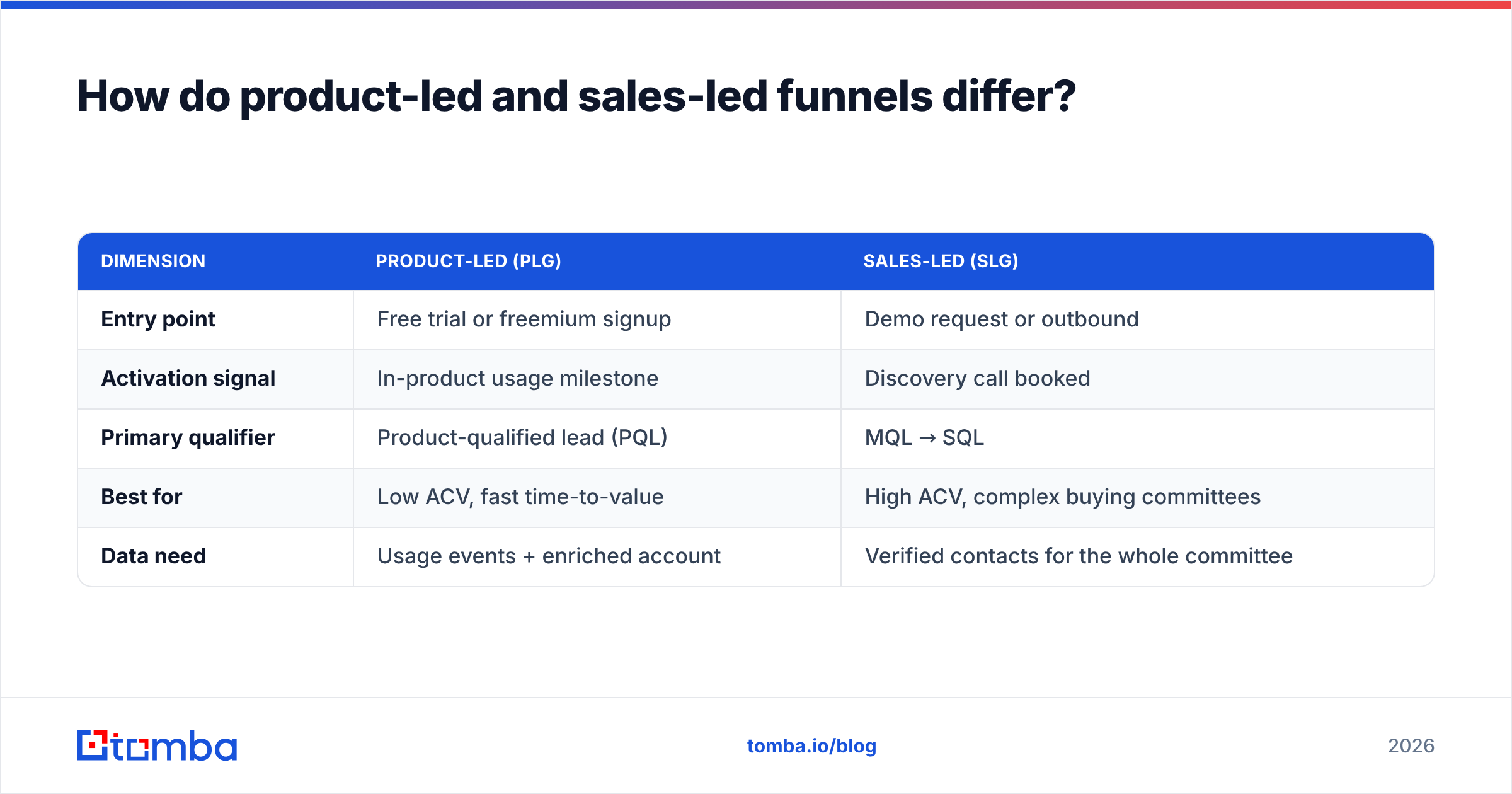
In 2026 most SaaS companies run a hybrid, but the two underlying motions ask different things of your funnel.
| Dimension | Product-led (PLG) | Sales-led (SLG) |
|---|---|---|
| Entry point | Free trial or freemium signup | Demo request or outbound |
| Activation signal | In-product usage milestone | Discovery call booked |
| Primary qualifier | Product-qualified lead (PQL) | MQL → SQL |
| Best for | Low ACV, fast time-to-value | High ACV, complex buying committees |
| Data need | Usage events + enriched account | Verified contacts for the whole committee |
The practical implication: a PLG funnel still needs enrichment, just later. A self-serve user signs up, you watch usage, and once they hit a PQL threshold you enrich the account and surface the rest of the buying committee for a sales-assisted expansion play. That is where a domain search helps — feed it the signup's company domain and get the other decision-makers you need to expand the deal.
How do you build outbound into the funnel?#
Outbound is not a separate funnel; it is a top-of-funnel source that feeds the same middle and bottom stages. The trick is to treat outbound leads with the same data discipline as inbound.
A reliable outbound-to-funnel flow looks like this:
- Define the ICP precisely. Industry, headcount, tech stack, and trigger events. Vague targeting is the root of low reply rates.
- Build the list from a real source. Pull verified contacts by company and role rather than scraping a stale CSV. Tomba's email finder returns professional addresses by name and domain, with a confidence score attached.
- Verify before you send. Bounces above 3-4% put your domain at risk. Run the list through verification first.
- Enrich for personalization. Append role, company news, and seniority so the first line of every email is specific, not templated.
- Route replies into the same CRM stages so outbound deals are measured on the same conversion math as inbound.
Done well, outbound becomes a controllable volume knob: you know roughly how many verified contacts produce one SQL, so you can scale spend predictably. For teams running this at volume, the bulk email finder processes whole target lists in one pass.
What metrics should marketing and sales share?#
Conclusion first: both teams should own a single funnel dashboard with shared definitions, or they will fight over whose number is "right." The minimum shared set:
- Funnel velocity — how fast a deal moves from MQL to won. Slowing velocity is an early warning before revenue dips.
- Stage conversion rates — the table above, reviewed weekly.
- Cost per SQL and CAC payback — ties marketing spend to actual sellable pipeline, not vanity leads.
- Net revenue retention — the bottom-of-funnel truth that says whether you acquired good-fit customers in the first place.
- Data health rate — the percentage of contact records that are complete and verified. Treat this as a leading indicator; it predicts conversion drops weeks ahead.
When marketing is measured on SQLs and revenue rather than raw MQL count, the incentive to stuff the funnel with low-intent leads disappears. That alignment, more than any single tactic, is what separates funnels that compound from funnels that stall.
What tools do you actually need?#
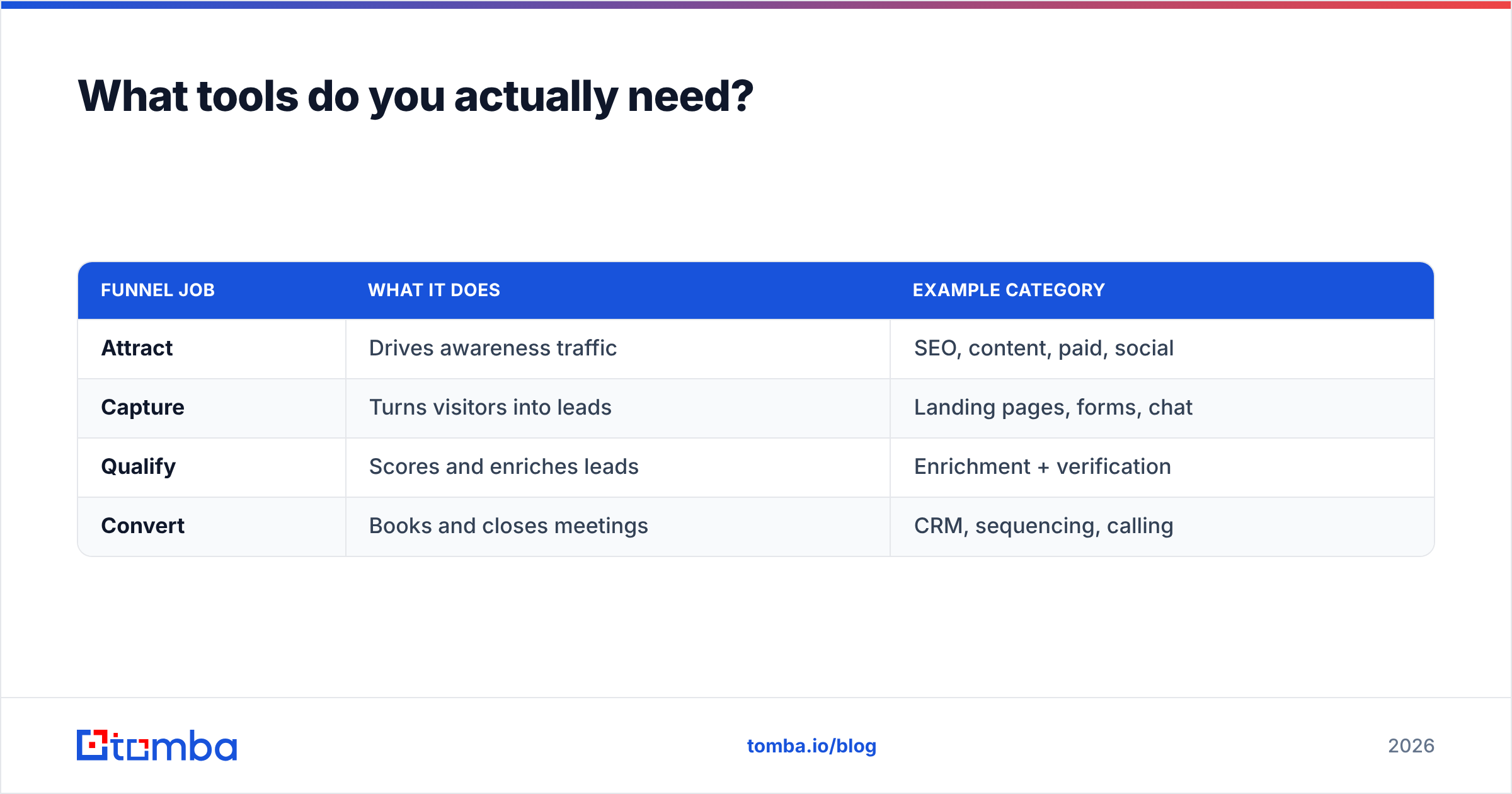
You do not need 40 tools. You need coverage across four jobs: attract, capture, qualify, and convert. The mistake is buying overlapping platforms while neglecting the data layer that every stage depends on.
| Funnel job | What it does | Example category |
|---|---|---|
| Attract | Drives awareness traffic | SEO, content, paid, social |
| Capture | Turns visitors into leads | Landing pages, forms, chat |
| Qualify | Scores and enriches leads | Enrichment + verification |
| Convert | Books and closes meetings | CRM, sequencing, calling |
Most teams over-invest in attract-and-convert and under-invest in qualify — which is exactly the stage where the funnel leaks most. A modest budget on enrichment and verification lifts every rate downstream of it. Compare the cost: Tomba starts free with 25 searches per month, with paid plans at $49/mo (Starter), $99/mo (Growth), and $249/mo (Pro). You can see the full Tomba pricing breakdown, but the point is that fixing the data layer is the cheapest high-leverage move on this list.
If you want to benchmark vendors, neutral review sites like G2 and Capterra carry verified user reviews by category, and analyst coverage from Gartner is useful for enterprise procurement. For the inbound side of the funnel, HubSpot's research on conversion benchmarks is a solid free reference.
How do you fix a leaking funnel, step by step?#
Work bottom-up, not top-down. Fixing the top of a leaky funnel just pours more water into a broken filter.
- Find the worst-converting stage using the conversion table. That is your bottleneck.
- Diagnose the cause — is it data quality, qualification criteria, messaging, or sales capacity?
- If it is the MOFU hand-off (it usually is), audit your contact data first. Run a sample of recent MQLs through verification and see how many are even reachable.
- Tighten the MQL definition so volume reflects real intent.
- Re-measure after one full cycle before changing anything else. Changing five things at once means you learn nothing.
Repeat. Funnel optimization is not a one-time project; it is a quarterly rhythm.
Frequently asked questions#
How long should a B2B SaaS sales cycle be? It depends on price. Low-ACV self-serve can close in days; mid-market lands around 60-90 days; enterprise often runs 6-12 months. Track your baseline and watch for it lengthening.
Is MQL still relevant in 2026? Yes, but only with a tight, data-backed definition. The PQL has joined it for product-led motions — most teams now run both.
What is the single highest-leverage funnel fix? Clean, verified contact data at the point of capture. It improves deliverability, qualification, and personalization at once, so every downstream rate rises together.
Build a funnel that runs on clean data#
Your funnel is only as strong as the data flowing through it. The most reliable way to lift conversion across every stage is to make sure each lead is a real, reachable, well-described contact before sales ever touches it. Start free with the Tomba Email Finder — find verified professional emails by name or domain, enrich them with firmographic detail, and feed your funnel records that actually convert instead of records that bounce. Plug the leak in the middle of your funnel first, and watch the revenue at the bottom follow.
// get started
Find, verify and enrich your first contacts today
Start on the free plan with 25 searches a month, then scale when your team is ready.
Free plan · No credit card required · GDPR & CCPA
// about the author