B2B SaaS Marketing Plan: A 2026 Framework That Drives Pipeline
A practical, channel-by-channel B2B SaaS marketing plan for 2026 — with a budget framework, a comparison of growth motions, and the metrics that actually predict revenue.
Most B2B SaaS marketing plans fail for the same reason: they are a list of activities ("do more content, run some ads, post on LinkedIn") instead of a chain that connects spend to pipeline to revenue. This guide gives you the chain — a 2026 framework you can fill in this week, with a budget model, a channel comparison, and the handful of metrics that actually predict whether you hit your number.
TL;DR#
- A B2B SaaS marketing plan is a revenue model first and a channel list second — start from your ARR target and work backward to leads, not the other way around.
- Pick one primary growth motion (product-led, sales-led, or community-led) before you pick channels. Mixing all three with a small team is the most common way to stall.
- Budget by motion: PLG leans on product and content; sales-led leans on outbound data and SDR capacity; most companies run a hybrid by year two.
- Track pipeline-influenced revenue, CAC payback, and lead-to-opportunity rate — vanity metrics like impressions and MQL volume hide whether the plan works.
- Clean contact data is the cheapest lever you control: accurate emails and enriched accounts lift every downstream conversion rate at once.
What is a B2B SaaS marketing plan, really?#
A B2B SaaS marketing plan is a written model that says: here is our revenue target, here is the pipeline math required to hit it, here are the motions and channels we will fund, and here is how we will know each month whether it is working.
Think of it like a flight plan. A pilot does not just "head west and hope" — they calculate fuel, distance, weather, and checkpoints before takeoff. Your plan is the same: ARR target is the destination, pipeline coverage is the fuel, and your monthly metrics are the checkpoints that tell you to adjust before you run out of runway.
Concretely, a complete plan has six parts:
- Revenue target & pipeline math — the number, the average deal size, win rate, and sales cycle that turn it into a lead goal.
- ICP & segments — who you sell to, by firmographic and behavioral signals, not just "mid-market SaaS."
- Primary growth motion — product-led, sales-led, or community-led as the spine.
- Channel mix & budget — where the money and effort go, ranked by expected payback.
- Content & messaging system — the assets that feed every channel.
- Measurement & cadence — the metrics, the dashboard, and the weekly/monthly review rhythm.
Skip the math at the top and everything below becomes guesswork.
)
How do you set the revenue and pipeline math?#
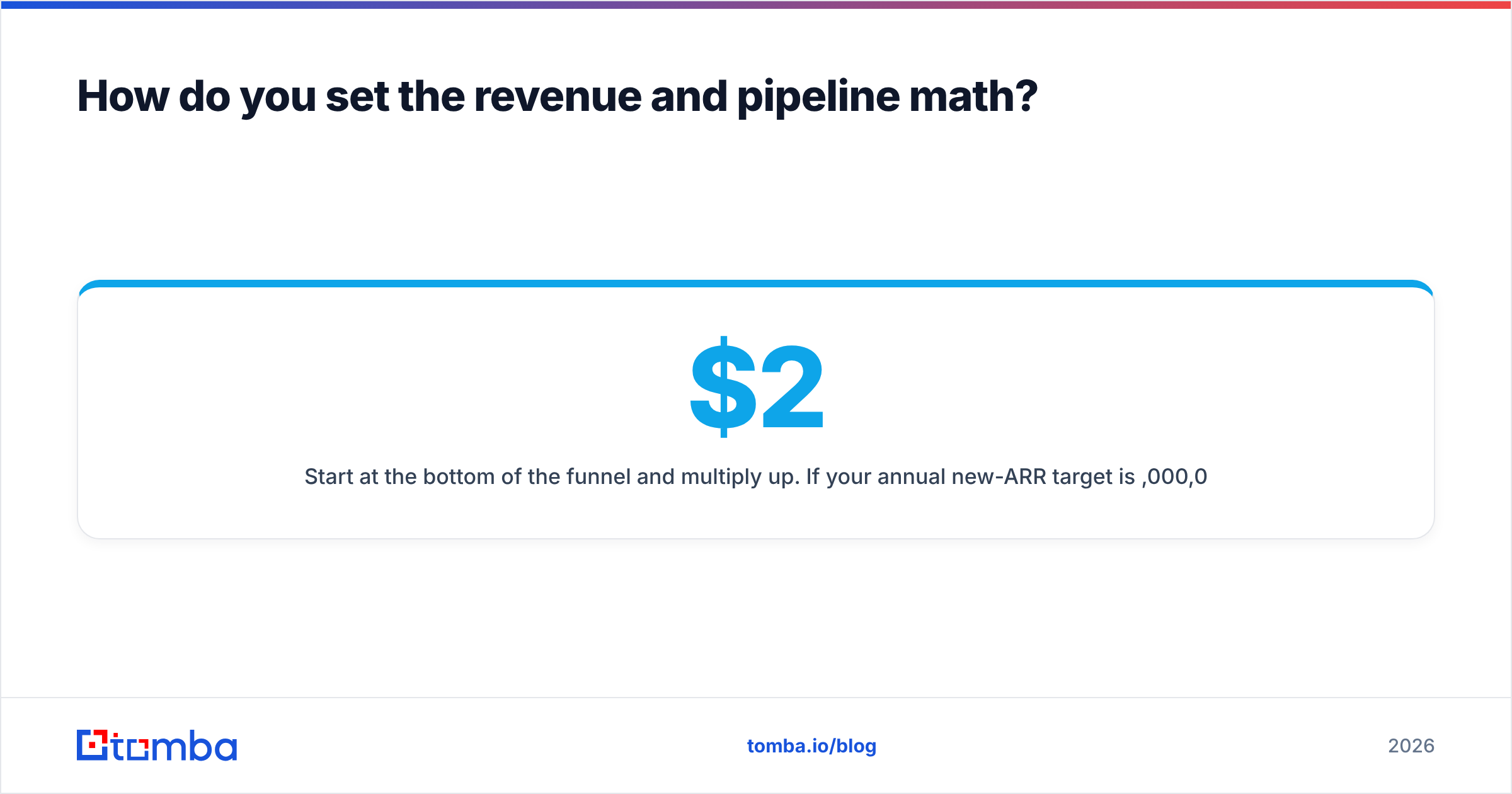
Start at the bottom of the funnel and multiply up. If your annual new-ARR target is $2,000,000 and your average contract value is $12,000, you need roughly 167 new customers. With a 25% opportunity-to-close rate, that is 668 opportunities. If 12% of qualified leads become opportunities, you need about 5,560 qualified leads for the year — call it 460 a month.
That single calculation reframes the entire plan. "Get more leads" becomes "produce 460 qualified leads a month at a blended cost we can afford." Now every channel decision has a target to answer to.
The other number to fix early is CAC payback — how many months of gross margin it takes to recover the cost of acquiring a customer. According to widely cited SaaS benchmarks compiled by HubSpot and analysts like Gartner, healthy B2B SaaS companies target a payback under 12 months and an LTV:CAC ratio above 3:1. If a channel can't get you there, it doesn't belong in the plan yet.
Which growth motion should anchor the plan?#
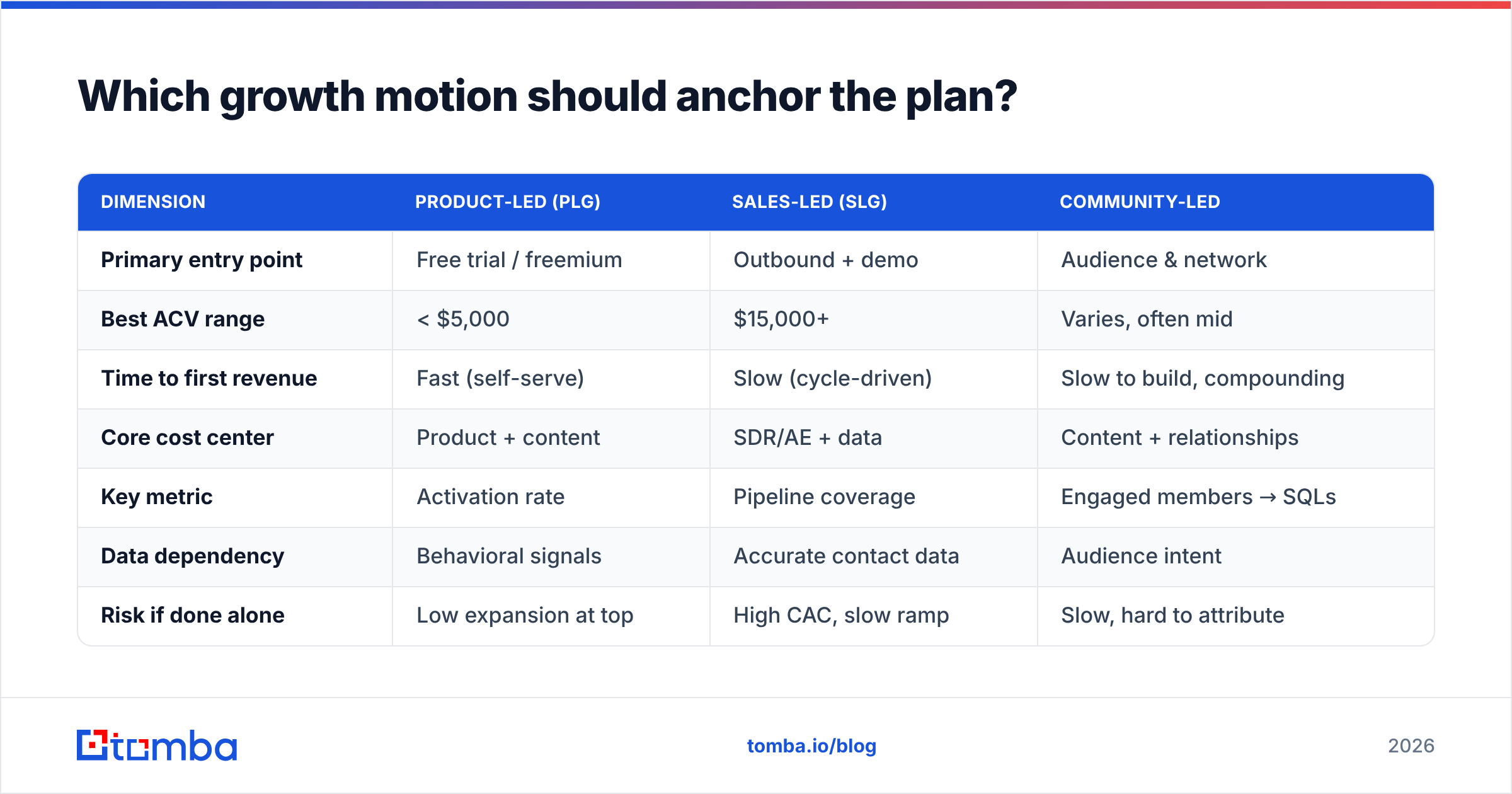
Pick one spine. You can layer the others later, but a small team that splits focus across all three usually does none well. Here is how the three dominant B2B SaaS motions compare.
| Dimension | Product-led (PLG) | Sales-led (SLG) | Community-led |
|---|---|---|---|
| Primary entry point | Free trial / freemium | Outbound + demo | Audience & network |
| Best ACV range | < $5,000 | $15,000+ | Varies, often mid |
| Time to first revenue | Fast (self-serve) | Slow (cycle-driven) | Slow to build, compounding |
| Core cost center | Product + content | SDR/AE + data | Content + relationships |
| Key metric | Activation rate | Pipeline coverage | Engaged members → SQLs |
| Data dependency | Behavioral signals | Accurate contact data | Audience intent |
| Risk if done alone | Low expansion at top | High CAC, slow ramp | Slow, hard to attribute |
A quick rule: if your product delivers value before a sales call (low ACV, fast "aha"), lean product-led. If buyers need a guided evaluation and the contract is large, lean sales-led. If your founders have reach and your category is education-heavy, community-led can subsidize the other two. Most 2026 SaaS companies end up product-led with a sales-assist layer, or sales-led with a content engine feeding it.
What does the channel mix look like in 2026?#
Channels are not the plan — they are how you execute the motion you chose. Map each channel to a job, fund the two or three with the best payback for your motion, and treat the rest as experiments with a kill date.
- Content & SEO — the compounding asset. Slow to start, cheapest at scale. Owns the "problem-aware" and "solution-aware" stages. Non-negotiable for almost every B2B SaaS plan.
- Outbound (cold email + LinkedIn) — the fastest controllable channel for sales-led motions. Its ceiling is set entirely by list quality: bad emails mean bounces, spam folders, and burned domains.
- Paid search & paid social — buys speed and demand capture. Good for testing messaging fast; expensive as a sole engine.
- Product-led loops — referrals, invites, and "powered-by" links that turn usage into acquisition. Free, but only works if activation is solid.
- Partnerships & integrations — co-marketing and marketplace presence. Underused; often the best CAC in the mix once a few are live.
- Community & events — webinars, Slack/Discord groups, and field events that build trust and feed sales-led pipeline.
For outbound specifically, the input that makes or breaks everything is whether you can reach the right person at all. That is a data problem, not a copy problem. Using a reliable email finder to source verified work emails — and an email verifier to clean the list before send — protects your sender reputation and lifts reply rates more than any subject-line tweak. If you sell into specific companies, a domain search lets you pull every relevant contact at a target account in one pass.
)
How should you budget a B2B SaaS marketing plan?#
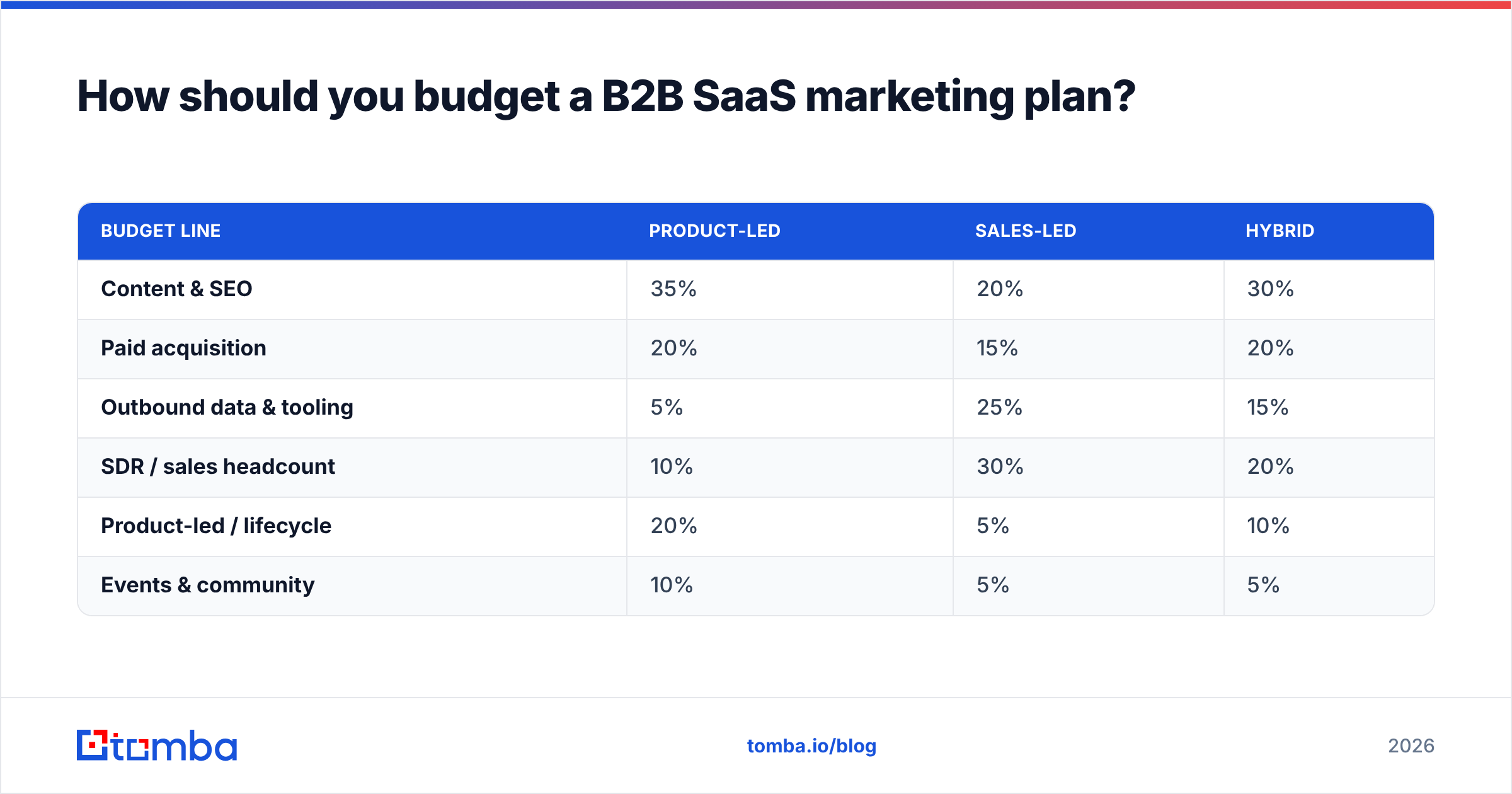
Tie the budget to your stage and motion, not to a generic "spend 10% of revenue" rule. Early-stage companies chasing growth often spend far more than 10% of ARR; efficiency-focused later-stage companies spend less. The useful question is per-channel payback, not total percentage.
A workable starting allocation by motion:
| Budget line | Product-led | Sales-led | Hybrid |
|---|---|---|---|
| Content & SEO | 35% | 20% | 30% |
| Paid acquisition | 20% | 15% | 20% |
| Outbound data & tooling | 5% | 25% | 15% |
| SDR / sales headcount | 10% | 30% | 20% |
| Product-led / lifecycle | 20% | 5% | 10% |
| Events & community | 10% | 5% | 5% |
Two notes. First, outbound data and tooling is cheap relative to headcount — getting verified contacts and data enrichment right makes your expensive SDRs and AEs far more productive, so it's a high-leverage line even at a small percentage. Second, leave 10–15% unallocated for experiments; the plan should fund what works and have room to find what's next.
For a sense of real tool costs as you build the budget, compare published vendor pages directly — for example, Tomba pricing starts free (25 searches/month), with Starter at $49/mo and Growth at $99/mo, while review sites like G2 let you sanity-check alternatives before you commit.
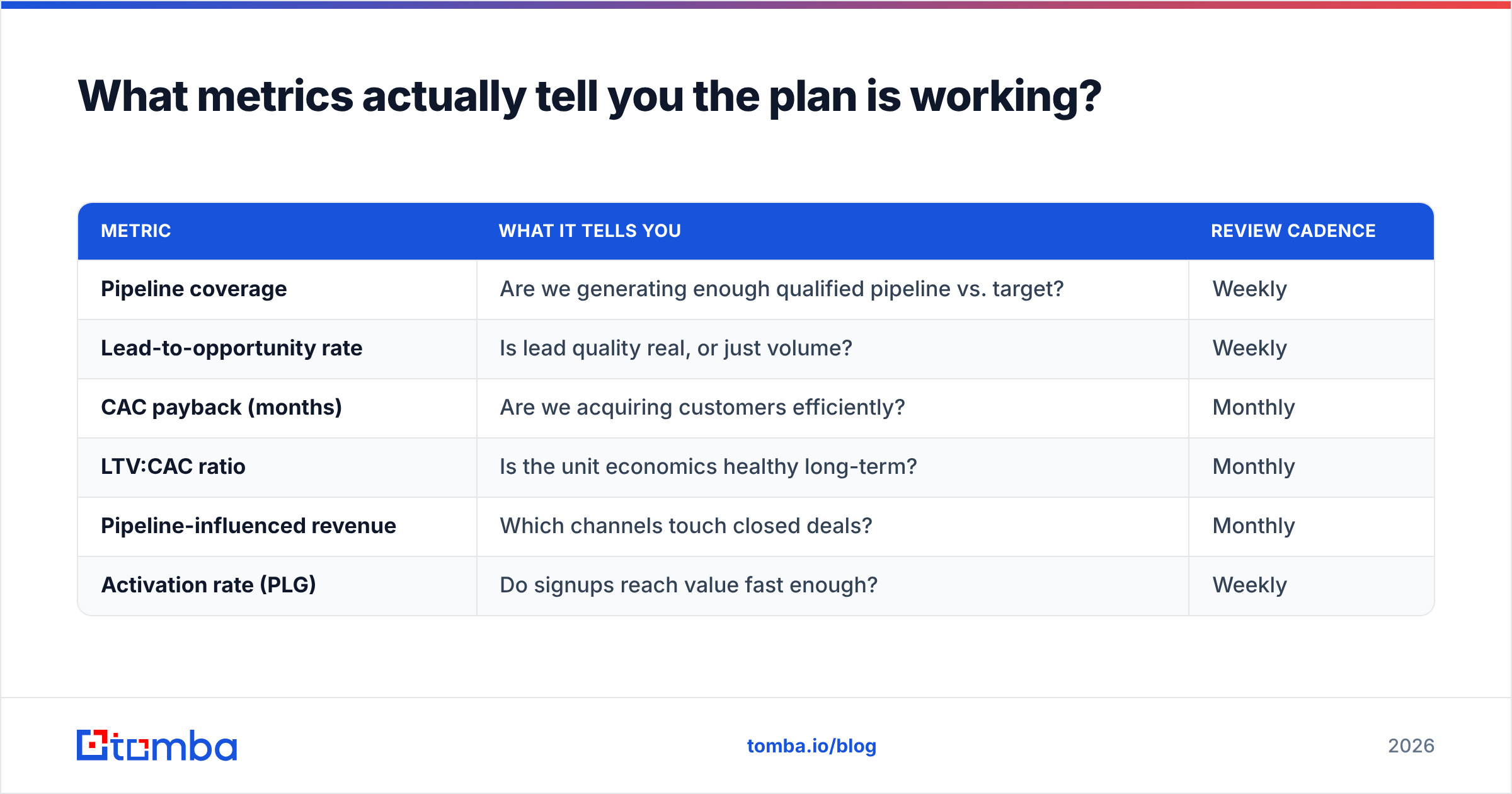
What metrics actually tell you the plan is working?#
Most dashboards drown in vanity metrics. Cut to the numbers that predict revenue and review them on a fixed cadence.
| Metric | What it tells you | Review cadence |
|---|---|---|
| Pipeline coverage | Are we generating enough qualified pipeline vs. target? | Weekly |
| Lead-to-opportunity rate | Is lead quality real, or just volume? | Weekly |
| CAC payback (months) | Are we acquiring customers efficiently? | Monthly |
| LTV:CAC ratio | Is the unit economics healthy long-term? | Monthly |
| Pipeline-influenced revenue | Which channels touch closed deals? | Monthly |
| Activation rate (PLG) | Do signups reach value fast enough? | Weekly |
The trap to avoid: optimizing MQL volume. A flood of low-intent MQLs makes a dashboard look healthy while sales drowns in junk. Watch lead-to-opportunity rate instead — if volume rises but that rate falls, you are buying noise. This is also where data quality shows up: feed sales verified, enriched contacts and the lead-to-opportunity rate climbs without spending another dollar on top-of-funnel.
How do you turn this into a 90-day rollout?#
A plan you can't execute in quarters is a wish. Sequence it.
- Days 1–30 — Foundation. Lock the revenue math, write the ICP, choose the primary motion, and stand up clean tracking. Build or refresh your contact data so outbound and lifecycle have a reliable base.
- Days 31–60 — Engine. Ship the two or three core channels for your motion. For sales-led, that's a sourced-and-verified outbound list plus sequences; for product-led, it's activation improvements plus content for organic discovery.
- Days 61–90 — Optimize. Read the metrics, kill the experiments that aren't paying back, and double down on the channel with the best lead-to-opportunity rate. Reforecast pipeline coverage against the target.
Wire your stack so data flows without manual exports — most teams connect their finder and enrichment tools straight into the CRM. Tomba's HubSpot integration and broader integrations push verified contacts into the systems your reps already live in, so the plan runs on current data instead of a stale spreadsheet.
What are the most common B2B SaaS marketing plan mistakes?#
- Starting with channels, not math. "Let's try TikTok" before you know your lead goal is how budgets evaporate.
- Running three motions at once. Pick a spine. Layer later.
- Treating data quality as an afterthought. Bounced emails and wrong contacts quietly tank every outbound and lifecycle metric.
- Confusing activity with progress. Ten blog posts and 500 LinkedIn impressions are not pipeline. Tie every activity to a funnel stage.
- No kill criteria. Every experiment needs a date and a threshold, or it lives forever on momentum.
Avoid these five and you're ahead of most teams, regardless of budget size.
Putting the plan into motion#
Your B2B SaaS marketing plan is only as strong as the data underneath it. Every motion in this guide — sales-led outbound, product-led lifecycle, account-based partnerships — depends on reaching the right person with a deliverable message. That's where most plans quietly break.
Start by fixing the input you control. Use the Tomba Email Finder to source accurate, professional email addresses by domain, name, or company, verify them before you send, and feed clean contacts straight into your CRM. With the free tier (25 searches/month) you can pressure-test your ICP this week; when the plan proves out, Starter at $49/mo and Growth at $99/mo scale with your pipeline. Build the math first, choose one motion, fund the channels that pay back — and give every one of them the verified data it needs to perform.
Ready to find emails that actually work?
Join 150,000+ professionals who stopped guessing and started sending. Free credits on signup — no credit card required.
Get the Tomba newsletter
Practical outbound tactics and product updates — once every two weeks.
About the author