B2B SaaS Marketing Strategy: The 2026 Growth Playbook
A no-fluff B2B SaaS marketing strategy for 2026: positioning, ICP targeting, demand gen, PLG motions, and the metrics that turn spend into predictable pipeline.
Most B2B SaaS marketing fails for the same boring reason: teams run tactics before they have a strategy. They launch a podcast, buy a list, spin up paid social, and a quarter later they have activity but no pipeline. A real B2B SaaS marketing strategy is the opposite — a small set of decisions about who you serve, why you win, and how demand becomes revenue, with every tactic downstream of those decisions.
This playbook walks through the full system for 2026: positioning, ICP, channel mix, the PLG-versus-sales-led question, and the metrics that tell you whether any of it is working.
TL;DR#
- Strategy precedes tactics. Pick a sharp position and a narrow ICP before you touch a single channel. Broad targeting is the most expensive mistake in SaaS.
- Demand creation and demand capture are different jobs. Most teams over-invest in capture (SEO, paid search) and starve creation (POV content, communities, events).
- Pick a primary motion — product-led, sales-led, or a hybrid — and build the funnel around it instead of copying a competitor with a different cost structure.
- Clean contact data is infrastructure, not a nice-to-have. Targeting and enrichment quality cap how good your campaigns can ever get.
- Measure pipeline and payback, not vanity metrics. CAC, LTV:CAC, payback period, and pipeline coverage decide whether the strategy compounds.
What is a B2B SaaS marketing strategy?#
A B2B SaaS marketing strategy is your written answer to four questions: who you're for, what makes you the obvious choice, how those buyers will discover and trust you, and how you'll measure the return. Everything else — campaigns, content, ads — is execution.
Think of it like a restaurant. The menu, location, and price point (strategy) determine who walks in. The daily specials and table settings (tactics) only matter once those bigger calls are right. Most struggling SaaS teams are perfecting table settings in a restaurant nobody can find.
The difference between B2B SaaS and other marketing is the buying motion: long cycles, multiple stakeholders, high lifetime value, and a product that can often sell itself through a free trial. That changes the math. You're not optimizing for a single transaction — you're optimizing for a buying committee's confidence over weeks or months, then for expansion revenue after the sale.
Why does positioning come before tactics?#
Positioning is the decision that makes every other decision cheaper. When you're clearly the best tool for a specific buyer with a specific problem, your content writes itself, your ads convert, and your sales calls get shorter. When you're "a platform for everyone," you compete on price and burn cash.
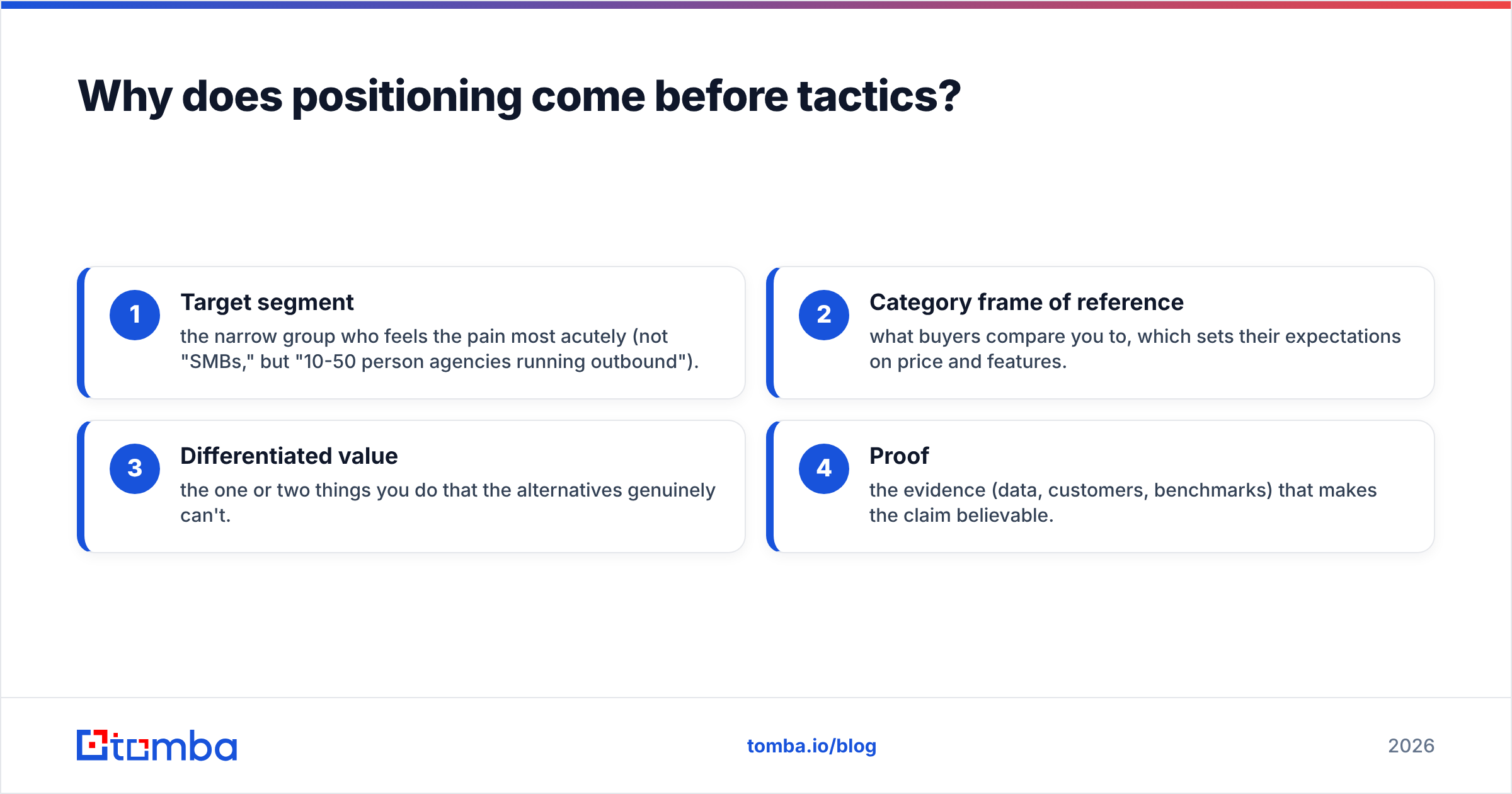
A useful positioning statement covers four parts:
- Target segment — the narrow group who feels the pain most acutely (not "SMBs," but "10-50 person agencies running outbound").
- Category frame of reference — what buyers compare you to, which sets their expectations on price and features.
- Differentiated value — the one or two things you do that the alternatives genuinely can't.
- Proof — the evidence (data, customers, benchmarks) that makes the claim believable.
Get those four right and you can change channels every quarter without losing the plot. Get them wrong and no channel will save you. April Dunford's work and most analyst frameworks from Gartner hammer the same point: weak positioning is the root cause of weak pipeline.

How do you define and reach the right ICP?#
Your Ideal Customer Profile (ICP) is the firmographic and behavioral fingerprint of accounts that buy fast, stay long, and expand. Defining it is the highest-leverage hour your team will spend this quarter, because it determines whether your spend lands on people who can actually say yes.
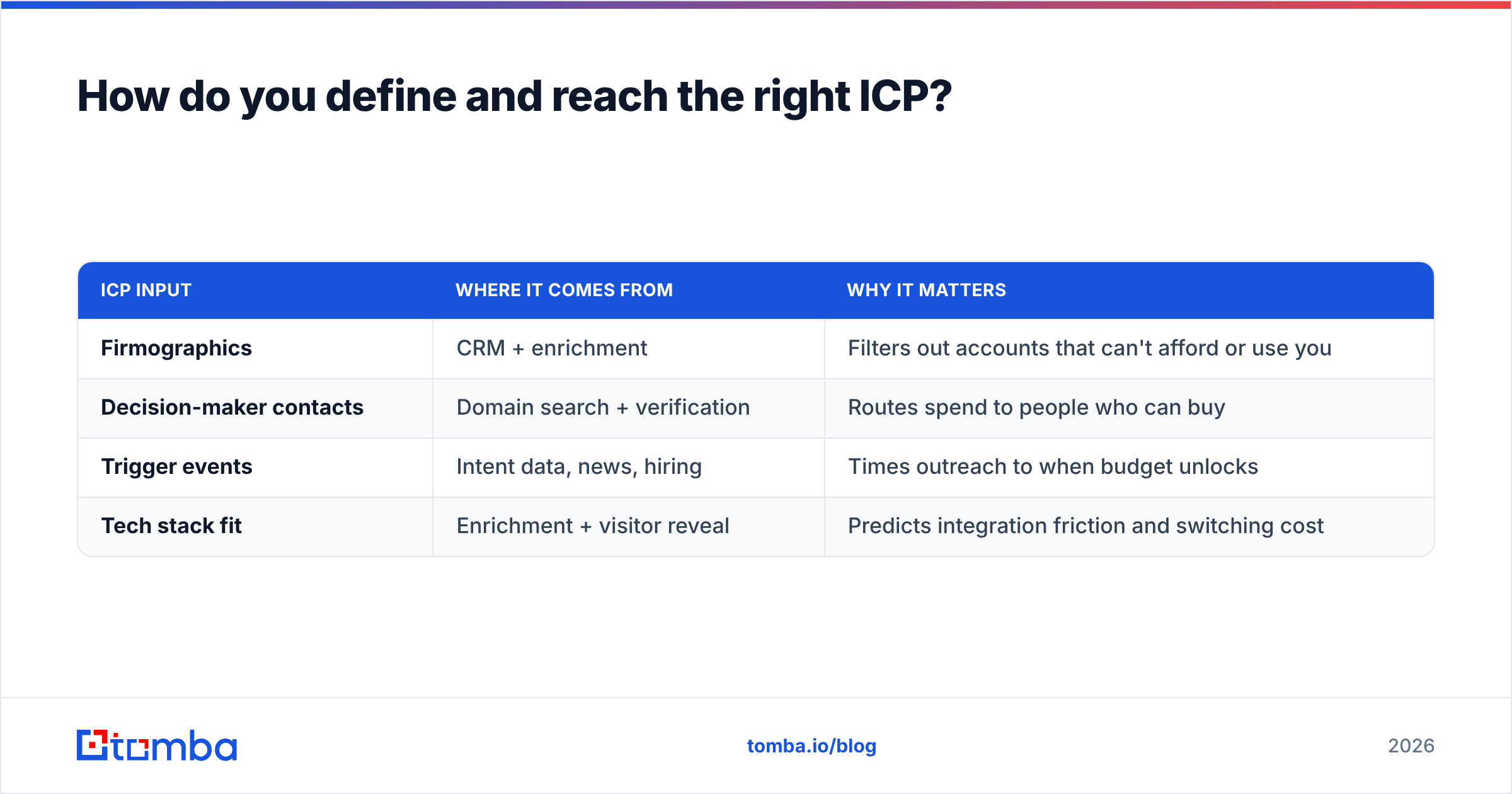
Build the ICP from your own data first: look at your best 20 customers and find what they share — company size, industry, tech stack, trigger events, and the title of the person who championed the deal. Then operationalize it. An ICP that lives in a slide deck does nothing; an ICP wired into your targeting, enrichment, and routing compounds.
This is where data infrastructure quietly decides outcomes. You can have a perfect ICP and still waste the budget if your contact data is stale, missing decision-makers, or full of bounces. Use a domain search to map every relevant contact at a target account, then layer data enrichment so your CRM holds role, seniority, and verified email — not guesses. Marketing that targets verified humans at in-ICP accounts simply costs less per opportunity.
| ICP input | Where it comes from | Why it matters |
|---|---|---|
| Firmographics | CRM + enrichment | Filters out accounts that can't afford or use you |
| Decision-maker contacts | Domain search + verification | Routes spend to people who can buy |
| Trigger events | Intent data, news, hiring | Times outreach to when budget unlocks |
| Tech stack fit | Enrichment + visitor reveal | Predicts integration friction and switching cost |
Demand creation vs. demand capture: which matters more?#
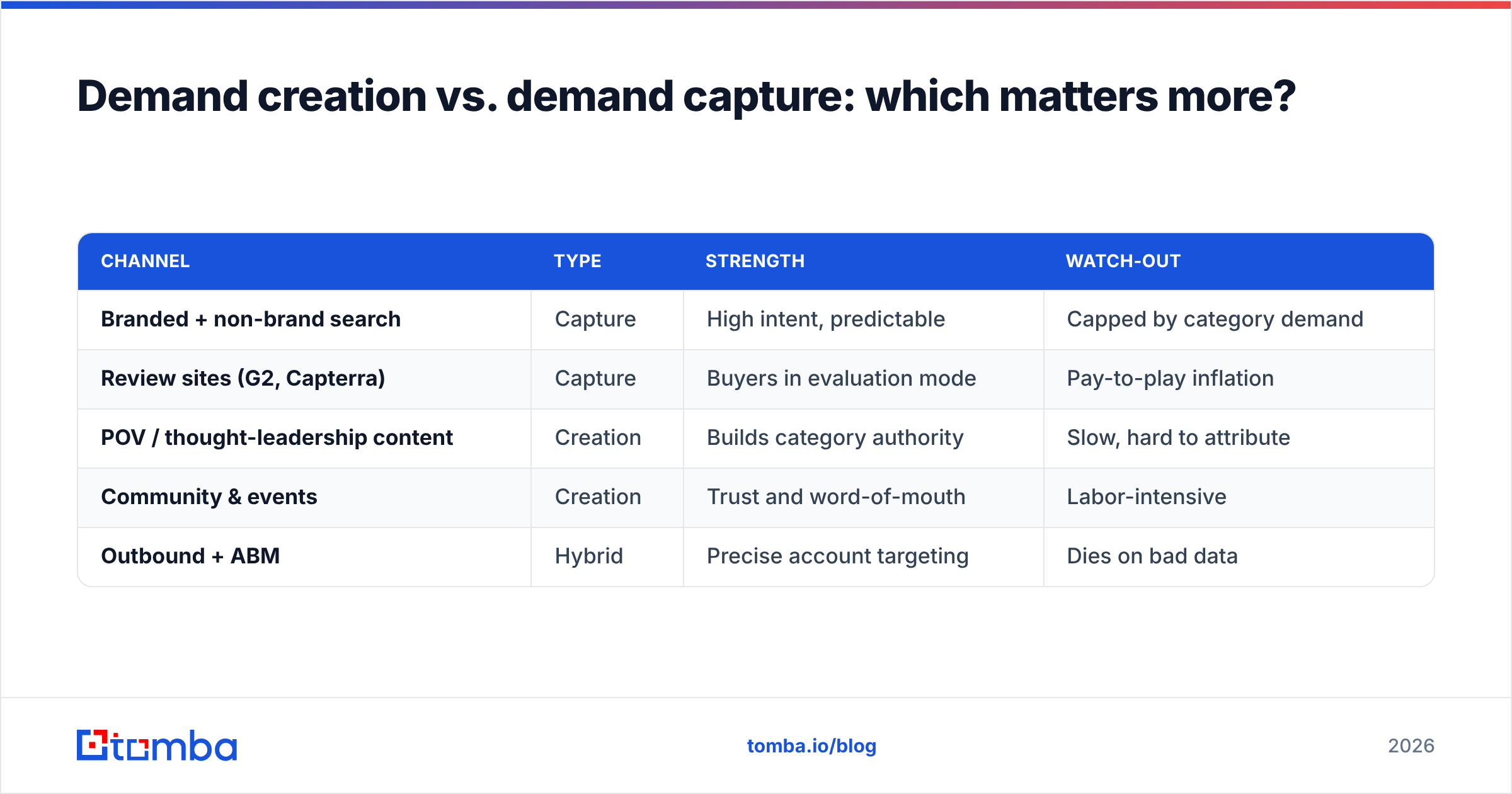
You need both, but they do different jobs and most teams get the ratio wrong. Demand capture harvests existing intent — branded search, review sites, retargeting. Demand creation builds intent that didn't exist — point-of-view content, communities, podcasts, events, founder-led posts. Capture is cheaper per conversion but capped by how many people already want what you sell. Creation is how you grow the total pool.
The trap is that capture is easy to measure and creation is not, so quarterly pressure pushes budget toward capture until growth plateaus. The fix is to fund creation as a fixed percentage of spend and judge it on leading indicators — branded search volume, direct traffic, community size — rather than last-click attribution.
| Channel | Type | Strength | Watch-out |
|---|---|---|---|
| Branded + non-brand search | Capture | High intent, predictable | Capped by category demand |
| Review sites (G2, Capterra) | Capture | Buyers in evaluation mode | Pay-to-play inflation |
| POV / thought-leadership content | Creation | Builds category authority | Slow, hard to attribute |
| Community & events | Creation | Trust and word-of-mouth | Labor-intensive |
| Outbound + ABM | Hybrid | Precise account targeting | Dies on bad data |
A quick reality check on review platforms: buyers genuinely use them, and a presence on G2 or similar is table stakes in most categories. But treat them as capture, not a growth engine — they convert demand you created elsewhere.
Product-led, sales-led, or hybrid growth?#
Pick your primary motion deliberately, because the funnel, pricing, and team you build all flow from it. Copying a competitor's motion without their cost structure is how SaaS companies quietly go broke.
Product-led growth (PLG) lets the product drive acquisition and expansion through free trials or freemium. It works when time-to-value is short, the product is easy to adopt solo, and the price point is low enough to land without a sales call. Sales-led growth (SLG) uses humans to guide higher-ACV, multi-stakeholder deals. Hybrid — increasingly the default in 2026 — uses PLG to generate qualified signups and a sales team to convert and expand the accounts worth the human touch.
The signal to watch is your average contract value and buying-committee size. Sub-$5K, single-user adoption leans PLG. $25K+, five-stakeholder deals need sales. In between, hybrid usually wins. HubSpot's research on SaaS go-to-market and most RevOps practitioners converge on the same conclusion: motion should match deal economics, not founder preference.

What does a 2026 channel mix actually look like?#
Channels are downstream of motion and ICP, so there's no universal answer — but there is a sane default for an early-stage B2B SaaS company. Concentrate, don't sprinkle. Two or three channels done well beat eight done badly.
- Content + SEO for capture and authority. Target bottom-funnel, high-intent keywords first (comparisons, alternatives, "best X for Y"), then expand to category education. This is your compounding asset.
- Founder-led and employee social for creation. In 2026, distribution on LinkedIn and niche communities outperforms cold ads for most early-stage SaaS because trust transfers from a person faster than from a logo.
- Outbound and ABM for precision. Build target-account lists from your ICP, find verified decision-maker contacts with an email finder, and run coordinated touches across email, social, and ads. Outbound's entire ROI lives or dies on data quality — a brilliant sequence to a wrong or dead address converts at zero.
- Paid as an accelerant, not a foundation. Use paid search to capture branded and high-intent terms, and paid social to retarget and amplify your best organic content. Don't use paid to compensate for weak positioning; you'll just pay to reach the wrong people faster.
The connective tissue across all of these is clean, current contact data feeding your CRM and automation. That's why revenue operations has become the function that quietly determines marketing ROI — it owns the data layer everything else runs on.
How do you build the funnel and lifecycle?#
Map your funnel to how buyers actually move, then assign one job per stage. A common B2B SaaS lifecycle:
- Awareness — they learn the problem and your point of view exist. Measure reach and branded search lift.
- Consideration — they evaluate options. Measure content engagement, demo/trial signups, and review-site activity.
- Evaluation — a buying committee forms. Measure opportunity creation and stakeholder coverage.
- Purchase — they buy. Measure win rate and sales-cycle length.
- Onboarding & activation — they reach first value. Measure time-to-value and activation rate.
- Expansion & advocacy — they grow and refer. Measure net revenue retention and referrals.
The expansion stages are where SaaS economics are won. A strategy that obsesses over acquisition and ignores activation and retention is filling a leaky bucket. Net revenue retention above 110% means you grow even if you stop adding new logos — that's the real prize.
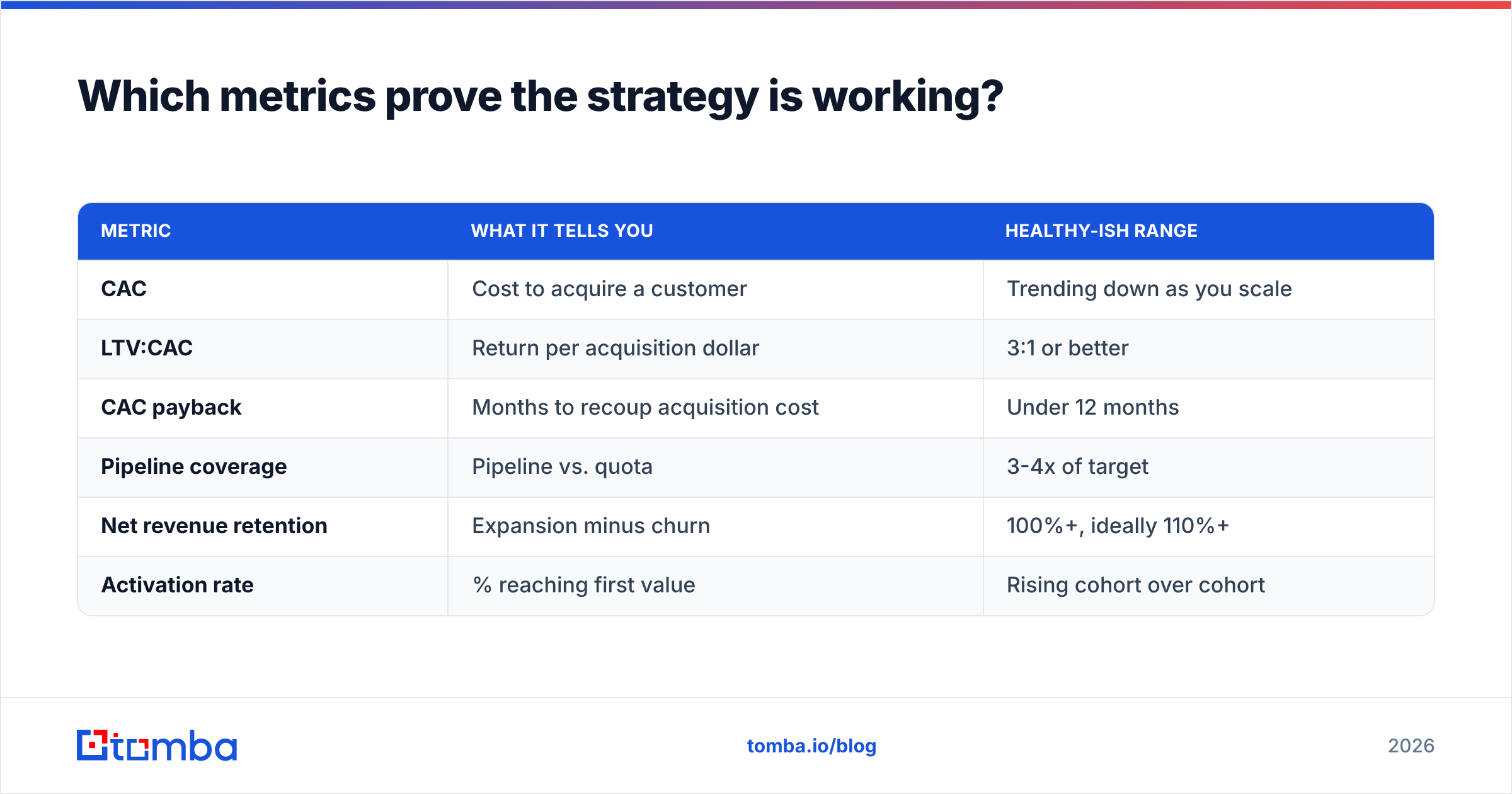
Which metrics prove the strategy is working?#
Track the numbers that connect spend to durable revenue, and ignore the ones that only make dashboards look busy.
| Metric | What it tells you | Healthy-ish range |
|---|---|---|
| CAC | Cost to acquire a customer | Trending down as you scale |
| LTV:CAC | Return per acquisition dollar | 3:1 or better |
| CAC payback | Months to recoup acquisition cost | Under 12 months |
| Pipeline coverage | Pipeline vs. quota | 3-4x of target |
| Net revenue retention | Expansion minus churn | 100%+, ideally 110%+ |
| Activation rate | % reaching first value | Rising cohort over cohort |
Vanity metrics — impressions, raw traffic, follower counts, MQL volume divorced from conversion — feel good and predict nothing. The discipline is to report on pipeline created and payback every month, and to let leading indicators (branded search, activation) explain the lag before pipeline catches up.
One practical note on data hygiene: bloated, unverified marketing lists wreck two of these metrics at once. Bounces hurt sender reputation (raising CAC on email), and bad contacts inflate MQL counts while deflating conversion. Periodically verifying your database — and checking your full Tomba pricing tier against list volume — keeps the denominator honest.
What are the most common B2B SaaS marketing mistakes?#
- Targeting everyone. Broad ICP is the master mistake that makes every channel underperform.
- Tactics without strategy. Launching channels because competitors have them, not because they serve your motion.
- Over-indexing on capture. Running out of existing demand and having built nothing to create more.
- Ignoring data quality. Spending on campaigns that hit dead contacts and wrong titles.
- Measuring activity, not pipeline. Optimizing MQL volume while opportunities stall.
- Neglecting retention. Treating the sale as the finish line when expansion is where SaaS margins live.
Fix these in order. Positioning and ICP first, then motion, then channels, then measurement. Skipping ahead is why most SaaS marketing plans read impressive and perform poorly.
Put the strategy to work#
A B2B SaaS marketing strategy compounds only when the foundation is solid: a sharp position, a narrow ICP, a motion that fits your deal economics, and clean data feeding every campaign. Tactics are easy to copy; that system is not — and it's what separates teams that grow predictably from teams that just stay busy.
Start where the leverage is highest. Lock your ICP, then make sure every target account is mapped to verified, decision-maker contacts so your demand-gen and outbound spend lands on people who can actually buy. The Tomba Email Finder finds professional email addresses by domain, name, or company — pair it with verification and enrichment so your CRM holds real, current data instead of guesses. Better targeting at the data layer makes every channel above it cheaper. Build the strategy first, then let accurate data make it pay.
// get started
Find, verify and enrich your first contacts today
Start on the free plan with 25 searches a month, then scale when your team is ready.
Free plan · No credit card required · GDPR & CCPA
// about the author