What Is B2B SaaS? Meaning, Model, and Examples (2026)
B2B SaaS means cloud software sold by one business to another on a subscription. Here's the model, the metrics that matter, and how it differs from B2C in 2026.
TL;DR
- B2B SaaS means business-to-business software-as-a-service: cloud-hosted software that one company sells to another company on a recurring subscription instead of a one-time license.
- The model runs on recurring revenue (MRR/ARR), high gross margins, and retention — not one-off sales. Churn quietly kills more B2B SaaS companies than slow acquisition does.
- B2B SaaS differs from B2C SaaS in buyer count, deal size, sales cycle length, and the need for a human-assisted go-to-market motion.
- The metrics that actually matter: CAC, LTV, NRR, payback period, and logo vs. revenue churn.
- Clean contact data is the fuel for every B2B SaaS growth motion — outbound, product-led, or hybrid.
What is the B2B SaaS meaning, in plain terms?#
B2B SaaS means software-as-a-service sold from one business to another. Think of it like renting an apartment instead of buying a house. You don't own the building, you don't fix the plumbing, and you don't pay a huge sum up front — you pay every month, you get to live there, and the landlord handles maintenance and upgrades. B2B SaaS works the same way: the vendor hosts and maintains the software in the cloud, and the customer (another business) pays a subscription to use it.
Break the acronym apart and it's clearer:
- B2B (business-to-business) — the customer is a company, not an individual consumer. A payroll platform sold to HR departments is B2B. A meditation app sold to individuals is B2C.
- SaaS (software-as-a-service) — the software is delivered over the internet and centrally hosted, rather than installed from a disc or licensed perpetually.
Put together, the B2B SaaS meaning is: cloud-based business software, sold on a subscription, where the buyer and the user are organizations rather than consumers. Salesforce, HubSpot, Slack, Zoom, Datadog, and Stripe are all B2B SaaS. So is Tomba — a data enrichment and email-finding platform that companies subscribe to for lead data.
How does the B2B SaaS business model actually work?#
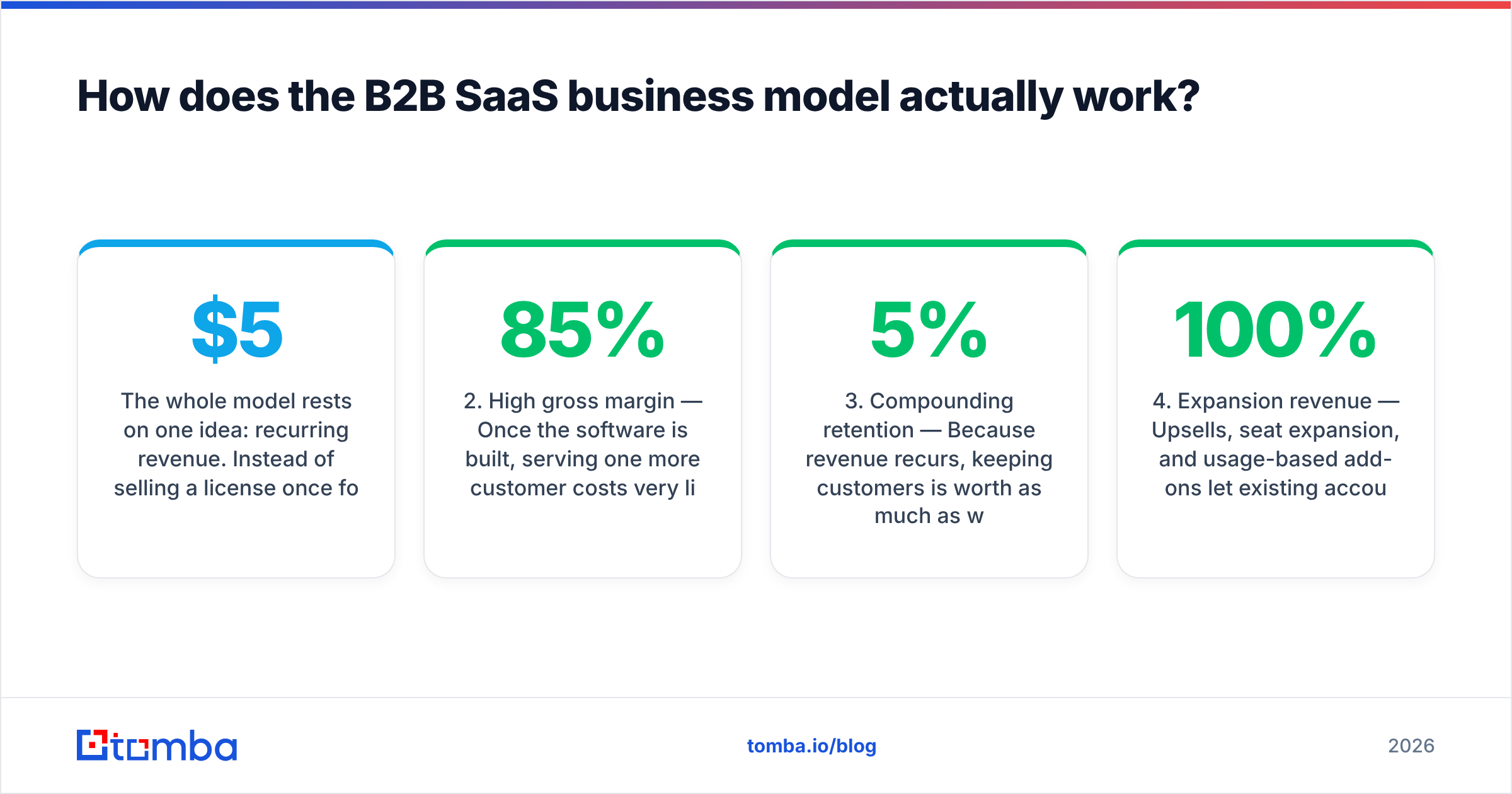
The whole model rests on one idea: recurring revenue. Instead of selling a license once for $5,000, a B2B SaaS company sells access for $200/month and keeps that customer for years. The lifetime value dwarfs the one-time sale — but only if the customer stays.
Here are the structural pillars that make it work:
- Subscription pricing — Monthly or annual contracts, often tiered (Starter / Growth / Pro / Enterprise). Annual prepay improves cash flow and reduces churn.
- High gross margin — Once the software is built, serving one more customer costs very little. Healthy B2B SaaS gross margins sit around 70–85%.
- Compounding retention — Because revenue recurs, keeping customers is worth as much as winning them. A 5% monthly churn rate means you lose nearly half your customers in a year.
- Expansion revenue — Upsells, seat expansion, and usage-based add-ons let existing accounts grow without new acquisition cost. This is the engine behind net revenue retention (NRR) above 100%.
- Scalable distribution — Self-serve signups, free trials, and product-led growth let the product sell itself at the low end, while sales reps close larger deals.
According to Gartner, SaaS remains the largest and fastest-growing segment of public cloud spending — and the B2B slice is where the durable, high-margin businesses live.
B2B SaaS vs. B2C SaaS: what's the difference?#
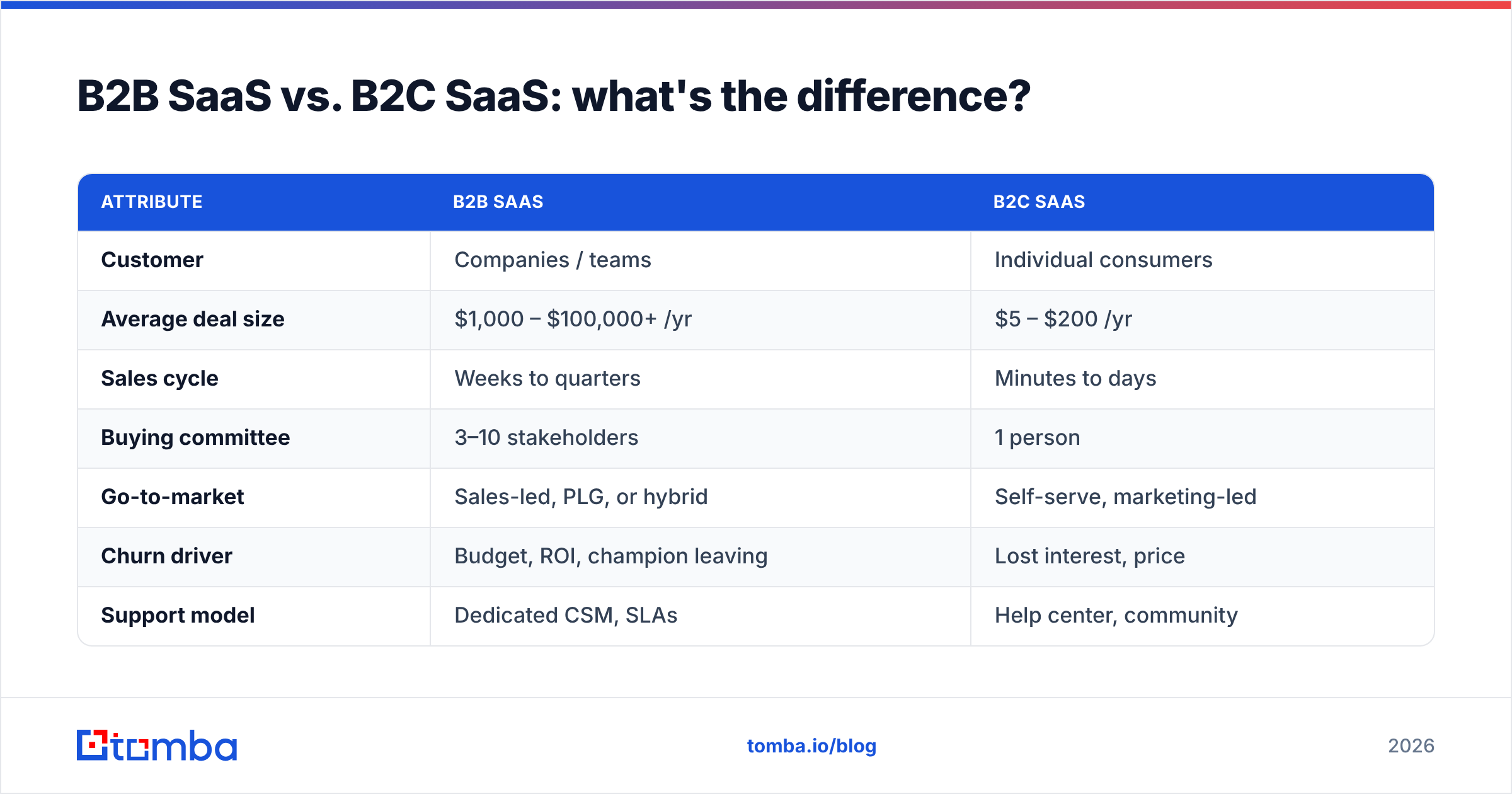
The biggest practical difference is who buys and how. A consumer makes a $9.99 decision in thirty seconds. A business makes a $40,000 decision over three months, with five stakeholders, a procurement review, and a security questionnaire.
| Attribute | B2B SaaS | B2C SaaS |
|---|---|---|
| Customer | Companies / teams | Individual consumers |
| Average deal size | $1,000 – $100,000+ /yr | $5 – $200 /yr |
| Sales cycle | Weeks to quarters | Minutes to days |
| Buying committee | 3–10 stakeholders | 1 person |
| Go-to-market | Sales-led, PLG, or hybrid | Self-serve, marketing-led |
| Churn driver | Budget, ROI, champion leaving | Lost interest, price |
| Support model | Dedicated CSM, SLAs | Help center, community |
| Example | Salesforce, Tomba, Datadog | Spotify, Duolingo, Netflix |
The takeaway: B2B SaaS sells fewer, bigger, slower deals to committees — which is why accurate contact data and a real sales process matter so much more than in B2C, where a clever ad and a one-click signup carry the day.
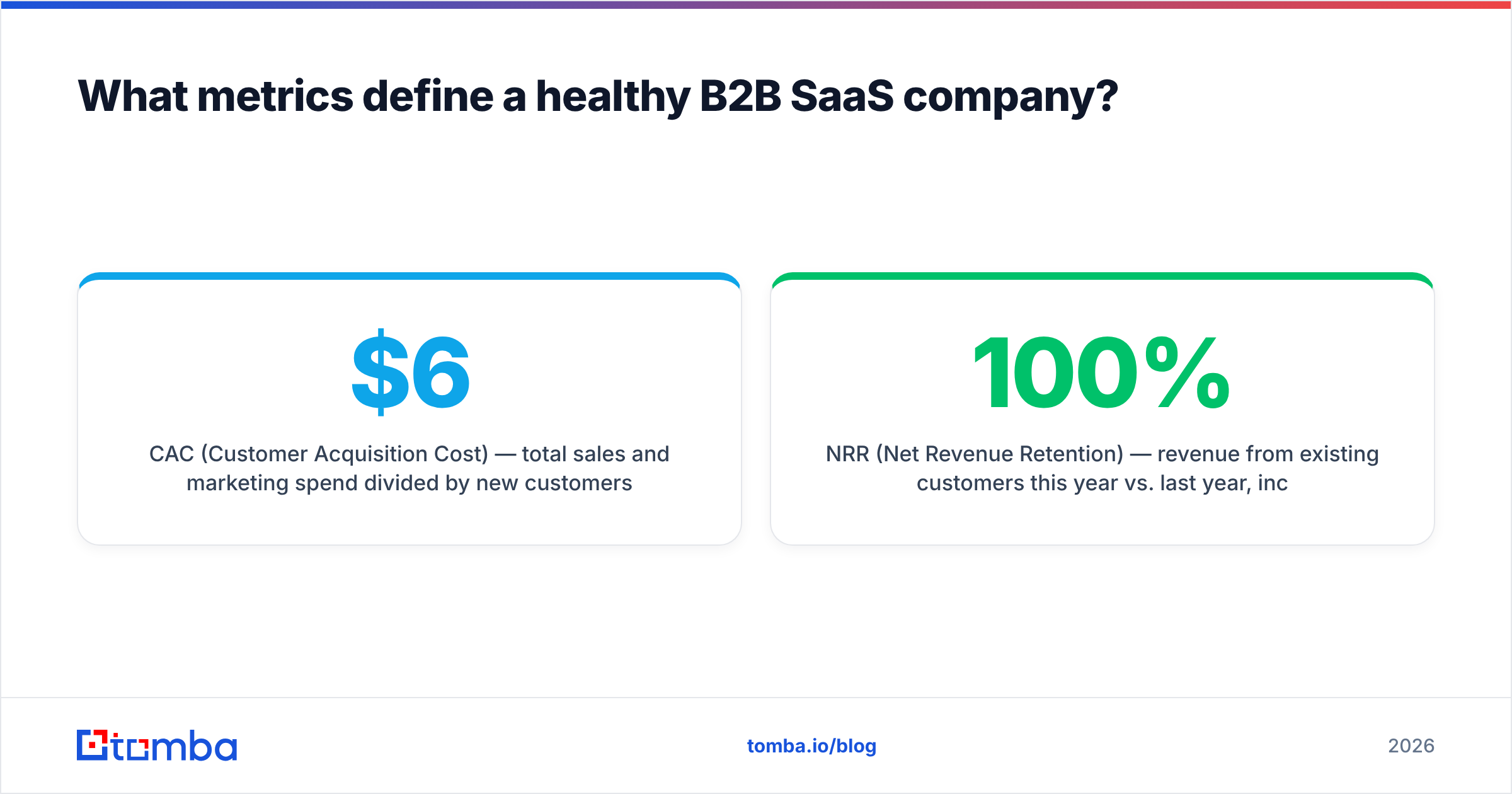
What metrics define a healthy B2B SaaS company?#
If you only learn five acronyms, learn these. They tell you whether a B2B SaaS business is actually working underneath the topline revenue.
- MRR / ARR (Monthly / Annual Recurring Revenue) — the predictable subscription revenue. The north-star topline for any subscription business.
- CAC (Customer Acquisition Cost) — total sales and marketing spend divided by new customers won. If it costs $6,000 to land a $200/month customer, you need to keep them ~30 months just to break even on acquisition.
- LTV (Lifetime Value) — the total gross profit you expect from a customer over their lifetime. A common health benchmark is LTV:CAC of 3:1 or better.
- NRR (Net Revenue Retention) — revenue from existing customers this year vs. last year, including expansion and churn. Above 100% means your base grows even with zero new logos. Best-in-class B2B SaaS hits 120%+.
- Churn (logo vs. revenue) — logo churn counts lost accounts; revenue churn counts lost dollars. You can lose many small logos and still grow revenue, or lose one whale and crater.
- Payback period — how many months of subscription revenue it takes to recover CAC. Under 12 months is strong; over 18 is a warning sign.
The uncomfortable truth: most early B2B SaaS founders obsess over acquisition when retention and expansion are where the durable value compounds. You can't out-acquire a leaky bucket.
What are real examples of B2B SaaS categories?#
"B2B SaaS" is an umbrella covering dozens of categories. Here's how the landscape breaks down, with examples you'll recognize:
- CRM and sales — Salesforce, HubSpot, Pipedrive. The system of record for customer relationships. (See the CRM definition for the fundamentals.)
- Sales intelligence and data — Tomba, ZoomInfo, Clearbit. Tools that supply the contact and company data that fuels outbound. Tomba's email finder sits here.
- Marketing automation — Marketo, Mailchimp, Customer.io. Nurture and campaign engines.
- Collaboration and productivity — Slack, Notion, Atlassian. How teams communicate and ship.
- Developer and infrastructure — Datadog, Twilio, Stripe. The plumbing modern software runs on.
- Vertical SaaS — Toast (restaurants), Veeva (life sciences), Procore (construction). Software built for one industry's specific workflow.
Notice that several of these categories feed each other. A sales team uses a CRM, fills it with data from a sales-intelligence tool, runs campaigns through marketing automation, and coordinates in a collaboration tool. That interdependence is why revenue operations emerged as a discipline — someone has to keep the whole stack aligned and the data clean.
How do B2B SaaS companies go to market?#
There are three dominant motions, and most modern companies blend them.
Sales-led (SLG). Reps prospect, demo, negotiate, and close. This fits high-ACV products with long cycles and buying committees — think six-figure platforms. It's expensive but necessary when the deal is too complex to self-serve.
Product-led (PLG). The product sells itself through a free tier or trial. Users adopt it bottom-up, then convert to paid and expand. Slack, Zoom, and Calendly grew this way. PLG lowers CAC but needs a product simple enough to deliver value in minutes.
Hybrid. Most successful B2B SaaS companies in 2026 run both: self-serve for SMBs and a sales team for enterprise. A user signs up free, hits a limit, and a rep reaches out to expand the account.
Every one of these motions runs on accurate contact data. PLG needs enrichment to turn anonymous signups into qualified accounts. SLG needs verified emails and direct dials to reach buyers at all. As HubSpot's research on sales productivity consistently shows, reps waste a huge share of their week on bad data and manual list-building — time that should go to selling.
This is the unglamorous foundation under every shiny growth chart: if your data is wrong, your outreach bounces, your sender reputation tanks, and your CAC balloons. Garbage in, garbage out — at scale.
How does data quality make or break B2B SaaS growth?#
Conclusion first: bad data is the silent CAC inflator in B2B SaaS. You can have a brilliant product and a sharp message, but if 30% of your prospect emails bounce, you've torched your domain reputation and paid for leads you can't reach.
Here's the chain reaction:
- A rep builds a list from scraped or stale sources.
- A third of the emails are invalid or catch-all.
- Bounces spike, and mailbox providers flag the sending domain.
- Even valid emails now land in spam.
- Reply rates collapse, pipeline dries up, and CAC quietly doubles.
The fix is boring and effective: find verified contacts and verify them before you send. That means pulling emails by domain or name from a real data source, then running them through an email verifier to strip invalids and risky catch-alls. Companies that treat data hygiene as infrastructure — not an afterthought — see materially better deliverability and lower acquisition cost.
For a B2B SaaS team, the build-vs-buy math is simple. Maintaining your own scrapers, proxies, and verification logic is a full engineering project. Subscribing to a data provider is a line item. Compare what you'd spend in-house against transparent Tomba pricing and the buy decision usually makes itself.
What does B2B SaaS pricing typically look like?#
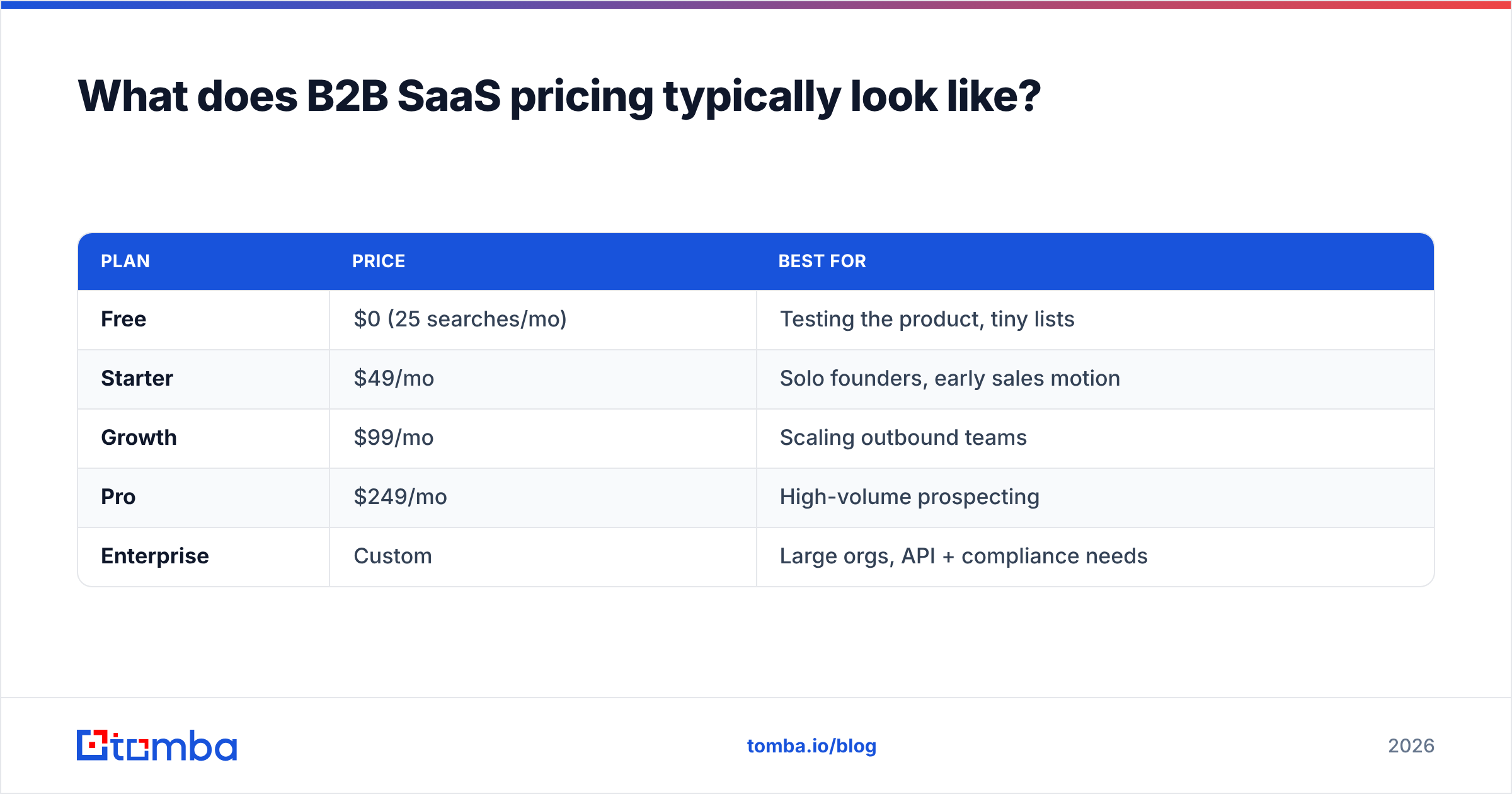
Tiered subscriptions are the norm. Each tier unlocks more usage, more seats, or more advanced features. Here's how a representative data tool like Tomba structures it, so you can see the pattern:
| Plan | Price | Best for |
|---|---|---|
| Free | $0 (25 searches/mo) | Testing the product, tiny lists |
| Starter | $49/mo | Solo founders, early sales motion |
| Growth | $99/mo | Scaling outbound teams |
| Pro | $249/mo | High-volume prospecting |
| Enterprise | Custom | Large orgs, API + compliance needs |
This shape — a free tier to drive adoption, mid-tiers that grow with the customer, and a custom enterprise plan — is the textbook B2B SaaS pricing ladder. The free tier feeds PLG, the paid tiers capture expansion revenue, and Enterprise lets sales-led deals capture the whales. It's the model and the metrics from the earlier sections, made concrete.
Is B2B SaaS still a good business to build in 2026?#
Short answer: yes, but the bar is higher. The easy land-grab era is over. AI has compressed the cost of building software, which means more competitors and faster feature parity. Differentiation now comes from three places:
- Proprietary data or workflow that's hard to replicate.
- Distribution — owning a channel or community competitors can't buy.
- Retention — a product so embedded that switching is painful.
The fundamentals haven't changed, though. A B2B SaaS company still wins by acquiring the right customers efficiently, keeping them, and expanding them. And every part of that loop depends on knowing who your buyers are and how to reach them — which loops right back to data.
The bottom line on B2B SaaS#
The B2B SaaS meaning comes down to this: cloud software sold business-to-business on a subscription, where durable value is built through recurring revenue, retention, and expansion — not one-time sales. The model rewards companies that keep CAC low, NRR high, and data clean.
If you're building or scaling a B2B SaaS go-to-market, start where the leverage is highest: accurate, verified contact data. Use the Tomba Email Finder to pull professional emails by domain, name, or company, then verify them before you send — so your outreach reaches real buyers, your sender reputation stays healthy, and your acquisition cost stays sane. Spin up the free tier (25 searches a month, no card) and see how much cleaner your pipeline gets when the data underneath it is right.
Ready to find emails that actually work?
Join 150,000+ professionals who stopped guessing and started sending. Free credits on signup — no credit card required.
Get the Tomba newsletter
Practical outbound tactics and product updates — once every two weeks.
About the author