B2B SaaS Sales in 2026: A Practical Playbook for Growth
B2B SaaS sales cycles are longer and buying committees are bigger than ever. Here is the 2026 playbook for building pipeline, qualifying faster, and closing more.
TL;DR
- B2B SaaS sales in 2026 means longer cycles, larger buying committees (now 6–10 people), and buyers who self-educate before they ever talk to a rep.
- The motion that wins blends product-led signals with human selling: let usage data tell you who is ready, then send a rep with relevant context.
- Pipeline math still rules. Win rate, sales cycle length, and average contract value decide your number — not activity for its own sake.
- Clean contact data is the cheapest lever you have. Bounced emails and wrong-number dials quietly tax every other part of the funnel.
- Your stack should do three jobs: find the right people, qualify them fast, and remove manual busywork so reps sell.
What is B2B SaaS sales, and why is it different?#
B2B SaaS sales is the process of selling subscription software to other businesses, where revenue arrives monthly or annually instead of in a single transaction. That recurring model changes everything about how you sell.
Think of it like the difference between selling a car and signing a gym membership. Sell a car once and you move on. With a subscription, the sale is just the start of the relationship — the customer can leave at the next renewal if they stop seeing value. So B2B SaaS sales is judged not only on closing, but on whether the account sticks and expands.
Three structural traits set it apart:
- Recurring revenue, recurring scrutiny. Buyers know they are committing to an ongoing cost, so they scrutinize ROI harder than a one-time purchase.
- Committee buying. According to Gartner research, a typical B2B purchase involves six to ten decision-makers, each armed with their own information. One champion is rarely enough.
- Self-serve education. Prospects read reviews on G2, compare pricing pages, and trial products before a rep is ever involved. By the time they raise a hand, they are often 60–70% through their decision.
The job of a modern SaaS seller is not to deliver a brochure. It is to orchestrate consensus across a committee that already knows a lot — and to do it before a competitor does.
How is the B2B SaaS sales cycle structured?#
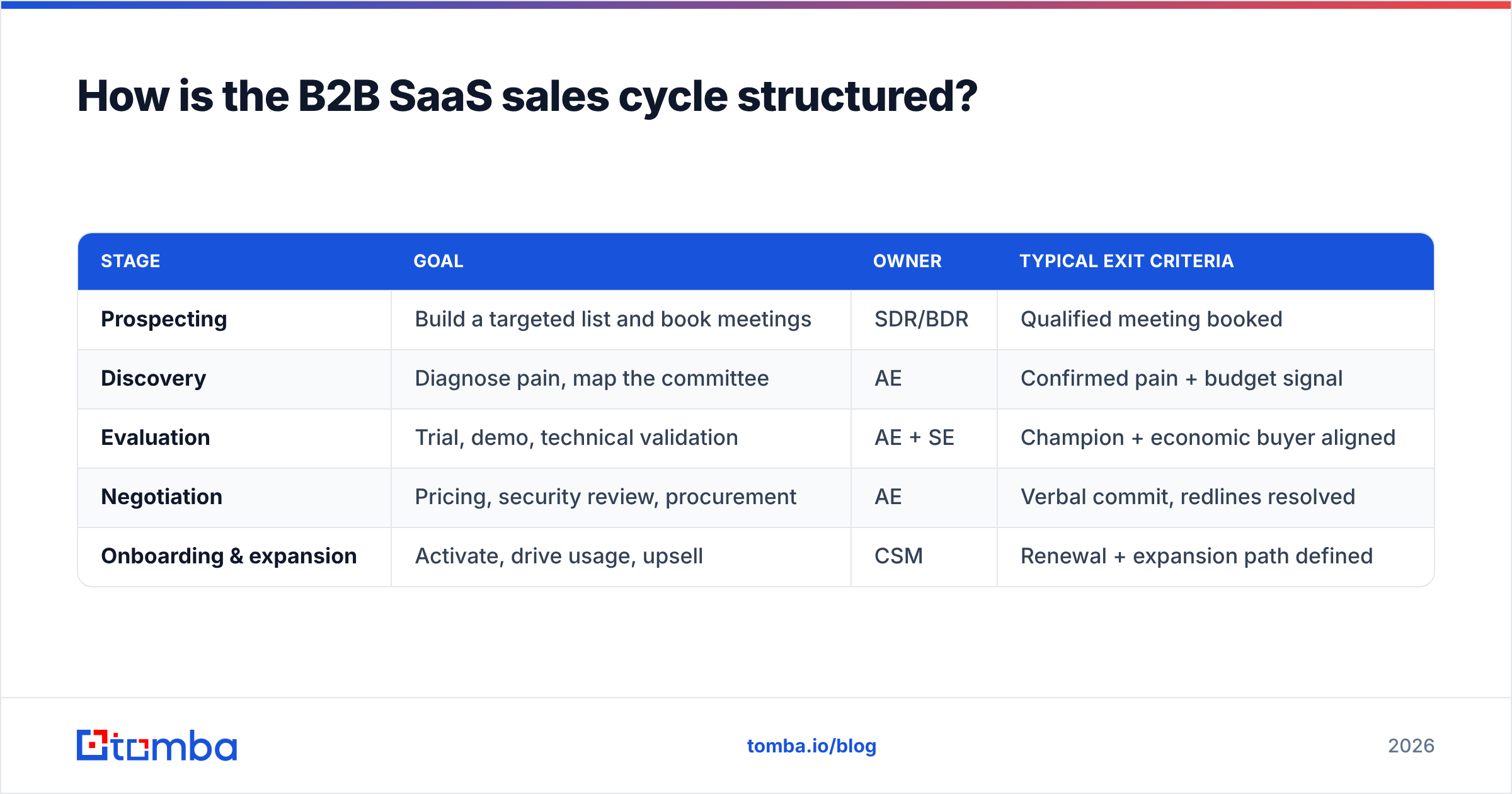
Most SaaS teams run some version of a five-stage pipeline. The labels vary, but the underlying motion is consistent: surface demand, qualify it, prove value, negotiate, and expand.
| Stage | Goal | Owner | Typical exit criteria |
|---|---|---|---|
| Prospecting | Build a targeted list and book meetings | SDR/BDR | Qualified meeting booked |
| Discovery | Diagnose pain, map the committee | AE | Confirmed pain + budget signal |
| Evaluation | Trial, demo, technical validation | AE + SE | Champion + economic buyer aligned |
| Negotiation | Pricing, security review, procurement | AE | Verbal commit, redlines resolved |
| Onboarding & expansion | Activate, drive usage, upsell | CSM | Renewal + expansion path defined |
The mistake teams make is treating these stages as a conveyor belt where volume at the top guarantees revenue at the bottom. It does not. A deal that enters discovery with a single contact and no budget signal is not really qualified — it is a hope. Tight exit criteria at each stage are what keep your forecast honest.
)
Notice where the highest-leverage work sits: the first two stages. If prospecting feeds the pipeline with the wrong accounts, every downstream stage inherits the problem. That is why data quality and targeting deserve more attention than they usually get.
What metrics actually drive B2B SaaS sales?#
Conclusion first: three numbers decide your revenue — win rate, sales cycle length, and average contract value (ACV). Everything else is a leading indicator that feeds these.
Here is how they interact in practice:
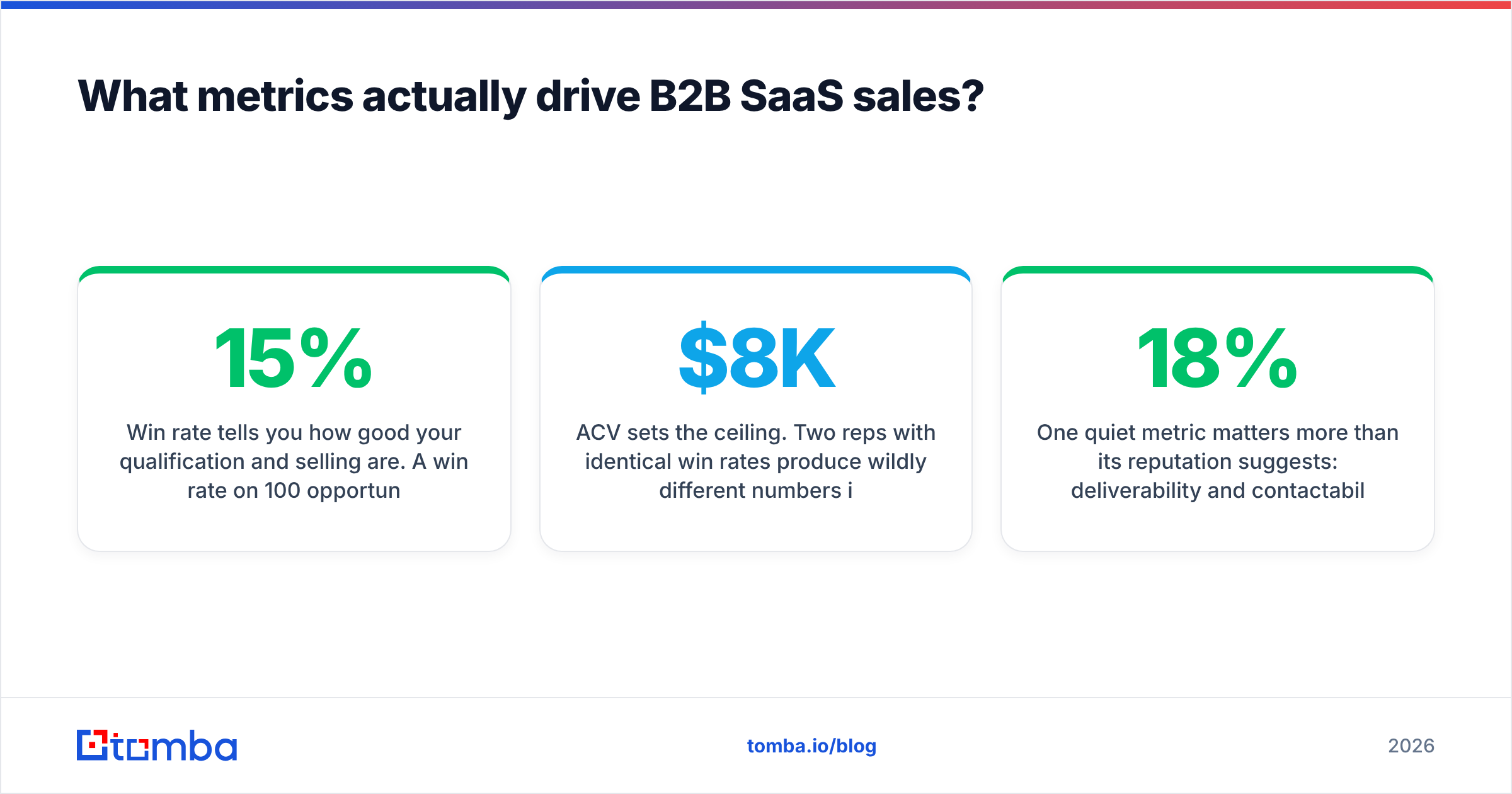
- Win rate tells you how good your qualification and selling are. A 15% win rate on 100 opportunities is 15 deals; pushing it to 22% without adding a single lead is a 47% revenue increase.
- Sales cycle length controls how fast that revenue lands. Shorter cycles mean more turns of the pipeline per quarter.
- ACV sets the ceiling. Two reps with identical win rates produce wildly different numbers if one sells $8K deals and the other sells $45K deals.
- Pipeline coverage (open pipeline ÷ quota) keeps you honest about whether the math is even possible. Most SaaS teams target 3x–4x coverage.
HubSpot's sales benchmarks are a useful external reference point, but your own historical conversion rates matter more than any industry average. Track win rate and response rate by segment, not just in aggregate — a blended number hides which motions are working.
One quiet metric matters more than its reputation suggests: deliverability and contactability. If 18% of your outbound emails bounce because the data is stale, you have effectively cut your prospecting capacity by a fifth before a single rep does anything wrong. Clean data is a metric multiplier.
Is product-led or sales-led growth better for B2B SaaS?#
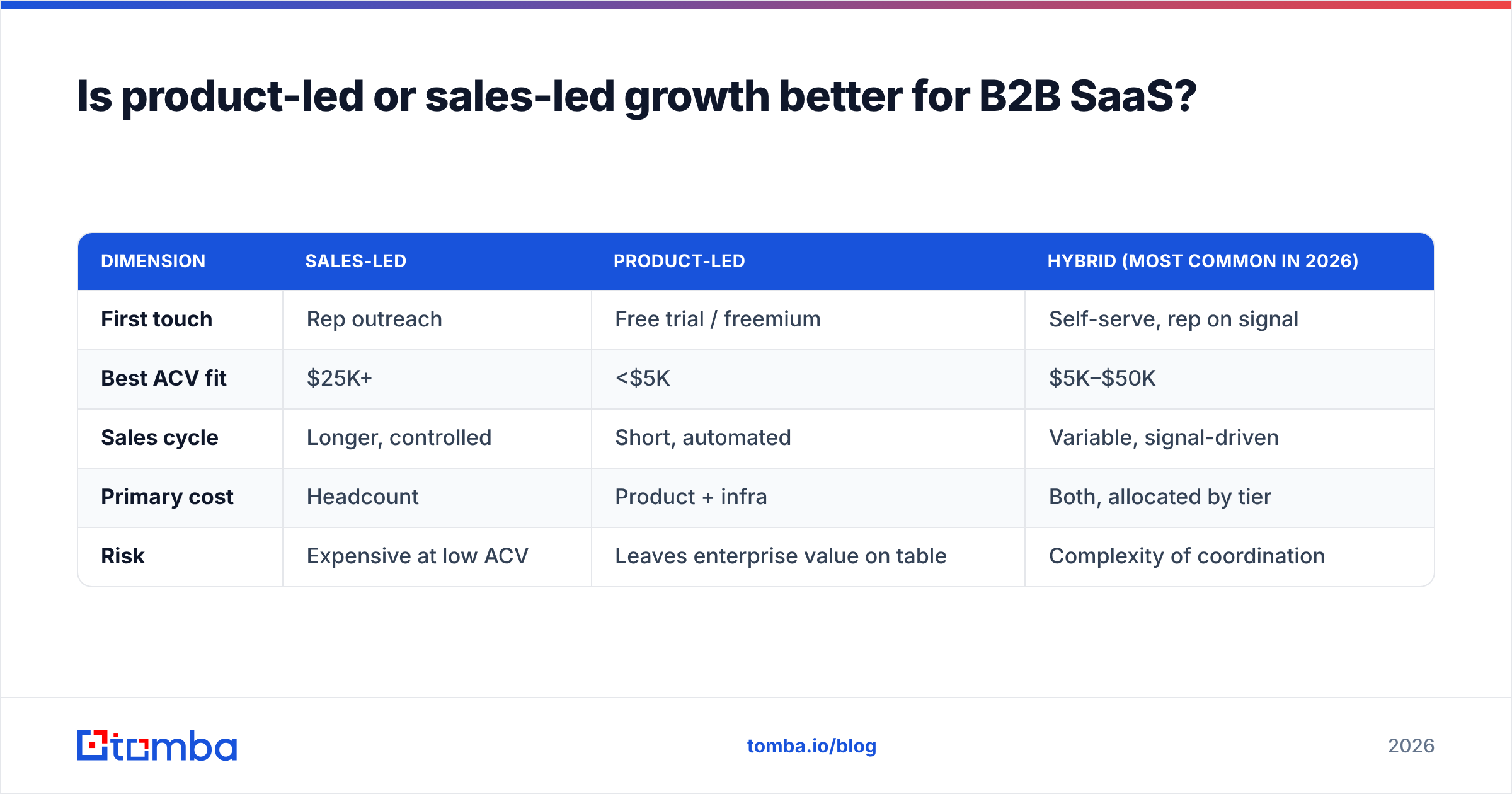
Neither wins outright in 2026 — the strongest teams run a hybrid. The real question is when to insert a human, not whether to.
| Dimension | Sales-led | Product-led | Hybrid (most common in 2026) |
|---|---|---|---|
| First touch | Rep outreach | Free trial / freemium | Self-serve, rep on signal |
| Best ACV fit | $25K+ | <$5K | $5K–$50K |
| Sales cycle | Longer, controlled | Short, automated | Variable, signal-driven |
| Primary cost | Headcount | Product + infra | Both, allocated by tier |
| Risk | Expensive at low ACV | Leaves enterprise value on table | Complexity of coordination |
The hybrid model works because it uses product usage as the world's best qualifier. Instead of a rep guessing who is interested, the product reports it: this account invited five teammates, hit the usage cap, and visited the pricing page twice. That is a buying signal no cold list can match.
To act on those signals you still need to know who the engaged users and their colleagues are. Tools like website visitor reveal and data enrichment turn an anonymous account into named, reachable contacts on the buying committee — so the rep arrives with context instead of a script.
How do you build pipeline without burning your domain?#
Pipeline generation in 2026 is a precision game, not a volume game. The spray-and-pray era is over: mailbox providers now penalize senders aggressively, and buyers ignore anything generic.
A durable outbound motion has four parts:
- Define the ICP narrowly. "Mid-market fintech, 200–800 employees, using a competing tool" beats "B2B companies." A tight ICP makes every later step easier.
- Build the list from accurate sources. Use domain search to map who works at a target account, then verify before you send. Garbage contacts poison both your numbers and your sender reputation.
- Protect deliverability. Warm up domains, authenticate with SPF/DKIM/DMARC, and keep bounce rates under 2%. Strong email deliverability is the difference between landing in the inbox and the spam folder.
- Personalize at the segment level. You do not need a hand-written novel per prospect, but the opening line should prove you understand their situation.
)
The single biggest avoidable mistake is sending to unverified addresses. Every hard bounce signals to inbox providers that you are a low-quality sender, which drags down delivery for your good emails too. Running your list through an email verifier before a campaign is the cheapest insurance in your entire stack.
What does a modern B2B SaaS sales stack look like?#
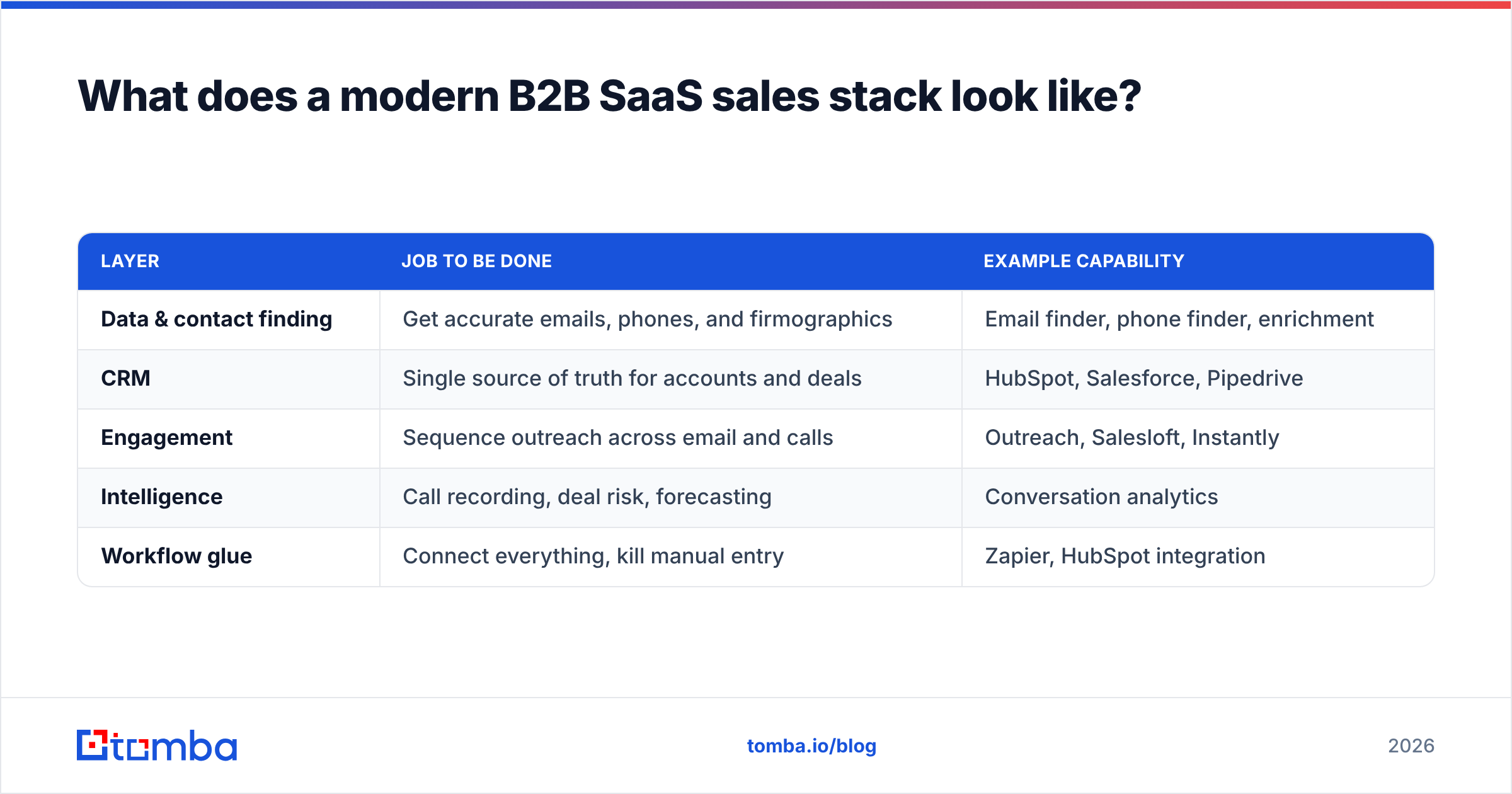
A lean 2026 stack does three jobs: find the right people, qualify them quickly, and automate the busywork. You do not need 30 tools. You need a few that talk to each other.
| Layer | Job to be done | Example capability |
|---|---|---|
| Data & contact finding | Get accurate emails, phones, and firmographics | Email finder, phone finder, enrichment |
| CRM | Single source of truth for accounts and deals | HubSpot, Salesforce, Pipedrive |
| Engagement | Sequence outreach across email and calls | Outreach, Salesloft, Instantly |
| Intelligence | Call recording, deal risk, forecasting | Conversation analytics |
| Workflow glue | Connect everything, kill manual entry | Zapier, HubSpot integration |
The foundation layer — data — is the one teams under-invest in and regret. A flawless engagement platform pointed at a bad list just sends bad emails faster. Get the contact data right first, then layer engagement and intelligence on top.
For teams already standardized on a CRM, the integration matters as much as the tool. Pushing verified contacts straight into your CRM — rather than exporting CSVs by hand — is where automation actually saves hours. Connect your finder to Salesforce or Pipedrive and the data flows without a human copy-pasting.
How do you sell to a buying committee, not a person?#
You win by helping your champion sell internally, because most of the deal happens in rooms you are not in.
A few tactics that consistently move committee deals:
- Map the committee early. In discovery, ask directly: "Besides you, who needs to be comfortable with this decision?" Then find and engage those people. A LinkedIn finder helps you connect names to reachable contacts across the org.
- Give your champion ammunition. A one-page business case, an ROI model, and answers to the objections their CFO will raise. Make it easy for them to be your advocate when you are not there.
- Address the skeptic, not just the fan. Every committee has someone who prefers the status quo. Surface their concern and answer it before it becomes a silent deal-killer.
- Multi-thread relentlessly. Single-threaded deals (one contact) are the most common reason forecasted deals slip. If your champion leaves or goes quiet, the deal dies with them.
This is also where shortening the cycle pays off. Every week a committee deal sits open, the odds of a reorg, budget freeze, or competitor entry rise. Speed is a risk-reduction strategy, not just an efficiency one.
What are the biggest B2B SaaS sales mistakes in 2026?#
The patterns below show up in pipeline reviews again and again:
- Confusing activity with progress. 200 dials a day means nothing if they hit wrong numbers. Validate contacts with a phone validator so dials reach real humans.
- Ignoring data decay. B2B contact data degrades roughly 25–30% per year as people change jobs. A list that was clean in 2024 is mostly noise by 2026 without ongoing enrichment.
- Over-discounting to close. Discounts train buyers to wait and erode the ACV that drives your whole model. Sell value; protect price.
- Treating onboarding as someone else's problem. In SaaS, the renewal is the real close. A deal that churns in month four was never a win.
- Forecasting on optimism. Use exit criteria, not gut feel. If a deal has no economic buyer engaged, it does not belong in commit.
Avoiding these is less about heroics and more about discipline: tight qualification, clean data, and honest stage definitions.
Frequently asked questions#
How long is a typical B2B SaaS sales cycle? It varies by ACV. Self-serve and low-ACV deals can close in days; mid-market deals average 1–3 months; enterprise deals with security reviews and procurement often run 6–12 months. Use your own historical data to set realistic expectations.
What is a good win rate for B2B SaaS sales? Most teams land between 15% and 30% on qualified opportunities. The exact number matters less than the trend — and than measuring it consistently with the same qualification bar.
Do I still need outbound if I have product-led growth? Usually yes. PLG fills the top of the funnel efficiently, but enterprise and expansion revenue almost always needs human selling. The hybrid model uses product signals to direct outbound, not replace it.
How much does bad data really cost? More than most teams measure. Between bounced emails hurting deliverability, reps wasting hours on wrong numbers, and missed contacts on the committee, poor data quietly taxes win rate, cycle length, and capacity all at once.
Getting started#
B2B SaaS sales in 2026 rewards precision over volume. Narrow your ICP, qualify with discipline, multi-thread every deal, and protect your domain reputation like the asset it is. None of it works on a foundation of bad contact data.
That is where to start. Before you optimize sequences or buy another intelligence tool, make sure the names, emails, and phone numbers feeding your pipeline are accurate. The Tomba Email Finder finds verified professional emails by name, domain, or company — so your reps spend time selling instead of chasing bounces. Pair it with the email verifier to keep bounce rates low, and check Tomba pricing — there is a free tier with 25 searches a month to test it on your own target accounts before you commit. Clean data is the cheapest growth lever you have. Pull it first.
// get started
Find, verify and enrich your first contacts today
Start on the free plan with 25 searches a month, then scale when your team is ready.
Free plan · No credit card required · GDPR & CCPA
// about the author