B2B SaaS Sales Model: Choosing the Right GTM Motion in 2026
Self-serve, inside sales, or enterprise? A practical breakdown of every B2B SaaS sales model, when each one wins, and how to match motion to ACV in 2026.
You are not picking a "sales team." You are picking a sales model — the repeatable motion that connects how people buy your software to how you make money from it. Get the match wrong and you will hire reps for a product that sells itself, or build a free trial for a product that needs a six-month enterprise cycle. This guide breaks down every B2B SaaS sales model, when each one wins, and how to staff it.
TL;DR#
- A B2B SaaS sales model is the structured motion (self-serve, inside sales, field/enterprise, or channel) that matches buyer behavior to your average contract value (ACV).
- The fastest predictor of which model fits: your ACV. Sub-$1K leans self-serve; $1K–$25K leans inside sales; $25K+ leans enterprise.
- Product-led growth (PLG) is not a separate model — it is a top-of-funnel engine that usually feeds inside or enterprise sales (the "sales-assisted" hybrid).
- Most scaling companies run two or three motions at once and segment leads by fit and intent rather than forcing everyone down one path.
- Every model still depends on clean contact data — accurate emails, verified phone numbers, and enriched accounts — or the motion stalls regardless of how elegant it is.
What is a B2B SaaS sales model?#
A B2B SaaS sales model is the system you use to acquire, close, and expand business customers for subscription software. Think of it like choosing a delivery method for a restaurant: a $4 coffee works at a self-serve counter, a $40 dinner needs a waiter, and a $4,000 catering contract needs a salesperson who visits your office. The food can be excellent in all three cases — but the way you sell it has to match the price and the buyer's expectations.
In SaaS, that "delivery method" usually comes down to four primary motions:
- Self-serve / no-touch — the buyer signs up, pays by card, and onboards without ever talking to a human. Best for low ACV and high volume.
- Inside sales / low-touch — reps work deals remotely by email, phone, and video; deal cycles run days to weeks. The workhorse of mid-market SaaS.
- Field sales / enterprise / high-touch — account executives run multi-stakeholder deals over months, often with solutions engineers and procurement. Highest ACV, longest cycle.
- Channel / partner-led — resellers, marketplaces, or integrators sell on your behalf. Extends reach without linearly growing headcount.
The model you choose dictates everything downstream: who you hire, what your CRM pipeline stages look like, how you compensate reps, and how much you can afford to spend acquiring each customer.
)
How do you choose between SaaS sales models?#
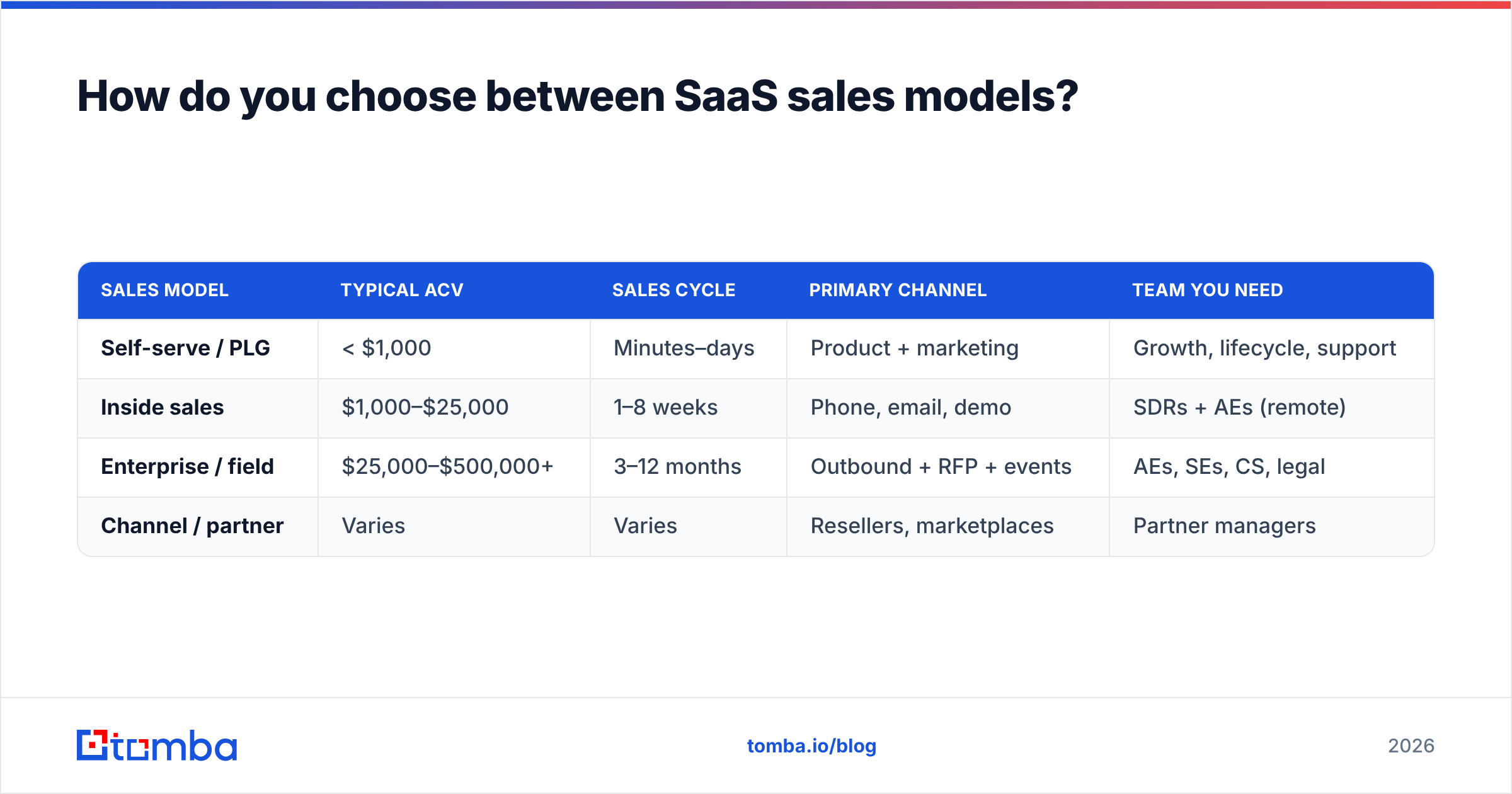
Start with one number: average contract value. It is the cleanest signal for how much human effort a deal can profitably absorb. A $300/year subscription cannot support a rep who spends 20 hours closing it. A $120,000 deal cannot be left to a self-serve checkout page and a help doc.
Here is the rough mapping most SaaS operators use:
| Sales model | Typical ACV | Sales cycle | Primary channel | Team you need |
|---|---|---|---|---|
| Self-serve / PLG | < $1,000 | Minutes–days | Product + marketing | Growth, lifecycle, support |
| Inside sales | $1,000–$25,000 | 1–8 weeks | Phone, email, demo | SDRs + AEs (remote) |
| Enterprise / field | $25,000–$500,000+ | 3–12 months | Outbound + RFP + events | AEs, SEs, CS, legal |
| Channel / partner | Varies | Varies | Resellers, marketplaces | Partner managers |
ACV is the starting point, not the whole answer. Three other factors pull the decision:
- Product complexity. If a buyer cannot get value without configuration, integration, or training, you need humans in the loop even at lower price points.
- Number of stakeholders. A tool one person adopts (a design app, a code linter) can go self-serve. A platform that touches finance, security, and IT needs enterprise selling.
- Time-to-value. If a user feels the benefit in ten minutes, let them self-serve. If value shows up after a 90-day rollout, a rep has to carry them there.
When two models seem viable, segment. Route low-fit, low-ACV signups to self-serve, and flag high-fit accounts for an SDR to chase. That brings us to the model everyone argues about.
Is product-led growth a sales model or a strategy?#
Product-led growth is a strategy, not a standalone sales model. PLG uses the product itself as the primary acquisition and activation engine — free trials, freemium tiers, and viral loops bring users in without a rep. But pure no-touch PLG only works at genuinely low ACV. The moment you want to land $20K+ contracts, you bolt a sales motion onto the front of your product signups. That hybrid is where most modern SaaS lives.
The three flavors you will see:
- Pure self-serve PLG — Calendly, early Notion. The product converts and expands on its own; sales is minimal.
- Sales-assisted PLG — Slack, Figma, Datadog. Free usage spreads bottom-up inside a company, then sales steps in to convert teams into enterprise contracts. This is the dominant motion for 2026.
- Sales-led with a PLG top of funnel — the product offers a trial mainly to generate qualified pipeline, but reps still drive every deal.
The operational catch with any PLG hybrid: your signup list is full of free users, tire-kickers, and a few real buyers mixed together. You need enrichment and scoring to tell them apart. Pulling firmographic data on each signup — company size, funding, tech stack — lets you route the 5% of accounts worth a human touch. Tools like data enrichment turn an anonymous email into a scored account so your AEs chase fit, not noise.
)
What does each B2B SaaS sales model actually require?#
Picking a motion is the easy part. Staffing and equipping it is where teams stumble. Here is what each model demands in practice.
Self-serve#
- Team: No quota-carrying reps. Invest in growth marketing, lifecycle email, in-app onboarding, and fast support.
- Metrics: Activation rate, free-to-paid conversion, time-to-value, net revenue retention.
- Data need: Light. You mostly need clean signup emails and basic enrichment to personalize onboarding and spot expansion accounts.
Inside sales#
- Team: SDRs to book meetings, AEs to close, all working remotely. This is the most common SaaS structure and the most scalable per dollar.
- Metrics: Meetings booked, opportunity-to-close rate, sales win rate, cycle length, email response rate.
- Data need: Heavy and constant. SDRs burn through contacts fast, so verified emails and direct-dial numbers are the fuel. Bad data here is the single biggest silent killer of inside-sales productivity.
Enterprise / field sales#
- Team: Senior AEs, sales engineers, customer success, and often a deal desk. Long cycles, big committees, real procurement.
- Metrics: Pipeline coverage, average deal size, stakeholder count, forecast accuracy.
- Data need: Deep account intelligence — org charts, multiple buyer contacts, mobile numbers for executives, and ongoing enrichment as committees shift.
Channel / partner#
- Team: Partner managers who recruit and enable resellers; marketing that builds co-sell programs.
- Metrics: Partner-sourced pipeline, partner activation, deal registration volume.
- Data need: Account mapping between your data and your partners' to avoid channel conflict.
Across all four, the constant is contact accuracy. A beautiful enterprise motion still dies if the AE emails a buyer who left the company eight months ago. This is why the data layer sits underneath every model, not beside it.
How does data quality decide whether a sales model works?#
A sales model is a machine, and bad contact data is sand in the gears. You can design the perfect inside-sales motion — tight stages, sharp messaging, well-trained reps — and still watch it grind to a halt because 30% of your prospect emails bounce and half your phone numbers are dead.
The math is brutal at scale. If an SDR works 200 contacts a week and a third of the emails are invalid, that is roughly 65 wasted touches, plus the deliverability damage from bouncing into spam traps. High bounce rates drag down your sender reputation, which means even your valid prospects stop seeing your emails. The model didn't fail; the inputs did.
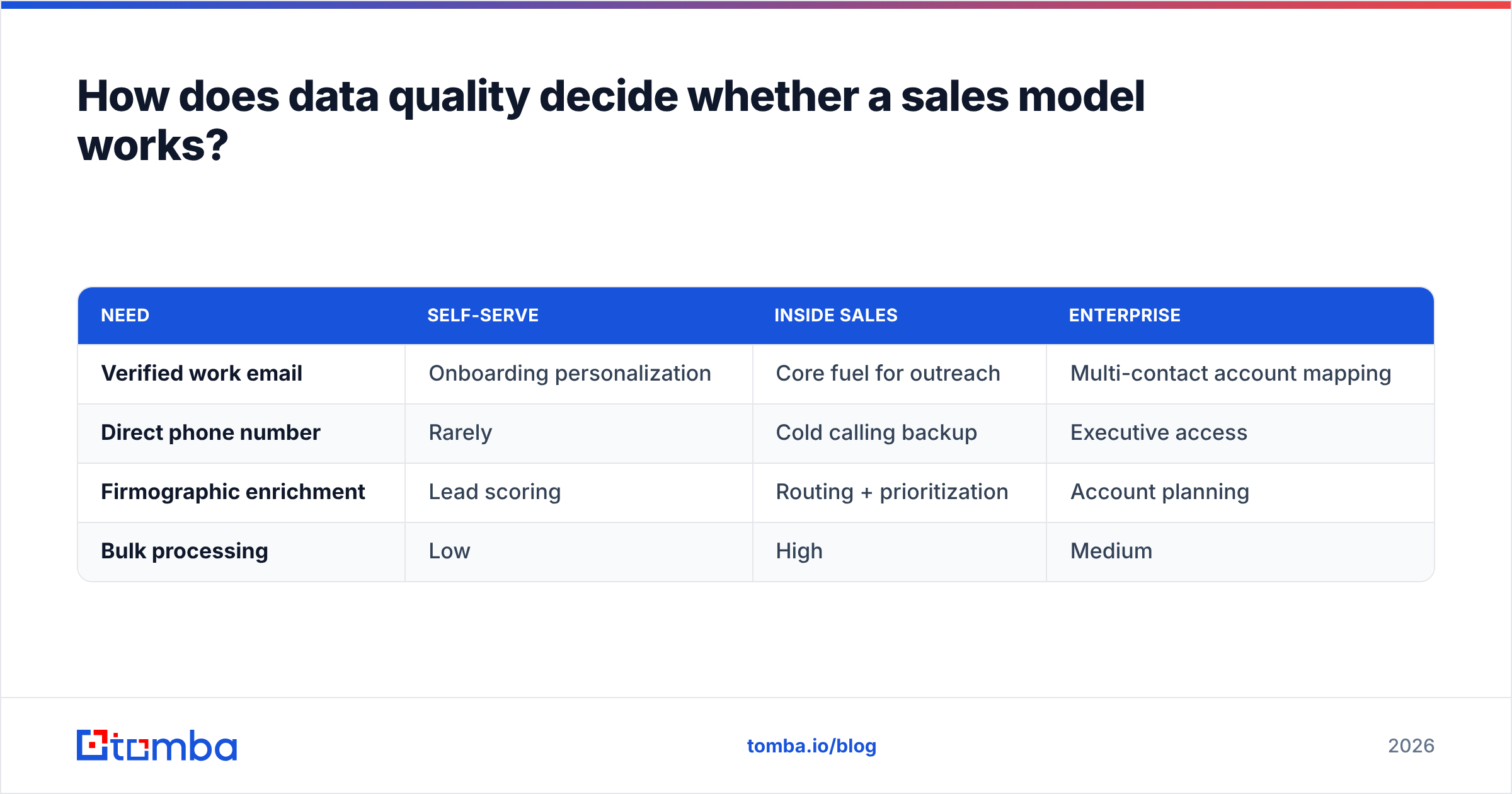
This is where a verification and finding layer pays for itself regardless of which motion you run:
| Need | Self-serve | Inside sales | Enterprise |
|---|---|---|---|
| Verified work email | Onboarding personalization | Core fuel for outreach | Multi-contact account mapping |
| Direct phone number | Rarely | Cold calling backup | Executive access |
| Firmographic enrichment | Lead scoring | Routing + prioritization | Account planning |
| Bulk processing | Low | High | Medium |
You can find and verify those contacts on demand with an email finder for individual prospects, run an entire target account through domain search to map every reachable contact, and clean an imported list before launch with an email verifier. For high-volume inside sales, the bulk email finder processes whole prospect lists at once so reps spend time selling, not hunting.
For benchmarks on how much data accuracy varies between providers, third-party review sites like G2 and Capterra publish verified user comparisons worth checking before you commit a stack.
What is the most common B2B SaaS sales model in 2026?#
The dominant motion in 2026 is sales-assisted PLG layered onto an inside-sales backbone. Buyers want to try before they talk to anyone, so the product carries the top of the funnel — but companies still want a human to handle expansion, security review, and multi-seat contracts. So a free or low-cost entry point generates signups, scoring routes the high-fit accounts to SDRs, and AEs close the team and enterprise deals.
This blended approach wins because it captures both buyer preferences at once: the self-serve user who wants speed, and the committee buyer who wants a guide. Industry analysts at firms like Gartner have tracked B2B buying shifting steadily toward this self-directed-then-assisted pattern, with buyers completing most of their research before they ever contact a vendor.
The practical implication for your team: invest equally in product activation and in the data infrastructure that lets you spot which self-serve users are worth a sales touch. A signup with a generic Gmail address and a one-person company is a self-serve customer forever. A signup from a 500-person company's VP, enriched and scored, is an enterprise opportunity hiding in your free tier. The difference between treating those two identically and routing them correctly can double the return on the same top-of-funnel volume.
How do you transition between sales models as you grow?#
Most SaaS companies do not pick one model and stay there — they layer motions over time. A typical evolution:
- Start self-serve to validate the product and generate early revenue cheaply.
- Add inside sales once you see accounts that want more seats or hand-holding than self-serve provides.
- Add enterprise when deal sizes justify dedicated AEs and solutions engineering.
- Add channel to extend reach into segments or geographies you cannot cover directly.
The hardest transition is self-serve to sales-assisted, because it requires building a pipeline-generation muscle you did not have. You suddenly need outbound contact data, sequencing, and qualification — the entire inside-sales apparatus. Teams that pre-build their data layer (enrichment on every signup, verified contacts ready for outreach) make this jump cleanly. Teams that treat data as an afterthought spend the first two quarters of their sales motion just cleaning lists. Review your Tomba pricing tier as volume grows so the data layer scales with the motion rather than capping it.
Which sales model is right for you?#
Run this quick filter:
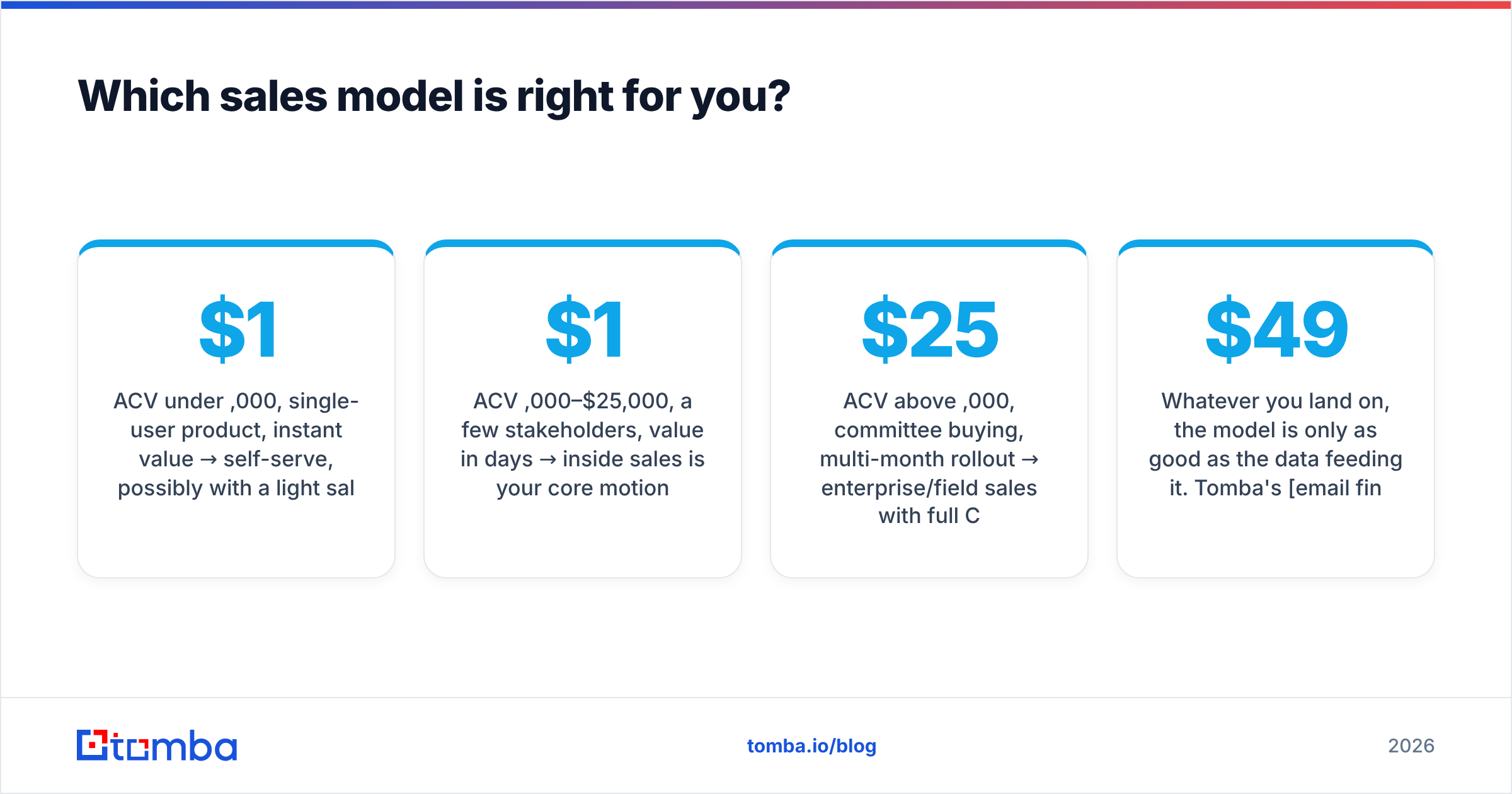
- ACV under $1,000, single-user product, instant value → self-serve, possibly with a light sales-assist for outliers.
- ACV $1,000–$25,000, a few stakeholders, value in days → inside sales is your core motion.
- ACV above $25,000, committee buying, multi-month rollout → enterprise/field sales with full CS and SE support.
- You have strong partners or marketplace presence → add a channel motion on top of whichever core model fits.
Whatever you land on, the model is only as good as the data feeding it. Tomba's email finder gives your reps verified, accurate contacts by name, domain, or company — so your chosen motion runs on clean fuel instead of bounced sends and dead dials. Start on the free tier (25 searches a month), and scale to Starter at $49/mo or Growth at $99/mo as your pipeline grows. Pick the sales model that matches how your buyers actually buy, then make sure every contact in it is real. That combination is what turns a sales model on a whiteboard into predictable revenue.
// get started
Find, verify and enrich your first contacts today
Start on the free plan with 25 searches a month, then scale when your team is ready.
Free plan · No credit card required · GDPR & CCPA
// about the author