The B2B SaaS Sales Process in 2026: A Step-by-Step Guide
A practical, stage-by-stage breakdown of the B2B SaaS sales process for 2026 — the seven stages, the metrics that matter, and the tools that move deals faster.
The B2B SaaS Sales Process in 2026: A Step-by-Step Guide
TL;DR
- The B2B SaaS sales process is a repeatable, seven-stage system: ICP definition, prospecting, qualification, discovery/demo, proposal, negotiation/close, and onboarding/expansion.
- Process beats heroics. Reps who follow a documented pipeline close more predictably than reps who improvise per deal.
- Your conversion math (win rate, cycle length, average contract value) tells you which stage is leaking — fix the stage, not the rep.
- Clean contact data feeds the whole machine. Bad emails and missing phone numbers stall stage two before discovery ever happens.
- The right stack is small: a CRM, a data/enrichment layer, a sequencer, and a demo tool. Everything else is optional.
If your SaaS revenue feels random — some months great, some months dead — the problem is almost never your product. It is that your sales process is undocumented, so every rep runs their own version and you cannot tell why deals die. This guide gives you a concrete, stage-by-stage framework you can copy, plus the metrics and tools that make each stage measurable.
What is the B2B SaaS sales process?#
The B2B SaaS sales process is the defined sequence of stages a prospect moves through from first touch to closed customer (and beyond, into renewal and expansion). Think of it like an assembly line: raw material (a lead) enters one end, and a paying, onboarded account comes out the other — but only if each station does its job and hands off cleanly.
SaaS sales differs from one-off B2B sales in three ways that shape the whole process:
- Recurring revenue. You are not selling a thing once; you are starting a relationship that has to survive a renewal. The close is the midpoint, not the finish line.
- Multiple stakeholders. A typical mid-market SaaS deal involves a champion, an economic buyer, a technical evaluator, and sometimes procurement and security. Your process has to manage a buying committee, not a person.
- Product-led pressure. Free trials and freemium tiers mean prospects often evaluate the product before they ever talk to sales. Your process has to meet self-serve buyers where they are.
A documented sales process turns those complications into stages you can measure and improve, instead of a fog you push deals through and hope.
What are the stages of a SaaS sales pipeline?#
Most high-performing SaaS teams run a seven-stage pipeline. Names vary, but the work is the same.
- Define your ICP and segments. Before any outreach, write down the firmographic and technographic traits of accounts that buy, stay, and expand. Company size, industry, tech stack, trigger events. This is the filter every later stage depends on.
- Prospect and build the list. Find the right accounts, then the right people inside them, then their verified contact details. This is where data quality makes or breaks volume.
- Qualify. Use a framework (MEDDIC, BANT, or a lightweight version) to confirm budget, authority, need, and timeline before you invest demo hours.
- Discovery and demo. Diagnose the prospect's actual problem, then show the product solving that problem — not a feature tour.
- Proposal and business case. Put pricing, ROI, and implementation in writing for the buying committee to circulate internally.
- Negotiate and close. Handle procurement, security review, redlines, and final terms. Get the signature.
- Onboard and expand. Hand off to customer success, drive activation, and set up the next renewal and upsell.
Stages 1 and 2 are where most SaaS pipelines silently underperform. You can have a brilliant demo (stage 4) and still starve if stages 1–2 feed you the wrong accounts or unreachable contacts.
A quick map of who owns each stage#
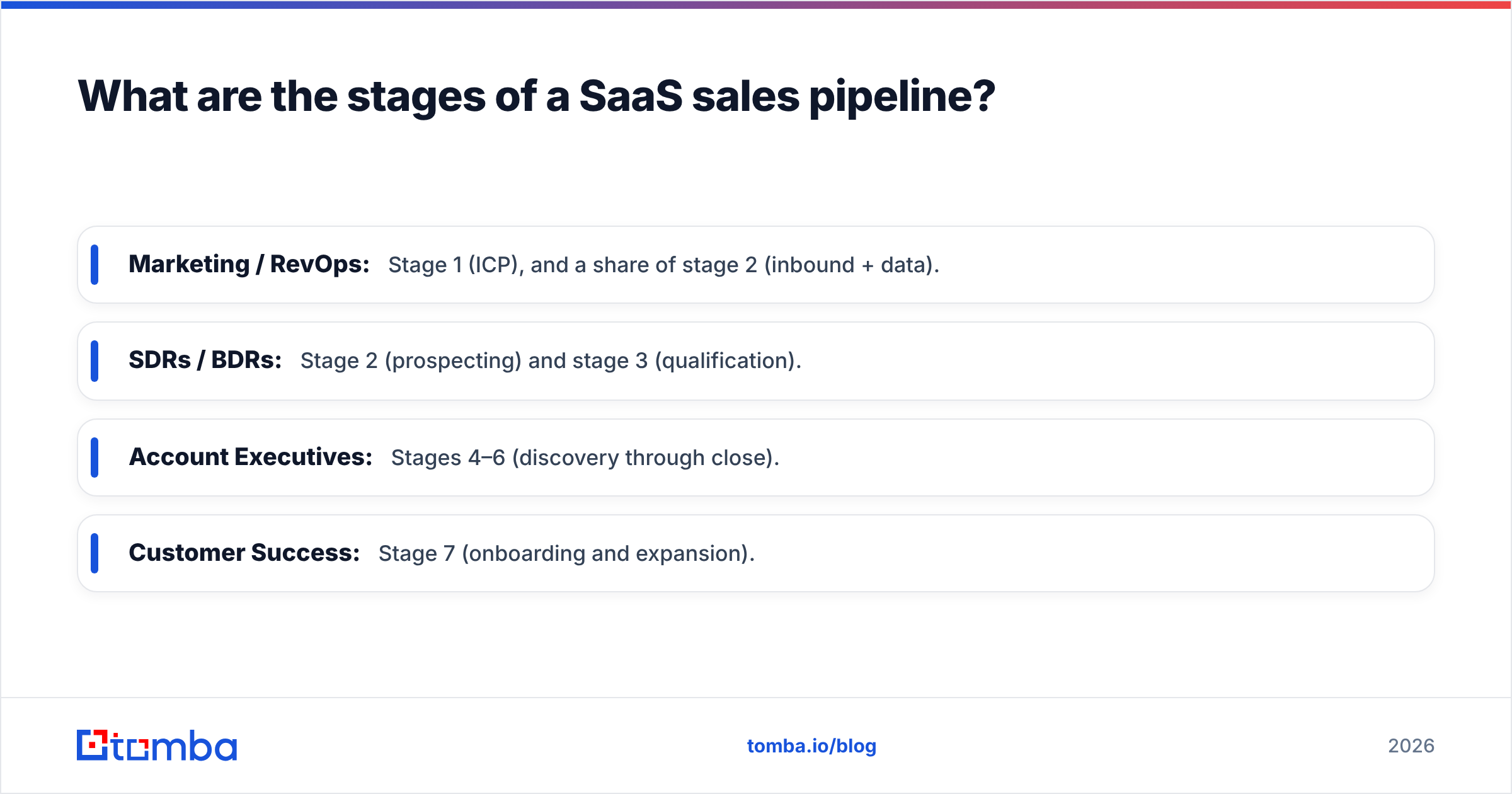
- Marketing / RevOps: Stage 1 (ICP), and a share of stage 2 (inbound + data).
- SDRs / BDRs: Stage 2 (prospecting) and stage 3 (qualification).
- Account Executives: Stages 4–6 (discovery through close).
- Customer Success: Stage 7 (onboarding and expansion).
When ownership is fuzzy, deals fall in the cracks between stages — especially the SDR-to-AE handoff. Write down who owns what.
How is SaaS sales different from traditional B2B sales?#
The headline difference is that the sale never really ends. In traditional B2B, you win the deal and move on. In SaaS, the deal you "won" can churn in 90 days, wiping out the acquisition cost. That reframes the entire process toward fit over force: a customer you talked into buying who isn't a real ICP match is a future churn statistic.
It also changes your metrics. Traditional B2B obsesses over deal size and close rate. SaaS adds win rate, net revenue retention, time-to-value, and CAC payback. A SaaS process that closes fast but onboards badly is a leaky bucket no amount of new pipeline can fill.
The practical takeaway: build qualification (stage 3) to screen for long-term fit, not just willingness to buy. The best SaaS reps walk away from poor-fit deals on purpose.
What metrics matter in the B2B SaaS sales process?#
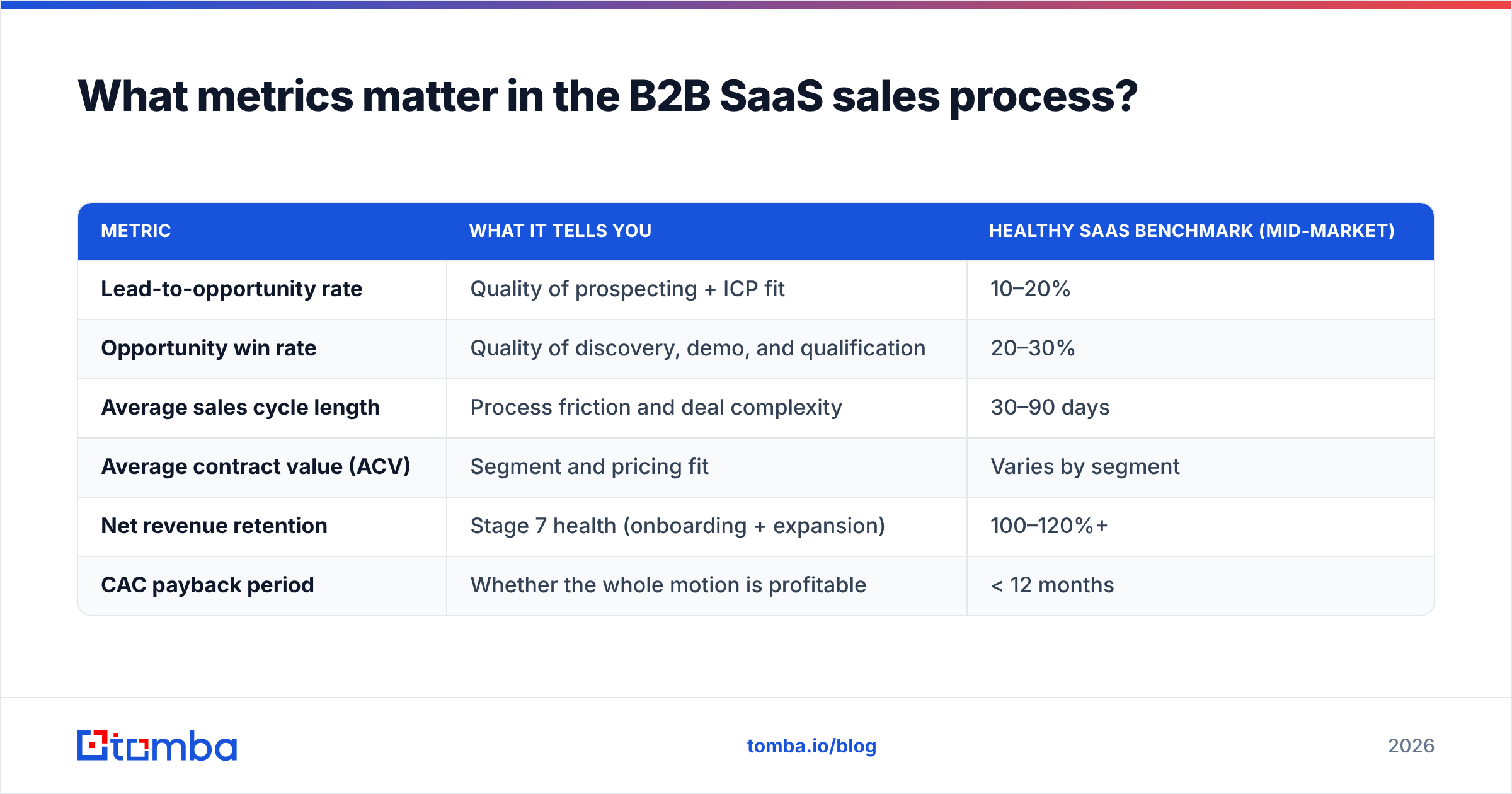
You manage a pipeline by its conversion math, not by gut feel. Track the rate at which deals move from each stage to the next, the time they spend in each stage, and the value that survives to close.
| Metric | What it tells you | Healthy SaaS benchmark (mid-market) |
|---|---|---|
| Lead-to-opportunity rate | Quality of prospecting + ICP fit | 10–20% |
| Opportunity win rate | Quality of discovery, demo, and qualification | 20–30% |
| Average sales cycle length | Process friction and deal complexity | 30–90 days |
| Average contract value (ACV) | Segment and pricing fit | Varies by segment |
| Net revenue retention | Stage 7 health (onboarding + expansion) | 100–120%+ |
| CAC payback period | Whether the whole motion is profitable | < 12 months |
The point of the table is diagnostic. If your win rate is healthy but your lead-to-opportunity rate is dismal, the leak is in prospecting and qualification — you are pouring bad leads into a good funnel. If win rate is the problem, the leak is in discovery and demo. Benchmarks vary widely by segment and price point; treat the ranges above as direction, not gospel, and compare against your own trailing quarters first. Public benchmark data from sources like Gartner and peer review sites like G2 can help you sanity-check where you stand.
How do you build a repeatable prospecting engine?#
Prospecting is the stage that scales — or fails to. Everything downstream depends on a steady flow of right-fit, reachable contacts, and that comes down to three sub-steps.
- Target by account, not by lead. Start from your ICP list of companies, then work into them. Use domain search to pull the verified email patterns and people at a target company in one pass, instead of hunting contact-by-contact.
- Find and verify the contact. A name without a working email is dead weight. Use an email finder to get the address, then run it through an email verifier so you are not burning sender reputation on bounces.
- Enrich for personalization and routing. Title, seniority, location, and phone number let you personalize the first touch and route the deal to the right rep. Data enrichment fills the gaps your list came with.
The failure mode here is volume without quality. Sending 1,000 emails to a list that is 30% invalid does three bad things at once: it tanks your email deliverability, it wastes SDR hours, and it pollutes your CRM with junk that skews every metric in the table above. Verify before you send. Always.
Which tools belong in the 2026 SaaS sales stack?#
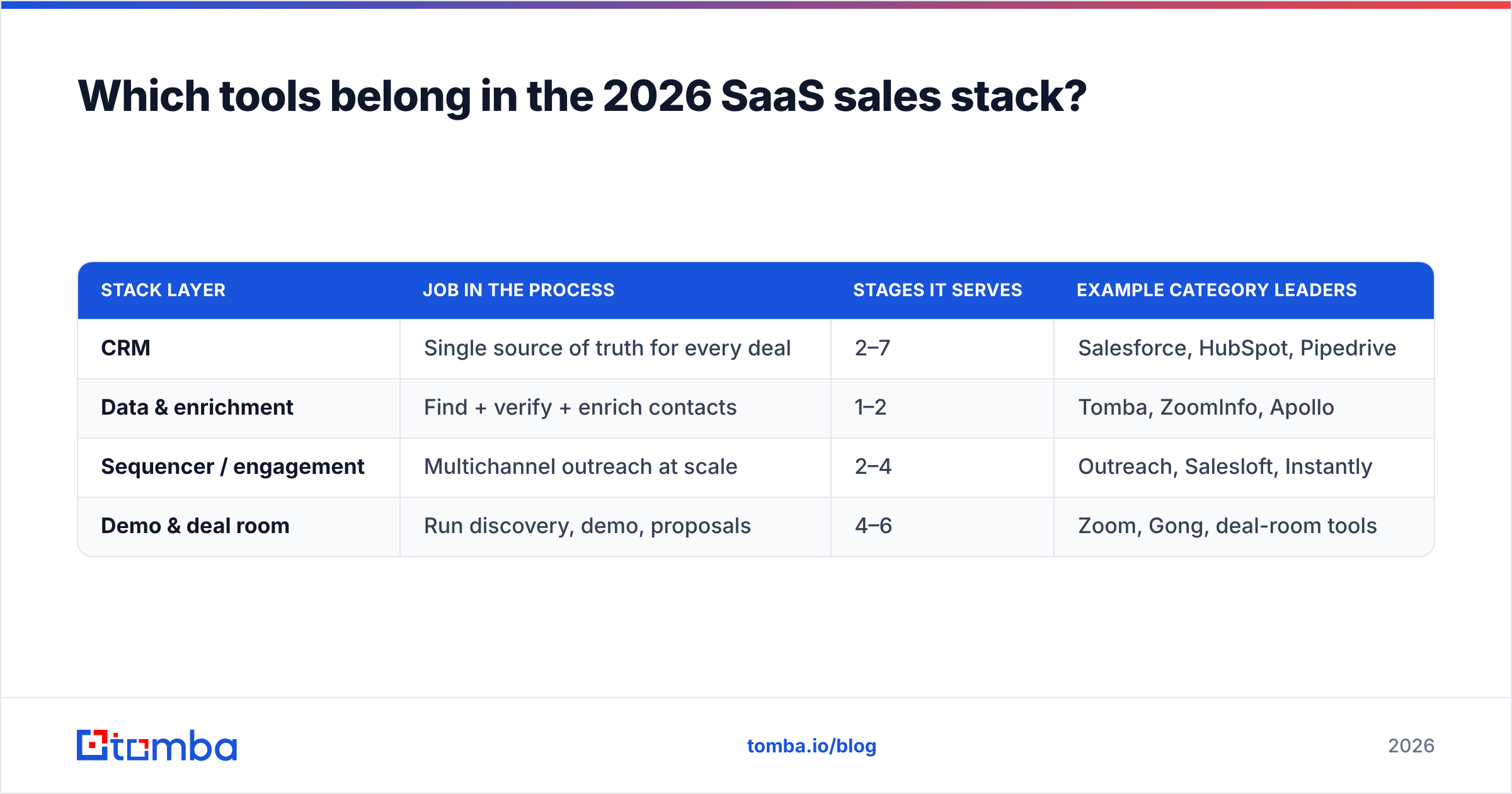
You need fewer tools than vendors want you to believe. Four categories cover the process end to end; everything else is a nice-to-have you can add once these are tuned.
| Stack layer | Job in the process | Stages it serves | Example category leaders |
|---|---|---|---|
| CRM | Single source of truth for every deal | 2–7 | Salesforce, HubSpot, Pipedrive |
| Data & enrichment | Find + verify + enrich contacts | 1–2 | Tomba, ZoomInfo, Apollo |
| Sequencer / engagement | Multichannel outreach at scale | 2–4 | Outreach, Salesloft, Instantly |
| Demo & deal room | Run discovery, demo, proposals | 4–6 | Zoom, Gong, deal-room tools |
A few honest notes on choosing. Your CRM is the anchor — pick it first, since every other tool integrates into it. For the data layer, the trade-off is coverage versus accuracy versus price; an all-in-one platform like Apollo bundles data and sequencing but often at lower verification accuracy, while a focused data tool keeps your CRM clean for less. Tomba sits in the data-and-enrichment layer with transparent Tomba pricing (a free tier at 25 searches/month, Starter at $49/mo, Growth at $99/mo, and Pro at $249/mo) and connects to the rest of the stack through native HubSpot integration and Salesforce integration, plus Zapier and the Tomba API for everything else.
Resist the urge to buy a tool per stage. Stack sprawl creates data silos, integration debt, and a per-seat bill that quietly outgrows your win rate. For more on how the platform fits, HubSpot's own sales software overview is a useful reference point for what a CRM layer should cover.
How do you shorten the SaaS sales cycle?#
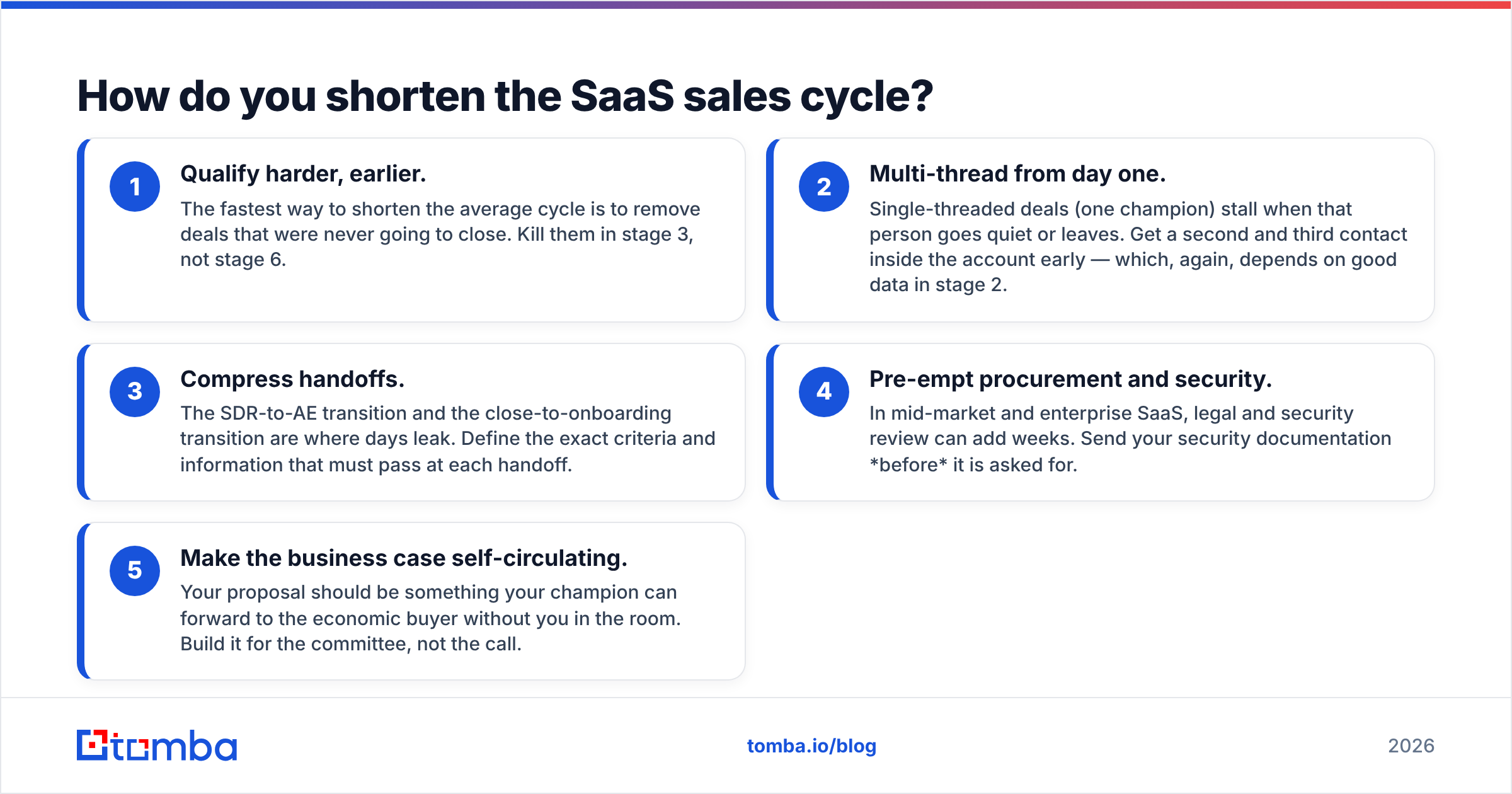
A long sales cycle is rarely one big delay; it is a dozen small ones compounding. Attack them in order of impact.
- Qualify harder, earlier. The fastest way to shorten the average cycle is to remove deals that were never going to close. Kill them in stage 3, not stage 6.
- Multi-thread from day one. Single-threaded deals (one champion) stall when that person goes quiet or leaves. Get a second and third contact inside the account early — which, again, depends on good data in stage 2.
- Compress handoffs. The SDR-to-AE transition and the close-to-onboarding transition are where days leak. Define the exact criteria and information that must pass at each handoff.
- Pre-empt procurement and security. In mid-market and enterprise SaaS, legal and security review can add weeks. Send your security documentation before it is asked for.
- Make the business case self-circulating. Your proposal should be something your champion can forward to the economic buyer without you in the room. Build it for the committee, not the call.
Notice how many of these trace back to stages 1–3. A cycle that drags in stage 6 was often mis-qualified in stage 3. Process problems are usually upstream of where they hurt.
What does a healthy SaaS pipeline review look like?#
Run a weekly pipeline review against the stages, not against rep optimism. For each open deal, confirm it has met the exit criteria of its current stage — a "demo scheduled" deal with no confirmed economic buyer is not really in stage 4, it is stuck in stage 3 wearing a costume.
Three questions cut through most pipeline fiction:
- What is the next committed step, with a date? No date means the deal is parked.
- Who is the economic buyer, and have we met them? No buyer means single-threaded risk.
- What would make this deal die? If the rep can't name the risk, they haven't done discovery.
Reviews like this keep your conversion metrics honest, which keeps your forecast honest, which is the entire point of having a process.
Bringing it together#
The B2B SaaS sales process is not bureaucracy — it is the difference between revenue you can forecast and revenue you pray for. Define the seven stages, assign clear owners, measure the conversion between each one, and feed the whole thing with clean, verified contact data so stage two never starves the rest. Then improve the worst-converting stage, ship that change, and re-measure. That loop, run quarterly, is how good SaaS teams compound.
Most of the leaks turn out to live in prospecting and qualification, which is exactly where data quality decides whether your pipeline is full of real opportunities or expensive noise. If your process is leaking at stage two, start there: the Tomba Email Finder gives you verified professional emails by name, company, or domain — with a free tier to test it on your own ICP list before you commit a cent. Build the engine on clean data, and every stage after it gets easier.
// get started
Find, verify and enrich your first contacts today
Start on the free plan with 25 searches a month, then scale when your team is ready.
Free plan · No credit card required · GDPR & CCPA
// about the author