B2B Sales Best Practices in 2026: A Complete Playbook
The B2B sales playbook changed. Here are the data-backed best practices top teams use in 2026 to book more meetings, shorten cycles, and close.
B2B selling in 2026 rewards teams that are precise, not loud. Buyers screen out generic outreach faster than ever, procurement committees have grown, and the rep who wins is the one with clean data, a sharp point of view, and disciplined follow-through. This playbook breaks down the b2b sales best practices that actually move pipeline today — and the habits worth retiring.
TL;DR#
- Data quality beats volume. A smaller list of verified, well-researched contacts outperforms a 10,000-row purchased list every time.
- Multichannel is the default, not a bonus. Email, phone, and LinkedIn working together beat any single channel.
- Lead with the buyer's problem, not your feature list. Relevance is the new personalization.
- Pipeline discipline wins quarters. Define stages by buyer behavior, inspect deals weekly, and kill stalled deals fast.
- Measure leading indicators (meetings booked, reply rate, stage conversion) — not just closed revenue.
What are B2B sales best practices in 2026?#
The short answer: do less, but do it with better data and a tighter process. The teams growing fastest right now have stopped treating outreach as a numbers game and started treating it as a precision game.
Three forces drive this shift. First, buying committees have grown — Gartner reports the typical B2B purchase now involves six to ten decision-makers, each armed with their own research. Second, inbox and dialer filters punish spray-and-pray outreach. Third, AI tooling has made personalization at scale possible, so generic messaging looks lazy by comparison.
Best practice in this environment rests on four pillars: accurate data, relevant messaging, multichannel sequencing, and pipeline discipline. Skip any one and the others lose their leverage.
)
Why does data quality matter more than list size?#
Because every downstream metric inherits the quality of your data. A bounced email hurts your sender reputation. A wrong phone number wastes a dial. A misattributed title sends the wrong message to the wrong person. Bad data doesn't just waste effort — it actively damages your ability to reach the next good contact.
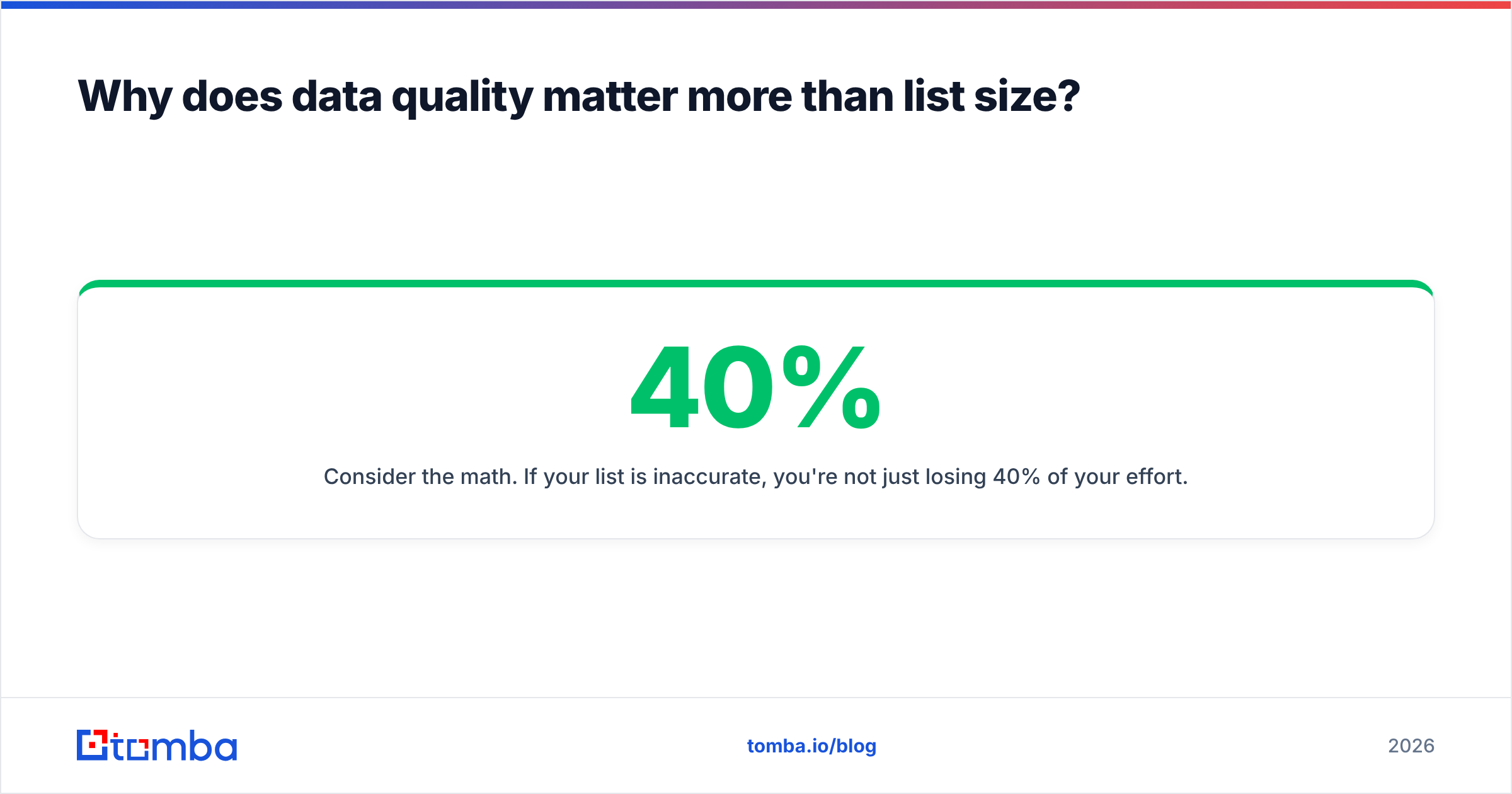
Consider the math. If your list is 40% inaccurate, you're not just losing 40% of your effort. You're degrading email deliverability for the 60% that were valid, because mailbox providers watch your bounce rate. One dirty campaign can suppress an entire domain's inbox placement for weeks.
This is why disciplined teams build their motion around verified contacts. Use an email verifier before every send, run a catch-all verifier on ambiguous domains, and enrich records so reps know who they're actually talking to. The goal is simple: every contact your team works should be real, reachable, and relevant.
)
How should you structure a modern outbound sequence?#
Around the buyer's attention, not your convenience. The old cadence — five identical emails, three days apart — is dead. Buyers need a reason to engage at each touch, and they engage on different channels.
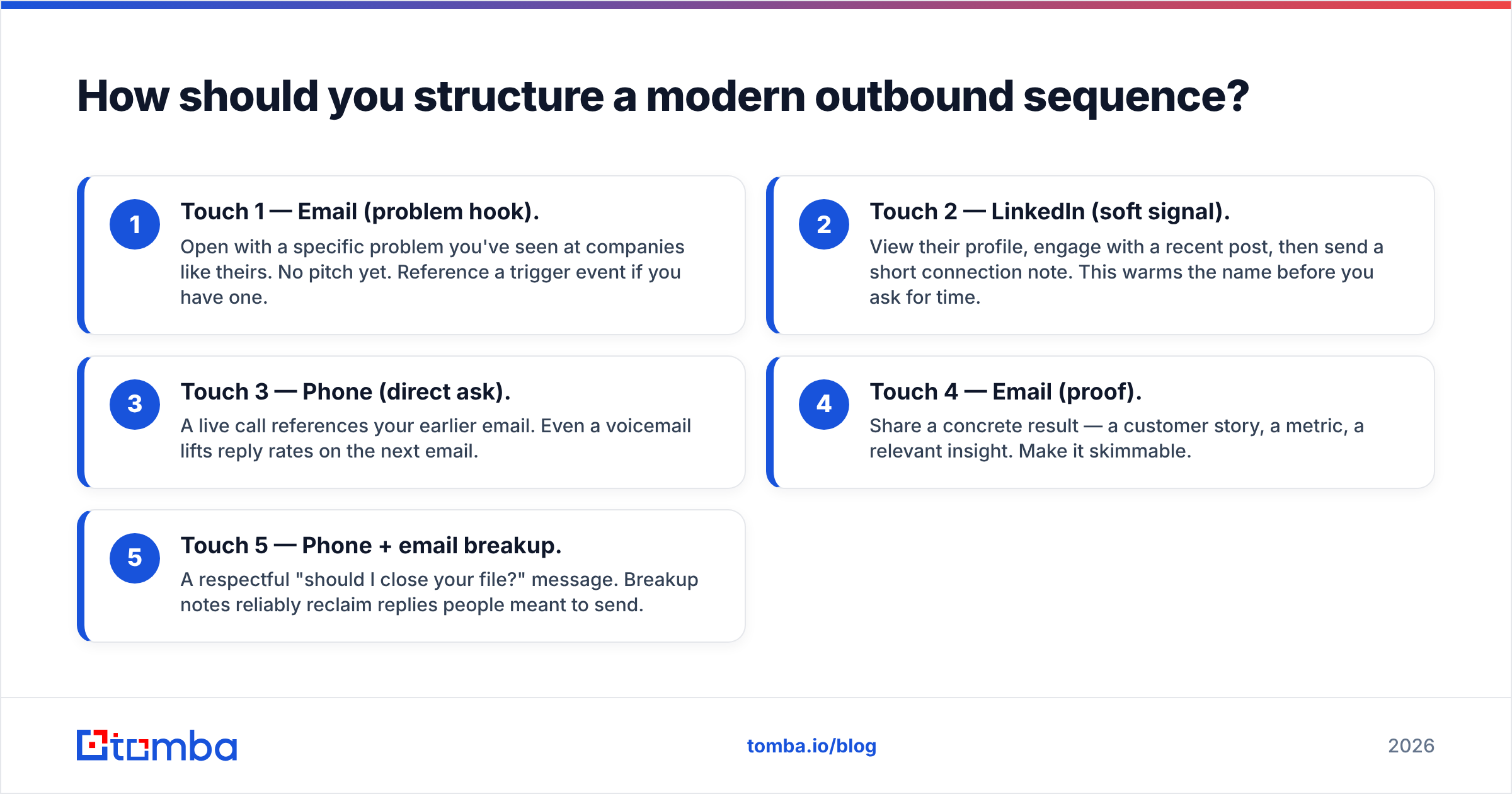
A strong 2026 sequence layers channels and varies the message angle:
- Touch 1 — Email (problem hook). Open with a specific problem you've seen at companies like theirs. No pitch yet. Reference a trigger event if you have one.
- Touch 2 — LinkedIn (soft signal). View their profile, engage with a recent post, then send a short connection note. This warms the name before you ask for time.
- Touch 3 — Phone (direct ask). A live call references your earlier email. Even a voicemail lifts reply rates on the next email.
- Touch 4 — Email (proof). Share a concrete result — a customer story, a metric, a relevant insight. Make it skimmable.
- Touch 5 — Phone + email breakup. A respectful "should I close your file?" message. Breakup notes reliably reclaim replies people meant to send.
The mechanics matter less than the principle: each touch must add value or earn attention, and the channels must reinforce each other. Pulling phone numbers with a phone finder alongside verified emails is what makes a true multichannel cadence possible instead of an email-only one wearing a costume.
What does great B2B prospecting look like?#
Targeted, researched, and fast. Prospecting is where most pipeline problems originate, so it's worth getting ruthless about your inputs.
Start with a tight ideal customer profile (ICP). Define it by firmographics (size, industry, geography), technographics (the tools they already run), and trigger events (funding, hiring, leadership changes). Then build lists that match — not lists that are merely large. Tools like a domain search let you find the right contacts at target accounts by role, so you reach the economic buyer instead of a generic info@ address.
Here's the discipline that separates top performers:
- Research before you reach. Two minutes on the company and the person beats an hour of generic sends.
- Tier your accounts. Spend personalization effort proportional to deal size. Tier 1 gets deep custom work; Tier 3 gets smart templates.
- Refresh data constantly. People change jobs every ~30 months on average. A list from last year is half-wrong today.
- Track leading signals. Job changes, new funding, and tech adoption are buying triggers — prioritize accounts showing them.
Which prospecting approach actually wins? A comparison#
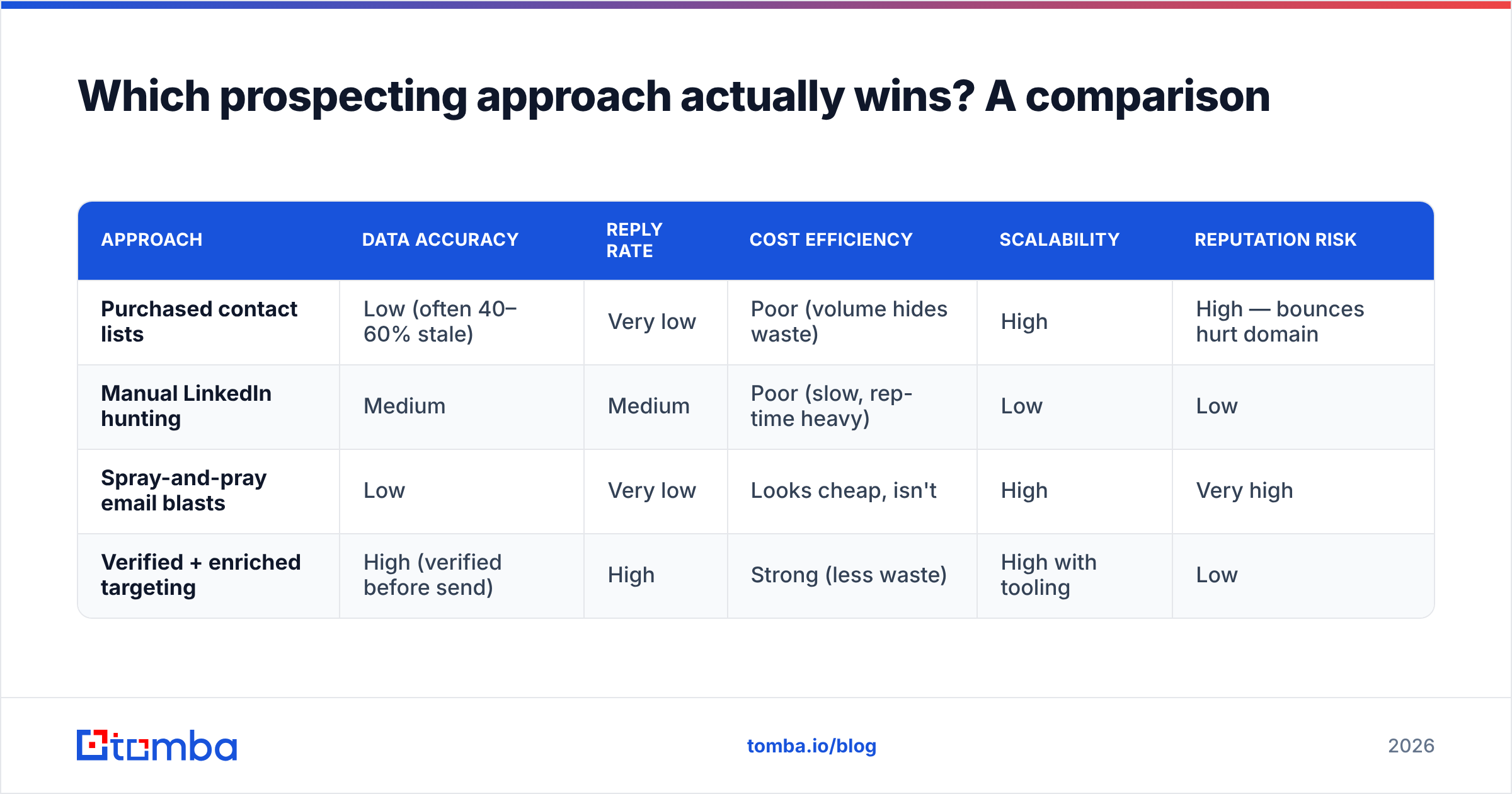
Not all prospecting motions deliver the same return. Here's how the common approaches stack up on the metrics that matter for B2B teams in 2026.
| Approach | Data accuracy | Reply rate | Cost efficiency | Scalability | Reputation risk |
|---|---|---|---|---|---|
| Purchased contact lists | Low (often 40–60% stale) | Very low | Poor (volume hides waste) | High | High — bounces hurt domain |
| Manual LinkedIn hunting | Medium | Medium | Poor (slow, rep-time heavy) | Low | Low |
| Spray-and-pray email blasts | Low | Very low | Looks cheap, isn't | High | Very high |
| Verified + enriched targeting | High (verified before send) | High | Strong (less waste) | High with tooling | Low |
The pattern is clear: the approach that combines verification, enrichment, and targeting wins on every axis except raw upfront simplicity. And simplicity that produces bounces is a false economy.
How do you write B2B sales messages that get replies?#
Lead with their problem, keep it short, and make one clear ask. The best cold messages read like a helpful note from a peer, not a brochure.
Apply these rules to every message:
- First line is about them, not you. Reference a trigger, a peer company, or a specific challenge. Never open with "I hope this email finds you well."
- Three to five sentences, max. If it needs scrolling, it won't get read on mobile.
- One CTA. Ask for a specific, low-friction next step ("Worth a 15-minute call Thursday?"), not "let me know your thoughts."
- Relevance over flattery. "I noticed you're hiring three SDRs" beats "I love what you're building."
- Proof, not adjectives. "We cut ramp time 30% for two firms like yours" beats "we're the leading platform."
If you want a starting structure, browse proven cold email templates and adapt them to your buyer — never send them verbatim. Templates are scaffolding, not scripts.
How should you manage pipeline and forecast accurately?#
Define stages by buyer behavior and inspect deals on a weekly cadence. A pipeline is only as honest as its stage definitions.
The most common forecasting failure is stages that describe what the rep did ("sent proposal") rather than what the buyer did ("confirmed budget and timeline"). Behavior-based stages — buyer has acknowledged a problem, identified a champion, confirmed budget, agreed on next steps — produce forecasts you can trust because they reflect real momentum.
Run these pipeline habits:
- Weekly deal inspection. Every deal in commit or best-case gets a "what's the next buyer action and when" check.
- Single exit criteria per stage. A deal only advances when the buyer-side condition is met. No "happy ears."
- Kill stalled deals fast. A deal with no buyer activity in 30 days is not pipeline — it's hope. Move it out or revive it deliberately.
- Track conversion between stages. If stage 2→3 conversion is 20% and the rest are 60%, you've found your coaching priority.
For teams formalizing this, it's worth grounding definitions in a shared vocabulary — see how a CRM should encode stages so reporting stays consistent across the team.
What metrics should B2B sales teams track?#
Leading indicators first, lagging revenue second. Revenue tells you what already happened; activity and conversion metrics tell you what's about to.
The metrics that predict next quarter:
- Meetings booked per rep per week — the single best early signal of future pipeline.
- Reply rate by sequence and segment — exposes messaging and targeting problems before they cost you a quarter.
- Stage-to-stage conversion — shows exactly where deals die.
- Sales cycle length — rising cycle time often signals a targeting or qualification problem upstream.
- Win rate by source and segment — tells you where to double down.
Track these weekly, not quarterly. By the time a revenue miss shows up in the lagging numbers, the leading indicators were flashing red weeks earlier.
What B2B sales mistakes should you avoid?#
Most teams lose pipeline to a handful of repeatable errors. Audit yourself against this list:
- Selling on features instead of outcomes. Buyers care about their result, not your feature matrix.
- Skipping discovery. Pitching before you understand the problem caps your deal size and your win rate.
- Treating every account the same. Uniform effort across tiers wastes your best reps on low-value deals.
- Ignoring data hygiene. Stale contacts and unverified emails quietly tax every campaign you run.
- Chasing volume over relevance. More bad touches don't add up to one good one.
- No structured follow-up. Most deals need multiple touches; most reps quit after two.
Avoiding these isn't glamorous, but the compounding effect is enormous. Fixing data hygiene and follow-up discipline alone can lift a team's productive output without adding a single headcount.
How does tooling fit into B2B sales best practices?#
Tooling should remove friction from the fundamentals, not add complexity. The right stack makes verified data, multichannel sequencing, and pipeline tracking effortless; the wrong stack adds tabs your reps ignore.
A lean, effective 2026 stack has four layers: a source of accurate contact data, a sequencing/engagement tool, a CRM as the system of record, and enrichment to keep it all current. Many teams over-buy at the engagement layer and under-invest in data quality — which is backwards, because the engagement tools only perform as well as the data feeding them.
That's where Tomba fits for most teams. The Tomba Email Finder finds professional email addresses by name, domain, or company, with verification built in so the addresses your reps work are real before the first send. Pricing scales with need: a free tier (25 searches/month), Starter at $49/mo, Growth at $99/mo, and Pro at $249/mo — see full Tomba pricing for details. For teams running real volume, the data enrichment and bulk email finder features keep large lists clean without manual work, and the Tomba API wires verified data straight into your existing sequencing tools.
To see how vendors stack up on independent reviews before you commit, G2's sales intelligence category and HubSpot's sales research are useful neutral starting points.
Put the playbook into motion#
The throughline across every best practice here is the same: precision compounds. Verified data makes your sequences land, relevant messaging earns replies, multichannel touches reinforce each other, and disciplined pipeline review turns activity into forecast you can trust. None of it requires more headcount — it requires better inputs and tighter process.
Start at the foundation. If your team is working contacts you haven't verified, you're leaking results at every stage downstream. Spin up the Tomba Email Finder on the free tier, point it at your next target account list, and feel the difference clean, verified, enriched data makes the moment your reply rate climbs. Fix the data first — the rest of the playbook works far better when it's standing on solid ground.
// get started
Find, verify and enrich your first contacts today
Start on the free plan with 25 searches a month, then scale when your team is ready.
Free plan · No credit card required · GDPR & CCPA
// about the author