B2B Sales Channels in 2026: The Complete Strategy Guide
Direct, partner, inside, self-serve, and marketplace selling each win different deals. Here is how to pick, mix, and measure your B2B sales channels in 2026.
TL;DR
- B2B sales channels are the routes you use to reach buyers and close revenue: direct sales, channel/partner, inside sales, self-serve (PLG), and marketplaces.
- No single channel wins everything. Deal size, buyer behavior, and your gross margin decide the right mix.
- Direct sales has the highest close rate on big deals but the worst CAC; self-serve flips that for low-priced products.
- The fastest-growing companies run a hybrid motion — self-serve to capture demand, inside sales to expand, partners to extend reach.
- Every channel runs on accurate contact data. Bad data quietly taxes all of them at once.
What are B2B sales channels?#
A B2B sales channel is simply the path a product takes from your company to a paying business customer. Think of it like getting water from a reservoir to a house: you can run one big pipe (direct sales), license local plumbers to connect homes (partners), or install self-service taps people turn on themselves (product-led). Same water, very different cost and speed.
In practice, most B2B companies use one of five channels — or a blend of them:
- Direct sales — your own quota-carrying reps sell straight to the buyer. Highest control, highest cost.
- Channel / partner sales — resellers, VARs, system integrators, and referral partners sell on your behalf for a margin.
- Inside sales — reps close remotely by phone, email, and video instead of in person. The default motion for mid-market today.
- Self-serve / product-led (PLG) — the product sells itself through a free trial or freemium tier; sales steps in only to expand.
- Marketplaces — you list on AWS Marketplace, Shopify, G2 buyer intent, or a cloud co-sell program and let platform demand find you.
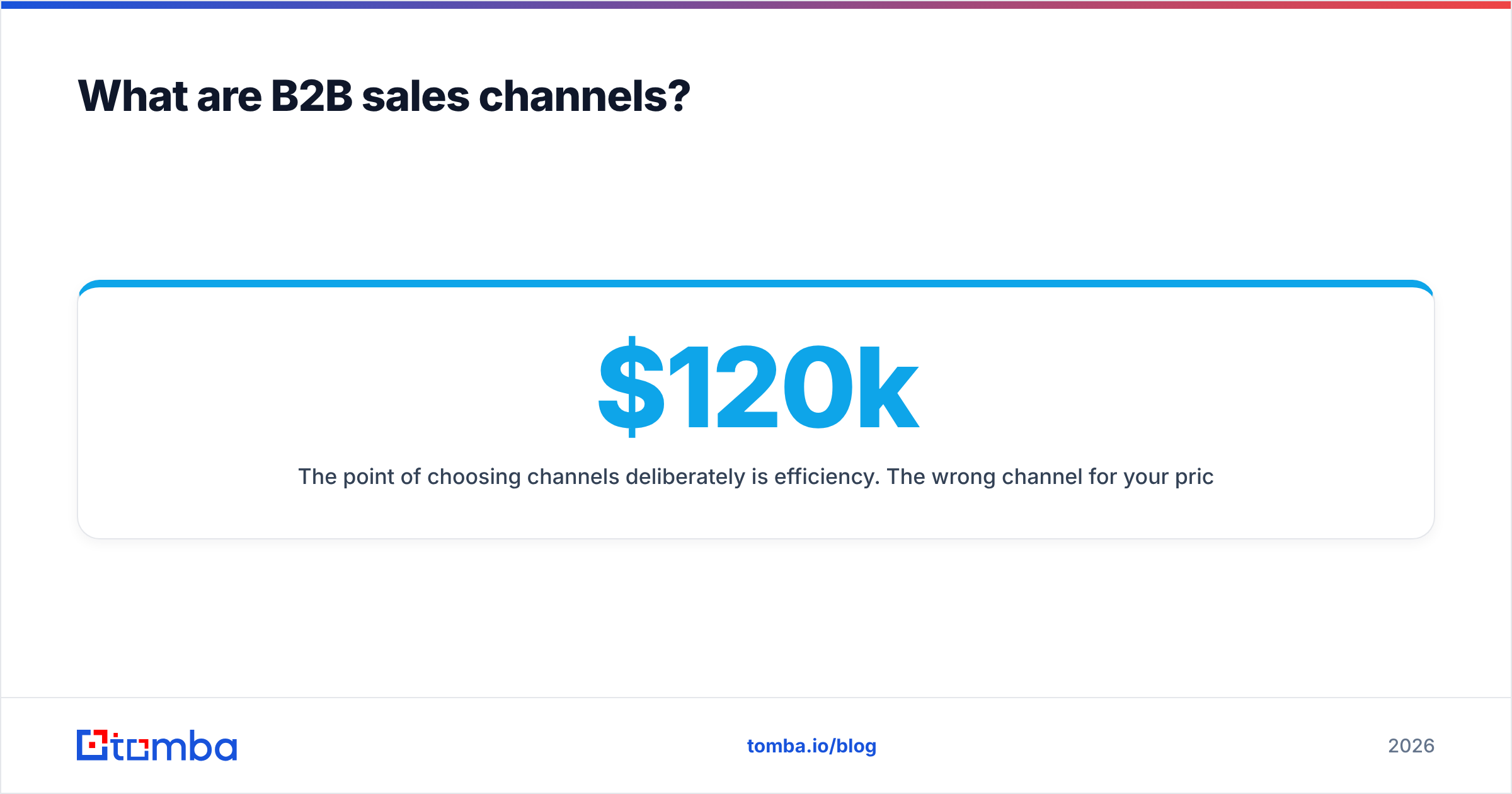
The point of choosing channels deliberately is efficiency. The wrong channel for your price point burns cash: paying a $120k account executive to close $40/month subscriptions never math out, and asking a free trial to close a $500k enterprise security deal never closes.
What are the main types of B2B sales channels?#
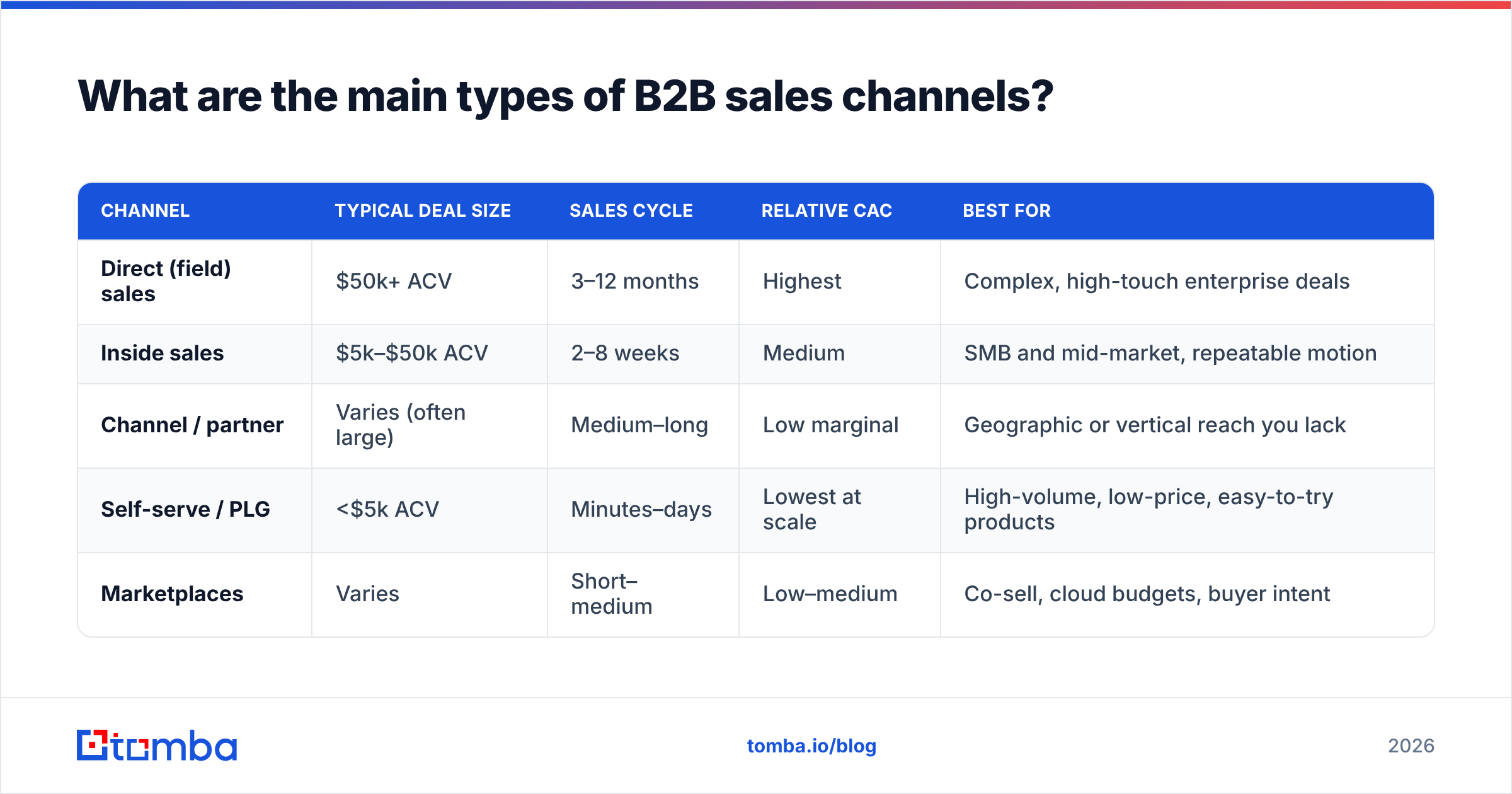
Here is how the five channels compare on the attributes that actually drive a decision — cost to acquire a customer, ideal deal size, sales cycle, and where each one breaks down.
| Channel | Typical deal size | Sales cycle | Relative CAC | Best for |
|---|---|---|---|---|
| Direct (field) sales | $50k+ ACV | 3–12 months | Highest | Complex, high-touch enterprise deals |
| Inside sales | $5k–$50k ACV | 2–8 weeks | Medium | SMB and mid-market, repeatable motion |
| Channel / partner | Varies (often large) | Medium–long | Low marginal | Geographic or vertical reach you lack |
| Self-serve / PLG | <$5k ACV | Minutes–days | Lowest at scale | High-volume, low-price, easy-to-try products |
| Marketplaces | Varies | Short–medium | Low–medium | Co-sell, cloud budgets, buyer intent |
A few things worth calling out from the table:
- Direct sales wins on win rate and deal size but is expensive to scale — every new dollar of capacity needs another hire and ramp time.
- Inside sales is the workhorse of modern B2B. It keeps the human touch of direct selling but strips out travel and field overhead, which is why most outbound sales programs are built here.
- Channel sales has near-zero marginal cost once a partner is productive, but partners need enablement, deal registration, and margin to stay loyal.
- Self-serve has the lowest CAC at scale but only works when a buyer can understand and adopt the product without a human.
- Marketplaces increasingly matter because enterprise buyers want to spend committed cloud budget; AWS reports buyers close faster through Marketplace than off-platform.
Is direct sales better than channel sales?#
Neither is universally better — they solve different problems. Direct sales gives you control and margin; channel sales gives you reach and speed into markets you cannot staff yourself.
Use direct sales when:
- Your average deal size justifies a full-time rep (rule of thumb: ACV of $25k+).
- The buying process is complex, with multiple stakeholders and custom requirements.
- You need tight control over messaging, pricing, and the customer relationship.
Use channel / partner sales when:
- You are entering a new geography or vertical where partners already have trust.
- Your product is part of a larger solution (e.g., it plugs into an integrator's stack).
- You want to scale revenue faster than you can hire and ramp reps.
The mistake is treating it as binary. According to research summarized by Gartner, B2B buyers move fluidly across human and digital touchpoints in a single purchase, which means most mature companies run direct and channel together — direct for strategic logos, channel for volume and reach. The deciding factor is usually gross margin: if you can't afford to give a partner 20–40% and still profit, the channel won't survive.
How do you choose the right channel mix?#
Start with three inputs: price point, buyer behavior, and margin. Then match the channel to the deal instead of forcing every deal through one motion.
A simple decision framework:
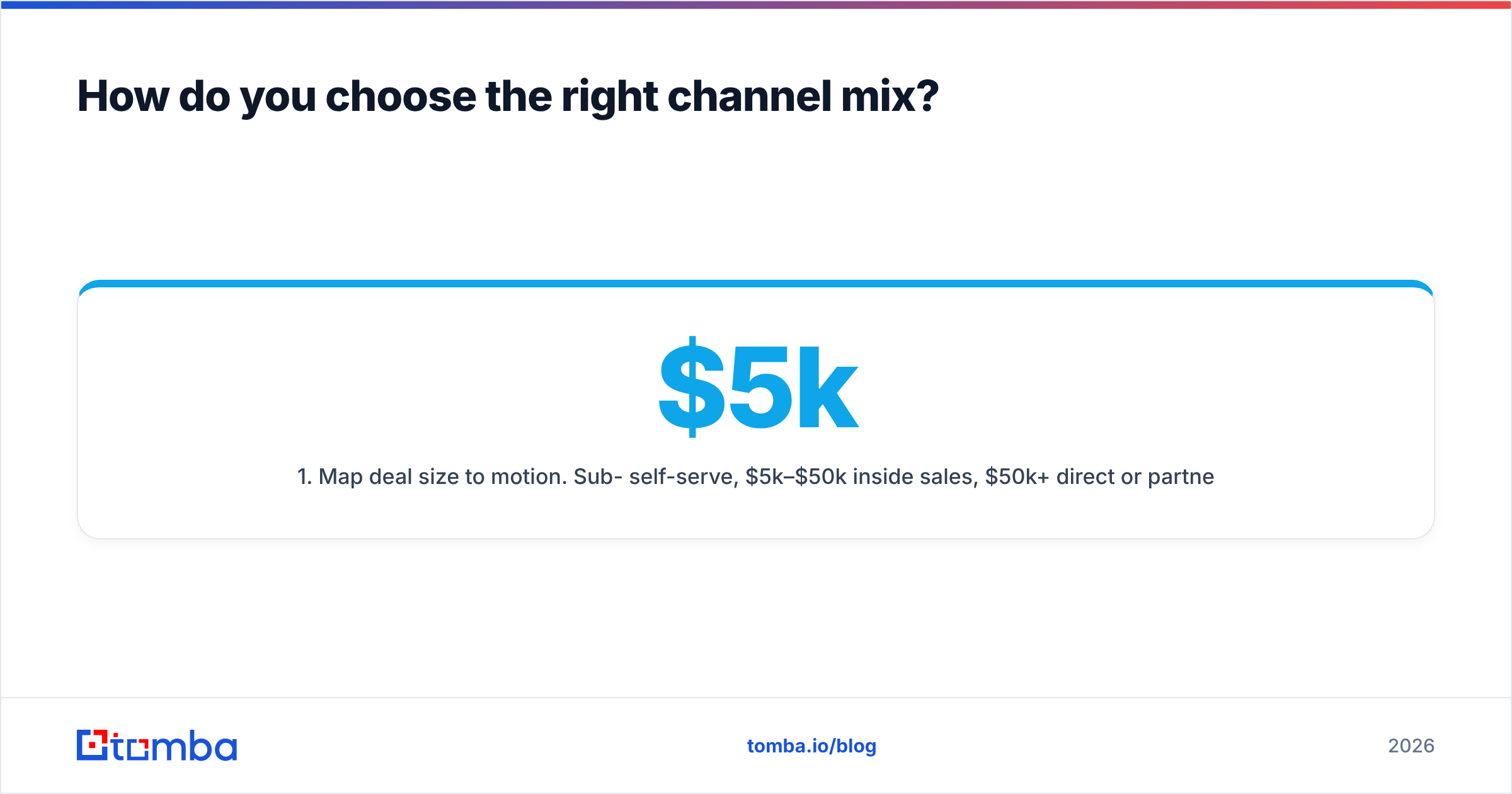
- Map deal size to motion. Sub-$5k self-serve, $5k–$50k inside sales, $50k+ direct or partner-assisted. Let the economics pick the channel, not org-chart habit.
- Follow the buyer, not the seller. If your buyers research and try before they talk to anyone, you need a self-serve front door even if you also have a sales team.
- Layer, don't replace. Most winning models stack channels: PLG to acquire, inside sales to convert and expand, partners to extend.
- Protect margin. Model fully-loaded CAC per channel before you commit headcount or partner margin. A channel that looks cheap can be expensive once you add enablement and support.
- Instrument everything. You can't optimize a mix you can't measure. Track pipeline, win rate, and CAC by channel from day one.
This is where revenue operations earns its keep — RevOps owns the data and reporting that tells you which channel is actually profitable versus which one just looks busy.
What is a hybrid or multi-channel sales model?#
A hybrid model deliberately combines two or more channels so each does what it's best at. It's the dominant pattern among fast-growing B2B companies in 2026, and for good reason: buyers themselves are multi-channel.
A typical hybrid stack looks like this:
- Self-serve captures inbound demand and qualifies intent cheaply. Free users become a pipeline you didn't pay reps to source.
- Inside sales converts the high-intent free accounts and runs targeted outbound to ideal-fit companies that never signed up.
- Field / direct sales takes the largest, most strategic opportunities that need executive relationships and custom terms.
- Partners and marketplaces extend reach into segments and budgets you can't address directly.
The friction in hybrid models is almost always routing and data, not strategy. When a self-serve user also gets cold-emailed by an SDR who doesn't know they already have an account, you look uncoordinated and lose trust. Clean, shared contact records and clear rules of engagement between channels are what make the hybrid model feel like one company instead of three.
Tools like HubSpot and Salesforce provide the CRM backbone for this, but the CRM is only as good as the data flowing into it.
How does data quality affect every sales channel?#
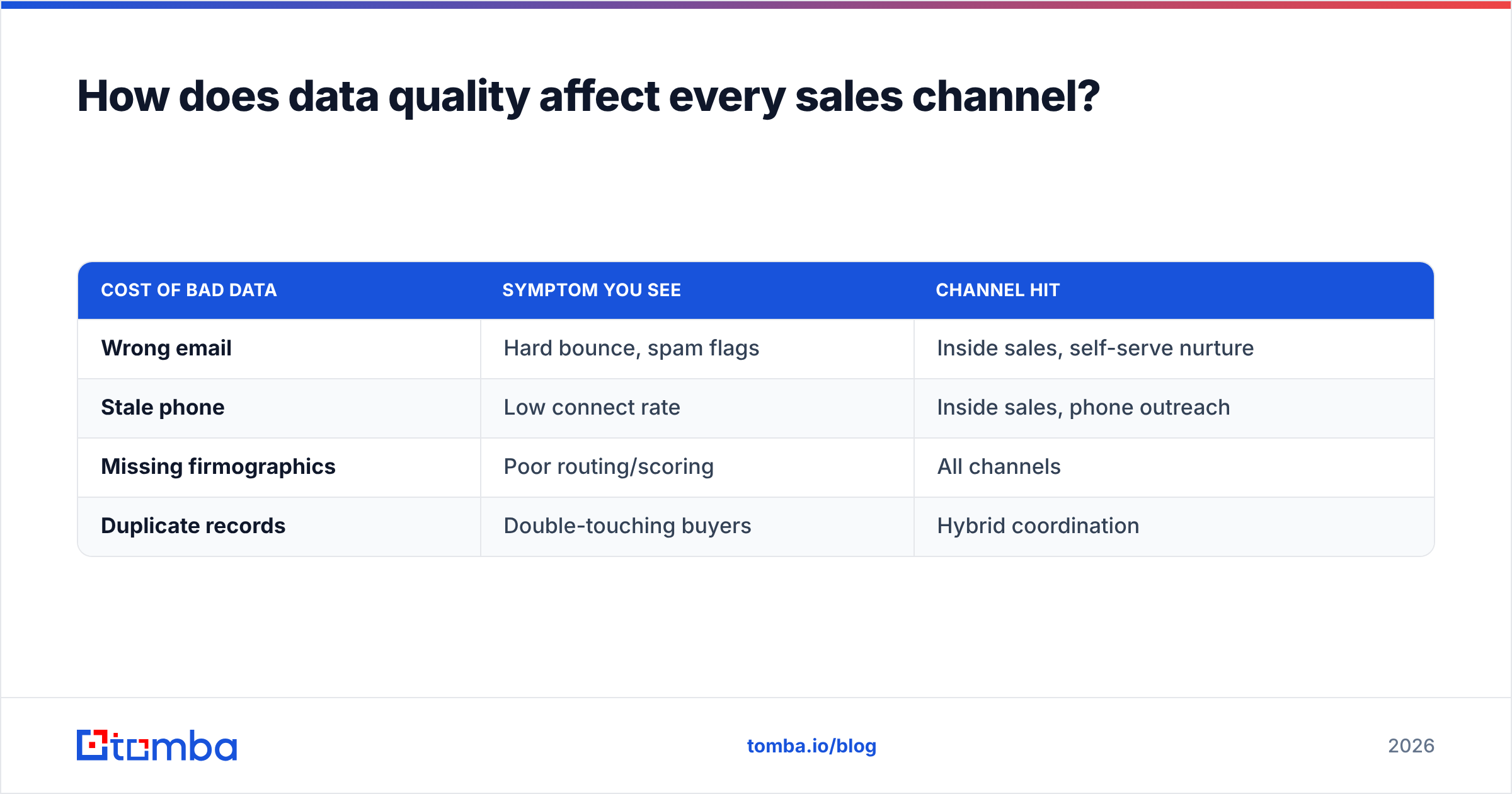
Bad contact data taxes all channels simultaneously, and most teams never see the bill itself — they just see lower connect rates, bounced sends, and reps chasing dead leads.
Consider how each channel degrades when the data is wrong:
- Inside sales wastes dials on disconnected numbers and emails that bounce, hurting sender reputation across the whole domain.
- Self-serve fills the CRM with junk signups that sales can't enrich, so good accounts get buried in noise.
- Channel partners lose faith fast if the leads you register are inaccurate.
- Marketplaces still require follow-up, and that follow-up needs verified contacts.
This is why data hygiene isn't a back-office chore — it's channel infrastructure. Before a rep ever picks up the phone or queues a sequence, the contact should be found and verified. A reliable email finder sources the right address by name and domain, and an email verifier confirms it's deliverable before it ever enters a sequence. Verified data is reviewed by independent buyers on platforms like G2 precisely because it changes channel economics so directly.
| Cost of bad data | Symptom you see | Channel hit |
|---|---|---|
| Wrong email | Hard bounce, spam flags | Inside sales, self-serve nurture |
| Stale phone | Low connect rate | Inside sales, phone outreach |
| Missing firmographics | Poor routing/scoring | All channels |
| Duplicate records | Double-touching buyers | Hybrid coordination |
How do you measure B2B sales channel performance?#
Measure each channel on the same four metrics so you can compare them honestly: pipeline generated, win rate, CAC, and payback period.
The metrics that matter per channel:
- Pipeline contribution — how much qualified pipeline each channel sources, not just closed revenue.
- Win rate — channels with high pipeline but low win rate are leaking somewhere in qualification.
- CAC and CAC payback — fully-loaded cost to acquire a customer through that channel, and how many months of revenue it takes to recover.
- Net revenue retention by channel — self-serve and partner customers often expand or churn very differently than direct-sold ones.
Two reporting habits separate teams that optimize their mix from teams that guess: attribute every deal to the channel that actually originated it (not the one that closed it), and review the mix quarterly against your targets. If a channel's CAC is rising while win rate falls, that's your signal to reallocate budget before the next planning cycle. You can see how Tomba structures usage and cost on the Tomba pricing page if you're modeling data costs into per-channel CAC.
Which sales channel should a new B2B company start with?#
Start with the single channel that matches your price point, then add others only once the first is repeatable. Trying to launch all five at once spreads a small team too thin to learn anything.
- Under $5k ACV: lead with self-serve. Make it trivially easy to try and buy, and add a light inside-sales layer for expansion.
- $5k–$50k ACV: lead with inside sales. It's the most capital-efficient way to build a repeatable, measurable motion.
- $50k+ ACV: lead with direct sales, and recruit partners once you have proof points and reference customers.
Whatever you start with, get the data foundation right early. It's far cheaper to build on verified contacts from day one than to clean a polluted CRM after two years of bad imports.
Closing: build every channel on data you can trust#
Your channel strategy can be brilliant on paper and still stall if reps are dialing dead numbers and SDRs are emailing addresses that bounce. Every B2B sales channel — direct, inside, partner, self-serve, or marketplace — runs on one shared input: accurate, verified contact data.
That's exactly what Tomba's Email Finder is built for. Find the right decision-maker's professional email by name or domain, verify it before it hits a sequence, and feed clean records into whatever channel mix you're running. Start free with 25 searches a month, then scale up as your channels prove out — Starter is $49/mo when you're ready. Get your data right first, and every channel you build on top of it performs better.
// get started
Find, verify and enrich your first contacts today
Start on the free plan with 25 searches a month, then scale when your team is ready.
Free plan · No credit card required · GDPR & CCPA
// about the author