12 B2B Sales Closing Techniques That Actually Work in 2026
Closing is not a magic line at the end of a call — it is a process you build into every stage. Here are 12 B2B sales closing techniques, with scripts and a workflow to win more deals in 2026.
Closing a B2B deal in 2026 looks nothing like the high-pressure "always be closing" caricature from sales movies. Modern buyers run committees, read review sites before they take your call, and ghost the moment they smell manipulation. The reps who win are the ones who treat the close as the natural last step of a well-run process — not a trick they spring at the end.
This guide breaks down 12 B2B sales closing techniques that actually move deals across the line, when to use each one, and the exact language to borrow. You will also get a comparison table and a repeatable closing workflow you can run on every opportunity.
TL;DR#
- The close starts at discovery. Most lost deals were lost in stage one, not at the signature line.
- Match the technique to the buyer. Assumptive closes work on warm champions; summary and takeaway closes rescue stalled deals.
- Objections are buying signals. A prospect who pushes back is engaged — handle the concern, then re-ask for the commitment.
- Clean data wins. You cannot close a deal you never reach; verified contacts and accurate enrichment keep your pipeline full of real buyers.
- Measure your win rate. Track which closes convert, by segment, and double down on what works.
What is a sales close, really?#
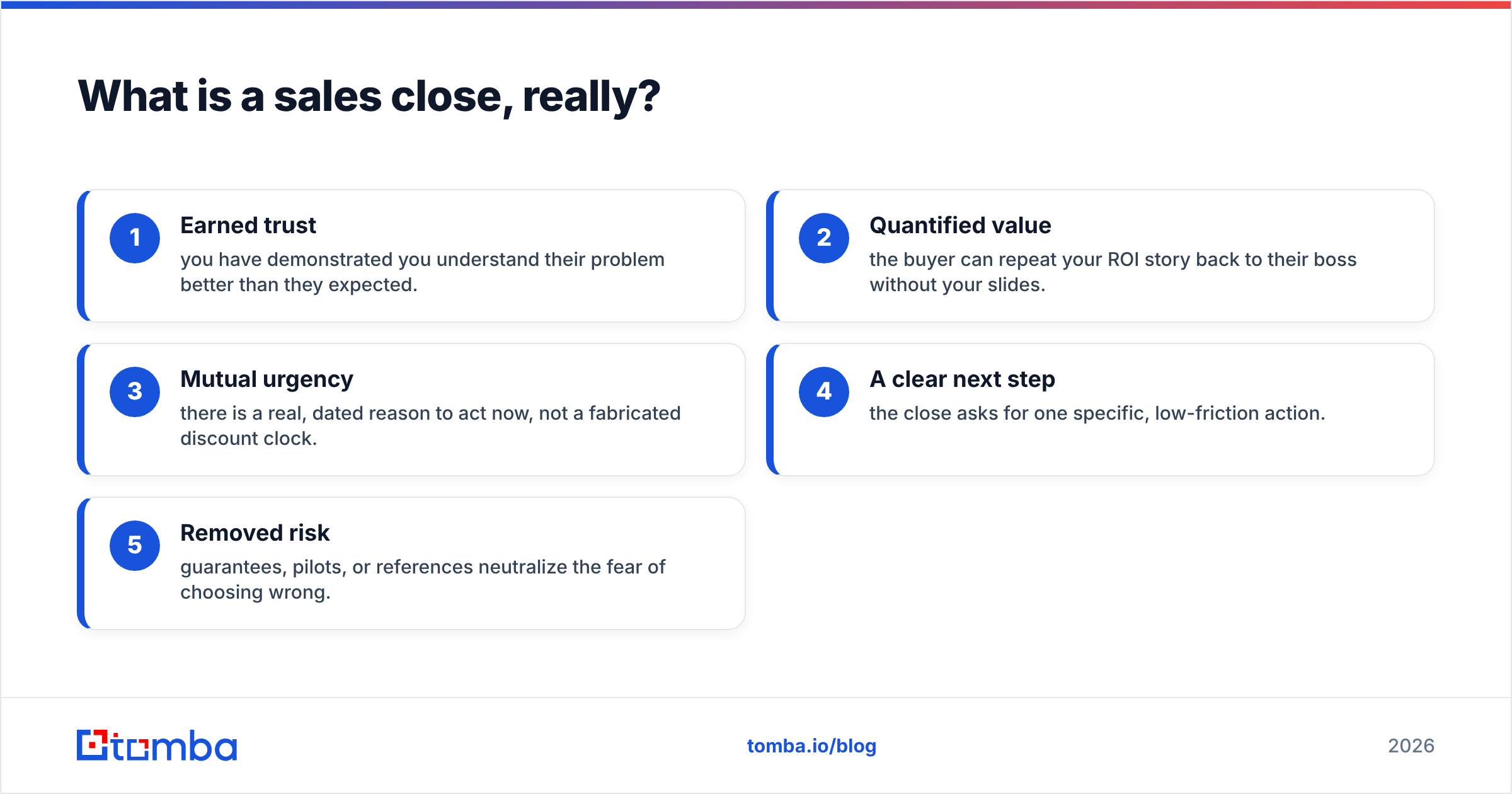
A sales close is the moment a prospect agrees to move forward — but think of it less as a finish line and more as the last domino in a row you have been setting up since the first call. If the earlier dominoes (discovery, value alignment, stakeholder buy-in) are stacked correctly, the final tap is gentle. If they are crooked, no clever closing line will save you.
In B2B specifically, the "yes" is rarely from one person. Gartner research has shown that a typical B2B buying group involves six to ten decision-makers, each armed with their own information. That means your close is really a series of micro-commitments across multiple stakeholders, not a single dramatic ask.
Here is what separates a strong closing motion from a weak one:
- Earned trust — you have demonstrated you understand their problem better than they expected.
- Quantified value — the buyer can repeat your ROI story back to their boss without your slides.
- Mutual urgency — there is a real, dated reason to act now, not a fabricated discount clock.
- A clear next step — the close asks for one specific, low-friction action.
- Removed risk — guarantees, pilots, or references neutralize the fear of choosing wrong.
What are the best B2B sales closing techniques?#
There is no single "best" close — the right move depends on deal temperature, stakeholder dynamics, and how much urgency genuinely exists. Below are the twelve that earn their place in a modern B2B playbook.
1. The assumptive close#
You proceed as if the decision is already made: "When we kick off onboarding next week, who on your side should be in the room?" Use it only when buying signals are strong. On a lukewarm deal it feels presumptuous; on a hot one it removes friction.
2. The summary close#
Recap every agreed-upon value point before you ask: "So we have agreed this cuts your ramp time by 40%, fits your current stack, and stays under budget — ready to move forward?" The cumulative weight of yeses makes the final yes easy.
3. The question close#
Instead of telling, you ask: "Is there any reason we couldn't get started this quarter?" The answer either surfaces a hidden objection or confirms the path is clear. It hands control to the buyer while keeping momentum.
4. The takeaway close#
Gently remove a feature or term to test commitment: "The enterprise tier might be more than you need — should we look at the smaller plan instead?" Loss aversion often makes the buyer reach for what you pulled away.
5. The urgency (or deadline) close#
Tie action to a real event — a pricing change, an implementation slot, a contract renewal. Never fabricate scarcity; B2B buyers verify, and a fake deadline torches trust permanently.
6. The puppy-dog close#
Let them try it. A pilot, free trial, or limited rollout lowers the perceived risk to near zero. Once the product is embedded in their workflow, switching back feels like the harder choice.
7. The Ben Franklin close#
Build a literal pros-and-cons list together. By co-authoring the reasons to buy, the prospect convinces themselves — and you learn exactly which cons to address.
8. The objection close#
Isolate the final concern: "If we solve the integration question, are you ready to sign?" Lock the commitment to the resolution, then resolve it.
9. The sharp-angle close#
When a buyer asks for a concession ("Can you include onboarding?"), respond with a reciprocal close: "If I can get that approved, can we sign today?" It converts a demand into a closing lever.
10. The soft close#
Low-pressure and exploratory: "If I could show you a way to cut your tooling cost by a third, would you want to hear about it?" Ideal early, when a hard ask would feel premature.
11. The needs-based close#
Map your solution line-by-line against the requirements they gave you in discovery. The close becomes a checklist they cannot logically argue with.
12. The follow-up close#
Most B2B deals close after the fifth touch, yet most reps quit after two. A disciplined, value-adding follow-up cadence — not "just checking in" — closes the deals everyone else abandoned.
Which closing technique should you use when?#
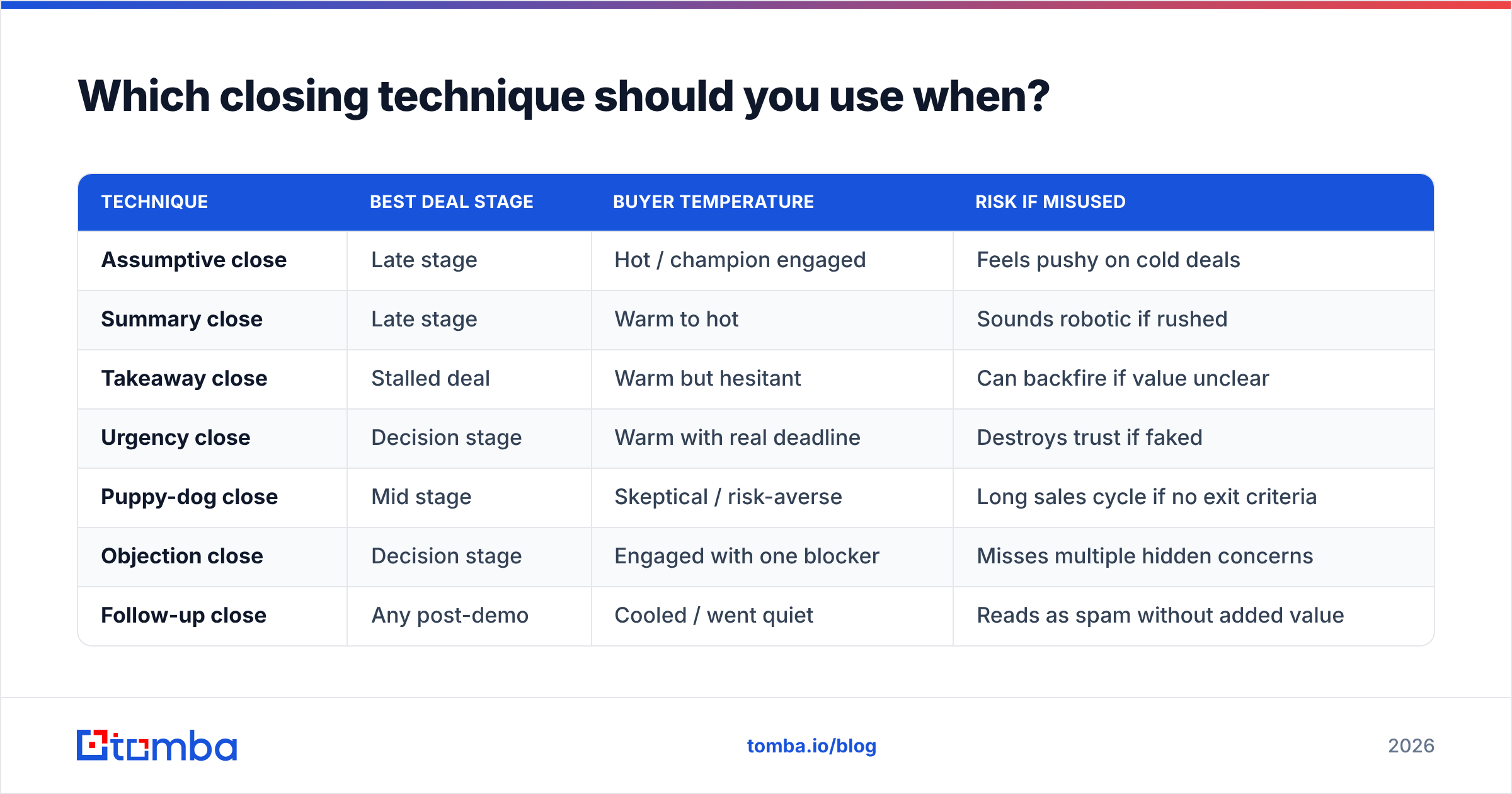
The table below maps each technique to the deal situation where it performs best, so you stop guessing and start matching.
| Technique | Best deal stage | Buyer temperature | Risk if misused |
|---|---|---|---|
| Assumptive close | Late stage | Hot / champion engaged | Feels pushy on cold deals |
| Summary close | Late stage | Warm to hot | Sounds robotic if rushed |
| Takeaway close | Stalled deal | Warm but hesitant | Can backfire if value unclear |
| Urgency close | Decision stage | Warm with real deadline | Destroys trust if faked |
| Puppy-dog close | Mid stage | Skeptical / risk-averse | Long sales cycle if no exit criteria |
| Objection close | Decision stage | Engaged with one blocker | Misses multiple hidden concerns |
| Follow-up close | Any post-demo | Cooled / went quiet | Reads as spam without added value |
Notice the pattern: assumptive and summary closes assume momentum, takeaway and objection closes rescue stalls, and the follow-up close is the safety net under all of them. A good rep keeps three or four of these loaded and reads the room.
How do you handle objections before closing?#
Treat every objection as a request for more information, not a rejection. The prospect who says "this is too expensive" is telling you the value story has not landed yet — which is a fixable problem, not a dead end.
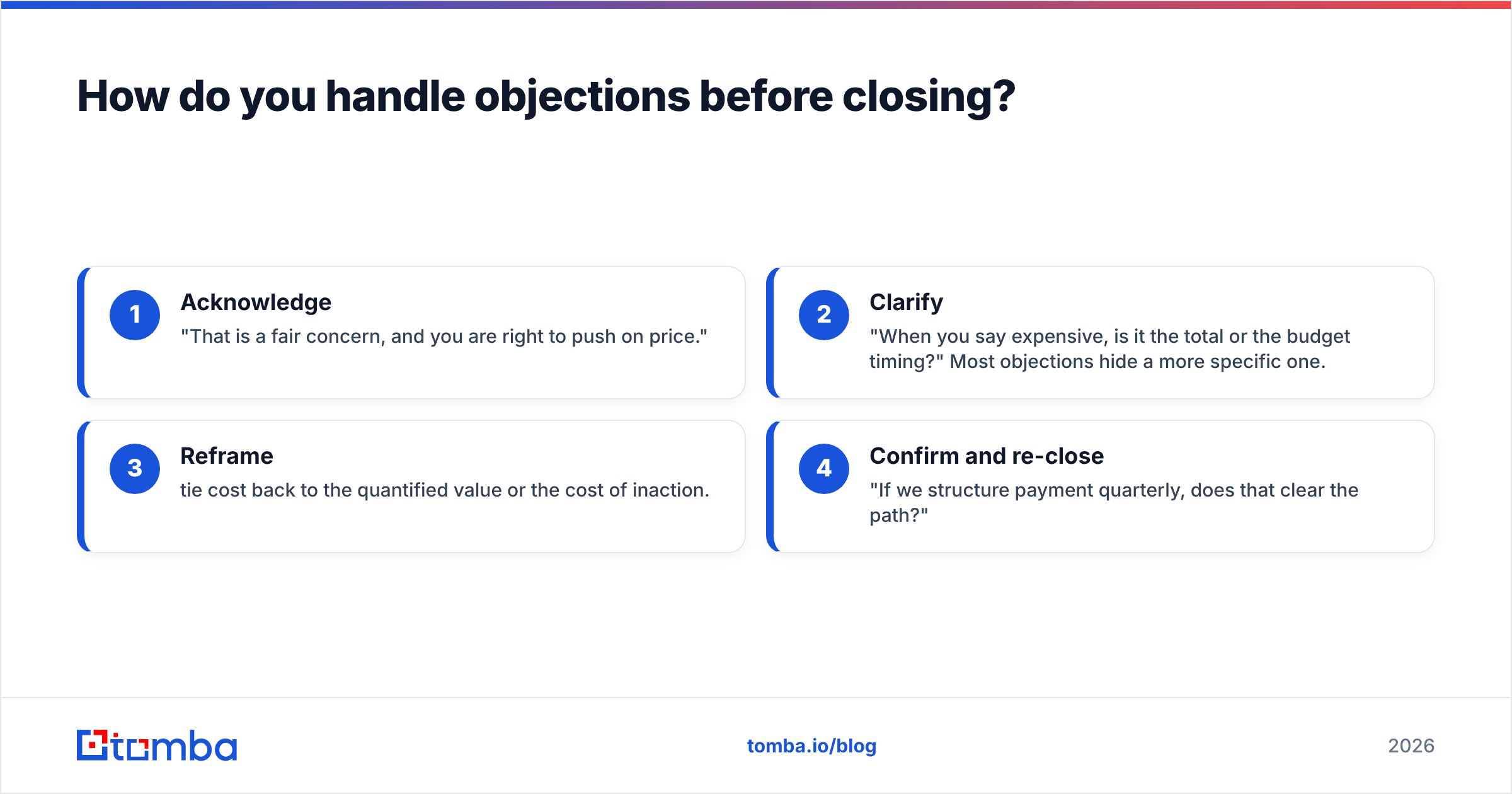
Use a simple four-step frame on any objection:
- Acknowledge — "That is a fair concern, and you are right to push on price."
- Clarify — "When you say expensive, is it the total or the budget timing?" Most objections hide a more specific one.
- Reframe — tie cost back to the quantified value or the cost of inaction.
- Confirm and re-close — "If we structure payment quarterly, does that clear the path?"
The fastest way to reduce objections is to surface them early. Strong discovery and a tight understanding of your buyer's response rate and engagement patterns mean fewer surprises at the finish line. HubSpot's sales research consistently shows that reps who pre-empt objections in the demo close faster than those who wait for them to appear at the contract stage — see their ongoing analysis at blog.hubspot.com/sales.
Why does your data decide whether you ever get to close?#
You cannot close a deal with a buyer you never reached — and this is where most pipelines quietly leak. A reputable closing technique applied to a wrong-number contact or a bounced email closes nothing. Before technique comes reachability.
Three data problems sabotage closes before they start:
- Stale contacts. People change jobs every few years; your champion may already be gone. Verified, refreshed records keep you talking to the actual decision-maker.
- Wrong stakeholders. If you only have one contact in a six-person buying group, you are one objection away from a stalled deal. Mapping and reaching the full committee is a closing advantage.
- Bounced outreach. High bounce rates wreck sender reputation and bury your follow-up close in spam folders.
This is the unglamorous half of closing. Tools that find and verify contact data — like a dedicated email finder and data enrichment layer — keep your committee map complete so your closing technique has someone real to land on. The best objection handler in the world cannot rescue a deal sent to a dead inbox.
How do you build a repeatable closing workflow?#
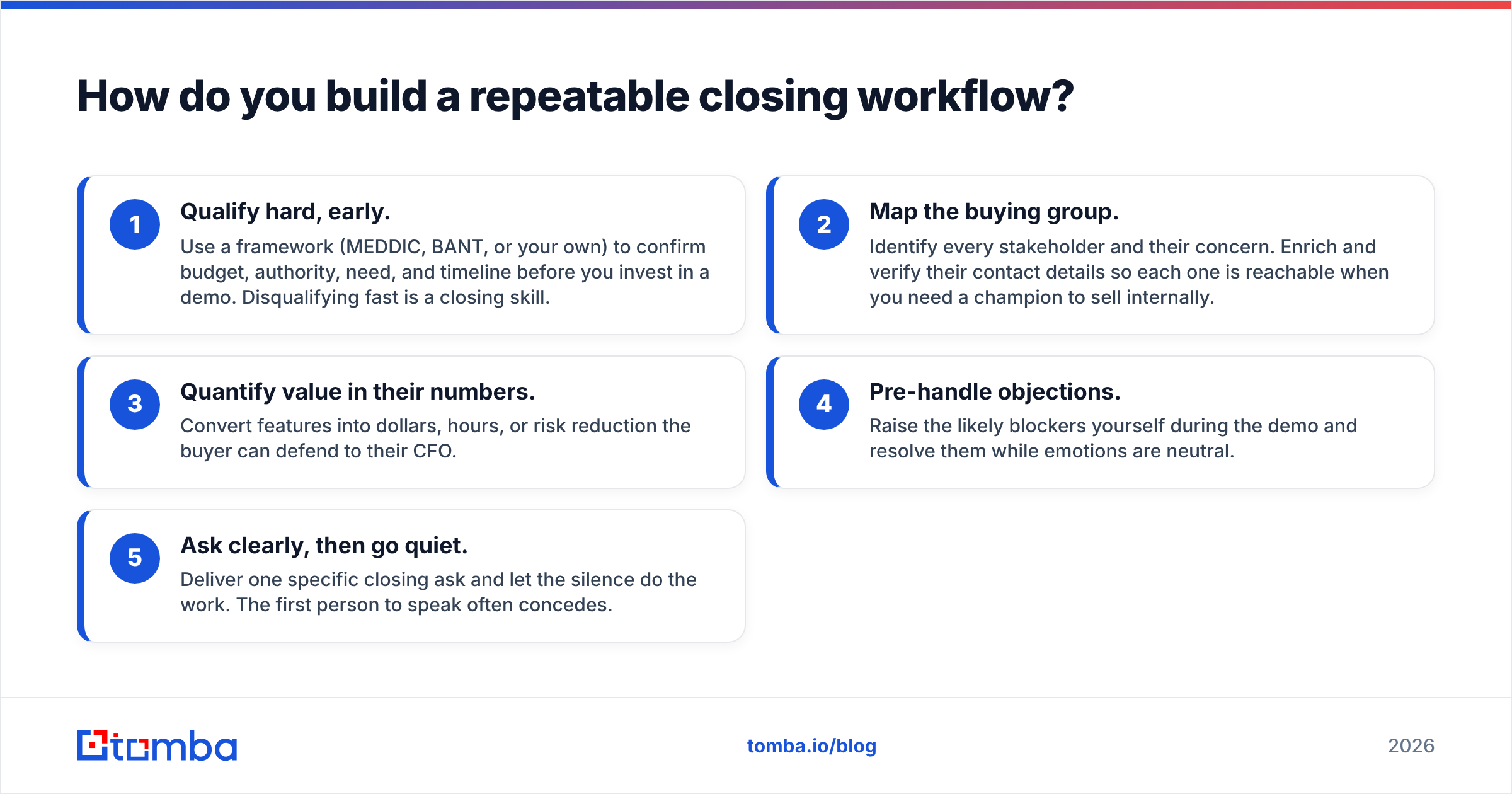
Top closers are not improvising; they run a process. Here is a five-step workflow you can apply to every opportunity, regardless of which technique you reach for.
- Qualify hard, early. Use a framework (MEDDIC, BANT, or your own) to confirm budget, authority, need, and timeline before you invest in a demo. Disqualifying fast is a closing skill.
- Map the buying group. Identify every stakeholder and their concern. Enrich and verify their contact details so each one is reachable when you need a champion to sell internally.
- Quantify value in their numbers. Convert features into dollars, hours, or risk reduction the buyer can defend to their CFO.
- Pre-handle objections. Raise the likely blockers yourself during the demo and resolve them while emotions are neutral.
- Ask clearly, then go quiet. Deliver one specific closing ask and let the silence do the work. The first person to speak often concedes.
Plug this into your CRM so every rep runs the same motion and you can see exactly where deals stall. When you can measure the drop-off stage, you know which closing technique to coach.
What closing mistakes kill B2B deals in 2026?#
Even strong reps sabotage themselves with avoidable habits. Watch for these:
- Closing too early. Asking for the signature before value is established reads as desperate and resets trust.
- Talking past the close. Once they say yes, stop selling. Continued pitching invites new doubts.
- One-threaded deals. Relying on a single contact means one job change or one skeptic ends the deal.
- Fake urgency. Manufactured deadlines are transparent to experienced buyers and permanently damage credibility.
- No mutual action plan. Without a shared, dated next-step document, "let me think about it" becomes a black hole.
Review sites like G2 make buyers more informed and more skeptical than ever, so manipulation-based closes age badly. The techniques that endure are the ones rooted in genuine value and respect for the buyer's process.
Frequently asked questions#
What is the most effective B2B closing technique? There is no universal winner. For warm, engaged deals the assumptive and summary closes convert best; for stalled deals the takeaway and objection closes re-open momentum. The most effective approach is matching the technique to the buyer's temperature and stage.
How many follow-ups does it take to close a B2B deal? Most B2B sales close between the fifth and twelfth touch, yet the majority of reps stop after two. A persistent, value-adding follow-up cadence is one of the highest-ROI closing habits you can build.
Can you close without discounting? Yes. Discounting trains buyers to wait for concessions. Lead with quantified value, payment-term flexibility, and risk reducers like pilots or guarantees before you ever touch price.
Close more of the deals you already have#
The hard truth: most of your lost revenue is not a closing-technique problem — it is a reachability and pipeline problem. The techniques above only pay off when you are talking to the right, verified, fully-mapped buying group at the right time.
Start there. Use the Tomba Email Finder to find and verify the professional emails of every stakeholder in your target accounts, enrich your CRM with accurate data, and keep your follow-up cadence landing in real inboxes instead of bouncing. When your pipeline is full of reachable, qualified buyers, these closing techniques do exactly what they are supposed to — turn good conversations into signed deals. Build the pipeline first, then close it.
// get started
Find, verify and enrich your first contacts today
Start on the free plan with 25 searches a month, then scale when your team is ready.
Free plan · No credit card required · GDPR & CCPA
Get the Tomba newsletter
Product and data updates
// about the author