B2B Sales Coaching in 2026: A Practical Framework for Managers
A no-fluff guide to B2B sales coaching in 2026: the frameworks, cadences, and metrics that turn average reps into consistent quota-crushers.
B2B Sales Coaching in 2026: A Practical Framework for Managers
Most B2B sales teams don't have a talent problem. They have a coaching problem. You hire smart people, hand them a quota, and then hope a quarterly pep talk turns them into closers. It doesn't. This guide shows you what actually works.
TL;DR
- B2B sales coaching is the ongoing, skill-by-skill development of reps — not deal inspection, not pipeline review, not motivation.
- The highest-leverage cadence is a weekly 1:1 focused on one behavior, backed by call recordings and real pipeline data.
- Coaching to a repeatable framework (like a defined sales process or methodology) beats coaching to "gut feel" every time.
- Measure coaching by leading indicators — activity quality, conversion between stages, ramp time — not just closed revenue.
- Good data is the fuel: clean contact records and accurate prospect info let reps spend coaching gains on selling, not list-building.
What is B2B sales coaching, exactly?#
B2B sales coaching is the process of helping a salesperson improve a specific selling skill through observation, feedback, and practice — repeated consistently over time. Think of it like a strength coach in a gym. A strength coach doesn't lift the weight for you, and they don't just yell "lift more." They watch your form, isolate the one thing breaking down, and drill it until it's automatic. Then they move to the next thing.
Technically, coaching is distinct from three things managers constantly confuse it with:
- Deal inspection — "Where is the Acme deal? What's the next step?" That's pipeline management. It moves one deal forward but teaches the rep nothing transferable.
- Managing — setting targets, running forecasts, enforcing CRM hygiene. Necessary, but it's administration, not development.
- Training — onboarding, product certs, a one-time methodology workshop. Training delivers knowledge once; coaching converts that knowledge into a habit.
The difference matters because most managers think they're coaching when they're actually just inspecting deals. According to research summarized by Gartner, reps forget the majority of what they learn in formal training within weeks unless it's reinforced — and reinforcement is exactly what coaching provides.
Why does B2B sales coaching matter more in 2026?#
Because buying got harder and the cost of a bad rep got higher. B2B buying committees now average 6–10 stakeholders, sales cycles stretched, and buyers do most of their research before they ever talk to you. A rep who "wings it" no longer survives on charm. They survive on disciplined discovery, sharp multithreading, and the ability to build a business case — all coachable skills.
There's also a math problem. Ramp time for a B2B rep often runs 3–9 months. If coaching cuts that ramp by even a few weeks, the compounding revenue impact across a team is enormous. Conversely, leaving a struggling rep uncoached for two quarters burns salary, pipeline, and the accounts they touched.
Here's the blunt reality: the manager is the single biggest variable in rep performance. Not the comp plan, not the territory, not the deck. Teams with managers who coach consistently outperform teams whose managers only forecast. Coaching is the highest-ROI activity a frontline sales leader can spend time on, and in 2026 most still spend it on spreadsheets.
What does a good B2B sales coaching framework look like?#
A good framework is simple enough to run every week without burning out. The one most consistent teams use has four steps you can remember as Observe → Diagnose → Drill → Verify.
- Observe — Watch the rep do the actual work. Listen to two recorded calls, read three prospecting emails, or shadow a live discovery call. Coaching from the rep's recollection of a call is coaching from fiction.
- Diagnose — Pick ONE skill gap. Not five. If discovery is shallow, that's the focus. Trying to fix everything at once fixes nothing.
- Drill — Role-play the specific moment. Have the rep re-run the discovery opening three times until the question framing is sharp. Practice, not lecture.
- Verify — On the next call, check whether the behavior changed. If yes, move to the next gap. If no, drill again.
The discipline is in the narrowness. One skill, observed in reality, drilled deliberately, verified next week.
Coaching cadence by rep stage#
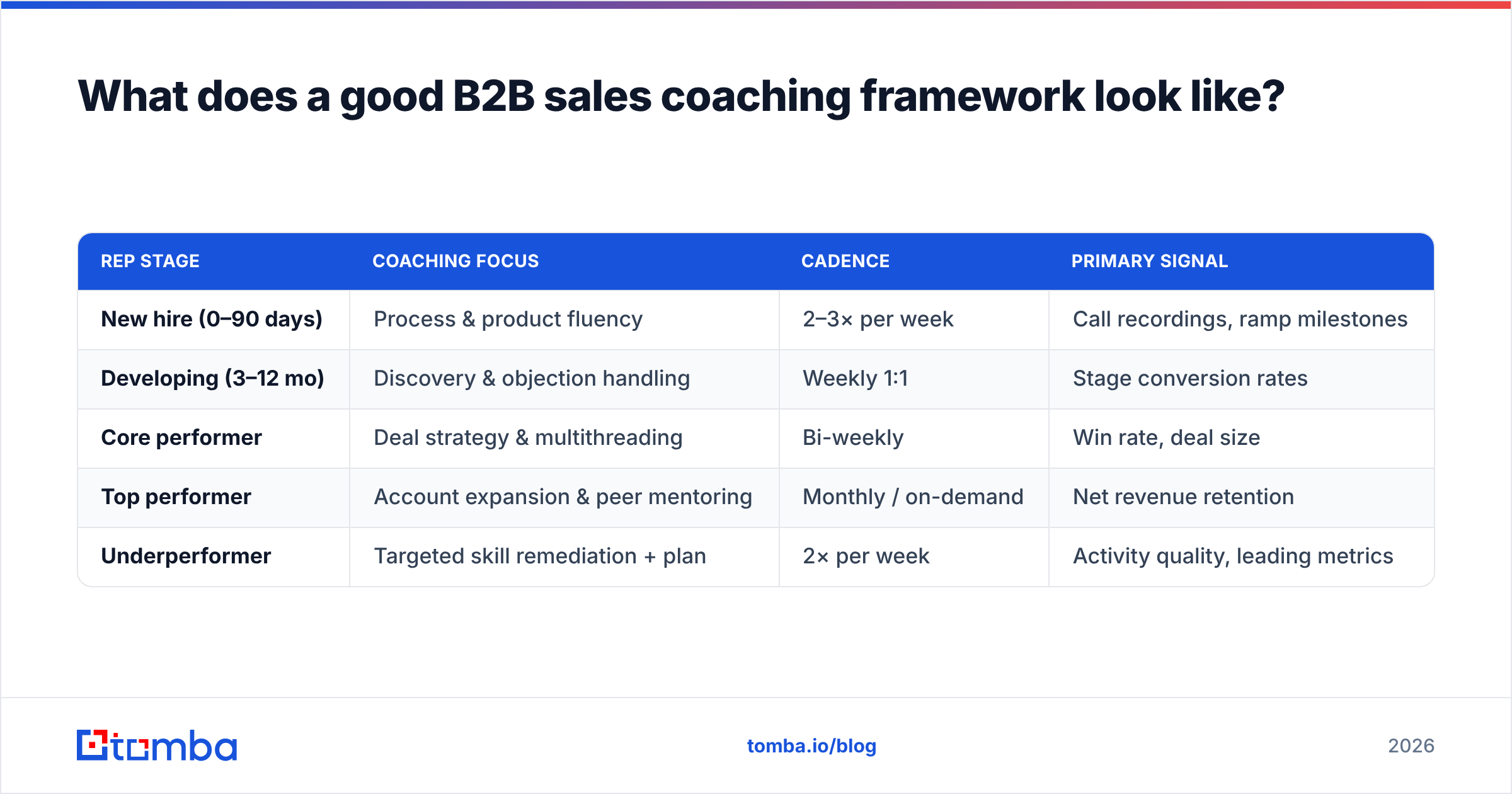
| Rep stage | Coaching focus | Cadence | Primary signal |
|---|---|---|---|
| New hire (0–90 days) | Process & product fluency | 2–3× per week | Call recordings, ramp milestones |
| Developing (3–12 mo) | Discovery & objection handling | Weekly 1:1 | Stage conversion rates |
| Core performer | Deal strategy & multithreading | Bi-weekly | Win rate, deal size |
| Top performer | Account expansion & peer mentoring | Monthly / on-demand | Net revenue retention |
| Underperformer | Targeted skill remediation + plan | 2× per week | Activity quality, leading metrics |
Notice top performers get less frequent coaching, not none — and they become coaches themselves. The heaviest investment goes to new hires and the rep on the edge, where the marginal return is highest.
How is sales coaching different from sales management?#
They overlap, but mixing them in the same conversation dilutes both. A clean split looks like this:
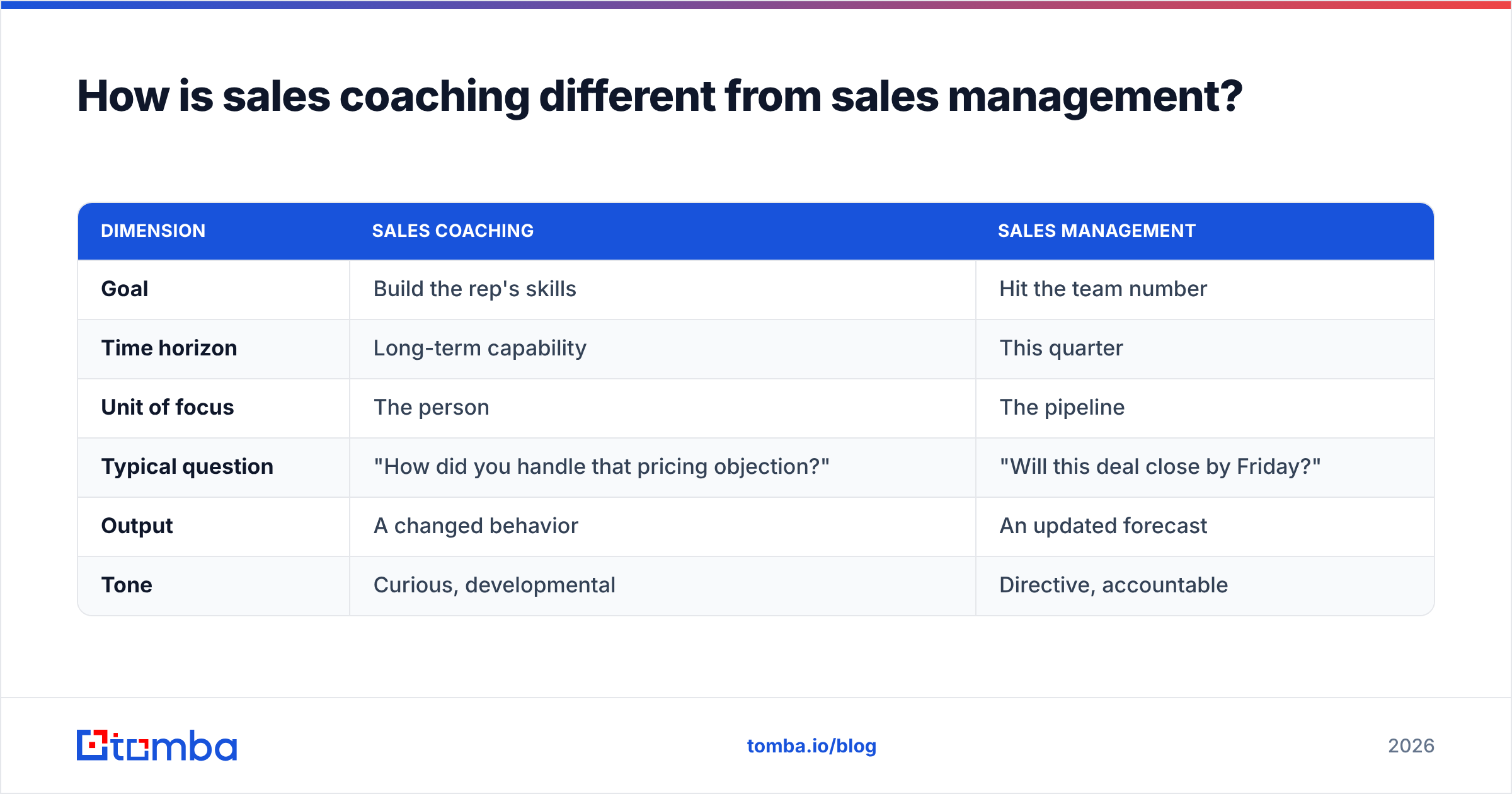
| Dimension | Sales coaching | Sales management |
|---|---|---|
| Goal | Build the rep's skills | Hit the team number |
| Time horizon | Long-term capability | This quarter |
| Unit of focus | The person | The pipeline |
| Typical question | "How did you handle that pricing objection?" | "Will this deal close by Friday?" |
| Output | A changed behavior | An updated forecast |
| Tone | Curious, developmental | Directive, accountable |
The practical takeaway: don't run them in the same meeting. If your "coaching 1:1" always drifts into "so where's the Globex deal," you'll never coach. Block separate time. Many strong leaders run a 30-minute pure-coaching session and a separate pipeline review, and they guard the coaching slot like a customer meeting.
If you want to dig into how the broader revenue function organizes around this, the discipline of revenue operations increasingly owns the data and tooling that make coaching measurable.
What should you actually coach? The high-leverage skills#
Not all skills move the number equally. Coach these, in roughly this priority for most B2B teams:
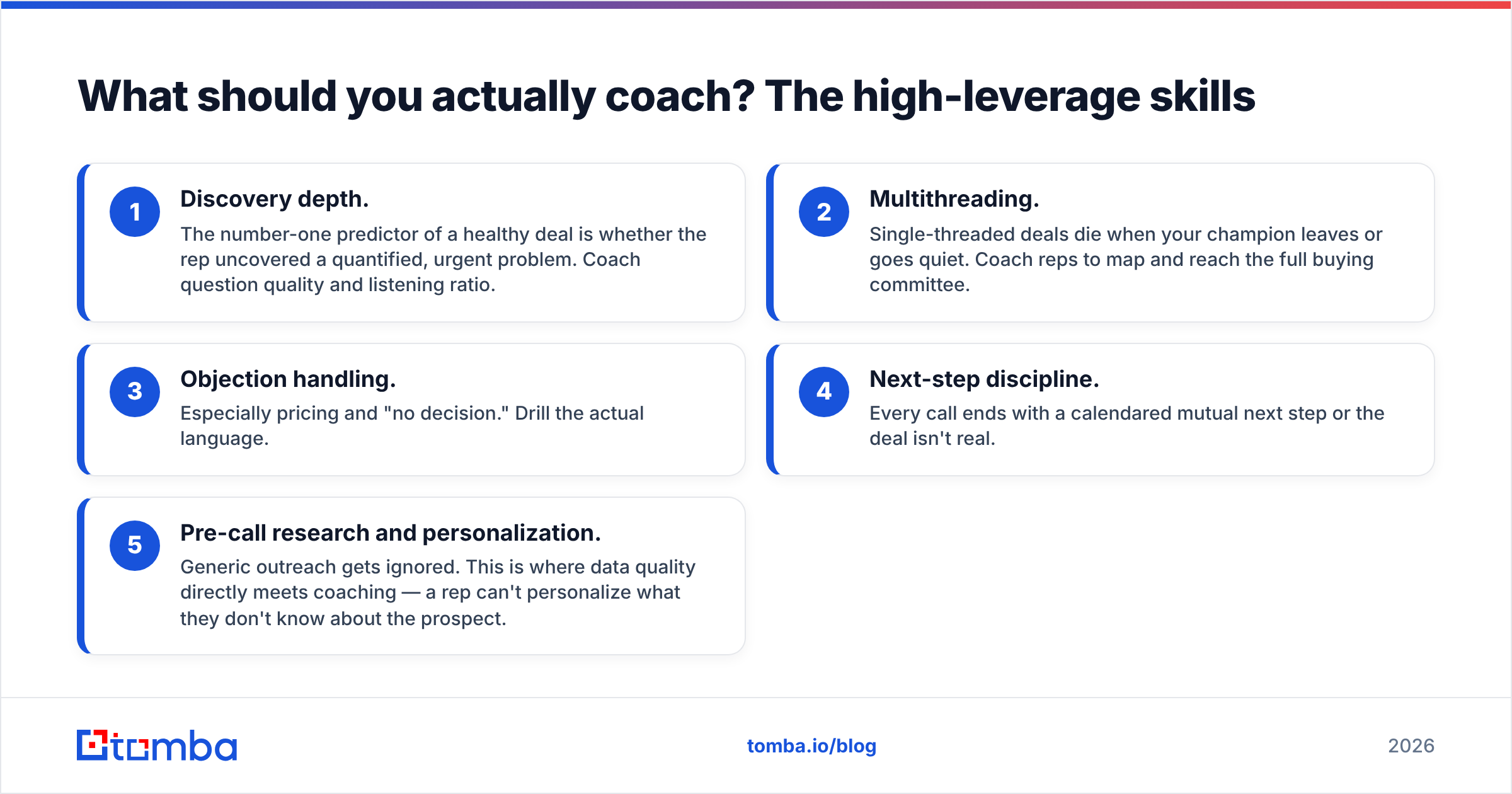
- Discovery depth. The number-one predictor of a healthy deal is whether the rep uncovered a quantified, urgent problem. Coach question quality and listening ratio.
- Multithreading. Single-threaded deals die when your champion leaves or goes quiet. Coach reps to map and reach the full buying committee.
- Objection handling. Especially pricing and "no decision." Drill the actual language.
- Next-step discipline. Every call ends with a calendared mutual next step or the deal isn't real.
- Pre-call research and personalization. Generic outreach gets ignored. This is where data quality directly meets coaching — a rep can't personalize what they don't know about the prospect.
That last point is where tooling earns its keep. If a rep burns the first 20 minutes of every block hunting for a contact's email or guessing at a company's structure, no amount of coaching converts that time into selling. Giving reps clean, verified contact data — through an email finder and reliable data enrichment — removes the friction so coaching gains land on conversations, not list-building.
Which metrics tell you coaching is working?#
Closed revenue is a lagging metric — it tells you what happened, not whether your coaching is changing behavior. Coach to leading indicators and let revenue follow.
- Stage-to-stage conversion. If you coached discovery, did the discovery-to-proposal conversion rate climb? That's the proof.
- Activity quality, not just volume. 40 thoughtful, researched touches beat 200 spray-and-pray emails. Track response rate, not just send count.
- Ramp time. Are new hires hitting full productivity faster quarter over quarter?
- Win rate by rep. Trend it over time, not a single quarter — small samples lie.
- Coaching consistency. Track whether the 1:1s actually happened. Skipped sessions are the silent killer; if you can't see the cadence, you can't protect it.
A simple operating rule: pick the ONE leading metric tied to the skill you're coaching this month, and review it weekly with each rep. If the metric isn't a number you both can see, the coaching has no scoreboard.
How do tools and data fit into coaching?#
Tools don't replace coaching — they make it visible and remove the busywork that crowds it out. Three categories matter.
Conversation intelligence (call recording + transcription) is the backbone. You cannot coach what you didn't observe, and you can't observe every live call. Recorded calls let you spot-check, build a library of "great discovery" examples, and let reps self-review before the 1:1.
Your CRM is the system of record for the pipeline data you'll coach against — stage conversion, cycle length, deal slippage. Coaching with CRM data turns "I feel like your deals stall" into "your discovery-to-demo conversion is 22% versus the team's 41% — let's look at why."
Prospecting and data tools protect coaching time. Here's where teams quietly lose hours: reps doing manual research, finding bad emails, bouncing campaigns, and re-keying contacts. Accurate data upstream means the skills you coach get spent on selling.
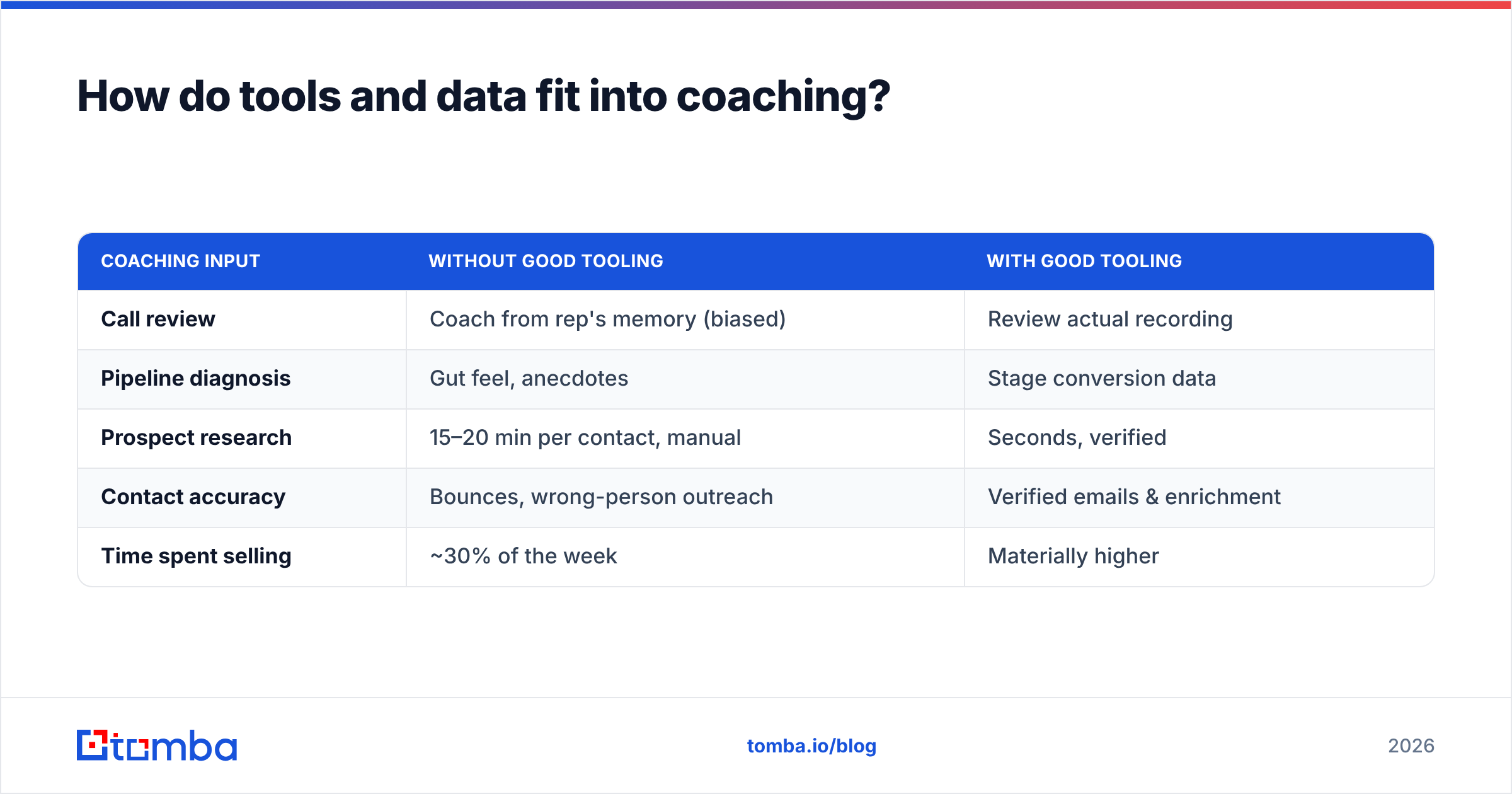
| Coaching input | Without good tooling | With good tooling |
|---|---|---|
| Call review | Coach from rep's memory (biased) | Review actual recording |
| Pipeline diagnosis | Gut feel, anecdotes | Stage conversion data |
| Prospect research | 15–20 min per contact, manual | Seconds, verified |
| Contact accuracy | Bounces, wrong-person outreach | Verified emails & enrichment |
| Time spent selling | ~30% of the week | Materially higher |
For the data layer specifically, tools like Tomba help reps find and verify professional emails by name or domain, enrich thin CRM records, and stop bouncing on bad addresses — so the behaviors you coach actually reach a real human. You can compare approaches against options listed on G2 to find the right fit for your stack.
What are the most common B2B sales coaching mistakes?#
Avoid these and you're ahead of most teams:
- Coaching the deal, not the rep. You close one deal and teach nothing repeatable. Always extract the transferable lesson.
- Coaching everything at once. Five pieces of feedback equal zero behavior change. One skill at a time.
- Skipping the reps in the middle. Managers obsess over top performers (fun) and bottom performers (urgent) and ignore the core — where the most total revenue lives.
- Telling instead of asking. "You should have asked about budget" creates compliance. "What stopped you from getting to budget?" creates insight. Self-discovered lessons stick.
- No follow-through. Coaching without a verify step is just commentary. Always check the next call.
- Inconsistency. A brilliant coaching session every other month loses to a decent one every week. Cadence beats intensity.
How do you build a coaching culture, not just a coaching habit?#
Personal habit is fragile — it leaves when the manager does. Culture is durable. Three moves build it:
First, coach the coaches. Train your frontline managers to coach, then coach them on their coaching. Sit in on their 1:1s. Most companies promote the best rep to manager and never teach them how to develop people — then wonder why performance flattens.
Second, make peer coaching normal. Have reps review each other's calls in a weekly 30-minute "deal clinic." Top performers teaching others reinforces their own skill and scales coaching beyond the manager's calendar.
Third, standardize on a process and a methodology so everyone is coaching toward the same definition of good. When discovery means the same thing to every manager, coaching feedback compounds instead of contradicting. Pair that with a documented sales process and reps onboard faster and ramp more predictably.
The payoff is a team that improves whether or not any single manager is in the room — which is the entire point.
Get started: build the data foundation your coaching needs#
Coaching turns potential into performance, but it can only work on time reps actually spend selling. If your team loses hours hunting for contacts, chasing bad emails, and re-keying records, fix that first — then coach the skills that move deals.
Start by giving every rep clean, verified contact data. The Tomba Email Finder lets reps find accurate professional emails by name, company, or domain in seconds, with verification built in so outreach lands instead of bouncing. Pair it with enrichment to keep CRM records complete, and your coaching sessions stop competing with grunt work. Check Tomba pricing — there's a free tier (25 searches/mo) to test it, with paid plans starting at $49/mo. Give your reps their selling time back, and coach what's left.
// get started
Find, verify and enrich your first contacts today
Start on the free plan with 25 searches a month, then scale when your team is ready.
Free plan · No credit card required · GDPR & CCPA
// about the author