B2B Sales Cycle in 2026: Stages, Length, and How to Shorten It
A practical breakdown of the B2B sales cycle in 2026: the seven stages, why deals stall, average length by deal size, and concrete tactics to close faster.
The B2B sales cycle is the single biggest lever you have over revenue predictability — and most teams measure it wrong, then wonder why forecasts slip. This guide breaks the cycle into its real stages, shows you what a healthy cycle length looks like in 2026, and gives you tactics that actually compress time-to-close instead of just rushing buyers.
TL;DR#
- The B2B sales cycle is the repeatable sequence of stages a deal moves through from first touch to closed-won (or closed-lost) — typically seven stages.
- Average B2B cycles run 34 to 90+ days, scaling with deal size, number of stakeholders, and contract risk.
- Deals stall most often at prospecting (bad data) and evaluation (no clear next step), not at closing.
- The fastest way to shorten the cycle is to start with accurate contact data and a tight ICP — every wrong contact adds days.
- Track stage conversion rates and time-in-stage, not just total length, to find where deals actually rot.
What is a B2B sales cycle?#
A B2B sales cycle is the closing routine of a restaurant, run in reverse: before anyone eats, you source ingredients, prep, plate, and serve in a fixed order — skip a step and the meal falls apart. Technically, it's the defined sequence of stages a B2B opportunity passes through from initial contact to a closed deal, with exit criteria gating each transition.
It differs from a sales process in scope: the cycle describes the buyer's journey through your funnel, while the process is the set of seller actions inside it. It differs from B2C because B2B deals involve multiple decision-makers, longer evaluation, larger contract values, and procurement or legal review.
The reason the cycle matters: it's the unit you forecast against. If you know your average cycle is 60 days and your conversion rates per stage, you can predict next quarter's revenue from today's pipeline. Get the cycle definition fuzzy and every downstream number — quota coverage, hiring plans, cash flow — inherits the error.
What are the stages of the B2B sales cycle?#
Most high-performing B2B teams run a seven-stage cycle. The names vary, but the exit criteria don't.
- Prospecting — Identify accounts that match your ideal customer profile and find the right contacts. Exit criterion: you have a verified decision-maker and a reason to reach out.
- Connecting / Outreach — Make first contact via email, phone, or social. Exit criterion: a two-way conversation, not just a delivered message.
- Qualification — Confirm budget, authority, need, and timeline. Exit criterion: the prospect is a real fit and agrees to a discovery call.
- Discovery / Needs analysis — Diagnose the problem in the prospect's words. Exit criterion: documented pain, success metrics, and stakeholders.
- Proposal / Presentation — Map your solution to their pain with pricing. Exit criterion: the buyer agrees the solution fits and asks "what's next?"
- Negotiation / Evaluation — Handle objections, security review, and procurement. Exit criterion: terms agreed, redlines resolved.
- Closing & Onboarding — Signature, handoff to customer success, and the first value milestone. Exit criterion: signed contract and a kickoff date.
Notice that stages 1 and 2 are where data quality decides everything. If your prospecting list is full of stale titles and bounced emails, you burn days re-routing and re-finding contacts — work that should never reach a rep's calendar.
How long is the average B2B sales cycle in 2026?#
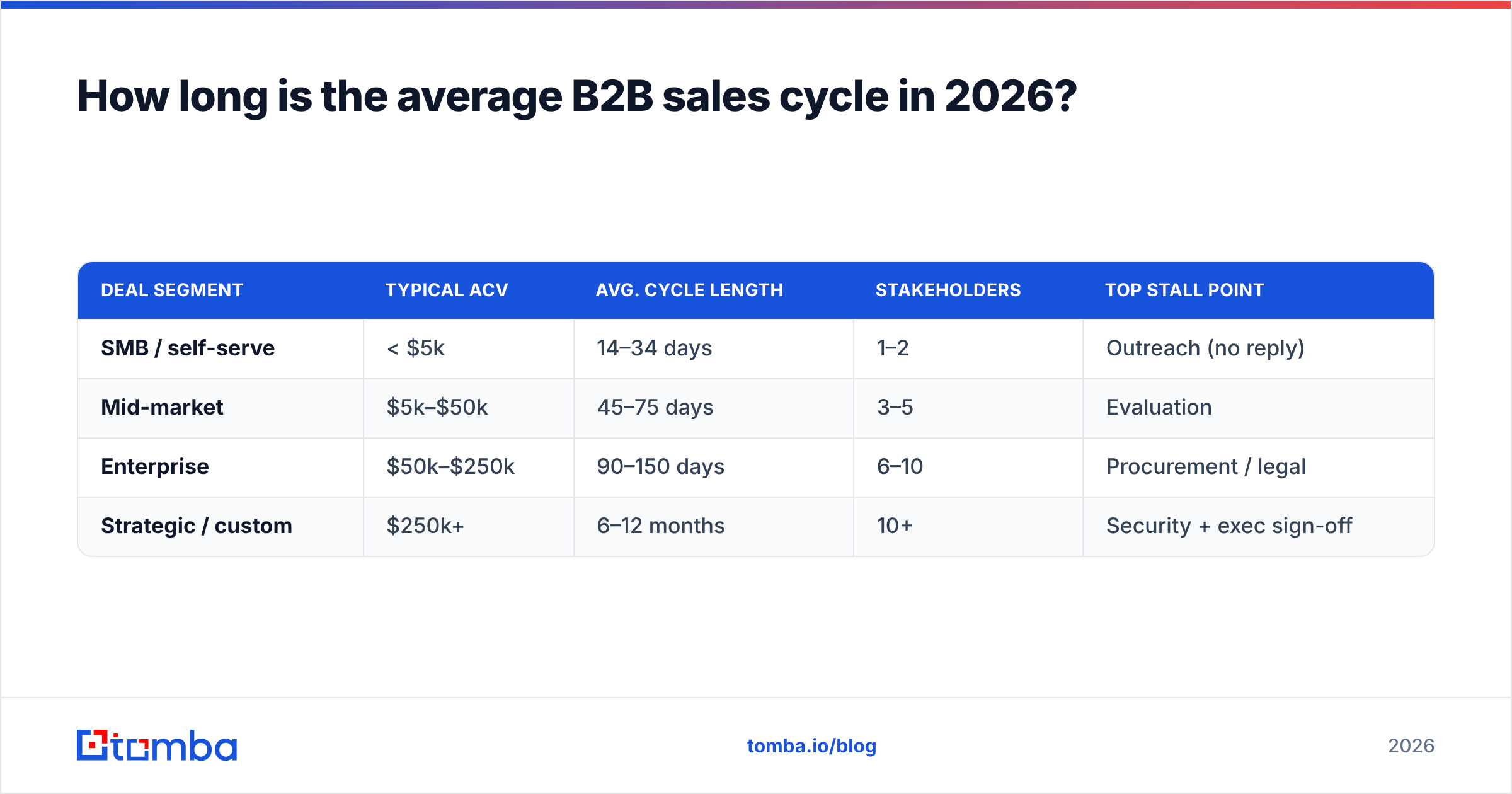
The honest answer: it depends on deal size and stakeholder count, but here are realistic 2026 benchmarks.
| Deal segment | Typical ACV | Avg. cycle length | Stakeholders | Top stall point |
|---|---|---|---|---|
| SMB / self-serve | < $5k | 14–34 days | 1–2 | Outreach (no reply) |
| Mid-market | $5k–$50k | 45–75 days | 3–5 | Evaluation |
| Enterprise | $50k–$250k | 90–150 days | 6–10 | Procurement / legal |
| Strategic / custom | $250k+ | 6–12 months | 10+ | Security + exec sign-off |
Two forces stretch these numbers in 2026. First, buying committees keep growing — Gartner has documented enterprise buying groups of six to ten-plus people, and every added stakeholder adds review loops. Second, budget scrutiny means more deals route through finance and procurement than three years ago.
The takeaway isn't "enterprise is slow, accept it." It's that your segment mix determines your blended cycle, so report cycle length per segment. A blended 70-day average hides the fact that your SMB motion might be leaking weeks it shouldn't.
Why do B2B deals stall?#
Deals rarely die at the signature line. They rot earlier, quietly, while the CRM still shows them as "open."
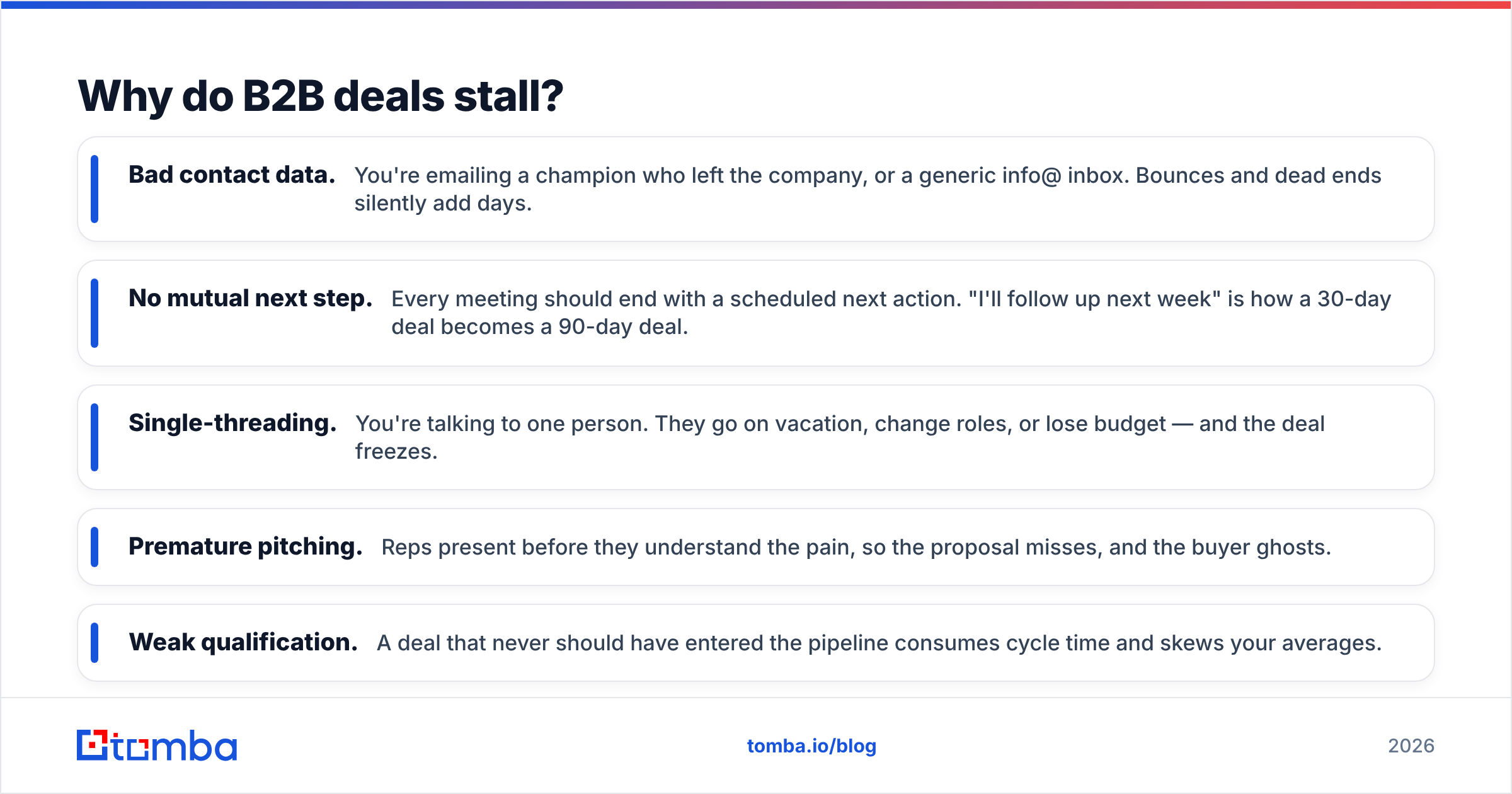
- Bad contact data. You're emailing a champion who left the company, or a generic info@ inbox. Bounces and dead ends silently add days.
- No mutual next step. Every meeting should end with a scheduled next action. "I'll follow up next week" is how a 30-day deal becomes a 90-day deal.
- Single-threading. You're talking to one person. They go on vacation, change roles, or lose budget — and the deal freezes.
- Premature pitching. Reps present before they understand the pain, so the proposal misses, and the buyer ghosts.
- Weak qualification. A deal that never should have entered the pipeline consumes cycle time and skews your averages.
The pattern underneath most stalls is information you didn't have early enough. You can't multi-thread if you don't know the other stakeholders. You can't tailor a proposal if discovery was thin. And you can't even start cleanly if the contact data was wrong on day one — which is why so much of cycle compression is really a data problem wearing a sales-process costume.
How do you shorten the B2B sales cycle?#
Shortening the cycle is not about pressuring buyers to move faster. It's about removing the dead time between productive moments. Here's where the days actually hide and how to reclaim them.
Start with accurate, enriched contact data#
The cheapest weeks you'll ever save come before outreach. If a rep spends the first two days of a deal hunting for the right email or discovering the contact bounced, that's pure waste. Feed reps verified contacts from the start. An email verifier keeps your bounce rate down so messages actually land, and data enrichment gives you the title, company, and adjacent stakeholders you need to multi-thread from message one.
Tighten your ICP so qualification is faster#
Every poorly-fit deal that enters the pipeline taxes your cycle time twice — once while you work it, and again when it skews your forecast. A sharper ICP means reps disqualify in minutes, not weeks.
Multi-thread from the first touch#
Map the buying committee early. Use domain search to find other decision-makers at the account so you're not betting the whole deal on one champion's calendar. When one stakeholder goes quiet, the deal keeps moving through the others.
Engineer the next step every time#
Never end an interaction without a scheduled, calendared next action. This single habit is the highest-leverage cycle-compressor there is, and it costs nothing.
Measure time-in-stage, not just total length#
You can't fix what you can't see. Instrument each stage so you know your median time-in-stage and stage-to-stage conversion. When you find the stage where deals sit longest, you've found your bottleneck.
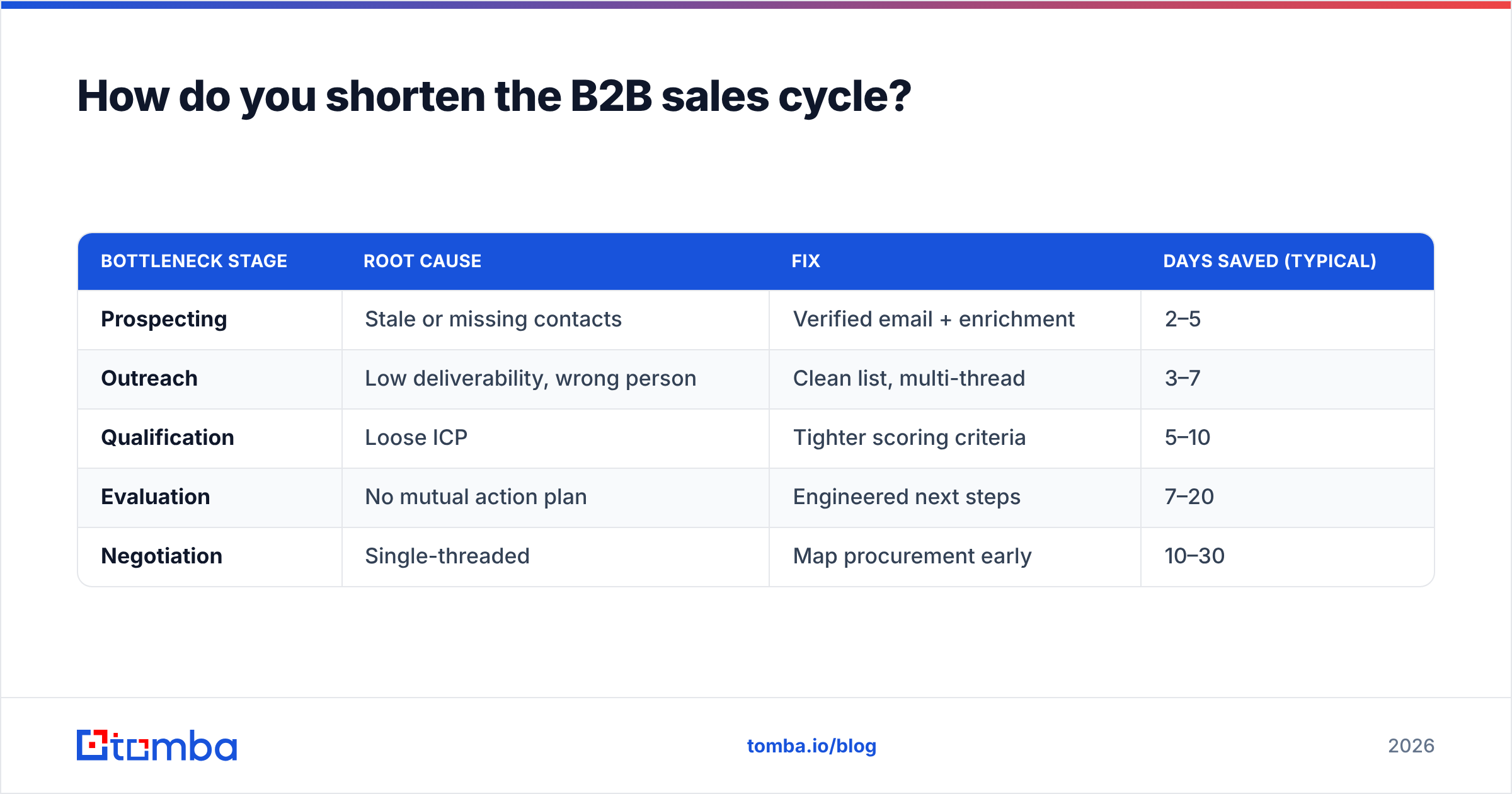
Here's how those tactics map to the stage they compress:
| Bottleneck stage | Root cause | Fix | Days saved (typical) |
|---|---|---|---|
| Prospecting | Stale or missing contacts | Verified email + enrichment | 2–5 |
| Outreach | Low deliverability, wrong person | Clean list, multi-thread | 3–7 |
| Qualification | Loose ICP | Tighter scoring criteria | 5–10 |
| Evaluation | No mutual action plan | Engineered next steps | 7–20 |
| Negotiation | Single-threaded | Map procurement early | 10–30 |
What metrics should you track for the sales cycle?#
Track these five, reviewed monthly, and your cycle becomes a system you can tune rather than a mystery you complain about.
- Average cycle length, by segment — Blended numbers lie. Split SMB, mid-market, and enterprise.
- Time-in-stage (median) — The median, not the mean, so one stuck whale doesn't distort the picture.
- Stage conversion rate — What percent of deals advance from each stage to the next. Your worst conversion is your priority.
- Win rate — Closed-won divided by total closed. Pair it with cycle length: a faster cycle with a collapsing win rate means you're rushing, not improving.
- Pipeline velocity — (Number of deals × win rate × average deal value) ÷ cycle length. The one number that ties speed, quality, and value together.
For benchmarking your own numbers against the market, G2 and Gartner both publish segment-level sales data worth cross-referencing; treat them as directional, not gospel, because your ICP and motion are unique.
B2B sales cycle vs. sales funnel vs. pipeline: what's the difference?#
These three get used interchangeably, and the confusion costs teams clarity in every forecast meeting.
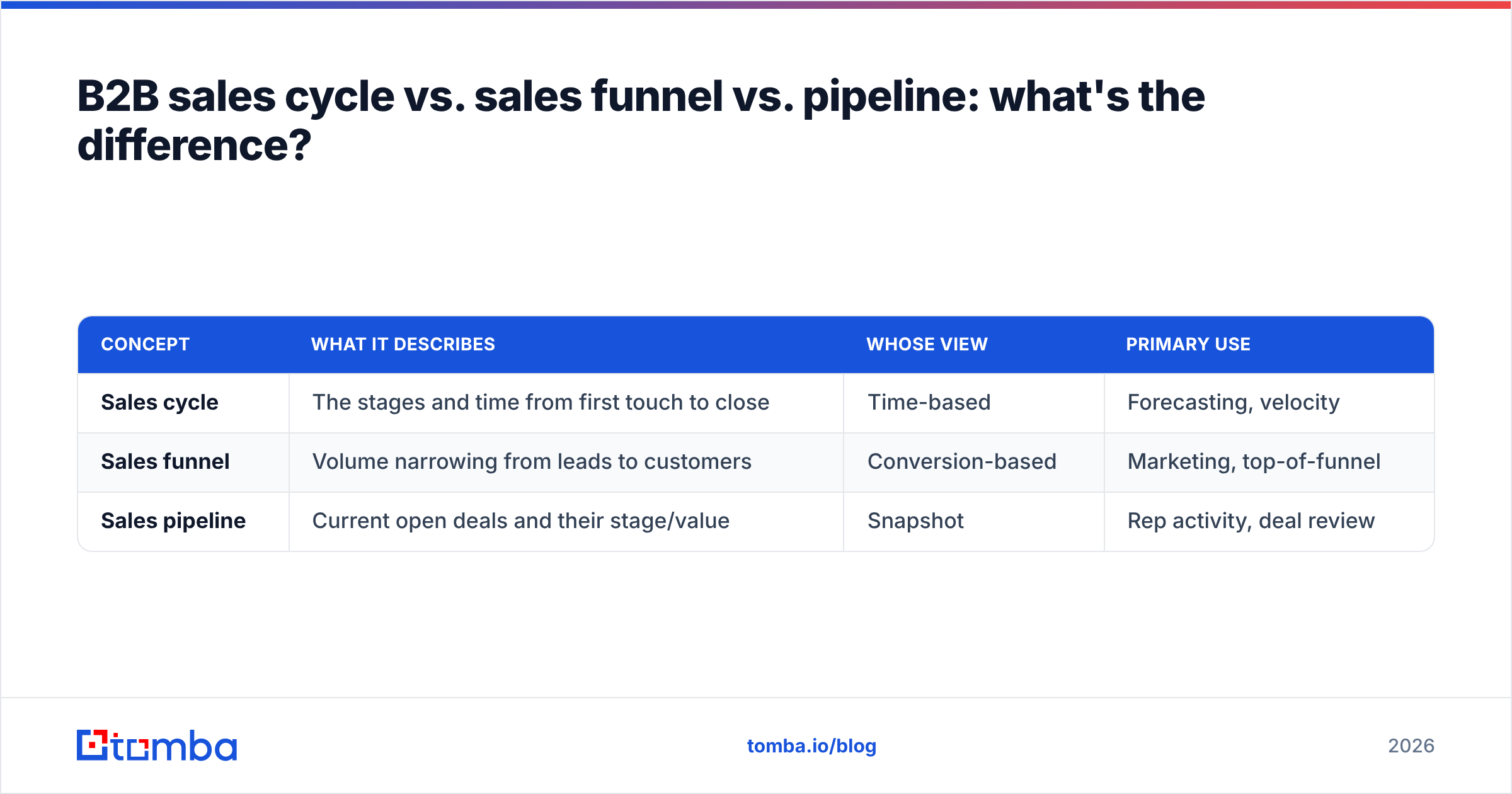
| Concept | What it describes | Whose view | Primary use |
|---|---|---|---|
| Sales cycle | The stages and time from first touch to close | Time-based | Forecasting, velocity |
| Sales funnel | Volume narrowing from leads to customers | Conversion-based | Marketing, top-of-funnel |
| Sales pipeline | Current open deals and their stage/value | Snapshot | Rep activity, deal review |
The cycle is about time and sequence. The funnel is about volume and conversion. The pipeline is a snapshot of what's live right now. You need all three, but only the cycle tells you how long money takes to arrive — which is why it deserves dedicated measurement.
Putting it together#
The B2B sales cycle is not something that happens to your team — it's a system you design, measure, and compress. Define seven clean stages with real exit criteria. Benchmark length by segment, not blended. Find your slowest stage by tracking time-in-stage. And recognize that a huge share of cycle time leaks before the first conversation, inside the data layer, where wrong contacts and missing stakeholders quietly add weeks.
Fix the front of the cycle and the back takes care of itself. Reps spend their hours on real buyers, multi-threaded from day one, with next steps always on the calendar.
That front-of-cycle fix starts with knowing exactly who to contact and reaching them on the first try. The Tomba Email Finder gives your reps verified, decision-maker email addresses by name, company, or domain — so prospecting stops eating days and your cycle starts where it should: in a real conversation. Start on the free tier (25 searches/month), and when you're ready to scale, Tomba pricing runs from $49/mo Starter up through Growth and Pro. Cut the dead time at the top of the funnel, and watch the whole cycle compress.
// get started
Find, verify and enrich your first contacts today
Start on the free plan with 25 searches a month, then scale when your team is ready.
Free plan · No credit card required · GDPR & CCPA
// about the author