B2B Sales Cycle Length: 2026 Benchmarks & How to Shorten It
Most B2B deals take far longer than reps think. Here are 2026 sales cycle benchmarks by deal size, why cycles stall, and a concrete playbook to compress them.
TL;DR
- The average B2B sales cycle runs 2 to 6 months, but it scales with deal size — sub-$5k deals can close in weeks, while six-figure enterprise contracts routinely take 6 to 12 months.
- Most cycle length is wasted in two places: slow lead-to-first-touch time and stalled deals in evaluation waiting on stakeholders, data, or internal approvals.
- You can shorten a B2B sales cycle by 15-30% without discounting — by tightening qualification, reaching the right contacts faster, and removing friction at each stage.
- Bad contact data is a silent cycle killer. Bouncing emails and wrong-number dials add days of dead time to every deal.
- Measure cycle length per segment, not as one blended number — averages hide the deals that are actually dragging your forecast down.
What is B2B sales cycle length?#
B2B sales cycle length is the average time from first meaningful contact with a prospect to a closed-won (or closed-lost) deal. Think of it like a recipe's total cook time: it's not one step, it's the sum of every stage — prospecting, qualification, discovery, proposal, negotiation, and close — plus all the waiting in between.
The waiting is the part most teams underestimate. A rep "works" a deal for 90 days, but if you add up actual selling activity, maybe 12 hours of it was real work. The rest was dead time: waiting for a reply, chasing the right stakeholder, re-sending a quote to a bounced inbox, sitting in a procurement queue.
That distinction matters because dead time is the cheapest thing to cut. You don't need a better pitch or a bigger discount to remove a week of waiting — you need better data and tighter process. That's where most of the 15-30% compression actually comes from.
What is the average B2B sales cycle length in 2026?#
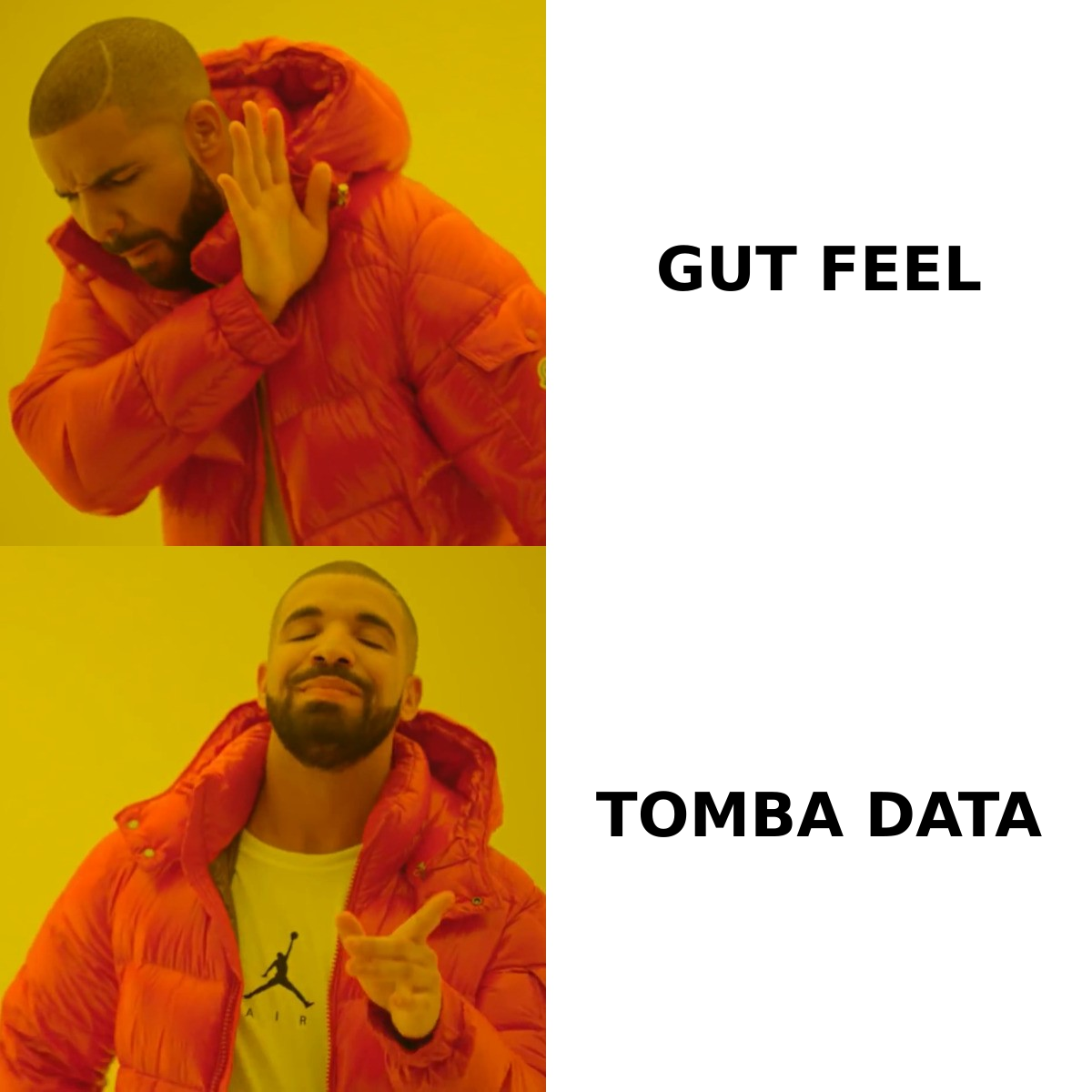
The honest answer: it depends on deal size, far more than on industry. A blended "average" of 84 days is close to useless if your portfolio spans $2k SaaS subscriptions and $400k platform deals. Segment first, then benchmark.
Here is a practical reference range for 2026, drawn from widely cited industry reporting and what most B2B teams see in their own CRM data:
| Deal profile | Typical ACV | Average cycle length | Primary bottleneck |
|---|---|---|---|
| Transactional / SMB | < $5,000 | 14-30 days | Lead response time |
| Mid-market SaaS | $5k-$25k | 1-3 months | Multi-threading stakeholders |
| Mid-market platform | $25k-$75k | 3-5 months | Security & legal review |
| Enterprise | $75k-$250k | 6-9 months | Procurement & budget cycles |
| Strategic / complex | $250k+ | 9-12+ months | Committee buy-in & ROI proof |
A few things to read into this table:
- Cycle length roughly doubles at each tier. Each jump in deal size adds a new class of stakeholder — a security reviewer here, a CFO sign-off there — and every stakeholder adds calendar time.
- Industry matters less than buyer count. Healthcare and fintech run longer mostly because compliance pulls more people into the deal, not because the product is harder to sell.
- The bottleneck shifts as deals grow. For small deals, speed of first contact wins. For enterprise, the constraint is internal consensus, which no amount of rep hustle fully controls.
For broader context on how buying committees have grown, Gartner's research on the B2B buying journey is a useful external benchmark — it pegs the typical buying group at 6 to 10 decision-makers, each conducting independent research.
Why do B2B sales cycles take so long?#
Most cycles aren't long because the product is complicated. They're long because of friction that compounds across stages. Here are the five biggest culprits, in roughly the order they cost you days:
- Slow lead response. A HubSpot analysis of lead response time found that contacting a lead within the first hour makes you dramatically more likely to qualify it. Yet most teams average hours or days. Every hour of delay is dead time bolted onto the front of the cycle.
- Reaching the wrong person. If your first three touches go to a junior contact who has to forward you up the chain, you've burned a week before the real buyer even knows you exist. Multi-threading early — reaching the economic buyer and the champion in parallel — is one of the highest-leverage cycle reducers.
- Bad contact data. A bounced email or a disconnected phone number doesn't just fail; it fails silently. The rep assumes the prospect is ignoring them and waits, when the message never arrived. Clean, verified data removes this entire category of dead time.
- Weak qualification. Deals that should have been disqualified in week one instead crawl through your pipeline for months, inflating your average cycle length and stealing attention from winnable deals.
- Procurement and legal. For larger deals, this is unavoidable calendar time. You can't eliminate it, but you can start it earlier by surfacing security and legal requirements during discovery instead of after the verbal yes.
How is sales cycle length measured?#
Use a simple, repeatable formula and apply it per segment:
Sales cycle length = (sum of days-to-close for all won deals) ÷ (number of won deals)
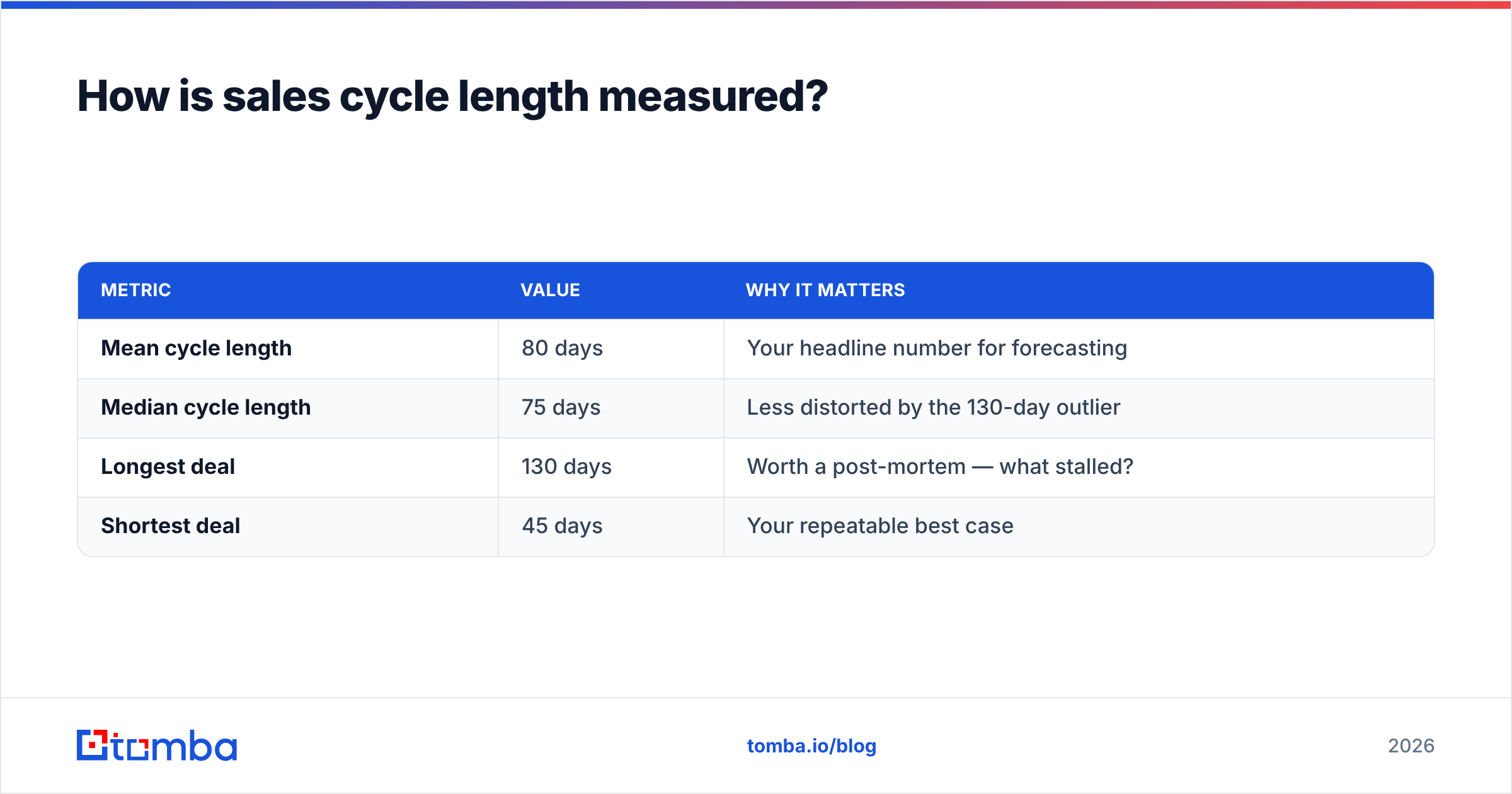
A worked example. Say you closed five mid-market deals last quarter with these durations: 45, 60, 75, 90, and 130 days.
| Metric | Value | Why it matters |
|---|---|---|
| Mean cycle length | 80 days | Your headline number for forecasting |
| Median cycle length | 75 days | Less distorted by the 130-day outlier |
| Longest deal | 130 days | Worth a post-mortem — what stalled? |
| Shortest deal | 45 days | Your repeatable best case |
Track both mean and median. When the mean sits well above the median, a few dragging deals are skewing your forecast — and those are exactly the deals to dissect. Also segment by lead source: inbound demo requests almost always close faster than cold outbound, so blending them hides the true performance of each channel.
One caveat most teams miss: decide upfront whether you measure from first contact or from qualified opportunity created. Both are valid, but mixing them across reps makes your data meaningless. Pick one definition and enforce it in your CRM.
How do you shorten a B2B sales cycle?#
Shortening a cycle is about removing friction, not rushing the buyer. You can pressure a prospect into a faster "no," but you can't pressure them into a faster "yes." Instead, attack the dead time. Here's a stage-by-stage playbook.
1. Compress lead-to-first-touch time#
The single fastest win. Route inbound leads instantly and give reps verified contact details so the first outreach actually lands. If your reps spend the first 20 minutes of every deal hunting for a working email, you've built delay into your process. A reliable email finder collapses that step from minutes to seconds and ensures the message reaches a real inbox.
2. Qualify harder, earlier#
Adopt a consistent framework (MEDDIC, BANT, or your own) and disqualify ruthlessly in the first call. A shorter cycle is partly an illusion created by removing deals that were never going to close from your denominator — but it's also real, because reps stop spending weeks nurturing dead opportunities.
3. Multi-thread from day one#
Don't sell to a single contact. Map the buying committee early and reach the champion, the economic buyer, and the likely blocker in parallel. Use data enrichment to fill in the org chart — titles, departments, and reporting lines — so you know who else needs to be in the room before the deal stalls waiting for an introduction.
4. Pre-empt the slow stages#
Surface security questionnaires, legal terms, and procurement steps during discovery. If you know a SOC 2 review is coming in month three, start it in month one. This overlaps stages that would otherwise run sequentially.
5. Remove proposal friction#
Send quotes the same day. Use e-signature. Offer a clear, single next step in every email instead of an open-ended "let me know your thoughts." Ambiguity is dead time wearing a polite disguise.
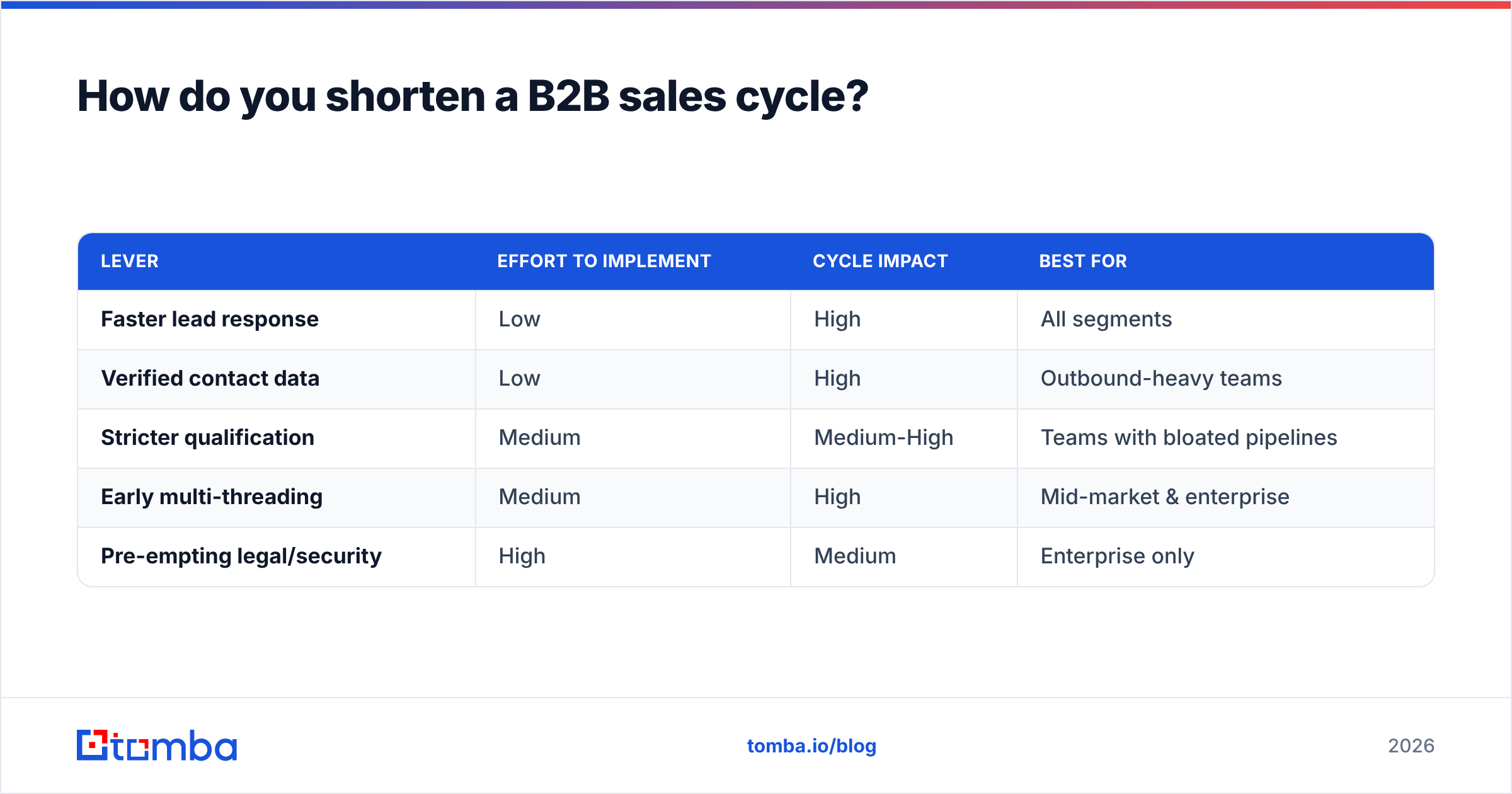
Here's how those levers compare on effort versus impact:
| Lever | Effort to implement | Cycle impact | Best for |
|---|---|---|---|
| Faster lead response | Low | High | All segments |
| Verified contact data | Low | High | Outbound-heavy teams |
| Stricter qualification | Medium | Medium-High | Teams with bloated pipelines |
| Early multi-threading | Medium | High | Mid-market & enterprise |
| Pre-empting legal/security | High | Medium | Enterprise only |
Notice the pattern: the two lowest-effort levers — response time and clean data — are also among the highest-impact. Start there before you try to re-engineer your whole methodology.
How does contact data quality affect cycle length?#
Directly and brutally. Bad data taxes every stage of the cycle, and because it fails quietly, most teams never connect the dots between a bouncing email and a stalled deal.
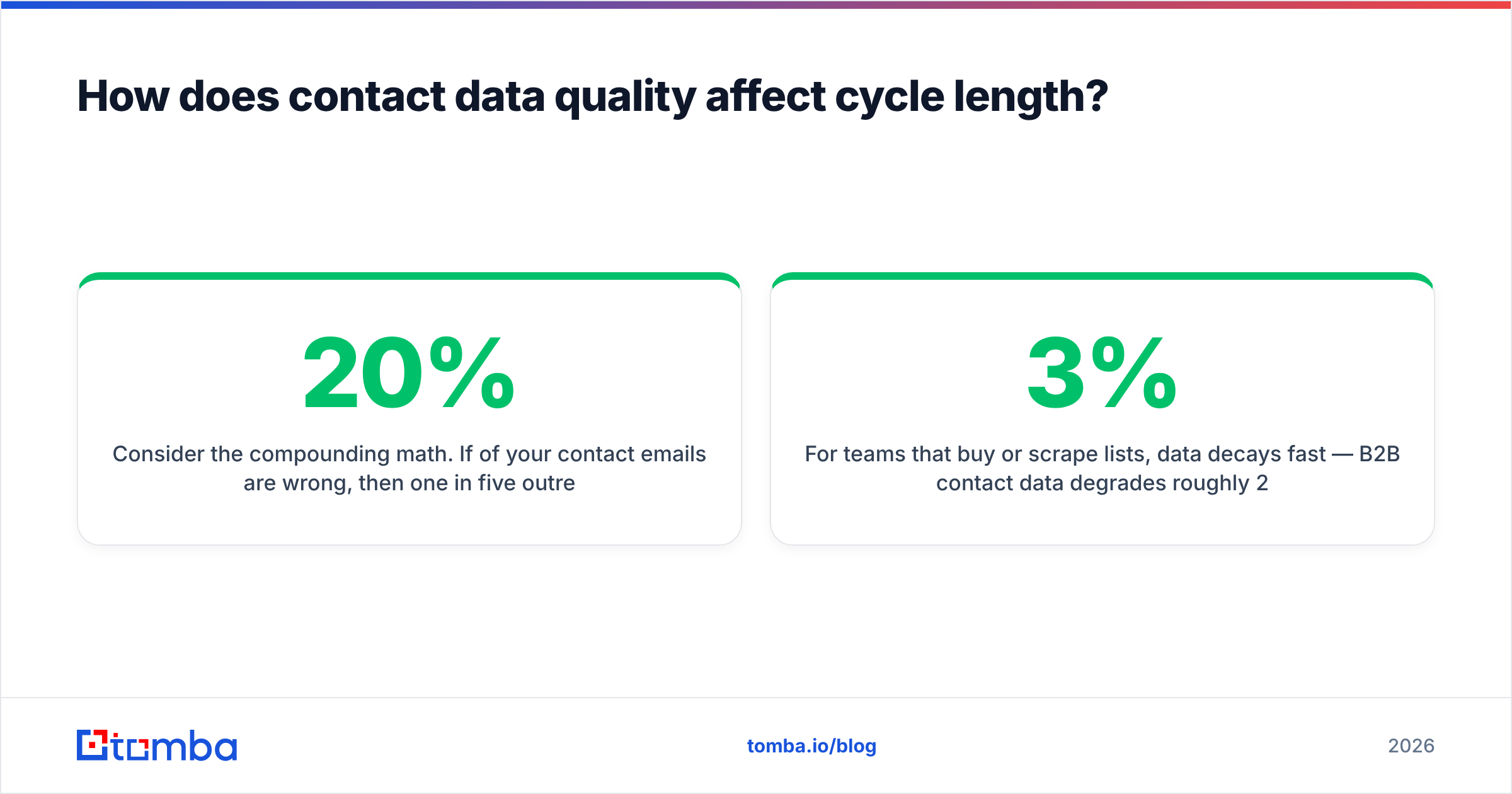
Consider the compounding math. If 20% of your contact emails are wrong, then one in five outreach sequences fails before it starts. The rep waits for a reply that can't come, marks the lead "unresponsive," and moves on — or worse, keeps nurturing a ghost for weeks. Across a full pipeline, that's hundreds of hours of dead time and a measurably longer average cycle.
The fix is unglamorous but cheap: verify before you send. Run new lists through an email verifier to strip out invalid addresses, and use a bulk email finder when you're enriching large account lists at once. The goal is simple — every outreach should reach a real, monitored inbox so that silence actually means "not interested" instead of "never received."
For teams that buy or scrape lists, data decays fast — B2B contact data degrades roughly 2-3% per month as people change jobs. A list that was 95% accurate last year is meaningfully worse today. G2's reviews of sales intelligence software consistently flag data freshness as the top differentiator users care about, ahead of price or features.
How long should your sales cycle be?#
There's no universal target — only a benchmark against your own segment and a trend line that should bend downward over time. Use this quick diagnostic:
- Pull your last 50 closed-won deals and calculate mean and median cycle length per segment.
- Flag every deal more than 1.5x your median. These are your draggers. Read the activity history and find where the time went.
- Categorize the dead time — was it slow first contact, a wrong contact, a stalled evaluation, or procurement? Most teams find one category dominates.
- Attack the dominant category first. If it's first-contact speed or data quality, you can show improvement within a single quarter.
- Re-measure every quarter. Cycle length is a trend, not a snapshot. A 10% reduction per quarter compounds fast.
If your cycle sits well above the benchmark table earlier in this post and the cause is front-of-funnel friction rather than enterprise procurement, you have a data and process problem — which is good news, because those are the fixable kind.
The bottom line#
B2B sales cycle length isn't a fixed property of your market. It's the sum of selling time plus dead time — and dead time is where the easy wins live. Reach the right contact faster, verify before you send, multi-thread early, and disqualify the deals that don't belong. Do that consistently and a 15-30% compression is realistic without touching your pricing.
The cheapest place to start is the very front of the cycle: making sure your first outreach actually lands. Tomba's Email Finder gives reps verified, deliverable contact details by name, domain, or company — so the first touch reaches a real inbox instead of a bounce. Pair it with the built-in verifier and enrichment, and you remove an entire category of dead time from every deal. Start free with 25 searches a month, or check Tomba pricing — the Starter plan is $49/mo when you're ready to scale. Shorter cycles begin with data you can trust.
Ready to find emails that actually work?
Join 150,000+ professionals who stopped guessing and started sending. Free credits on signup — no credit card required.
Get the Tomba newsletter
Practical outbound tactics and product updates — once every two weeks.
About the author