B2B Sales Email Template Guide: 9 Examples That Convert in 2026
Nine proven B2B sales email templates for cold outreach, follow-ups, and re-engagement — plus the structure, metrics, and tooling that make them reply.
A great b2b sales email template is not a magic script — it is a repeatable structure you can personalize in 60 seconds and still sound like a human wrote it. This guide gives you nine of them, the framework behind each, and the benchmarks that tell you whether your version is working.
TL;DR#
- Structure beats wording. Every reliable b2b sales email template follows the same skeleton: relevant trigger → one clear value point → low-friction ask. Master the skeleton and you can write 100 variations.
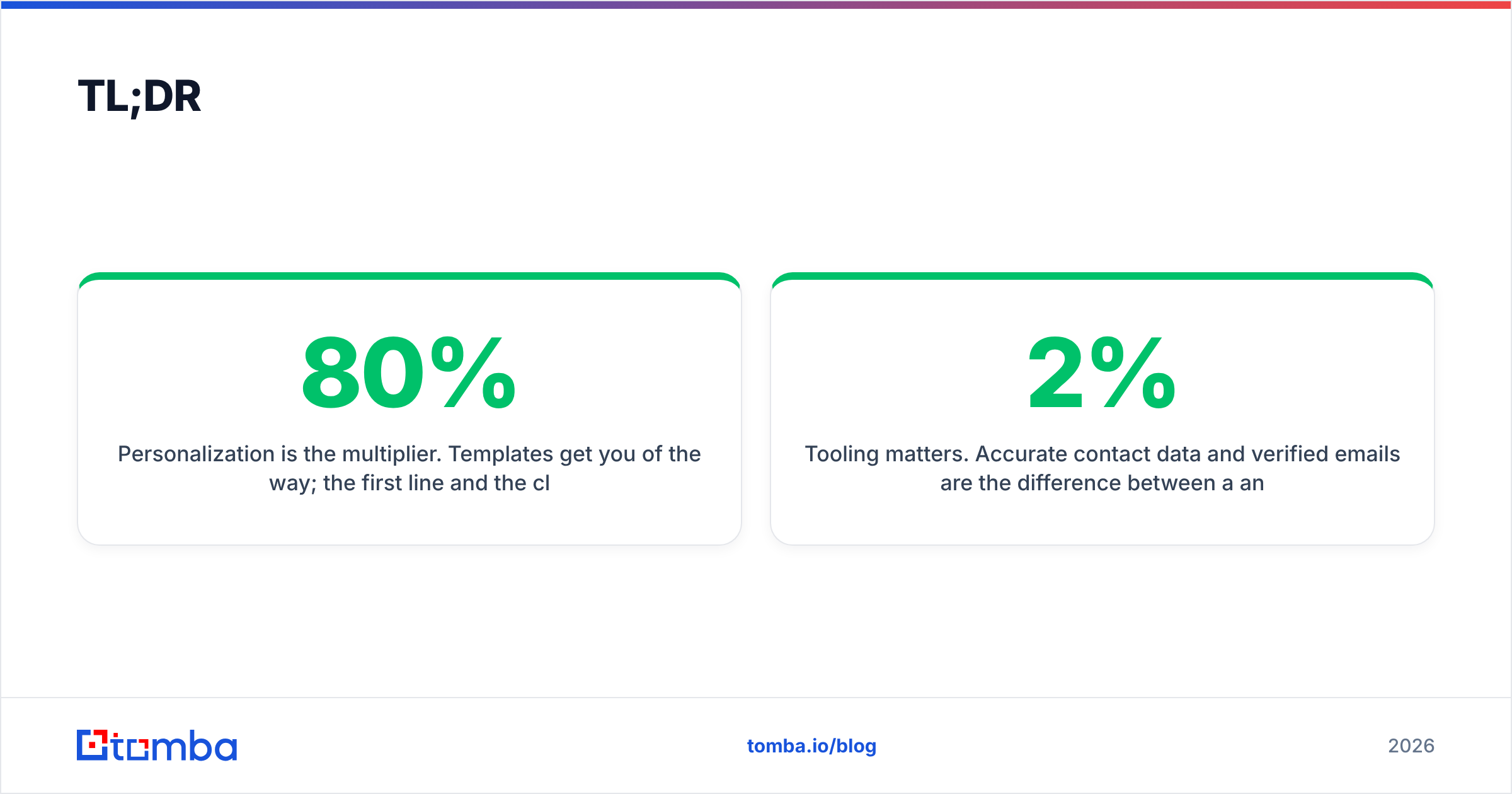
- Personalization is the multiplier. Templates get you 80% of the way; the first line and the closing ask are where replies are won or lost.
- Deliverability decides if any of it matters. A perfect template sent from a bad domain to an unverified address never gets read.
- Nine templates below cover cold intro, follow-up, re-engagement, referral, breakup, and more — copy, paste, and adapt.
- Tooling matters. Accurate contact data and verified emails are the difference between a 2% and a 12% reply rate.
What makes a B2B sales email template actually work?#
The conclusion first: a template works when it reads like a one-to-one message even though you sent it 200 times. That happens when the structure carries the persuasion and the personalization carries the relevance.
Think of a template like a song's chord progression. The chords (structure) stay the same; the lyrics (personalization) change per prospect. Amateurs rewrite the chords every time and burn hours. Pros lock the progression and spend their energy on the lyrics that matter.
Every high-performing b2b sales email template has four moving parts:
- The trigger — a specific, verifiable reason you are emailing this person now (a funding round, a job change, a tech-stack signal, a published article).
- The bridge — one sentence connecting that trigger to a problem you solve. Not your features. Their problem.
- The proof — a single, concrete outcome (a number, a comparable customer, a result). One. Not three.
- The ask — a low-commitment next step phrased as a question they can answer in five words.
Notice what is not on the list: your company history, a feature dump, or three different calls to action. Restraint is the skill.

What is the ideal structure for a cold B2B sales email?#
Short answer: under 120 words, one idea, one ask, formatted for a phone screen.
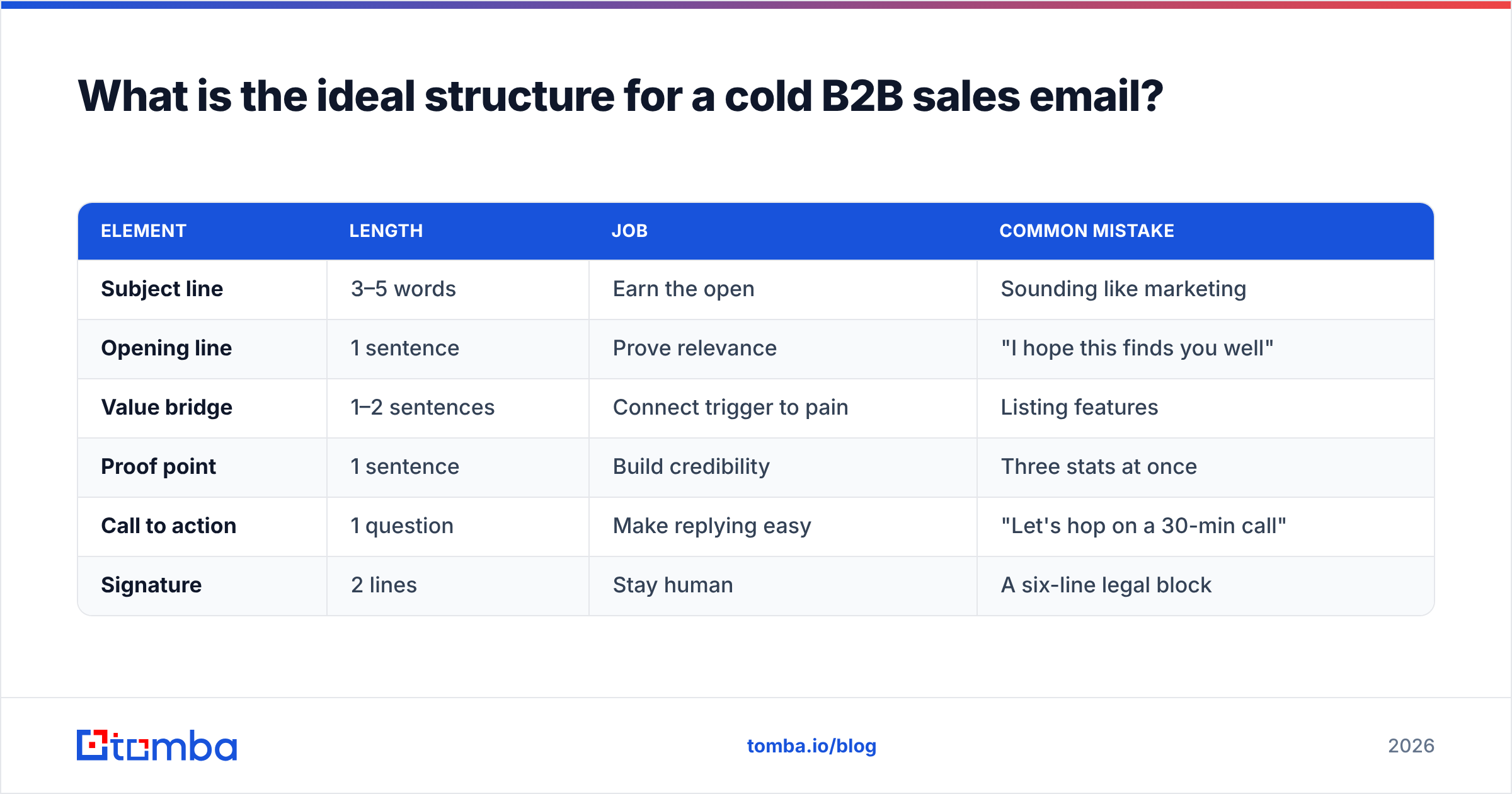
Here is the reusable skeleton every template in this post is built on:
| Element | Length | Job | Common mistake |
|---|---|---|---|
| Subject line | 3–5 words | Earn the open | Sounding like marketing |
| Opening line | 1 sentence | Prove relevance | "I hope this finds you well" |
| Value bridge | 1–2 sentences | Connect trigger to pain | Listing features |
| Proof point | 1 sentence | Build credibility | Three stats at once |
| Call to action | 1 question | Make replying easy | "Let's hop on a 30-min call" |
| Signature | 2 lines | Stay human | A six-line legal block |
Keep the whole thing scannable. Most B2B email is now first read on a phone, and a wall of text gets archived before the value bridge is reached. If you want a deeper primer on the building blocks of subject lines specifically, the subject line generator is a fast way to test variants before you commit.
Which 9 B2B sales email templates should you steal?#
Below are nine templates mapped to the most common outbound moments. Swap the bracketed fields for real, verified details — never send a [first_name] token live.
1. The trigger-based cold intro#
Subject: quick question, [company]
Hi [first_name],
Saw [company] just [specific trigger — e.g., "opened a second office in Austin"]. Teams hitting that stage usually start struggling with [specific problem].
We helped [comparable company] cut [metric] by [number] in [timeframe].
Worth a quick look for [company]?
[Your name]
2. The "I did my homework" opener#
Subject: your post on [topic]
Hi [first_name],
Your [article/talk/comment] on [topic] nailed the part about [specific point]. We see the same thing with [customer type].
One idea that might help: [one-line insight].
Open to me sending the 2-minute version?
3. The first follow-up (no reply)#
Subject: re: quick question, [company]
Hi [first_name],
Floating this back up. The reason I reached out: [restate the one outcome].
Is [problem] a priority this quarter, or should I check back later?
4. The value-add follow-up#
Subject: thought you'd find this useful
Hi [first_name],
No pitch here — just saw [resource/benchmark] and thought of [company]'s work on [project].
Happy to share how [comparable company] applied it if helpful.
5. The re-engagement / "still relevant?"#
Subject: bad timing?
Hi [first_name],
We spoke about [topic] a while back. Things may have changed on your side.
Is improving [metric] back on the roadmap, or has the priority shifted?
6. The referral request#
Subject: wrong person?
Hi [first_name],
I may have reached the wrong desk. Who owns [function] at [company] these days?
Happy to take it off your plate with a quick intro.
7. The social-proof template#
Subject: how [competitor] handled [problem]
Hi [first_name],
[Competitor in their space] was facing [problem] and solved it by [approach], landing [result].
Want the one-page breakdown?
8. The breakup email#
Subject: closing the loop
Hi [first_name],
Haven't heard back, so I'll assume the timing isn't right. I'll stop reaching out.
If [problem] resurfaces, you know where to find me.
9. The post-event / mutual-connection#
Subject: [event] follow-up
Hi [first_name],
[Mutual connection] mentioned you're tackling [initiative]. We work with teams on exactly that.
Worth 10 minutes next week?
Each of these is intentionally skeletal. The persuasion is in the structure; your job is the trigger and the proof. If you want pre-formatted variants you can drop into a sequence, the cold email templates library is a useful starting library.
How do you personalize a template without spending all day?#
The trick is to tier your personalization to your list size.
- Tier 1 (1–25 accounts): Fully custom opening line referencing something specific to each person. Research time: 3–5 minutes each.
- Tier 2 (25–200 accounts): A custom variable in the trigger slot (industry, role, recent news), templated everywhere else. Research time: 30–60 seconds each.
- Tier 3 (200+ accounts): Segment-level personalization — one trigger per segment, not per person. Research time: batch it.
The mistake reps make is treating every list like Tier 1 and burning out, or treating every list like Tier 3 and sounding like a robot. Match the effort to the value of the account.
This is also where contact data quality compounds. A personalized line aimed at the wrong title, or a verified-looking address that bounces, wastes all the research you just did. Building your list with an email finder and then running it through an email verifier keeps the personalization pointed at real inboxes.

What reply rates should a B2B sales email template hit?#
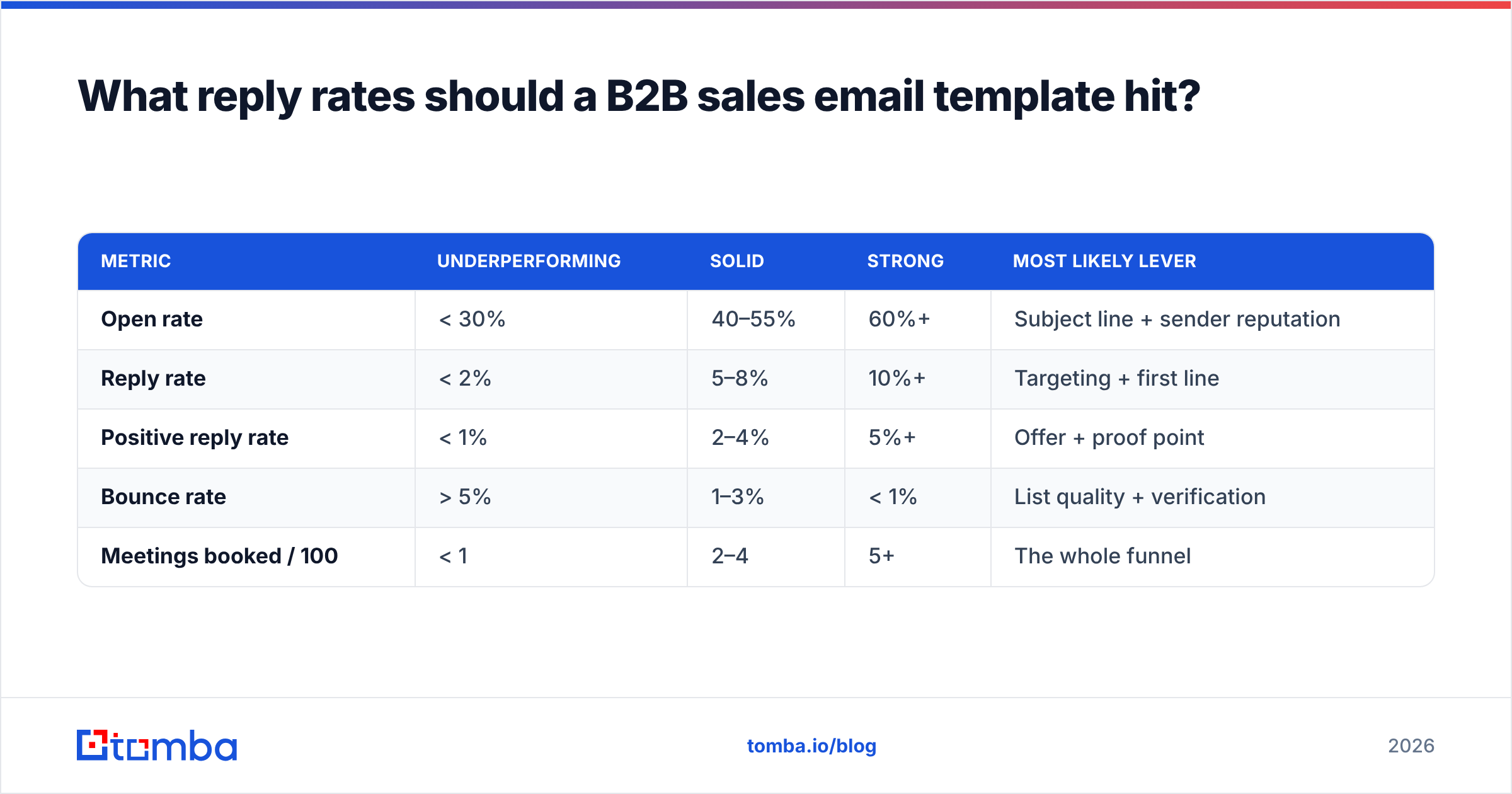
Conclusion first: a healthy cold sequence lands a 5–10% reply rate; anything under 2% means the problem is upstream — list, deliverability, or relevance — not the wording.
Here is a rough benchmark grid to diagnose where you stand. These are directional ranges from common industry reporting, not guarantees:
| Metric | Underperforming | Solid | Strong | Most likely lever |
|---|---|---|---|---|
| Open rate | < 30% | 40–55% | 60%+ | Subject line + sender reputation |
| Reply rate | < 2% | 5–8% | 10%+ | Targeting + first line |
| Positive reply rate | < 1% | 2–4% | 5%+ | Offer + proof point |
| Bounce rate | > 5% | 1–3% | < 1% | List quality + verification |
| Meetings booked / 100 | < 1 | 2–4 | 5+ | The whole funnel |
If your open rate is fine but replies are flat, your wording is the issue. If your open rate itself is low, the problem is almost always email deliverability or a stale list — not your copy. Diagnose before you rewrite.
For a credible external benchmark on how buyers actually prefer to be contacted, the HubSpot Sales Statistics roundup is worth bookmarking and citing internally when you set targets.
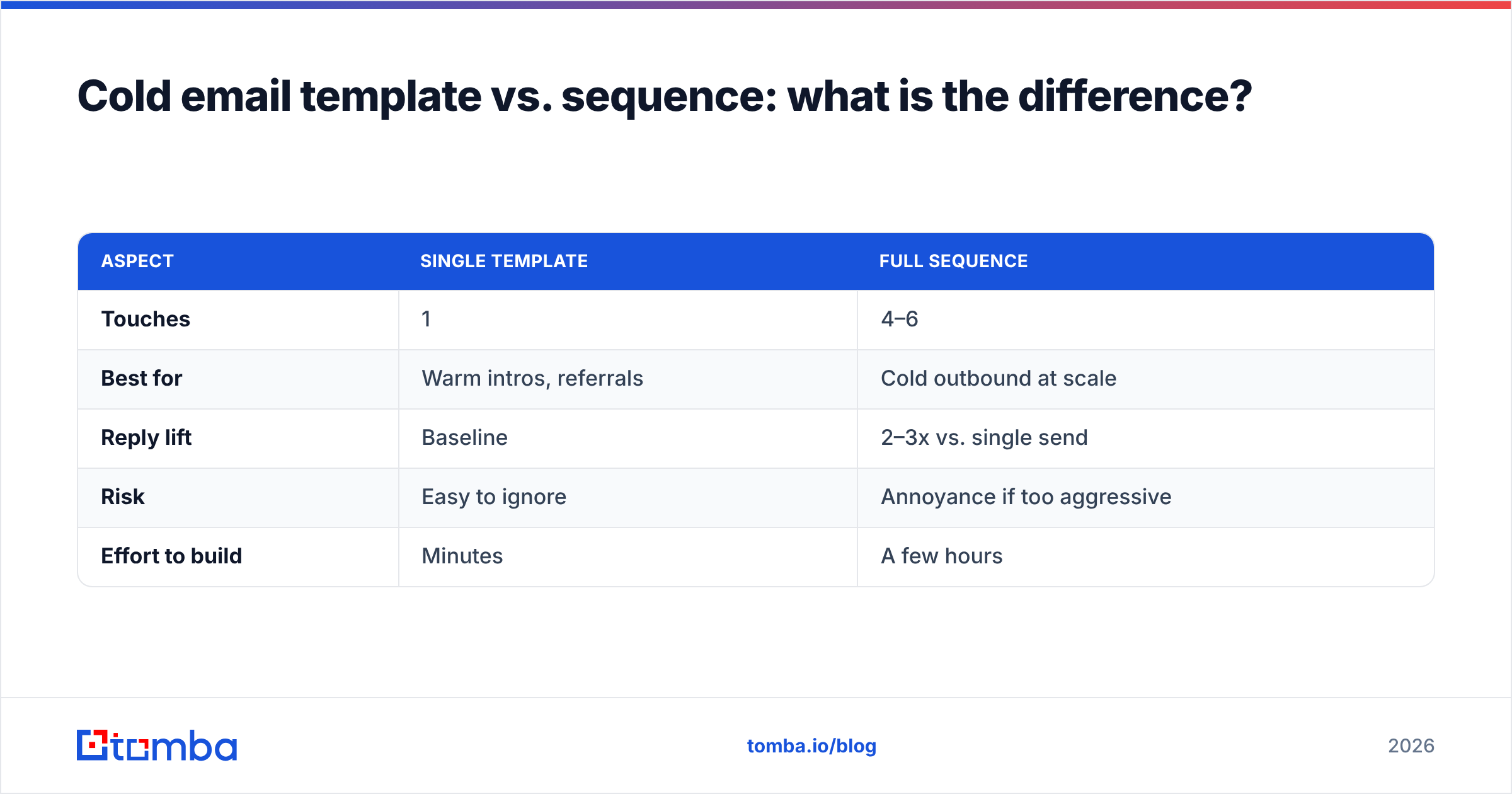
Cold email template vs. sequence: what is the difference?#
A single template is one message. A sequence is a choreographed series — typically 4 to 6 touches over 2 to 3 weeks — where each template plays a distinct role.
| Aspect | Single template | Full sequence |
|---|---|---|
| Touches | 1 | 4–6 |
| Best for | Warm intros, referrals | Cold outbound at scale |
| Reply lift | Baseline | 2–3x vs. single send |
| Risk | Easy to ignore | Annoyance if too aggressive |
| Effort to build | Minutes | A few hours |
Most replies to cold outbound arrive on the second through fourth touches, not the first. Reps who send one email and give up leave the majority of their pipeline on the table. Build the sequence: intro → follow-up → value-add → social proof → breakup. The templates above slot directly into those roles.
A word of caution on cadence: spacing touches 3–4 business days apart reads as persistent; same-day or daily follow-ups read as desperate and hurt your sender reputation. Patience is part of the strategy.
What kills a good template before it is read?#
Even a perfect b2b sales email template fails if the plumbing is broken. The usual culprits:
- Unverified addresses. Bounces above 3–5% tank your domain reputation and route future sends to spam. Verify before you send.
- Missing authentication. No SPF or DKIM and mailbox providers distrust you on arrival. Check your records with an SPF checker before a campaign.
- Spam-trigger language. "Free," "guarantee," "act now," and excessive links flag filters. Run a draft through a spam checker first.
- No warmup. A brand-new domain sending 200 cold emails on day one looks exactly like a spammer.
- One giant blast. Volume spikes are a reputation red flag. Ramp gradually.
The order of operations matters: fix deliverability first, then list quality, then copy. Rewriting templates while your domain is blacklisted is rearranging deck chairs. If you suspect the latter, a quick pass through a blacklist checker tells you fast.
For a vendor-neutral deep dive on the mechanics of inbox placement, Google's own Postmaster Tools guidelines is the authoritative reference for Gmail, which is where most of your B2B prospects read mail.
How do you measure and improve a template over time?#
Treat every template as a hypothesis. Conclusion first: change one variable at a time, give each version at least 50 sends, and let reply rate — not open rate — be your north star.
A simple weekly loop:
- Pick one variable — subject line, first line, or CTA. Never all three.
- Run an A/B split across a statistically meaningful sample.
- Read replies, not just metrics. The content of "not interested" replies tells you whether it is targeting or offer.
- Kill losers fast, scale winners. Retire any template that underperforms after a fair sample.
- Refresh quarterly. Triggers go stale; a "saw your funding round" line from eight months ago is now noise.
The teams that win at outbound are not the ones with the cleverest copy — they are the ones with the tightest feedback loop and the cleanest data feeding it.
Frequently asked questions#
How long should a B2B sales email be? Under 120 words for cold outreach. Long enough to establish relevance and one outcome, short enough to read on a phone in under 15 seconds.
Should I use the prospect's first name in the subject line? Usually no for cold email — it now reads as automated and can trip filters. Save personalization for the body where it carries more weight.
How many follow-ups is too many? Four to six total touches, spaced 3–4 business days apart, is the sweet spot. Past six, you are training prospects to ignore you.
Do templates hurt deliverability? Identical templates sent at high volume can. Vary the wording enough that each send is not byte-for-byte identical, and keep volume ramped sensibly.
What is the single biggest lever on reply rate? List quality and targeting. The best copy aimed at the wrong person beats nothing — but the right person with average copy beats both.
Put your templates to work with verified contacts#
A b2b sales email template is only as good as the inbox it reaches. Before you send your next sequence, build the list on a foundation of real, verified contacts: use the Tomba Email Finder to source professional email addresses by name, company, or domain, then verify them so your carefully written templates actually land in front of decision-makers instead of bouncing. Start on the free tier (25 searches a month), and when outbound becomes a real motion, the Tomba pricing scales with you — Starter at $49/mo, Growth at $99/mo, and Pro at $249/mo. Write the template once; point it at the right person every time.
// get started
Find, verify and enrich your first contacts today
Start on the free plan with 25 searches a month, then scale when your team is ready.
Free plan · No credit card required · GDPR & CCPA
// about the author