B2B Sales Funnel in 2026: Stages, Metrics, and Fixes
A practical breakdown of the B2B sales funnel in 2026 — every stage, the metrics that matter, and the conversion leaks quietly killing your pipeline.
The B2B sales funnel is the single most misunderstood object in revenue work. Everyone draws the same triangle on a whiteboard, then runs their business as if leads fall through it by gravity. They don't. In 2026, with longer buying committees and tighter budgets, the funnel is less a chute and more a series of doors — each one a chance for a deal to walk out. This guide breaks the funnel down door by door, shows you the metrics that actually predict revenue, and points at the leaks that quietly drain most pipelines.
TL;DR#
- A B2B sales funnel is the staged path a buyer takes from first awareness to closed deal — typically Awareness → Interest → Consideration → Intent → Evaluation → Purchase.
- The funnel only works if stage transitions have exit criteria. Vague stages ("they seem interested") are where forecasts go to die.
- The biggest leak in 2026 is not the bottom — it's the top. Bad contact data and unqualified leads poison everything downstream.
- Track conversion rate per stage, velocity, and stage-to-stage drop-off, not vanity volume.
- Clean, verified contact data at the top of the funnel is the cheapest conversion lever you have. Tools like the Tomba Email Finder feed the funnel accurate inputs instead of guesses.
What is a B2B sales funnel?#
A B2B sales funnel is a model of how a business buyer moves from "never heard of you" to "signed the contract," split into stages so you can measure and manage each transition. Think of it like airport security: you don't walk straight from the curb to the gate. You pass through check-in, bag drop, ID check, the scanner — each a checkpoint that either lets you through or sends you back. A deal moves the same way, and your job is to know how many people clear each checkpoint and why the rest don't.
The B2B funnel differs from B2C in three ways that change everything:
- Multiple buyers. The average B2B deal in 2026 involves 6–10 stakeholders, each with their own funnel position. Your champion may be at "Intent" while their CFO is still at "Awareness."
- Longer cycles. Weeks to quarters, not minutes. The funnel has to survive budget freezes, reorgs, and stalled momentum.
- Considered, not impulsive. Nobody buys $50k of software on a whim. Every stage is a justification the buyer builds for their internal case.
This is why the funnel matters more in B2B than anywhere else: with so many checkpoints and so many people, an unmanaged funnel leaks at a dozen points you can't even see.
What are the stages of the B2B sales funnel?#
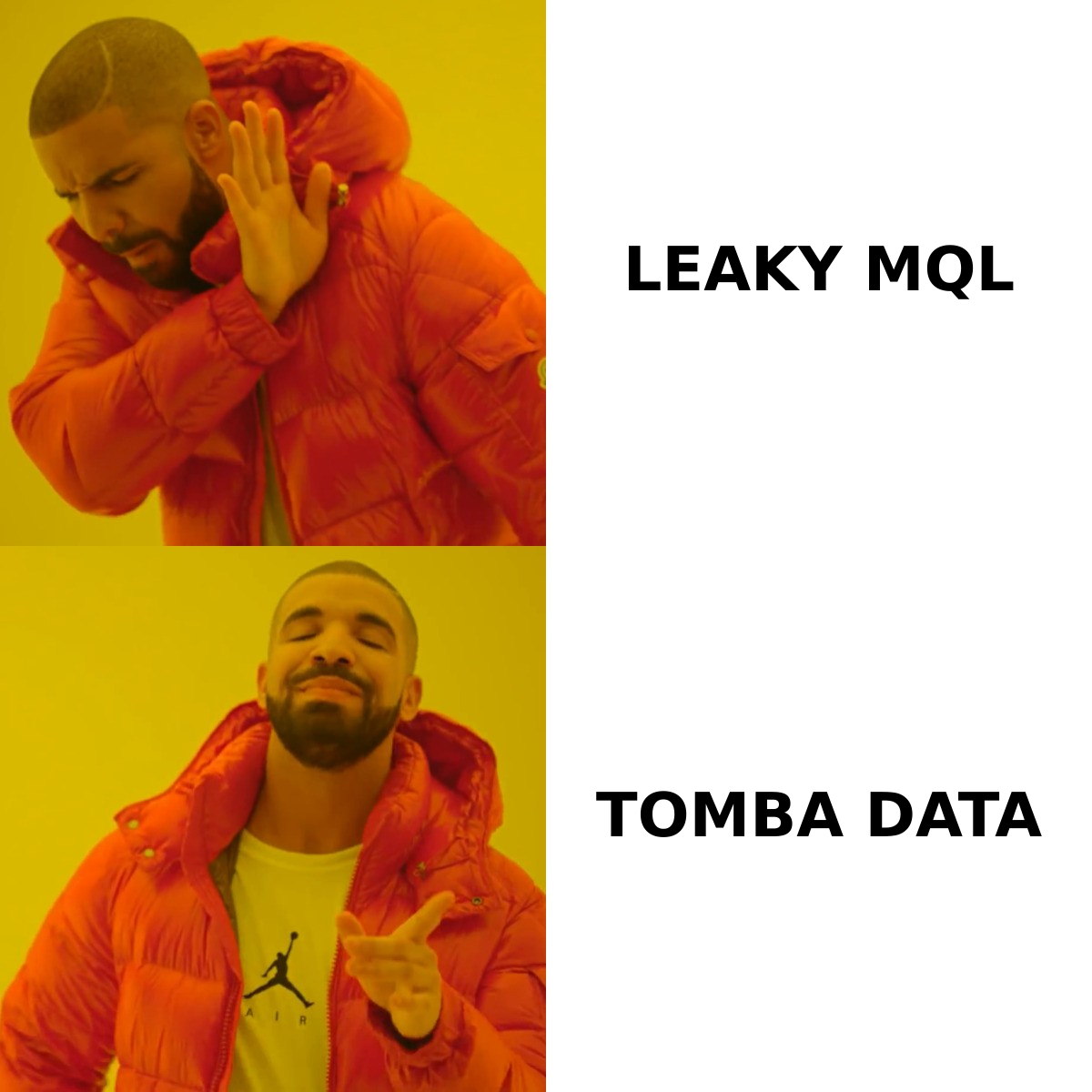
Most teams oversimplify to three stages (top, middle, bottom). That's fine for a napkin, useless for management. Here is the working six-stage model with concrete exit criteria — the conditions a lead must meet to advance.
| Stage | Buyer mindset | Your goal | Exit criteria (move to next stage when…) |
|---|---|---|---|
| 1. Awareness | "I might have a problem" | Get on their radar | Lead engages with content or accepts outreach |
| 2. Interest | "Tell me more" | Educate, capture intent | Lead requests info, replies, or books a call |
| 3. Consideration | "Could this fix it?" | Map needs to your solution | Discovery call completed, pain confirmed |
| 4. Intent | "We're seriously looking" | Qualify budget & authority | BANT/MEDDIC criteria met, champion identified |
| 5. Evaluation | "Prove it" | Demo, trial, references | Technical/security sign-off, proposal sent |
| 6. Purchase | "Let's do it" | Negotiate & close | Contract signed |
The numbered transitions matter more than the boxes. A lead sitting in "Consideration" for 40 days with no movement isn't in your funnel — it's clogging it. Write down the exit criteria for each stage and enforce them in your CRM, or your stages mean nothing and your forecast is fiction. If you need a refresher on terms like MQL versus SQL, Tomba's B2B glossary is a quick reference.
Top, middle, and bottom of funnel#
If six stages feel heavy, group them:
- Top of funnel (ToFu): Awareness + Interest. Volume game. Driven by content, ads, outbound, and SEO.
- Middle of funnel (MoFu): Consideration + Intent. Qualification game. Driven by discovery, lead scoring, and nurture.
- Bottom of funnel (BoFu): Evaluation + Purchase. Conviction game. Driven by demos, proof, and negotiation.
Each band needs different metrics and different people. A common failure is running ToFu tactics (more leads!) to fix a BoFu problem (deals stall at proposal). Diagnose the band before you spend.
How is a sales funnel different from a sales pipeline?#
The funnel is the buyer's journey; the pipeline is your deal inventory. The funnel describes how prospects behave in aggregate — what percentage convert from one stage to the next. The pipeline is the list of specific open deals and their dollar value at each stage.
Put simply: the funnel is the statistical shape, the pipeline is the actual money in motion. You use funnel conversion rates to forecast what the pipeline will produce. If your Consideration→Intent rate is 30%, and you have $1M sitting in Consideration, you can reasonably expect $300k to advance. Confuse the two and you'll either overspend on lead gen or under-resource your closers. For a deeper split, see how teams structure the sales process and pipeline inside their CRM.
Which B2B sales funnel metrics actually matter?#
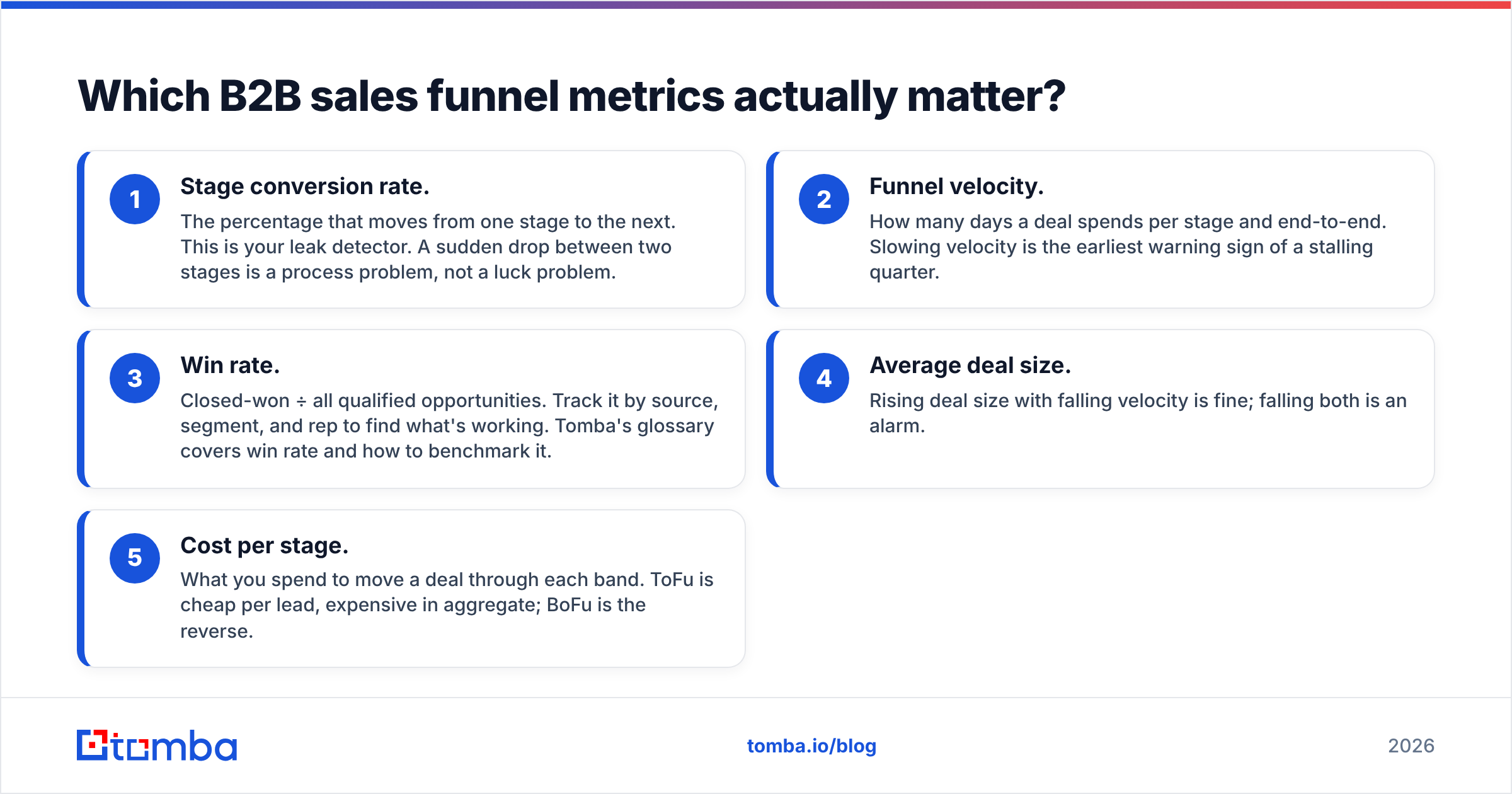
Stop counting raw leads. Volume is a vanity metric — it feels like progress and predicts nothing. These five metrics tell you whether the funnel is healthy:
- Stage conversion rate. The percentage that moves from one stage to the next. This is your leak detector. A sudden drop between two stages is a process problem, not a luck problem.
- Funnel velocity. How many days a deal spends per stage and end-to-end. Slowing velocity is the earliest warning sign of a stalling quarter.
- Win rate. Closed-won ÷ all qualified opportunities. Track it by source, segment, and rep to find what's working. Tomba's glossary covers win rate and how to benchmark it.
- Average deal size. Rising deal size with falling velocity is fine; falling both is an alarm.
- Cost per stage. What you spend to move a deal through each band. ToFu is cheap per lead, expensive in aggregate; BoFu is the reverse.
A practical rule: if a metric can go up while revenue stays flat, it's a vanity metric. "Leads generated" passes that test — you can triple it and close nothing. "Stage conversion rate" does not — it can't improve without real movement toward revenue.
Where do B2B sales funnels leak in 2026?#
Funnels leak at three predictable points. Here's where, why, and the fix.
Leak 1: The top — bad data and unqualified volume#
The most expensive leak is also the most ignored. When the top of your funnel fills with wrong emails, dead contacts, and prospects who never fit your ICP, every downstream stage inherits the rot. Reps waste cycles, conversion rates crater, and the forecast lies.
The fix is unglamorous: verify and enrich contacts before they enter the funnel. A bounced email isn't a lead, it's noise. Use an email verifier to scrub lists before outreach, and a domain search to find the right decision-makers instead of spraying generic inboxes. Clean inputs are the single cheapest conversion improvement available — it costs less to not chase a dead lead than to chase one.
Leak 2: The middle — no exit criteria#
Deals rot in the middle when "qualified" means "the rep has a good feeling." Without enforced exit criteria, MoFu becomes a parking lot. The fix is mechanical: define what BANT or MEDDIC evidence is required to advance, and make the CRM refuse stage changes without it. If a rep can't name the economic buyer, the deal isn't at "Intent" — full stop.
Leak 3: The bottom — proof gaps#
At Evaluation, buyers want proof, not pitches. Deals leak here when you can't supply references, security documentation, or a clean trial fast enough, and momentum dies. The fix is a BoFu kit: case studies, security/compliance docs, ROI calculators, and a named technical contact — assembled before you need them, not scrambled for mid-deal.
How do you build and optimize a B2B sales funnel?#
Build it backward from revenue, then instrument every transition. Here's the sequence.
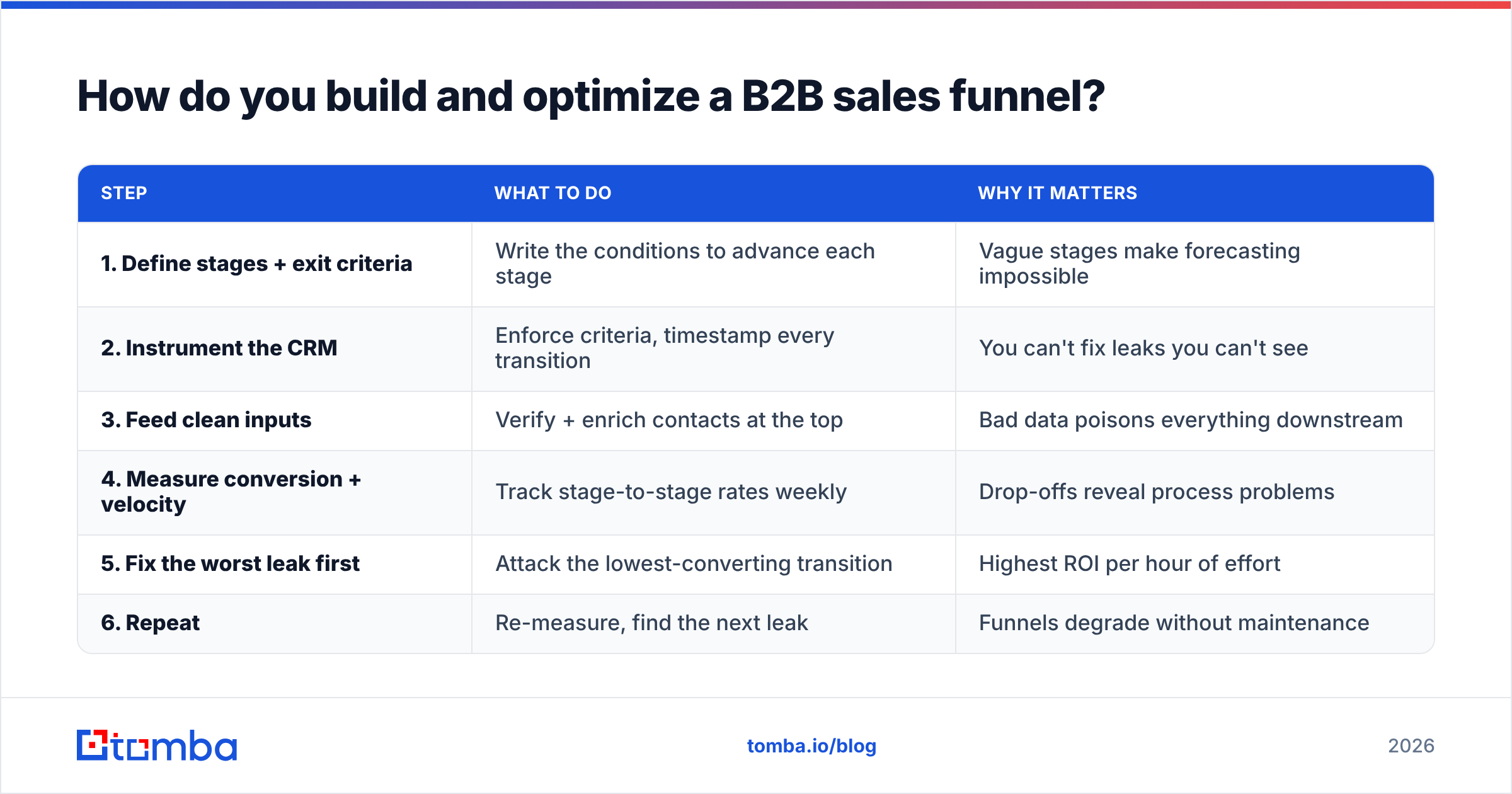
| Step | What to do | Why it matters |
|---|---|---|
| 1. Define stages + exit criteria | Write the conditions to advance each stage | Vague stages make forecasting impossible |
| 2. Instrument the CRM | Enforce criteria, timestamp every transition | You can't fix leaks you can't see |
| 3. Feed clean inputs | Verify + enrich contacts at the top | Bad data poisons everything downstream |
| 4. Measure conversion + velocity | Track stage-to-stage rates weekly | Drop-offs reveal process problems |
| 5. Fix the worst leak first | Attack the lowest-converting transition | Highest ROI per hour of effort |
| 6. Repeat | Re-measure, find the next leak | Funnels degrade without maintenance |
The discipline that separates good operators: fix one leak at a time. Don't redesign the whole funnel because Q3 was soft. Find the single worst-converting transition, fix it, re-measure, move on. A funnel is optimized the way you tighten a bicycle wheel — one spoke at a time, checking true after each.
Feed the funnel, don't just admire it#
A perfectly designed funnel with no fuel is a diagram, not a revenue engine. Two practical ways to keep quality volume flowing:
- Build targeted lists by company. Use a domain search to pull the right roles at your ICP accounts, then verify before adding them.
- Enrich what you already have. Run existing contacts through data enrichment to fill missing titles, phones, and company data so reps personalize instead of guessing.
For broader stack decisions, frameworks from analysts like Gartner and review data on G2 are useful neutral references — and the HubSpot sales blog is a solid running source on funnel benchmarks.
What does a healthy B2B funnel look like in 2026?#
A healthy funnel is narrow, fast, and honest. Narrow because you reject bad fits early instead of dragging them to the bottom. Fast because velocity is enforced with exit criteria. Honest because the numbers in the CRM match reality — no inflated "Intent" deals propping up a forecast nobody believes.
Concretely, a healthy 2026 B2B funnel tends to show:
- Tight ToFu qualification — fewer leads, higher fit, verified contact data.
- Predictable stage conversion — rates stable enough to forecast within ±10%.
- Short MoFu dwell time — deals don't sit for months without evidence of progress.
- A documented BoFu proof kit — references and security docs ready on day one of evaluation.
- Weekly leak review — the team knows its worst-converting transition right now.
If you can't name your funnel's worst leak this week, that's the first thing to fix — not with a new tool, but with measurement.
Frequently asked questions#
What's the difference between a marketing funnel and a sales funnel? The marketing funnel covers awareness through to a qualified lead (MQL); the sales funnel picks up at the qualified lead and runs to close. They overlap in the middle, which is exactly where most handoff leaks happen. Aligning the two — what marketing calls "qualified" matching what sales will accept — is a recurring RevOps project.
How many stages should my funnel have? As many as map to real, observable changes in buyer behavior — usually four to six. More stages give finer measurement but cost discipline to maintain. Start with six, collapse any stage whose exit criteria you can't define.
Can you automate the B2B sales funnel? Parts of it. Lead capture, enrichment, scoring, and routing automate well; discovery and negotiation don't. The highest-leverage automation in 2026 is at the top — auto-verifying and enriching contacts so reps spend time selling, not data-cleaning.
How do I know if my funnel is leaking? Compare conversion rates between adjacent stages. The transition with the steepest drop relative to its band benchmark is your leak. If velocity is also slowing at that point, you've confirmed it.
Put clean data at the top of your funnel#
A B2B sales funnel rewards exactly one thing above all: honest inputs. You can redesign stages, retrain reps, and rebuild your CRM, but if the top of the funnel fills with bad contacts, every downstream metric lies and every rep wastes cycles. Fix that first.
The Tomba Email Finder gives your funnel verified, accurate contact data from the start — find the right decision-makers by name, company, or domain, confirm the addresses are real, and feed your pipeline leads worth chasing instead of guesses. Start on the free tier (25 searches a month), and when you're ready to scale, Tomba pricing runs from $49/mo Starter to custom Enterprise. Clean inputs, honest funnel, better forecast — that's the whole game.
// get started
Find, verify and enrich your first contacts today
Start on the free plan with 25 searches a month, then scale when your team is ready.
Free plan · No credit card required · GDPR & CCPA
// about the author