7 B2B Sales Funnel Examples That Actually Convert in 2026
Seven real B2B sales funnel examples — PLG, outbound, ABM, and more — with stage-by-stage metrics, tooling, and the data that keeps each one from leaking.
Most "sales funnel" articles show you a triangle and call it a day. That triangle doesn't tell you what to build on Monday. This post does the opposite: it walks through seven B2B sales funnel examples used by real go-to-market teams, with the stages, the conversion math, and the tooling each one actually needs.
TL;DR#
- A B2B sales funnel is the staged path a buyer takes from first touch to closed revenue — and the right shape depends on your motion (PLG, outbound, ABM, inbound, hybrid).
- The most common failure point isn't the bottom of the funnel; it's the top, where bad contact data and weak targeting poison everything downstream.
- Below you'll find 7 worked examples with stage names, benchmark conversion rates, and the stack each uses.
- Every funnel lives or dies on data quality. Clean, verified contact data at the top compounds into higher win rates at the bottom.
- Use the comparison table to match a funnel to your average deal size and sales cycle, then steal the stage structure that fits.
What is a B2B sales funnel, exactly?#
A B2B sales funnel is the sequence of stages a business buyer moves through, from "never heard of you" to "signed the contract" — and ideally to "renewed and referred someone." Think of it like an airport: a crowd arrives at the entrance (awareness), most peel off to other gates, a smaller group clears security (qualification), and only ticketed passengers actually board (purchase). Each checkpoint filters volume down to intent.
Technically, the funnel is a measurement model. Each stage has an entry definition, an exit definition, and a conversion rate between them. When you can name those, you can find the leak.
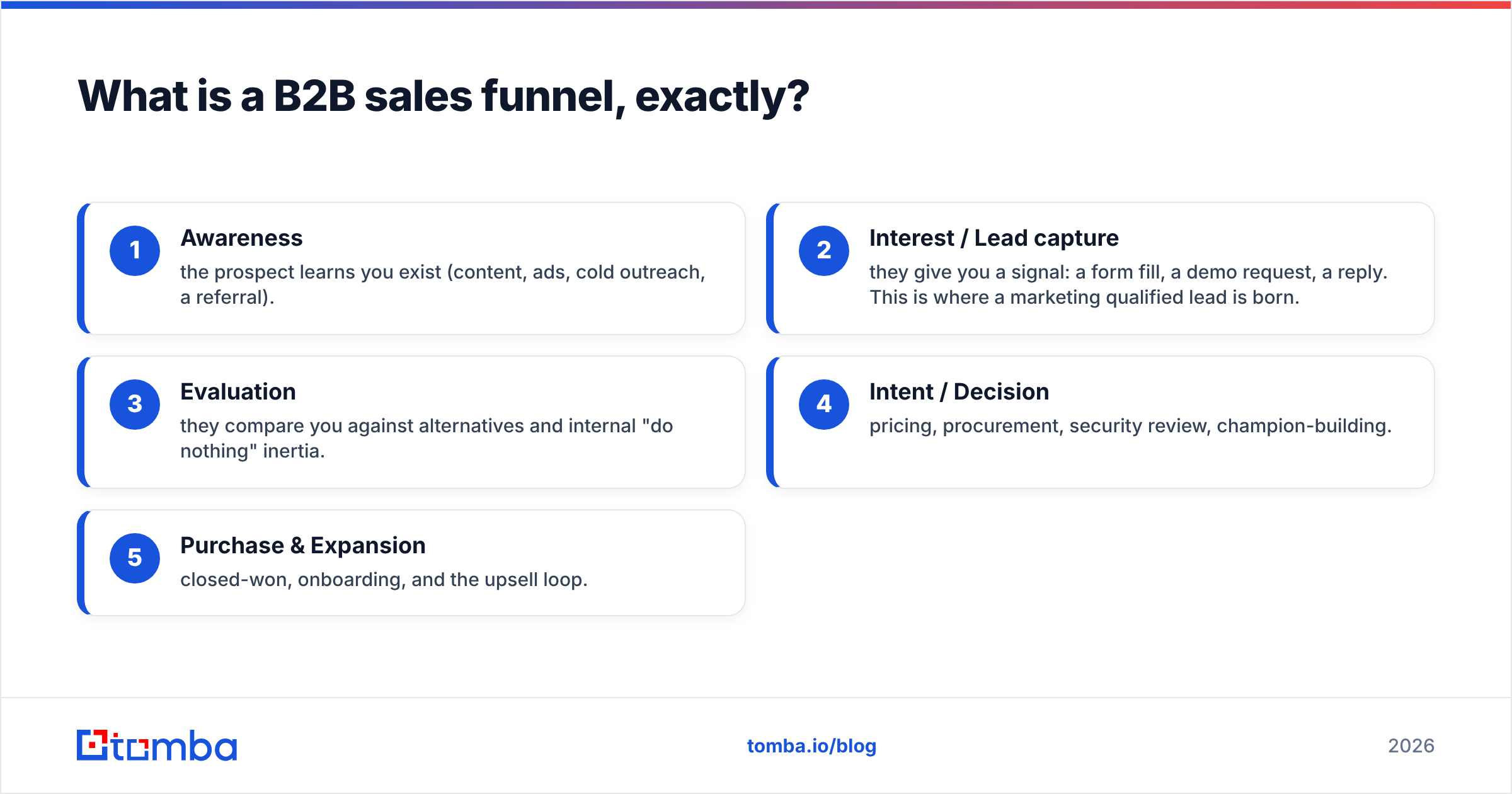
A typical B2B funnel has five core layers, and almost every example below is a variation on these:
- Awareness — the prospect learns you exist (content, ads, cold outreach, a referral).
- Interest / Lead capture — they give you a signal: a form fill, a demo request, a reply. This is where a marketing qualified lead is born.
- Evaluation — they compare you against alternatives and internal "do nothing" inertia.
- Intent / Decision — pricing, procurement, security review, champion-building.
- Purchase & Expansion — closed-won, onboarding, and the upsell loop.
The B2C funnel can collapse all of this into one impulse click. B2B can't: you're selling to a committee, the deal is bigger, and the cycle runs weeks to quarters. That's why structure matters more here than anywhere else.

Wait — ignore that placeholder direction; the meme below is the real one.
Why do most B2B funnels leak at the top?#
Because teams obsess over closing tactics while feeding the funnel garbage. If 40% of your top-of-funnel contacts have wrong or dead email addresses, you've capped your win rate before a rep ever sends a message. No amount of clever follow-up fixes a bounced email or a contact who left the company 14 months ago.
The fix is unglamorous: verified contact data and tight targeting at the entry point. Tools like the Tomba Email Finder and a real-time email verifier exist precisely so the top of your funnel isn't built on guesses. Get that right and every downstream conversion rate improves without changing a single sales script.
Now, the examples.
What are the 7 B2B sales funnel examples?#
1. The product-led growth (PLG) funnel#
Used by self-serve SaaS (think Slack, Notion, Calendly in their early days). The product is the funnel.
- Stages: Visitor → Free signup → Activated user → Paid conversion → Expansion
- Key metric: Activation rate (did they hit the "aha" moment in week one?)
- Where sales enters: Only at the top end — a "product-qualified lead" (PQL) hits a usage threshold and a rep reaches out to convert a team into an enterprise plan.
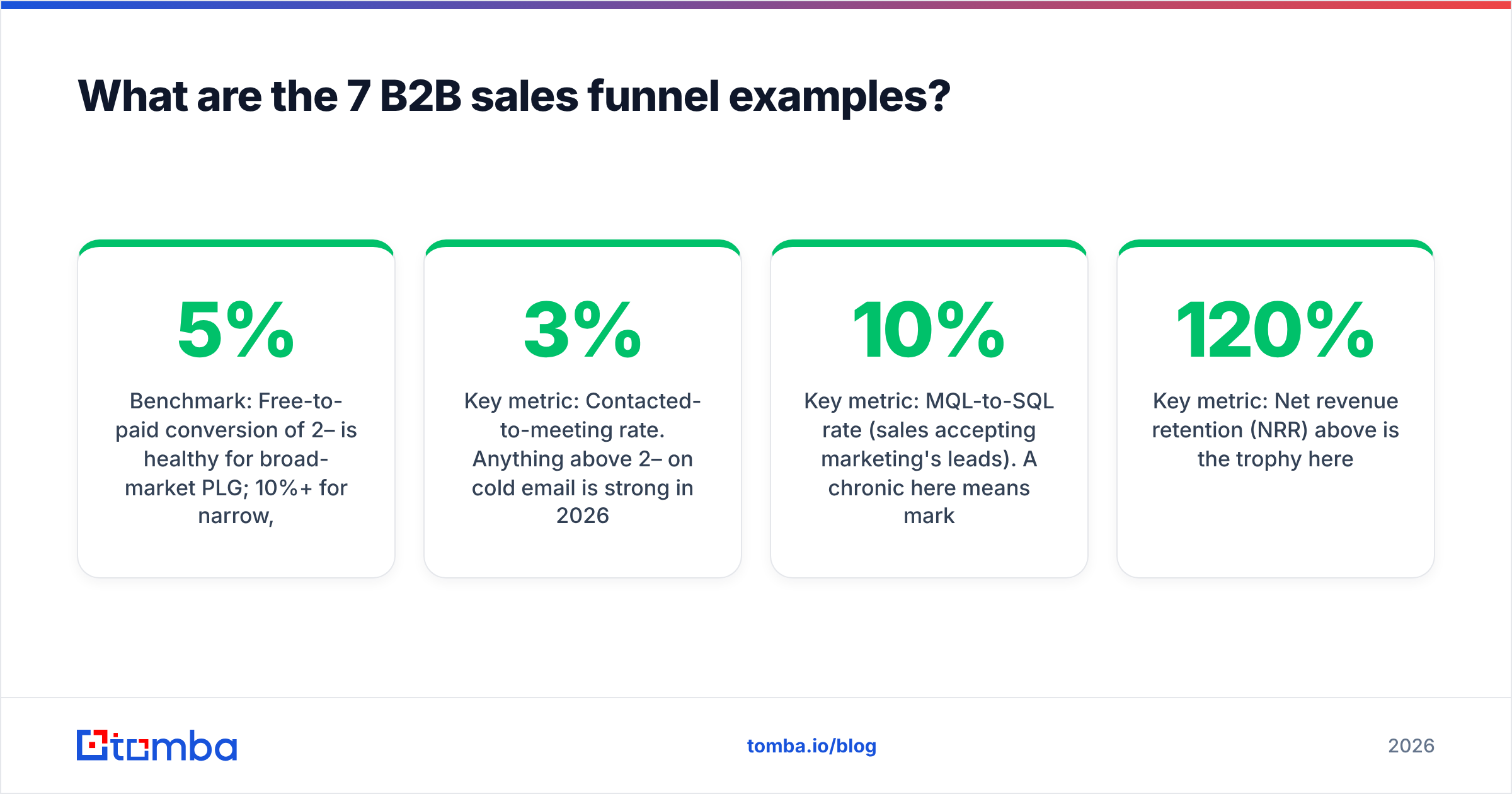
- Benchmark: Free-to-paid conversion of 2–5% is healthy for broad-market PLG; 10%+ for narrow, high-intent tools.
PLG looks like it removes sales, but the best PLG companies layer outbound on top once a PQL appears — using enrichment to find the economic buyer behind a free user.
2. The outbound (cold) funnel#
The classic SDR motion. You go to the buyer; they didn't come to you.
- Stages: Target list → Contacted → Engaged (reply) → Meeting booked → Opportunity → Closed
- Key metric: Contacted-to-meeting rate. Anything above 2–3% on cold email is strong in 2026.
- The data dependency: This funnel is entirely gated by list quality. Build it with a bulk email finder and verify before sending, or your deliverability — and sender reputation — tanks.
3. The inbound content funnel#
Buyers find you through search, get educated, and self-select into a conversation.
- Stages: Organic visitor → Content subscriber → MQL (gated asset) → SQL → Opportunity → Closed
- Key metric: MQL-to-SQL rate (sales accepting marketing's leads). A chronic 10% here means marketing and sales disagree on "qualified."
- Strength: Lower cost per lead over time. Weakness: slow to spin up, and you don't control timing.
4. The account-based marketing (ABM) funnel#
Flipped on its head: you pick the accounts first, then orchestrate marketing + sales against them. HubSpot and Salesforce both publish strong ABM playbooks worth reading.
- Stages: Target account list → Engaged account → Multi-threaded opportunity → Closed → Expansion
- Key metric: Account engagement and number of contacts engaged per account (multi-threading).
- The data dependency: You need every relevant stakeholder at each target account — which is where domain search earns its keep, mapping all the emails behind a single company domain.
5. The freemium-to-enterprise hybrid funnel#
PLG at the bottom, sales-assisted at the top. Common in dev tools and data platforms.
- Stages: Free user → Team adoption → PQL flagged → Sales-assisted expansion → Enterprise contract
- Key metric: Net revenue retention (NRR) above 120% is the trophy here.
- Why it works: The product does qualification for free; sales only spends time on accounts already proving value.
6. The channel / partner funnel#
Revenue flows through resellers, agencies, or integration partners instead of direct.
- Stages: Partner recruited → Partner enabled → Partner-sourced lead → Co-sell opportunity → Closed
- Key metric: Percentage of pipeline that is partner-sourced vs. partner-influenced.
- Watch-out: Attribution gets messy fast; instrument it before you scale it.
7. The event / community-led funnel#
Webinars, conferences, and communities feed the top.
- Stages: Event registrant → Attendee → Follow-up engaged → Opportunity → Closed
- Key metric: Registrant-to-attendee, then attendee-to-meeting. Most teams nail the first and fumble the second.
- The data dependency: A registrant list is just names until you enrich it. Pair it with data enrichment to turn a CSV of attendees into routable, verified leads.
How do these B2B sales funnel examples compare?#
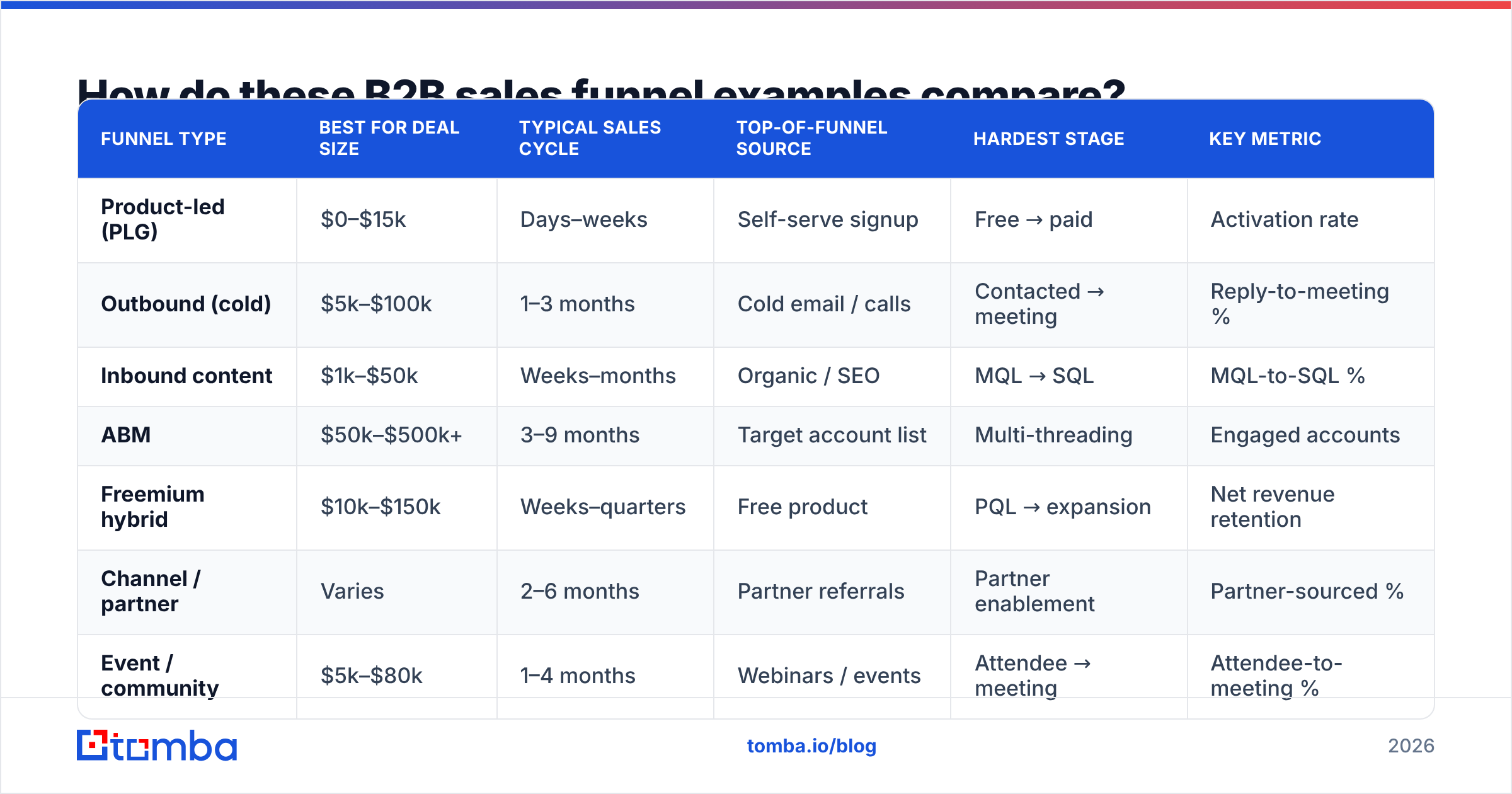
Here's the side-by-side so you can match a model to your reality. Sales cycle and deal size should drive your choice more than fashion.
| Funnel type | Best for deal size | Typical sales cycle | Top-of-funnel source | Hardest stage | Key metric |
|---|---|---|---|---|---|
| Product-led (PLG) | $0–$15k | Days–weeks | Self-serve signup | Free → paid | Activation rate |
| Outbound (cold) | $5k–$100k | 1–3 months | Cold email / calls | Contacted → meeting | Reply-to-meeting % |
| Inbound content | $1k–$50k | Weeks–months | Organic / SEO | MQL → SQL | MQL-to-SQL % |
| ABM | $50k–$500k+ | 3–9 months | Target account list | Multi-threading | Engaged accounts |
| Freemium hybrid | $10k–$150k | Weeks–quarters | Free product | PQL → expansion | Net revenue retention |
| Channel / partner | Varies | 2–6 months | Partner referrals | Partner enablement | Partner-sourced % |
| Event / community | $5k–$80k | 1–4 months | Webinars / events | Attendee → meeting | Attendee-to-meeting % |
Notice the pattern: every funnel's "top-of-funnel source" is a list of humans you need to reach. That's the common denominator — and the common failure point.
Which B2B sales funnel example should you pick?#
Conclusion first: pick the funnel that matches your deal size and how your buyers prefer to buy — not the one your favorite founder tweets about.
A few decision rules:
- Small deals, broad market, low-touch product? PLG or freemium hybrid. Don't put a $120k-quota AE on a $40/month product.
- Big deals, named accounts, committees? ABM. You can't spray-and-pray a 7-person buying group.
- No inbound yet and you need pipeline this quarter? Outbound. It's the only motion you can switch on tomorrow — assuming your data is clean.
- Long game, content engine, patient budget? Inbound. Compounds beautifully, starts slowly.
Most mature orgs run two or three of these in parallel. A common stack: inbound for the bottom of the market, outbound for mid-market, ABM for enterprise. The funnels share a CRM and a data layer but keep separate stage definitions and conversion benchmarks.
For benchmarking your own conversion rates against the wider market, G2's annual buyer behavior reports and the data on g2.com are a reasonable public reference point — just remember benchmarks are directional, not destiny.
How do you keep any of these funnels from leaking?#
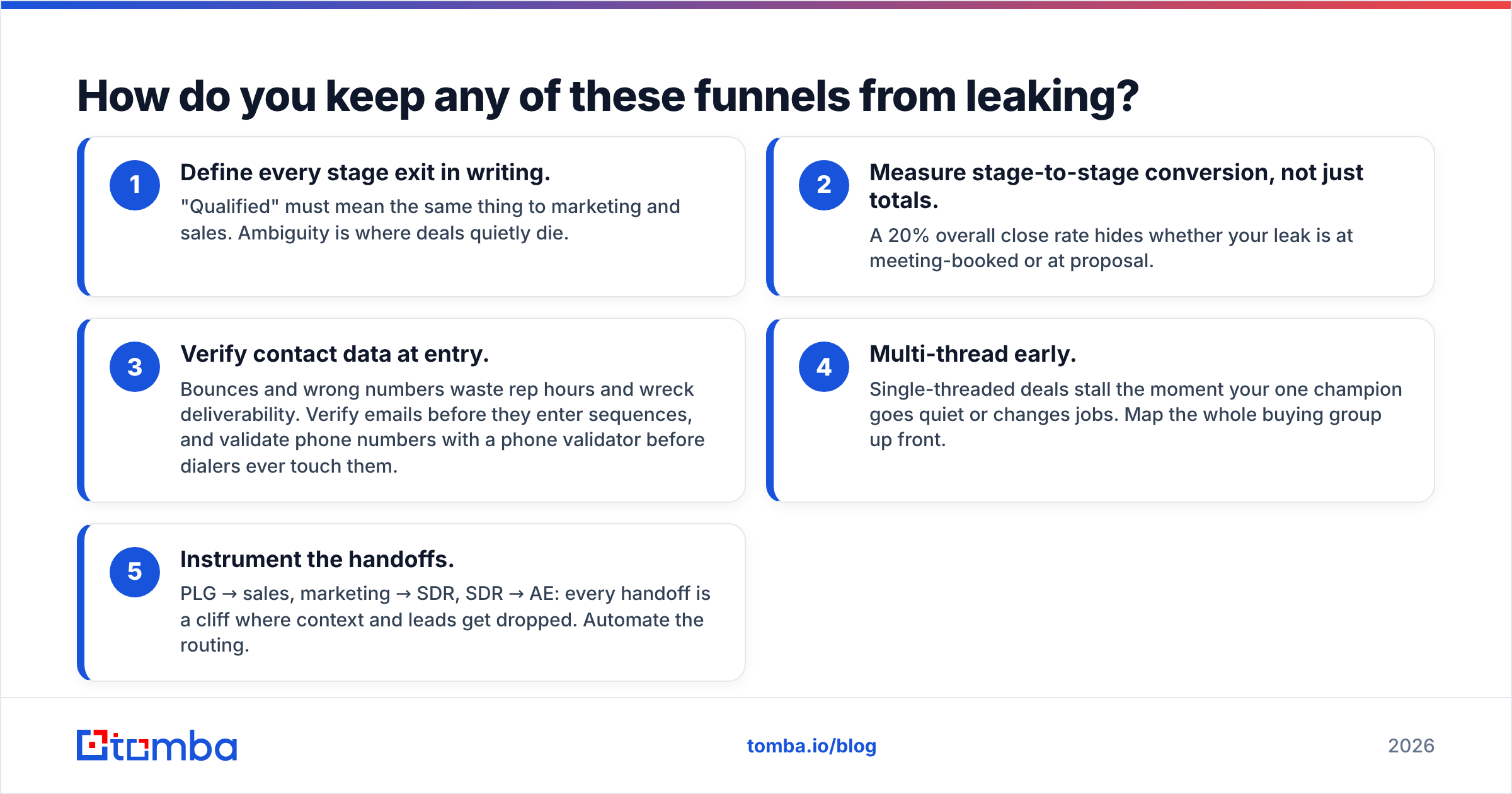
Five moves apply regardless of which example you chose:
- Define every stage exit in writing. "Qualified" must mean the same thing to marketing and sales. Ambiguity is where deals quietly die.
- Measure stage-to-stage conversion, not just totals. A 20% overall close rate hides whether your leak is at meeting-booked or at proposal.
- Verify contact data at entry. Bounces and wrong numbers waste rep hours and wreck deliverability. Verify emails before they enter sequences, and validate phone numbers with a phone validator before dialers ever touch them.
- Multi-thread early. Single-threaded deals stall the moment your one champion goes quiet or changes jobs. Map the whole buying group up front.
- Instrument the handoffs. PLG → sales, marketing → SDR, SDR → AE: every handoff is a cliff where context and leads get dropped. Automate the routing.
The unifying theme — and the reason data-tooling sits underneath all seven examples — is that funnels are only as good as the contacts entering them. You can A/B-test subject lines forever, but if the email is invalid, none of it matters.
What does a healthy funnel's data layer look like?#
Underneath the stage names, a working B2B funnel needs four data jobs done well:
- Discovery — finding the right contacts at the right accounts (email finder, domain search).
- Verification — confirming those contacts are real and reachable before outreach (email + phone validation).
- Enrichment — adding firmographics, role, and intent so you can score and route (lead scoring depends on this).
- Maintenance — refreshing data as people change jobs, which in B2B happens to ~25–30% of contacts a year.
Get these four right and your funnel doesn't just convert better — it stays accurate as the world moves underneath it. Public data tools and CRMs like those documented at hubspot.com handle the workflow; a dedicated data provider handles the accuracy.
Build the top of your funnel on data you can trust#
Whichever of these B2B sales funnel examples you adopt, the entry point is the same problem: you need verified, accurate contact data, or the rest of the funnel is theater. That's exactly what the Tomba Email Finder is built for — finding and verifying professional email addresses by name, company, or domain so your funnel starts clean.
You can test it on the free tier (25 searches a month), then scale into the Starter plan at $49/mo or Growth at $99/mo as your volume grows — see full Tomba pricing for the breakdown. Start by fixing the leak at the top, and watch every conversion rate below it quietly improve.
// get started
Find, verify and enrich your first contacts today
Start on the free plan with 25 searches a month, then scale when your team is ready.
Free plan · No credit card required · GDPR & CCPA
// about the author