B2B Sales Intelligence in 2026: Tools, Data, and Tactics
What B2B sales intelligence actually is in 2026, how the platforms differ, and how to turn signal-rich data into booked meetings without burning your sender reputation.
placeholder
TL;DR
- B2B sales intelligence is the practice of collecting, enriching, and acting on data about companies and the people inside them — firmographics, technographics, contact details, and buying signals — so reps spend time on accounts that are actually in-market.
- The category splits into three jobs: find the right accounts, find the right people and their contact data, and know when to reach out. Most tools are strong at one or two, weak at the rest.
- Data decays fast. Roughly 25–30% of B2B contact data goes stale every year as people change jobs, so accuracy and re-verification matter more than raw record counts.
- You don't need the most expensive platform. You need clean contact data, a signal you trust, and a workflow that turns both into outreach.
- Tomba fits the "find the right people and verify their contact data" layer cheaply, with a free tier and plans from $49/mo.
What is B2B sales intelligence?#
B2B sales intelligence is the data and tooling that tells a revenue team who to sell to, how to reach them, and when the timing is right. Think of it like a fishing sonar: instead of casting your line randomly across the whole lake, the sonar shows you where the fish are, how deep, and which way they're moving. You still have to cast well — but you're no longer guessing.
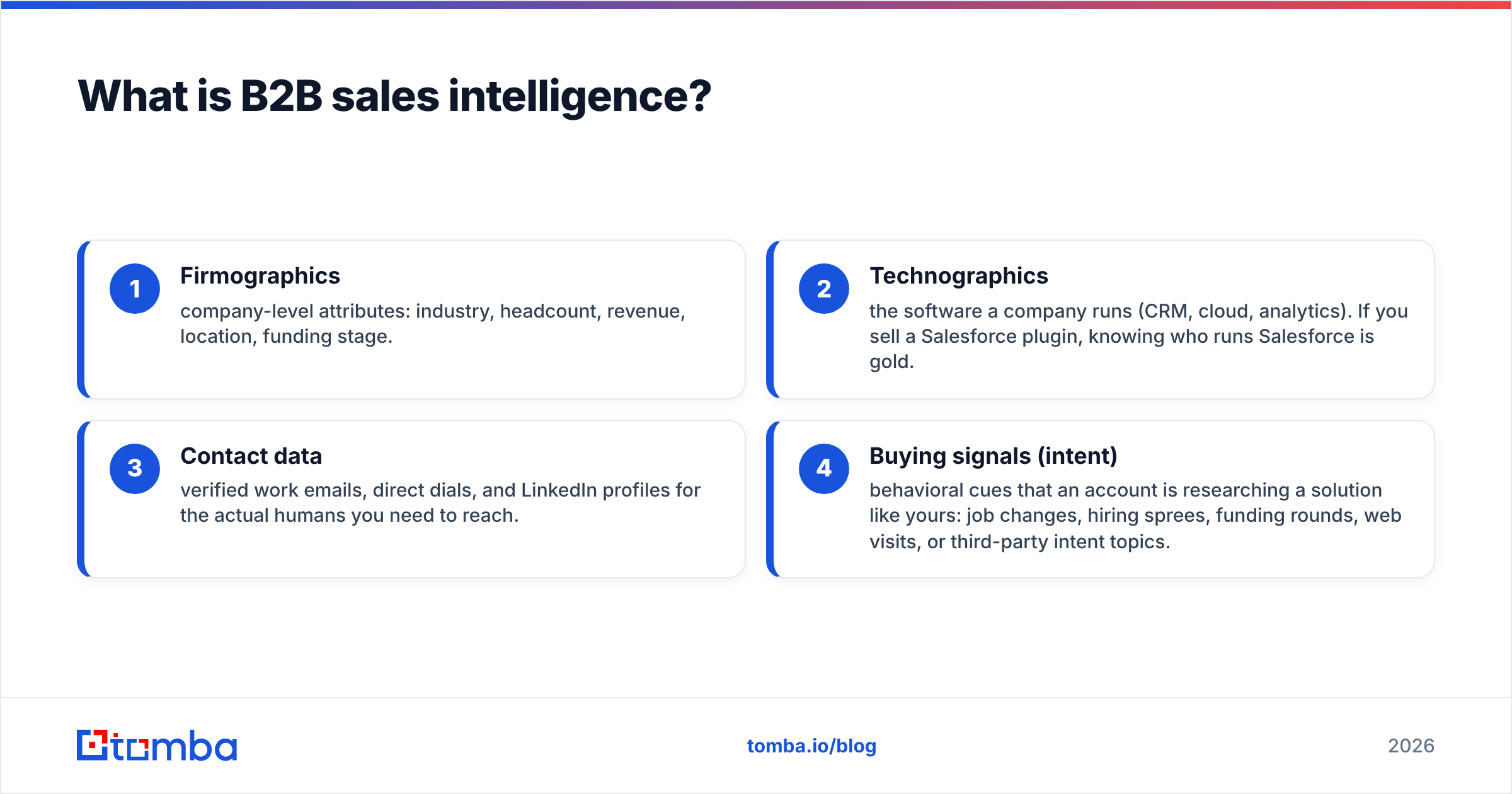
Technically, the category bundles four data types:
- Firmographics — company-level attributes: industry, headcount, revenue, location, funding stage.
- Technographics — the software a company runs (CRM, cloud, analytics). If you sell a Salesforce plugin, knowing who runs Salesforce is gold.
- Contact data — verified work emails, direct dials, and LinkedIn profiles for the actual humans you need to reach.
- Buying signals (intent) — behavioral cues that an account is researching a solution like yours: job changes, hiring sprees, funding rounds, web visits, or third-party intent topics.
A platform that only does one of these is a point tool. A "sales intelligence platform" tries to do several at once — which is why pricing and accuracy vary so wildly across the market.
Why does B2B sales intelligence matter in 2026?#
Because bad data quietly taxes every other investment you make. You can hire great SDRs, write great copy, and run a sharp sequence — and still fail if 30% of your contacts bounce or the buyer left the company eight months ago.
A few realities shaping the category this year:
- Data decay is relentless. Industry estimates from analysts like Gartner and validation vendors put B2B contact decay at roughly 25–30% per year. A list you bought in January is meaningfully wrong by summer.
- Deliverability is fragile. Inbox providers tightened bulk-sender rules, so sending to unverified addresses doesn't just waste time — it damages your sender reputation and can blacklist your domain.
- Intent is now table stakes, not a luxury. Buyers complete most of their research before they ever talk to sales, so catching them mid-research beats interrupting them cold.
The takeaway: in 2026, sales intelligence is less about more data and more about trustworthy, timely data. A smaller verified list with a real signal outperforms a giant unverified dump every time.
What are the core components of a sales intelligence stack?#
Here's the structured breakdown most teams converge on. Use it to audit which layer you're actually missing before you buy anything.
- Account identification — Define your ICP and build a list of companies that match. Firmographic + technographic filters live here.
- Contact discovery — For each target account, find the decision-makers and their verified contact data. This is where email finders and data providers earn their keep.
- Data verification — Re-check emails and phone numbers before you send. A separate email verifier step protects deliverability.
- Signal layer — Monitor for intent: funding, hiring, leadership changes, web visits, technology adoption.
- Enrichment & sync — Push clean records into your CRM and keep them fresh with data enrichment so reps work from current information.
- Activation — The sequencer, dialer, or social tool that actually delivers the message.
Most "all-in-one" platforms try to own all six. In practice, teams mix a broad data provider for accounts and intent with a precise, affordable tool for contact discovery and verification — because no single vendor is best at everything.
How do the main B2B sales intelligence tools compare?#
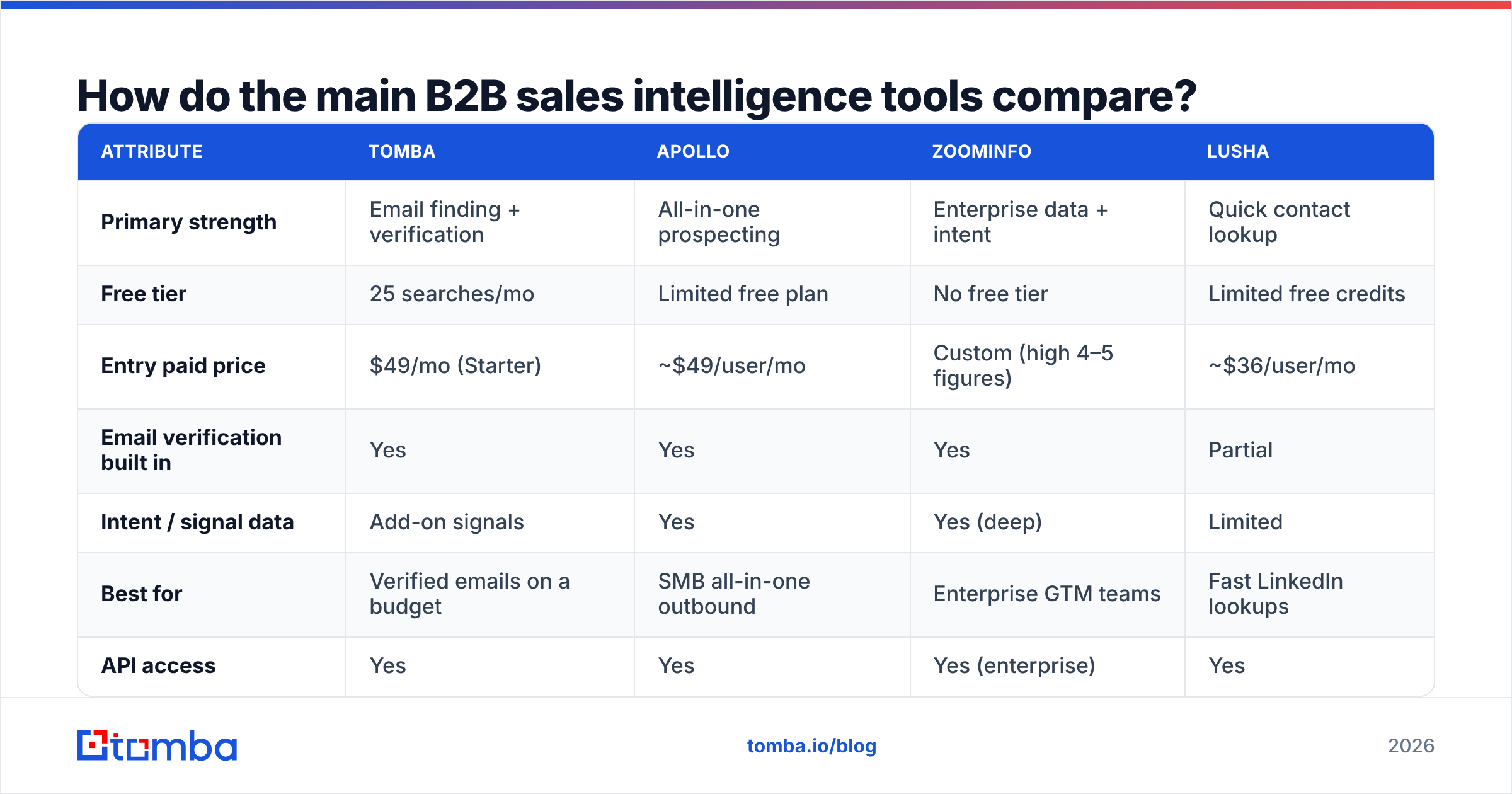
The big platforms (Apollo, ZoomInfo, Cognism, Lusha, Clearbit) optimize for breadth and intent. Focused providers like Tomba optimize for accurate contact discovery and verification at a fraction of the price. Here's a concrete comparison across the attributes that actually change your monthly bill and your bounce rate.
| Attribute | Tomba | Apollo | ZoomInfo | Lusha |
|---|---|---|---|---|
| Primary strength | Email finding + verification | All-in-one prospecting | Enterprise data + intent | Quick contact lookup |
| Free tier | 25 searches/mo | Limited free plan | No free tier | Limited free credits |
| Entry paid price | $49/mo (Starter) | ~$49/user/mo | Custom (high 4–5 figures) | ~$36/user/mo |
| Email verification built in | Yes | Yes | Yes | Partial |
| Intent / signal data | Add-on signals | Yes | Yes (deep) | Limited |
| Best for | Verified emails on a budget | SMB all-in-one outbound | Enterprise GTM teams | Fast LinkedIn lookups |
| API access | Yes | Yes | Yes (enterprise) | Yes |
A few honest notes on reading this table:
- ZoomInfo has the deepest enterprise dataset and the heaviest price tag and contract. If you're an enterprise GTM team with budget, it's a serious contender — check current reviews on G2 before committing.
- Apollo is the popular SMB all-in-one: data plus sequencing in one seat. Good if you want one tool; less specialized on data accuracy than dedicated providers.
- Lusha is fast for grabbing a contact off a LinkedIn profile but thinner on company-level intelligence.
- Tomba isn't trying to be the whole stack. It's the precise, low-cost layer for finding and verifying business emails — pair it with whatever account/intent source you already use. See full Tomba pricing for the Growth ($99/mo) and Pro ($249/mo) tiers.
If your gap is "I have target accounts but can't reliably reach the people," a focused finder beats paying enterprise rates for breadth you won't use.
How do you evaluate data quality and accuracy?#
Conclusion first: judge a provider on verified accuracy and freshness, not on the size of its database. A 100M-record database is meaningless if a quarter of it is wrong.
Run this checklist on any tool before you trust it:
- How is data sourced? Public crawling, opt-in contributions, partner feeds, or human research? Transparency matters — Tomba documents its data sources openly.
- Is there a verification step? Look for SMTP-level checks, catch-all detection, and a confidence score per record. A guess dressed up as a "found" email still bounces.
- How fresh is it? Ask when records were last re-verified, not just when they were added.
- What's the catch-all handling? Catch-all domains accept everything at the server, so they need a dedicated catch-all verifier to avoid false confidence.
- Can you test before you commit? Run 50 known-good contacts through the free tier and measure the real bounce rate yourself.
That last point is the one teams skip and regret. Vendor-quoted accuracy is a lab number; your bounce rate on your ICP is the truth.
How do buying signals turn data into meetings?#
Data tells you who. Signals tell you when — and timing is most of the battle. A perfectly accurate email sent six months too early is a wasted touch.
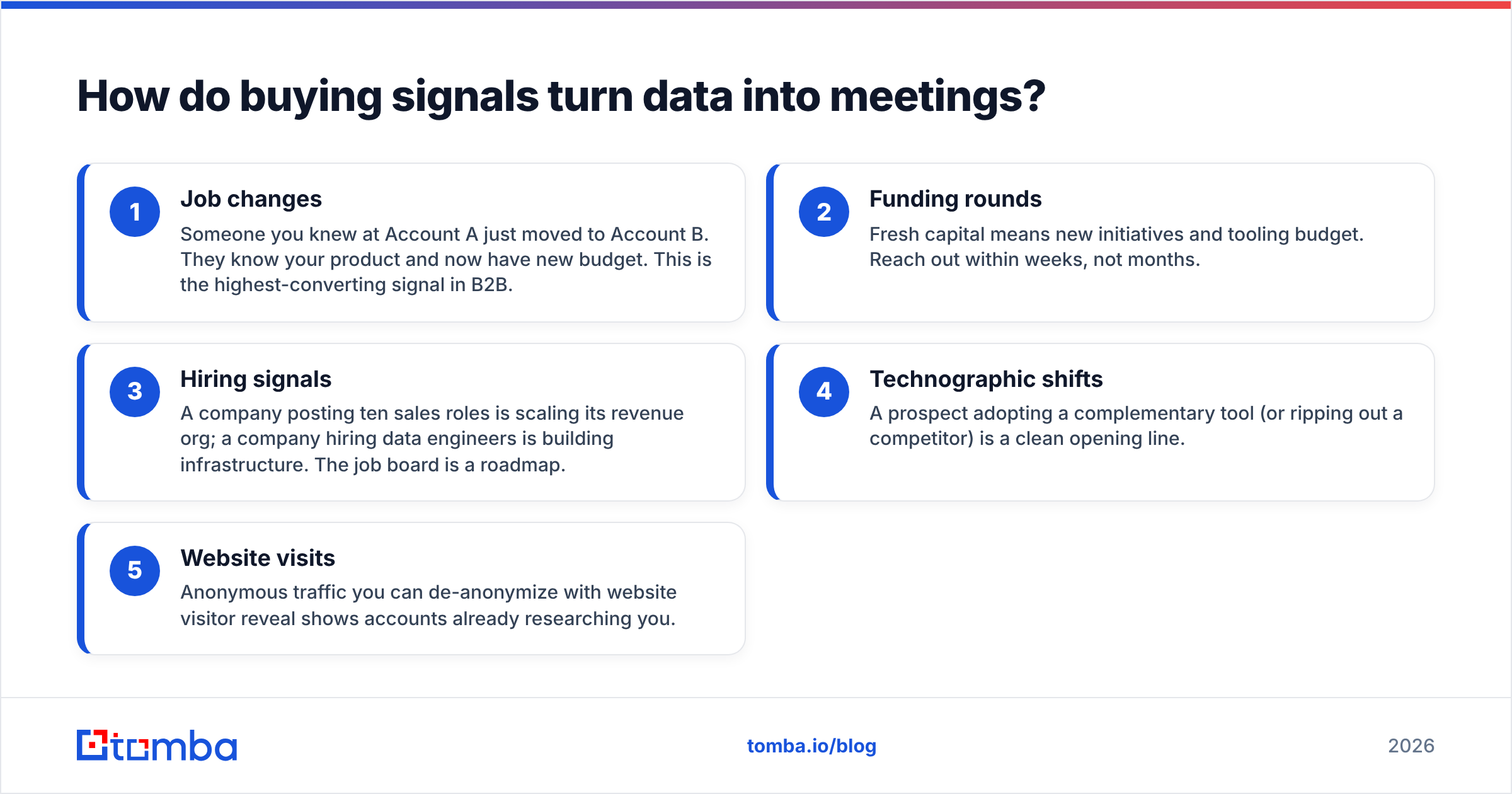
The signals worth wiring into your workflow, ranked by how actionable they are:
- Job changes — Someone you knew at Account A just moved to Account B. They know your product and now have new budget. This is the highest-converting signal in B2B.
- Funding rounds — Fresh capital means new initiatives and tooling budget. Reach out within weeks, not months.
- Hiring signals — A company posting ten sales roles is scaling its revenue org; a company hiring data engineers is building infrastructure. The job board is a roadmap.
- Technographic shifts — A prospect adopting a complementary tool (or ripping out a competitor) is a clean opening line.
- Website visits — Anonymous traffic you can de-anonymize with website visitor reveal shows accounts already researching you.
The workflow that ties it together: detect the signal → confirm the right contact and verify their email → enrich the CRM record → fire a relevant message that references the signal. That relevance is why signal-driven outreach beats spray-and-pray by a wide margin — you're showing up with a reason, not an interruption.
How do you build a B2B sales intelligence workflow on a budget?#
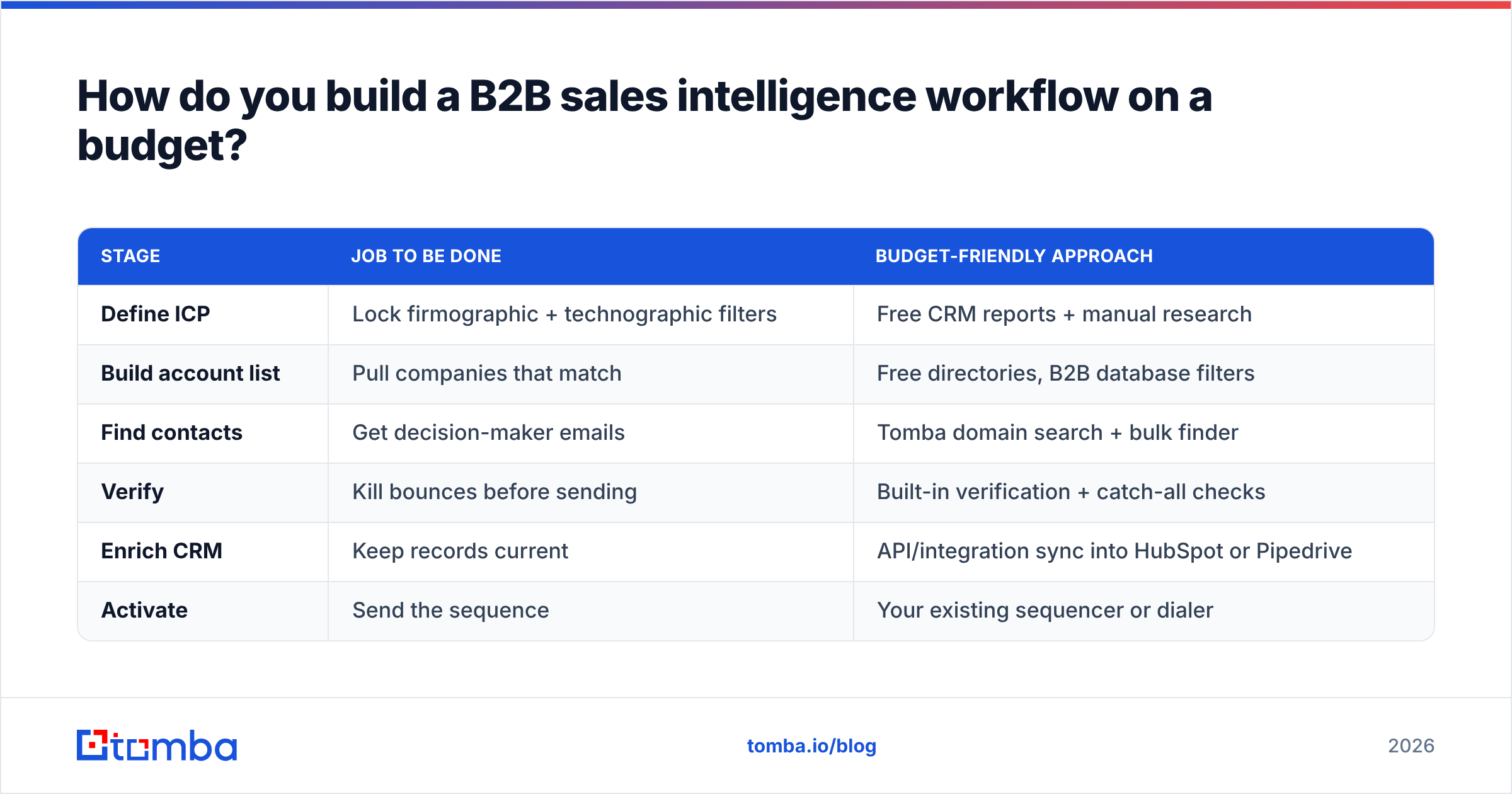
You can assemble a credible stack without an enterprise contract. Here's a lean version that most SMB and mid-market teams can run today:
| Stage | Job to be done | Budget-friendly approach |
|---|---|---|
| Define ICP | Lock firmographic + technographic filters | Free CRM reports + manual research |
| Build account list | Pull companies that match | Free directories, B2B database filters |
| Find contacts | Get decision-maker emails | Tomba domain search + bulk finder |
| Verify | Kill bounces before sending | Built-in verification + catch-all checks |
| Enrich CRM | Keep records current | API/integration sync into HubSpot or Pipedrive |
| Activate | Send the sequence | Your existing sequencer or dialer |
Two practical tips:
- Verify in bulk, not one-by-one. Upload your list to a bulk email finder so verification happens before the data ever touches your sequencer.
- Integrate, don't copy-paste. Tools like HubSpot publish solid guidance on keeping CRM data clean (see HubSpot's resources); the principle is to sync verified records automatically so reps never work from a stale export.
The whole point of doing this on a budget is discipline: a tight ICP and verified contacts beat a sprawling, half-accurate list that quietly tanks your deliverability.
What mistakes kill B2B sales intelligence ROI?#
The failures are predictable, which means they're avoidable:
- Buying breadth you won't use. Paying enterprise prices for 100M records when your ICP is 4,000 accounts is pure waste. Match the tool to the territory.
- Skipping verification. Treating "found" as "valid" is the fastest way to a blacklist. Always re-verify before send.
- Ignoring decay. A list is a perishable good. Re-enrich quarterly or accept a rising bounce rate.
- Chasing every signal. Not all intent is equal. A job change beats a vague third-party topic spike. Prioritize.
- No CRM hygiene. If clean data lands in a messy CRM, reps still work from duplicates and dead records. Dedupe and enrich on ingest.
Avoid those five and you'll outperform teams paying ten times more, because most of the spend in this category is wasted on data nobody verifies or acts on.
Frequently asked questions#
Is B2B sales intelligence the same as a CRM? No. A CRM stores and manages your relationships and deals. Sales intelligence feeds the CRM with accurate, enriched, signal-rich data about who to contact and when. They're complementary layers, not substitutes.
How much should a small team spend? Start lean. A focused finder-plus-verifier on a $49–$99/mo plan covers most SMB needs. Add intent and enterprise data only once you've proven the motion converts.
Does intent data really work? Yes, when it's specific and timely. Broad topic-level intent is noisy; concrete signals like job changes and funding are far more reliable triggers for outreach.
The bottom line#
B2B sales intelligence in 2026 rewards precision over volume. The teams winning aren't the ones with the biggest database — they're the ones reaching the right person, at a verified address, with a message tied to a real signal. Build the workflow around clean contact data and a signal you trust, and the rest of your stack starts paying off.
If your gap is reliably finding and verifying the people behind your target accounts, start with the Tomba Email Finder. Find professional emails by domain, name, or company, verify them before you send, and sync the clean records into your CRM — on a free tier to test and plans from $49/mo when you're ready to scale. It's the cheapest, highest-leverage layer you can add to a sales intelligence stack today.
Ready to find emails that actually work?
Join 150,000+ professionals who stopped guessing and started sending. Free credits on signup — no credit card required.
Get the Tomba newsletter
Practical outbound tactics and product updates — once every two weeks.
About the author