B2B Sales Meetings in 2026: How to Book, Run, and Close
A practical 2026 playbook for B2B sales meetings: how to book qualified meetings, run them so buyers actually engage, and turn them into pipeline.
B2B sales meetings are where deals are actually won or lost — not in the inbox, not on the dialer, but in the 30 minutes you get face-to-face (or screen-to-screen) with a buyer. Yet most reps treat the meeting as the finish line of prospecting instead of the start of a buying process. This guide fixes that.
TL;DR#
- A booked meeting is worthless if the wrong person shows up. Qualification and accurate contact data do more for close rates than any script tweak.
- Buyers run 6–10 person buying committees now. One champion is a single point of failure — multithread from meeting one.
- The best meetings are mostly the buyer talking. Aim for a 60/40 listen-to-talk ratio and a written agenda sent in advance.
- Follow-up within 24 hours with a recap and clear next step is the highest-leverage, most-skipped habit in B2B selling.
- Tooling matters at the top of the funnel: verified emails and direct phone numbers are what turn a target account into a calendar invite.
What counts as a B2B sales meeting in 2026?#
A B2B sales meeting is any scheduled, two-way conversation between a seller and one or more stakeholders at a target company, held to advance a buying decision. That definition is broad on purpose — discovery calls, demos, technical deep-dives, and executive-alignment sessions are all "meetings," and each has a different job.
The mistake reps make is treating them as interchangeable. A discovery call that turns into a feature dump kills momentum. A demo with no discovery behind it is a guessing game. Knowing which meeting you're in — and what the buyer needs to leave with — is the whole skill.
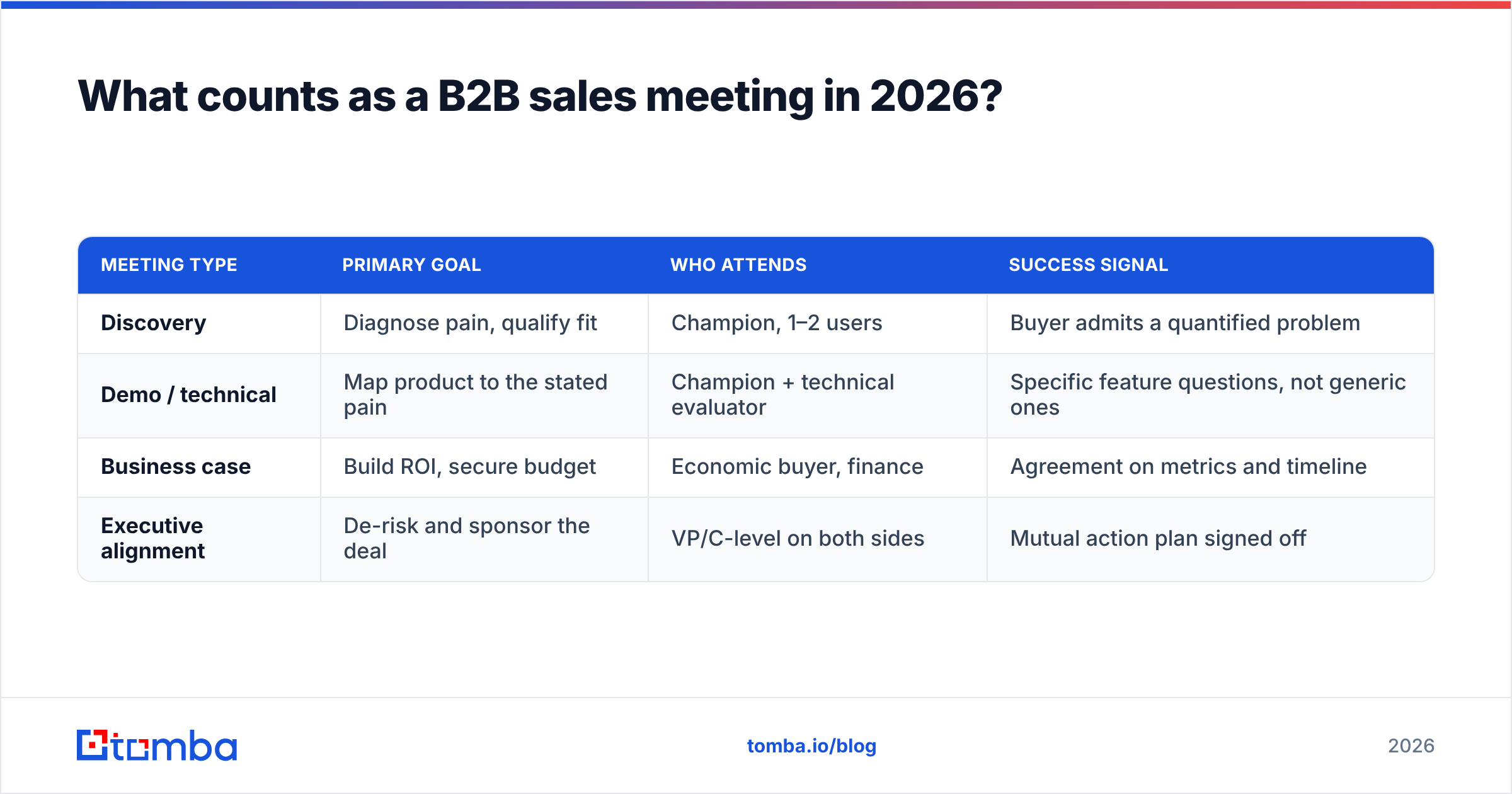
Here's how the core meeting types break down:
| Meeting type | Primary goal | Who attends | Success signal |
|---|---|---|---|
| Discovery | Diagnose pain, qualify fit | Champion, 1–2 users | Buyer admits a quantified problem |
| Demo / technical | Map product to the stated pain | Champion + technical evaluator | Specific feature questions, not generic ones |
| Business case | Build ROI, secure budget | Economic buyer, finance | Agreement on metrics and timeline |
| Executive alignment | De-risk and sponsor the deal | VP/C-level on both sides | Mutual action plan signed off |
If you can name which row you're in before you join the call, you're already ahead of most of the field.
Why do so many B2B sales meetings fail before they start?#
Most meetings fail at the booking stage, not the conversation stage. The three quiet killers:
- Wrong contact. You booked the user, not the decision-maker — or your email reached a catch-all address and a different person replied.
- No real qualification. The meeting got booked because someone said "sure," not because they have a budget, an authority, a need, and a timeline.
- Bad data. Roughly 30% of B2B contact data decays every year as people change jobs. A meeting booked on stale data is a no-show waiting to happen.
That last point is where prospecting and meetings collide. You cannot run a great meeting with someone who never picks up. Getting accurate, verified contact details is the unglamorous foundation — which is why teams lean on an email finder and a phone finder before they ever touch a calendar link. According to HubSpot's sales research, the average buyer ignores most outreach simply because it never reaches the right person with a relevant reason to engage.
How do you book more qualified B2B sales meetings?#
Booking volume is easy. Booking qualified meetings is the actual game. Work the problem in this order:
1. Define the account, then the person. Start from your ideal customer profile, not from whoever's email you happen to have. Use domain search to map every relevant contact at a target company, then identify the specific role you need — champion, user, or economic buyer.
2. Verify before you send. A bounced cold email damages your sender reputation and your meeting never happens. Run addresses through an email verifier so you're only spending outreach effort on deliverable contacts. This single step lifts reply rates more than any subject-line trick.
3. Lead with the buyer's problem, not your product. The meeting ask should reference something specific and true about their world: a hiring spike, a new compliance rule, a competitor move. Generic "I'd love 15 minutes" requests get generic ignores.
4. Multithread the ask. Don't bet the meeting on one inbox. Reaching two or three stakeholders at the same account — politely, with different angles — dramatically raises the odds someone says yes, and it sets up the multithreaded deal you'll need later anyway.
5. Make scheduling frictionless. Offer two concrete time windows or a booking link. Every extra back-and-forth email loses prospects.
A quick benchmark to hold yourself to: if fewer than 60% of your booked meetings actually happen, your problem is data and qualification, not your pitch.
What makes a B2B sales meeting actually productive?#
The productive meeting is the one the buyer leaves feeling understood. That happens by design, not charisma. The repeatable structure:
- Send an agenda in advance. Three to five bullets, shared the day before. It signals respect for their time and lets the buyer add items — which tells you what they actually care about.
- Open with a recap and a permission-based agenda check. "Here's what I planned to cover — anything you'd add or cut?" Thirty seconds, and the buyer co-owns the meeting.
- Spend the first half on discovery. Ask about the current state, the cost of inaction, and who else is affected. Quantify everything. "How much is that costing you per month?" beats any feature you could name.
- Mirror their language back. When you demo or propose, use the buyer's exact words for the problem. Now it's their initiative, not your sales pitch.
- Earn the next step explicitly. Never end without a scheduled, calendar-confirmed next action. "I'll follow up" is not a next step; "Thursday at 2pm with your VP of Ops" is.
The talk ratio matters more than people admit. Gong's conversation analytics consistently show that top performers talk less and listen more in winning calls — roughly 40% talk, 60% listen — while losing calls flip that ratio. If you're doing most of the talking, you're probably losing.
How many stakeholders should be in the room?#
More than one — and that's the headline. The modern B2B purchase involves a buying committee, and a champion who loves you but can't sign anything is the most common way deals die in "verbal yes" limbo.
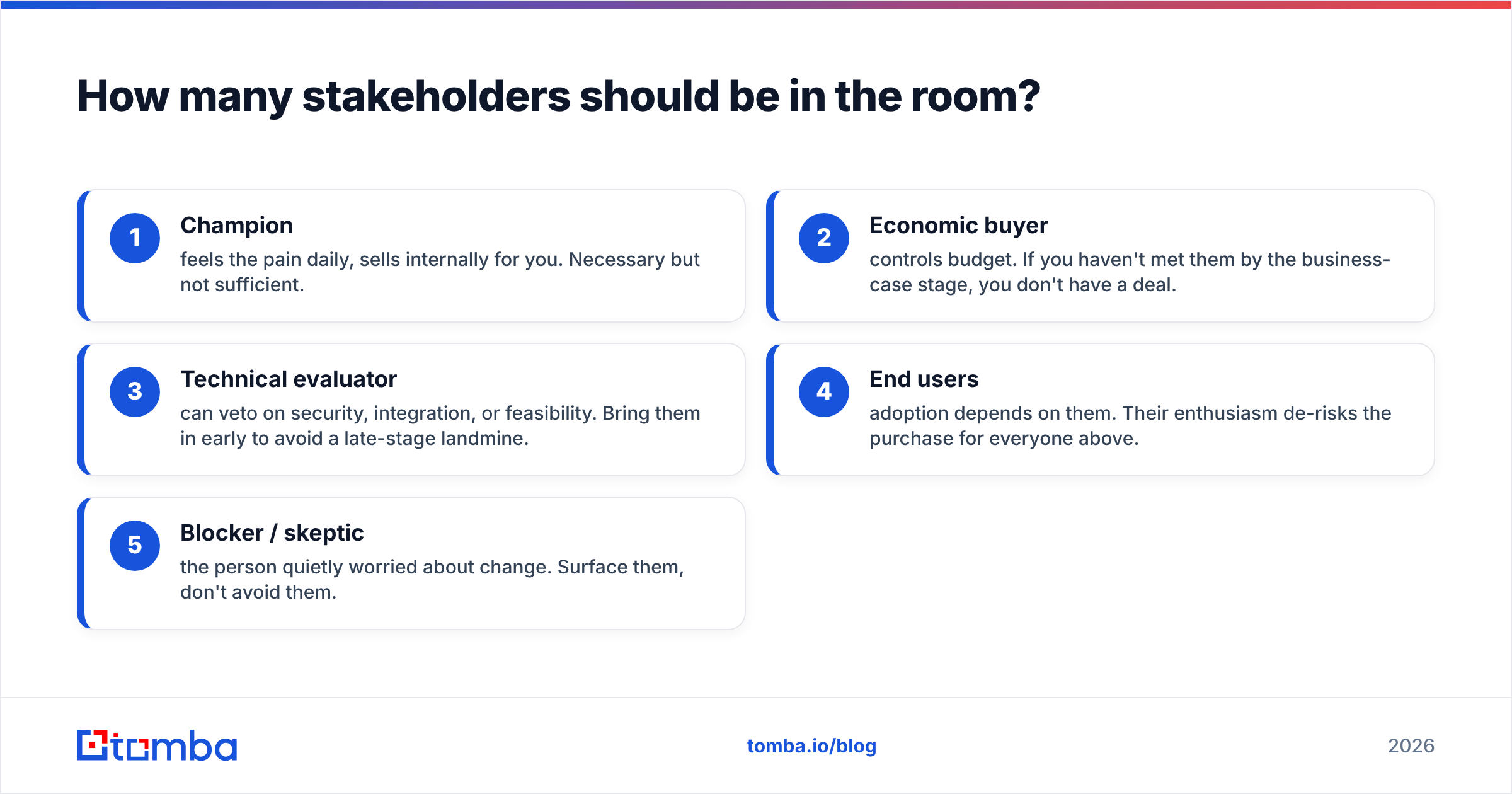
Plan to multithread across these roles:
- Champion — feels the pain daily, sells internally for you. Necessary but not sufficient.
- Economic buyer — controls budget. If you haven't met them by the business-case stage, you don't have a deal.
- Technical evaluator — can veto on security, integration, or feasibility. Bring them in early to avoid a late-stage landmine.
- End users — adoption depends on them. Their enthusiasm de-risks the purchase for everyone above.
- Blocker / skeptic — the person quietly worried about change. Surface them, don't avoid them.
To reach these people you need contact data for each, not just your champion. Tools like a LinkedIn finder and data enrichment help you fill in the org chart so you can request the right people for the next meeting by name. The goal is simple: never let your deal depend on a single relationship.
What's the difference between a discovery call and a demo?#
They are not the same meeting, and running them as one is the most expensive habit in B2B sales.
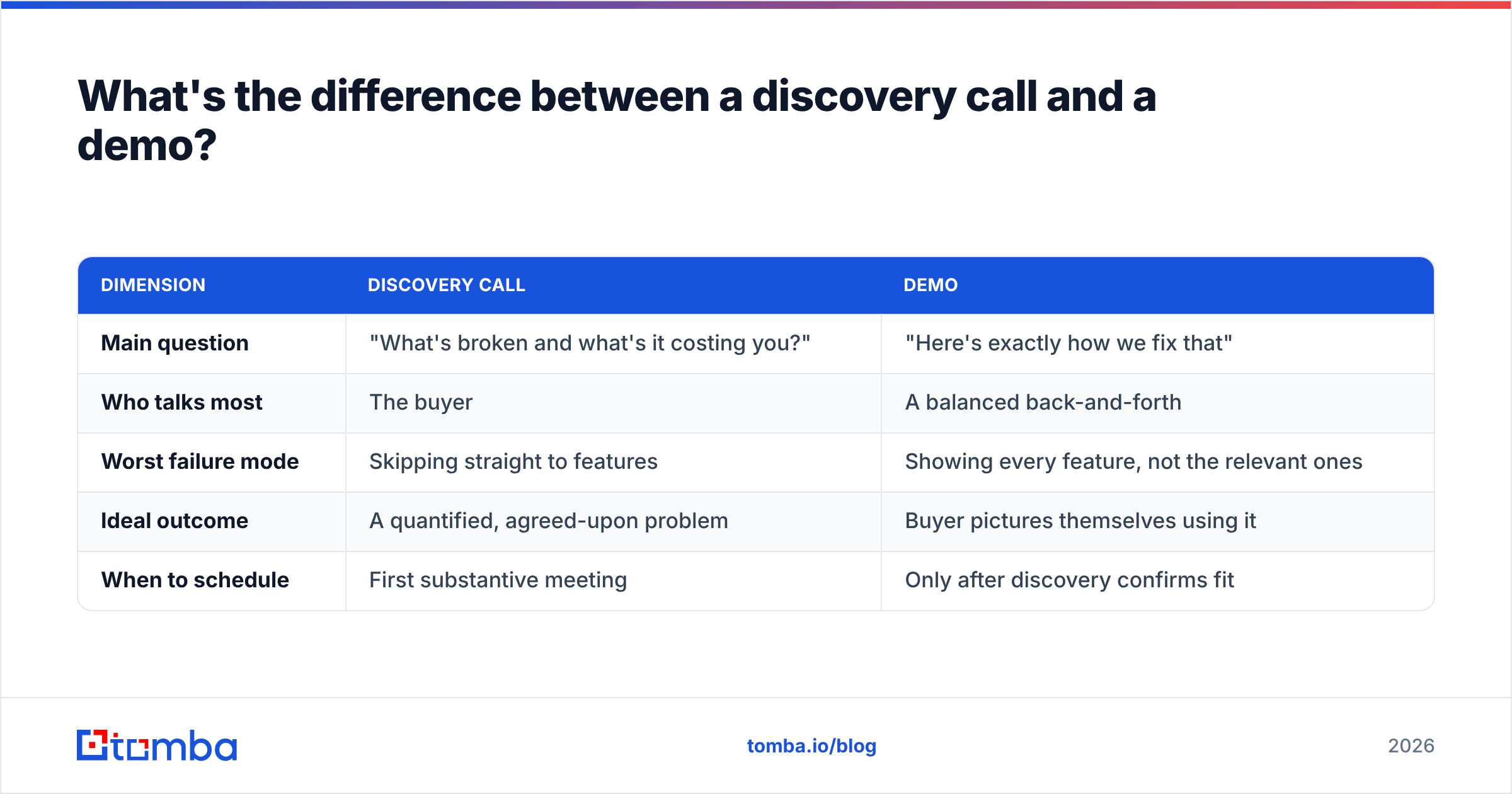
| Dimension | Discovery call | Demo |
|---|---|---|
| Main question | "What's broken and what's it costing you?" | "Here's exactly how we fix that" |
| Who talks most | The buyer | A balanced back-and-forth |
| Worst failure mode | Skipping straight to features | Showing every feature, not the relevant ones |
| Ideal outcome | A quantified, agreed-upon problem | Buyer pictures themselves using it |
| When to schedule | First substantive meeting | Only after discovery confirms fit |
The rule: no demo without discovery. A demo built on a real, quantified problem feels like a custom solution. A demo built on assumptions feels like a brochure. If a prospect pushes for a demo on the first call, do five minutes of discovery first — "so I only show you what's relevant" is a reason no one argues with.
How should you follow up after a B2B sales meeting?#
Fast, specific, and in writing. The follow-up is where average reps quietly lose deals they thought were won.
Within 24 hours, send a recap that includes:
- The problem in their words — proves you listened and aligns everyone.
- What you agreed on — scope, metrics, who's involved.
- The explicit next step — with a date and the names of who needs to attend.
- One resource that earns its place — a case study or doc that answers the exact objection they raised, not a generic deck.
Then keep the deal warm without nagging. A short, value-led touch — a relevant article, an intro to a customer in their industry, a metric that strengthens their internal business case — beats "just checking in" every time. If you want a measurable handle on this, track your team's response rate on post-meeting follow-ups; a low rate usually means your recaps are about you, not them.
For multithreaded deals, the recap goes to the champion and gives them a forwardable version to share upward. Make it effortless for your champion to sell for you when you're not in the room.
What tools support better B2B sales meetings?#
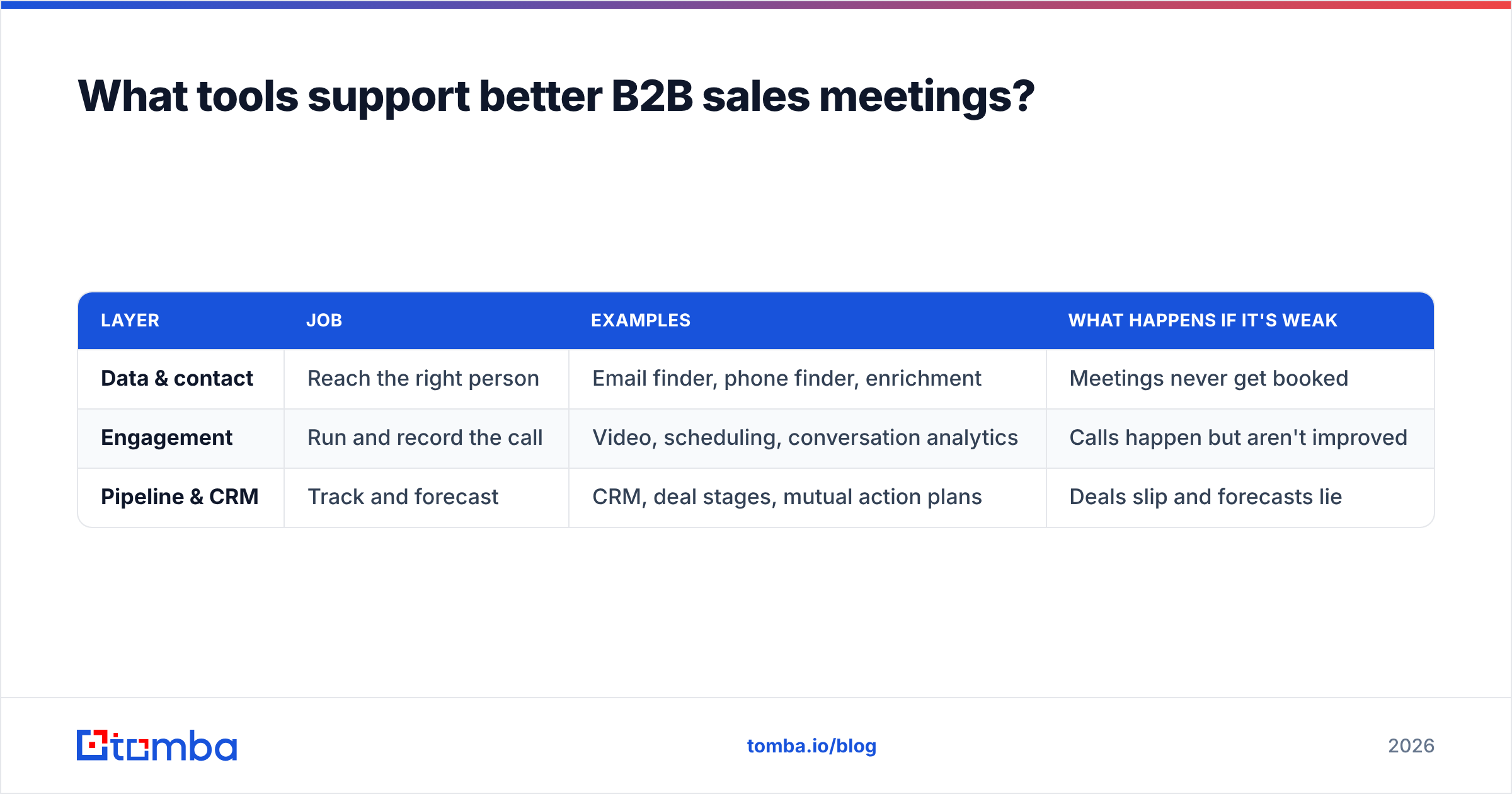
Tooling sits in three layers, and most teams over-invest in the middle while neglecting the top.
| Layer | Job | Examples | What happens if it's weak |
|---|---|---|---|
| Data & contact | Reach the right person | Email finder, phone finder, enrichment | Meetings never get booked |
| Engagement | Run and record the call | Video, scheduling, conversation analytics | Calls happen but aren't improved |
| Pipeline & CRM | Track and forecast | CRM, deal stages, mutual action plans | Deals slip and forecasts lie |
The uncomfortable truth: a flawless demo platform and a polished CRM do nothing if your contact data is wrong. Garbage in, no meeting out. That's why the data layer comes first. Before you compare engagement tools, make sure the email and phone details feeding your calendar are accurate and verified — you can sanity-check vendors on a review site like G2 before committing.
If you're evaluating where to spend first, start at the top of that table. You can always upgrade your demo software next quarter; you cannot recover the pipeline lost to meetings that never happened because the email bounced. Check current Tomba pricing if you want to see how the data layer is costed — the Free tier (25 searches/month) is enough to test the workflow before you commit to Starter at $49/month.
A simple weekly meeting cadence that works#
You don't need a complex system. You need consistency:
- Monday: Build the target list — accounts, roles, verified contacts. This is the data work that determines everything downstream.
- Tuesday–Wednesday: Outreach and booking. Multithread every account.
- Thursday: Run meetings. Stick to the agenda structure above.
- Friday: Follow-ups, recaps, and CRM hygiene. Every open deal gets a dated next step or it's not a real deal.
The reps who hit quota aren't the ones with the slickest pitch. They're the ones who reliably get the right people into well-run meetings and never let a deal sit without a next step.
Start with the data that books the meeting#
Everything in this playbook depends on one thing: reaching the right person. The script, the agenda, the multithreading, the follow-up — none of it fires if your email bounces or your champion never sees the message. Get the contact layer right and the rest of the process compounds.
That's exactly what the Tomba Email Finder is built for. Find verified professional emails by name, domain, or company, map the full buying committee with domain search, and stop wasting outreach on dead addresses. Start free with 25 searches a month, confirm the workflow fills your calendar with qualified B2B sales meetings, then scale up when the pipeline proves it. Book better meetings by reaching better contacts — that's where the quarter is won.
// get started
Find, verify and enrich your first contacts today
Start on the free plan with 25 searches a month, then scale when your team is ready.
Free plan · No credit card required · GDPR & CCPA
// about the author