B2B Sales Methodologies in 2026: A Practical Comparison
A no-nonsense breakdown of the top B2B sales methodologies in 2026 — MEDDIC, SPIN, Challenger, Sandler and more — with a side-by-side comparison to help you pick the right one.
A sales methodology is the how behind your what. Your sales process maps the stages a deal moves through; the methodology is the playbook your reps run at each stage. Pick the wrong one and you get reps who follow a pipeline religiously yet still lose winnable deals. Pick the right one and forecasting, qualification, and win rates all tighten.
This guide compares the B2B sales methodologies that actually matter in 2026, when to use each, and how to layer them onto your existing pipeline.
TL;DR#
- A methodology is not a process. Your process is the stages; the methodology is the behavior and questions reps use inside those stages.
- MEDDIC and its variants win for complex, high-ACV enterprise deals where qualification rigor protects the forecast.
- SPIN and Sandler win for consultative, discovery-heavy sales where uncovering pain drives the deal.
- Challenger wins when buyers are stuck in the status quo and need to be taught a new way to think.
- No methodology survives bad data. Every framework assumes you can reach the right buying-committee contacts in the first place.
What is a B2B sales methodology?#
Think of it like cooking. A recipe lists the steps — chop, sear, simmer. But a technique like knife skills or temperature control is what makes the dish good regardless of recipe. A sales methodology is that technique layer. It governs how reps qualify, ask questions, handle objections, and advance deals.
Most teams confuse the two. They build a CRM pipeline with stages like "Discovery → Demo → Proposal → Closed" and call it a process. That's necessary but not sufficient. Without a methodology, every rep improvises inside those stages, and improvisation doesn't scale or forecast.
A good methodology gives you three things:
- A shared language — "this deal has no Champion" means the same thing to every rep and manager.
- Consistent qualification — deals advance on evidence, not optimism.
- Coachable behavior — managers can diagnose why a deal stalled, not just that it did.
What are the most popular B2B sales methodologies in 2026?#
The field hasn't fundamentally changed in decades, but emphasis has. Multi-threading and buying-committee selling are now table stakes — Gartner has long noted that a typical B2B purchase involves six to ten decision-makers. That reality pushes teams toward methodologies that force you to map and reach every stakeholder, not just one friendly contact.
Here are the frameworks worth knowing.
MEDDIC / MEDDPICC#
The qualification standard for enterprise SaaS. MEDDIC stands for Metrics, Economic buyer, Decision criteria, Decision process, Identify pain, Champion. MEDDPICC adds Paper process and Competition. It's less a selling style and more a checklist that exposes risk in your forecast. If you can't name the Economic Buyer and Champion, the deal isn't real.
SPIN Selling#
Neil Rackham's research-backed questioning model: Situation, Problem, Implication, Need-payoff. You guide the buyer from surface facts to the cost of inaction to the value of solving it. Excellent for consultative, discovery-led sales where the buyer doesn't yet feel the pain acutely.
The Challenger Sale#
Based on CEB/Gartner research, the Challenger rep teaches, tailors, and takes control. Instead of asking what keeps the buyer up at night, the rep reframes the problem and offers a provocative insight. Works best in mature markets where buyers think they already know what they need.
Sandler Selling System#
A relationship-and-qualification hybrid that flips the traditional dynamic — the rep disqualifies hard and gets the buyer to "sell themselves." The "up-front contract" sets clear expectations for every meeting. Strong for SMB and mid-market where time-wasting prospects drain capacity.
BANT and its successors#
Budget, Authority, Need, Timing. The old IBM standby. Fast and simple, but criticized for being seller-centric and easy to game. Many teams now prefer GPCTBA/C&I (HubSpot's expansion) or fold BANT into MEDDIC.
Value Selling / Command of the Message#
Methodologies like MEDDICC's sister framework focus on articulating differentiated value tied to the buyer's metrics. Less a qualification checklist, more a messaging discipline.
How do the top B2B sales methodologies compare?#
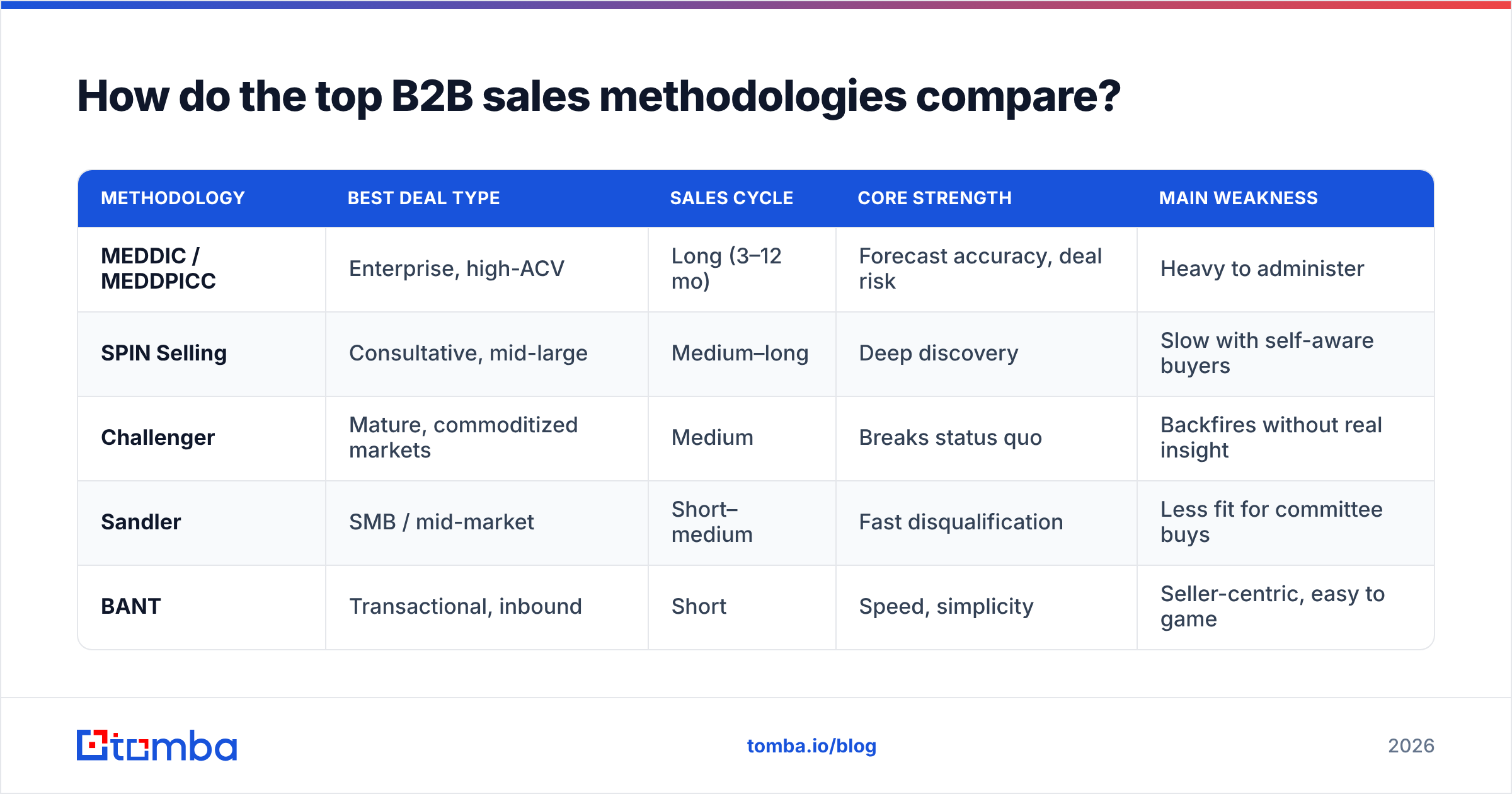
Here's the side-by-side. Match the methodology to deal complexity, sales cycle, and how aware your buyer already is of their problem.
| Methodology | Best deal type | Sales cycle | Core strength | Main weakness |
|---|---|---|---|---|
| MEDDIC / MEDDPICC | Enterprise, high-ACV | Long (3–12 mo) | Forecast accuracy, deal risk | Heavy to administer |
| SPIN Selling | Consultative, mid-large | Medium–long | Deep discovery | Slow with self-aware buyers |
| Challenger | Mature, commoditized markets | Medium | Breaks status quo | Backfires without real insight |
| Sandler | SMB / mid-market | Short–medium | Fast disqualification | Less fit for committee buys |
| BANT | Transactional, inbound | Short | Speed, simplicity | Seller-centric, easy to game |
A useful mental model: the more decision-makers and the longer the cycle, the more your methodology should emphasize qualification and multi-threading. The shorter and more transactional the deal, the more it should emphasize speed and disqualification.
How do you choose the right sales methodology?#
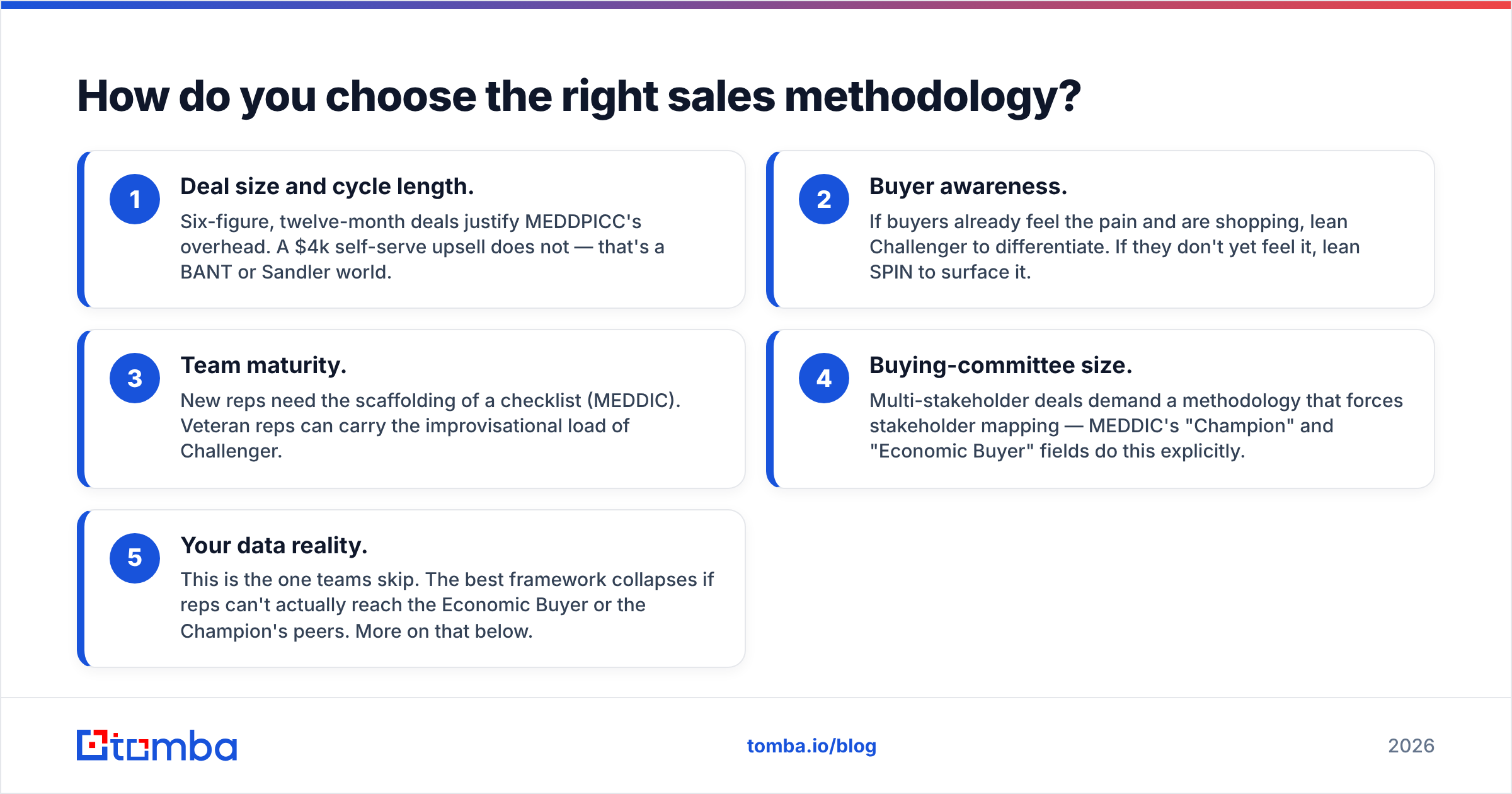
Conclusion first: choose based on your average deal complexity and buyer awareness, then standardize hard before you customize. Five practical filters:
- Deal size and cycle length. Six-figure, twelve-month deals justify MEDDPICC's overhead. A $4k self-serve upsell does not — that's a BANT or Sandler world.
- Buyer awareness. If buyers already feel the pain and are shopping, lean Challenger to differentiate. If they don't yet feel it, lean SPIN to surface it.
- Team maturity. New reps need the scaffolding of a checklist (MEDDIC). Veteran reps can carry the improvisational load of Challenger.
- Buying-committee size. Multi-stakeholder deals demand a methodology that forces stakeholder mapping — MEDDIC's "Champion" and "Economic Buyer" fields do this explicitly.
- Your data reality. This is the one teams skip. The best framework collapses if reps can't actually reach the Economic Buyer or the Champion's peers. More on that below.
Most high-performing orgs don't run one pure methodology. They run a qualification framework (usually MEDDIC) as the spine and borrow questioning techniques (SPIN) and messaging discipline (Challenger) as the muscle.
Why does data quality decide whether any methodology works?#
Here's the part the framework vendors gloss over: every B2B sales methodology assumes you can reach the right people. MEDDIC tells you to identify the Economic Buyer — but identifying isn't reaching. Challenger tells you to deliver an insight to a senior stakeholder — but you need that stakeholder's direct contact first.
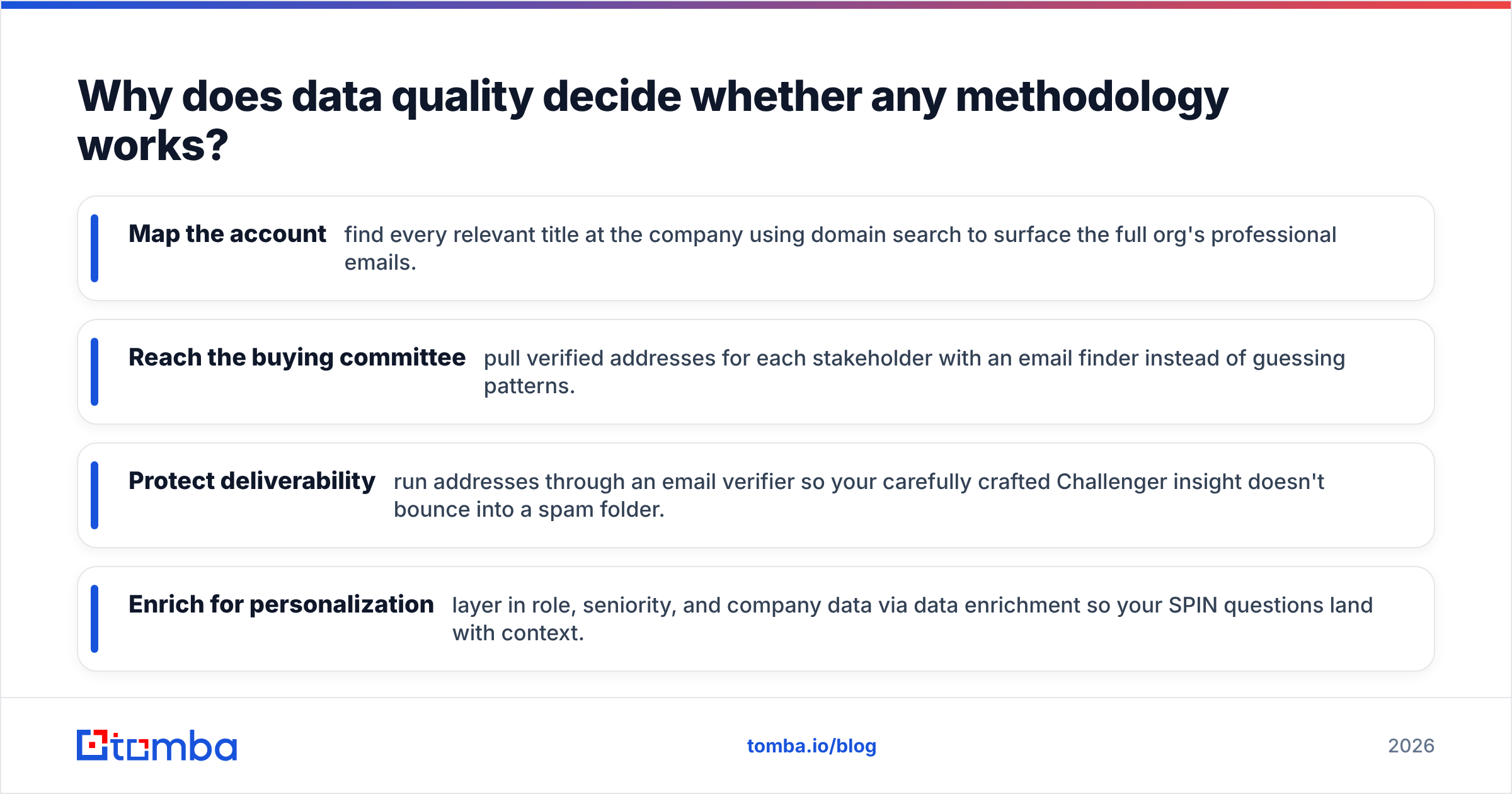
Multi-threading is the clearest example. If your methodology demands you engage six to ten committee members, you need verified contact details for all of them — not one champion and a prayer. This is where prospecting data becomes the foundation under the methodology. Consider the workflow:
- Map the account — find every relevant title at the company using domain search to surface the full org's professional emails.
- Reach the buying committee — pull verified addresses for each stakeholder with an email finder instead of guessing patterns.
- Protect deliverability — run addresses through an email verifier so your carefully crafted Challenger insight doesn't bounce into a spam folder.
- Enrich for personalization — layer in role, seniority, and company data via data enrichment so your SPIN questions land with context.
A methodology gives your reps the right questions. Accurate data gives them the right audience to ask. Skip the second and the first is theater. G2's category reviews of sales engagement and intelligence tools consistently show that teams rank data accuracy above feature breadth — because they've felt this exact gap.
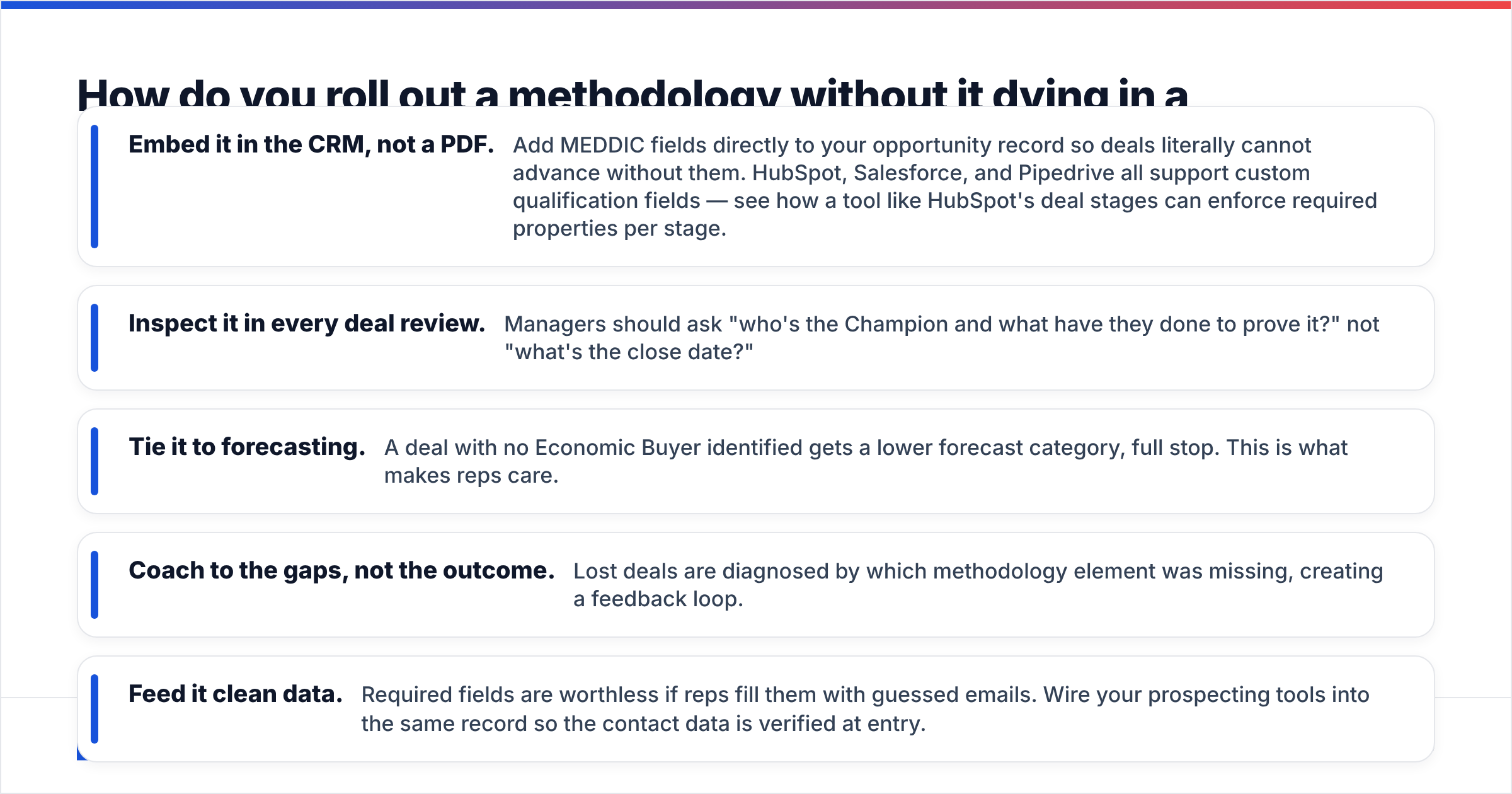
How do you roll out a methodology without it dying in a binder?#
Adoption is where most methodology projects fail. The framework gets a two-day training, a laminated card, and then quietly disappears within a quarter. To make it stick:
- Embed it in the CRM, not a PDF. Add MEDDIC fields directly to your opportunity record so deals literally cannot advance without them. HubSpot, Salesforce, and Pipedrive all support custom qualification fields — see how a tool like HubSpot's deal stages can enforce required properties per stage.
- Inspect it in every deal review. Managers should ask "who's the Champion and what have they done to prove it?" not "what's the close date?"
- Tie it to forecasting. A deal with no Economic Buyer identified gets a lower forecast category, full stop. This is what makes reps care.
- Coach to the gaps, not the outcome. Lost deals are diagnosed by which methodology element was missing, creating a feedback loop.
- Feed it clean data. Required fields are worthless if reps fill them with guessed emails. Wire your prospecting tools into the same record so the contact data is verified at entry.
The teams that win don't pick the "best" methodology — they pick a good enough one and execute it with discipline and clean data. A perfectly chosen framework run sloppily loses to a decent framework run rigorously.
Common mistakes teams make with sales methodologies#
A few patterns that quietly kill results:
- Treating BANT as discovery. Budget and authority are outputs of good discovery, not the opening questions. Lead with pain, not paperwork.
- Single-threading inside a multi-threaded framework. Adopting MEDDIC but only ever talking to one contact defeats the purpose. If you can't reach the rest of the committee, fix your data sourcing before blaming the methodology.
- Methodology tourism. Switching frameworks every two quarters because the last one "didn't work." It didn't work because you didn't inspect it. Commit for at least a full sales cycle.
- Ignoring deliverability. You can run flawless Challenger messaging into an inbox that never sees it. Verify and warm your outreach so the insight actually arrives.
- No disqualification muscle. Every methodology is also a disqualification tool. Reps who never lose deals early are wasting capacity on deals they'd lose late.
Frequently asked questions#
Is MEDDIC better than Challenger? They solve different problems. MEDDIC is a qualification framework that protects your forecast; Challenger is a selling style that breaks buyer inertia. Most enterprise teams run MEDDIC for qualification and borrow Challenger's "teach and reframe" approach for messaging. They're complementary, not competing.
What's the easiest methodology to start with? Sandler or BANT for small teams and transactional deals; MEDDIC if you sell complex, high-value B2B software. Start with whichever maps to your current deal complexity, then add sophistication.
Do I need a sales methodology if I already have a sales process? Yes. The process tells you which stage a deal is in. The methodology tells reps what to do inside that stage. Without it, every rep improvises and your pipeline stages mean different things to different people.
How does data quality affect methodology success? Directly. Every modern framework assumes multi-threading across a 6–10 person buying committee. If you can't find and verify those contacts, the methodology can't be executed as designed — you'll default to single-threading and lose to competitors who reached the full committee.
The bottom line#
Pick a methodology that matches your deal complexity, embed it in your CRM, inspect it in every deal review, and — most importantly — feed it accurate contact data so reps can actually reach the buying committee the framework tells them to engage.
That last piece is where most teams quietly underperform. Your MEDDIC fields and Challenger scripts are only as good as your ability to reach the Economic Buyer and Champion in the first place. Tomba's Email Finder gives your reps verified, professional email addresses for every stakeholder on the buying committee — so your methodology runs on real contacts, not guesses. Start free with 25 searches a month, and check the Tomba pricing plans (Starter at $49/mo) when you're ready to scale your prospecting to match your process.
// get started
Find, verify and enrich your first contacts today
Start on the free plan with 25 searches a month, then scale when your team is ready.
Free plan · No credit card required · GDPR & CCPA
// about the author