B2B Sales Model Explained: Types and Examples for 2026
Field-sales, inside-sales, self-serve, or channel? Compare every B2B sales model, see when each one wins, and learn how to match a model to your deal size and ACV.
TL;DR
- A b2b sales model is the repeatable structure you use to find, win, and grow accounts — it decides your team shape, your cost per deal, and how fast you can scale.
- The five dominant models in 2026 are field sales, inside sales, self-serve, product-led growth (PLG), and channel/partner sales. Most companies run a hybrid.
- Match the model to your average contract value (ACV): roughly, self-serve under $2K, inside sales $2K–$50K, field sales $50K+.
- The model only works if the pipeline feeding it is accurate. Bad contact data inflates cost per acquisition no matter which model you pick.
- Use this guide's comparison table and decision checklist to choose, then pressure-test your choice against unit economics — not gut feel.
What is a B2B sales model?#
A b2b sales model is the blueprint for how your company turns strangers into paying business customers. Think of it like the floor plan of a restaurant: the same food can be served as fast-casual counter service, a sit-down bistro, or a catered enterprise event — and each layout demands different staff, pricing, and square footage. Pick the wrong layout and you either overstaff a sandwich shop or under-serve a banquet.
Technically, the model defines four things: who sells (reps, the product itself, or partners), how they reach buyers (outbound, inbound, or self-serve), how long the cycle runs, and what it costs to close one deal. Everything downstream — comp plans, tooling, hiring — flows from that choice.
The reason this matters more in B2B than B2C is deal size and complexity. A B2B purchase often involves 6–10 stakeholders, a procurement review, and a multi-month evaluation. According to Gartner research on buying groups, the typical B2B deal now spans multiple decision-makers who each touch the process independently. Your model has to absorb that complexity without burning cash.

What are the main types of B2B sales models?#
There are five core models. Here's the practical version of each.
- Field sales (outside sales). Reps own territories and close large, complex deals in person or over high-touch video. Highest cost per rep, highest ACV. Used for enterprise software, manufacturing, and anything with a six-figure contract.
- Inside sales. Reps sell remotely — phone, email, video — across a defined book of accounts. The workhorse model for most SaaS in the $5K–$50K ACV band. Faster cycles, lower cost than field.
- Self-serve (low-touch). The buyer signs up, pays, and onboards with little or no human contact. Works when the product is simple to evaluate and priced low enough to expense without approval.
- Product-led growth (PLG). A free tier or trial does the selling; the product surfaces value, then sales steps in only to expand or convert power users. Slack, Notion, and Figma popularized it.
- Channel and partner sales. Resellers, VARs, agencies, or marketplaces sell on your behalf in exchange for margin or commission. Extends reach without growing headcount, at the cost of control and margin.
Most real businesses blend these. A company might run PLG to fill the top of the funnel, inside sales to convert mid-market signups, and field sales for enterprise expansion — three models under one roof.
How do the B2B sales models compare?#
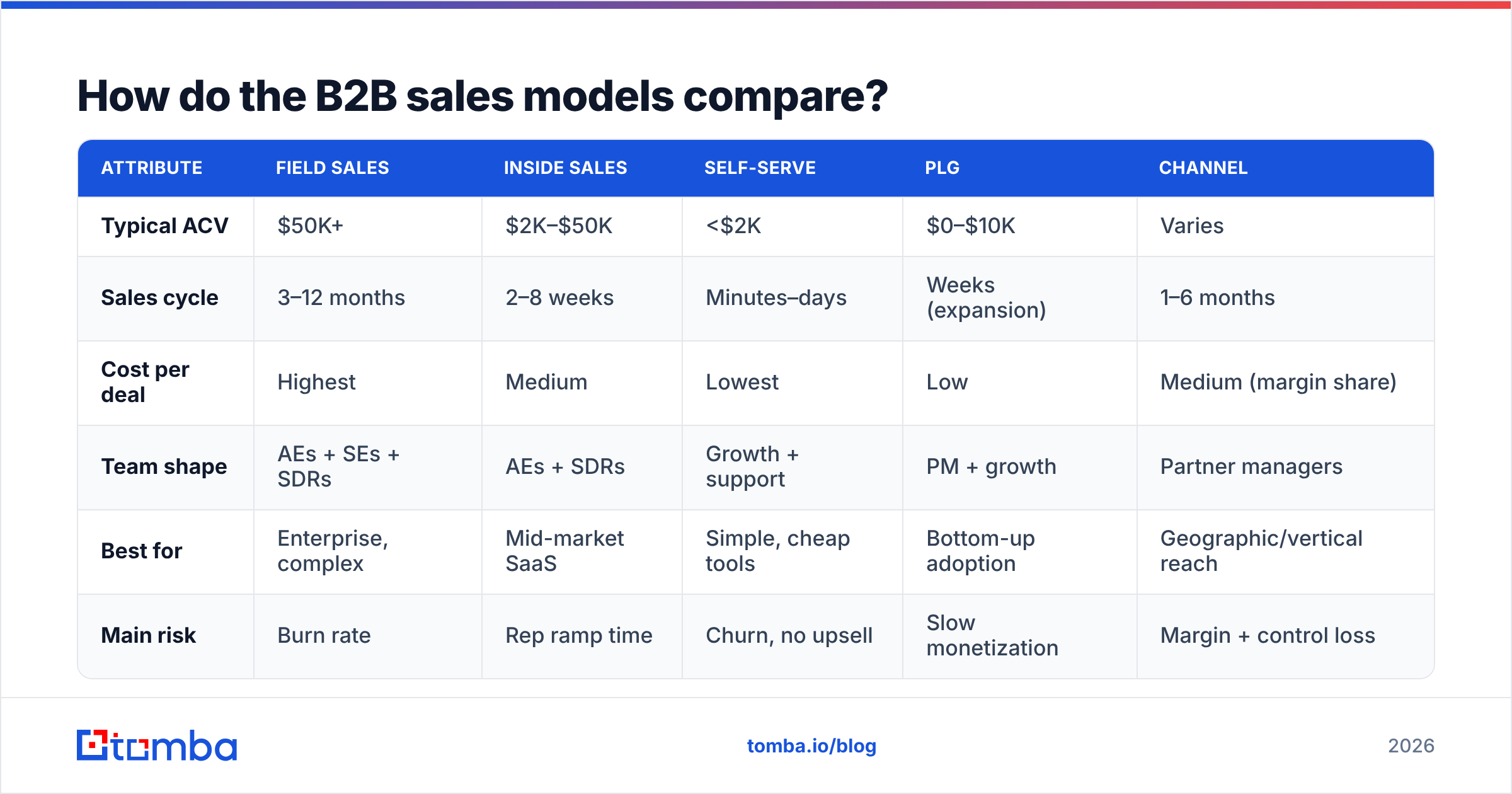
The table below maps each model against the attributes that actually drive your decision. Numbers are 2026 market ranges, not absolutes.
| Attribute | Field Sales | Inside Sales | Self-Serve | PLG | Channel |
|---|---|---|---|---|---|
| Typical ACV | $50K+ | $2K–$50K | <$2K | $0–$10K | Varies |
| Sales cycle | 3–12 months | 2–8 weeks | Minutes–days | Weeks (expansion) | 1–6 months |
| Cost per deal | Highest | Medium | Lowest | Low | Medium (margin share) |
| Team shape | AEs + SEs + SDRs | AEs + SDRs | Growth + support | PM + growth | Partner managers |
| Best for | Enterprise, complex | Mid-market SaaS | Simple, cheap tools | Bottom-up adoption | Geographic/vertical reach |
| Main risk | Burn rate | Rep ramp time | Churn, no upsell | Slow monetization | Margin + control loss |
A useful rule of thumb: your model has to be cheaper than the deal it closes. If your blended cost to acquire a customer exceeds first-year revenue and you can't prove fast payback, the model is wrong for your price point — not your reps.
Which B2B sales model is right for your business?#
Start with one number: your ACV. It eliminates most options before you debate anything else.
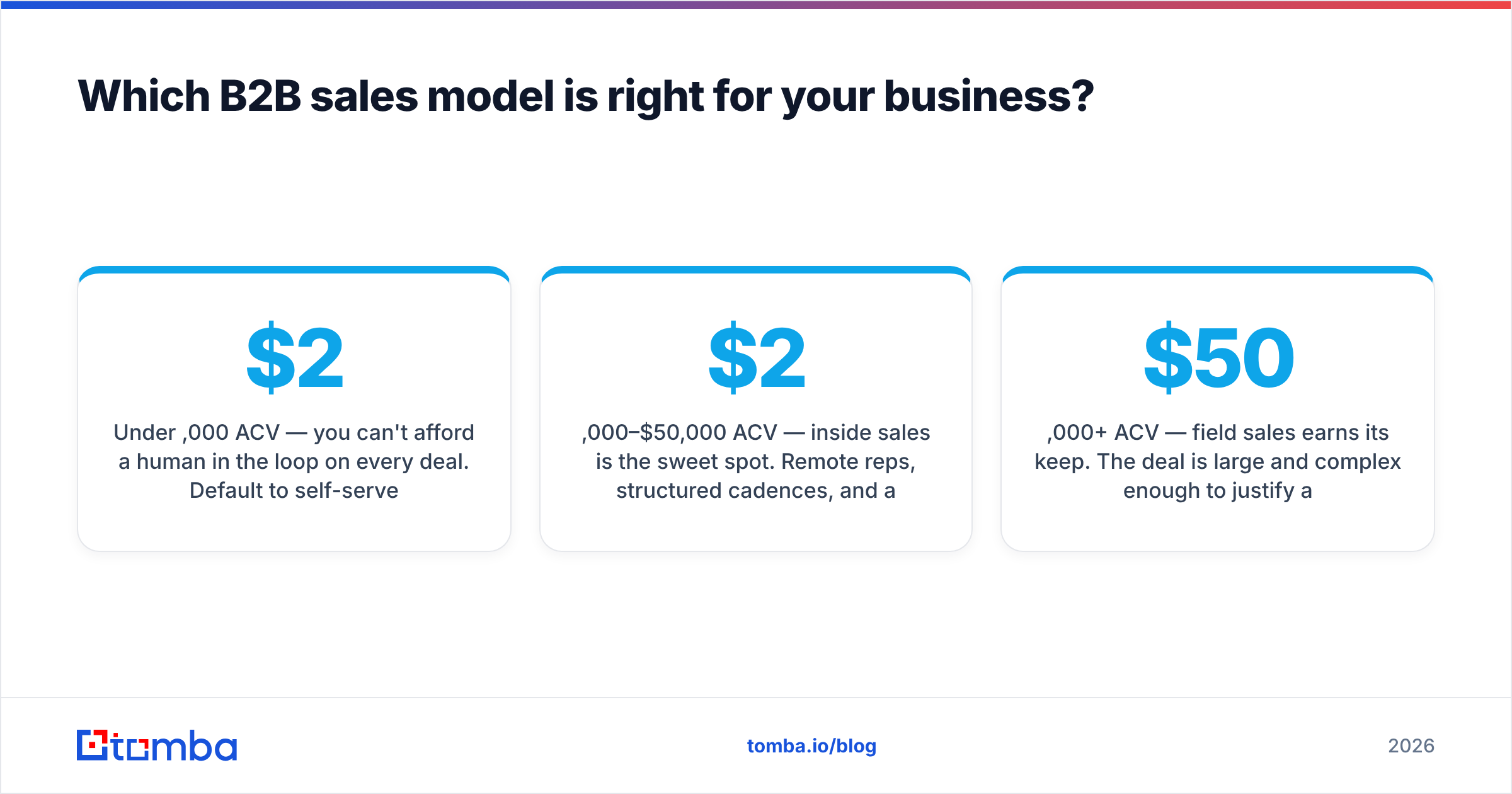
- Under $2,000 ACV — you can't afford a human in the loop on every deal. Default to self-serve or PLG. A salesperson costs more than the deal returns.
- $2,000–$50,000 ACV — inside sales is the sweet spot. Remote reps, structured cadences, and a strong CRM keep cost-per-deal sane while still giving buyers a human.
- $50,000+ ACV — field sales earns its keep. The deal is large and complex enough to justify a high-touch rep, a sales engineer, and a multi-month cycle.
- Any ACV, but you lack reach — layer channel sales on top of your primary model to enter new regions or verticals without hiring locally.
Then sanity-check three more inputs:
- Product complexity. If a buyer can't self-evaluate in an afternoon, self-serve will stall. Complexity pushes you up the touch ladder.
- Buyer expectations. Procurement-heavy industries (finance, healthcare, government) expect a named rep and a contract. PLG alone won't clear their security review.
- Unit economics. Model your fully loaded cost per deal against gross margin and payback period. The HubSpot sales research library is a solid public benchmark for cycle length and conversion rates by motion.
Document your pick the way you'd document a sales process and pipeline — stages, owners, and exit criteria — so it's repeatable instead of tribal knowledge.
How does data quality make or break the model?#
No b2b sales model survives bad data — this is the part teams underestimate. The model defines how you sell; the data defines who you sell to. Get the second wrong and the first becomes expensive theater.
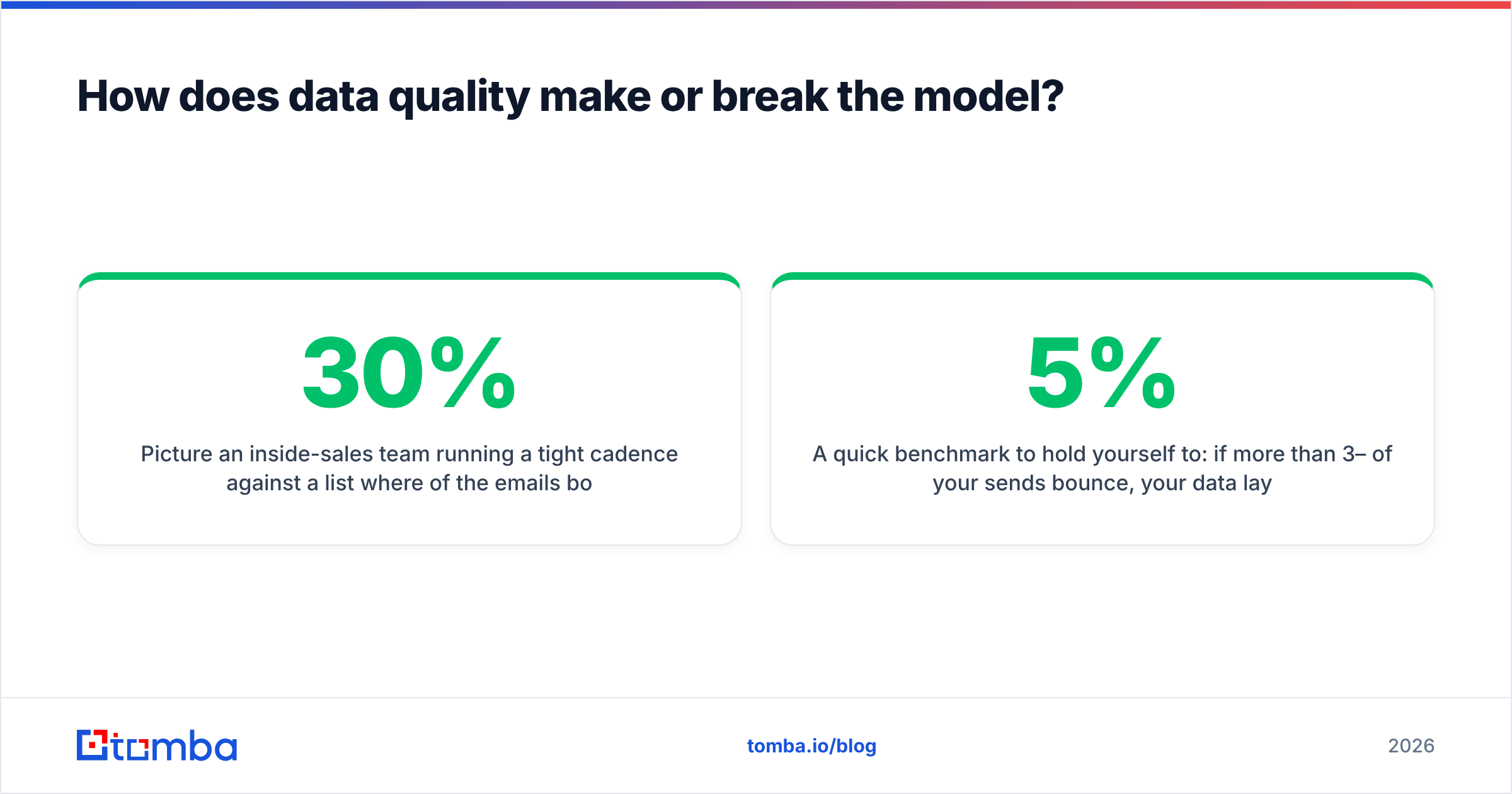
Picture an inside-sales team running a tight cadence against a list where 30% of the emails bounce and another 20% point to people who left the company. The cadence is perfect. The reps are skilled. And half their effort lands in the void. Every model — field, inside, self-serve outreach, channel enablement — multiplies whatever quality of data you feed it, good or bad.

Three data failures quietly tax every model:
- Wrong contact — you reach a real person who can't buy, wasting a touch and a rep's time.
- Stale contact — the buyer changed jobs; your CRM still shows the old role, so routing and personalization break.
- Unverifiable contact — catch-all domains and risky addresses inflate bounce rates, which then damages your sender reputation and tanks deliverability for good leads too.
This is where a verified email finder and an email verifier stop being "nice to have" and become load-bearing. Before a single cadence fires, you want the contact confirmed real, the role current, and the address safe to send to. For teams running outbound at the top of the funnel, domain search pulls every reachable contact at a target account, so territory coverage matches the org chart instead of whatever stale rows happen to sit in the CRM.
A quick benchmark to hold yourself to: if more than 3–5% of your sends bounce, your data layer is undermining your model. Fix the inputs before you blame the motion.
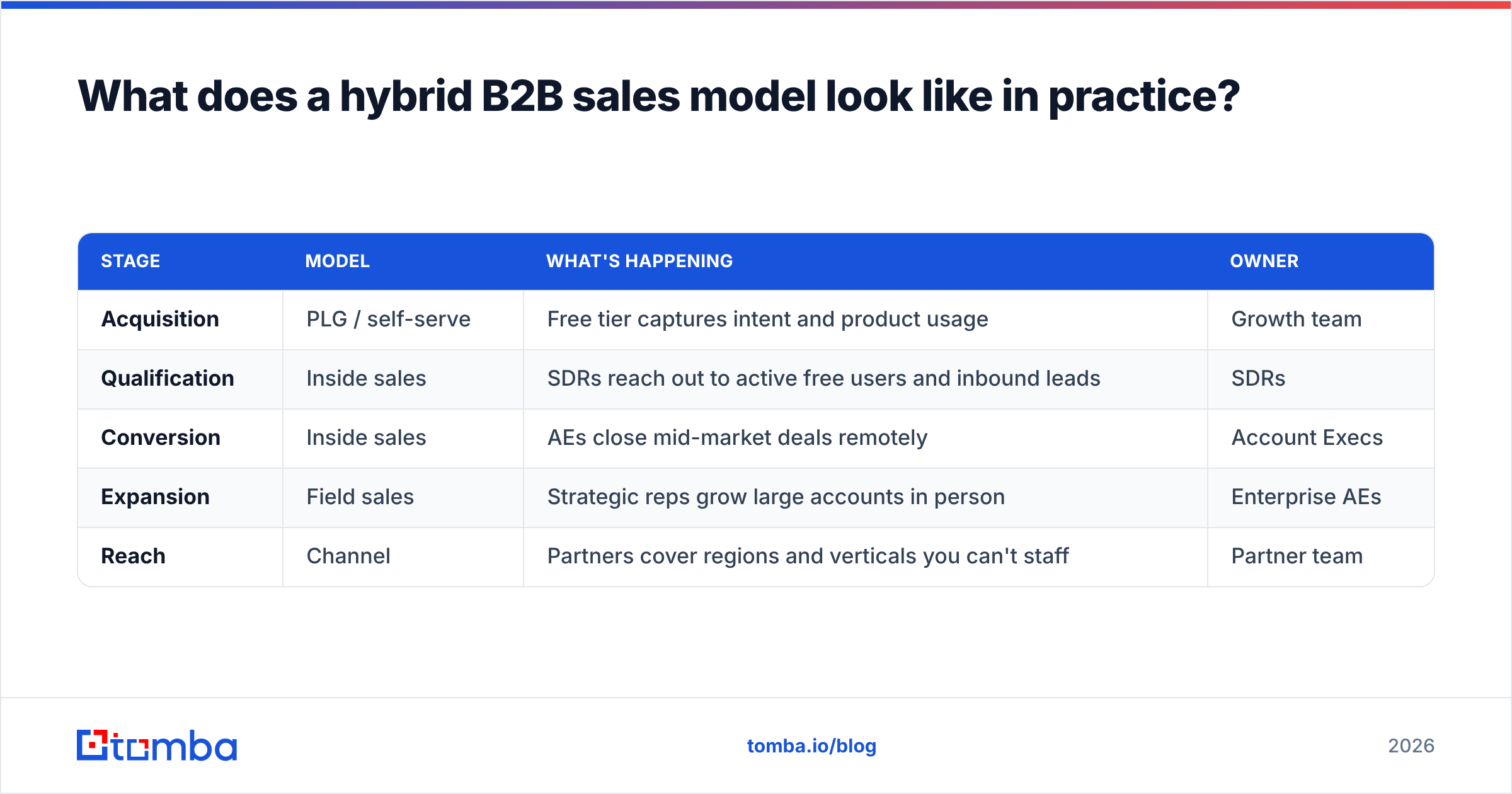
What does a hybrid B2B sales model look like in practice?#
Most scaling companies in 2026 don't pick one model — they sequence several. Here's a common, working pattern.
| Stage | Model | What's happening | Owner |
|---|---|---|---|
| Acquisition | PLG / self-serve | Free tier captures intent and product usage | Growth team |
| Qualification | Inside sales | SDRs reach out to active free users and inbound leads | SDRs |
| Conversion | Inside sales | AEs close mid-market deals remotely | Account Execs |
| Expansion | Field sales | Strategic reps grow large accounts in person | Enterprise AEs |
| Reach | Channel | Partners cover regions and verticals you can't staff | Partner team |
The trick is clean handoffs. A signup that PLG surfaces as "high intent" has to reach an SDR with the contact details already enriched — title, company size, verified email — or the lead cools before anyone calls. That's why data enrichment sits between stages in mature setups: it fills the gaps the buyer didn't volunteer, so the next rep starts warm instead of cold.
Hybrid models fail in the seams, not the stages. Audit your handoffs the way you'd audit a deploy pipeline: where does a lead lose information as it moves between motions?
What are common B2B sales model mistakes?#
- Over-touching cheap deals. Putting an AE on a $900/year contract. The deal can't repay the rep's time. Push it to self-serve.
- Under-touching complex deals. Expecting PLG to close a $200K enterprise contract with a security review. It won't; you need a human and a contract.
- Copying a competitor's model blindly. Their ACV, margin, and buyer aren't yours. A model that prints money at $80K ACV bankrupts you at $4K.
- Scaling a leaky model. Hiring 20 reps before unit economics work just multiplies the loss. Prove payback at small scale first.
- Ignoring the data layer. Buying a fancy sequencer while feeding it lists that bounce. The tool isn't the bottleneck; the data is.
- Never revisiting the choice. Your ACV and product change. A model that fit at launch may be wrong at Series B. Re-evaluate yearly.
For a deeper comparison of tooling that supports each motion, the independent reviews on G2 are a good neutral starting point before you commit budget.
How do you measure if your B2B sales model is working?#
Track four metrics and read them together, not in isolation:
- CAC payback period — months to recover the cost of acquiring a customer. Under 12 months is healthy for most B2B SaaS; under 6 is excellent.
- Sales cycle length — trending up means friction crept into the model; trending down means it's tightening.
- Win rate by stage — tells you where the model leaks, not just that it does.
- Cost per opportunity — rising cost here usually traces back to data quality or targeting, not rep effort.
If payback is climbing while win rate holds steady, your acquisition cost is the problem — often a data or targeting issue feeding the wrong accounts into a perfectly good motion. If win rate is falling while cost holds, the problem is fit or messaging inside the model. Reading the pair tells you which lever to pull.
The bottom line#
Your b2b sales model is a financial decision dressed up as an org-chart decision. Anchor it to ACV, validate it against unit economics, and revisit it as your product and price evolve. And whatever model you run — field, inside, self-serve, PLG, or channel — protect it with clean, verified contact data, because every motion multiplies the quality of the list underneath it.
Ready to feed your model accounts that actually convert? Tomba's Email Finder finds professional emails by name, domain, or company and verifies them before they ever hit your sequence — so your reps spend time selling, not chasing bounces. Start free with 25 searches a month, then scale on a plan that fits your motion: see full Tomba pricing from the $49/mo Starter tier up. Pick the right model, then give it the data it deserves.
// get started
Find, verify and enrich your first contacts today
Start on the free plan with 25 searches a month, then scale when your team is ready.
Free plan · No credit card required · GDPR & CCPA
// about the author