B2B Sales Orchestration in 2026: The Complete Playbook
B2B sales orchestration coordinates every rep, channel, and tool into one timed sequence. Here's how it works in 2026, what stack you need, and where most teams break.
B2B sales orchestration is the discipline of coordinating every touch — email, call, LinkedIn, ad, and task — across people and tools so the right message reaches the right buyer at the right moment. If your reps are improvising sequences in their heads and your data lives in five disconnected apps, you don't have orchestration. You have noise.
TL;DR#
- Sales orchestration ≠ sales automation. Automation fires single actions; orchestration choreographs the whole multi-channel, multi-person motion around a buyer signal.
- It runs on clean data. Orchestration breaks the moment a contact record is stale, an email bounces, or a phone number is wrong — so enrichment and verification are non-negotiable foundations.
- The 2026 stack is four layers: data, sequencing/cadence, signal/intent, and a CRM system of record tied together by an API.
- Start narrow. Orchestrate one segment with one play, measure reply and meeting rates, then expand. Boiling the ocean is the top failure mode.
- Tomba sits at the data layer — supplying verified emails, phone numbers, and enrichment that the rest of your orchestration engine depends on.
What is B2B sales orchestration?#
Think of orchestration like a conductor leading a symphony. Each musician (rep, SDR, AE) and each instrument (email, phone, social) can play alone, but without a conductor keeping time, you get cacophony instead of music. B2B sales orchestration is the conductor: it decides what plays, in what order, through which channel, and who executes it — all triggered by what the buyer is actually doing.
Technically, orchestration is a layer that sits above your individual tools and sequences their actions into a coherent play. When a target account downloads a whitepaper, an orchestrated motion might enrich the contact, verify their email, assign the account to an AE, draft a personalized first touch, queue a LinkedIn connection two days later, and notify the rep to call if the email is opened twice. No single tool does all of that. Orchestration is the wiring between them.
The reason this matters in 2026 is buyer behavior. According to Gartner research on B2B buying, customers now spend the majority of their journey doing independent research and engaging multiple channels before they ever talk to sales. A linear "email, wait, email again" cadence can't keep up with a buyer who's hopping between your pricing page, a peer review on G2, and your competitor's webinar. Orchestration lets your motion react to that reality instead of ignoring it.
How is orchestration different from automation?#
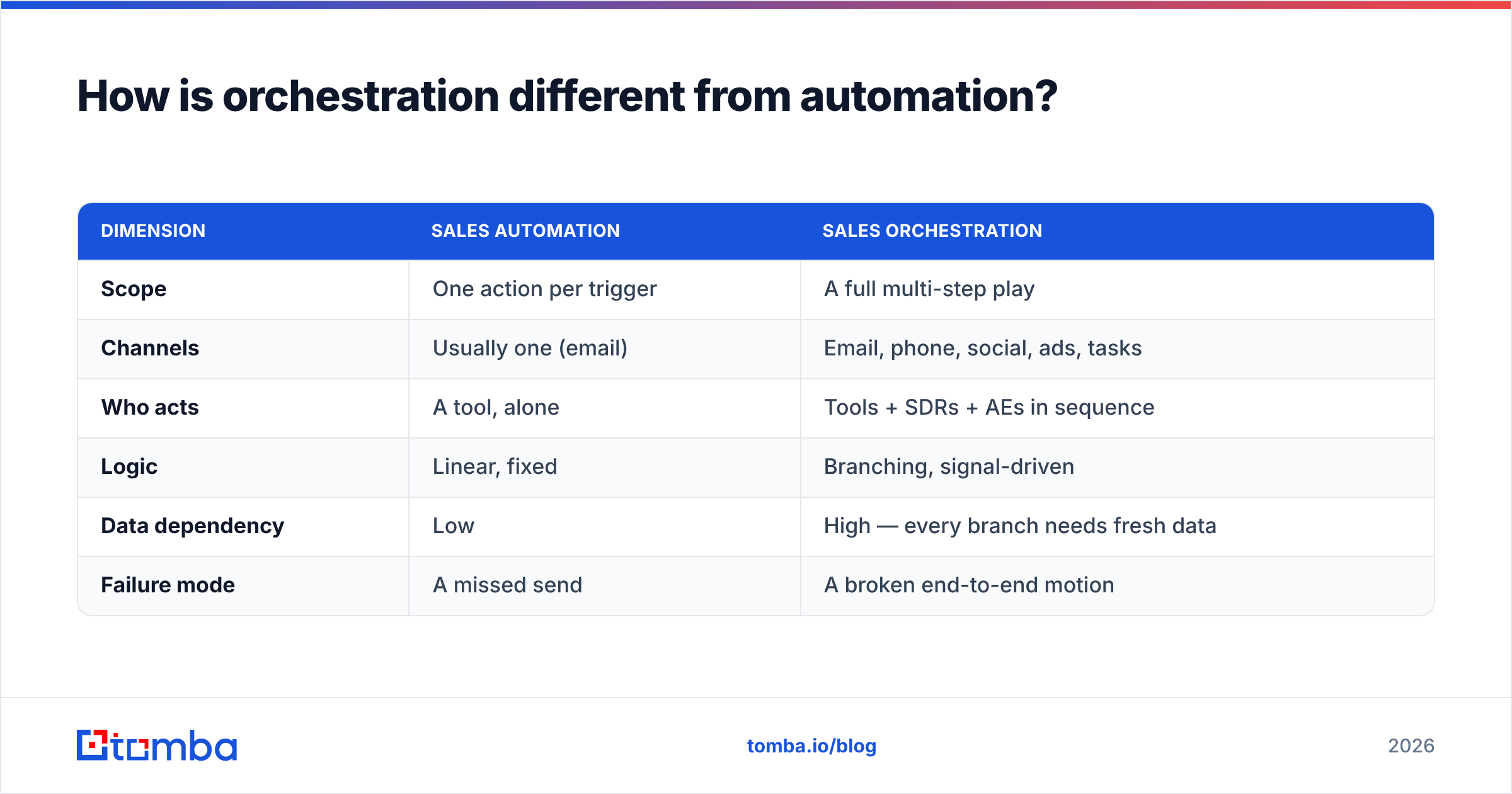
This is the distinction most teams get wrong. Automation is a single trigger firing a single action — "when a form is submitted, send email A." Orchestration is a conditional, multi-step, multi-channel, multi-person flow that adapts based on responses and signals.
Here's the difference laid out concretely:
| Dimension | Sales automation | Sales orchestration |
|---|---|---|
| Scope | One action per trigger | A full multi-step play |
| Channels | Usually one (email) | Email, phone, social, ads, tasks |
| Who acts | A tool, alone | Tools + SDRs + AEs in sequence |
| Logic | Linear, fixed | Branching, signal-driven |
| Data dependency | Low | High — every branch needs fresh data |
| Failure mode | A missed send | A broken end-to-end motion |
The practical upshot: you can run automation on dirty data and get away with it for a while. You cannot run orchestration on dirty data at all. A branching play that says "if the email opens, have the AE call" collapses if the email address was never valid or the phone number is three years old. That's why the foundation of any orchestration program is contact data you can trust — start by making sure you can verify emails before a single one enters a sequence.
What are the core components of a sales orchestration engine?#
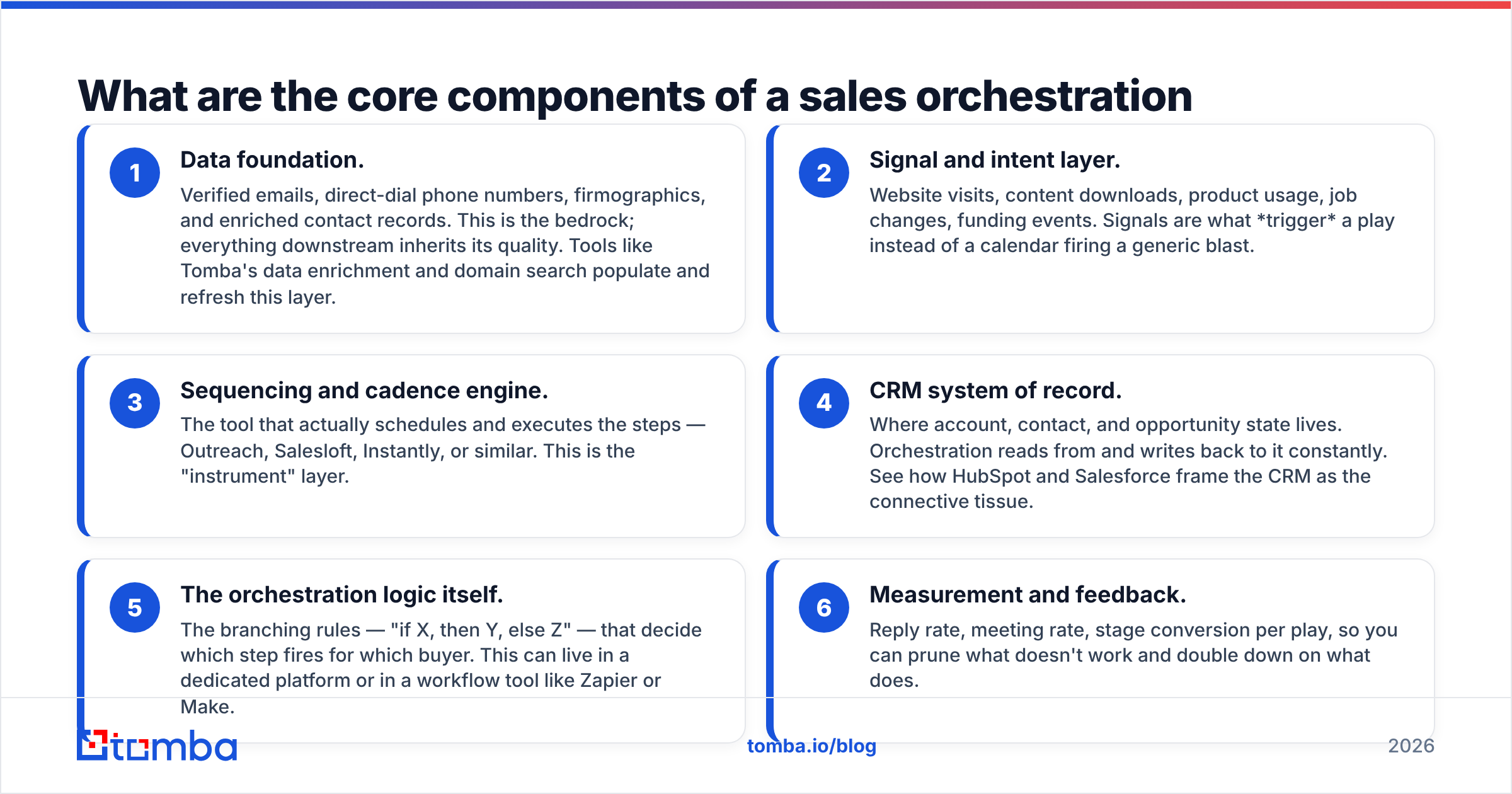
Every orchestration program — whether you build it on a dedicated platform or stitch it together with an automation layer — needs these building blocks working together:
- Data foundation. Verified emails, direct-dial phone numbers, firmographics, and enriched contact records. This is the bedrock; everything downstream inherits its quality. Tools like Tomba's data enrichment and domain search populate and refresh this layer.
- Signal and intent layer. Website visits, content downloads, product usage, job changes, funding events. Signals are what trigger a play instead of a calendar firing a generic blast.
- Sequencing and cadence engine. The tool that actually schedules and executes the steps — Outreach, Salesloft, Instantly, or similar. This is the "instrument" layer.
- CRM system of record. Where account, contact, and opportunity state lives. Orchestration reads from and writes back to it constantly. See how HubSpot and Salesforce frame the CRM as the connective tissue.
- The orchestration logic itself. The branching rules — "if X, then Y, else Z" — that decide which step fires for which buyer. This can live in a dedicated platform or in a workflow tool like Zapier or Make.
- Measurement and feedback. Reply rate, meeting rate, stage conversion per play, so you can prune what doesn't work and double down on what does.
Miss any one of these and the others underperform. A great cadence engine fed by bad data sends polished emails to dead inboxes. Perfect data with no signal layer just means you're blasting verified contacts on a fixed schedule — better, but still not orchestration.
Why does data quality make or break orchestration?#
Bad data doesn't just hurt orchestration — it compounds through it. A single wrong field at the data layer multiplies across every branch of every play that touches that record.
Consider a simple three-channel play: enrich the contact, send a verified email, and if no reply in 48 hours, place a call. If the email is a guess that bounces, three things happen at once. First, your sender reputation takes a hit, dragging down deliverability for every other contact in the domain. Second, the "no reply" branch fires falsely — the prospect never got the message, but your logic treats silence as disinterest and escalates to a cold call with the wrong context. Third, your reporting lies to you: the play looks like it's underperforming when the real problem is upstream data.
This is why the highest-leverage investment in an orchestration program is usually not a fancier sequencing tool. It's verification and enrichment. Run your list through an email verifier and a catch-all verifier before anything enters a cadence, and append direct phone numbers with a phone finder so the call branch actually connects. Clean inputs make every downstream branch trustworthy.
Which tools make up a 2026 orchestration stack?#
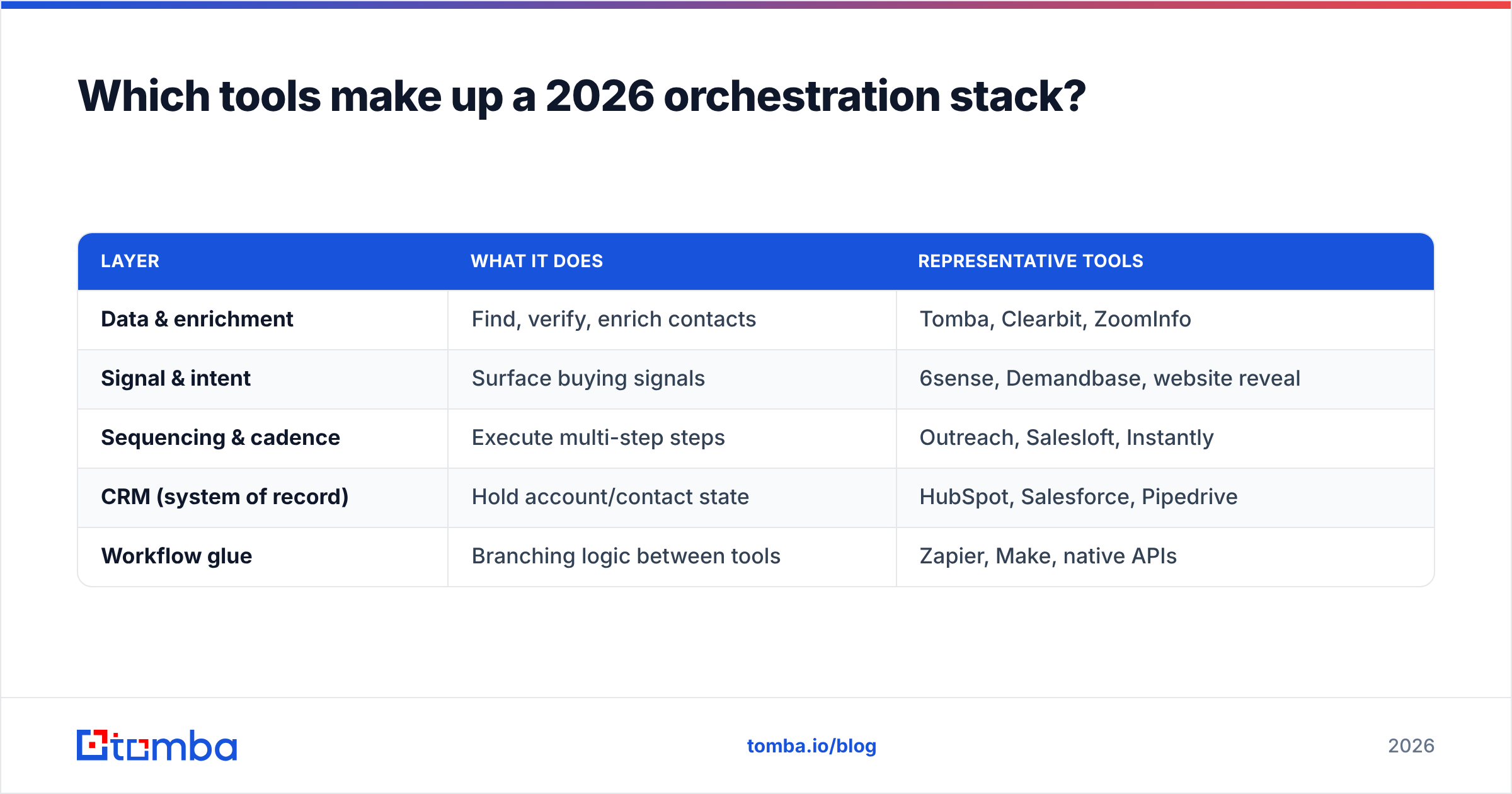
There's no single product that does everything well. The reality is a stack, and the smart move is to pick best-of-breed at each layer and connect them with an API. Here's how the layers map to representative tools:
| Layer | What it does | Representative tools |
|---|---|---|
| Data & enrichment | Find, verify, enrich contacts | Tomba, Clearbit, ZoomInfo |
| Signal & intent | Surface buying signals | 6sense, Demandbase, website reveal |
| Sequencing & cadence | Execute multi-step steps | Outreach, Salesloft, Instantly |
| CRM (system of record) | Hold account/contact state | HubSpot, Salesforce, Pipedrive |
| Workflow glue | Branching logic between tools | Zapier, Make, native APIs |
The connective tissue is the Tomba API, which lets your orchestration logic call for a verified email or enriched record in real time — at the exact moment a signal fires — rather than relying on a stale nightly batch. If you're identifying anonymous demand, pair it with website visitor reveal so an account hitting your pricing page becomes a named, enriched, callable contact inside the same play.
A note on cost. You don't need every category from day one. Most teams over-buy sequencing seats and under-invest in data, then wonder why reply rates are flat. Get the data layer right first — Tomba's pricing starts free at 25 searches per month and scales to $49/mo (Starter), $99/mo (Growth), and $249/mo (Pro) — and layer signal and sequencing on once your foundation is clean.
How do you build your first orchestrated play?#
Don't try to orchestrate your entire funnel at once. Pick one segment, one trigger, and one play. Here's a concrete sequence to ship in a week:
- Choose a narrow segment. One ICP, one region, 50–200 accounts. Narrow enough that you can inspect every record by hand.
- Build clean data for it. Run domain search to find decision-makers, verify every email, and append phone numbers. Reject anything that doesn't verify.
- Define the trigger. A signal, not a date. "Visited pricing twice" or "downloaded the ROI guide" beats "Monday at 9am."
- Map the branches. Step 1: personalized email. If opened, Step 2: LinkedIn touch. If no open in 48h, Step 3: a different-angle email. If two opens, Step 4: AE call task. Keep it under five steps.
- Assign owners per step. A tool sends the emails; a named SDR owns the LinkedIn touches; a named AE owns the call. Orchestration is about people plus tools, not tools alone.
- Instrument it. Track reply rate, meeting-booked rate, and bounce rate per step. Bounce rate above 2% means your data layer needs work, not your copy.
Run it for two weeks, read the numbers, and only then expand to a second segment or add a channel. This is the opposite of how most teams operate — they buy a platform, build twelve sequences, and never learn which step actually moves the deal. A tight, measured first play teaches you more than a sprawling untested system ever will.
What metrics tell you orchestration is working?#
Orchestration shifts which numbers matter. Activity counts (emails sent, calls dialed) become almost meaningless — orchestration can inflate them effortlessly. What you watch instead:
- Reply rate per play, segmented by first-touch channel. Tells you whether the sequence design works.
- Meeting-booked rate per account, not per contact. Orchestration targets accounts; measure at that level.
- Bounce and invalid rate. Your early-warning system for data decay. Rising bounces mean the foundation is rotting before the plays do.
- Stage conversion lift versus a non-orchestrated control group. The only honest proof orchestration beats your old cadence.
- Time-to-first-meaningful-touch after a signal fires. The whole point of orchestration is reacting in hours, not the next batch run.
Keep a holdout. Run a control group on your old linear cadence and compare. Without a control, every improvement gets attributed to orchestration when half of it might be seasonality or a better offer. Tie these back to revenue operations reporting so the whole GTM team reads from the same scoreboard.
What are the most common orchestration mistakes?#
Four failure modes account for most stalled programs:
- Building on dirty data. Already covered, and it's number one for a reason. No play survives bad inputs.
- Over-orchestrating. Eleven-step, four-channel monsters that feel sophisticated and convert worse than a clean three-step play. Complexity is not the goal; relevance is.
- Ignoring the human steps. Fully automated plays with no human judgment read as spam. The best orchestration reserves the high-value moments — the call, the tailored note — for a person.
- No feedback loop. Teams launch plays and never prune. Orchestration is a living system; the plays that worked in Q1 decay. Review and retire underperformers monthly.
The throughline: orchestration rewards discipline at the foundation and restraint in design. Teams that win treat data quality as a permanent practice — continuously verifying, enriching, and deduping — rather than a one-time list cleanup.
Getting started#
B2B sales orchestration in 2026 isn't about buying the most expensive sequencing platform. It's about coordinating people, channels, and tools around real buyer signals — and that coordination only works when the contact data underneath is verified and current.
Start at the foundation. The Tomba Email Finder gives you accurate, verified professional emails by name, domain, or company — the clean inputs every downstream branch of every play depends on. Pair it with the verifier and enrichment, wire it into your cadence engine through the API, and build your first measured play this week. Get the data right, and the rest of the orchestra finally plays in time.
// get started
Find, verify and enrich your first contacts today
Start on the free plan with 25 searches a month, then scale when your team is ready.
Free plan · No credit card required · GDPR & CCPA
// about the author